A TRANSITIVITY ANALYSIS OF DESCRIPTIVE TEXT IN JUNIOR HIGH SCHOOL TEXTBOOK ENTITLED “ENGLISH IN MIND SECOND
EDITION - STUDENT'S BOOK KELAS VII”
THESIS
Submitted as A Partial Requirements for the degree of Undergraduate
By:
NUFI FEBRIYANA SAGARENI SRN 163221197
ENGLISH LANGUAGE EDUCATION DEPARTMENT FACULTY OF CULTURES AND LANGUAGES
RADEN MAS SAID STATE ISLAMIC UNIVERSITY OF SURAKARTA
2023
ii
iii
iv
DEDICATION The thesis is dedicated to:
1. Allah SWT and Prophet Muhammad SAW.
2. My beloved father Mr. Nugroho and my mom Mrs. Peni who always support me.
3. My friends, Iin, Lisa, Halimah, Heni, and Putri, who strengthened me with their support and laugh. Our bestfriendship is very special and will be always kept in our memory.
4. My lecturers in English Language Education Study Program who have given me guidance during my study in this study program. My honor and gratitude I address to my lecturers.
5. My almamater UIN Raden Mas Said.
v MOTTO
“Anyone can lose their way. All you need is the courage to walk the unfamiliar and daunting path again”
-S. Coups-
“If you think positively, it may become a motivation. We still have a long way to go, so let’s think positively and fighting”
-Wonwoo-
vi
vii
viii
ix
x
TABLE OF CONTENTS
TITLE PAGE ... i
ADVISOR’S SHEET ... Error! Bookmark not defined. RATIFICATION ... Error! Bookmark not defined. DEDICATION ... iv
MOTTO ... v
PRONOUNCEMENT ... Error! Bookmark not defined. ACKNOWLEDGEMENT ... Error! Bookmark not defined. TABLE OF CONTENTS ... x
LIST OF TABLE ... xii
LIST OF FIGURE ... xiii
ABSTRACT ... xiv
CHAPTER I INTRODUCTION ... 1
A. Background of the Study ... 1
B. Identification of the Problems ... 5
C. Limitation of the Problems ... 6
D. Formulation of the Problems ... 7
E. Objective of the Study ... 7
F. Benefits of the Study ... 7
G. Definition of Key Terms ... 9
CHAPTER II LITERATURE REVIEW ... 11
A. Theoretical Review ... 10
1. Review on Text and Context ... 10
2. Review on Systemic Functional Linguistics ... 12
xi
3. Review on Transitivity ... 13
4. Review on Lexicogrammatical Features ... 29
5. Review on Textbook ... 30
6. Review on Descriptive Text ... 34
B. Previous Related Study... 38
CHAPTER III RESEARCH METHODOLOGY ... 42
A. Research Design ... 42
B. Data and Source of the Data ... 43
C. Technique of Collecting the Data ... 44
D. Trustworthiness of the Data ... 44
E. Techniques of Analyzing the Data ... CHAPTER IV FINDING AND DISCUSSIONS ... 48
A. Research Findings ... 48
B. Discussion ... 66
CHAPTER V CONCLUSION AND SUGGESTION ... 68
A. Conclusion ... 68
B. Suggestion... 68
BIBLIOGRAPHY ... 70
Appendices ... 74
xii
LIST OF TABLE
Table 2. 1 Process Types ... 17
Table 2. 2 Examples of Material Processes... 18
Table 2. 3 Examples of Recipient and Client in Material Process ... 18
Table 2. 4 Examples of Actor and Initiator in Material Process ... 19
Table 2. 5 Examples of Mental Process ... 20
Table 2. 6 Examples of Behavioral Process ... 21
Table 2. 7 Examples of Relational Process ... 21
Table 2. 8 Examples of Verbal Process ... 23
Table 2. 9 Examples of Existential Process ... 24 Table 3. 1 The Descriptive Texts used the data source in the research ... Error!
Bookmark not defined.
xiii
LIST OF FIGURE
Figure 2. 1 Text in Context ... 11 Figure 2. 2 Aspects of Context of Situation ... 12 Figure 2. 3 Relationship between Text and Context ... 13
xiv ABSTRACT
Sagareni, Nufi Febriyana. 2023. A Transitivity Analysis of Descriptive Text in Junior High School Textbook Entitled “English in Mind Second Edition - Student's Book Kelas VII”, UIN Raden Mas Said, Academic Year 2022/2023. Thesis. English Education Department, Cultures and Language Faculty.
Advisor : H. Zainal Arifin, S.Pd., M.Pd.
Keywords : Lexicogrammar; transitivity system; textbook; descriptive text Textbook plays an important role in the field of education. Moreover, in some schools, teachers rely heavily on textbook to establish and to formulate the course based on the content of textbook. This issue leads the researcher to conduct a research about the content of textbook. The research was aimed at finding out process types are employed in descriptive texts in junior high school textbook; and the transitivity system characterizing the descriptive text in junior high school textbook entitled English in Mind Second Edition - Student's Book Kelas VII in terms of the significant lexicogrammatical features.
The content analysis with document analysis technique was employed as the study method. The data were obtained from nine descriptive texts in one of textbooks for grade VII. To analyze the data, Systemic Functional Linguistics (SFL) framework especially transitivity analysis was employed. The used expert judgment to get trustworthiness the data.
The result revealed that six process types were employed in descriptive text, existential, material, mental, relational, behavioral and verbal process. From these process types, three types, relational, material, and mental process, played a significant and important role in descriptive text. In addition, four out of nine descriptive texts in junior high school textbook fully met the characteristics of significant lexicogrammatical features.
CHAPTER I Introduction
A. Background of the Study
English is a second language. Fauziati (2015) claims, language has meaning in human articulation as a communicative tool (Fauziati, 2015, p.196). It means someone used language for communication in a daily life context. English is a widely used language in many countries around the world, including Indonesia. To help Indonesians communicate with people all over the world, the Indonesian government has made English one of the compulsory subjects in the school curriculum. In order to learn English language, students are required not only to know the vocabulary but also have to use or apply their knowledge for communication (Depdiknas, 2004, p.2).
In fact, it is true that students cannot communicate clearly without knowing the vocabulary. It is necessary that they master the vocabulary but they must be able to use their knowledge in communication. They have not mastered English yet if they do not use the language for communication, even they get a good mark in vocabulary.
In order for students to communicate effectively, the teacher teach four skills during teaching learning process, namely; listening, speaking, reading, and writing. In the teaching learning process, the teacher employs something to improve the effectiveness of his teaching-learning process.
Many English teachers use textbooks in their classrooms to teach and
learn. The importance of using textbooks is that the textbooks provide information of materials for the students, and the students can improve their ability using the textbook. Textbook also takes an important role in the learning process, which is to decide good and bad of the learning process. It contains a lot of information related to the subjects the learners learn.
The researcher choose an English textbook entitled “English in Mind Second Edition Student's Book Kelas VII”, because the textbook declares in the preface that it is designed on Merdeka Curriculum. It is an integrated English textbook for Junior High School, and the course covers the four skills, namely, listening, speaking, reading, and writing.
In learning the various text types, textbook plays an important role since textbook is designed around the text types, Kirkpatrick (2016) mentioned that one of the most commonly provided materials in textbooks is genres/text types which are commonly presented in textbook material (Kirkpatrick, 2016, p.132), Genre-based approach has been adopted for teaching English in Indonesia. The approach is integrated into national curricula in the Merdeka curriculum, Nurlaelawati and Novianti (2017) stated that the understanding of genre-based approach is language instruction using texts in which the texts are selected and arranged according to text types such as descriptive, recount, narrative, news item, procedure, etc. (Nurlaelawati & Novianti, 2017, p.161), while the teaching stages are organized according to building knowledge, modeling, joint
construction and independent construction of the texts. Therefore, the implementation of genre-based approach results in using various text types in teaching and learning English.
One of the text types learned by students is descriptive text. Based on the Merdeka curriculum, it will be learned by seventh grade junior high school students. Descriptive text is presented in the earlier chapter of junior high school textbook. This text is as opening text to be recognized by students to describe, represent or reveal a person or an object, either abstract or concrete descriptive text have some variations created by an author based on object or phenomena. So, it is more interesting to be studied.
Producing descriptive text itself is not an easy. For example, the author writes a descriptive text need to pay attention to text composition, vocabulary, syntax, and mechanics. The author occasionally uses words that are inappropriate for the circumstance. Aside from that, the author need to pay attention to generic structure and lexicogrammatical features.
In general, it is easy to understand the generic structure of descriptive text, while its lexicogrammatical features re complex that need more attention.
The author will evaluate the material coverage. This issue leads the researcher to conduct a research whether the descriptive text material in textbook still fulfil the characteristic descriptive text or not. Emilia (2011) mentioned that descriptive text has three characteristics such as social purpose, structure (organization), and language features (Emilia, 2011).
The three characteristics construe the meanings of the text in which they are realized through the organization and language features (the selection of words and grammar) to social functions and culture context (Mickan, 2013). The analysis will focus on the language feature (the selection of words and grammar) which is called lexicogrammar.
For conducting the research, Systemic Functional Linguistics (SFL) provides a tool for analyzing text. SFL has also proved to be keystone for investigating text and genre (Kornetzki, 2012). In SFL, language is considered serving three metafunctions, ideational, interpersonal, and textual. In lexicogrammar, ideational metafunction is realized in transitivity system; the interpersonal metafunction is realized in modality system; and the textual metafunction is realized in theme-rheme system (Liu, et al., 2002, p.158). The transitivity system will be employed to analyze the characteristics of descriptive text in terms of significant lexicogrammartical features because the system reveals how the clause represents a slice of experience in descriptive texts (Christie &
Derewianka, 2008, p.8).
Based on the preliminary research above, this research would identify this study aimed to know and focused on transitivity analysis of descriptive text in junior high school textbook. This research is expected to enrich and to develop the theory of Systemic Functional Linguistics especially in transitivity system. Practically, this result is expected to provide
information about the quality of descriptive text in textbook as reference to the teacher to select the material from the textbook.
The researcher identified a gap the prior research. First, in the other research entitled "Transitivity Systems Analysis of English of Vocational High School (SMK) of Sosorgadong Textbook for Grade X and Its Relevance to English Language Teaching", the transitivity system reveals that material process and circumstances of location are the dominant process and circumstance in this research (Bondar, G. K., Tangkas, I. W.
D., & Setia, E., 2018). In the second gap in the other research entitled
"Transitivity System of Narrative Text in Junior High School English Textbook in Indonesia", transitivity system reveals that material process is the dominant process, the process valences were monovalent and bivalent, and the most dominant circumstance is adverb of place (Marhamah, A. &
Mukhaiyar. 2018). What makes the research differ from the previous studies is the research analyzes descriptive text in junior high school textbook.
Based on the explanation above, the researcher wanted to conduct a research about A Transitivity Analysis of Descriptive Text in Junior High School Textbook Entitled “English in Mind Second Edition - Student's Book Kelas VII”. In this study, the researcher wanted to analyze the descriptive texts in the junior high school textbook in terms of significant lexicogrammatical features not the social purposes or
schematic structures. The transitivity system developed by M.A.K Halliday is employed to conduct the analysis.
B. Identification of the Problems
Based on the background of the study, the researcher formulates the problem as follow:
1. Teacher uses textbook as guidance for teaching reference.
Unfortunately, some of English teacher in Indonesia do not have time to develop their own learning material for teaching English. Some of them consequently depend on the textbook which issue usually recommended by the publishing company or because it is one of the books sub-propped by the ministry of education.
2. The second issue is the vocabulary. This problem deals with the choice of words, as mentioned before that the book is used by the seventh grade students so the choice of words should be different from words used by adults. Since the students are categorized as teenage learners, the book has to be convenient to the students' age. Therefore, the chosen topics of descriptive text in the textbook usually refer to the nearest environment of the students.
3. The third issue is the sentence pattern. This problem is related to how the sentences in descriptive text on the textbook are combined and arranged as comprehensible materials for the reader. The issue also includes the accurate use of grammatical rules in the materials.
C. Limitation of the Problems
Based on the explanation above, the researcher focused the study on sentence pattern problems of descriptive text found in English in Mind Second Edition - Student's Book Kelas VII. The researcher focused on find out the characterizing of transitivity on descriptive text in terms of the significant lexicogrammatical features. The reason is why that the researcher chose to analyze the transitivity because the researcher wanted to provide information about the quality of descriptive text in textbook as reference to the teacher to select the material from the textbook.
D. Formulation of the Problems
1. What are process types employed in descriptive text in senior high school textbook entitled English in Mind Second Edition - Student's Book Kelas VII?
2. What are the transitivity system characterizing the descriptive text in junior high school textbook entitled English in Mind Second Edition - Student's Book Kelas VII in terms of the significant lexicogrammatical features?
E. Objective of the Study
Based on the statement of the problem above, the researcher conduct the objective of the study are as follows:
1. To know the process types employed in descriptive text in senior high school textbook entitled English in Mind Second Edition - Student's Book Kelas VII.
2. To find out the transitivity system characterizing the descriptive text in junior high school textbook entitled English in Mind Second Edition - Student's Book Kelas VII in terms of the significant lexicogrammatical features.
F. Benefits of the Study
This research is anticipated to give several benefits. Those benefits are for the students of seventh grade junior high school, for the English teacher of seventh grade junior high school, for the other researcher and for the researcher herself.
1. Theoretical benefits
The researcher is expected to give additional information and knowledge about transitivity analysis used in descriptive text and also to give several benefits of the research to the readers and the other researcher.
2. Practical benefits a. For Teacher
The benefit for teacher of junior high school can knowing transitivity system which are commonly used in descriptive text and knowledge about descriptive texts lexicogrammatical features. So, the teacher can follow to analyze the text before teach the descriptive text in the class, because with the transitivity analysis the teacher can make a lesson plan.
b. For Student
The benefit for the students is improve their students’ knowledge and ability in descriptive text and to help them understand the materials clearly.
c. For Researcher
The benefits for the researcher from this research are the researcher had a chance to discover the problems that were related to the subject.
Then, the researcher had fulfilled one of the requirements to graduate from English Language Education Study Program of Raden Mas Said State Islamic University of Surakarta. In addition, this research was able to improve the researcher ability’s and to understand the transitivity system in descriptive text.
G. Definition of Key Terms 1. Lexicogrammar
Lexicogrammar is a term coined by Halliday (1994) to capture that lexis and grammar form a continuum of linguistic resources for the expression of meaning (Halliday,1994, p.110).
2. Transitivity System
Emilia (2014) stated that transitivity is simply the study of what people are depicted as doing and refers broadly, to who does what to whom, and how (Emilia, 2014, p.15).
3. Textbook
Tarigan (2015) stated textbook is a lesson book in specific field of study, which is a standard book written by the experts in that field according to the instructional purpose, completed by suitable teaching
media which is easy to be understand by the users in schools or college (Tarigan, 2015, p.15).
4. Descriptive Text
Husna et al. (2013) stated that a descriptive text is a text which a writer tries to picture what he is describing.
CHAPTER II LITERATURE REVIEW
A. Theoretical Review
1. Review on Text and Context
Crystal (1992) defines text as “a piece of naturally occurring spoken, written, or signed discourse identified for analysis purposes” (p.72). It is frequently a linguistic unit with a distinct communicative function, such as a conversation or a poster.
Text is a coherent collection of meaning that is appropriate to its context. The length of a text is not important, and it can be spoken or written.
This purpose gives a text both texture and structure. Texture comes from the way the meanings in the text fit coherently with each other. Structure refers to the way that most pieces of language in use will contain certain obligatory structural elements appropriate to their purpose and context (Butt et al., 1995, p.12).
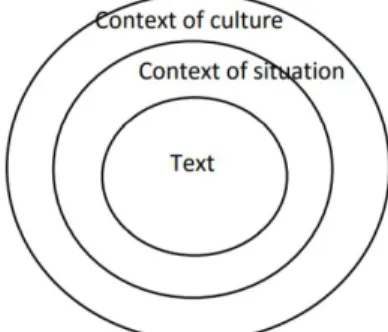
A text can be found in two contexts. They are the context of culture and the context of situation as shown in the figure below.
Figure 2. 1 Text in Context
The context of culture is defined as the sum of all meanings that can be expressed in that culture. Within the context of culture, speakers and writers used language in much more specific contexts and situations. Each of these is a context of situation, which called as an inner context.
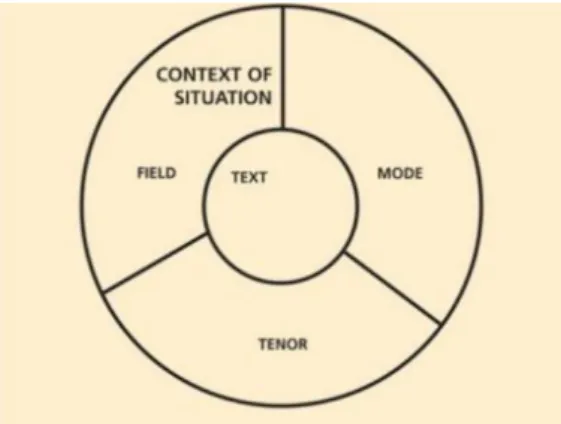
In context of situation, it has three aspects or parameters. These three aspects are Field, Tenor, and Mode. It will be represented in the figure below.
Figure 2. 2 Aspects of Context of Situation The following is a definition of those aspects:
a. Field: about something being talked or written in a text. It also can be called as the goal of the text in the long and short terms.
b. Tenor: the relationship between the writer and the reader, or the speaker and the listener.
c. Mode: the kind of text produced by the speaker or writer.
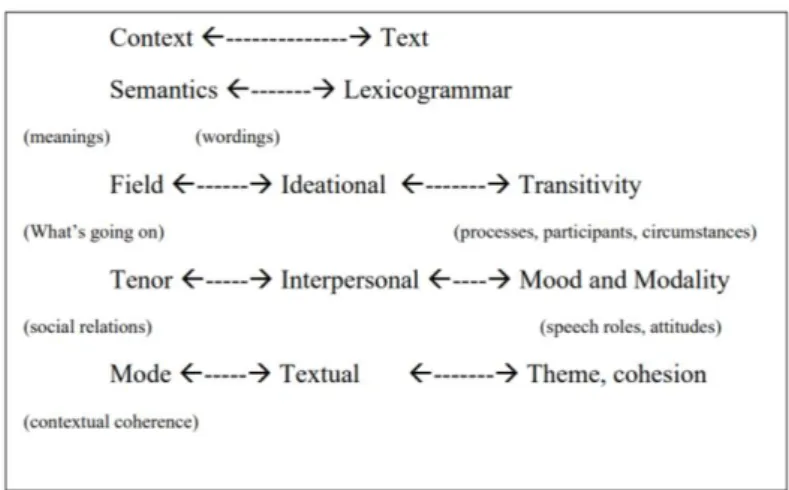
According to Gerot and Wignell (1995), we can reconstruct the text’s context of situation when we read or hear a text since there is a systemic relationship between text and context (Gerot & Wignell, 1995, p.15). The relationship between them can be shown as the figure below.
Figure 2. 3 Relationship between Text and Context 2. Review on Systemic Functional Linguistics
Systemic Functional Linguistics was developed by Halliday (1985) a professor of linguistics from university of Sydney. Systemic Functional Linguistics is a theory about language as a resource for making meaning base on a context of situation and a context of culture. Rather than focusing solely on formal linguistics, functional approaches emphasize the social and interpersonal aspects of language. According to Schleppegrell (2004),
"rather than viewing language as a set of rules, the functional perspective views the language system as a set of options available for construing various kinds of meanings”.
In SFL, the ways people use language are classified into three categories, as follows: every clause our language simultaneously construes some kind of experience (ideational metafunction), enacts a role relationship with a listener or reader (interpersonal metafunction), and relates our messages to the prior and following text and context (textual metafunction). According to Halliday (2014), these three kinds of
metafunctions are integrated in the structure of a clause; the structure as a whole construes or realizes the meaning.
Systemic Functional Linguistics is usually used to find interpretation of language in different ways such as text or analyzing text as a form of discourse. When analyzing text, the grammar becomes a thing to describe how language works. In other words, how language is performed as the expression of meaning involving the idea.
The advantages and relationships of the systemic functional theory approach put language as a tool to represent ideas and how language function is used by a speaker or writer in relation to social context. The function of language is then viewed as a scheme of social semiotic language in which the idea occurs and is adapted to the culture context, then related to the situational context, and finally expressed in the form of language.
3. Review on Transitivity a. Definition of Transitivity
Transitivity belongs to the ideational meaning which is how language is used to represented experience or to organize, understand and express our perception of the world and our consciousness. Ideational meaning, according to Emilia (2014), can be classified into two sub- functions: experiential function and logical function. The experiential functions concerned with content or idea, while the logical function is concerned with the relationship between ideas (Emilia, 2014, p.77).
Thompson (2014) defines experiential meaning as a way of using language to talk about the world (Thompson, 2014, p.30). Experiential
meaning focusing the language on the clause level concerning the notion of the clause as representation. Clause as representation means that one function of the clause is a representation of the experience of both external and internal reality. Then, the experiential meaning is realized by the transitivity system of language (clause).
The transitivity system interprets the experience as a system of processes in grammatical clauses. In general, transitivity refers to how meaning is represented in the clause. According to Halliday in Haratyan (2011), transitivity is an important component in the experiential meaning of the clause because it deals with the transfer of ideas representing process or experience (Haratyan, 2011, p.260). Based on the explanation above, it is possible to conclude that transitivity is a grammatical system that interprets experience and is represented in the form of a process.
b. Transitivity Analysis
Transitivity is a grammatical system associated with the content or ideas expressed in a clause. According to Fowler in Haratyan (2011) journal, transitivity is a semantic system for analyzing reality representations in linguistic text and creating the same experience through various lexicogrammatical options influenced by different mind styles authorial ideology (Haratyan, 2011, p.261). According to Machin and Mayr, transitivity is simply the study of what people are depicted as doing and refers to who does what to whom and how. After that, a
transitivity analysis of clause structure reveals who is primarily assigned a subject or object position (Emilia, 2014, p.150).
When people talk about the meaning of words or sentences, there is a meaning that is their minds. The transitivity system investigates a clause that functions as a representation because the meaning is related to the content or idea. The clause can be explored in terms of who does what, to whom, when, where, why, and how to function using the transitivity system. A transitivity analysis describes a structural clause that determines the various types of processes that are recognized in language.
The transitivity system interprets human experience into a set of process types. In the transitivity system, there are three aspects of meaning: process, participant, and circumstance. The concept of process, participant, and circumstance are semantic categories that explain how the phenomenon of the real world is represented as a linguistics structure.
The concept of the process is expressed through verbal groups, participants through nominal groups, and circumstance through adverbial groups or prepositional phrases.
c. Process Types and Its Participants of Transitivity
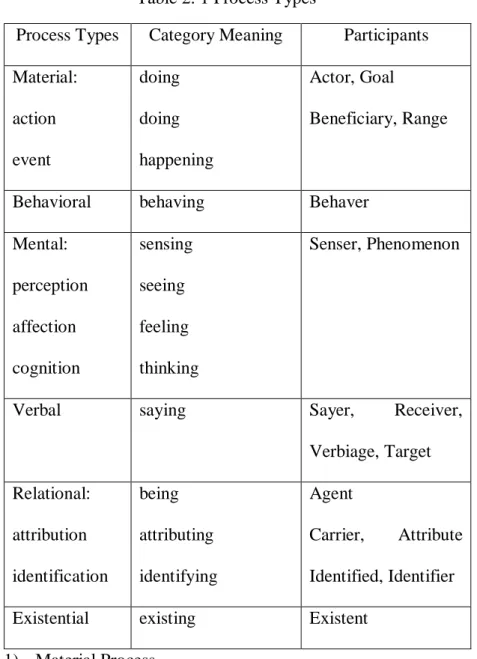
Processes are central to transitivity. According to Halliday (1985) there are different types of process which are: material, mental, relational, behavioral, verbal, and existential process (Halliday, 1985,
p.102). The table below shows the process types, category meaning and participants.
Table 2. 1 Process Types
Process Types Category Meaning Participants Material:
action event
doing doing happening
Actor, Goal
Beneficiary, Range
Behavioral behaving Behaver
Mental:
perception affection cognition
sensing seeing feeling thinking
Senser, Phenomenon
Verbal saying Sayer, Receiver,
Verbiage, Target Relational:
attribution identification
being attributing identifying
Agent
Carrier, Attribute Identified, Identifier
Existential existing Existent
1) Material Process
Material processes are process of doing and happening. They express the notion that the same entity does something which may be done to some other entities. Happening represented by an intransitive material clause and doing represented by a transitive
material clause. There are two main participant functions. They are actor and goal involve in material process. Actor is the one that does the need or performs the action, whereas goal is the one suffers or undergoes the process.
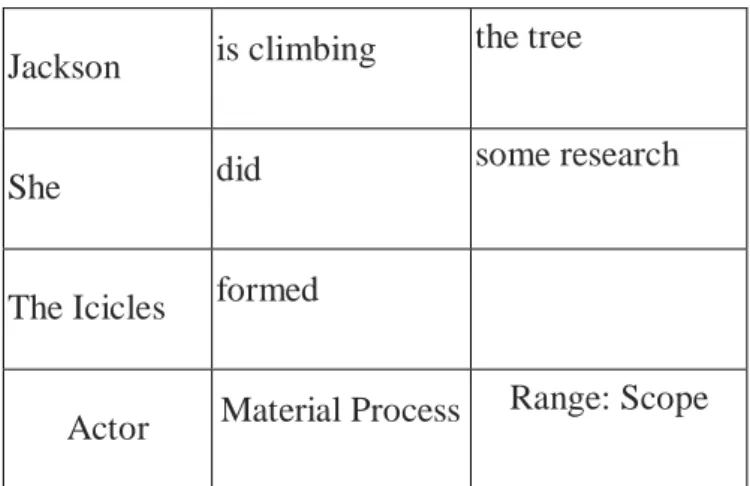
Beside two participants above, material also has two other participants named range and beneficiary. The Range in the material process is usually called as scope.
Table 2. 2 Examples of Material Processes Jackson is climbing the tree
She did some research
The Icicles formed
Actor Material Process Range: Scope
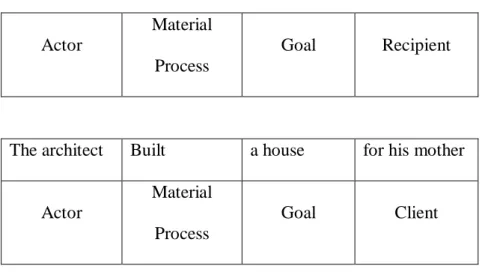
Beneficiary is the one to whom or for whom the process is said to take place. In material process, there are two kinds of beneficiary named recipient and client. Recipient is one that goods are given to, whereas client is one that services are done for. These involve verbs such as give, send, offer, buy, and take.
Table 2. 3 Examples of Recipient and Client in Material Process
I Posted a letter to a friend
Actor
Material Process
Goal Recipient
The architect Built a house for his mother Actor
Material Process
Goal Client
According to Halliday and Matthiessen (2004), a rather rare participant in material process is initiator (Halliday & Matthiessen, 2004, p.509). This shows up in such structures as He marched them up to the top of the hill. Here, he is not the Actor; the actual marching is done by them. He is the prime instigator of the action, which he initiates, hence Initiator. The examples below can ensure the difference between actor and initiator.
Table 2. 4 Examples of Actor and Initiator in Material Process
John Rolled the ball
Actor Goal
John Made the ball Roll
Initiator Actor
In addition, some clauses may contain circumstantial elements to show that the process happens in certain Circumstance.
2) Mental Process
Mental process is a processing of sensing. Halliday and Matthissen (2014) stated mental process are concerned with our experience of the world of our own consciousness (Halliday &
Matthissen, 2014, p.245). It implies that mental process occurs when we sense something in our thinking.
Gerrot and Wignell (1994) utter that there are three types of sensing: feeling, thinking, and perceiving (Gerrot & Wignell, 1994, p.58). It can be elucidated that sensing of feeling can be called as affective or reactive, sensing of thinking is called cognitive, and sensing of perceiving can be mentioned as perceiving using five senses.
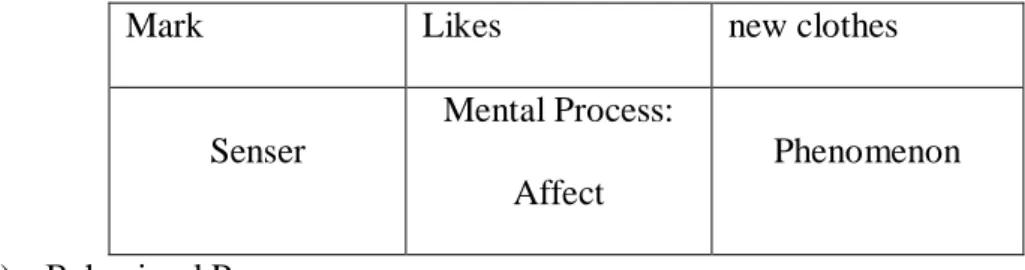
In mental process, there are two types of participants, namely senser and phenomenon. Senser is the one who can feel, think, or see consciously; meanwhile phenomenon is something which is sensed.
Table 2. 5 Examples of Mental Process
Mark Likes new clothes
Senser
Mental Process:
Affect
Phenomenon 3) Behavioral Process
Behavioral process is process of physiological and psychological manners, such as treating, dreaming, smiling, and coughing. The largest part of behavioral process has one participant only.
The participant who is behaving, called behaver, is typically a conscious being like senser, but the process functions more like the one of doing. Rarely, a further participant occurs named behavior.
Examples of verbs expressing behavioral processes include breathe, cry, laugh, stare, yawn, frown, smile, and chat (Fontaine, 2013 p.78).
Table 2. 6 Examples of Behavioral Process
He Threw a tantrum
Behaver Behavioral Process Range 4) Relational Process
The other type of processes is relational process. Halliday and Matthiessen (2014) stated relational clauses serve to characterize and to identify (Halliday & Matthiessen, 2014, p.259). It implies that relational process has roles in characterizing and identifying the text and context. In a relational clause, a thing, act or fact construed as a participant is configured with another relational participant that has to come from the same domain of being.
Relational processes consist of identifying and attributive processes. Processes which establish an identity are called identifying process, and process which assign quality are called attributive process. The participants in atributtive process are carrier and atributtive, while in identifying process, the participants are token and value (Gerot & Wignell, 1994 p.67).
Table 2. 7 Examples of Relational Process
Barry tuckwell Is a fine horn player
Carrier Attributive Attribute
Barry tuckwell maybe a fine horn player
Token Identifying Value
5) Verbal Process
Verbal Process is a process of saying. Some verbs used to express the verbal processes include talk, say, ask, reply, suggest, praise, insult, slander, and flatter. It has a participant named Sayer, who is the doer of the process of verbalization. Moreover, Halliday (1985) categorizes the projection of Verbal Process as follows:
a) Stating: statement, report, news, rumor, claims, assertion, argument, insistence, proposition, assurance, and imitation.
b) Questioning: question, query, inquiry argument, despite.
c) Offering: offer, suggestion, proposal, threat, promise.
d) Commanding: order command, instruction, demand, and request.
Bloor and Bloor (2004) say that sometimes, the Sayer use some extra element of meaning related to the speech act realized the usage of some verbs as urge, explain, remind, challenge, beg, promise, grumble, agree, report, lisped, growled, whisper, sneer, snarled, barked, bawled, babbled on, gasped (Bloor & Bloor, 2004, p.124).
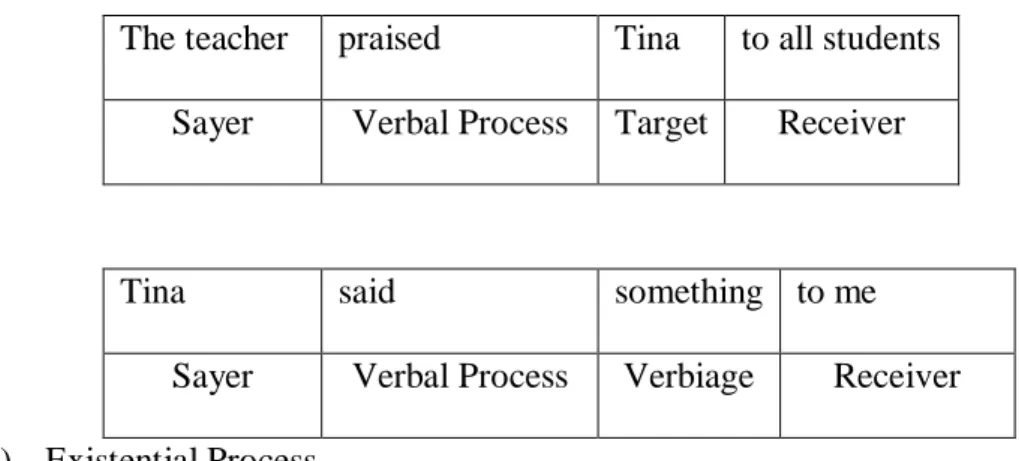
The process also has other Participants named Receiver, Verbiage, and Target.
a) The receiver
The receiver is the one to whom the saying is directed.
b) The Verbiage
The verbiage is the function that corresponds to what is said, representing it as a class of thing rather than as a report or quote.
c) The target
The target occurs only in a sub-type of verbal clause, this function construes the entity that is targeted by the process of saying.
Table 2. 8 Examples of Verbal Process The teacher praised Tina to all students
Sayer Verbal Process Target Receiver
Tina said something to me
Sayer Verbal Process Verbiage Receiver 6) Existential Process
Existential processes fall between material and relational processes. They are called existential processes because they are concerned with existence. Gerot and Wignell (1994) revealed that existential processes are showed by verbs of existing, such as be, exist, arise (Gerot & Wignell, 1994, p.72).
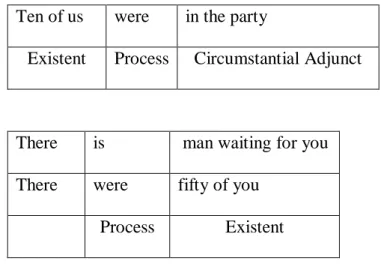
Existential Process has only a participant named Existent. The process has two main forms of grammatical relation, with a copular verb and an empty there as Subject and with a copular verb, the Existent as Subject and usually a circumstantial adjunct. When some clauses have only the Existent without any explicit Circumstances, the semantically empty Subject there is almost obligatory. (Eggins, 2004, p.238).
Table 2. 9 Examples of Existential Process Ten of us were in the party
Existent Process Circumstantial Adjunct
There is man waiting for you There were fifty of you
Process Existent d. Circumstances
Some linguists identify Circumstances by considering what probes use for eliciting or looking at the different question to which the circumstances provide answers. Gerot and Wignell (1994) revealed circumstances answer such questions as when, where, why, how, how many, and as what (Gerot &Wignell, 1994, p.52). It means the circumstance gives detail information about place, time, manner, etc in which its context will be easier to understand.
Bloor and Bloor (2004) stated that circumstance is more peripheral that participants, being concerned with such matters as the settings, temporal and physical, the manner in which the process is implemented, and the people or other entities accompanying the process rather than directly engaged in it (Bloor & Bloor, 2004, p.131). It implies that actually participant is more crucial that circumstance, because it is only to give explanation about context. It can be call as adverb in traditional grammar.
There are many types of circumstances, according to Halliday &
Matthiessen (2014) circumstance differentiates into nine types, that are extent, location, manner, cause, contingency, accompaniment, role, matter, and angle. Those theories are as follow:
1) Extent Circumstance
Extent construes the extent of the unfolding of the process in space-time: the distance in space over which the purpose unfolds or the duration in time during which the process unfolds. The interrogative forms for Extent are how far?, how long?, how many (measure units)? How many times?. The typical structure is a nominal group with a qualifier, either definite e.g. five days, or indefinite, e.g. many miles, a long way, this occurs either with or without prepositions, the most usual preposition is for.
2) Location Circumstance
Location interprets the setting of the unfolding of the process in space time: the place where it unfolds or the time when it unfolds.
The common questioning of Location are where?, when?. Place include not only static location in space, but also the source, path, and destination of movement. Similarly, time includes not only stagnant location in time, but also the sequential analogues of source, path, and destination. The typical structure is an adverbial group or prepositional phrases, for examples are down, underneath, by the door, in Canberra, long ago, before sunset, on Wednesday evening, among friends, between you and me (Halliday & Matthiessen, 2014, p.316).
3) Manner Circumstance
The Circumstantial Element of Manner construes the way in which the process is actualized. Manner comprises four subcategories: Means, Quality, Comparison, and Degree. These cover a considerable range; Means and Comparison tend to be realized by prepositional phrases, whereas Quality and Degree tend to be realized by adverbial groups (Halliday & Matthiessen, 2014, p.318).
Means refers to the means whereby a process takes place. It is typically expressed by a prepositional phrase with the preposition by or with. The interrogative forms are how and what with?.
Quality is typically expressed by an adverbial group with –ly and adverb as Head; the interrogative is how? or how …? plus appropriate adverb. Less commonly, Quality is realized by a prepositional phrase. The general type is one where the preposition is in or with and the Head/Thing of the nominal group is the name of manner either manner or way, or of a qualitative dimension such as speed, tone, skill, ease, difficulty, term; but phrasal expression of Quality also include more specific types, such as specifications of the manner of movement.
Comparison is typically expressed by prepositional phrase with like or unlike, or an adverbial group of similarity or difference.
The interrogative is what … like?.
Degree is typically expressed by an adverbial group with a general indication of degree such as much, a good deal, a lot, or with a collocationally more restricted adverb of degree such as deeply, profoundly, completely, and heavily. The collocationally restricted adverbs collocate with verbs serving as Process, as in Mental clauses: love + deeply, understand + completely, believe + strongly.
Less commonly, Degree may be expressed by a prepositional phrase, usually with to plus a nominal group with extent, degree as thing and intensifying adjective such as high, large, great as Epithet.
4) Cause Circumstance
Cause tells about why. It divides into three subtypes which construes the cause why the process is actualized (Halliday &
Matthiessen, 2014, p.319). Reason tells what causes the Process and is probed by why? or how?. It represents the reason for which a process takes place, what causes it, and they have the sense of because. For example of thirst in sentence The sheep died of thirst.
Purpose tells the purpose and is probed by what for? For example for cigarettes in sentence He went to the shop for cigarettes.
While, in addition, Behalf tells for whose sake and is probed by for whom? For example for his mother in sentence He went to the shop for his mother.
5) Contingency Circumstance
Contingency specifies an on which the actualized of the process depends on what. There are three subtypes. Those are Condition, Concession, and Default. Condition construes Circumstances that have to obtain something in order for the process to be actualized, they have the sense of it. They can be expressed by prepositional phrase of with complex prepositions in case of, in the event of, on condition of. Concession construes frustrating cause, with the sense of although. It is expressed by prepositional phrase with the prepositions despite, notwithstanding, or the complex prepositions in spite of or regardless of. Default has the sense of
negative condition. It is expressed by prepositional phrase with the complex prepositions in the absence of, in default of.
6) Accompaniment Circumstance
Accompaniment tells about with or without who or what and is can be probed by who or what else? It is expressed by prepositional phrase such as with, without, besides, and instead of. There are two types of Accompaniment. They are Comitative and Additive.
Comitative represents the process as a single instance of a process.
For example, ‘I left work without my briefcase’. Additive represents the process as two instances. For example, ‘Instead of dingy velveteen he had brown fur, soft, and shiny’.
7) Role Circumstance
Role Circumstance construes the meaning be and become circumstantially; the Role corresponds to the Attribute or Value of an intensive relational clause. Role includes the subcategories of Guise (be) and Product (become). Guise usually tells about what as and is probed by as what?. For example, He lived a quiet life as a beekeeper. Product refers to a probe what into, with the meaning of become. For example, They bend that rod in a straight line (Halliday
& Matthiessen, 2014, p.326).
8) Matter Circumstance
Matter tells about ‘what’ or ‘with reference to what’ and is probed by what about? It is related to Mental Process, especially the
cognitive subtype, and Verbal Process since it is the circumstantial equivalent of the Verbiage which is described, referred to, or narrated. The interrogative is what about? It is expressed by preposition such as about, concerning, with reference to. For example: ‘This book is talking about functional grammar’ and ‘We must warn of the consequences of this truth’.
9) Angle Circumstance
Angle is related ether to the Sayer of a Verbal clause, with the sense of ‘as … says’ or to the Senser of a Mental clause, with the sense of ‘as … thinks’. The former is called as Source since it is used to represent the source of information. It is expressed by complex prepositions such as according to and in the words of. The latter is called as Viewpoint because it is used to represent the information given by the clause from somebody’s viewpoint. It is expressed by simple preposition to or by complex preposition such as in the view/opinion of and from the standpoint of. This type of Angle occurs in Relational clauses that are agnate with Mental ones (Halliday & Matthiessen, 2014, p.3).
4. Review on Lexicogrammatical Features
Lexicogrammatical is a term used in Systemic Function Linguistic (SFL) to emphasize the interdependence of and continuity between vocabulary (lexis) and syntax (grammar). The term lexicogrammatical was introduced by a linguist, M.A.K. Halliday. Halliday (1985) stated that the heart of language is the abstract level of coding that is the lexicogrammar
(Halliday, 1985, p.8). Meanwhile, according to Systemic Functional theory, lexicogrammar is diversified into a metafunctional spectrum, extended in delicacy from grammar to lexis, and ordered into a series of ranked units.
The other definition of lexicogrammatical delivered by Sinclair and Ronald (2004), they stated lexicogrammatical is now very fashionable, but it does not integrate the two types of pattern as its name might suggest, its fundamentally grammar with a certain amount of attention to lexical patterns within the grammatical frameworks; it is not in any sense an attempt to build together a grammar and lexis on equal basis. Lexicogrammar is still firmly a kind of grammar, laced, or perhaps spiked with some lexis (Sinclair
& Ronald, 2004, p.124).
There are several elements in lexicogrammatical features, one of them is process. Processes are realised by verbs, Gerot and Wignel, (1994:54). There are six different process types identified in lexicogrammatical features by Halliday as stated by Gerot and Wignell (1994:54). Those processes, namely: material, mental, relational, verbal, existential, and behavioral.
5. Review on Textbook a. Definition of Textbook
There are some definitions of textbook. Simply, a textbook is a book which contains some information to be read by the student or people. Buckingham in Tarigan (2013) stated textbook is a learning media which is used in schools and colleges to support a teaching program (Tarigan, 2013, p.5). Tarigan (2015) stated textbook is a lesson
book in specific field of study, which is a standard book written by the experts in that field according to the instructional purpose, completed by suitable teaching media which is easy to be understand by the users in schools or college (Tarigan, 2015, p.15). Richard claims that textbooks are a key component in most language program. That is the majority of teacher in country, which learn as foreign language, use it as guidance in teaching. “Textbook provides the basis for the content of the lesson, the balance of the skill taught and the kind of language practice the student take part in”.
According to Thomson (2000) English textbook is a stimulus or instrument for teaching and learning (Thomson, 2000, p.175). A teacher usually uses some media to make easier in explaining the teaching materials. One media which is ordinarily uses is a textbook. The textbook is easy to buy, to carry and to study. Even though, there are many kinds of media rivaling the printed materials of communication, the textbook remains the major source in school. It is a book giving instruction in an English subject, used especially in schools. Sitepu (2012), points out that textbook is all book used in the teaching and learning process, including working book, modules, and reference book (Sitepu, 2012, p.12). In my opinion, textbook is a learning tool that is used in schools and colleges to support a teaching program.
From the definition above described by expert, the conclusion is that a textbook is a certain textbook of the students which are
appropriates with standard curriculum and arranged to measure the student’s comprehension in understanding the materials that have been taught by the teacher in the classroom.
b. Function of Textbook
Textbook has function for student as manual instructor in studying and for the teacher as direction to teach a lesson. Thomson (2000) said the textbook has many functions, as follows:
1) Individualization of instruction
A textbook helps students to individualize instruction by enabling them to proceed at their own rate and to a limited extent, according to what they are interested in studying.
2) Organization of instruction
A textbook helps students to organize instruction by providing experiences, suggested activities, recommended reading and question. Written textbook give unity to classroom interaction and are graded to introduce new concepts or contents they build upon what has preceded.
3) Tutorial Contribution
A teacher often uses the textbook to help students learn how to read better, to study, to weigh evidence, and to solve problems.
4) Improvement of Teaching
A textbook is also regarded as a helpful utility which is used by teachers to improve their skills in teaching.
From the explanation above, except help to easy for learning process, textbook is a kind of visual aid in teaching learning process. It means that the function of a textbook is actually as one of the visual aids by teachers, when they are teach and explain the teaching materials.
Besides, it also helps the students in getting a better understanding of the materials given by teacher.
c. Criteria of Good Book
Textbook is one of the important media of teaching and learning activity in the classroom so it must have a good quality. To know how a textbook is categorized in a good quality, the researcher provides some criteria from the experts. Tarigan (1993) have made the way to arrange the textbook with 10 criteria (Tarigan, 1993, p.143). Good textbook has certain qualities, they are:
1) The textbook must be interesting and attractive toward the learners.
So, they will be interested in using textbooks.
2) The textbook must be able to motivate the learners.
3) The contents of textbook must be illustrative.
4) The textbook should consider the linguistic aspect. So, it will be suitable with the learner`s ability the contents of textbook must be related to the other branch of science.
5) The textbook must stimulate the personal activity of the learners.
6) The contents of textbook must be clear in written to avoid the children to be confused in using textbook.
7) The textbook must have the clear point of view because it will be the learner`s point of view.
8) The textbook must be able to give the balance and emphasis on the value of the learners.
9) The textbook must be able to respect to the differences of the individual.
d. About English in Mind Second Edition – Student’s Book Kelas VII English in Mind Second Edition – Student’s Book Kelas VII is published by Ministry of Education and Culture in order to promote Merdeka Curriculum for junior high school students. It consists of 126 pages with 14 chapters. Each chapter of the materials is accompanied by song, games, and pictures. Inside the book, there are glossary and list of Classroom Language for students.
The English textbook was published in 2021 by Pusat Kurikulum dan Perbukuan (Balitbang), Jakarta. There are two adaptors involved in writing this textbook. They are Ika Lestari Damayanti and Pipit Prihartanti Suharto. The textbook also involves four people as writers named Hebert Puchta, Jeff Stranks, Richard Carter, and Peter Lewis- Jones.
6. Review on Descriptive Text a. Definition Descriptive Text
According to Mukarto (2007) says that descriptive text is a kind of text to describe something (Mukarto, 2007, p.140). Tompkins (1994) states that descriptive text is painting pictures with words (Tompkins,
1994, p.111). The other experts are Gerot and Wignel (1994) state that descriptive text has purpose to describe particular thing, people or place which show the reader about physical appearance of something clearly.
Also, Husna et al. (2013) stated that a descriptive text is a text which a writer tries to picture what he is describing. Description is used to describe a particular thing/object, place, or person. The descriptive text is the text that describes something.
Based on definition of descriptive text above, it can be concluded that descriptive text is a text which describe people, thing or place that write its physical appearance and characteristic of the object.
Gerot and Wignell (1994) explained that the social function of descriptive text is to describe a particular person, place, or thing. The purpose of descriptive text is to describe the information about people, things, places, and animals particularly whether visible or invisible case.
b. Characteristic of Descriptive Text
There are several characteristics of descriptive text. First of all, it focuses on what will be described, for instance, place, thing or people.
The second, descriptive text uses simple present tense as grammatical rule. Third, for its title descriptive text uses noun phrase, for example in describing motorcycle. The title which is used not only motorcycle but also with its label. Fourth, usually adjective is used to explain noun or the object in the descriptive text. The last one is that the description of the object is written from general to spesific (Sudarwati, 2007).
c. Generic Structure of Descriptive Text
1) Identification: identifies phenomenon to be described.
2) Description: describes part, qualities, and characteristics.
d. Lexicogrammatical Features of Descriptive Text
Acording to Hammond (1996:78), a descriptive text have three lexicogrammatical features, i.e.:
1) Focus on specific participants.
Specific participant is something that has a specific object; it is neither general nor unique (there is only one). For instance, consider Uncle Jack and the Borobudur Temple.
2) Use of attributive and identifying processes.
Process which establish an identity are called Identifying Process and process which assign a quality are called Attributive Process. Usually, they are classified into three sub-classification named Intensive, Possessive, and Circumstance.
Table 2.10 Examples of Attributing Process
Intensive Michelle Is very busy
Possesive
Muhammed and Maureen
have a grocery shop
Circumstantial Michelle Is from Chicago
Carrier Re:
Attributing
Attribute
Table 2.11 Examples of Identifying Process
Intensive John Is
the cleverest student here
Possesive The cat Is Mary’s
Circumstantial Today Is August,16 2013
Identified Re:
Identifying
Identifier
3) Use of simple present tense.
In English, the simple present tense is one of numerous variants of the present tense. It is used to depict routines, constant conditions, general facts, and set arrangements. The basic present tense is easy to construct.
Simply use the base form of the verb: (I take, you take, we take, they take) The third person singular ends with a -s. (He accepts, she accepts) e. Types of Descriptive Text
A few types that depend heavily on descriptive language (Carrel, 2001, p.101):
1) Descriptions of a person, place or thing contain sensory details that bring to life actual people, places, and things.
2) Observations describe an event the writer has witnessed. Often, the event takes places over an extended period of time.
3) Travel Brochures contain factual information as well as persuasive language to encourage tourism.
4) Character sketches describe fictional characters-their appearances, personalities, hopes and dreams.
B. Previous Related Study
The researcher has some references to help him conduct the research. The references are helpful in making it easier for the researcher to conduct research.
The researcher is using similar research as references in this research.
The first previous study is entitled "Transitivity Analysis in Reading Passage of English Textbook for Junior High School at SMP Negeri 18 Medan". The study was conducted by Sri Devi Rezeki Sitanggang (2018). This research aimed to find out the process, participant, circumstances types of transitivity system and the process, participant, circumstances of transitivity system that frequently occurs in reading passages. This research used descriptive qualitative method. The source of data was taken from English Textbook for nine grades at SMP Negeri 18 Medan entitled Practice Your English Competence 3 by Erlangga. There are 50 reading passages as source of data of this research. The data was chosen 5 reading passages. The result showed that relational process, actor participant and circumstances extent more dominant than others.
From the research above, the differences are about subject, object, and research design of this research. The similarity is the collecting data. The collecting data is document.
The second previous study is entitled "Transitivity Systems Analysis of English of Vocational High School (SMK) of Sosorgadong Textbook for Grade X and Its Relevance to English Language Teaching". The study was conduct by Gusman Keizer Bondar, I Wayan Dirgeyasa Tangkas, and Eddy Setia (2018). The analysis uses systemic functional linguistics (SFL) theory (Halliday) as the main theoretical framework. Their research is descriptive qualitative research. The objectives of this research are to know and explain about (1) what are the transitivity systems elements that characterize English for SMK 1 textbook for grade X and (2) what is the relevance of transitivity elements (process and circumstance) with the English teaching and learning processes. In collecting the data, the researcher used document. There were 238 clauses selected to be analyzed. The findings of the research showed that material process type was the dominant type used, i.e. (48.6%), followed by relational process type (27,2%), mental process (18.6%) verbal process type 8,4%, and behavioral and existentional 7.0% each respectively. Related to the circumstance, the dominant one is circumstance of location (time and place = 37.7%). For the participant, it is related to the process exists in the text, i.e.
actor for participant 1 and goal for participant 2. Research problem two deals with the results of the research that have relevance with the English teaching and learning processes. The roles of clause where it consists of transitivity system and as the most complete language unit determine meaning expressed to the receiver.
From the research above, the differences are about the research design, subject, and object of the research. The similarity is about the collecting data.
The collecting data is document.
The third previous study is entitled “The Transitivity Analysis of the Short Story: Tell-Tale Heart by E. A. Poe". This international journal was conduct by Ali Furqan Syed, Uzma Akram, and Ijaz Hussain. This journal was published on 2020. The focus of this research was to identify and explain the representation of different processes and circumstances used in the text while examining the frequency and types of the processes used in the text. The data had been collected from the short story. As a unit of analysis, 61 clauses were collected from the story. This qualitative research presented findings that all six processes have been used in the story but the same frequency. The mental process is the most frequently. Among circumstances used i.e. Location, Manner, Time and Accompaniment, Location is most frequently used to indicate the place of happenings.
In this research found different in analysis data, the previous study used short story as data. Meanwhile the research used English intructional textbook.
The similarity with this previous study is the researcher conduct qualitative method.
The Fourth previous study of research come from Anni Marhamah and Mukhaiyar (Padang State University). The title is "Transitivity System of Narrative Text in Junior High School English Textbook in Indonesia". This International Journal published on 2018. This research aims at investigating
how the transitivity system in Narrative text of Think Globally Act Locally grade 9th textbook are constructed. Transitivity system analysis based on Halliday’s theory. This research was conducted using a descriptive method.
The data were analyzed based on theory proposed by Gay et.al; Data Managing, Reading, Description, Classifying, Interpreting and Writing the Report. This research found that material process was the most dominant process types in narrative text. Most of the process valences found in the reading passages were monovalent and bivalent. The most dominant circumstances elements are adverb of place.
From the research above, the researcher found similarity in data collection of research that conduct document. The differences with this research are technique of analyzing data and the valence.
CHAPTER III
RESEARCH METHODOLOGY
A. Research Design
Related to the problem of this research, the researcher conducted qualitative method. According to Moleong (2018), qualitative method is method that produces a procedure of analysis. It doesn’t use a statistical procedure of analysis or the other quantitative method (Moleong, 2018, p.6).
Furthermore, Kothari (2020) mentioned that a qualitative research is concerned with data in the form of words or images rather than numbers and statistics (Kothari, 2020, p.3). In addition, the content analysis was employed for the research. Content analysis is applicable to various studies including language studies, that are concerned with analyzing the content of a specific matter through classification, tabulation, and evaluation. Krippendorff (2019) argued that content analysis is a research technique for drawing replicable and reliable conclusions about the contexts of use from texts (printed matter, recorded voice, visual communications, works of art, artifacts) or other significant matter (Krippendorff, 2019, p.37). Texts can be defined broadly as books, book chapters, newspaper headlines and articles, speeches, conversations, or really any occurrence of communicative language.
Furthermore, Systemic Functional Linguistics (SFL) provided a tool for text analysis. The SFL framework for transitivity system was specifically chosen. According to Halliday (2018), transitivity specifies various types of processes recognized in language and the grammatical structures through
which they are expressed (Halliday, 2018, p.101). The use of transitivity system analysis enabled the investigation of lexicogrammatical features in terms of significant lexicogrammatical patterns of descriptive text.
B. Data and Source of the Data
The data of this research were clauses of descriptive text in the English textbook entitled English in Mind Second Edition – Student’s Book Kelas VII published by The Ministry of Education and Culture 2021. In this research the researcher analyzed English in Mind Second Edition – Student’s Book Kelas VII published by The Ministry of Education and Culture 2021. The researcher concerns on all descriptive text available on the English textbook.
Table 3.1 The Descriptive Texts used the data source in the research
No Title
1 An American Icon 2 British Families 3 Anais or Anna?
4 Calvin 5 Mawar 6 Claire Woods
7 We Never Win But We Always Win 8 Craig
9 Julia
C. Technique of Collecting the Data
Technique of collection the data is how the researcher collect and get the data. Yin (2013 as cited in Markula & Silk, 2011) identifies six sources for a qualitative study, such as: documentation, archival records, interviews, direct observation, participant-observation, and collecting physical artefacts. In this research, the researcher used documentation. This method is suitable with Arikunto (2019) argued that documentation is used to investigate written document such as notes, transcript, books, magazines, newspapers, etc.
(Arikunto, 2019, p.236). This research used one document; English textbook entitled English in Mind Second Edition – Student’s Book Kelas VII for first year student on junior high school published by The Ministry of Education and Culture 2021. By using this textbook the researcher wanted the data from this study were collected through several steps. First, the researcher read and observed the content of the textbook. Second, the researcher selected and noted the needed data which are descriptive texts.
D. Trustworthiness of the Data
The researcher used expert judgment to determine the validity of the data in this study. Expert judgment is an informed opinion from individuals with a track record in the field who are regarded by others as qualified expert and who can provide information, evidence, judgement, and assessment (Perez &
Martinez, 2008). Expert judgement as an evaluation strategy offers many advantages, such as the high quality of the judge responses and the possibility
of obtaining extensive information on the subject matter (Cabero & Llorente, 2013)
As a validator, the researcher recruited an English literature lecturer at UIN Surakarta, Mr. Husin Al Fatah M.Hum is chosen as the validator by the researcher. He is a linguistics expert. The member of checking was used by the researcher since it is more effective and objective in validating the data. The process is used to determine whether or not the data is true in its category.
E. Techniques of Analyzing the Data
In this research, the researcher used the transitivity system to analyze data from the English textbook entitled English in Mind Second Edition - Student's Book Kelas VII published by The Ministry of Education and Culture 2021. In analyzing the data, the researcher employed the interactive mode proposed by Miles and Huberman (2019), which consists of three streams of activity: data reduction, data display, and drawing conclusions or verification (Miles &
Huberman, 2019), as described below:
1. During the data reduction phase, the researcher concentrated on analyzing the descriptive text of English in Mind Second Edition - Student's Book Kelas VII published by The Ministry of Education and Culture 2021. The process of selecting, focusing, simplifying, abstracting, looking for themes and patterns, and discarding unnecessary data is known as data reduction (Miles, Huberman & Saldana, 2019). During this phase, the researcher divided the descriptive text into clauses and listed in the data sheet by