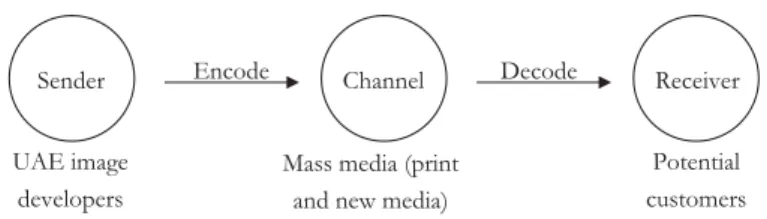
The broader topic of this study consists of marketing activities, especially image creation and transfer activities of the United Arab Emirates. The insights gained are often eye-opening, especially from the point of view of European readers, when their picture of the.
Introduction
After that, the United Arab Emirates will be represented with attention to the economic, political and infrastructural situation of the country. To what extent are the strategies of image developers in the United Arab Emirates intertwined with the traditional cultural background of Arab culture in developing the image as a brand for tourist destinations?”.
Image and destination brands
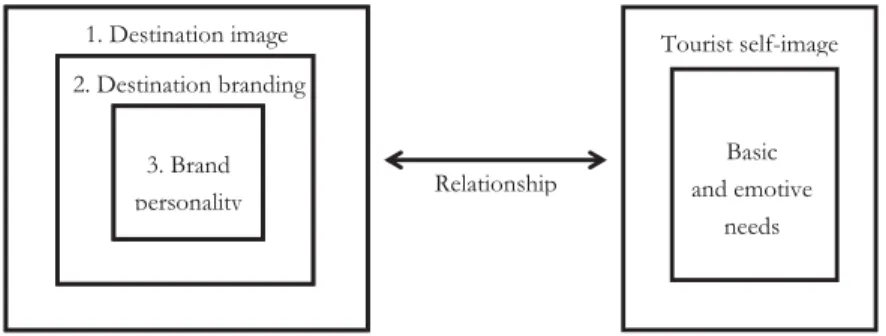
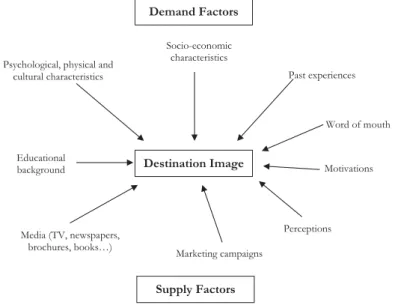
To summarize, the organic image of a tourist destination can also be defined as the main image of a destination as well as what. Another important aspect to consider when developing the image of a tourist destination is the financial aspect.
The United Arab Emirates
There are two main reasons that have affected the economic significance of the United Arab Emirates. The geographical location of the United Arab Emirates plays a decisive role in the development of the country's economy.
The image of the United Arab Emirates
The third and final internal problem of the emirate is the issue of freedom and privacy. According to Kabasci et al. ibid.), the emirate is promoted as the pinnacle of the United Arab Emirates and should therefore attract investors, property owners and tourists.
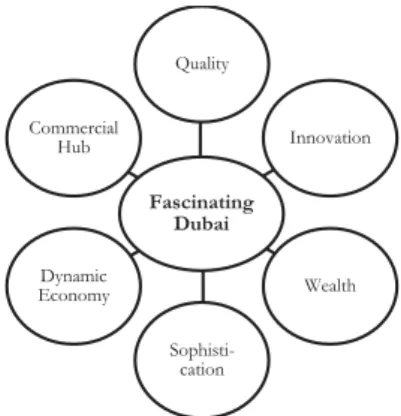
A cultural perspective
The Arabic language should be seen as an essential part of the United Arab Emirates. Therefore, this element should be included in the induced and consequently transferred image of the United Arab Emirates as a tourist destination.
Theoretical orientation
In addition, the educational background of the potential customer as well as the supplier has an effect on the destination image (Stabler, cited by Goodall and Ashworth 1995, p. 142). The author will analyze newspaper articles that refer to the image of the United Arab Emirates as a tourist destination brand, focusing on the research area.
The empirical research methodology
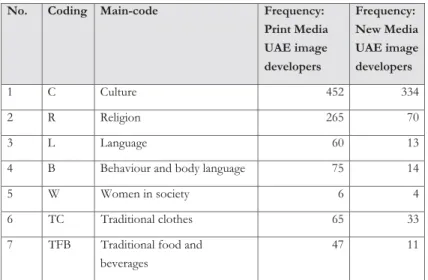
In the next subsection, the author provides a detailed overview of the selected empirical research process that is suitable for this specific research area. Therefore, the available content should be divided into categories to avoid personal influences of the author (Bryman and Bell 2011, pp. 289ff). The system of main categories is based on the theoretical part of the master's thesis and.
For the second phase of the empirical research process, the author chose a semi-structured interview with experts in the field of image development of the United Arab Emirates as a tourist destination brand. The assumptions are based on the theoretical part of this master's thesis and form the basis for the second, empirical part of the research process.

Awareness deficit of image developers
Therefore, the author aims to determine whether image developers in the United Arab Emirates are aware of the importance of building image strategies on the organic image of the country, including Arab history, culture and traditions. According to this model, based on Govers et al. 2007, p. 16), the first GAP may appear if there is a mismatch between the organic and induced picture of the United Arab Emirates. Therefore, the author wants to check whether the induced image of the United Arab Emirates, developed by image developers, lacks the traditional Arab cultural background, in other words, the organic image.
As already mentioned in sub-chapter 2.1.2, a successful TDI should appeal to be credible, which builds the foundation for the following sub-proposition 1c: The transmitted image of the United Arab Emirates is not authentically and credibly related to the traditional Arab cultural background. By analyzing this sub-proposition, the author wants to identify whether the transmitted image of the United Arab Emirates as a tourist destination brand is authentic and credible with respect to the traditional Arab cultural background.
Current image transfer as a tourist destination brand
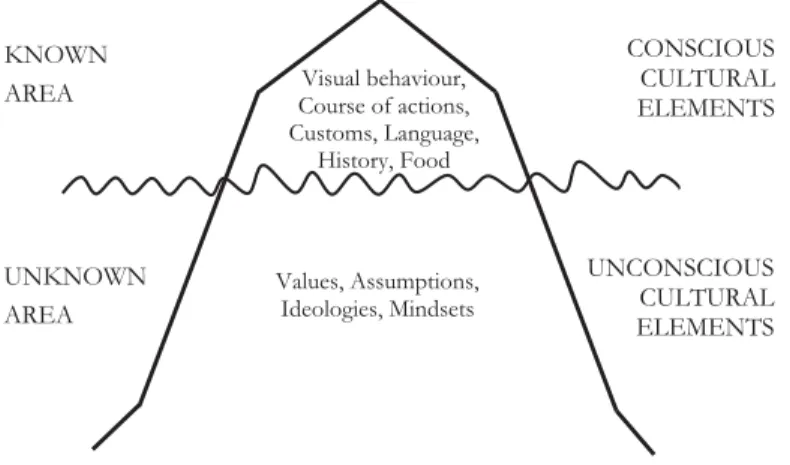
Although Muslims are not allowed to eat pork products and drink alcoholic beverages, travelers are allowed to do so (Lee and Jain 2009, p. 239), so the author wants to find out whether this openness is also involved in the transmission of the image of the UAE as a tourist destination brand. Local food and drink are also part of the culture and can be categorized as a conscious cultural element, leading to the following sub-item 2d: Traditional Emirati cuisine is not included in the conveyed image of the UAE. The author wants to analyze whether Emirati cuisine is part of the transferred image of the tourist destination brand and whether the developers of the image have included recommendations and rules of tourist behavior in this aspect.
As mentioned in subchapter 4.6, the Emirate of Sharjah uses the term "Cultural Capital" as a promotional slogan, which leads to sub-proposition 2e: In the United Arab Emirates, the Emirate's promotional slogan, which leads to Sub-proposition 2e: In the United Arab Emirates , the Emirate of Sharjah is more authentically incorporating the traditional Arab cultural background into its image strategies. The author wants to find out if the image transfer of Sharjah is authentic with the traditional cultural background of Arab culture and if the slogan "Cultural Capital" creates an advantage in authenticity compared to the other six emirates.
Lack of culture in image transfer – Possible reasons
This sub-proposal is grounded in the fourth chapter of this master's thesis, which provides an insight into the image of the United Arab Emirates in general, as well as the image of each of the seven emirates. As Steiner (2010, p. 242) states, artificial projects such as shopping malls and tourist attractions lack the traditional Arab historical culture. Consequently, the author wants to investigate whether and to what extent artificial projects in the United Arab Emirates lack the traditional Arab culture and negatively affect the authentic image transmission as a tourist destination brand.
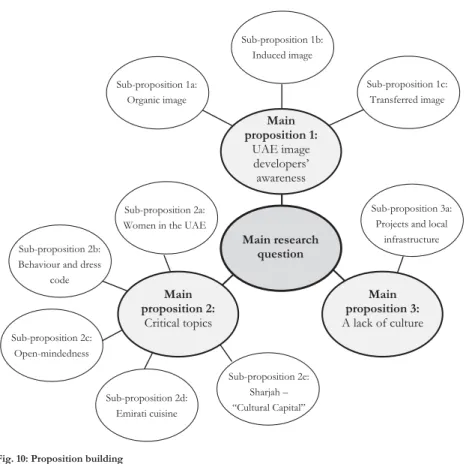
In addition, the author must be aware of which variables a selected term can measure (Halbmayer 2010, only). The propositions were built in a logical sequence as the first dimension deals with the image developers of the United Arab Emirates, including the awareness of image development and a possible shortage of expertise.
Dimension 2 Dimension 3 Image developers
The qualitative media analysis
In the next chapter, the author describes the first part of the empirical research process, the qualitative media analysis. In the following subchapters, the author presents the selected data corpus (print and new media) that will be analyzed empirically. As discussed earlier, the author will analyze newspaper articles referring to the image of the United Arab Emirates as a tourist destination brand, with an emphasis on the cultural perspective.
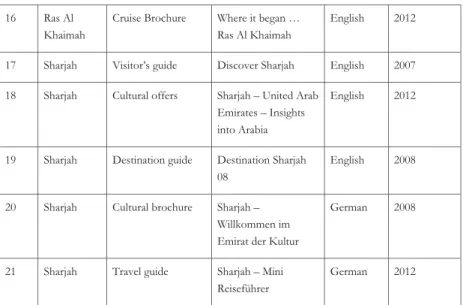
As already mentioned, the author also analyzes the individual websites of the seven emirates. Therefore, the author analyzes the content related to these emirates on the United Arab Emirates NCTA website.
The qualitative interviews
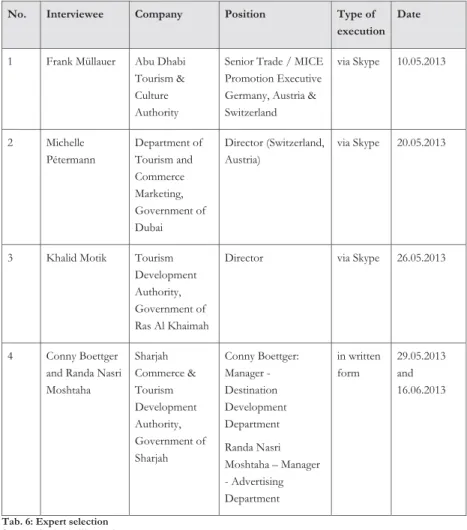
The chairman of the Abu Dhabi Tourism and Culture Authority is a member of the Abu Dhabi royal family (ibid., l. 21). The second interviewee is Michelle Pétermann, Director of Tourism and Marketing of the Dubai Store. The first expert is Conny Boettger, Head of Destination Development at the Sharjah Trade and Tourism Development Authority.
That's why the author selected these five experts, each of them image developers from the United Arab Emirates. As mentioned in subchapter 7.3.2, the author has opted for the method of word-for-word transcription.
Data analysis and research findings
The transmitted image of the United Arab Emirates is not authentic and trustworthy in relation to the traditional Arab cultural background. The currently downloaded United Arab Emirates TDI does not include critical topics related to traditional Arab culture. As mentioned earlier, the local residents of the United Arab Emirates are deeply rooted in Arab culture.
Traditional Emirati cuisine is not embedded in the transferred image of the United Arab Emirates. The small number of official Emirati citizens in the UAE leads to the loss of traditional Arab culture.
Discussion and Conclusion
Finally, the author addressed a possible lack of culture in the current tourist image transfer of the United Arab Emirates. Available at: http://www.thenational.ae/arts-culture/ask-ali-etiquette-for-giving-dinner-with-emiratis [Access. Available at: http://www.thenational.ae/arts-culture/what-makes-our-united-emirates-different Retrieved from .
Available from: http://www.arabnews.com/travel/ksa-among-top-5-muslim-friendly-holiday-destinations [Accessed. Available from: http://www.thenational.ae/news/uae-news/heritage/festivities-pay-tribute-to-historic-building [Visit.
Interview manual – Expert interviews (English language)
Image developers: awareness deficit
Scheich Mohammed hat tatsächlich schon sehr früh gemerkt, […] dass Dubai finanziell nicht lange vom Öl leben kann.“ ] Nun, ich glaube, Öl wurde 1967 entdeckt, erstmals 1969 exportiert, und dann hat man mit diesem Einkommen wirklich begonnen, […] diese Stadt, dieses Emirat aufzubauen.“ Gegründet im Jahr 2011, Vergrößerung des Zimmerbestands und Erkundung anderer Märkte … was Es wird uns die Möglichkeit geben, andere Märkte zu erkunden, und dies ist eine unserer Hauptaufgaben, das Image des Reiseziels zu entwickeln. [...] und auch andere Reiseziele und Ras Al Khaimah in einer sehr guten Position auf dem Tourismusmarkt zu erkunden.“ Nein, aber vielleicht in der Zukunft (derzeit - nur Hotels) .. hier sind wir ein sehr kleines Team, [ ...] Wir entwickeln gerade Autorität und dann werden wir natürlich ein größeres Team haben, wir werden sehen, wo die Schwächen des Teams liegen, und dann können wir für sie trainieren, mich eingeschlossen.“
Unverzichtbar „Nun, ich denke, es ist wichtig, insbesondere in Ländern wie Abu Dhabi oder den Vereinigten Arabischen Emiraten insgesamt, den kulturellen Aspekt sehr stark zu integrieren.“ Wir integrieren den traditionellen Teil bereits […] in unsere Strategien und […] in unsere Pakete […], damit die Menschen den Stempel des Landes sehen können.“
Current image transfer
Anyone who opens up to the world because of the lost history of security, stability, the broad mindset of people, soon things are put into the right perspective and the image straightens out." .. proposition 2a: Similar transport of women. in the United Arab Emirates does not have recent developments in the field of emancipation and equality in the local community. Usually communication does not reach .. such areas in this part of the world.” proposal 2b: No tourism recommendations for traditional Arab rules of behavior and body language and dress code are included in the transferred image of the United Arab Emirates. However, these spaces are usually hidden behind curtains, blinds, folding walls, etc.” .. proposition 2d: Traditional Emirati cuisine is not integrated into the transferred image of the UAE.
What do you think is the reason that only a few restaurants in the UAE focus on traditional Emirati cuisine?). In the United Arab Emirates, the emirate of Sharjah most authentically incorporates the traditional Arab cultural background into pictorial strategies.
Lack of culture in image transfer: possible reasons
Is traditional Arab culture taken into account in large-scale developments and construction projects in the UAE?). Here in Ras Al Khaimah, all these villas and these buildings […], all that is a stamp of the traditional things.“. Yes "Yes, it is very important to keep the culture and then the Islamic architecture and all."
Medienanalysen zeigen, dass für die Emirate Fujairah und Umm Al Quwain kaum oder gar keine Ergebnisse erzielt werden konnten. Ich denke, dass es in Umm Al Quwain zwei Strandhotels gibt, die relativ günstig und sehr beliebt sind.