A THESIS
Submitted to the Faculty of Teacher Training and Education Makassar Muhammadiyah University in Part Fulfillment
Of the Requirement for the Degree of Educationin English Department
MUSDALIFAH 10535 4362 09
ENGLISH EDUCATION DEPARTEMENT
FACULTY OF TEACHERS TRAINING AND EDUCATION MAKASSAR MUHAMMADIYAH UNIVERSITY
2014
A Thesis
Submitted to the Faculty of Teacher Training and Education Makassar Muhammadiyah University in Part Fulfillment
Of the Requirement for the Degree of Education in English Department
MUSDALIFAH 10535 4362 09
ENGLISH EDUCATION DEPARTMENT
FACULTY OF TEACHERS TRAINING AND EDUCATION MAKASSAR MUHAMMADIYAH UNIVERSITY
2014
Satuan Pendidikan : SMA Perguruan Islam Makassar Mata Pelajaran : Bahasa Inggris
Kelas/Semester : XI/II Kemampuan : Writing
Materi : Narrative paragraph Alokasi Waktu : 10 x 45 menit
A. Standar Kompetensi:
Menulis
Mengungkapkan makna dalam teks fungsional pendek dan monolog sederhana berbentuk narrative, descriptive dan news item dalam konteks kehidupan sehari-hari.
B. Kompetensi Dasar:
Mengungkapkan makna dalam teks monolog sederhana dengan menggunakan ragam bahasa lisan secara akurat, lancar dan berterima dalam konteks kehidupan sehari-hari dalam teks berbentuk: narrative, descriptive dan news item.
C. Indikator:
1. Kognitif
Mengidentifikasi ciri-ciri paragraf deskriptif melalui contoh paragraf deskriptif.
Menulis paragraf deskrifsi 3. Afektif
a. Karakter
Jujur
Tanggung jawab·
Rasa ingin tahu b. Keterampilan Sosial
Bertanya dengan bahasa yang santun
Menyumbang ide
Membantu teman yang mengalami kesulitan D. TUJUAN PEMBELAJARAN
1. Kognitif
Mengidentifikasi ciri-ciri paragraf naratif melalui contoh paragraf naratif
Menulis paragraf naratif 2. Psikomotor
Siswa dapat menulis sebuah paragraf naratif 3. Afektif
a. Karakter
b. Keterampilan social
Siswa terlibat aktif dalam pembelajaran dengan memperlihatkan kemajuan dalam keterampilan bertanya dengan bahasa yang santun, menyumbang ide, dan membantu teman yang mengalami kesulitan, menghargai pendapat orang lain.
E. MATERI PEMBELAJARAN
Merujuk pada teaching material F. MODEL PEMBELAJARAN
Flowchart G. MEDIA
Instrumen lagu dan gambar H. LANGKAH PEMBELAJARAN
Pada pertemuan pertama, guru memberi pre test dengan istruksi membuat paragraf naratif dengan judul “Cinderella”.
Pada pertemuan kedua, merupakan tahap pertama treatment. Guru memberi penjelasan tentang flowchart dan manfaatnya dalam menyusun paragraf naratif.
Pada tahap kedua treatment (pertemuan ketiga), guru memberi contoh pada siswa tentang flowchart dan memberi ujian stimulan.
Pada pertemuan terakhir (pertemuan kelima), guru mengadakan post-test dan memberi tugas siswa untuk menyusun paragrafnaratif dengan judul
“The Legend of Lake Batur sesuai dengan metode Flowchart”
I. SUMBER / BAHAN/ALAT PEMBELAJARAN
Developing English Competencies for Grade XI Senior High School (SMA/MA)
Loudspeaker
Kamus
Laptop
Marker J. PENILAIAN
1. Teknik : Tugas individu 2. Bentuk Instrumen : Tes tertulis
3. Instrumen : attached in appendices 4. Pedoman penilaian:
Makassar …. Maret 2014
Mahasiswa
Musdalifah
viii
Research at the Second Year Students of SMA Perguruan Islam Makassar), under the thesis of English Education Department, the Faculty of Teachers Training and Education, Makassar Muhammadiyah University, supervisors by Arif Paturusi and Achmad Basir.
The objective of the research was to find out whether or not the use of Flowchart Method is effective to improve the students’ speaking ability in term of organization and vocabulary. The researcher provided learning material during treatment and gave chance to the students to write down their ideas. The research was held in five meetings.
The researcher used a pre-experimental design with one group pretest and posttest design. The population was the second year students of SMA Perguruan Islam Makassar, in academic year 2013/2014, which consisted of two classes, it was XI IPA and XI IPS. The sample was taken by purposive sampling technique.
The number of the samples were 30 students consisted of 24 women and 6 men of class XI IPS.
The research findings indicated that Flowchart Method was effective to improve the students’ writing ability in terms of organization and vocabulary. It was proved by the students’ mean score in pretest was 43,87 and posttest was 67,7. It showed that the students’ writing skill in posttest was higher than pretest.
After calculating the difference between matched pair (D), it was found that the result of t-test value was 11,32. By applying the level of significance (p) = 0, 05 and the degree of freedom (df) = 30-1 = 29, it was found that the result of t-table was 2,045. Therefore, the t-test was greater than t-table (11,32> 2,045) and Null hypothesis was rejected and Alternative hypothesis was accepted. It meant that there was a significant difference in the students’ writing ability before and after being taught by Flowchart Method.
Alhamdulillahi Rabbil Alamin, I would like to express my profound gratitude to the almighty God Allah SWT, the most compassionate and merciful, the cherisher and sustainer of the world. Peace be upon him, Rasulullah Muhammad SAW, Shalawat and Salam are addressed to the beloved and chosen messenger.
Many problems and difficulties had been encountered in finishing this thesis. I do realized that in conducting the research and writing this report, I got invaluable contribution and assistance from a great number of people. Therefore, I would like to express my deep appreciation and sincere thanks to all of them as follows:
1. The Rector of Makassar Muhammadiyah University, Dr. H. Irwan Akib, M.Pd.
2. Dr. Arif Paturusi, M.Hum as the first consultant who guided, gave corrections and advices to writing this proposal, and then to the second consultant, Achmad Basir, SS., M.,BA., for his time in guiding, giving correction and suggestion from the preliminary manuscript until the last page of this proposal.
3. The Dean of Faculty of Teacher Training and Education, Dr. A. Sukri Syamsuri, M.Hum.
4. The Head of English Education Department, Erwin Akib, S.Pd. M.Pd., and Ummi Khaerati Syam, S. Pd., M. Hum., the secretary of English Education Department for their guidance and aid.
5. My beloved parents, Muh.Dahlan and Hj.Nurasiyah(Almh), for their love, sacrifices, advices and pray; and also special thanks to my beloved aunties who always support me in any condition.
K’ndah,Nana ,for their help and support in finishing my research.
8. All my friends from EDSA-09 and all of people who always gave me inspiration that cannot be mentioned one by one
Hopefully, this thesis would be useful for many people who need it.
Makassar, November 2014
The Researcher
viii PAGE TITLE
APPROVAL SHEET ... ii
CONSELLING SHEET ... iii
ACKNOWLEDGEMENT ... vi
TABLE OF CONTENTS ... viii
CHAPTER I INTRODUCTION ... ….. 1
A. Background ... 1
B. Problem Statement ... 4
C. Objective of the Study ... … 4
D. Significance of the Study ... 4
E. Scope of the Study ... 5
CHAPTER II REVIEW OF THE RELATED LITERATURE ... 6
A. Some Previous Related Findings ... 6
B. Some Partinent Ideas ... 7
D. Conceptual Framework ... 24
E. Hypothesis ... 25
CHAPTER III RESEARCH METHOD... 26
A. Design of the Research ... 26
ix
E. Procedures of data collection ... 28
F. Technique of data analysis ... 29
CHAPTER IV FINDING AND DISCUSSIONS ... 32
A. Findings ... 32
B. Some pertinent ideas ... 37
CHAPTER V CONCLUSION AND SUGGESTION ... 45
A. Conclusion ... 45
B. Suggestion ... 45
BIBLIOGRAPHY APPENDICES
CHAPTER I INTRODUCTION.
A. Background
English language has a central role in developing intellectual, social, and emotional competence to students. It is also an important tool in learning and developing sciences, technology, and art. Language learning is expected to help the students to recognize themselves, their culture and another culture. Besides, it also helps students to express their idea, thought, and feeling. In addition, they are able to participate in society and even to find and also use their analectic and imaginative ability.
In the competence based curriculum, the students are expected to be able to communicate. The ability to communicate is the ability to understand and produce language of which it can be realized in four language skills, namely listening, speaking, reading, and writing. Moreover those four skills should be applied in real life. Hencein English subject needs to improve those skills. In order that, the students are able to communicate and make discourse in English language in certain literacy level.
Writing is one of the language skills that play an important role in human communication. The important of writing is coming to be more and more recognized. It is through the written mark that links with the outside word are formed.There is no doubt that English writing is important as the other three- language skills. The ability to write is frequently demanded in many occasions in our life. For many reasons, writing skill is crucial to most people. Adelstein and
1
Vipal (1980: 25) state that in all subjects in our life or in all professions, the ability to write or express oneself clearly is essential basic for success. Writing is crucial meaning of human communication. It is used to communicate with other people in society and to express our feeling and opinions. Writing means of both communication and self expression.
Heaton in Noni(1984:126) states that many students still encounter difficulties in writing because it is complex and difficult. In studying English, many students who study in the tertiary level still often make errors in writing for many times, even years. In writing, we need a good idea in order to produce a composition or written material. If students have no good ideas they will get boring and not interesting in it. For writing subject, students must have idea about what will they write and how far they know about the topic, sometimes they have to choose one theme and then decide one topic, finding the appropriate word to express an idea.
Based on the writer’s preliminary observation, teachers in SMA Perguruan Islam Makassar have taught English by using some techniques that are appropriate for writing skill. Generally, teacher reviewed the characteristic of the text, text organization and the vocabularies.then, the teacher asked students to write simple essay individually based on the picture they had given. Ideally the tenth grade year strudent of SMA Perguruan Islam Makassar are able to write paragraph.
In reality, the condition of SMA Perguruan Islam Makassar were far from expectation. The writer found that some of the students were still not able to write
paragraph. It can be seen from the following symptoms: Some of the students need a long time to express their idea, some of the students use inappropriate vocabularies in writing text and their score of vacabularies is still low based on the pre test mean score in vocabulary was 2,4 and some of the students are not focused on the topic of their writing especially in organization or the relation between the sentences was not relevant based on the pre test mean score in organization was 4,12. It was distant from the goal score 6 to passed English subject.
Based on the phenomena above, the writer has an alternative to use flowchart. flowchart can help the students to express their idea or opinion in to written form and help them to improve sometimes their limited idea and make their writing finish.Flowchart using fictures symbolizes or signs for kinds of work and certain function. It fictures only essential commands and is effective to design structured programs. The use of flowchart can be used as on alternative media in writing because it serves both visual aids and minds mapping.
Refering to the explanation above, the writer is interested to conduct a research at SMA Perguruan Islam Makassar. So through flowchart, it tends help the students to express their ideas easier. Experienced writers often return to flowchart whenever they are stuck for ideas or words. It gives them writing power.
Based on the explanation above, the writer carries out the research under the title “The Use of Flowchart Method to Improve the Students’ Ability in Writing Narrative Paragraph (A Pre- Experimental Research of the Second Year Students at SMAPerguruan Islam Makassar)”
B. Problem Statement
Based on the previous background, the writer formulates a research question as follows:
1. How does the use of Flowchart improve the students’ ability in writing narrative paragraph to focus on the vocabulary at the second year students of SMA Perguran Islam Makassar?
2. How does the use of Flowchart improve the students’ ability in writing narrative paragraph to focus on the organization at the second year students of SMA Perguuran Islam Makassar?
C. Objective of the Research
1. To find out whether or not the use of flowchart method can improve the ability of the second year students of SMA Perguruan Islam Makassar to write paragraph focused on vocabularies.
2. To find out whether or not the use of Flowchart method can improve the ability of the second year student of SMA Perguruan Islam Makassar to write narrative paragraph focused on the organization.
D. Significance of the Research
The result of this research was expected to be a piece of useful information for teaching in general, in particular for those who teach English in SMA Perguruan Islam Makassar. In addition, it was intended to find out the ability of the second year students to write paragraph and apply flowchart as one alternative media in teaching writing.
E. Scope of the Research
This scope of the research was restricted to find out the students’ writing ability through Flowchart Method. Teh researcher measured the students writing ability by vocabulary and organization. The researcher was hold in five meetings in the classroosm and gave 5 topics about narrative text related to flowchart.
CHAPTER II
REVIEW OF RELATED LITERATURE
This chapter presents the literature review, which deals with the previous related research findings and some pertinent ideas.
A. Previous Related Research Findings
Many researchs on teacher profile or characteristics of a good teacher together with learning writing in or outside the classroom had been done to reach certain objectives in learning and teaching process. There are some researchers who have conducted some studies relating to the students’ writing ability. They are as follows:
1. Wishonand Burks (1980:128-9) says that a good description (in a paragraph form) usually has three important qualities it has a dominant impression supported by specific details clearly recognizable and logical development.
2. Alam (2006) concludes that the ability of the second year students in English writing has improved after applying writing materials based on Community Language Learning. It can stimulate the students in learning writing skill. The result can be seen in the mean score of pre-test was 4.643 and post test was 6.703, with the t-test was 8.68.
3. Amin (2007) concludes that using the student’s error in teaching the language use aspect of writing is an effective way. The students interested in learning writing through the student’s error usage in teaching. The mean
6
score of students’ pre-test was 6.83 and post-test was 7.55. The result of t- test indicates that the value 4.13.
4. D’ Angelo in Indrayani (2007: 142) considers that writing is a form of thinking for a particular audience, and for a particular occasion. According to this concept that one of the most important tasks as a writer is to master the principles of writing and thinking that will help to achieve his goal.
The most important of these principles are those of invention arrangement, and style invention is the process of discovering ideas for speaking or writing arrangement.
5. Sulaeman (2009) in his thesis, “Using Guided Questions to Improve the Students’ Ability to Write Narrative Paragraph”. He found that the
students’ writing mean score based on elements of organization and content in cycle I was 58.0 and in the cycle II was 72.3 it was gotten improvement was 14.3can improve the students’writing ability expecially on their narrative paragraph and can make the students more enjoy and active in the learning process because they can tell or create all about their self.
All research findings above discuss about writing ability with different methods and the other problems in the students’ writing ability. Based on the research findings above, the researcher concludes that the students’ writing ability is still low. Therefore, the researcher considers that the students need many exercise and interesting technique to improve writing ability. On the other side,
the writer would like to present her research about the flowchart strategy in developing the students’ ability in writing.
B. Some Pertinent Ideas 1. The Concept of Writing
a. Definition of Writing
Kroma (1998) argues that writing is kind of activity where the writer expresses all ideas in his mind in the paper (print) from words to sentences, sentences to paragraph to essay. In relation about it, Lannon (1992) describes that writing is process of transforming the material you discover by research, accident, trial and error, or whatever into message which has a meaning. In short, writing is deliberated process.
Writing is transpiring data or feeling to another as the reader. In another word, it is a communication process by undirected speech or reported speech. In addition, D’ Angelo in Indrayani (2007) considers that writing is a form of thinking for a particular audience, and for a particular occasion.
According to this concept that one of the most important tasks as a writer is to master the principles of writing and thinking that will help to achieve his goal.
The most important of these principles are those of invention arrangement, and style invention is the process of discovering ideas for speaking or writing arrangement.
The definition of writing is how to express our mind as the writer on the paper and let another people read it as the reader. Furthermore, Lindbolm in Supriandi (2004) states that writing is a way of learning to focus our mind
on important matters and of learning of them. By writing activity a person can find solution of difficult problem. This process of writing needs a greater attention on the problem.
According to Trimmer and Summer (1983:10) that writing is one way to convey something about ourselves or to communicate ideas to people beyond our immediate to learn something you did not know. Furthermore, West in Ummi (2001) states that reason for learning to write well is to transunit idea for people specially those who are distance in time and space.
Writing can be a process of self-discovery about who we are what we think.
Based on some definitions presented, writing could be defined as a complex process where by looks at and understands what has been written, the combination of some components that result of one active attempt the part of the reader to understand writer’s message. Writing is a part of language skill which requires and elliptical ability in order to construct a brief and good order of sentence. As one of the language skill in English, writing is used to express the student ideas, opinion or comments which are conveyed in the written form.
b. Characteristics of Good Writing
Yarber in Murniati (2006) says that an effective writer agrees that good writing has several important characteristics, they are:
1) Good writing is not boring; it keeps your interest by what is says and how to say.
2) Good writing is easy to follow because it follows a plan.
3) Good writing presents ideas that are fresh.
4) Good writing is free of serious mistake in grammar, spelling, and punctuation because those errors get in the way of the writers idea and distract the reader.
5) Good writing uses language that is right for the job formal when required and informal when appropriate.
Marwah (2002:6) writes four characteristics of a good writing, namely:
significance, clarity, unity and organization, and adequate development. Those are described as follow:
1. Significance
Writing is significance if the readers enjoy it reading and learn something from it. In order to produce a significance writing, the author has to under estimate his own resources. He has to have valuable information about some activities interest that someone would like to read about it.
2. Clarity
One thing is very important in writing is clarity. A piece of writing that lacks clarity will annoy the reader.
3. Unity and organization
A piece of writing is called unity if each sentence in paragraph develops or supports the main idea of the paragraph and connects in some ways with any sentences that same before and after it.
4. Adequate development
In writing, the author establishes a contract with the reader that contract can take various from such as a title that predicts and opening question that must be answered, a thesis statement to be developed, or an anecdote.
c. Component of Writing
There are five significant components of writing according to Jacob in Indrayani (2007: 19) they are content, organization, vocabulary, language use, and mechanic. They are as follows:
1) Content
Content of writing should be clear for the readers so that the readers can understand the message conveyed and get information from it.
In order to have a good content of writing, the content should be well unified and completed. This term is usually known as unity and completeness which become the characteristics of the good writing.
2) Organization
In organization, the writing concerns with the ways the writer to arrange and organize the ideas or the messages in the writing. Organizing the material in writing involves coherence, order of importance, and general to specific, specific to general, chronological order that happened from the beginning to the end.
3) Vocabulary
The effective use of words will always result good writing both specific and technical writing, the dictionary is very considerable vocabulary is one in writing. To express ideas we always deal with vocabulary. The lack of vocabulary makes it difficult to express ideas.
4) Language use
Language use in writing description and other form of writing involves correct language and point of grammar. An adequate grammar should be one that is capable of producing grammar. We should not able to do anything more than utter separate items of language function and also grammar can help the students to improve the use of formal language.
5) Mechanics
There are at least two parts of mechanic in writing, namely punctuation and capitalization. Punctuation is important as the way to clarify meaning in English writing capital letters have to participles. First they are used to distinguish between particular and proper things. Second, it is used as first word in quotations, a formal statement and proper adjective.
d. Writing Forms
Students often write personal narratives about experiences in their own lives. They may write about a vacation whatever they want to go. Sometimes they may choose to report information about dinosaurs, making candles, or other topics they are knowledgeable about.
According to Temple, et. al. (1982:39), many other forms of writing are available to the students, in the following:
1) Journal writing
Students write in personal journals about events in their lives, in dialogue journals to converse with classmates and the teacher, in learning logs to document learning in content area classes, in reading logs to reflect on literature, and in simulated journals in the role of a historical personality or literary character.
2) Descriptive writing
Students use observation, sensory words, and comparisons to write descriptions of objects, people and events.
3) Letter writing
Students write friendly letters to pen pals and authors, courtesy letters, and business letters to request and share information.
4) Biographical writing
Students write biographies of well-known contemporary and historical personalities, personal narratives about experiences in their own lives, and autobiographies to document their own lives.
5) Expository writing
Students write reports and other forms of expository writing to share information about social studies, science, and familiar topics.
6) Narrative writing
Students retell familiar stories, write stories a well-developed structure, and rewrite stories from different points of view.
7) Poetic writing
The Students play with words, create word pictures, and write poems.
8) Persuasive writing
The students use persuasion techniques and propaganda devices to write persuasive essays and letters and create advertisements and commercials.
e. Kinds of Composition
Writing in many ford varieties the classical rhetoricians classify writing and speech in four forms of the discourse, those are:
1. Narration
Narrationis writing which tells a story. When a writer uses this method of development of writing, he intends to tell readers something that happened and how it happened. The story or ideas in narration are ordered chronologically, starting from the beginning up to the end.
2. Description
Descriptionis writing which attempts to create a picture in the readers mind. When a writer uses this method to write, he intends to make the readers vividly aware of what something look like, sounded like, smelled like, field like, or started like. When the writer uses description
mode, he is trying to recreate in words something he perceived trough his five senses or created in his imagination. Descriptive is common way to present details, but it often appears with others forms or pattern of development.
3. Exposition
Exposition is writing which informs or explains. When a writer uses exposition, he intends that readers will understand the something informed or explained more clearly when they have finished reading the writing. Exposition or expository writing, which is informative writing, designed to explain or clarify facts and ideas. It is the kind of writing most often required of college students and people holding job that required a college education.
4. Argumentation
Argumentation is writing which are attempts to convince someone else about something. When a writer uses argument to write, he intends to convince readers to believe something, or to have a certain attitude about an issue, or to fell a certain way about a situation, or to do something.
g. Writing Process
The writing is a way of looking at writing instruction in which the emphasis is shifted from students’ finished products to what students think and do as they write. Furthermore, Temple, et. al. (1982:9-24) state that writing activity generally requires several processes namely prewriting, drafting,
revising, editing and publishing. To make it clearer, the explanation is as follows:
1) Prewriting
Prewriting is the getting-ready-to-write stage. The traditional notion that writers have thought out their topic completely is ridiculous. If writers wait for the ideas to be fully developed, they may wait forever.
Instead, writers begin tentatively talking, reading, and writing to see what they know and direction they want to go.
Prewriting has probably been the most neglected stage in the writing process; however, it is as crucial to writers as a warm up is to athletes. During the prewriting stage, the activities are: (1) choosing a topic, (2) considering purpose, form, and audience, and (3) generating and organizing ideas for writing.
2) Drafting
In the process approach to writing, students write and refine their compositions through a series of drafts. During the drafting stage, students focus on getting their ideas down on paper. Because writers do not begin writing with their compositions already composed in their minds, they begin with tentative ideas developed through prewriting activities.
The drafting stage is the time to pour out ideas, with little concern about spelling, punctuation, and other mechanical errors. The activities in this stage are: (1) writing a rough draft, (2) writing leads, and (3) emphasizing content, not mechanics.
3) Revising
During the revising stage, writers correct their ideas in their compositions. Often students terminate the writing process as soon as they complete a rough draft, believing that once their ideas are jotted down the writing task is complete. Experienced writers, however, know they must turn to others for reactions and revise on the basis of these comments.
Revising is not just polishing writing; it is meeting the needs of readers by adding, substituting, deleting, and rearranging material. The word revision means “seeing again”, and in this stage writers see their compositions again with their classmates and the teacher helping them.
Revising is the examination of the draft to find mistakes, deficiencies or irrelevant points and after that improving the text. Revising should be better done after the completion of the first draft, so that it will not interrupt the flow of writing. The activities in the revising stage are:
(1) rereading the rough draft, (2) sharing the rough draft in writing group, and (3) revising on the basis of feedback received from the writing group.
4) Editing
Editing is putting the piece of writing into its final form. Until this stage, the focus has been primarily on the content of students’ writing.
Once the focus, changes to mechanics, students polish their writing by correcting spelling and other mechanical errors. The goal here is to make writing “optimally readable”.
Writers who write for readers understand that if their compositions are not readable, they have written in vain because their ideas will never be read. Students move through three activities in the editing stage: (1) getting distance from the composition, (2) proofreading to locate errors, and (3) correcting errors.
Editing means that how to correct the organization of writing and seeing the wrong words. Furthermore, Flower and Hayes in Indrayani (2007) say that there are four types of editing:
a. Editing for standard language conventions: spelling, grammar, repetitions.
b. Editing for accuracy of meeting: wrong words, ambiguities.
c. Editing for reader understanding: unusual words, missing contexts.
d. Editing for reader reacceptance: offensive tone and consistency.
5) Publishing
In the final stage of the writing process, students publish their writing and share it with an appropriate audience. As they share their writing with real audiences of their classmates, other students, parents, and the community, students come to think of themselves as authors. The ways to share writing are students read their writing to classmates, or share it with larger audiences through hardcover that are placed in the class or school library, class anthologies, letters, newspaper articles, plays, filmstrips and videotapes, or puppet shows.
2. Paragraph
a. Definition of Paragraph
Lindbolm in Indrayani (2007) describes that a paragraph is a group of sentences. It is composed by expressing one central idea, complete itself, and also subdivision or a part of something larger such as a composition or a chapter in a book.
Paragraph is a group of sentences. It means there are some sentences are grouped with one central idea. In addition, Barnett (1974: 78) defines that a paragraph is a group or related sentences about a single topic. It has four essential parts: topic, idea, details, and transition.
According to Crimon in Irwan (2006) a paragraph is a group related sentence which presents one idea or aspect of on idea. A good paragraph not only just state the idea, but also each sentence in it support or extend the central idea. In spite of the paragraph is short but it is complete composition.
The basic rule of follow the length of the paragraph you write is making the paragraph long enough to develop its central idea clearly and completely. Do not make a paragraph so long that you do not relate to the central idea becomes repetition and boring.
b. Characteristics of Good Paragraph
Sawaka (1988: 61) explains that a good paragraph should have four characteristics, they are:
1) Unity, a paragraph has a unity if every sentence in it develops one central idea. When a paragraph a unity, it sticks to the topic. It develops without
getting of track. This means that all developments support the topic sentence.
2) Completeness, a complete paragraph provides information well enough and it develops the truth for the reader. In complete paragraph, the writers provide the readers with restricted topic sentences and sufficient information to clarify analyze and support the main idea that which is stated in the topic.
3) Order, in paragraph can be achieved by presenting the information of paragraph in a desirable sequence. The order of information is a paragraph depends on the subject mater, the purpose of the writing, and the writer’s preference.
4) Coherence means sticking together and in paragraph can be achieved by connecting one sentence to other. Each sentence in a paragraph is closely related to the next. It takes the reader logically and smoothly from one sentence to the next so that ideas stick one another.
c. Main Parts of Paragraph
Oshimaet. el. in Saraka (1988) classifies paragraph into three major structural parts namely topic sentence, supporting and concluding sentence. Those are described as follow:
1. Topic sentence
The topic sentence states the main idea of paragraph it briefly indicates what the paragraph is going to discuss. It contains both a topic and a controlling idea. It names the topic and them limits the topic to a
specific area to be discussed in the space of single paragraph. A topic sentence is a complete sentence, that it contains a subject, a verb, and usually complement. The topic sentence gives only the main idea, therefore it is the most general statement in the paragraph. It does not give any specific details.
2. Supporting sentence
The supporting sentence develops the topic sentence. It explains the topic sentence by giving reasons (exemplifications), statistics and quotations.
3. Concluding sentence
The concluding sentence signals the end of the paragraph and leaves the readers with important points to remember. It serves three purposes namely, (1) it signals the end of the paragraph, (2) it summarizes the main points of the paragraph, and (3) it gives a final comment on the topic and leaves the reader with the most important ideas to think about.
3. Concept of Flowchart
As a whole, flow-charting has been around for a very long time. In fact, flowchart has been used for so long that no one individual specified as the father of the flowchart. The reason for this is obvious. A flow this reason, flowcharts can be recognized as a unique quality improvement method.
a. Definition of Flowchart
A flowchart is defined as a pictorial representation describing a process being studied or even used to plan stages of a project. The flowchart is a visual representation of the square of the content of your plan (Parr, 2006:24).
According to Steven (2005:56) Programmers use flowchart to plan their programs before write them. A flowchart is a picture to show how to do something. It shows all the necessary steps. When a programmer writes a computer program, it must be very specific. It must include all the steps of a process. A flowchart helps programmers to organize their thinking.
Scott in Andreas (1996:22) assumes Flowchart is pictures in flow diagram form from algoritma in one program that says the role of at that program. Flowchart is one alternative media in teaching writing. A flowchart is a diagrammatic representation that illustrates the sequence of operations to be performed to get the solution of problem.
b. Types of Flowchart
Four particular types of flowchart have proved useful when dealing with a process analysis: top-down flowchart, detailed flowchart, work flow diagrams, and a deployment chart. Each of the different types of flowchart tends to provide a different aspect6 to a process or a task. Flowcharts provide an excellent from of documentation foe process, and quite often are useful when examining how various steps in a process work together.
c. Characteristics of Flowchart
Flowchart is specifically used for a process. Flowchart tends to provide people with a common language or reference point with dealing with a project or process. It shows what comes first, second, third, etc. as well as what your reader will do, if anything, and what will happen when they’ve done it. Flowchart organizes your topic, strategies, treatments, and options into a plan from which you can work out the details of what each screen, page, frame, or shot will look like. Flowchart use pictures to symbolize or sign for kinds of work and certain function. It pictures only essential commands and it is effective to design structured programs.
d. The Use of Flowchart in Teaching Writing
Based on some research findings, students’ ability to write paragraph cannot achieve into very good or excellent category. It indicates that teacher help them by writing, like diagram, photograph and pictures, flowchart also be used as one alternative media in writing.
Flowchart is specially used to describe chronological order or even and to make planning. It is visual or pictorial representation that is completed by arrows.
e. Advantages of Using Flowcharts
According to Swatt (2009:45) the benefits of flowcharts are as follows:
1. Communication: Flowcharts are better way of communicating the logic of a system to all concerned.
2. Effective analysis: with the help of flowchart, problem can be analyzed in more effective way.
3. Proper documentation: program flowcharts serve as a good program documentation, which is needed for various purposes.
4. Efficient coding: the flowcharts act as a guide or blueprint during the system analysis and program development phase.
5. Proper debugging: the flowchart helps in debugging process.
It seems that, students were more interested and more stimulated to write about something which is related to students’ lives. Writing about students’
experience was very interesting, however, the flowchart experience is valuable because students are developing writing fluency, learning a strategy to use when they do not know how to start a writing assignment, and learning that they usually do have something to say on almost any topic. Moreover the students was more interested in writing when they are given certain topics. By using flowchart they will be able to express their ideas, vocabulary and sentences easily to write.
Flowchart can help students overcome the sense of block. It gives them writing power.
C. Theoretical Framework
The theoretical framework in this research is show in the following diagram:
Figure 1. Theoretical Framework INPUT
Materials
PROCESS Writing Activities
OUTPUT Students’ ability
in writing
D. Hypothesis
Based on the theoretical framework, the hypothesis can be formulated as follow:
a. The Null Hypothesis (H0)
The use of Flowchart Method does not effectively improve the students’ ability in writing narrative paragraph.
b. The Alternative Hypothesis (H1)
The use of Flowchart method effectively improves the students’
writing ability.
CHAPTER III
METHODOLOGY OF THE RESEARCH
This chapter presents the research design, variable, population and sample, research instrument, procedure of collecting data, and technique of data analysis.
A. Research Design
The method used in this research was pre-experimental with one group pretest-posttest design. This design was involved in one group which is pre-tested (O1), exposed to a treatment (X), and post-tested (O2). The design was presented as follows:
Figure 2. Research Design
(Gay, 1981,225) B. Research Variables
a. Independent variable of the research was using flowchart in writing a paragraph.
b. Dependent variable was the ability of students to write a paragraph.
C. Population and Sample 1. Population
The population of the research was taken from the students at the second year students of SMA Perguruan Islam Makassar in 2013/2014 academic year. This population consisted of 52 students in two classes they were XI IPA and XI IPS.
Pre-Test (O1)
Treatment X
Post-Test (O2)
26
2. Sample
This researcher used cluster random sampling technique. It meant that the writer choose only one class, namely the students of class XI IPA with 24 students consisted of 14 females and 10 males.
D. Instruments of the Research
To collect data, the researcher used writing test. The test consisted of pre- test and post-test.
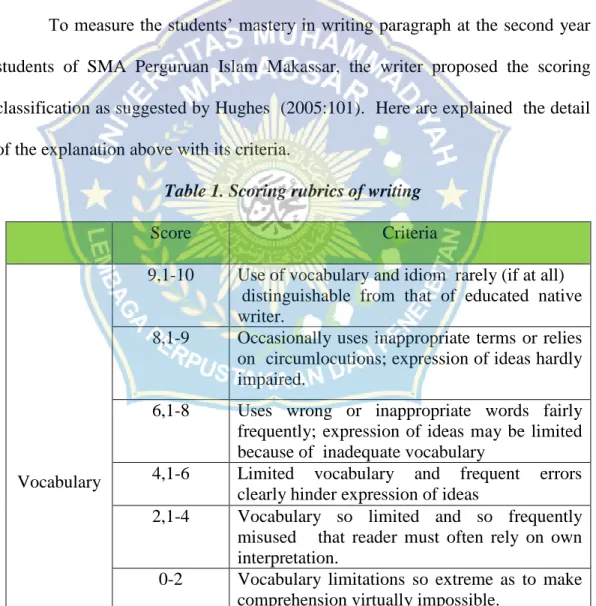
To measure the students’ mastery in writing paragraph at the second year students of SMA Perguruan Islam Makassar, the writer proposed the scoring classification as suggested by Hughes (2005:101). Here are explained the detail of the explanation above with its criteria.
Table 1. Scoring rubrics of writing
Score Criteria
Vocabulary
9,1-10 Use of vocabulary and idiom rarely (if at all) distinguishable from that of educated native writer.
8,1-9 Occasionally uses inappropriate terms or relies on circumlocutions; expression of ideas hardly impaired.
6,1-8 Uses wrong or inappropriate words fairly frequently; expression of ideas may be limited because of inadequate vocabulary
4,1-6 Limited vocabulary and frequent errors clearly hinder expression of ideas
2,1-4 Vocabulary so limited and so frequently misused that reader must often rely on own interpretation.
0-2 Vocabulary limitations so extreme as to make comprehension virtually impossible.
Hughes (2005:101) E. Procedure of Collecting Data
The procedure in collection data was presented in chronological order as follows:
a. Socialization: the writer socialized the way of the research that was conducted to the students.
b. Pre-test: the students write a paragraph according to the topic that the researcher given.
c. Treatment: after giving the pre-test, the students were given a treatment for three meetings. In each meeting the students were given learning materials.
Score Criteria
Organization
9,1-10 Highly organised; clear progression of
ideas well linked; like educated native writer.
8,1-9 Material well organised; links could occasionally be clearer but communication not impaired. .
6,1-8 Some lack of organisation; re-reading required for clarification of ideas.
4,1-6 Little or no attempt at connectivity, through
reader can deduce some organisation.
2,1-4 Individual ideas may be clear, but very difficult to deduce connection between them.
0-2 Lack of organization so severe that communication is seriously impaired.
For detail information, the writer explained the treatment in every meeting in the following:
1) The first meeting: the researcher introduced and explained about paragraph.
2) The second meeting: the researcher introduced and explained the flowchart.
3) The third meeting until the fifth meeting: make a paragraph according to material that was given for students.
d. Post-test: after the treatment, the post-test conduct to find out the students’
achievement and their progress. The test was similar to the pre-test.
F. Technique of Data Analysis
The data collected through the test were analyzed by using pre- experimental method.
1. Scoring the students’ answer of pre-test and post-test.
2. Classifying the students’ score
Table.1. Scoring Rank
No Classification Range of Score
1.
2.
3.
4.
Excellent to very good Good to average Fair to poor Very poor
100-84 83-68 67-51 50-34 (Heaton: 1984)
3. To find out the mean score, the following formula was applied:
X = N
xWhere:
X : Mean score
X : The sum of all scores N : The number of students(Gay, 1987: 361) 4. To find out the significant differences between the score of pre-test and post-
test by using the formula:
t =
1
2 2
N N
N D D
D
Where:
t : Test of significance
D : The mean of the differences score
D : The sum of total score of difference D : The Square of the sum score of different N : The total number of students(Gay: 1987)
CHAPTER IV
FINDINGS AND DISCUSSIONS
This chapter deals with the findings of the research and the discussion of the findings. The findings of the research reveal with students’ Writing performance in terms of Vocabulary, and Organization toward the use of Flowchart Method. In the discussion, arguments and further interpretation of findings are given.
A. Findings
Based on data analysis, it was found that the use of Flowchart Method is one of learning strategy of English Writingability was effective to improve the students’ Writing ability, to the good and accurate content as indicated by means score, frequency and rate percentage of pre-test and post-test covering the two elements of Writing ability.
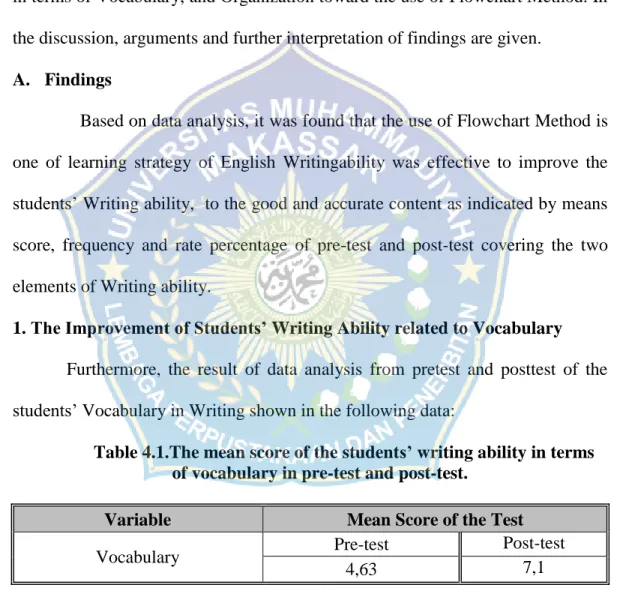
1. The Improvement of Students’ Writing Ability related to Vocabulary Furthermore, the result of data analysis from pretest and posttest of the students’ Vocabulary in Writing shown in the following data:
Table 4.1.The mean score of the students’ writing ability in terms of vocabulary in pre-test and post-test.
Variable Mean Score of the Test
Vocabulary Pre-test Post-test
4,63 7,1
1.
Table 4.1 shows that the mean score of student’s writing ability in terms of vocabulary in pre-test was 4,63and the mean score of post-test was 7,1. It means that the means score of post-test was higher than pre-test in term of vocabulary.
From the data analysis in table above, the researcher concluded that there is significance difference between the pretest and posttest in improving the students’ writing ability. This means that learning by Flowchart Method could improve the students’ writing ability.
2. The Improvement of Students’ Writing Ability related to Organization The result of data analysis from pre-test and posttest of the students’
organization in writing shown in the following data:
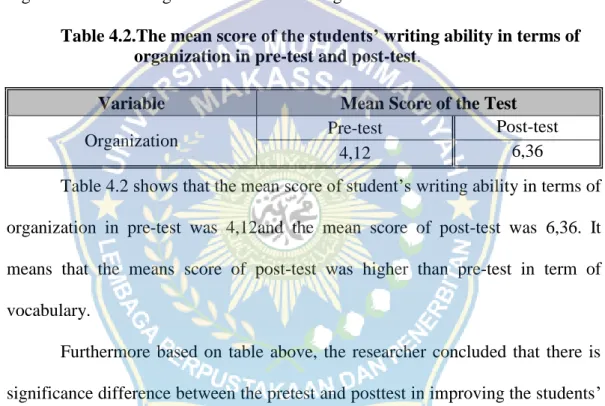
Table 4.2.The mean score of the students’ writing ability in terms of organization in pre-test and post-test.
Variable Mean Score of the Test
Organization Pre-test Post-test
4,12 6,36
Table 4.2 shows that the mean score of student’s writing ability in terms of organization in pre-test was 4,12and the mean score of post-test was 6,36. It means that the means score of post-test was higher than pre-test in term of vocabulary.
Furthermore based on table above, the researcher concluded that there is significance difference between the pretest and posttest in improving the students’
writing ability. This means that learning by Flowchart method could improve the students’ writing ability.
2. The Rate Percentage and Frequency of Pretest and Posttest
The rate percentage from pre-test and posttest of the students’ ability (in term of Vocabulary and Organization) in Writing shown in the following data:
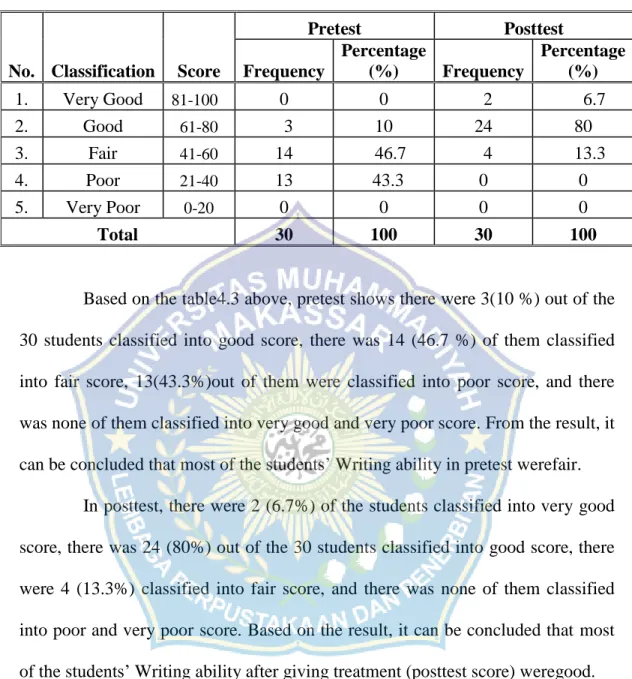
Table 4.3 The Percentage and Frequency of Pretest and Post test
No. Classification Score
Pretest Posttest
Frequency
Percentage
(%) Frequency
Percentage (%)
1. Very Good 81-100 0 0 2 6.7
2. Good 61-80 3 10 24 80
3. Fair 41-60 14 46.7 4 13.3
4. Poor 21-40 13 43.3 0 0
5. Very Poor 0-20 0 0 0 0
Total 30 100 30 100
Based on the table4.3 above, pretest shows there were 3(10 %) out of the 30 students classified into good score, there was 14 (46.7 %) of them classified into fair score, 13(43.3%)out of them were classified into poor score, and there was none of them classified into very good and very poor score. From the result, it can be concluded that most of the students’ Writing ability in pretest werefair.
In posttest, there were 2 (6.7%) of the students classified into very good score, there was 24 (80%) out of the 30 students classified into good score, there were 4 (13.3%) classified into fair score, and there was none of them classified into poor and very poor score. Based on the result, it can be concluded that most of the students’ Writing ability after giving treatment (posttest score) weregood.
5. The Mean Score of Pretest and Posttest
The result of the pretest and posttest after calculating the mean score is presented in the following table:
Table 4.4 The Mean Score of Pretest and Post test
Variable Mean Score
Vocabulary and Organization Pre-test Post-test
43,87 67.77
Table 4.4 shows that the mean score of student’s pre-test was 43.87and the mean score of post-test was 67.77. The mean score of the student’s post-test was higher than the mean score of student’s pre-test. This means that learning by Flowchart Method is effective to improve the studets’ writing ability.
6. T- Test Value
In order to know whether or not the mean score is different between the two variables (pre-test and post-test) at the level of significance 0.05 with degrees of freedom (df) = n-1, where n = number of subject (30).
The following table shows the result of the calculation:
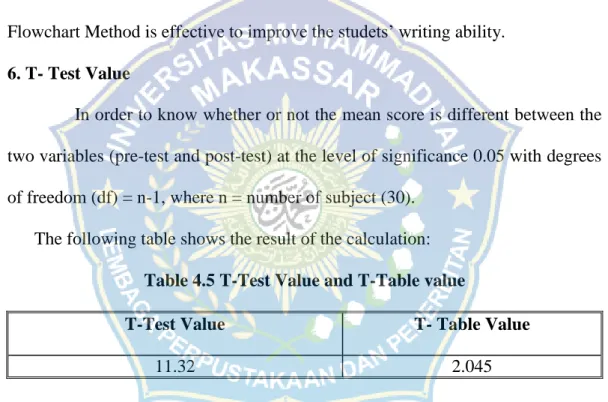
Table 4.5 T-Test Value and T-Table value
T-Test Value T- Table Value
11.32 2.045
Table 4.5 above shows that t-table (2.045) was smaller than t-value (11.32) of the students’ Writing achievement. So, it can be concluded that there is significance difference between the results of the student’s pre-test and post-test.
7. Hypothesis Testing
To find out degree of freedom (df), the researcher used the following formula:
df = N - 1 = 30 - 1 df = 29
For the level of significance (P) = 0.05 and degree of freedom (df) = 29, then the value of t-table = 2.045 and t-test = 11.32. Thus the value of t-test is greater than t-table (11.32 > 2.045).
These findings are used to determine whether or not the hypothesis stated in this research is statically proved. As being stated in previous chapter that the null hypothesis (H0) is rejected when the t-test value is greater than the t-table value and the alternative hypothesis (H1) is accepted. Therefore, based on the result above where the t-test value is greater than the t-table value (11,32>2,045).
It means that the hypothesis “The use of Flowchart Method effectively improves the students’ Writing ability” is accepted.
From the analysis above, the researcher concluded that there is a significance difference between pre-test and post-test in the use of Flowchart Method in improving Writing ability. In other words, Flowchart Method is effective to be used in improving Writing ability.
B. Discussion
The discussion section deals with the interpretation of the findings from the result of statistical analysis and the researcher’s note during the classroom interaction.
1. Students’ Writing Vocabulary
The student’s Writing Vocabulary was classified poor in pretest although the result of post-test showed that the student’s Vocabulary was increased. It can be concluded that flowchart method can help the students to improve their Writing Vocabulary.
The researcher found that there were some factors influenced the student’s Writing Vocabulary, included their mother tongue, mispronunciation, and word choice. The main component that influences students in Writing performance was their pronunciation, grammar and word choice. The example of errors in word choice were:
- This is unforgetable moment for me…should This is my unforgetable moment…
- Expect that . . . should be beside that . . .
During the treatment, the researcher gave some interesting topics to be discussed by the students. Some of them are about their unforgetable moment,embarassing moment, their daily activity and etc.
2. The students’ Writing Organization
Almost students had enough vocabulary that could be use in Writing, but they were influenced by their organizing in writing. Besides that, low achievement of the students’ Writing Organization sometimes caused by the topics which is unfamiliar for them.
In pre-test, the researcher found that most of students were not fluently in Writing when they have not prepared for the topic discussion. After treatment, the students could express their ideas related with the given topics. The improvement of students’ writing organization showed in Table 4.2. It can be concluded that using Flowchart Method in teaching and learning process can helps the students to Writing relax and more cheerfull. So that, students did not make many unnatural filters or pauses. They arranged the word and say it fluently.
3. Writing Skill and Flowchart Method
Flowchart method is used to students to work in cooperative groups to help the teacher to overcome to the problem in teaching English.. For instance, students who study English find some difficult questions. Furhtermore, we can see the type of learning and teaching activities in the class by using Flowchart Method as follow that the learners may engage in various group discussions, such as small group discussion of a topic that will be presented to the students after discussion.
The students’ Vocabulary in Writing involves acceptable pronunciation, correct grammar, and appropriate word choice were developed significantly by using Flowchart Method. This method makes the students enjoyable in learning and can make improve their skill where they can express their ideas and share
each other. It is supported by the data analysis in Writing test students to improve their Writing ability.
In teaching Writing ability the students needs adequate vocabulary mastery before delivering opinion. Most of them are reluctant to speak out about the topic because their weakness in vocabulary in this case the word choice is one of problem.
The researcher also gave the students grammar explanation for their better understanding. In the first meeting the grammar understanding of the student is limited. They could not arrange sentences in to good order and limited in using tenses, therefore the researcher gave some basic structure.
The result of the data analysis through the Writing test showed that the students’ Writing achievement by Flowchart Method improves significantly. It was indicated from thescore of all students based on the pre-test was 1316 and the total score of all students after based on post-test was 2033. Before treatment most of them were categorized in fair score. But after using a treatment, their score were improve significantly. And most of them were categorized as good score. It was proved that Flowchart method is a good way to be used to improve student’s ability in Writing English.
CHAPTER V
CONCLUSION AND SUGGESTION
This chapter consists of two parts. The first part is conclusion, based on the data analysis and findings in the previous chapter. The second part presents some suggestions based on conclusion.
A. Conclusions
1. Related to the previous chapter showed that the mean score of student’s writing ability in terms of in pre-test was 4,63and the mean score of post- test was 7,1. It means that the means score of post-test was higher than pre-test in term of vocabulary. The researcher concluded that there is significance difference between the pretest and posttest in improving the students’ writing ability. This means that learning by Flowchart method could improve the students’ writing ability.
2. The mean score of student’s writing ability in terms of organization in pre- test was 4,12and the mean score of post-test was 6,36. It means the score of post-test was higher than pre-test in term of vocabulary. The researcher concluded that there is significance difference between the pretest and posttest in improving the students’ writing ability. This means that learning by Flowchart method could improve the students’ writing ability.
B. Suggestions
Based on the result of data analysis and the conclusion above, the researcher put forward to suggestion as follows:
1. It is suggested for the English teachers to use Flowchart Method as a strategy in learning process to improve writing ability of students.
2. It is suggested for the English teachers to find some new ways those can prevent the problems usually appear during the teaching English process, especially related with the students’ interest in learning and their interest to improve their writing performance. It is aim to creating effective and good classroom atmosphere.
3. The materials of writing should be appropriate with the students’ environment, in order to make them easy to express their ideas.
4. The students should be stimulated in writing trough Flowchart Method as one way to improve their writing ability.
BIBLIOGRAPHY
Adelstein, M.M.E. Pival J.G. 1980. The Writing Commitment 2nd. New York.
Alam. 2006. Developing the Writing Ability of the Second Year Students of MAN Model Makassar through Community Language Learning (CLL) Method.
Thesis S1, UIN Alauddin Makassar.
Amin, Syarif. 2007. Using the Students’ Error for Teaching in Improving the Writing Abilty of the Fourth Semester Students of English Deparment of Tarbiyah and Teaching of Alauddin State Islamic University Makassar.
Thesis S1, UIN Alauddin Makassar.
Arnaydet, Martin. 1981. Paragraph Development. New Jersey: Prentice Hall Inc.
Bambang, Sugeng and Nazr, Sainah. 2004. Functional English for Senior High School. Solo: PT Tiga Serangkai Mandiri.
Bram. 1995. Techniques in Teaching Writing. New York.
Bram, Bark. 1995. Write Skill, Improving Writing Skills. Yogyakarta: Kamision Publisher.
Daila, Sari. 2004. Improving Writing Ability at the Third Year Students of MAN Wajo through Mind Mapping. Unpublished Thesis FBS UNM.
Fitriani. 2007. Using Synergetic Teaching Strategy to Improve the Writing Ability of the Third Year Students of MAN 1 Makassar. Thesis S1, UIN Alauddin Makassar.
Gay, L.R. 1981. Educational Research. Second Edition. Merill Publish Company.
Heaton, J.B. 1984. Writing English Language Test. Singapore: Banwash Press Ptc., Ltd.
Indrayani, Mastira. (2007) Improving Students’ Ability to Write Descriptive Paragraph by Using Photographs. Thesis S1, UNM Makassar
Irwans. 2006. The Ability at the Students to Use Conjunction in Paragraph Writing. Unpublished Thesis FBS UNM.
Jacobs. et. al. 1981. Testing ESL Composition Profile: A Practical Approach.
Rowley Mass: Newbary House Publisher Inc.
Joharr, Abdul Rajab. 1999. Extensive Reading. Makassar.
Kroma. 1998. Action Research in Teaching Composition. Washington D.C.:
Forum. Vol. XXVI. No.1.
Lannon, John. 1992. The Writing Process: A Concise Rhetorik 4th Edition. New York: Harper Collins Publisher Inc.
Marwah, M. 2002. Stimulating Students to write an Essay by using Outline.
Unpublished Thesis FBS UNM.
Murniati. 2006. The Ability of the Students of SMP Negeri 3 Makassar to Use Correct Punctuation. A thesis S1 UNM
Noni, Nurdin. 1984. The Writing Ability of the Sixth Semester Students of the English Department of Tarbiyah Faculty of IAIN Alauddin Ujung Pandang. Unpublished Thesis, FBS IKIP Ujung Pandang.
Rahman, A. 2005. Statistic. Makassar.
Saraka. 1988. From Paragraph to Essay. Jakarta: Depdikbud.
Sulaeman, 2009 Using Guided Questions to Improve the Students’ Ability to Write Narrative Paragraph. An public thesis.
Supriadi. 2008. Developing the Students’ Ability in Writing Paragraph Through Quickwriting at the Third year Students of MA Syekh Yusuf Sungguminasa. Thesisi S1 UIN Alauddin Makassar.
Supriandi. 2004. Developing Students Writing Ability through Topic of Interest.
Thesis FBS. UNM.
Tatang, SM. 1988. Writing Paragraph and Essays through Model and Exercises.
Jakarta: Depdikbud.
Temple, Charles A., Nathan, Ruth., Burris, Nancy., Temple, Frances. 1982. The Beginning of Writing. Second Edition. Copyright by Allyn and Bacon, Inc.
United States of America.
Thaib, Nainah. 2002. Using Questions to Guide the Second Year Students of SLTPN 2 Makassar to Write Simple Paragraph. Unpublished Thesis FBS UNM.
Trimmer and Summer. 1983. Writing with a Purpose (8th edition). Boston:
Houghton Miffin Company.
Ummi, Hani. 2001. The Use of Photograph as a Device in Teaching Descriptive English Writing. Unpublished Thesis FBS UNM.
No. Nama Siswa A F Jumlah Score Classification
1 AB01 4,8 4 8,8 44.44 Fair
2 AB02 6,11 5 11,11 55.56 Fair
3 AB03 3,8 4 7,8 38.89 Poor
4 AB04 3,6 3 6,6 33.33 Poor
5 AB05 4,8 4 8,8 44.44 Fair
6 AB06 5 5 10 50.00 Fair
7 AB07 6,2 6 12,2 61.11 Good
8 AB08 6,11 5 11,11 55.56 Fair
9 AB09 3,3 3,3 6,6 33.33 Poor
10 AB010 2,4 2 4,4 22.22 Poor
11 AB11 5 5 10 50.00 Fair
12 AB12 2,55 3 5,55 27.78 Poor
13 AB13 4,8 4 8,8 44.44 Fair
14 AB14 4,59 3,2 7,79 38.89 Poor
15 AB15 4,59 3,2 7,79 38.89 Poor
16 AB16 4,8 4 8,8 44.44 Fair
17 AB17 5,11 6 11,11 55.56 Fair
18 AB18 6 4 10 50.00 Fair
19 AB19 3,79 4 7,79 38.89 Poor
20 AB20 7,2 5 12,2 61.11 Good
21 AB21 3,6 3 6,6 33.33 Poor
22 AB22 2,55 3 5,55 27.78 Poor
23 AB23 4,88 4 7,8 44.44 Fair
24 AB24 2,55 3 5,55 27.78 Poor
25 AB25 4,8 3 7,8 38.89 Poor
26 AB26 4,8 3 7,8 38.89 Poor
27 AB27 5 5 10 50.00 Fair
28 AB28 3,8 4 7,8 38.89 Poor
29 AB29 7,44 7 14,44 72.22 Good
30 AB30 5,11 6 11,11 55.56 Fair