Leonard Felix Hutabarat Universitas Kristen Indonesia
ABSTRACT
The development of international politics due to the Russian-Ukrainian conflict has caused international political instability and pressure on agricultural products and the energy sector in the world. Indonesia’s leading export commodity, under discriminatory pressure from the European Union, also has economic implications due to the Russian-Ukrainian war. Disruption to the world’s vegetable oil supply chains, the urgent need for food security, and the impact on achieving the goals of sustainable development that have been agreed upon so far make Indonesia seek to use the existing narrative through economic diplomacy. This condition is also related to Indonesia’s vegetable oil diplomacy as one of the foreign policy instruments. Therefore, economic diplomacy regarding Indonesian vegetable oils is also part of Indonesia’s national interest.
This article uses qualitative methods with a descriptive-analytical type on how Indonesia uses the narrative of sustainable development issues in the context of Indonesian vegetable oils to achieve Sustainable Development Goals 2030, including instruments of economic diplomacy in realizing Indonesia’s national interest in Indonesia’s vegetable oil diplomacy.
Keywords: economic diplomacy, Indonesia, foreign policy, vegetable oil, SDGs 2030
Perkembangan politik internasional akibat konflik Rusia-Ukraina telah menimbulkan dampak tidak hanya instabilitas politik internasional, namun juga tekanan terhadap komoditas produk pertanian maupun sektor energi di dunia. Komoditas ekspor unggulan Indonesia yang selama ini mendapatkan tekanan yang bersifat diskriminatif dari Uni Eropa juga memiliki implikasi ekonomi akibat terjadinya perang Rusia-Ukraina. Gangguan terhadap rantai pasok minyak nabati dunia dan sangat diperlukan tersedianya ketahanan pangan serta dampak terhadap pencapaian tujuan dari pembangunan berkelanjutan yang telah disepakati selama ini, menjadikan Indonesia berupaya menggunakan narasi yang ada melalui diplomasi ekonomi. Hal ini juga terkait dengan diplomasi minyak nabati Indonesia sebagai salah satu instrumen kebijakan luar negeri. Diplomasi ekonomi berkenaan dengan minyak nabati Indonesia juga merupakan bagian dari kepentingan nasional Indonesia. Artikel ini akan menjelaskan dengan metode kualitatif dengan jenis deskriptif analitis bagaimana Indonesia menggunakan narasi pembangunan berkelanjutan dalam konteks minyak nabati Indonesia guna mencapai Sustainable Development Goals 2030, termasuk instrumen diplomasi ekonomi dalam mewujudkan kepentingan nasional Indonesia dalam diplomasi minyak nabati Indonesia.
Kata-kata Kunci: diplomasi ekonomi, Indonesia, kebijakan luar negeri, minyak nabati, SDGs 2030
The global supply chain disruption that has started since the US- China trade war will continue. The COVID-19 pandemic and the Russia-Ukraine conflict have expanded today’s global supply chain crisis. In addition, lockdown policies adopted by several countries, especially the People’s Republic of China (PRC), have caused production delays, logistical disruptions due to ports that cannot operate optimally, and reduced human resources. At least five export categories are affected by global supply chain disruption:
agricultural products, chemicals, manufacturing, metals, and oil and gas (McKinsey 2022). Some factors to be blamed that cause these situations are a decrease in production and a large number of closures of manufacturing plants, low purchases of goods sourced from Russia as a result of economic sanctions or sanctions imposed by the company, and logistical disruptions that occur in air, sea and land and rail transport.
Global supply chains that continue to experience pressure impact Indonesia, especially in meeting domestic wheat and fertilizer materials needs. Indonesia is one of the largest wheat importers in the world. According to Badan Pusat Statistik (BPS) data, in 2021, Indonesia’s wheat imports reached 11.48 million metric tons with a value of USD 3.3 billion. The most significant imports came from Australia (40.90%), Ukraine (26.8%), and Canada (16.7%). Wheat has strategic value for flour supply to support the food industry in Indonesia. Based on the Indonesian Wheat Flour Producers Association(APTINDO) data, flour is needed mainly for Micro, Small, and Medium Enterprises (MSME) and household businesses (71%: bread, retail, wet noodles, traditional cakes, biscuits, cakes, pancakes, pastries) and the rest for large industries (29%, including instant noodles). In the fourth quarter of 2021, the Government of Indonesia imported 300 thousand metric tons of wheat as an alternative to raw materials for animal feed amid rising corn prices.
Regarding fertilizers, Indonesia is the 10th largest fertilizer importer in the world, with a total share of imports to total world imports of 2.31%. The source of Indonesian fertilizer imports mainly comes from Canada, China, Russia, Belarus, and Vietnam.
In addition, Indonesia is also listed as the largest importer of one of the fertilizer materials, namely phosphate. Indonesia’s five largest
phosphate exporting countries are the PRC, Thailand, Germany, France, and the United States (US). In responding to the current global supply chain situation, Indonesia needs to continue seeking efforts, including finding alternative sources of supply, keeping the Indonesian economy open and not taking protectionist measures, and capitalizing on the situation for a more viable energy transition and food security schemes. In addition, looking at the challenges of world supply chain disruption and achieving the resilience of Indonesia’s supply chain can also maximize existing opportunities.
For example, the production vacuum caused by the Russian- Ukrainian war could allow Indonesian commodity production to enter the global supply chain. Major commodities such as crude palm oil (CPO) or Indonesian vegetable oil, coal, and nickel can be commodities that can compete in the global supply chain. The nickel production shortage, the European Union (EU) and Japan’s policies to stop importing coal from Russia, and the need for CPO as a substitution of reduced sunflower seeds from Ukraine will be good opportunities for Indonesia to enter the global market.
The above conditions and developments in the international political economy require complementary academic perspectives to enrich the study of foreign policy and economic diplomacy.
Economic diplomacy, indeed, is not a new phenomenon. Since the beginning of nation-state interactions, economic interests have driven the developing relations between countries. Often the economic dimension does not receive attention from students who study diplomacy traditionally. Many governments prioritize commercial diplomacy and view diplomacy as contributing to national welfare and economic security. Several world crises and global problems related to food, energy, environment, and global finance and economy, forced countries to influence international regimes and institutions in the global order (global governance);
thus, this condition requires understanding. This impact is equally crucial in political science, where economic and commercial diplomacy’s low politics implications are inseparable from global political relations (Masoed 1994; Hadiwinata 2017).
Economic diplomacy is not only about commercial and economic interests in a narrow sense. Economic diplomacy involves broader national interests, political and strategic dimensions,
and economics (Viotti & Kauppi 1993; Wæver & Newmann 1997;
Griffiths 1999). The government designs and conducts economic diplomacy to promote national economic welfare and economic security (Sabaruddin 2017). Economic diplomacy simultaneously became part of foreign policy (Moons & van Bergeijk 2017).
This article explains the framework and concepts of economic diplomacy to understand economic diplomacy activities and its objectives in the context of Indonesian vegetable oil diplomacy.
The state is not seen as the only actor but as the primary actor in economic diplomacy. The conceptual framework of economic diplomacy will be seen from the purpose of business or power in economic diplomacy. Economic diplomacy has become part of foreign policy, and foreign policy analysis increasingly shows the interrelationship between a country’s economic and foreign policy interests (Hutabarat 2005; Lestari et al. 2020; Killian 2022).
Based on the conditions and developments in the international political economy above, especially the Russian-Ukrainian conflict, the impact on Indonesia’s export commodities, especially vegetable oil, makes Indonesia use vegetable oil diplomacy as part of Indonesia’s foreign policy instruments in the future. This article will discuss how Indonesia should use the narrative of sustainable development in the context of Indonesian vegetable oils in achieving the SDGs 2030, including economic diplomacy instruments in realizing Indonesia’s national interest in Indonesia’s vegetable oil diplomacy.
Economic Diplomacy
In explaining Indonesia’s vegetable oil diplomacy in the context of the impact on Indonesia’s leading export commodities due to the Russian-Ukrainian conflict, a shared understanding of the concepts in economic diplomacy is needed. Furthermore, a shared understanding of economic diplomacy will explain why Indonesia uses certain narratives in vegetable oil diplomacy to realize Indonesia’s national interests in the economic field at the bilateral, regional, and multilateral levels. Taking into account that the nation-state is not the only actor in international relations, yet the nation-state is a central actor in economic diplomacy, within the framework of state-centric realist thinking, economic diplomacy is
defined as an attempt to achieve economic security in international anarchist politics (Lee and Hocking, 2010).
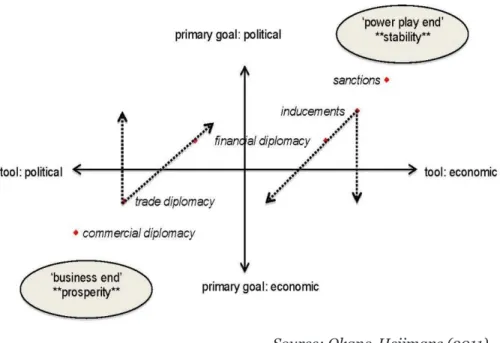
Figure 1 Economic Diplomacy
Source: Okano-Heijmans (2011) Suppose economic security consists of a country’s economic welfare and political stability. In that case, economic diplomacy carried out by a government involves many economic and political instruments. In other words, economic diplomacy includes business-end and power-end, and all economic diplomacy efforts can be between these two aspects (see Figure 1). From the chart, it can be seen that the goals achieved by a country lie in balancing national interests, on the one hand, economic prosperity as well as political stability, and national security on the other. It also shows that economic power has different forms of power. According to Berger (2010), economic power is one of the most basic and most important sources of soft power, but it also supports military power.
While Berridge and James (2003) define economic diplomacy as economic policy and diplomacy that uses economic resources,
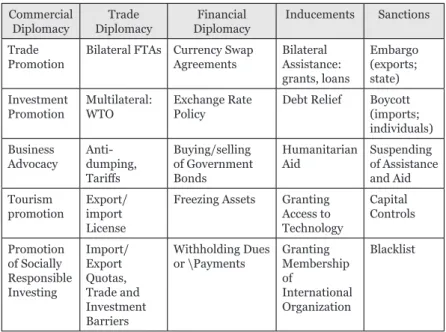
either as rewards or sanctions, to achieve specific foreign policy objectives, in addition, Gilpin (1987; 2020) states that the essence of economic diplomacy is to conduct and direct political and economic activities. Based on the conceptualization and definition above, Okano-Heijmans (2013) describes the forms from economic diplomacy to commercial diplomacy, trade diplomacy, financial diplomacy, inducements, and sanctions. The activities carried out in various forms of economic diplomacy can be seen in the following table.
Table 1 Economic Diplomacy
Commercial
Diplomacy Trade
Diplomacy Financial
Diplomacy Inducements Sanctions Trade
Promotion Bilateral FTAs Currency Swap
Agreements Bilateral Assistance:
grants, loans
Embargo (exports;
state) Investment
Promotion Multilateral:
WTO Exchange Rate
Policy Debt Relief Boycott (imports;
individuals) Business
Advocacy Anti- dumping, Tariffs
Buying/selling of Government Bonds
Humanitarian
Aid Suspending
of Assistance and Aid Tourism
promotion Export/
import License
Freezing Assets Granting Access to Technology
Capital Controls Promotion
of Socially Responsible Investing
Import/
Export Quotas, Trade and Investment Barriers
Withholding Dues
or \Payments Granting Membership of
International Organization
Blacklist
Source: Okano-Heijmans (2013) Today, a country’s interaction with other countries through its foreign policies is almost inseparable from economic diplomacy.
Economic diplomacy is an inseparable part of a country’s foreign policy in its international relations with other countries or regional and multilateral organizations (Dinnata & Nuraeni 2020). Many countries also have those interactions with regional organizations in other regions in the context of economic diplomacy (Hutabarat 2018; Haryono 2019). For example, in developing non-traditional markets, Indonesia also explores cooperation with countries of the
Pacific Alliance in the South American region, including efforts to establish economic cooperation through a Comprehensive Economic Partnership Agreement (CEPA) with Chile. Indonesia’s foreign policy in the 2020-2024 period also prioritized economic diplomacy (Ministry of Foreign Affairs 2020).
Economic diplomacy studied through international relations is mainly concerned with issues of high politics and issues related to national security, where national interests are primarily defined in the context of national stability. Baldwin (1985) introduced the study of economic statecraft, which refers to understanding economics as a political goal. The power-play or high politics element explains why political scientists discussing the relationship between international politics and economics use economic statecraft or discuss it without linking to a concept.
In this context, attention is often directed to sanctions, whether negative or positive, and discussions related to economic statecraft are more about the relationship between foreign policy on the one hand and trade or investment on the other. The focus of attention on economic diplomacy can be seen in three areas—first, a concept aimed at improving understanding of the relationship between the international economy and foreign policy. Second, studies address the practice of economic diplomacy, such as development assistance and normative trade policies of investment in a particular country. Third, international aspects or laws, including legal institutions, deal with international trade.
International political economy primarily pays attention to the political forces shaped by economic interactions, including the impact of economic interactions on political structures. Observers of the international political economy see economic diplomacy as involving a mixture of foreign policy objectives and commercial efforts, and commercial objectives and political efforts in a particular environment where economic diplomacy is run by a country (Rana 2012). The focus of this study is trade diplomacy and commercial diplomacy. Trade diplomacy addresses trade liberalization and trade power. An example is trade and economic diplomacy (Woolcock 2012a; Woolcock 2012b). Meanwhile, commercial diplomacy discusses government programs involving trade finance, trade facilitation, and trade missions. Discussing
trade, investment, and financial negotiations is part of this category.
Since the 1980s, diplomacy and international negotiations have concerned international relations academics. Since 1970 concerning the more international organization developing in the world, the nation-state government realized the increased importance of IO’s and their roles in achieving the nation-state’s interests in its diplomacy. The constructivist perspective sees the importance of ideas and processes in negotiation in many meetings of international organizations. Furthermore, agenda and assumptions in neo-realist and neo-liberalist theories see the same important roles of international organizations to fulfill national interests in international organizations and international relations. The main driver of this is the character of diplomacy as an institution that contributes to the order in the international community, in addition to the balance of power, international law, and war and the great powers (Bull 2002). In parallel with this development, since the 1970s, in the study of international relations, there have been many developments in international organizations. The analysis in the category of economic diplomacy is described by Lee and Hocking (2010), and Bayne and Woolcock (2007), and the emphasis is on the form of commercial diplomacy by Lee and Hudson (2004). Other categories narrow the discussion on aspects of negotiations, such as discussions related to the General Agreement on Tariffs and Trade (GATT) (Lee and Hudson 2004). Bayne and Woolcock (2007) state that economic diplomacy is part of the international political economy. International political economy academics see institutional interests in world trade, while economic diplomacy academics will discuss why and how governments negotiate tariff-cut agreements.
Indonesia’s diplomacy efforts seem to have experienced exciting developments in financial diplomacy and trade and commercial diplomacy in recent years (Nugroho 2021). Various initiatives and negotiations are carried out in trade negotiations bilaterally, regionally, and multilaterally. Some of the trade negotiations that have been carried out can be seen as conveyed through the website of the Ministry of Trade. Indonesia also carries out various trade negotiations with various partners at this time, including several
explorations of trade negotiations with many countries and in the context of the Association of Southeast Asian Nations (ASEAN).
In addition, Indonesia continuously adjusts its foreign policy instruments, including economic diplomacy, due to the constantly changing international political development, mainly due to the Russian-Ukrainian conflict.
Impact of the Russian-Ukrainian Conflict on Indonesian Vegetable Oil Export Commodities The occurrence of geopolitical conflicts in international politics today, such as the conflict between Russia and Ukraine in early 2022, has significantly impacted many countries related to the supply of food, fertilizer, energy, and other trade commodities worldwide. World vegetable oil, for example, as a global trading commodity with an important role, also experiences supply disruptions and impacts price volatility, which tends to rise.
Before the Russian-Ukraine conflict, rising vegetable oil commodity prices were influenced by various things such as weather, drought, labor issues, regulations for biofuels, as well as the impact of COVID-19 restrictions. However, the Russian-Ukrainian conflict exacerbated the price of vegetable oil commodities to a significantly increase. In addition, using other vegetable oil alternatives also has its costs with clinical trial requirements and other requirements that increase production costs. Vegetable oil is one of the commodities with high global demand. This demand will increase as the world’s oil needs increase globally. However, amid the world’s increasing needs, vegetable oils are experiencing various challenges, such as discriminatory policies and negative campaigns. Some policies that discriminate against vegetable oils are based on various issues, such as health, environment, and socio-culture.
There is discrimination against contaminant standards in the European Union (EU) against palm oil compared to other vegetable oils. In addition, there is a ban on using Vanaspati Ghee, a primary ingredient made from palm oil by the Punjab Government in Pakistan, because palm oil is considered unhealthy. Furthermore,
some countries implement discriminatory regulations against palm oil, such as the Due Diligence policy by the European Union and the United Kingdom and the Forest Act policy by the United States. In addition, there are also allegations related to violations of labor rights, exploitation of child labor, and conflicts over land grabs with indigenous peoples. Likewise, negative campaigns (black campaigns), such as labeling “Palm Oil Free” in various food products in Europe, and other negative campaigns were published through news, blogs, and social media. Such discriminatory policies and negative campaigns tend not to be based on facts and empirical evidence, using specific issues narrowly. They are often carried out as an attempt at protectionism over similar products produced by the country. This situation has created a mistaken opinion of palm oil. Therefore, it is necessary to mainstream sustainable vegetable oils (SVO) narratives that are fact-based and evidence-based and use 3 (three) aspects of the SDGs: economic, social, and environmental, in an inclusive, holistic, and non- discriminatory manner. This condition makes Indonesia have to carry out a series of economic diplomacy activities to protect Indonesia’s national interests in the face of various accusations or restrictions, including non-tariff trade barriers that are likely to be imposed on Indonesia at present and in the future.
The crisis between Russia and Ukraine has also increased vegetable oil prices by an average of 30%. Sunflower oil is the vegetable oil that has been directly affected by the crisis, with an increase in prices reaching USD 2,400/ton in March 2022 (International Food Policy Research Institute 2022). Ukraine and Russia are the world’s largest exporters of sunflower oil. Ukraine contributed 48.5%, and Russia accounted for 21.1% of world exports. Therefore, the crisis has pushed vegetable oil prices significantly higher, triggering a worldwide trade policy response that further limited supply and raised prices (Trading Economics 2022).
Indonesian Vegetable Oil Economic Diplomacy as a Foreign Policy Instrument
To address Indonesia’s economic diplomacy on the issue of vegetable oil, especially related to palm oil, the approach put
forward is to actively voice a narrative that focuses on an inclusive and non-discriminatory approach. Indonesian vegetable oils are claimed to follow sustainable principles based on the commitment to the international community in accordance with the Sustainable Development Goals (SDG) 2030. Economic diplomacy in this regard promotes an inclusive, non-discriminatory approach to all vegetable oils, referring to its main multilateral agreements. Those agreements are (1) the 2030 Agenda for Sustainable Development, an international agreement on sustainable development targets expected to be met before 2030, and (2) the Paris Agreement, an international consensus that requires state parties to reduce the risks and impacts of climate change, including the reduction of greenhouse gas emissions globally. In particular, the issue of climate change is covered in SDG number 13.
The main thing to note here is the balance of three aspects of sustainable development: economic, social, and environmental.
In this connection, there have been researching results based on facts and empirical evidence regarding the contribution of 20 (twenty) types of vegetable oils in the world (based on the list of the Food and Agricultural Organization/FAO) to the achievement of the SDGs with a comparative analysis approach. There are 20 (twenty) types of vegetable oils studied (1) Castor Oil Seed, (2) Coconut Ol, (3) Cotton Seed, (4) Groundnut, (5) Hemp Seed, (6) Jojoba Seed, (7) Kapok Fruit, (8) Linseed, (9) Melon Seed, (10) Mustard Seed, (11) Oil Palm, (12) Olive, (13) Poppy Seed, (14) Rapeseed, (15) Safflower seed, (16) Sesame Seed, (17) Shea Nut, (18) Soybean, (19) Sunflower Seed, and (20) Tung Nut (Ministry of Foreign Affairs, 2021). From the study results, information was obtained about the highest aspects of achieving each SDGs.
Figure 2
The contribution of vegetable oil to the achievement of the SDGs
Source: Ministry of Foreign Affairs (2022) SDG 1 (No Poverty): palm oil is the highest contributor, increasing food security by 80%, boosting a country’s average income, and reducing poverty by 20-30%. Data shows that palm oil contributes 3.5% of Indonesia’s GDP growth and creates 7.5 million jobs in Indonesia.
Figure 3
The contribution of vegetable oils to the achievement of SDGs 1
Source: Ministry of Foreign Affairs (2022)
SDG 3 (Good Health and Well-Being): Rapeseed oil is an ideal vegetable for global health and well-being. Rapeseed oil reduces air pollution as it produces only 3.77 kg of greenhouse gas emissions globally. Rapeseed oil can also provide 13 calories per person per day to support the healthy lives of citizens.
Figure 4
The contribution of vegetable oils to the achievement of SDGs 3
Source: Ministry of Foreign Affairs (2022) SDG 7 (Affordable and Clean Energy): The most promising vegetable oil in providing renewable energy sources is palm oil, with a biodiesel productivity ratio of 4,736.00 liters per hectare globally and a greenhouse gas emission rate from palm oil of 7.32 kg of greenhouse gas emissions globally. This condition makes palm oil a substitute fuel provider for conventional diesel because it has a high ratio of biodiesel productivity and low greenhouse gas emissions so that it can supply renewable fuels and affordable clean energy.
Figure 5
The contribution of vegetable oils to the achievement of SDGs 7
Source: Ministry of Foreign Affairs (2022) Based on the data presented above, it is known that, in general, vegetable oil commodities play an essential role in the contribution and achievement of the SDGs, among others, through job creation, increasing GDP, providing a good supply of protein and polyunsaturated fats, reducing greenhouse gas emissions, and supplying renewable energy sources (biodiesel). Therefore, in facing various challenges in the vegetable oil sector, it is necessary to mainstream vegetable oil diplomacy as an effort to encourage holistic, fair, non-discriminatory, and balanced treatment between political, economic, and social aspects within the framework of the 2030 SDGs for all types of vegetable oils, without distinction against certain vegetable oils, such as palm oil. Accordingly, efforts at vegetable oil economic diplomacy have been carried out at various levels, such as bilateral, regional, and multilateral.
The form of efforts to diplomacy the vegetable oil economy at the bilateral level has been carried out through several activities, including socialization, seminars, cooperation with universities at home and abroad, policy dialogue, and discussion. Socialization/
webinars related to Sustainable Vegetable Oil (SVO) sustainable
vegetable oil in collaboration with several Representatives of the Republic of Indonesia, such as the Indonesian Embassy in Stockholm in 2021, the Indonesian Embassy in New Delhi in 2021, and the Indonesian Embassy in Islamabad in early 2022. This activity is carried out by inviting academics and think tanks from local countries to share knowledge about applying sustainable practices for vegetable oil commodities produced in each country.
In addition, this activity is a significant opportunity to establish networks between researchers and academics who are expected to collaborate on research related to SVO.
In addition, the Ministry of Foreign Affairs also conducts dissemination through international seminars such as the 8th Cross- Sector Social Interactions (CSSI) Online Symposium at Panel 16 (Governing Palm Oil and Other Vegetable Oil Crops by the SDGs:
From Fragmented to Integrative Governance), which was held virtually by Wageningen University (WUR) in the Netherlands on June 23, 2022. International seminar activities can be used to convey various results of studies related to the contribution of vegetable oils to the achievement of the SDGs and invite academics present to conduct joint research to enrich further data related to all vegetable oils. It has been done through cooperation with several universities abroad (joint research), such as a joint study between IPB and Wageningen University (Netherlands), which began to be implemented in early 2022. In addition, a series of Policy Dialogues and Discussions were also carried out with countries producing vegetable oil commodities. This activity is not only to share knowledge and best practices regarding the application of sustainability to vegetable oil commodities in the local country but also as an effort to gain support for various initiatives proposed by Indonesia in various international for SVO.
In the regional order, the Joint Working Group Meeting on Palm Oil between the European Union and Relevant ASEAN Member States was held in 2021 and 2022 due to the agreement at the 23rd ASEAN-EU Ministerial Meeting in December 2020. This meeting is a forum for discussion and sharing views on the sustainability aspects of vegetable oils. Matters discussed at the meeting include the mechanism for sharing information about SVO; SVO production challenges; establishing standard views in addressing
challenges comprehensively, holistically, transparently, and non-discriminatory; building a shared understanding of ongoing criteria and certification processes; advancing the framework of the 2030 Agenda as a basis for discussion; and discuss technical cooperation opportunities regarding SVO.
Indonesia’s vegetable oil diplomacy efforts have been carried out at the multilateral level, as was carried out at the Intergovernmental Group Meeting on Oilseeds, Oils, And Fats (IGG OOF), which is an intergovernmental consultation and exchange forum on trends in the production, consumption, trade, and commodity prices of vegetable oils, oils, and fats, including an assessment of the global market situation and its prospects. Furthermore, on the 31st IGG OOF on March 4-5, 2021, an initiative was discussed by Indonesia to compile the Voluntary Guidelines for Sustainable Vegetable Oils in Support of SDGs (VGSVO). This voluntary guideline encourages fair, holistic, non-discriminatory treatment of all types of vegetable oils following the three pillars of the SDGs. In addition, this initiative also aims to encourage the participation of all stakeholders, including small-scale farmers in SVO production.
In addition, the Ministry of Foreign Affairs has also developed a Vegetable Oils and SDGs Dashboard on the Ministry of Foreign portal, an interactive visual medium for accessing vegetable oil data. This dashboard is one of the Ministry of Foreign Affairs’
innovations to encourage vegetable oil economic diplomacy. The data in the dashboard contains indicators of the contribution of 20 (twenty) types of vegetable oils to the achievement of the SDGs following data obtained from the results of a study in 2021 (Ministry of Foreign Affairs 2021) entitled “What Numbers Tell:
Contribution of Vegetable Oils towards Sustainable Development Goals”. This dashboard presents three data menus, namely: first, Global Data in Vegetable Oils, to see the types of vegetable oils produced by countries in the world. Second, SDGs Achievement, to see data related to the contribution of vegetable oils by the SDGs, and thirdly the Comparison of Vegetable Oils, to see the comparison between vegetable oils and the SDGs Goals.
The use of narratives in the context of achieving the 2030 SDGs above and the pressures that occur on the availability of vegetable oil in the world to support global food security and disruptions
to global supply chains will strengthen Indonesia’s vegetable oil economic diplomacy efforts at the global level amidst the pressures and discriminatory efforts that have been occurring on Indonesia’s leading export commodities. Nonetheless, the Russian-Ukrainian conflict has challenged various countries’ efforts to achieve the 2030 SDGs targets. Discriminatory efforts and treatment of any vegetable oil products will not support the world’s current efforts in addressing food safety.
Conclusion
The development of international politics due to the Russian- Ukrainian conflict has caused international political instability and pressure on agricultural products and the energy sector in the world. Indonesia’s leading export commodity, under discriminatory pressure from the European Union, also has economic implications due to the Russian-Ukrainian war.
Disruption to the world’s vegetable oil supply chains, the urgent need for food security, and the impact on achieving the goals of sustainable development that have been agreed upon so far make Indonesia seek to use the existing narrative through economic diplomacy. This condition is also related to Indonesia’s vegetable oil diplomacy as one of the foreign policy instruments. Therefore, economic diplomacy regarding Indonesian vegetable oils is also part of Indonesia’s national interest.
In general, vegetable oils can play an important role, among others, in creating jobs, increasing gross domestic product (GDP), providing a good supply of protein and polyunsaturated fats, reducing greenhouse gas emissions, and supplying renewable energy sources (biodiesel). The various forms of contribution from vegetable oil need to be supported by the role of various parties in mainstreaming vegetable oil diplomacy at various levels, both bilateral, regional, and multilateral. In addition, it is vital to encourage synergy between stakeholders in encouraging sustainability policies based on internationally agreed frameworks, in particular, the 2030 Agenda for Sustainable Development and its SDGs, encouraging a balanced and sustainable approach by focusing on three dimensions of sustainable development, namely
socio-cultural, economic and environmental; promoting the value of inclusivity in developing an oil framework sustainable plant- based, including partnerships between consumers and producers;
strengthening partnerships to advance SVO, including through capacity building, technology transfer, and knowledge transfer in developing and producing SVO and its entire global supply chain;
enhance international cooperation for research and development on SVO; and establishing internationally agreed standardization for SVO based on SDGs at the regional and multilateral levels. The impact of the Russian-Ukrainian conflict on Indonesia’s export commodities, especially vegetable oil, has encouraged Indonesia to approach vegetable oil economic diplomacy in the context of achieving the 2030 SDGs as one of the foreign policy instruments to realize Indonesia’s national interests.
About the Author
Leonard Felix Hutabarat is a senior lecturer at the International Relations Study Program, Indonesian Christian University (Universitas Kristen Indonesia). Leonard completed his bachelor’s degree at Gadjah Mada University in 1996. Leonard continued his master’s degree at the University of Indonesia and graduated in 1999 before continuing his Doctoral degree at the Ecole Des Hautes Etudes Internationales, Geneva which he completed in 2004. The author can be contacted via email [email protected].
References Book or Book Chapter
Baldwin, David A., 1985. Economic Statecraft. Princeton:
Princeton University Press.
Bayne, Nicholas dan Stephen Woolcock, 2007. The New Economic Diplomacy: Decision-Making and Negotiation in International Economic Relations. London: Ashgate Publishing Company.
Berridge, G. R., dan Alan James, 2003. A Dictionary of Diplomacy.
New York: Palgrave.
Bull, Hedley, 2002. The Anarchical Society: A Study of Order in World Politics. New York: Palgrave.
Gilpin, Jean M., 2000. The World Economy in the 21st Century.
Princeton: Princeton University Press.
Gilpin, Robert, 1987. The Political Economy of International Relations. Princeton: Princeton University Press.
Griffiths, Martin, 1999. Fifty Key Thinkers in International Relations. New York: Routledge.
Hadiwinata, Bob S., 2017. Studi dan Teori Hubungan Internasional: Arus Utama, Alternatif, dan Reflektivis.
Jakarta: Yayasan Pustaka Obor.
Hakim, Lukman, et al. (eds.), 2021. The Global South: Refleksi dan Visi Studi Hubungan Internasional. Yogyakarta: Gajah Mada University Press.
Lee, Donna, and Brian Hocking, 2010. “Economic Diplomacy”, in R. A. Denemark & R. Marlin-Bennett (eds.), 2010. The International Studies Encyclopedia. Hoboken: Wiley- Blackwell.
Lestari, Dian, et. al. (eds.), 2020. Dinamika kerja sama ekonomi dan keuangan regional dan bilateral dalam upaya mewujudkan Indonesia maju 2045. Jakarta: Gramedia Pustaka Utama.
Masoed, Mohtar, 1994. Hubungan Internasional: Disiplin dan Metodologi. Jakarta: LP3ES.
Nugroho, Riant, 2021. Foreign Policy: Menuju Kebijakan Luar Negeri Level 4. Jakarta: PT. Elex Media Komputindo.
Okano-Heijmans, Maaike, 2013. Economic Diplomacy: Japan and the Balance of National Interests. Leiden: Martinus Nijhoff Publishers.
Rana, Kishan S., 2012. “Economic Diplomacy: The Experience of Developing Countries”, in N. Bayne and S. Woolcock (eds.), 2012. The New Economic Diplomacy: Decision Making and
Negotiations in International Relations. London: Ashgate Publishing Company.
Viotti, Paul R., and Mark V. Kauppi, 1993. International Relations Theory: Realism, Pluralism, Globalism. London: Macmillan Publishing Company.
Wæver, Ole, and Iver B. Newmann, 1997. The Future of International Relations: Masters in the Making. New York:
Routledge.
Woolcock, Stephen, 2012a. European Union Economic Diplomacy:
The Role of the EU in External Economic Relations. London:
Ashgate Publishing Company.
Woolcock, Stephen, 2012b. “Multilevel Economic Diplomacy:
The Case of Investment”, in N. Bayne & S. Woolcock (eds.), 2012. The New Economic Diplomacy: Decision Making and Negotiation in International Economic Relations. London:
Ashgate. Publishing Company.
Journal Articles
Berger, Thomas, 2010. “Japan in Asia: A Hard Case for Soft Power”, Orbis, 54 (4):565-582.
Dinnata, Hanifa Z., and Nuraeni, Nuraeni, 2020. “Kerja Sama Selatan-Selatan dan Triangular dalam Implementasi Sustainable Development Goals 2030 oleh ASEAN (2015- 2019)”, Padjadjaran Journal of International Relations, 2 (2):187-207.
Haryono, Endi, 2019. “Economic Diplomacy as Indonesian Foreign Policy Orientation in 2015-2018: Challenges and Opportunities”, Global Strategis, 13 (2):49-62.
Hutabarat, Leonard, 2005. Analisis Kebijakan Luar Negeri dalam Studi Hubungan Internasional. Sociae Polites : Jurnal Ilmu Sosial dan Politik, 5 (22):13-22.
Hutabarat, Leonard, 2018. “Diplomasi Ekonomi Indonesia dan
Pasar Prospektif di Kawasan Pacific Alliance: Studi Kasus Meksiko dan Chile”, Jurnal Asia Pacific Studies, 2 (2):161- 179.
Killian, Pantri Muthriana Erza. 2022. “ASEAN’s External Economic Relations and the Limits of Its Economic Diplomacy”, Intermestic: Journal of International Studies, 6 (2):314-334.
Lee, Donna, and David Hudson, 2004. “The old and new significance of political economy in diplomacy”, Review of International Studies, 30 (3):343–360.
Moons, Selwyn J. V., and Peter A. G. van Bergeijk, 2017. “Does Economic Diplomacy Work? A Meta-analysis of Its Impact on Trade and Investment”, The World Economy, 40 (2):336–368.
Okano-Heijmans, Maaike, 2011. “Conceptualizing Economic Diplomacy: The Crossroads of International Relations, Economics, IPE and Diplomatic Studies”, The Hague Journal of Diplomacy, 6 (1–2):7–36.
Okano-Heijmans, Maaike, 2012. “Japan’s New Economic Diplomacy: Changing Tactics or Strategy?”, Asia-Pacific Review, 19 (1):62–87.
Sabaruddin, Sulthon S., 2017. “Grand Design Diplomasi Ekonomi Indonesia: Sebuah Pendekatan Indeks Diplomasi Ekonomi”, Jurnal Ilmiah Hubungan Internasional, 12 (1):69–90.
Reports
Kementerian Luar Negeri, 2020. Rencana Strategis (Renstra) Kementerian Luar Negeri Tahun 2020-2024.
Kementerian Luar Negeri, 2022. What Numbers Tell: Contribution of Vegetable Oils towards Sustainable Development Goals.