CHAPTER I INTRODUCTION
1.1 Background of the Study
A language is a tool of communication that has the function of being significant and organized inside the form of units, which include phrases, groups of words, clauses, and sentences that are expressed either orally or in writing, wherein each party uses them to understand each other. In this world, there are thousands of languages. People talk, share, and express their feeling with language. Nowadays, language diversity and the development of science and knowledge lead people to communicate in another and different languages. Therefore, communicating in two ways should be possible for people. Communicate with foreign languages, for example through translation.
The translation is the result of a word or sound that has been translated, from a language that may not have been understood into a language that is understandable to acquire the understanding and the contents of the context that you want to be delivered. The translation very helps us, either in the form of literature (such as books, novels, magazines, etc) as well as in other forms (such as a dictionary app, its subtitle film, website translation of the song, and so on). The ability to translate foreign language texts is important. Through translating, people can obtain information and knowledge from a variety of source languages, without having to
involve native speakers directly.
The communication tool used to learn a foreign language is named translation. Translation today is an increasingly common human condition, and the rapid rise of electronic media has also served to heighten awareness of the importance of communicating across cultures (Bassnett, 2013). The translation is important in delivering information that uses a different language because it can assist human beings, who don’t understand a source language, to take in the information of a particular material. This indicates that translation refers to the process of translating one language into another. It is also the process of transferring messages and information from one language to another language. In addition, it translates the message from the source language to the target language. As a result, the reader can comprehend the meaning and purpose of the target language.
Translating a text is not an easy thing and can be underestimated. To translate something, translators must use many ways so that the meaning can be conveyed well. The translation process does not permit changes in meaning or message from the source of the translation. However, translators can add, eliminate, or change the word to get the result of the translation accurate, natural, and communicative translations.
In this era, technology has deeply influenced the development of all aspects of life. All things can be done instantly from food even up to doing the job. It can’t be denied, that the development of this technology also affects translation, translating words or sentences can be very practical. In this era, many machine translations can find. Each machine has its advantages and disadvantages. In this era, Google Translate is one of the most widely used machine translations.
Google Translate is a free Google program that can assist in the translation of several languages. Google Translate supports roughly 100 languages. However, certain problems occur while using Google Translate. The use of Google Translate must be considered especially related to the results of the translation. The difference in the results of the use of Google translate could be affected by the number of sentences, words, or sentences that don't draw, and also the words or sentence that is not clear. The human translator is a good solution if errors are found during the translation process because human translator data directs the purpose of a word or sentence better. And a good translation allows the meaning or message to be presented accurately. Errors encountered in Google Translate results can be corrected with human translation results. The errors encountered are usually not too many, but they can change the intent or meaning of the translated text and can change the structure of the text.
Error is an incident on a program that is not expected due to the fault of the user program. When an error occurs, it is predictable and can be handled.
Understanding error, in general, is a 'mistake', but the implications of error can also be grouped according to the use of words, for example, error in the sense of computer science that is not able to display the data (can't proceed to the system next). Another example like in the style of the language day-to-day what if we want to show something to others, the error means: 'unstable, crazy, empty, and others depending on what's become a staple of the problem.
Errors that occur in the translation are connected. This means that one mistake might have an impact on other errors. The same goes for handling the error.
Because the error is interconnected, the way to resolve these errors will also affect other errors.
There were six causes of error, those are lack of knowledge, unable to compose correct grammar of the target language, not consulting with the dictionary, or employing a translation machine. The researchers also added that the causes of translation errors were not always from the translators. The source text also can cause translation errors, such as bad quality of the source text, unclear sentences, and incoherent ideas from the source text (Silalahi et al., 2018). However, translators who have good knowledge, and language skills in both the source and target languages, know how to translate effectively and well without changing the intended meaning. Therefore, the quality of the translation can be measured by the errors that occur. Translators can reveal what is going on in their thought processes or their minds. Errors translation according to Sigrid Kupsch-Losereit in Nord as a violation: 1. The translation function, 2. The coherence of the text, 3. The type of text or the form of text, 4. Linguistic conventions, 5. Culture and conventions, situation-specific and conditions, and 6. the system language. Meanwhile (Solano- Flores et al., 2009) describes that translation error is multidimensional; it is not simply the consequence of defective translation but an inevitable fact derived, among many other reasons, from the tension between translation error dimensions—broad categories of translation errors such as those related to semantics, register, or the construct being measured—and the fact that languages encode meaning in different ways. While it cannot be eliminated, a translation error
can be minimized. From the definition of translation error, when translating, it is necessary to consider not only how meaningful the text is translated, but the translator has to consider many aspects of the context. It's not an easy task for translators. If even your interpreter has difficulty understanding the expressions and sentences, the translation function cannot be fulfilled.
Social Media is media created to facilitate human social interaction using internet connections and web technology. Van Dijk said that social media is a media platform that focuses on the existence of users that facilitates users in doing activities and collaborating. Several types of social media are popular today, one of which is Instagram. Instagram is one of the most widely used social media applications today, where we can share photos, and videos, and can use them to apply unique filters to our photos and videos. When uploading photos or videos, we can add a description or describe the photos or videos. The description of the uploaded photo or video is named a caption. To upload videos or photos, users must have an Instagram account, because only by having an Instagram account, users can access Instagram. In this study, the author analyzes the Folkative Instagram Account.
Folkative Instagram Account is a news, art, culture, and local Indonesian product-focused online media site. Folkative is a collective firm that caters to young people, particularly millennials. Folkative is a media founded by Kenneth William in 2016. Folkative was founded to inspire, enlighten, and express the distinctive cultural voices of Indonesian youth. Folkative carries news about Creative Culture and targets millennials, Indonesian pop culture content around news, arts, culture, and brands that are being loved a lot is Folkative's main weapon.
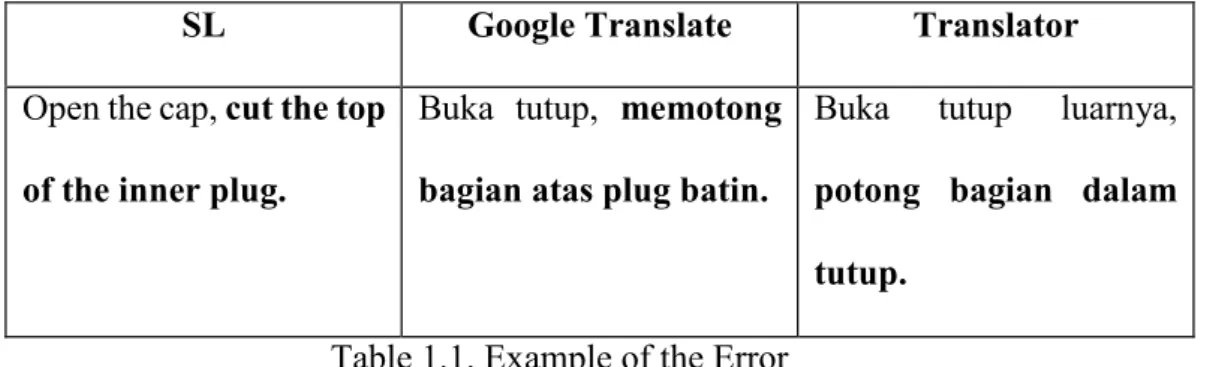
The phenomenon found in this translation case is that several errors occur in the use of Google Translate. A translator is required to compare the translation results to correct the errors. As an example:
SL Google Translate Translator
Open the cap, cut the top of the inner plug.
Buka tutup, memotong bagian atas plug batin.
Buka tutup luarnya, potong bagian dalam tutup.
Table 1.1. Example of the Error
Google Translation results are different from translator results. This will be observed by the author and will be analyzed by the author. The author will find the error from the result of Google Translation by comparing the result with the result of the translator. According to (Mossop et al., 2014), he stated to correct translation errors, you need to make revisions to provide the proper output text. He found that the revision was an act of verifying the correctness of the language, as well as the suitability of text styles for future readers and their use. There are twelve Mossop revision parameters, accuracy, completeness, logic, fact, smoothness, tailoring, sub-language, idiom, mechanics, layout, typography, and organization. An error happened in this section when transferring the SL term with an incorrect translation meaning, so the parameter that is used to analyze the error is the accuracy parameter. The phrase cut the top of the inner plug translated error using word- by-word translation into memotong bagian atas plug batin that caused the whole sentence to incomprehensible to the TL culture. According to the translator, cut the top of the inner plug means potong bagian dalam tutup. Based on the definition
and in comparison, to a translator’s translation, the phrase cut the top of the inner plug should have been translated into potting bagian dalam tutup.
The application of translation applied by Google Translate is not effective so researchers need a human translation. According to Halimah’s research, the correlation between human translation and machine translation in translating procedural text is low. To create better translations, machine translation still requires human intervention (Halimah, 2018). According to the research of Mia Rahmannia and Sulis Triyono, Google Translate results are frequently wrong or contain inaccuracies. The error analysis always occurs in grammar and the use of improper words (Rahmannia & Triyono, 2019).
According to the explanation, the writer picked the translation error as a topic because an error in translation deserves to be studied especially in this era of increasingly sophisticated technology. The technology also affects the translation process becomes easier, there is a lot of machine translation that can be used. The writer chose to research Google Translate because the machine translator is a popular machine translator. Nevertheless, machine translation is not always correct in its translation, and therefore the writer wants to analyze the errors found in Google Translate. The writer also uses a translator, because the translator can better understand and the translation is clearer, and the quality of the translation machine remains much below that of translation. Errors are frequently discovered while translating with Google Translate, hence human intervention is essential to repair the problem. And the author chooses the Instagram Folkative account as the object or source of research data to be able to analyze the caption translation of the uploaded account, which will be translated by Google Translate and translator.
Therefore, the writer wants to analyze the errors that occur in the translation of Google Translate and the human translator from the caption text for the Instagram Folkative account.
1.2 The Problems of the Study The problem of the study are:
1. What are the translation errors applied by Google Translate and human translator?
2. What is the dominant translation error applied by Google and human translator?
1.3 The Objective of the Study The objective of the study are:
1. To find the translation errors applied by Google Translate and human translator.
2. To find out the dominant translation error applied by Google Translate and human translator.
1.4 The Scope of the Study
This study focuses on analyzing translation errors using Google Translate and translators. Some errors was analyzed in this research in translation by Mossop, they are errors in accuracy, completeness error, logical error, errors, in fact, smoothness error, errors in tailoring, sub language errors, idiomatic errors, and mechanic errors, errors in layout, typography errors, organization errors (Mossop et al., 2014). This study will be analyzed errors in the translation of Google Translate through the translation results of the translator.
1.5 The Significances of the Study
The findings of the study are experts to be relevant and significant theoretically and practically.
a) Theoretically, the result of this study is contributions to translation, to develop knowledge about translation errors.
b) Practically a. The Research
For the research, the study’s findings will be very useful to develop or further study translation, especially error translation by Google Translate.
b. The Students
The research would be beneficial to the students in that it will be helped them to understand machine translation, human translator, and errors in translation and enrichment their knowledge about translation.
c. The English Teacher
For the English teacher, the study will be useful to enrich their knowledge and add their knowledge about errors in translation applied by Google Translate (machine translation) and translator. So that, the teacher will be able to better teach their students about translation.
d. The Other Researchers
The findings of this study will be valuable as a reference for the error in translation used by Google Translate and translators.
CHAPTER II
REVIEW OF LITERATURE
2.1 Theoretical Framework
This chapter provides an overview of the review literature and the accompanying explanations. A theory is needed to explain some of the concepts that apply to studying the problem. This theoretical framework which is presented the errors analysis of English to Indonesian translation text on Folkative's Instagram caption using Google Translate and human translator is an example of a concept used in this study. This concept helps authors narrow down the scope of the problem, leading to a better analysis of the selected variables. Several references are provided to avoid misunderstanding the terms used.
2.2 Errors
Errors mean that the learner did something wrong because he or she did not understand or could not utilize the system effectively. Making errors is part of learning a language, this is a natural thing, but it is deadly if it affects the real meaning of the translation. Learners can make errors and mistakes when writing and speaking, even if the language is their mother tongue, a second language.
Learner's errors show the language system you are using (i.e.has) at any stage in the course (if you are using some system that is not yet the proper system, must be repeated).
The fact that students can make errors and can observe, analyze, and classify them to learn about the systems that work within them is an important part of studying learning errors known as error analysis. The learner can recognize the
occurrence of such an error. This indicates that errors are made because each learner has distinct motivations, social backgrounds, and intellects. It has something to do with the learner's linguistic ability. The error is a weakness in the abilities of learners in writing and speaking. This is a section of a conversation or composition that deviates from chosen natural language performance standards. Brown argues, that errors are distinct from mistakes (Brown, 2007).
2.2.1 Errors Analysis
Error analysis is a technique for identifying errors in writing and speaking.
Making errors in the process of learning. Important aspects of learning and getting information on virtually all skills are mistakes, misjudgments, miscalculations, and false assumptions (Brown, 2007).
Brown defines error analysis as the act of observing, analyzing, and classifying deviations from second language rules and revealing the system that the learner operates. Error analysis has a benefit for both teachers and students. It enables teachers to identify the causes of errors and take pedagogical precautions.
For learners, error analysis identifies the kinds of errors encountered by students and warns of mistakes. Therefore, error analysis of the learner's language turns into a crucial want to overcome a question and suggest solutions to the errors themselves.
From all definitions, error analysis is the activity of identifying, classifying, interpreting, or explaining the mistakes someone made when someone speaks or writes, and obtaining information about the common problems faced when speaking or writing. Is executed to get better English sentences. Error analysis is very
important in teaching the learning process. Provide feedback to students as long as they know they are writing the text in the correct grammatical structure. Analyzing mistakes allows teachers to focus on the material that most learners made mistakes.
Teachers can also decide for themselves whether the learning is successful. Finally, he or she can improve his or her teaching abilities by developing organized content.
(Corder, 1974), Corder distinguished five steps in implementing error analysis.
1. Collection of a sample of learner language
Researchers must collect a sample of language learners to give data for error analysis. Researchers can regulate the data in this stage by tightly selecting the samples to acquire.
2. Identification of errors
Error detection involves comparing a learner's sentence with a native sentence in the same context. The researcher can determine which part of the learner’s sentence is different from the "reconstructed version".
3. Description of errors
To describe the difference between a learner's sentence and a native speaker's sentence, the description of errors often employed either a linguistic or surface structural categorization.
4. Explanation of errors
"Explaining errors requires determining their assets to account for why they were produced." Learners make errors as a result of difficulties in accessing
their L2 communication experience.
5. Evaluation errors
Error evaluation is a supplementary level of error analysis. "The important thing is to determine the severity of the various errors and decide which one to direct."
2.2.2 Source of Error
The last stage in analyzing the erroneous language from the learner is to discover the reason for the problem after reviewing the error analysis approaches used to detect faults in the learner's output data for the second lesson. Why does the learner make specific errors? What are the cognitive techniques and personality or style factors that underpin a specific defect? The answers to these questions are somewhat speculative because they must deduce the source from the given facts, but the ultimate worth of a learner's linguistic analysis exists in general. By attempting to pinpoint the source, we may further our knowledge of the cognitive and emotional processes of language system learners and develop an integrated picture of the learner's second language acquisition process.
(Brown, 2007) states that there are four main causes of learning errors, namely:
1) Interlingual transfer
In the early stages, the language system that learners can trust is the mother tongue. Therefore, interference is inevitable.
2) Intralingual transfer
Intralingual transfers are becoming more and more common as soon as learners get part of the new system.
3) Context of learning
This overlaps both types of transfer. For example, the classroom with the teacher and its materials in the case of school learning or the social situation in the case of untutored second language learning. In a classroom context, the teacher or the textbook can lead the learner to make the wrong generalization about the language (Heydari & Bagheri, 2012).
4) Communication strategies
To convey the message, learners can use several techniques such as word coining, paraphrasing, misrecognition, and pre-made patterns. All of these can cause errors.
2.2.3 The Causes of Error
Errors might occur throughout the learning process. It is caused by a variety of reasons. Norrish divides mistake sources into three categories: carelessness, first language interference, and translation.
1. Carelessness
It is often associated with a lack of motivation. Many teachers would confess that even if they lose interest, it is not always the fault of the student. Perhaps the teaching materials and presentation styles don't
suit them.
2. First language interference
Norrish explains that learning a language (native or foreign) is a matter of hobbit education. When attempting to develop a new habit, the old habit can interfere. First language interference is the cause of the error.
3. Translation
That is one of the causes of error. This happens because the student is translating a native sentence or idiom, word by word into the target language. Most students probably make mistakes when translating.
This happens because students translate their native language idioms word by word into the target language. It can be pointed out that Norrish divides the root causes of errors into three groups. It is Carelessness, First Language Interference, Translations by learners or teachers, and methods.
2.3 Translation
The translation is the result of a word or sound that has been translated, from a language that may not have been understood into a language that is understandable to acquire the understanding and the contents of the context that you want to be delivered. The translation very helps us, either in the form of literature (such as books, novels, magazines, etc) as well as in other forms (such as a dictionary app, its subtitle film, website translation of the song, and so on). The ability to translate texts from a foreign language is important. Through translating, people can obtain
information and knowledge from a variety of source languages, without having to involve native speakers directly.
The communication tool used to learn a foreign language is named translation. Translation today is an increasingly common human condition, and the rapid rise of electronic media has also served to heighten awareness of the importance of communicating across cultures (Bassnett, 2013). The translation is important in delivering information that uses a different language because it can assist human beings, who don’t understand a source language, to take in the information of a particular material. This implies that translation is the process of translating one language into another. It is also the process of transferring messages and information from one language to another. In addition, it translates the message from the source language to the target language. As a result, the reader can comprehend the meaning and purpose of the target language.
2.3.1 Types of Translation
Roman Jacobson ( Susan Bassnett, 2002) distinguishes between three types of translations in his article "On the Linguistic Aspects of Translation":
1. Intraligual translation, or rewording (interpreting of verbal messages with the help of additional signs in the same language)
2. Interlingual translation or actual translation (interpreting of verbal signs utilizing some other language)
3. Intersemiotic translation or transmutation (interpreting of verbal signs utilizing signs of nonverbal sign system)
2.3.2 Error in the Translation
To correct translation errors, you need to make revisions to provide the proper output text. Mossop found that the revision was an act of verifying the correctness of the language, as well as the suitability of text styles for future readers and their use (Mossop et al., 2014). If you want to change the nasty wording without changing the author's meaning, you'll need to fix it later. Mossop revision parameters consist of 12 parameters, which can be divided into 3 groups (Kartika Amilia et al., 2020):
1. Group A – the problem of meaning transfer (Transfer) 1. Accuracy
Accuracy is of paramount importance when revising translated text. Mossop explains that the first task of a translator is to make sure that the translation means the meaning of the source (Mossop et al., 2014).
2. Completeness
The completeness of the target text should be by the completeness of the important elements of the source text (Mossop et al., 2014).
2. Group B – the problem of content (Content) 1. Logic
This parameter is generally used to detect gibberish, contradictions in textual claims, impossible temporal or causal sequences, as well as other logical issues (Mossop et al., 2014).
2. Fact
Checking for conceptual, factual, and mathematical errors in the text is not the main task of translators. However, according to (Mossop et al., 2014), translators should not pass these de facto errors, and clients would be thankful if this responsibility is essential. These errors are usually found in the original text, but they can also be introduced incorrectly by the translator.
3. Group C – the problem of language and style (Language) 1. Smoothness
Smoothness is determined by the reader's ability to comprehend the meaning of the text while reading it for the first time at a normal reading pace.
2. Tailoring
According to (Mossop et al., 2014), the translated material should be relevant and easy for the reader to grasp.
3. Sub Language
(Mossop et al., 2014)observed that each text genre has its own set of stylistic possibilities. This language's rhetorical resources (lexical or syntactic).
4. Idiom
According to (Mossop et al., 2014), idiomatic terms are grammatically feasible pairings. In reality, each language uses
5. Mechanics
(Mossop et al., 2014) states that the mechanic handles translation sheets for style manuals or house style.
6. Layout
One of the most crucial aspects of making the text more readable is page layout (readability). Certain changes, such as margins that are neither too broad nor too small, are critical for the reader to read the text. The layout should be consistent as well.
7. Typography
When looking at the font of the text, its size, type, moderation, or consistency, it's all about typography. If the text has too many bold words, or if it has a different uppercase, underlined, italic, size, color, etc., the text will be difficult to read. As a response, translators must be careful to ensure that each feature is employed consistently for the same purpose (Mossop et al., 2014).
8. Organization
Organizations are interested in the ability of readers to track text and find its sections, passages, chapters, and more. Labeling, numbering, page references, captions, presentation features, headers, and footers are organizational features (Mossop et al., 2014).
The authors of this study used Instagram captions from the Folkative account as her data source. This account is a popular account to give updated information on social media that's called Instagram. The goal was to find an
Instagram signing error for the Folkative account and analyze the error based on Mossop's revision parameters. Using the parameters, the author was able to target and observe Google Translate errors.
2.4 Google Translate and Human Translator 2.4.1 Google Translate
Google Translate is a free Google program that can assist in the translation of several languages. Google Translate supports roughly 100 languages. However, certain problems occur while using Google Translate. On its website or application, Google Translate recognizes that even the most advanced machine translation cannot match the quality of a native speaker's language or the abilities of a translator. Google Translate can be one solution for academics to understand the text the whole so that it can be a solution in understanding foreign language texts or literature in foreign languages (Alam, 2020).
The usage of Google Translate must be carefully evaluated, especially concerning the results of the translation. The difference in the results of the use of Google Translate could be affected by the number of sentences, words, or sentences that don't draw, and also the words or sentence that is not clear. If you find any errors during the translation process, we recommend translating the results of the Translator, because translator data directs the purpose of a word or sentence better.
And the translation good is if the meaning or message contained can be delivered correctly.
When translating words, Google Translate employs word-to-word system operations. Google will also add a system that can translate according to specific phrases and idioms so that the translation quality is adjusted. Another choice that Google Translate strives for is statistics-primarily, based on complete translation.
Google Translate revolution began in 2007 with the announcement of a new algorithm based on a statistical model that enhances translation accuracy ( Grajales, 2015). Using statistical translation, Google Translate can learn recommendations and common terms from billions of words in various texts stored in Google Collection texts. However, Google Translate, like a computer, makes mistakes, and sentence/text translations only offer a basic understanding, rather than semantically and grammatically accurate translations.
2.4.2Human Translator
Human translation is a type of translation performed by professionals who have received translation training. They can be comprehending two languages, comprehending the area of content to be translated, comprehending the cultures of two nations, comprehending the translation of the two languages, and comprehending their own interpreter's experience. (Imran, 2003) stated that a trained translation machine will not be able to provide a translation similar to that of an expert interpretation. As a result, rather than machines, the problem here is with the quality, accuracy, and acceptance of translation results. Instead of translating the intended meaning, the translation machine is solely good for
translating words of speech.
As a result, employing translation machines, particularly Google Translate, does not provide the same results as expert translators, and the quality of the translation remains much below that of human translation. Errors are frequently discovered while translating with Google Translate, hence human intervention is essential to repair the problem.
2.5 Folkative’s Instagram Caption 2.5.1 Instagram
Instagram is one of the most widely used social media applications today, where we can share photos, and videos, and can use them to apply unique filters to our photos and videos. Instagram was founded in 2010, Instagram comes from the words 'insta' and 'telegram' which means Instagram can display photos or videos instantly and can share quickly. There are many features in the Instagram application, such as sharing photos and videos, comments and likes, exploring, Instagram Stories, and IGTV.
Instagram has owned the function of sharing photographs and videos since its inception, and it is the core feature of Instagram. Users can add filters to the photos or videos that will be uploaded. In addition, Instagram users can also tag people who are involved in the photos and videos that will be uploaded.
Comments and likes are Instagram feature as our reaction to these uploads.
The number of likes on a feed can affect the level of popularity of the uploads. The wide variety of followers additionally impacts the wide variety of likes and comments. If there are more likes and comments on an upload, then the upload will
enter the popular page provided by Instagram.
Explore features on Instagram are a feature that presents a page with popular photographs and videos that are liked by many people and have a large number of visitors. This feature will also display your photos or videos taken in the location closest to the user. And the contents of this feature are Instagram search results suggestions. In 2015 this feature was developed, and this feature can display something that is trending, and this feature can transform and look for a location.
Instagram story is a feature that was launched in 2016. This feature is a feature that can take photos and videos that can be applied with funny and good filters. This feature is almost similar to Snapchat, where Snapchat also uses funny filters in taking photos and videos. Content uploaded on Instagram stories will disappear within 24 hours. Instagram stories have undergone many developments, wherein features you can add stickers, locations, and effects to photos and videos.
IGTV is an Instagram feature that was introduced in June 2018. All functions available on Instagram can be applied to this feature, such as likes, comments, and adding filters. Videos that can be uploaded in this feature are 10 minutes long and the video file is only 650 MB. However, authenticated or blue tick users can upload up to 60 minutes of video and the video file can be up to 5.4 GB in size.
Instagram users currently reach 1.07 billion active users and 345 million users are aged 25 to 34 years. Instagram is ranked 5th in the order of the most popular
social media.
2.5.2 Folkative
Folkative is a media founded by Kenneth William in 2016. When Indonesian media are racing to become the number one media in this beloved country, Folkative is also keen to see the opportunities that exist. Folkative carries news about Creative Culture and targets millennials, Indonesian pop culture content around news, arts, culture, and brands that are being loved a lot is Folkative's main weapon.
Folkative penetrates various social media, including Facebook, Instagram, and Twitter, and even has its website page. On social media Facebook, Folkative uses Indonesian as the language of information distribution, as well as on Twitter.
However, on Instagram, Folkative chose to use English as the language of information distribution.
Folkative Instagram Account is a news, art, culture, and local Indonesian product-focused online media site. Folkative is a collective firm that caters to young people, particularly millennials. Folkative was founded to inspire, enlighten, and express the distinctive cultural voices of Indonesian youth. Folkative accomplishes this by developing interactive internet material and events relevant to young people.
2.5.3 Caption
Currently, almost all people can access social media, such as Facebook, Instagram, and Twitter. There are many photos and videos uploaded every day.
Social media users must be familiar with the writing under the photos and videos, the writing is called a caption. This caption is written interestingly so that the upload
is liked by many people.
Captions are words that describe photos or videos. In other words, captions are an explanation and description of something. In everyday language, captions are sometimes referred to as brief explanations. Captions also have a general structure, namely: 1. Explaining the context of the image, video, table, or graphic, 2. Short, concise, and clear, 3. Persuasive, 4. Identify the subject of the image or video clearly without explaining it in detail.
Tips in writing captions, first, the caption must match what was uploaded.
Second, the text must be able to add information to the reader. Third, the text should be accurate and get the reader's attention. Fourth, use a language style that matches the picture. Finally, the text must be able to identify the people in the photo or video.
2.6 Previous Research
This chapter provides definitions and theories related to the research object.
In this thesis, the writer uses some of the other early studies which can be found in the following paragraphs.
The first review is related to this study, and the title is “Error Analysis in Translating English from Indonesian of Semester Sixth Student of Cokroaminato Palopo University”. Which has been researched by Muhammad Hasby (2015) (Hasby, 2017) a student of Cokroaminoto Palopo University. Hasby used a descriptive qualitative method in his research. In his research, he has analyzed the students' errors in translating English from Indonesian from several texts of the semester fifth students of Cokroaminoto Palopo University academic year 2014/2015, some of which he discovered are discourse error, syntactic error, and lexical e error (Hasby, 2017). The result of his study will be used as the reference
to analyze errors from English to Indonesian by google translation and human translator in Folkative's Instagram caption.
The second review related to this study is, “Analyzing Indonesian-English Abstracts Translation in View of Translation Errors by Google Translate”, which has been researched by Sependi Napitupulu (Napitupulu, 2017), a student of Methodist University Indonesia. The author uses a descriptive qualitative method in his research. In his study, the author analyzed errors in Google Translate translations of abstract; his parameters are lexicosemantic error, tenses error, preposition error, word order error, distribution and usage of verb group error, and active and passive voice error. He used Keshavar’s (1999) model of error analysis. The result of his study will be used as the reference to analyze errors from English to Indonesian by google translation and human translator in Folkative’s Instagram caption.
The third review related to this study is “ A Study of The Translation of Google translate: An error analysis of the Translation of Eliza Riley’s Return to Paradise” which has been researched by Ika Kartika Amilia, M. Hum, Darmawan Eko Yuwono, S. Ling (Kartika Amilia et al., 2020). The author used a descriptive method in their research. In this research, the error is analyzed based on Mossop's revision parameters.
In this study, the writer will be presented an analysis of error translation by using Google Translate and translator. This research has similarities with the above researchers. All of them study error translation from the students’ ability, error translation in Google Translate translations of abstracts, and error
difference from the previous study, there is the object of the study and how to get the data of this study.
2.7 Conceptual Framework
The translation is the result of a word or sound that has been translated, from a language that may not have been understood into a language that is understandable to acquire the understanding and the contents of the context that you want to be delivered. The translation very helps us, either in the form of literature (such as books, novels, magazines, etc) as well as in other forms (such as a dictionary app, its subtitle film, website translation of the song, and so on).
Translating a text can be done by using a machine translation, in this discussion, the author uses Google Translate. On the other hand, the results of translating using Google Translate are not always correct and on target, so a Human translator is also needed because Human Translator can produce a natural result and targeted translations.
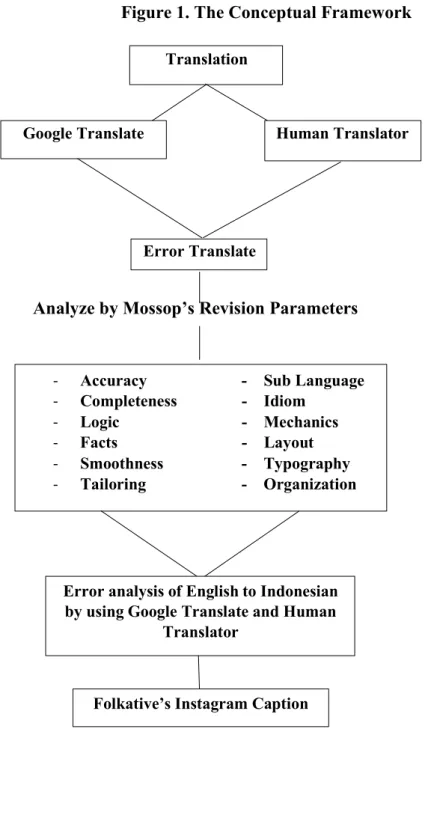
To correct translation errors, you need to make revisions to provide the proper output text. (Mossop et al., 2014) found that the revision was an act of verifying the correctness of the language, as well as the suitability of text styles for future readers and their use. If you want to change the nasty wording without changing the author's meaning, you'll need to fix it later. Mossop revision parameters consist of 12 parameters, there are accuracy, completeness, logic, facts, smoothness, tailoring, sub-language, idiom, mechanics, layout, typography, and organization. The process of this study can be seen in the following figure:
Figure 1. The Conceptual Framework Translation
Google Translate Human Translator
Error Translate
Analyze by Mossop’s Revision Parameters
- Accuracy - Sub Language - Completeness - Idiom
- Logic - Mechanics - Facts - Layout - Smoothness - Typography - Tailoring - Organization
Error analysis of English to Indonesian by using Google Translate and Human
Translator
Folkative’s Instagram Caption
CHAPTER III
RESEARCH METHODOLOGY 3.1 Research Design
All study has a research design. This study was used the Descriptive Qualitative Research Method. According to (Sukmadinata, 2006), he said that descriptive research is a type of research that aims to explain existent occurrences, whether natural or artificial. Phenomena are forms, activities, and characteristics between one phenomenon and another., Changes, relationships, similarities, and differences.
The goal of descriptive research is to describe a phenomenon and its characteristics. Descriptive research is more concerned with what rather than how or why something has happened (Nassaji, 2015). Therefore, observation and survey tools are often used to gather data (Gall et al., 2003). Descriptive qualitative studies are studies that attempt to describe and interpret states, relationships, heightened opinions, ongoing processes, outcomes and implications, and ongoing trends. In this study, the author attempts to explain the error from Google Translate using Mossop revision parameters.
3.2 Data and Source of Data
The data was taken from the result of the translation of the Instagram Folkative’s caption which is translated by Google Translate, and translator. All captions for this account are in English. All studies are one data source. The data source for this study was taken from the Folkative Instagram account. This account used English as the language of information distribution.
3.3 Instrument of Collecting Data
In this study, observation was used to obtain data. A tool or facility used by a researcher to collect data is referred to as an instrument. The objective is to simplify the task and get the best outcomes, or to make the process simpler, more accurate, complete, and methodical.
3.4 Procedure of Collecting Data
The procedure is very important in this study. In this study, the writer was used several procedures to collect data, namely:
1. Reading the caption from the Folkative Instagram account,
2. Inserting the Folkative’s caption into Google Translate to get the translation,
3. Observing and marking all kinds of expressions (words, phrases sentences) that are specified in terms of meaning, content, and language usage,
4. Analyzing any errors found based on the parameters of the Mossop revision.
3.5 Technique of Analyzing Data
In analyzing this data there are some techniques were used, namely:
1. Identifying and analyzing the error in translating the Folkative’s caption on Instagram,
2. After identifying the error in translating and comparing the result of translation, the writer classified the data to Mossop's Revision Parameters.
3. Making the conclusion.