Accountability of Budget Users and Proxy Budget users on the Emergence of State Losses in the Procurement of Government
Goods/Services
Rustanto
[email protected] Chief of the Banjarmasin District Court Abstract
Many criminal acts of corruption originate from the procurement of goods/services which turns out to not make the application of the article on corruption crimes to matters relating to state losses or the application of corruption crimes to KPA and PA actions important to get attention, because many parties are certainly familiar with the character of law enforcement for criminal acts of corruption, which are always linked with administrative errors. Based on this background, this research raises the title: “Criminal legal responsibility for budget users and budget users authority in the procurement of government goods/services for the occurrence of state losses”. The purpose of this study is to analyze and find the ratio of the legal liability of PA and KPA in the procurement of government goods/services for the occurrence of state losses and legal consequences for the implementation of PA and KPA duties that cause state losses in the procurement of government goods/services. The research method used is legal research (doctrinal research) and the approach used is the statutory approach, case study, conceptual approach, and comparative approach. The results of this study, namely the Legis Ratio of accountability for PA and KPA for the occurrence of state losses, is because PA and KPA are state officials who have special authority which in fact is not owned by everyone, even public officials, so that, according to the legal principle of deen bevoegdheid zonder verantwoordenlijkheid (there is no authority without accountability), it is logical that, when exercising this authority, when the PA and KPA make a mistake, there are juridical consequences, but the mistakes made by the PA and KPA cannot be generalized immediately. The mistakes made by the PA and KPA must be analyzed, to find out the qualifications for the responsibilities of the PA and KPA, whether administrative, criminal, and/or civil liability. This, when associated with the ten-to-one rule principle, should not allow the PA and KPA to be held accountable for more than the mistakes made.
Keywords: Accountability; Budget Users; Budget User Authorizations; Authority.
YURIDIKA
FAKULTAS HUKUM UNIVERSITAS AIRLANGGA
Fakultas Hukum Universitas Airlangga, Jalan Dharmawangsa Dalam Selatan Surabaya, 60286 Indonesia, +6231-5023151/5023252
Fax +6231-5020454, E-mail: [email protected]
Yuridika (ISSN: 0215-840X | e-ISSN: 2528-3103)
by http://e-journal.unair.ac.id/index.php/YDK/index under a Creative Commons Attribution 4.0 International license.
DOI: 10.20473/ydk.v37i3.41280 Volume 37 No 3, September 2022
Article history: Submitted 23 April 2022; Accepted 8 June 2022; Available Online 1 September 2022.
Copyright © 2022 Rustanto
Introduction
The implementation of the government of the Republic of Indonesia to improve people’s welfare is closely related to the rights and obligations of the state that may be appraised by money, so it is necessary to have a good state financial management.1 In order to make a good financial management come true, parties involved in the state financial management shall act according to the principle of good governance and clean governance2 and collaborate it with the principles of state financial management, which is the principle of accountability orienting toward results, professionalism, proportionality, and transparency in managing state finances. Besides, the state finances shall be audited by a free and independent audit board.3 In the provision of Article 6 of Law Number 17 of 2003 on State Finance (State Gazette of 2003 Number 47, Supplement to the State Gazette Number 4286, hereinafter referred to as Law No. 17/2003),4 the main actor who has the authority to manage state finance is the President as the head of government, but, in practice, the President is represented by the Minister of Finance, who is the Chief Financial Officer (CFO).5
Duties of Budget Users/Pengguna Anggaran (hereinafter abbreviated as PA) in the context of the procurement of goods and services are regulated in Article 9 of the Presidential Regulation Number 16 of 2018 on the Procurement of Government Goods/Services (State Gazette of 2018 Number 33, hereinafter abbreviated as Perpres No. 16/2018)6 amended by the Presidential Regulation Number 12 of 2021 on the Amendment of the Presidential Regulation Number 16 of 2018 on the Procurement of Government Goods/Services (State Gazette of 2021
1 Telly Sumbu, ‘Hubungan Pemerintah Pusat Dengan Pemerintah Daerah Dalam Kerangka Pengelolaan Keuangan Negara Dan Daerah’ (2010) 17 Jurnal Hukum Ius Quia Iustum.[567].
2 Nur Rohim Yunus, ‘Menciptakan Good and Clean Government Berbasis Syariah Islamiyah Dalam Tatakelola Pemerintahan Republik Indonesia’ (2016) 3 Nur El-Islam.[143].
3 Law of the Republic of Indonesia Number 17 of 2003 on State Finances 2003.
4 Law Number 17 of 2003 on State Finance 2003.
5 SH Adrian Sutedi, Hukum Keuangan Negara (Sinar Grafika 2022).
6 Hendra Wahanu Prabandani and MH SH, Kebijakan Baru Dalam Peraturan Presiden Nomor 16 Tahun 2018 Tentang Pengadaan Barang/Jasa Pemerintah (Prenada Media 2020).
Number 63, hereinafter abbreviated as Perpres No. 12/2021).7 In carrying out its duties, PA has the authority to appoint Proxy of Budget Users/Kuasa Pengguna Anggaran (hereinafter abbreviated as KPA) in each agency and implementation unit with duties in managing and implementing state finances,8 if the PA is not able to carry out part or all of the duties in the management of goods and services in the relevant agency. Administratively, the authority obtained by KPA is actually the authority of PA delegated to it.9 This is regulated in Article 9 paragraph (2) and paragraph (3) of Perpres No. 12/2021.10 Duties of KPA are not only to manage state finance, but also implement the procurement of government goods/services. This is as regulated in Perpres No. 16/2018 amended by Perpres No. 12/2021, where in the procurement of goods and services, KPA has duties and authorities as a result of delegation from PA. In addition to the authorities delegated by PA to KPA, KPA also has other authorities, which are responding to objections to appeals from construction work tender participants and implementing the procurement of goods and services using budget from Provincial Budget (APBD), and then PA can also serve as Commitment Making Official/Pejabat Pembuat Keputusan (hereinafter abbreviated as PPK).11
In carrying out its duties and authorities, KPA formally and materially is held accountable to PA for the implementation of duties assigned to it,12 as regulated in Article 10 paragraph (1) of the Government Regulation of the Republic of Indonesia Number 45 of 2013 on the Procedures for the Implementation of State Revenues
7 Yusuf Laoh And Mh Sh, Peran Ppk (Pejabat Pembuat Komitmen) Dalam Pencegahan Tindak Pidana Korupsi (Pengadaan Barang Dan Jasa) (Rizmedia Pustaka Indonesia 2020).
8 I Putu Jati Arsana, Manajemen Pengadaan Barang Dan Jasa Pemerintah (Deepublish 2016).
9 Ronald Saija, Dimensi Hukum Pengadaan Barang/Jasa (Deepublish 2019).
10 Regulation of the President Number 12 of 2021 on Amendments to Regulation of the President Number 16 of 2018 on the Procurement of Government Goods/Services 2021.
11 Nasridal Patria, ‘Kompetensi Pengadaan Barang/Jasa Bagi Aparatur Sipil Negara (ASN) Pada Pemerintah Provinsi Sumatera Barat’ (2021) 5 Jurnal Ilmiah MEA (Manajemen, Ekonomi, &
Akuntansi).[253].
12 Salwa Salsabila Mudian, ‘Tinjauan Yuridis Terhadap Tanggung Jawab Kuasa Pengguna Anggaran (KPA) Tindak Pidana Korupsi Studi Kasus Putusan: Nomor 55/Pid. Sus. TPK/2020/PN.
Mks’ (Universitas Hasanuddin, 2022).
and Expenditures Budget (hereinafter abbreviated as PP No. 45/2013), as amended by the Government Regulation Number 50 of 2018 (hereinafter abbreviated as PP No. 50/2018). Definition of accountability formally is accountability for the implementation of its duties seen in the report on the implementation of its duties and responsibilities,14 in accordance with Article 10 paragraph (2) of PP No. 45/2013.15 Meanwhile, definition of accountability materially is accountability for the use of budget and output resulted from state budget16 as in accordance with Article 10 paragraph (3) of PP No. 45/2013.17 This accountability is actually logical and is indeed important to avoid fraud, abuse, or negligence on the use of state finances that result in state losses.
In the legal construction where there is a delegation between PA and KPA in implementing and exercising the authority, and then KPA abuses the authority delegated to it in order to obtain its own benefit, so according to the concept of delegative authority, PA shall not be responsible for the abuse committed by KPA even though KPA is an organ given the authority to take every action on behalf of PA and, in other words, KPA is “the intermediary” of PA in managing state finance. Besides, the delegative authority shall be delegated in full (as a whole) to the delegator, but the authority obtained by KPA is only a part of the authority previously obtained by PA. Therefore, it leads to ambiguity in the construction of accountability of PA and KPA in the procurement of goods and services. This ambiguity is one of problems in the procurement of goods and services in Indonesia. According to the existing data, there are many misuses of state finances in the procurement of goods and services, for example, data mentioned by Deputy Chairman of the Corruption Eradication
13 Samsul Ramli and Muhammad Ide Ambardi, Bacaan Wajib Menyusun Perencanaan Pengadaan Barang/Jasa Pemerintah (VisiMedia 2016).
14 Manggaukang Raba, Akuntabilitas Konsep Dan Implementasi, vol 1 (UMMPress 2006).
15 Erna Irawati and Aldhino Niki Mancer, ‘Menyemai Agen Perubahan Kebijakan Publik’
(2017) 1 Jurnal Analis Kebijakan.
16 Cokorda Dian Permana, ‘Tanggungjawab Formil Dan Materil Bendahara Pengeluaran Pembantu Dalam Ganti Kerugian Keuangan Negara Pada Perkara Tindak Pidana Korupsi’ 4 Tadulako Master Law Journal.[318].
17 M Zainul Abidin, ‘Mechanisms of Budgeting on Public Service Obligation And Premium Subsidy in Agricultural Insurance’ (2015) 19 Kajian Ekonomi dan Keuangan.[45].
Commission (KPK), Alexander Marwata, revealing that 80 percent of corruption at the regional level is related to the procurement of goods/service, data of Indonesian Corruption Watch (ICW) in 2016 shows that from 482 corruption cases prosecuted by law, 195 cases of which were related to the procurement of goods and services with a state loss of Rp 680 billion and bribes worth of Rp 23.2 billion.18
The fact that most corruption crimes are committed in the procurement of goods and services does not make the implementation of articles on corruption crimes to matters related to state losses or the implementation of articles on actions of KPA and PA become important to get attention, because many parties are already familiar with the characteristics of law enforcement for corruption crimes that are always linked.19 This is because there is a common point of contact between corruption and maladministration, namely “abuse of authority”. The difference is that corruption crime has specific characteristics, where the abuse of authority brings benefit only to oneself or a group. Forms of administrative errors or maladministration are behavior or actions that are against the law, exceed the authority, use authority for purposes other than those for which the authority is intended, including negligence and flagrant for legal obligation in the administration of public services carried out by state or government administrators leading to material/immaterial losses for community and individuals.20
One real case illustrating the possibility of indictment alleging that a party commits corruption in the procurement of goods and services causing state losses, but the act actually is not corruption, can be seen in the case of Chris L.
Manggala, the former General Manager of PT PLN Sumatera Utara who was in the procurement of goods and services and had a position as good/service user
18 Nur Hadiyati, ‘Urgensi Pengaturan Pengadaan Barang Dan Jasa Melalui Undang-Undang’
(2018) 1 Jurnal pengadaan.[1].
19 Ranu Wijaya, ‘Kesalahan Administrasi Kaitannya Dengan Tindak Pidana Korupsi (Studi Putusan Nomor: 35/Pid. Tipikor/2011/Pn. Smda Di Pengadilan Tipikor Samarinda) Ranu Wijaya, Prof. Masruchin Rubai, Sh. Ms, Milda Istiqomah, Sh. Mtcp’ (Brawijaya University, 2014).
20 Fajri Budiman Taufiq, ‘Implementasi Undang-Undang Nomor 37 Tahun 2008 Tentang Ombudsman Dalam Penyelesaian Maladministrasi Kasus Kependudukan Di Kota Surabaya’ (Upn”
Veteran” JATIM 2020).
or equivalent to Commitment Making Official/Pejabat Pembuat Keputusan (hereinafter abbreviated as PPK) as the institutional representative in signing contracts with the providers of goods and services.21 This case shows the potential for errors that cause state financial losses, but not due to corruption. Errors in this case were damage to operational tools found in the future, delay from the provider, and the absence of minutes due to negligence. Based on the discussion above, this research comprehensively discusses in detail about fair accountability for PA and KPA in the procurement of goods and services according to philosophical context.
This is a doctrinal research.22 According to Hutchinson, doctrinal research is “a research which provides a systematic exposition of the rule governing a particular legal category, analyses the relationship between rules, explains areas of difficulty and perhaps, predicts future development”.23 This doctrinal research aims to produce systematic explanation about legal rules governing problems being faced. In this case, the research was conducted by analyzing the relationship between legal rules and the problems.24 This legal research was also conducted to analyze the accountability of PA and KPA in the procurement of goods and services for the occurrence of state losses.
Accountability of Budget Users and Proxy of Budget Users
The use of authority by officials in carrying out state function shall always be accompanied with accountability (deen bevoegdheiden zonder verantwoordenlijkheid).25 As aforementioned in the theoretical framework, legal accountability in this research is obligation to be responsible for any mistakes,
21 Kukuh Tejomurti, ‘Pertanggungjawaban Hukum Yang Berkeadilan Terhadap Aparatur Pemerintah Pada Kasus Pengadaang Barang Dan Jasa’ (2017) 8 Dialogia Iuridica: Jurnal Hukum Bisnis dan Investasi.[42].
22 Peter Mahmud Marzuki, Penelitian Hukum (Kencana Prenada Media Group 2011).[35].
23 Terry Hutchinson, ‘Developing Legal Research Skills: Expanding the Paradigm’ (2008) 32 Melb. UL Rev.[1065].
24 Abdulkadir Muhammad, Hukum Dan Penelitian Hukum (1st edn, Citra Aditya Bakti 2004).
[52].
25 Sufriadi Sufriadi, ‘Tanggung Jawab Jabatan Dan Tanggung Jawab Pribadi Dalam Penyelenggaraan Pemerintahan Di Indonesia’ (2017) 1 Jurnal Yuridis.[57].
especially when obligation is violated. The accountability shall be carried out to recover and restore every loss due to someone’s action. According to Hans Kelsen, a person can be considered to be legally responsible for a certain act when he can be subjected to a sanction when committing violation.26 According to Black’s Law Dictionary, sanction is “a penalty or coercive measure that results from failure to comply with a law, rule, or order (a sanction for discovery abuse)”.27 In other words, KPA’s accountability is when KPA can be subjected to a sanction because of its actions or negligence that lead to failure to comply with the provisions of law and legislation.
There is a contradiction between the existing legal concepts and legal norms in the context of accountability of PA and KPA. It can be seen from the word
“kuasa/proxy” in (Kuasa Pengguna Anggaran/Proxy of Budget User (KPA)) in which “kuasa” as stated in the provision of Article 1792 of BW is “an approval containing a mandate to another party to carry out the authority on behalf of the party delegating the authority.” In the context of the accountability of this authority, based on Article 1811 of BW, it is regulated that:
If a party receiving the authority is appointed by other parties to carry out a business that they must resolve together, then each of them is responsible for the entirety of the party receiving the authority regarding all consequences of the delegation of the authority (bold by the author), therefore the party responsible is the one who delegates the authority.28
This is by taking into account that the actions taken by the party receiving the authority are not beyond one’s legal authority (ultra vires), as regulated in Article 1797 BW that: “The party receiving the authority must not do anything beyond his authority which is delegated to resolve a dispute peacefully and it does not contain the right to depend on the arbitrator’s decision for the dispute resolution”.
From the construction of accountability of the party delegating and party receiving the authority in the BW, it can be seen that the form of accountability
26 Jimly Asshiddiqie and Muchamad Ali Safa’at, Teori Hans Kelsen Tentang Hukum (Mahkamah Konstitusi RI, Sekretariat Jenderal dan Kenpaniteraan 2006).[61].
27 Samsul Ramli, Bacaan Wajib Swakelola Pengadaan Barang/Jasa Pemerintah (VisiMedia 2014).[191].
28 Pieter E Latumeten, ‘Reposisi Pemberian Kuasa Dalam Konsep Volmacht Dan Lastgeving Berdasarkan Cita Hukum Pancasila’ (2017) 47 Jurnal Hukum & Pembangunan.[21].
is parallel to the accountability of the authority obtained from the mandate in administrative law.29 The accountability of the authority obtained from the mandate in this administrative law normatively can be seen in Article 1 point 24 of Law no. 30/2014, which regulates that: “Mandate is the delegation of authority from a higher government agency and/or official to a lower government agency and/or official with responsibility and accountability remaining with the mandate giver (bold by the author).” Thus, if the construction of accountability for the delegation of authority from PA to KPA is consistent with the concept of authority, then it is called a mandate.30
From the construction of delegation and mandate in Law no. 30/2014 with the regulation of PA and KPA in Presidential Regulation No. 12/2021, it can be seen that there is a conflict of norms. If the KPA is indeed the “proxy” of the PA, then the delegation of authority to the KPA is a mandate, not a delegation, as in Article 10 paragraph (1) of Presidential Regulation No. 12/2021. Unless, in its development, the construction is changed into “KPA” is not “the proxy” of PA, then the source of delegation of authority is still delegation, as in Article 10 paragraph (1) of Presidential Regulation No. 12/2021. Therefore, it can be said that, in the construction of the ius constitutum, there is a conflict between the concept of authority in the delegation of authority, in the regulation of PA and KPA in Presidential Regulation No. 12/2021. The ambiguity of the accountability of PA and KPA in Regulation No. 12/2021 is related to the construction of delegation and mandate in Law no. 30/2014, then in fact there is a theory of accountability in criminal law that can be used as an “analysis or approach method,” that is the theory of functional manufacturing concepts or theory of functional actors (functioneel daderschap).
29 Bagus Oktafian Abrianto, Xavier Nugraha and Nathanael Grady, ‘Perkembangan Gugatan Perbuatan Melanggar Hukum Oleh Pemerintah Pasca-Undang-Undang Nomor 30 Tahun 2014 Development of Lawsuit for Law Violation by the Government of the Post Law Number 30 of 2014’
(2018) 48 Jurnal Hukum & Pembangunan.[466].
30 Roseno Napu Setiawan, Yohanes Tuba Helan and Saryono Yohanes, ‘Wewenang Dan Tanggung Jawab Kuasa Pengguna Anggaran Dalam Pelaksanaan Anggaran Belanja Negara’ (2019) 12 Arena Hukum.[464].
This theory was first introduced by Roling in his notes under the decisions of the Hoge Raad dated January 31 and February 21, 1950.31 Functioneel daderschap theory is one of the theories often used in the context of corporate accountability.
Based on this theory, corporations can be held criminally responsible for actions taken on behalf of the corporation by attaching the element of guilt to its functional actors.32 Corporations can be treated as criminals if they carry out illegal acts when carrying out their duties/and or achieving corporate goals, for which criminal responsibility is imposed on legal entities. Thus, although actually and factually, criminal acts are committed by corporate personnel who carry out business activities for the benefit of the corporation, on the other hand, functionally the corporation mandates its personnel to carry out these activities, so that in the case of violating the rule of law, the corporation can be declared as a criminal because the corporation has a function of delegating task mandates to personnel who directly commit criminal acts.
Administrative Liability
According to Ten Berge, administrative law sanctions are the core of administrative law enforcement. In this case, sanctions are needed to ensure the enforcement of administrative law.33 Nicolai also stated that the means of enforcing administrative law include (1) supervision that government organs are able to comply with written laws and supervision of decisions that take obligations on individuals and (2) imposition of sanctions.34 What are meant by administrative sanctions are penalties imposed on government officials who violate the provisions of administrative law, that is a set of norms that regulate the authority of government officials and how that authority is exercised.
31 JM Van Bemmelen, Hukum Pidana I Material Bagian Umum. Diterjemahkan Oleh Hasnan (Binacipta 1987).[236].
32 SH Aldwin Rahadian Megantara, Aspek Hukum Atas Senjata Api Bela Diri (Deepublish 2021).[34].
33 HR Ridwan, Hukum Administrasi Negara Edisi Revisi (Raja Grafindo Persada 2014).
34 ibid.[298].
Regarding the administrative sanctions imposed to the KPA, Article 82 of the Presidential Regulation No. 16/2018 only stated that this sanction will be imposed to the KPA who fails to meet its obligations and the imposition of this sanction will be given by the civil service officer or authorized official in accordance with the laws and regulations. Meanwhile, Law no. 30/2014 as lex specialis actually has already categorized actions and forms of administrative sanctions according to the violations committed. Regulations regarding compensation for government officials or civil servants other than treasurers can also be found in Article 20 paragraphs (4) and (5) of Law no. 30/2014 in conjunction with Article 3 paragraph (2) PP No.
38/2016 stating that all government officials or civil servants other than treasurers who violate the law or neglect their obligations, either directly or indirectly, resulting in state losses, are required to compensate the state losses. These articles also do not provide confirmation, whether the compensation sanctions are included in the realm of civil law or administrative law. The obligation for compensation certainly does not only apply to actions that can be subject to moderate administrative sanctions, but also to light or severe administrative sanctions that cause state losses.
Criminal Liability
Criminal sanctions are heavier when compared to the imposition of sanctions in civil law and administrative law. The approach built is as an effort to prevent and overcome crime through criminal law with violations subject to criminal sanctions. The imposition of criminal sanctions on KPA administrative errors is indeed possible, considering that it has been regulated in Article 19 paragraph (1), Article 20 paragraph (5), and Article 36 PP. 48/2016 and Article 52 of PP No.
38/2016. These articles are the basis for the entry of criminal sanctions in addition to administrative sanctions or compensation.
Criminal sanctions are basically forms of accountability of the perpetrator in relation to the crime committed. Criminal sanctions can simply be defined as a misery or suffering inflicted on someone who is guilty of committing an act
prohibited by criminal law.35 Sudarto defines criminal sanctions as suffering that is deliberately imposed on people who commit acts that meet certain conditions.
Meanwhile, Roeslan defines crime as a reaction to an offense, and it is in the form of a misery deliberately inflicted by the state on the perpetrator of the offense.36
Mistakes made by PA and KPA as previously described are actions that are threatened with criminal sanctions based on applicable laws. The mistakes often made by PA and KPA related to the procurement of goods/services are corruption.
According to Kaufmann, the procurement of goods/services is a government activity that is considered to be prone to corruption, and this happens anywhere in the world.37 Corruption in the procurement of goods/services lately can be said to have been set from upstream to downstream because its nature has been changed from “control point” into fraud point.
Perpetrators of corruption have practiced corruption since budget planning, which should have been a control point, as a result, the processes for procuring goods/services that should be profitable for the state have become formalities (manipulated) which ultimately result in state losses. It is evidenced that fraud in the procurement of goods/services is one of the most reported cases and handled by the KPK. Citing statistical data on the handling of corruption cases by the KPK, corruption in the procurement of goods and services occupies the second highest number of cases handled by the KPK.
Civil Liability
Based on the types and forms, corruption is basically the same; it is an act of confiscation of state assets so that the state loses its ability to carry out its obligations and responsibilities for the welfare of its people. The effect of corrupt acts continuously done, is that people lose their rights to welfare.38 Money that
35 Mahrus Ali, Dasar-Dasar Hukum Pidana (Sinar Grafika 2022).[19].
36 ibid.[196].
37 Elodie Beth, ‘Integrity in Public Procurement: Good Practice from A to Z’ (2007) Organisation for Economic Co-operation and Development (OECD).
38 Michael Levi, ‘Tracing and Recovering the Proceeds of Crime’ (Cardiff University 2004).[17].
should be used for the prosperity of the people is actually lost, so that the people cannot obtain their right; it can even be said that corruptors make the state to be a victim (victim state).39 The Corruption Eradication Commission (KPK) classifies corruption as an extraordinary crime because corruption is carried out widely and systematically.40
If it is seen from Law no. 31/1999 in conjunction with UU no. 20/2001, there are at least four reasons to eradicate corruption: (1) harming state finances or the country’s economy, (2) hampering national development, (3) corruption crimes have occurred widely, and (4 ) violating the social and economic rights of the community.41 Efforts to eradicate corruption are focused on three main issues of prevention, eradication, and asset recovery.42 These three issues emphasize a meaning that eradicating corruption does not only rest on preventing and imposing sanctions to corruptors, but also includes actions that require the corruptors to restore state financial losses as a result of the corruption.43 In other words, the state’s financial losses must be returned or compensated by the perpetrators of corruption (asset recovery). According to Sadli Isra, failure to compensate state losses due to corruption can reduce the meaning and achievement of punishment for corruptors.44
The rationale for the regulation of civil lawsuits in Law no. 31/1999 in conjunction with UU no. 20/2001 indicates that state recovery for financial losses due to corruption cannot be rely solely based on criminal law norms. The regulation of civil lawsuits is possible in the regulation, so it indicates that corruption, which is categorized as an extraordinary crime, is required to be handled in extraordinary
39 Artidjo Alkostar, ‘Kerugian Keuangan Negara Dalam Perspektif Tindak Pidana Korupsi’
(2008) 275 Varia Peradilan.[34-35].
40 I Gusti Ayu Eviani Yuliantari, ‘Legal Standing Komisi Pemberantasan Tindak Pidana Korupsi (Kpk) Dalam Sengketa Kewenangan Lembaga Negara Di Mahkamah Konstitusi’ (2015) 4 Jurnal Magister Hukum Udayana (Udayana Master Law Journal).[174].
41 Amiruddin Amiruddin, ‘Analisis Pola Pemberantasan Korupsi Dalam Pengadaan Barang/
Jasa Pemerintah’ (2012) 8 Jurnal Kriminologi Indonesia.[30].
42 Ridwan Arifin, Indah Sri Utari and Herry Subondo, ‘Upaya Pengembalian Aset Korupsi Yang Berada Di Luar Negeri (Asset Recovery) Dalam Penegakan Hukum Pemberantasan Korupsi Di Indonesia’ (2017) 1 IJCLS (Indonesian Journal of Criminal Law Studies).[105].
43 Eddy OS Hiariej, ‘Pengembalian Aset Kejahatan’ (2013) 13 Jurnal Opinio Juris 2.
44 Firdaus Arifin, ‘Problematika Hukum Pengembalian Aset Tindak Pidana Korupsi Pelaku Dan Ahli Warisnya’ (2019) 3 Pagaruyuang Law Journal.[64].
ways. Iskandar said that it is possible to regulate civil lawsuits in Law no. 31/1999 in conjunction with Law no. 20/2001. In other words, a civil lawsuit for a criminal act of corruption filed by the evidence obtained by investigators is not sufficient to show the guilt of the suspect or elements of a criminal act of corruption at the investigation stage, so that it is impossible to conduct follow-up for the criminal process even though there has been a real loss to the state. According to the explanation of Article 32 paragraph (1) of Law no. 31/1999 in conjunction with Law no. 20/2001, “a real loss to the state” is a state loss in which the amount can be calculated based on the findings of the authorized agency or the appointed accountant.45 Civil lawsuits for criminal acts of corruption can also be filed in connection with the acquittal decision on KPA. Decision is a judicial process ending with a final decision (verdict). In the decision, the judge states his opinion on what has been considered and his decision. The definition of acquittal in Article 32 paragraph (2) of Law no. 31/1999 in conjunction with Law no. 20/2001 is a court decision as referred to in Article 191 paragraph (1) and paragraph (2) of the Law of Criminal Procedure in the form of a vrijspraak decision or onslag van rechtvervolging. The decision referred to in Article 191 paragraph (1) is based on the results of the examination accused to the perpetrator not legally and convincingly proven, which means it is not proven according to the judge’s assessment on the basis of evidentiary process in which the evidence used is in accordance with the provisions of the Law of Criminal Procedure. As for the meaning contained in Article 191 paragraph (2), the act is not considered as a crime.46
In the case of corruption, the acquittal decision does not forfeit the right to claim losses on state finances. The state, through the state attorney, can take legal action in the form of a civil lawsuit for compensation for state finances. In other words, the provisions of Article 32 paragraph (2) of the Law on Corruption
45 Fitrizia Blessi Karina, ‘Gugatan Perdata Dalam Tindak Pidana Korupsi Menurut Undang- Undang Nomor 31 Tahun 1999 Jo Undang-Undang Nomor 20 Tahun 2001 Tentang Pemberantasan Tindak Pidana Korupsi’ (2017) 6 Lex Crimen.[108].
46 Kiki Kristanto, John Terson and Ronaldi Ronaldi, ‘Karakteristik Gugatan Perdata Dalam Tindak Pidana Korupsi Di Indonesia’ (2021) Palangka Law Review 1.[7-8].
Eradication (UU PTPK) are very significant in anticipating the existence of an acquittal decision which is likely to release the convict from all claims for state financial losses, so that, legally, the provisions of this article are the legal umbrella and at the same time the hallmark of a civil lawsuit against acquittal decision. In the case of the two conditions above, the state attorney or agency that was harmed can file actions taken by the KPA with a lawsuit to the district court based on Article 1365 BW on the basis of an unlawful act (onrechtmatigedaad) to ask for compensation for state losses.47
In the criminal justice process, there is a possibility that the KPA is passed away at the investigation stage or during examination in court, so that the state’s right to sue the KPA in that case is null and the judicial process is terminated by law. This has been regulated in Article 77 of the Criminal Code which states that
“the right to sue is null and void because the suspect is passed away”. Soesilo in his book entitled The Criminal Code (KUHP) and its Complete Commentary said that:
In this article there is a principle that the prosecution of sentences must be directed at individuals. If the person accused of having committed a criminal incident is passed away, then the lawsuit on the case must be terminated, meaning that the lawsuit cannot be directed to the heirs”.48
In the criminal law, liability is personal, meaning that only people who are guilty can be subjected to punishment. Thus, it can be seen that the criminal action brought against the suspect or accused of corruption that is passed away is indeed null and void and the criminal offense cannot be directed to their heirs. However, if there has been a real loss of state finances, a civil lawsuit can be filed by the state attorney or agency that has been harmed against the heirs of the suspect or defendant of corruption who has passed away.
In the event that the KPA has been decided and sentenced by a judge to compensate state financial losses due to corruption but then the KPA is passed away before compensating the losses, meanwhile there are assets belonging to the convict which is suspected or reasonably suspected to have originated from corruption
47 Karina (n 45).[107].
48 ibid.
committed and they have not been confiscated by the state, so the heirs may be prosecuted based on the debts of the testator as long as the person concerned does not refuse to be the heirs. BW provides some suggestions related to steps that can be taken by the heirs when the testator is passed away. At the time the inheritance is renounced, the heirs can determine whether to accept or reject the inheritance, or there is also the possibility to accept it given that they are not obliged to pay debts and meet the obligations of the testator, which exceeds his share in the inheritance.49 In accordance with Article 1048 of BW, the heirs can receive the inheritance secretly by reflecting an attitude of receiving an inheritance unconditionally (zuivere aanvaarding). The heir who takes and sells the inheritance as well as pays off the debts of the testator can be considered to have received the inheritance in full.50 It is required to file a civil lawsuit and compensate the state losses due to the mistakes made by PA and KPA resulting in state loss.51
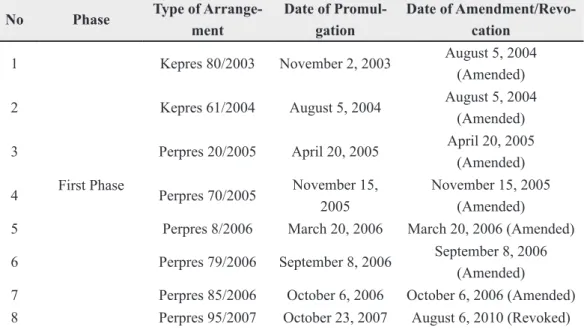
The matters that need to be considered regarding the accountability of PA and KPA are related to the tempus or timing of actions taken by PA and KPA, as historically there are three major phases in the regulation of goods/services, which are:
a. Phase of the Presidential Decree No. 80 of 2003 on Guidelines for the Implementation of Government Procurement of Goods/Services (hereinafter abbreviated to Keppres No. 80/2003) and its amendments. This phase is the first phase of the legal politics of regulating goods/services.
Keppres No. 80/2003 is the first regulation related to the guidelines for goods/
services which came into force on November 3, 2003. Since then, there are seven amendments:
1. Presidential Decree Number 61 of 2004 on Amendments to the Presidential Decree Number 80 of 2003 on Amendments to Guidelines for the
49 Subekti, Pokok-Pokok Hukum Perdata (Intermasa 2002).[103].
50 Ni Made Dwi Julia Patria Dewi, I Made Dedy Priyanto and I Wayan Wiryawan,
‘Pertanggungjawaban Perdata Ahli Waris Pelaku Tindak Pidana Korupsi Dalam Mengembalikan Kerugian Negara’ (2018) 5 Kertha Semaya: Journal Ilmu Hukum 1.[4-5].
51 Faizal Kurniawan and others, ‘The Involvement of Soes in Procurement of Goods or Services in Indonesia: Is It Ethical?’ (2020) 24 International Journal of Psychosocial Rehabilitation.
[1287].
Implementation of the Procurement of Government Goods/Services, which was ratified on August 5, 2004.
2. Presidential Regulation Number 20 of 2005 on the Second Amendment to the Presidential Decree Number 80 of 2003 on the Second Amendment to the Guidelines for the Implementation of the Procurement of Government Goods/Services, which was ratified on April 20, 2005.
3. Presidential Regulation Number 70 of 2005 on the Third Amendment to the Presidential Decree Number 80 of 2003 on the Second Amendment to the Guidelines for the Implementation of the Procurement of Government Goods/Services, which was ratified on November 15, 2005.
4. Presidential Regulation Number 8 of 2006 on the Fourth Amendment to the Presidential Decree Number 80 of 2003 on the Second Amendment to the Guidelines for the Implementation of the Procurement of Government Goods/Services, which was ratified on March 20, 2006.
5. Presidential Regulation Number 79 of 2006 on the Fifth Amendment to the Presidential Decree Number 80 of 2003 on the Second Amendment to the Guidelines for the Implementation of the Procurement of Government Goods/Services, which was ratified on September 8, 2006.
6. Presidential Regulation Number 85 of 2006 on the Sixth Amendment to the Presidential Decree Number 80 of 2003 on the Sixth Amendment to the Guidelines for the Implementation of the Procurement of Government Goods/Services, which was ratified on October 6, 2006.
7. Presidential Regulation Number 95 of 2007 on the Sixth Amendment to the Presidential Decree Number 80 of 2003 on the Sixth Amendment to the Guidelines for the Implementation of the Procurement of Government Goods/Services, which was ratified on October 23, 2007.
This phase was started from November 3, 2003 to October 23, 2007. PA and KPA were just stated in expressis verbis manner in the regulation of goods/
services contained in the Presidential Regulation Number 8 of 2006 on the Fourth Amendment to the Presidential Decree Number 80 of 2003 on the Second Amendment to Guidelines for the Implementation of the Procurement of Government Goods/Services, which was ratified on March 20, 2006.
b. Phase of the Presidential Regulation Number 54 of 2010 on the Procurement of Government Goods/Services (hereinafter abbreviated as Perpres 54/2010) and its amendments.
This phase began with the issuance of Perpres 54/2010, which revoked the previous regulations related to goods/services on August 6, 2010. This arrangement was the beginning of the second phase of the legal politics of the
procurement of goods/services. Over time, there have been some changes:
1. Presidential Regulation Number 35 of 2011 on Amendments to the Presidential Regulation Number 54 of 2010 on the Procurement of Government Goods/Services, which has been in effect since June 30, 2011.
2. Presidential Regulation Number 70 of 2012 on the second amendment to the Presidential Regulation Number 54 of 2010 on the Procurement of Government Goods/Services, which has been in effect since August 1, 2012.
3. Presidential Regulation Number 172 of 2014 on the third amendment to the Presidential Regulation Number 54 of 2010 on the Procurement of Government Goods/Services, which has been in effect since December 1, 2014.
4. Presidential Regulation Number 4 of 2015 on the fourth amendment to the Presidential Regulation Number 54 of 2010 on the Procurement of Government Goods/Services, which has been in effect since January 16, 2015.
c. Phase of Presidential Regulation Number 16 of 2018 on the Procurement of Government Goods/Services (hereinafter abbreviated as Perpres No. 16/2018) and its amendments. Presidential Regulation 16/2018 revoked the previous regulation on goods/services and took effect on 22 March, 2018. This Presidential Regulation was later amended by the Presidential Decree 12/2021 on February 2, 2021.
Periodization of the Arrangements for the Procurement of Goods/Services
Table 1. Periodization of the Arrangements for the Procurement of Goods/Services No Phase Type of Arrange-
ment Date of Promul-
gation Date of Amendment/Revo- cation
1
First Phase
Kepres 80/2003 November 2, 2003 August 5, 2004 (Amended)
2 Kepres 61/2004 August 5, 2004 August 5, 2004
(Amended)
3 Perpres 20/2005 April 20, 2005 April 20, 2005
(Amended)
4 Perpres 70/2005 November 15,
2005
November 15, 2005 (Amended) 5 Perpres 8/2006 March 20, 2006 March 20, 2006 (Amended) 6 Perpres 79/2006 September 8, 2006 September 8, 2006
(Amended)
7 Perpres 85/2006 October 6, 2006 October 6, 2006 (Amended) 8 Perpres 95/2007 October 23, 2007 August 6, 2010 (Revoked)
9
Second Phase
Perpres 54/2010 August 6, 2010 June 30, 2011
10 Perpres 35/2011 June 30, 2011 August 1, 2012
11 Perpres 70/2012 August 1, 2012 December 1, 2014
12 Perpres 172/2014 December 1, 2014 January 16, 2015
13 Perpres 4/2015 January 16, 2015 March 22, 2018
14
Third Phase
Perpres 16/2018 March 22, 2018 February 2, 2021 15 Perpres 12/2021 February 2, 2021 (Still effective)
Each of these phases certainly has significant differences. There are matters that are prohibited in one phase, but they are allowed in another phase, so this is in accordance with the principle of nullum delictum nulla poena sine praevia lege penali, as stated in Article 1 of the Criminal Code, so this is allowed.52 For example, in Article 87 paragraph (3) of Perpres No. 54/2010, it is basically regulated in expressis verbis manner, that providers of goods/services are prohibited from transferring the implementation of the main work based on the contract by subcontracting to other parties, except for part of the main work, they can be transferred to specialist providers of goods/services. The violation of this matter can potentially be criminalized, but it turns out that the prohibition on transferring the implementation of the main work to subcontracts is not regulated in Presidential Decree No. 16/2018.
The importance of understanding the regulatory phase of the procurement of goods/services and relating it to the tempus or timing of a criminal event can be seen in the Supreme Court Decision Number 845 K/PID.SUS/2021. The case was registered on May 29, 2020, by the District Court of Pontianak with registration number 10/Pid.Sus-TPK/2020/PN Ptk. The primary indictment of the case is Article 2 paragraph (1) in conjunction with Article 18 paragraph (1) letter b, paragraph (2) in conjunction with Article 4 of Law no. 31/1999 in conjunction with
52 Dwi Afrimeti Timoera, ‘Asas Legalitas Dalam Doktrin Hukum Indonesia: Prinsip dan Penerapan’ (2011) 10 Jurnal Ilmiah Mimbar Demokrasi.[67].
Law no. 20/2001. Meanwhile, the subsidiary charges are Article 3 paragraph (1) in conjunction with Article 18 paragraph (1) letter b, paragraph (2) in conjunction with Article 4 of Law no. 31/1999 in conjunction with Law no. 20/2001. One of the judge’s legal considerations (decedendi ratio), thus imposing a guilty verdict on the defendant is:
Considering, that in the construction of the Pantek Well and its Equipment for the Budget Year of 2015 at the Department of Agriculture and Livestock of Ketapang Regency, there were several companies whose flags were borrowed, meaning that the owner of the company who signed the work order did not carry out the work independently, but they were assisted by other parties. It was based on the testimony of a witness, Supriyadi, that a quo project was carried out by CV Maulia whose director was also a witness, Muzakir. At the hearing process, he explained that his company was borrowed by a witness, Supriyadi. Agus Herianto also borrowed CV Permata Indah whose director was Sunardi, M. and Ali, Amd. also borrowed CV Yosa Sejahtera whose director was Mursalin. These actions violate the Presidential Regulation No. 4 of 2015 on the fourth amendment to the Presidential Regulation No.
54 of 2010 on the procurement of government goods/services Article 87 paragraph (3): Providers of goods/services are prohibited from transferring the implementation of the main work based on the contract, by subcontracting to other parties, except for some of the main work, they can be transferred to specialist providers of goods/services (bold by the author)”.
In this case, even though the case was registered on May 29, 2020, in which Perpres 16/2018 has been issued, the case still referred to Presidential Decree 54/2010 and its amendments. It was because the tempus or time frame for the occurrence of criminal acts was 2015, which incidentally were the phase of Presidential Decree 54 /2010 and its amendment. Suppose that the incident occurred in 2019, the defendant could not be found guilty because of the prohibition as in Article 87 paragraph (3) of Perpres 54/2010 and its amendments are not contained in Perpres 16/2018.
Conclusion
The ratio legis (legal ratio) of the existence of accountability to PA and KPA for the occurrence of state losses is because PA and KPA are state officials who have special authority which in fact is not owned by everyone, even public officials. Therefore, according to the legal principle of deen bevoegdheid zonder
verantwoordenlijkheid (no authority without accountability), it is logical that there will be juridical consequences when the PA and KPA make a mistake while carrying out that authority. However, the mistakes made by the PA and KPA cannot be generalized immediately. The mistakes made by the PA and KPA must be analyzed to determine the qualifications of the accountability of the PA and KPA, whether it is administrative, criminal, and/or civil liability. If this is related to the ten-to-one rule principle, then PA and KPA should not be held accountable for more than the mistakes they made.
Bibliography
Abidin MZ, ‘Mechanisms of Budgeting on Public Service Obligation And Premium Subsidy in Agricultural Insurance’ (2015) 19 Kajian Ekonomi dan Keuangan.
Abrianto BO, Nugraha X and Grady N, ‘Perkembangan Gugatan Perbuatan Melanggar Hukum Oleh Pemerintah Pasca-Undang-Undang Nomor 30 Tahun 2014 Development of Lawsuit for Law Violation by the Government of the Post Law Number 30 of 2014’ (2018) 48 Jurnal Hukum & Pembangunan.
Adrian Sutedi SH, Hukum Keuangan Negara (Sinar Grafika 2022).
Aldwin Rahadian Megantara SH, Aspek Hukum Atas Senjata Api Bela Diri (Deepublish 2021).
Ali M, Dasar-Dasar Hukum Pidana (Sinar Grafika 2022).
Alkostar A, ‘Kerugian Keuangan Negara Dalam Perspektif Tindak Pidana Korupsi’
(2008) 275 Varia Peradilan.
Amiruddin A, ‘Analisis Pola Pemberantasan Korupsi Dalam Pengadaan Barang/
Jasa Pemerintah’ (2012) 8 Jurnal Kriminologi Indonesia.
Arifin F, ‘Problematika Hukum Pengembalian Aset Tindak Pidana Korupsi Pelaku Dan Ahli Warisnya’ (2019) 3 Pagaruyuang Law Journal.
Arifin R, Utari IS and Subondo H, ‘Upaya Pengembalian Aset Korupsi Yang Berada Di Luar Negeri (Asset Recovery) Dalam Penegakan Hukum Pemberantasan Korupsi Di Indonesia’ (2017) 1 IJCLS (Indonesian Journal of Criminal Law Studies).
Arsana IPJ, Manajemen Pengadaan Barang Dan Jasa Pemerintah (Deepublish 2016).
Asshiddiqie J and Safa’at MA, Teori Hans Kelsen Tentang Hukum (Mahkamah Konstitusi RI, Sekretariat Jenderal dan Kenpaniteraan 2006).
Beth E, ‘Integrity in Public Procurement: Good Practice from A to Z’ [2007]
Organisation for Economic Co-operation and Development (OECD).
Dewi NMDJP, Priyanto IMD and Wiryawan IW, ‘Pertanggungjawaban Perdata Ahli Waris Pelaku Tindak Pidana Korupsi Dalam Mengembalikan Kerugian Negara’ (2018) 5 Kertha Semaya: Journal Ilmu Hukum.
Hadiyati N, ‘Urgensi Pengaturan Pengadaan Barang Dan Jasa Melalui Undang- Undang’ (2018) 1 Jurnal pengadaan.
Hiariej EOS, ‘Pengembalian Aset Kejahatan’ (2013) 13 Jurnal Opinio Juris.
Hutchinson T, ‘Developing Legal Research Skills: Expanding the Paradigm’ (2008) 32 Melb. UL Rev.
Irawati E and Mancer AN, ‘Menyemai Agen Perubahan Kebijakan Publik’ (2017) 1 Jurnal Analis Kebijakan.
Karina FB, ‘Gugatan Perdata Dalam Tindak Pidana Korupsi Menurut Undang- Undang Nomor 31 Tahun 1999 Jo Undang-Undang Nomor 20 Tahun 2001 Tentang Pemberantasan Tindak Pidana Korupsi’ (2017) 6 LEX CRIMEN.
Kristanto K, Terson J and Ronaldi R, ‘Karakteristik Gugatan Perdata Dalam Tindak Pidana Korupsi Di Indonesia’ [2021] Palangka Law Review.
Kurniawan F and others, ‘The Involvement of Soes in Procurement of Goods or Services in Indonesia: Is It Ethical?’ 24 International Journal of Psychosocial Rehabilitation.
Laoh Y and SH MH, PERAN PPK (Pejabat Pembuat Komitmen) Dalam Pencegahan Tindak Pidana Korupsi (Pengadaan Barang Dan Jasa) (Rizmedia Pustaka Indonesia 2020).
Latumeten PE, ‘Reposisi Pemberian Kuasa Dalam Konsep Volmacht Dan Lastgeving Berdasarkan Cita Hukum Pancasila’ (2017) 47 Jurnal Hukum &
Pembangunan.
Levi M, ‘Tracing and Recovering the Proceeds of Crime’ (Cardiff University 2004).
Mudian SS, ‘Tinjauan Yuridis Terhadap Tanggung Jawab Kuasa Pengguna Anggaran (KPA) Tindak Pidana Korupsi Studi Kasus Putusan: Nomor 55/
Pid. Sus. TPK/2020/PN. Mks’ (Universitas Hasanuddin, 2022).
Muhammad A, Hukum Dan Penelitian Hukum (1st edn, Citra Aditya Bakti 2004).
Patria N, ‘Kompetensi Pengadaan Barang/Jasa Bagi Aparatur Sipil Negara (ASN) Pada Pemerintah Provinsi Sumatera Barat’ (2021) 5 Jurnal Ilmiah MEA (Manajemen, Ekonomi, & Akuntansi).
Permana CD, ‘Tanggungjawab Formil Dan Materil Bendahara Pengeluaran Pembantu Dalam Ganti Kerugian Keuangan Negara Pada Perkara Tindak Pidana Korupsi’ 4 Tadulako Master Law Journal.
Peter Mahmud Marzuki, Penelitian Hukum (Kencana Prenada Media Group 2011).
Prabandani HW and SH MH, Kebijakan Baru Dalam Peraturan Presiden Nomor 16 Tahun 2018 Tentang Pengadaan Barang/Jasa Pemerintah (Prenada Media 2020).
Raba M, Akuntabilitas Konsep Dan Implementasi, vol 1 (UMMPress 2006).
Ramli S, Bacaan Wajib Swakelola Pengadaan Barang/Jasa Pemerintah (VisiMedia 2014).
Ramli S and Ambardi MI, Bacaan Wajib Menyusun Perencanaan Pengadaan Barang/Jasa Pemerintah (VisiMedia 2016).
Ridwan HR, Hukum Administrasi Negara Edisi Revisi (RajaGrafindo Persada 2014).
Saija R, Dimensi Hukum Pengadaan Barang/Jasa (Deepublish 2019).
Setiawan RN, Helan YT and Yohanes S, ‘Wewenang Dan Tanggung Jawab Kuasa Pengguna Anggaran Dalam Pelaksanaan Anggaran Belanja Negara’ (2019) 12 Arena Hukum.
Subekti, Subekti, Pokok-Pokok Hukum Perdata (Intermasa 2002).
Sufriadi S, ‘Tanggung Jawab Jabatan Dan Tanggung Jawab Pribadi Dalam Penyelenggaraan Pemerintahan Di Indonesia’ (2017) 1 Jurnal Yuridis.
Sumbu T, ‘Hubungan Pemerintah Pusat Dengan Pemerintah Daerah Dalam Kerangka Pengelolaan Keuangan Negara Dan Daerah’ (2010) 17 Jurnal Hukum Ius Quia Iustum.
Taufiq FB, ‘Implementasi Undang-Undang Nomor 37 Tahun 2008 Tentang Ombudsman Dalam Penyelesaian Maladministrasi Kasus Kependudukan Di Kota Surabaya’ (UPN” Veteran” Jatim 2020).
Tejomurti K, ‘Pertanggungjawaban Hukum Yang Berkeadilan Terhadap Aparatur Pemerintah Pada Kasus Pengadaang Barang Dan Jasa’ (2017) 8 Dialogia Iuridica: Jurnal Hukum Bisnis dan Investasi.
Timoera DA, ‘Asas Legalitas Dalam Doktrin Hukum Indonesia: Prinsip Dan Penerapan’ (2011) 10 Jurnal Ilmiah Mimbar Demokrasi.
Van Bemmelen JM, Hukum Pidana I Material Bagian Umum. Diterjemahkan Oleh Hasnan (Binacipta 1987).
Wijaya R, ‘Kesalahan Administrasi Kaitannya Dengan Tindak Pidana Korupsi (Studi Putusan Nomor: 35/Pid. Tipikor/2011/Pn. Smda Di Pengadilan Tipikor Samarinda) Ranu Wijaya, Prof. Masruchin Rubai, Sh. Ms, Milda Istiqomah, Sh. Mtcp’ (Brawijaya University, 2014).
Yuliantari IGAE, ‘Legal Standing Komisi Pemberantasan Tindak Pidana Korupsi (Kpk) Dalam Sengketa Kewenangan Lembaga Negara Di Mahkamah Konstitusi’ (2015) 4 Jurnal Magister Hukum Udayana (Udayana Master Law Journal).
Yunus NR, ‘Menciptakan Good and Clean Government Berbasis Syariah Islamiyah Dalam Tatakelola Pemerintahan Republik Indonesia’ (2016) 3 Nur El-Islam.
Peraturan Presiden Nomor 12 tahun 2021 tentang Perubahan atas Peraturan Presiden Nomor 16 Tahun 2018 tentang Pengadaan Barang/Jasa Pemerintah 2021.
Undang-undang nomor 17 tahun 2003 tentang Keuangan Negara 2003.
Undang-Undang Republik Indonesia Nomor 17 Tahun 2003 tentang Keuangan Negara 2003.
HOW TO CITE: Rustanto, ‘Accountability of Budget Users and Proxy Budget users on the Emergence of State Losses in the Procurement of Government Goods/Services’ (2022) 37 Yuridika.
--This page is intentionally left blank--