I hereby declare that the matter included in this thesis is the result of research carried out by me at the Department of Chemistry, Indian Institute of Technology Guwahati, Guwahati, India under the supervision of Prof. Moholkar, Department of Chemical Engineering, for their valuable suggestions and comments during all evaluations during the entire period of my Ph.D.
Co(II)-Catalyzed Site-Selective C7-Arylation of Indolines with Arylboronic Acids
Cp*Co(III)-Catalyzed C-C Coupling of Indolines at C-7 Position with Aziridines via C-H Activation
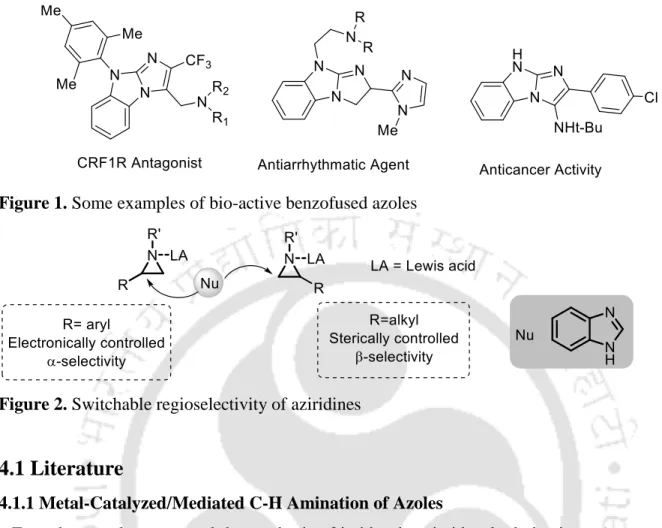
Chapter IV. Regioselective Cu(II)-Catalyzed Coupling of Aziridines with Benzimidazoles
Ru(II)-Catalyzed C7-Acyloxylation of Indolines with Carboxylic Acids
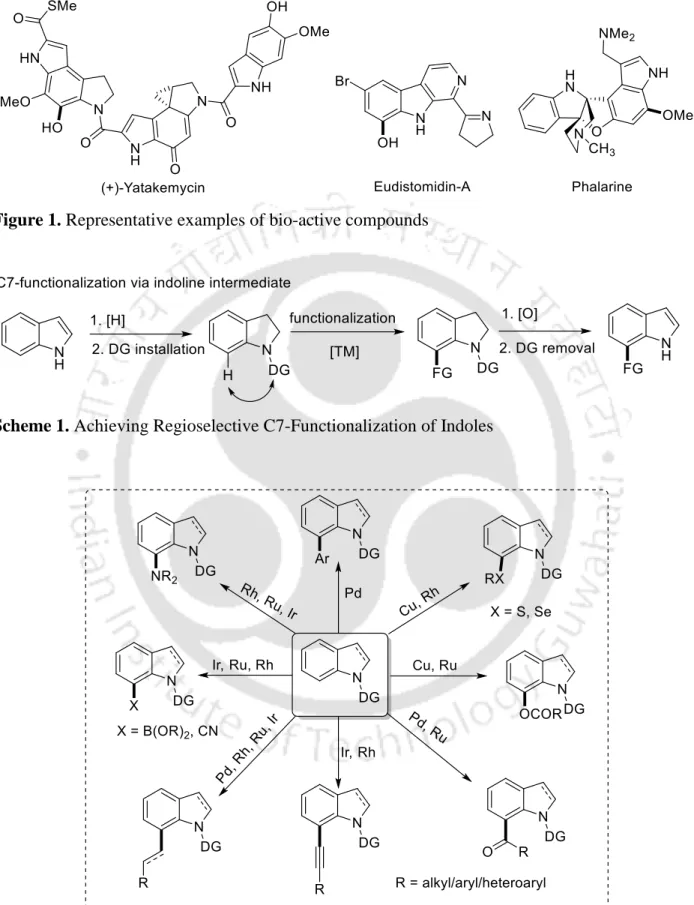
Achieving Regioselective C7-Functionalization of Indoles
Transition-Metal-Catalyzed C7 Functionalization of Indoles/Indolines
- Literature
- Rh-Catalyzed C-H Oxygenation of Arenes
Rh-Catalyzed C-H Oxygenation of 2-Aryl Pyridines
Directed Rh-Catalyzed C-H Oxygenation with Carboxylic Acids 1.1.2 Ru-Catalyzed C-H Oxygenation of Arenes
Cheng and co-workers reported a Rh(I)-catalyzed direct ortho-acyloxylation of aromatic C-H bond at high temperature, affording corresponding esters in moderate yields (Scheme 3).11 The reaction offers a broad substrate range such as alkyl and - unsaturated carboxylic acids are well tolerated. Zhong and co-workers demonstrated ortho-selective benzoxylation of 2-phenylpyridines with aromatic carboxylic acids using Pd(II) catalysis in (CH2Cl)2 under oxygen atmosphere (Scheme 7).15 Both electron-donating and electron-withdrawing 2-arylpyridines showed good reactivity in this regioselective protocol .
Pd-Catalyzed C-H Benzoxylation of 2-Aryl Pyridines
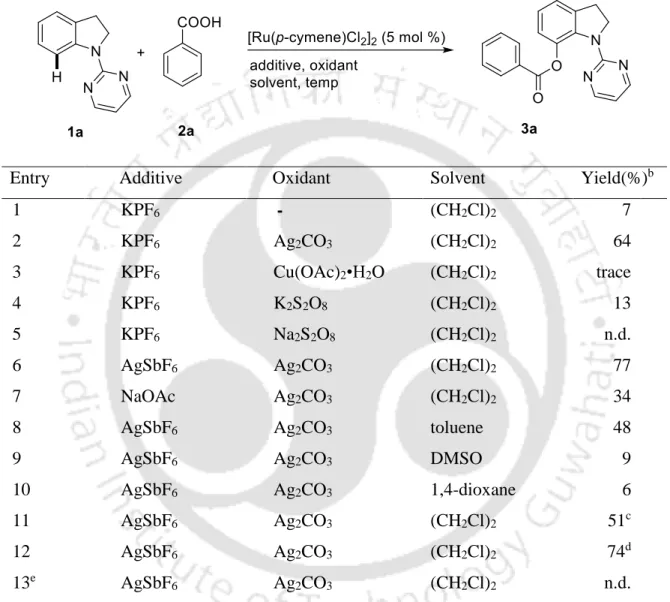
Our group reported a Ru-catalyzed positionally selective C-H acyloxylation of N-aryl-2-pyrimidines with carboxylic acids in the presence of AgSbF6 as an additive (Scheme 6).14 Several alkyl, aryl, heteroaryl, and unsaturated carboxylic acids and a variety of functionalized N-aryl-2-pyrimidines were used to find the general applicability of the methodology. Ortho-Selective C-H Oxygenation Using Ru Catalysis 1.1.3 Pd-Catalyzed C-H Acyloxylation of Arenes 1.1.3 Pd-Catalyzed C-H Acyloxylation of Arenes.
Regioselective Pd-Catalyzed C-O Coupling with Carboxylic Acids 1.1.4 Co-Catalyzed C-H Acyloxylation of Arenes
Positional-Selective Co-Catalyzed C-H Acyloxylation
Co-catalyzed C-H oxysylation of N-(quinolin-8-iel)bensamide 1.1.5 Cu-catalised C-H axis locsilation of Arenes 1.1.5 Cu-catalised C-H axis locsilation of Arenes. Cu-Catalised C-H Oxygenation of 2-Ariel-Piridiene 1.1.6 Au-Catalised C-H Benzoksylation of Arenes 1.1.6 Au-Catalised C-H Benzoksylation of Arenes.
Ag-Catalyzed Intramolecular C-H Oxygenation to Lactones
- Present Study
Michelet and co-workers use an Au-catalyzed direct C-H oxide deposition of arene with alkyl carboxyl to develop some PhI(OAc)2 as an oxidant under a solvent-free condition (Skema 13).20. Au-Catalyzed C-H Axis Decoupling of Arenes 1.1.7 Ag-Catalyzed C-O Cross-Coupling of Arenes 1.1.7 Ag-Catalyzed C-O Cross-Coupling of Arenes.
Screening of Directing Groups
Substrate Scope of Aryl Carboxylic Acids 2b-q with Indoline 1a
Substrate Scope of Alkyl Carboxylic Acids 2r-v with Indoline 1a
Substrate Scope of Indolines 1b-j with Benzoic Acids 2a
Competitive Experiment
Kinetic Isotope Experiments
To reveal the scale-up of this protocol, the reaction of 1a with 2a as the representative example was investigated (Scheme 22). Additionally, the ester can be hydrolyzed using base to produce 7-hydroxyindole 5 in 83% yield (Scheme 23).
Plausible Catalytic Cycle
In addition, kinetic isotope experiments using 1a and 1a-d with 2a in one-pot (kH/kD = 6.7) and side-by-side (kH/kD =2.65) indicate that C−H bond cleavage may be involved in the determination step speed. Chelation of the pyrimidyl nitrogen of 1 with Ru(II) carboxylate a can produce intermediate b together with RCOOH exclusion to give the six-membered ruthenium cycle c via C–H activation.
Gram-Scale Synthesis of 3a
Post-Synthetic Application
- Experimental Section
- Characterization Data
- References
- Selected NMR Spectra
After completion, the reaction mixture was diluted with ethyl acetate (30 mL) and washed with brine (2 x 5 mL) and water (1 x 5 mL). Drying (Na 2 SO 4 ) and evaporation of the solvent gave a residue which was purified on silica gel column chromatography using n-hexane and ethyl acetate as eluent to give 3a.
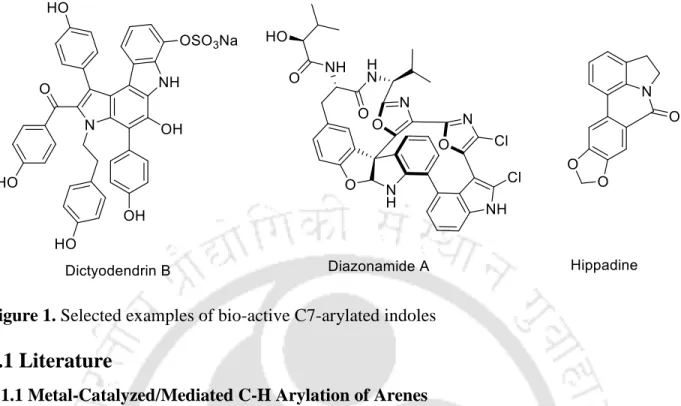
Co(II)-Catalyzed Site-Selective C7-Arylation of Indolines with Arylboronic Acids
Literature
- Metal-Catalyzed/Mediated C-H Arylation of Arenes
Shi and co-workers reported a direct C7 arylation of indoles using a di-tert-butylphosphine oxide as directing group under high-temperature Pd(II) catalysis in the presence of Ag2O and CuO as oxidants (Scheme 1).13 The use of pyridine-based ligand was shown to have a profound effect as it accelerates the product yield.
Pd-Catalyzed C7-Arylation of Indoles using Arylboronic Acids
Pd-Catalyzed Direct Suzuki Miyaura Coupling using Arylboronic Acids
Ru-Catalyzed C2-Arylation of Indoles using Arylsilanes
Rh-Catalyzed C-C/C-N Bond Formation Towards Phenanthridinones
Co-Catalyzed C2-Arylation of Indoles using Arylboronic Acids
Co-Mediated Positional-Selective C-H Arylation of Benzamides
Cu-Promoted ortho-C-H arylation using Arylboronic acids
Cu-Catalyzed ortho-Arylation using Arylboron Reagents
Fe-Catalyzed Regioselective C-C Bond Formation of Arenes
Ir-Catalyzed Coupling of Arenes using Diaryliodonium Salts
Directed ortho-Arylation of Benzamides under Ni-Catalysis
- Electrochemical Direct C-H Arylation of Arenes
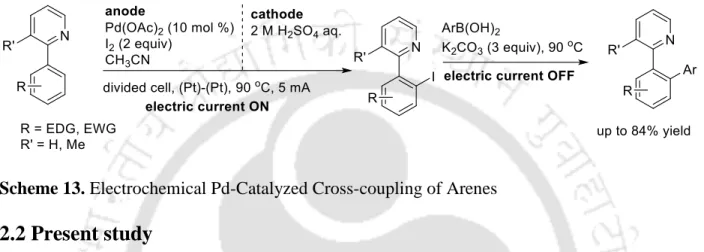
Electrochemical Pd-catalyzed ortho-arylation of 2-aryl pyridines via C–H iodination was developed by the Kakiuchi group.
Electrochemical Pd-Catalyzed Cross-coupling of Arenes
- Present study
A control experiment without the cobalt source resulted in no C7 arylation of the parent indoline (entry 22). Having established the efficient conditions for C7 arylation, the practical applicability of the protocol was assessed by engaging electronically varied arylboronic acids with indoline 1a as a standard substrate ( Scheme 14 ). Careful examination of the substituent pattern in the meta position on arylboronic acid, such as acetyl 2c, chloro 2d, methyl 2e, methoxy 2f and nitro 2g groups, effectively provided the corresponding arylated 3c–g in 54–65% yield regardless of their electronic effects.
Next, the robustness of the methodology was harnessed by extending the scope of the site-selective arylation of a series of substituted indolines with phenylboronic acid 2a as standard substrate (Scheme 15).
Preliminary Mechanistic Investigations
Based on preliminary mechanistic investigation and previous literature, a plausible mechanism is depicted in Scheme 17. Finally, reductive elimination of B can produce the target product with regeneration of cobalt(II) species to complete the catalytic cycle. Finally, to reveal the synthetic utility of the co-catalyzed arylation protocol, late-stage facile elimination of the pyrimidyl counterpart was achieved.
The C7-targeted arylated indoline 3a was oxidized to indole 4 in the presence of DDQ followed by base-promoted C–N bond cleavage to give 7-phenyl-indoline 5 in 84% yield ( Scheme 18 ).
Plausible Catalytic Cycle
First, MnII is oxidized to a MnIII complex under oxygen atmosphere, which reacts with CoII to form CoIII species. The latter can react with the substrate 1 to form the six-membered cobaltocycle A via the CMD (concerted metalation deprotonation) process. The aryl radical, formed by the reaction of arylboronic acid 2 with MnIII, can undergo a reaction with A to form the cobalt(IV) species B.
Late-State Removal of Directing Group
- Experimental Section
- Characterization Data of Products
- References
- Selected NMR Spectra
Drying (Na2SO4) and evaporation of the solvent gave a residue which was purified by column chromatography on silica gel using n-hexane and ethyl acetate as eluent to give analytically pure corresponding indolines. The reaction mixture was then cooled to room temperature and diluted with ethyl acetate (3 x 30 mL) and then washed with brine (2 x 10 mL) and water (1 x 10 mL). The reaction mixture was then cooled to room temperature and diluted with ethyl acetate (3 x 10 ml) and then washed with brine (2 x 5 ml) and water (1 x 5 ml).
Drying (Na 2 SO 4 ) and evaporation of the solvent gave a residue which was purified on silica gel column chromatography using n-hexane and ethyl acetate as eluent to give analytically pure substituted C7-arylated indolines.
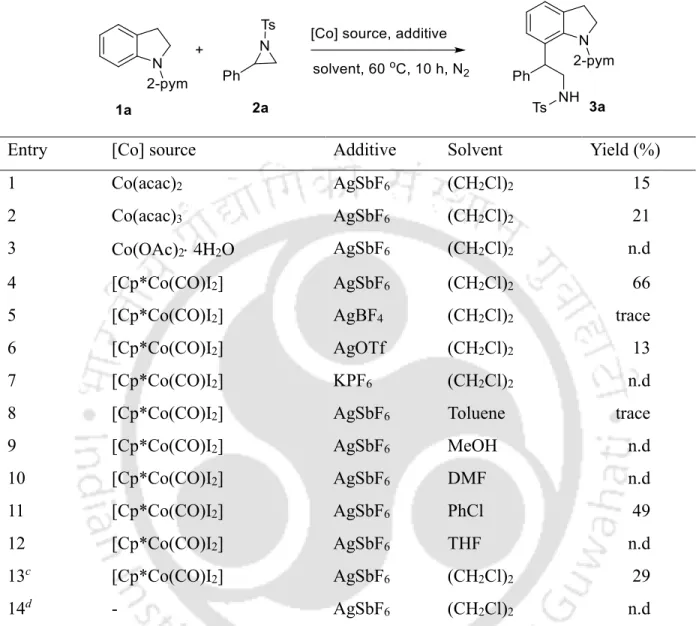
Cp*Co(III)-Catalyzed C-C Coupling of Indolines at C-7 Position with Aziridines via C-H Activation
- Transition-Metal-Catalyzed Ring Opening of Strained Three Membered Ring
- Literature
- Rh-Catalyzed Synthesis of Arylated Furans
- Directed Rh-Catalyzed C-C bond Formation using Cyclopropenones
- Co-Catalyzed C2-Alkylation of Indoles using Vinyl Cyclopropanes
- Rh-Catalyzed C-C Coupling of Arenes with Cyclopropanols
- Stereoselective Annulation of Methylenecyclopropanes
- Rh-Catalyzed Annulation of N-Aryloxyamides with Alkynylcyclopropanes 3.1.2 Reaction of Three Membered Heterocycles with Arenes
- ortho-Selective C-C Coupling of 2-Arylpyridines with Aziridines
- Pd-Catalyzed Regioselective C-H Alkylation using Aziridines
- Mn-Catalyzed Ring Opening of Oxiranes via C-H Activation
- Pd-catalyzed ortho-Alkylation Towards 3,4-Dihydroisocoumarins
- Cu-Promoted Selective Thioetherification of Arenes
Li and co-workers reported the C–C coupling of arenes with cyclopropanols as the coupling partner via Rh-catalyzed chelation providing β-aryl ketones via C–H activation and ring opening (Scheme 5).15 The authors extended their strategy for indole substrates by varying the addn. and temperature. Ackermann and co-workers described the stereoselective annulation of methylenecyclopropanes (MCPs) via C–H/C–C activation with ketimines to provide polycyclic anilines (Scheme 6).16 The authors presented detailed mechanistic studies for facile C–H manganation. Li and co-workers reported the rh(III)-catalyzed ortho-selective C–C coupling of 2-arylpyridines with aziridines for the synthesis of β-branched N-sulfonylethylamines in moderate to good yields (Scheme 8).18 Notably, the transformation silver salt activates both the aziridine as a Rh catalyst.
Dai and co-workers reported a selective thioetherification of arenes at ambient temperature using Cu as catalyst using thiarenes as thiolating agent (Scheme 12).22 This amide oxazoline.
Present Study
Substrate Scope of Aziridines 2b-p with Indoline 1a
Next, we investigated the substrate scope with respect to substituted indolines with aziridines 2a as a representative substrate (Scheme 14). Furthermore, 5-substituted indolines such as 5-bromo 1d , 5-benzoloxy 1e , 5-methyl 1f and 5-methoxy 1g were found to be well tolerated under identical conditions, affording 3u-v in 55- .
Substrate Scope of Indolines 1b-h with Aziridine 2a
Mechanistic Studies
Kinetic Isotope Studies
Proposed Catalytic Cycle
Post-Synthetic Application
- Characterization Data
- References
- Selected NMR Spectra
Drying (Na2SO4) and evaporation of the solvent gave a residue which was purified by silica gel column chromatography using n-hexane and ethyl acetate as eluent to give analytically pure C7 substituted alkylated indolines. After completion, as indicated by TLC, the reaction mixture was cooled to room temperature and diluted with ethyl acetate (15 mL). After completion, the reaction mixture was cooled to room temperature and diluted with ethyl acetate (1 x 15 mL).
Drying (Na 2 SO 4 ) and evaporation of the solvent gave a residue which was purified on silica gel column chromatography using n-hexane and ethyl acetate as eluent to give N-(2-).
Regioselective Cu(II)-Catalyzed Coupling of Aziridines with Benzimidazoles
Literature
- Metal-Catalyzed/Mediated C-H Amination of Azoles
Cu-Catalyzed Intramolecular C-H Amination of Azoles
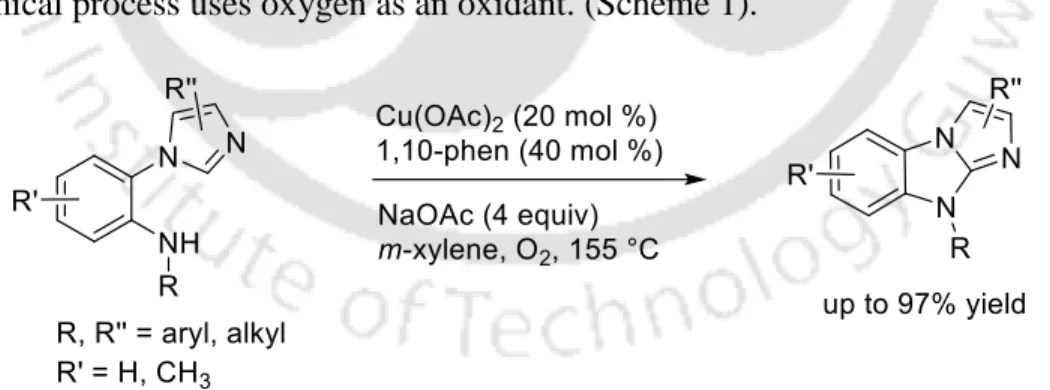
Fu and co-workers reported the synthesis of imidazobenzimidazole derivatives via copper(II)-mediated aerobic oxidative intramolecular sp2 C-H amination reaction at high temperature.9 This atom economical process uses oxygen as an oxidant. Fossey and coworkers developed a new method for the synthesis of multi-heterocyclic compounds from purine-based compounds though copper-catalyzed direct C-N bond formation via C-H amination. (Scheme 2).10.
Cu-Catalyzed C-N Bond Formation of Purine Compounds
Regioselective Fe-Catalyzed Intermolecular C-H Amination
Ni-Catalyzed Intramolecular C-H Amination of Benzoxazoles
Efficient heterogeneous -MnO2-catalyzed regioselective CN bond formation of benzoxazoles with a series of primary and secondary amines using molecular oxygen as oxidant has recently been accomplished by the Panda group. The catalyst can be reused several times after separation by filtration without significant loss of its catalytic activity (Scheme 5).13. Chang and co-workers reported co-catalyzed direct C–H amination of benzo-fused azoles with amines at room temperature.
Co-Catalyzed C-H Amination of Benzofused Azoles
Ag-Mediated C-H amination of Azoles with Formamides
- Amination of Azoles under Metal-free Approach
Studer and colleagues reported a metal-free protocol for the synthesis of 2-aminobenzoxazoles via intermolecular C-N bond formation of benzoxazoles with secondary amines by sacrificing the catalytic amount of triflic acid and N-oxoammonium salt (TEMPO+BF4) as oxidant. The authors demonstrated the synthetic application of the protocol for the synthesis of racemic MK-4305 in good yield (Scheme 8).16.
Synthesis of 2-Amino Benzoxazoles using N-Oxoammonium Salt
TBAI-TBHP-Catalyzed Intramolecular C-H Amination of Azoles 4.1.3 Electrochemical C-H Amination of Azoles
Electrochemical C-H Amination of Benzofused Azoles 4.1.4 Lewis Acid Catalyzed Aziridine Ring Opening/Cyclization
Cu-Catalyzed Ring Opening of Aziridines with N-Methyl Anilines
Cu-Catalyzed Ring Opening/Cyclization of Aziridines
Ring Opening of Aziridines with Benzyl Alcohols
- Present Study
After optimizing the reaction conditions, the substrate scope was explored with a series of 2-arylaziridines 1b-j using benzimidazole 2a as a representative substrate (Scheme 14). Next, the reaction of substituted benzimidazoles 2b–f was also investigated with 2-phenylaziridine 1a as a regular substrate (Scheme 15). Finally, the scope of the protocol was extended for the reaction of 2-alkylaziridines 1q–v with benzimidazole 2a as a representative substrate (Scheme 17).
Furthermore, the reaction of 2-isobutyl-, 2-benzyl and 2-(cyclohexylmethyl)aziridines 1t-v underwent reaction to provide the corresponding heterocycles 6d-f in 62-71% yields.

Reaction of 2,3-Disubstituted N-Tosylaziridine 1w with Benzimidazole 2a
One-Pot Cross-Coupling of Aziridine 1a with Benzimidazole 2a
Reaction of Optically Active Substrates
Proposed Catalytic Cycle
- Experimental Section
- Characterization Data of Products
- References
- HPLC Chromatogram
- Selected NMR Spectra
DRX-400 Varian and Bruker Avance III 600 spectrometers were used to record NMR (1H and 13C) spectra using CDCl3 as solvent and TMS as internal standard. The resulting material was then purified on a column using a mixture of n-hexane and ethyl acetate to produce analytically pure dihydroimidazobenzimidazoles. After cooling the reaction mixture to room temperature, PCy3 (20 mol %, 0.04 mmol, 11.2 mg), Na2CO3 (2 equiv., 0.4 mmol, 42.4 mg) was added to the same pot and the reaction mixture was stirred at 120 °C 6 h. The reaction mixture was transferred to column chromatography and m-xylene was eluted with hexane.
The resulting material was then purified on a column using a mixture of n-hexane and ethyl acetate to produce a mixture of regioisomers.
Thesis Overview
1 Copper-catalyzed stereoselective coupling of aziridines with benzimidazoles via nucleophilic ring opening and C(sp2)-H functionalization. 4 "Robust ligand-catalyzed cobalt(II)-catalyzed site-selective C7-arylation of indolines with boronic acids" De, P. 5 "Ligand-catalyzed cobalt(II)-catalyzed regioselective C7-arylation Boronic Acids" De, P.
6 “Regioselective copper-catalyzed cross-coupling of aziridines with benzomidazoles via nucleophilic ring opening and C(sp2)-H functionalization” De, P.