Synthesis of CO2-selective polymeric and mixed matrix membranes for CO2 separation from flue gas by facilitated transport mechanism. High-performance mixed matrix membrane (MMM), prepared by solution coating of PVA/PG/ZIF-8 solution on a polyethersulfone (PES) support, was used for CO2/N2 separation studies. Ghadimi, Gas permeation and sorption properties of poly(amide-12-b-ethylene oxide) (Pebax1074)/SAPO-34 mixed matrix membrane for CO2/CH4 and CO2/N2.
Gas transport mechanism in porous membrane 31
Knudsen diffusion 31
Where Cf and Cp are the concentration on the feed side and permeate side of the membrane and L is the membrane thickness. Donnellan, Kinetics and mechanism of the reaction between carbon dioxide and amines in aqueous solution, J.

Materials 43
Experimental 44
Synthesis of crosslinked PVA-PEG membrane 44
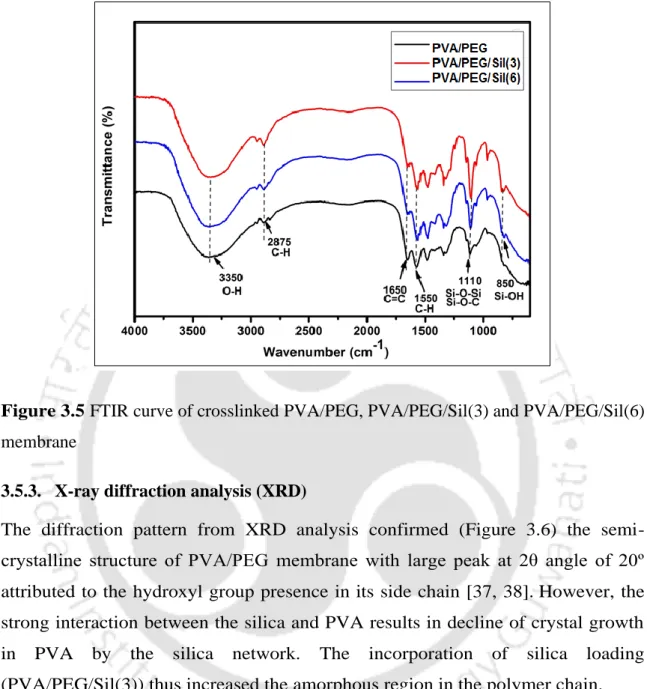
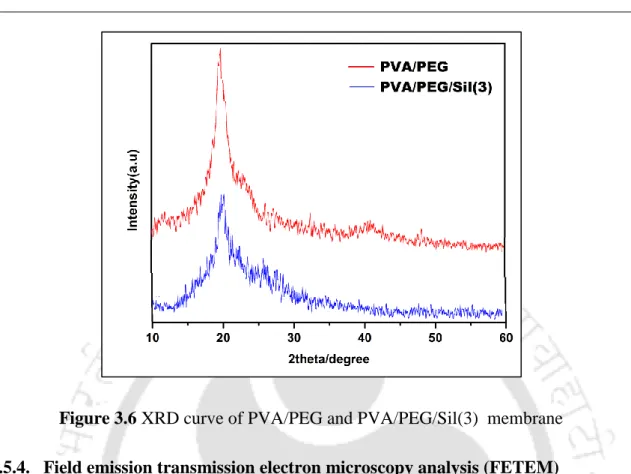
FTIR spectroscopy of PVA/PEG, PVA/PEG/Sil(3) and PVA/PEG/Sil(6) membranes is shown in Figure 3.5. The diffraction pattern from the XRD analysis confirmed (Figure 3.6) the semi-crystalline structure of the PVA/PEG membrane with a large peak at a 2θ angle of 20°, attributed to the presence of a hydroxyl group in its side chain [37, 38]. However, the strong interaction between silica and PVA results in the decline of crystal growth in PVA due to the silica network. These results could be attributed to the good interaction between the polymer and the filler, resulting in a significant improvement in CO2 separation efficiency.
The integrated positive effect of the amine carriers and the surface functionalization of nanoparticles provides improvement in the CO2 permeance and CO2/N2 selectivity. The FTIR characterization of the synthesized ZIF-8 filler, PVA/PG and PVA/PG/ZIF-8 membrane is depicted in Figure 5.4. The XPS analysis of the PVA/PG/ZIF-8 film was performed at a temperature of 24 ºC.
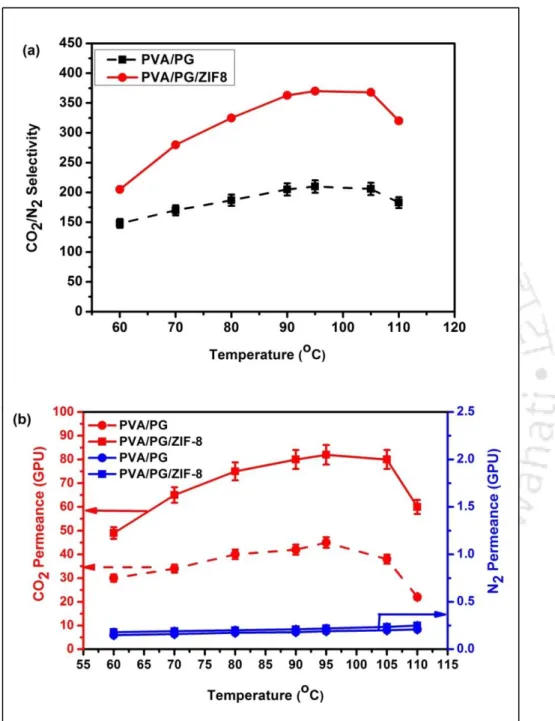
As observed in Figure 6.9(a), the CO2 permeance and CO2/N2 selectivity showed a gradual increase with temperature. FESEM analysis of the synthesized membranes established the homogeneous dispersion of the filler in the polymer matrix.
Synthesis of crosslinked PVA/PEG facilitated transport 44
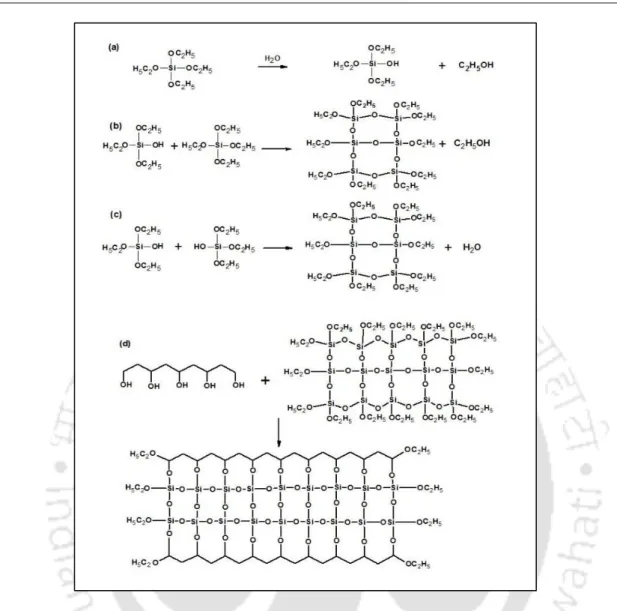
- Reaction mechanism 45
Synthesis of crosslinked PVA/PEG/Silica mixed matrix membrane 46
Then silica contents with filler of 3 wt% and 6 wt% were added to form PVA/PEG/Silica MMM. The MMM sample with silica loading of 3 wt% and 6 wt% was designated as PVA/PEG/Sil(3) and PVA/PEG/Sil(6), respectively.
Membrane characterization 47
Gas permeation study 47
TGA analysis of cross-linked PVA/PEG and PVA/PEG/Sil(3) membrane The thermal stabilities and weight loss regime of cross-linked PVA-PEG and PVA/PEG/Sil(3) membrane were determined using TGA curves (figure 3.4(b) )). It was observed that PVA/PEG/Sil(3) membrane showed higher stability than PVA/PEG membrane. However, for PVA/PEG/Sil(3) and PVA/PEG/Sil(6) membranes, an increase in the peak intensity in this range is attributed to the overlap of (Si-O-C) and (Si-OH) bonding, confirming the presence of silica in the membrane.
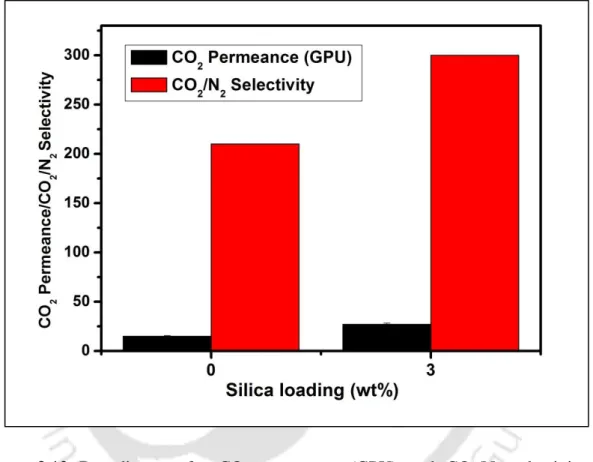
The CO2 permeability and CO2/N2 selectivity increased by 75% and 36%, respectively, for the PVA/PEG/Sil(3) membrane compared to the PVA/PEG membrane. Synthesis of cross-linked PVA/PEG/APTMS-Sil mixed matrix membrane A solution of cross-linked PVA/PEG polymer (10 wt.% of solid mass) was prepared [9]. FESEM analysis of PVA/PEG/Sil and PVA/PEG/APTMS-Sil membranes was performed as shown in Figure 4.4 (a, b).
The presence of dark spots in the PVA/PEG/APTMS-Sil membrane could be attributed to the presence of amine groups. An overview scan of the XPS spectrum (Figure 4.7 a) of the PVA/PEG/Sil and PVA/PEG/APTMS-Sil film (temperature ~ 24 ºC) revealed the presence of C, N, O, Si peaks.
CO 2 separation performance study of the membrane 79
Effect of temperature on CO 2 performance 79
Field emission scanning electron microscopy analysis 53
Effect of temperature on CO 2 performance 54
Effect of sweep water flow rate on CO 2 performance 57
Robeson’s curve 60
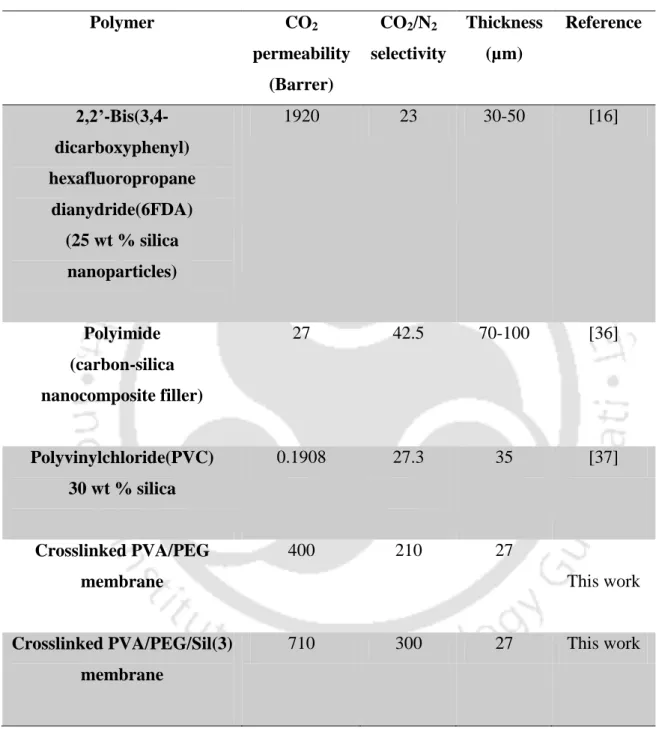
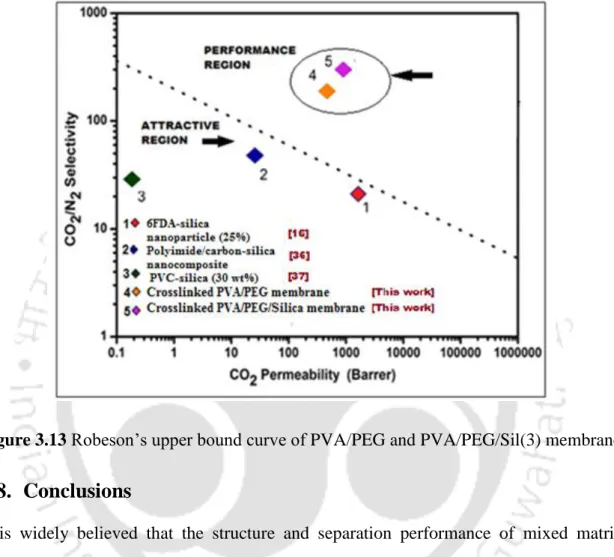
The experimental results in this work when compared to the polymer/silica combination reported in the literature exceeded the Robeson upper limit barrier with remarkable CO2 separation (Figure 3.13). Thus, PVA/PEG membrane and PVA/PEG/Sil(3) membrane.
Conclusions 61
The bonding between the polymer backbone and the functional groups of the filler materials improves the interaction with CO2. The inclusion of silica particles in the PVA/PEG matrix improved the gas permeability along with the structural, mechanical and thermal behavior of the membrane as discussed in Chapter 3. Thus the test established the successful binding of PEI amine to the surface of the ZIF-8 filler.
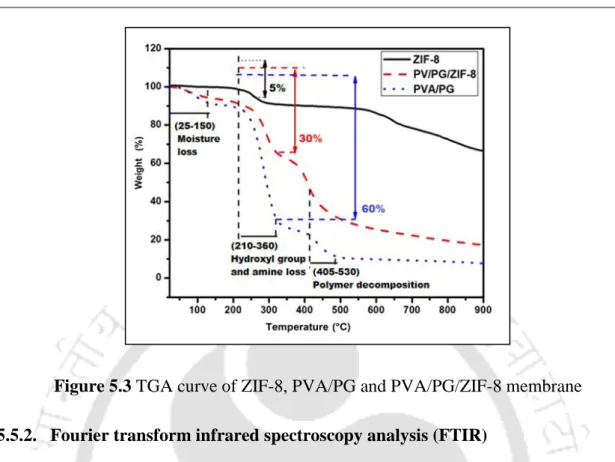
The novelty of this work is the incorporation of ZIF-8 filler into the PVA/PG membrane, the combination of which has not been reported for gas separation studies to date. The thermal effect of the polymer film was investigated using TGA analysis (TGA4000, Perkin-Elmer, USA). The top surface image of pure PVA/PG membrane confirms a smooth topography of the active layer.
AFM studies showed an increase in membrane roughness with increasing ZIF-8 loading. These phenomena could contribute to the interaction of polyethyleneimine (PEI) amine with ZIF-8. This result could be attributed to the molecular seeding properties of amino-functionalized ZIF-8 and the presence of amino groups in the ZIF-8 filler, which facilitates the reversible reaction of CO2-amine.
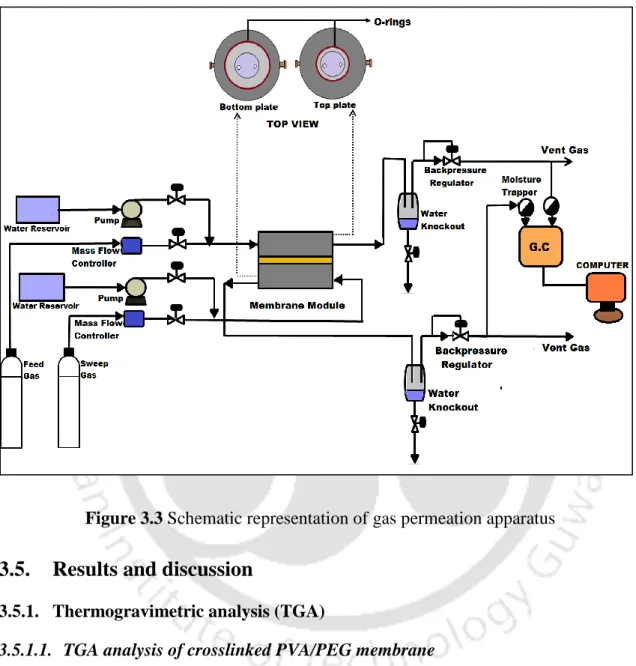
The increased compatibility between the polymer-filler group and the thermal and mechanical behavior of the membrane. The mixing gas supplied to the supply side of the membrane module consists of 20% CO2. The outlet connection of the MFC (flow range: 0-250 ml/min, maximum pressure limit: 1000 psi) flows via a humidifier to the supply side of the membrane module.

Materials 69
Experimental 69
- Synthesis of amino-functionalized silica (APTMS-Sil) 69
- Synthesis of crosslinked PVA/PEG/APTMS-Sil mixed matrix 70
The stress-strain curve (Figure 4.6) showed the positive effect of silica loading on the mechanical properties of the membranes. FESEM study established the increased surface roughness of the membrane with the incorporation of APTMS-Sil thereby improving the reaction surface which aids the CO2 permeability. Salooki, Effect of polyvinyl alcohol-modified silica particles on the physical and gas separation properties of the polyurethane mixed matrix membranes, Silicon.
It is also expected that the molecular sieving property of the ZIF-8 particle will separate the smaller CO2 gas molecules through its inner cavity and thus lead to the increase in CO2/N2 selectivity. The sharp peak at 3620 cm−1 is due to O−H bonding indicating the presence of water molecule in the crystal. The broad peak observed at 2θ of 19.8o corresponding to (101) plane for PVA/PG and PVA/PG/ZIF-8 membrane confirms the semi-crystalline structure of the membrane film.
The slight shift of the peak to the right in the case of PVA/PG/ZIF-8 membrane indicates the reduction in the PVA chain spacing, indicating close interaction between the polymer-filler material. The survey scan (Figure 5.8) of XPS spectrum of the PVA/PG/ZIF-8 film sample showed the existence of C 1s, N 1s, O 1s and Zn 2p peaks, which confirmed the successful formation and integration of ZIF-8 MOF in the membrane sample. Detailed characterization studies revealed the effect of amine functionalization on membrane mechanical strength.
The porous stainless steel support was held on the permeate side of the membrane module. The permeate section supplies pure argon gas (Ar) as a carrier to the permeate side of the membrane module. Other connections of the permeate side were similar to the feed side with separate MFC (flow range: 0-250 ml/min, maximum pressure limit: 1000 psi).
Materials 94
Experimental 95
- Synthesis of piperazine glycinate salt 95
- Synthesis of crosslinked PVA/PG membrane 95
- Synthesis of ZIF-8 nanocrystal 96
- Synthesis of crosslinked PVA/PG/ZIF-8 mixed matrix membrane 96
Stoichiometric amount of glycinate aqueous solution was prepared with continuous stirring under ambient conditions for 2 hours. The piperazine and glycinate salt were further mixed together and stirred continuously for another 2 h until a homogeneous solution of PG cellular carrier was formed which was used for MMM preparation. Here, the pollutant solution was cast onto porous poly support (ether sulfone) (average pore size: 0.03 µm).
An aqueous solution of PVA (10 wt.% of solids) was prepared with constant stirring at a temperature of 90 C, which was maintained constant with an oil bath. The PVA solution was in situ cross-linked with formaldehyde at a ratio already optimized in our previous studies. Then, the prepared PG salt solution fixed at a mass ratio of 70 and 30 was added to form the final cross-linked PVA/PG polymer solution.
The final centrifuged solution was then cast onto the porous PES support held on the glass plate. The ligand solution was prepared by adding 6.48 g of 2-methylimidazole (Hmim) to 200 ml of methanol.

Membrane characterization 97
Results and discussion 98
- Thermogravimetric analysis (TGA) 98
- Fourier transform infrared spectroscopy analysis (FTIR) 99
- X-ray diffraction analysis (XRD) 100
- Field emission transmission electron microscopy analysis (FETEM) 101
- Field emission scanning electron microscopy analysis (FESEM) 102
- X-ray photoelectron spectroscopy analysis (XPS) 103
Bands below 800 cm−1 were attributed to out-of-plane bending of the rings. The functional groups present in PVA/PG and PVA/PG/ZIF-8 membranes were investigated. FTIR spectra of PVA/PG/ZIF-8 film confirmed the presence of ZIF-8 nanoparticles and PVA film.
The peak intensity of OH bonding increased with a small shift, thereby confirming interaction with the ZIF-8 particles for PVA/PG/ZIF-8 membrane. The new peak at 1650 cm-1 confirms the N-H bending for PVA/PG/ZIF-8 membrane, thereby confirming the interaction of PG-amine with ZIF-8. The crystalline structure of as-synthesized ZIF-8 powder, PVA/PG and PVA/PG/ZIF-8 membrane was investigated by XRD analysis as shown in Figure 5.5.
For the PVA/PG/ZIF-8 membrane, homogeneous distribution of ZIF-8 in the matrix is observed, thus confirming the excellent compatibility and interaction between the polymer-filler interface. The cross-sectional view for both PVA/PG and PVA/PG/ZIF-8 membranes confirmed the formation of a 4µm thick dense active layer on the PES support.
CO 2 separation performance study of the membranes 104
However, for the PVA/PG/ZIF-8 membrane, a large increase in CO2 permeability and CO2/N2 selectivity is observed at higher temperature. The compatibilization of ZIF-8 filler in the PVA/PG matrix resulted in increased CO2 permeability and CO2/N2 selectivity. Abstract PEI graphic amino-functionalization of ZIF-8 and PVA/PG/ZIF-8@PEI mixed matrix membrane.
The transmittance results obtained experimentally in this work far exceeded the upper bound Robeson curve (Figure 6.11). This result discussed the effect of amine impregnation on ZIF-8 filler on the CO2 efficiency and mechanical properties of the membrane. The excellent compatibility of the ZIF-8 filler in the PVA/PG matrix resulted in improved CO2 permeability and CO2/N2 selectivity. The remarkable molecular seeding properties of fine-tuned amino-functionalized ZIF-8, which allows the selective passage of gas molecules and amino groups in highly branched polyethyleneimine (PEI), facilitating the CO2-amine reaction mechanism, revealed a potential and novel mixed matrix membrane for CO2 separation.
The effect of impurities from industrial flue gases such as SOx and NOx on gas performance and membrane stability can be studied. Also, a rigorous model can be developed for the successful design of the membrane transport process. The pressure on the feed side of the membrane module was maintained by the back pressure regulator (0-20 bar) connected to the outlet of the feed side membrane module.
Finally, the plug of the back pressure regulator was connected to the G.C for compositional analysis.