The work in this thesis entitled "Nonlinear Dynamics in P T-Symmetric Optical Systems" was carried out by me under the guidance of prof. It is certified that the work contained in the thesis entitled "Nonlinear Dynamics in P T-Symmetric Optical Systems" by Mr.
ACKNOWLEDGMENTS
I would like to thank the most special friends in my life at the University of Delhi. I would like to thank the oldest friends of my life, Dristirupa Patgiri and Jubaraj Jnanbikash Baruah, with whom I have been friends for more than twenty-five years.
A BSTRACT
L IST OF P UBLICATIONS AND C ONFERENCES A TTENDED
Journal Publications
L IST OF F IGURES
The red colored area is the non-convergent area, which means the presence of periodic and chaotic oscillations. The black colored region is the divergence region and in this region the optical power in both resonators diverges to infinity.
I NTRODUCTION
- Introduction
- HAMILTONIAN APPROACH
- Hamiltonian Approach
- TRANSFER MATRIX APPROACH
- Transfer Matrix Approach
- HARMONIC OSCILLATOR APPROACH
- Harmonic Oscillator Approach
- Organization of the Thesis
- ORGANIZATION OF THE THESIS
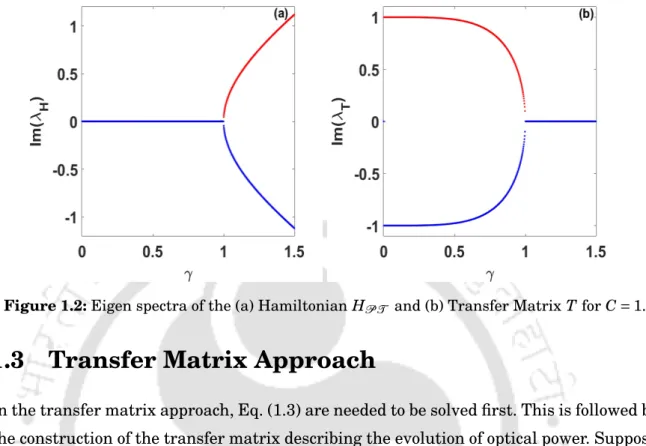
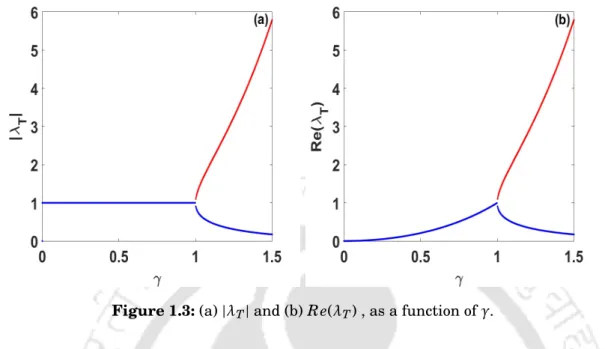
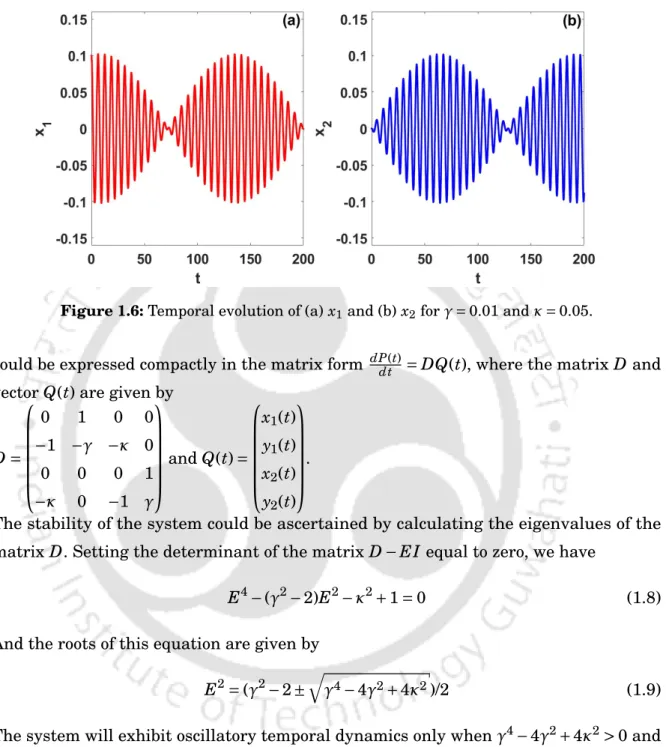
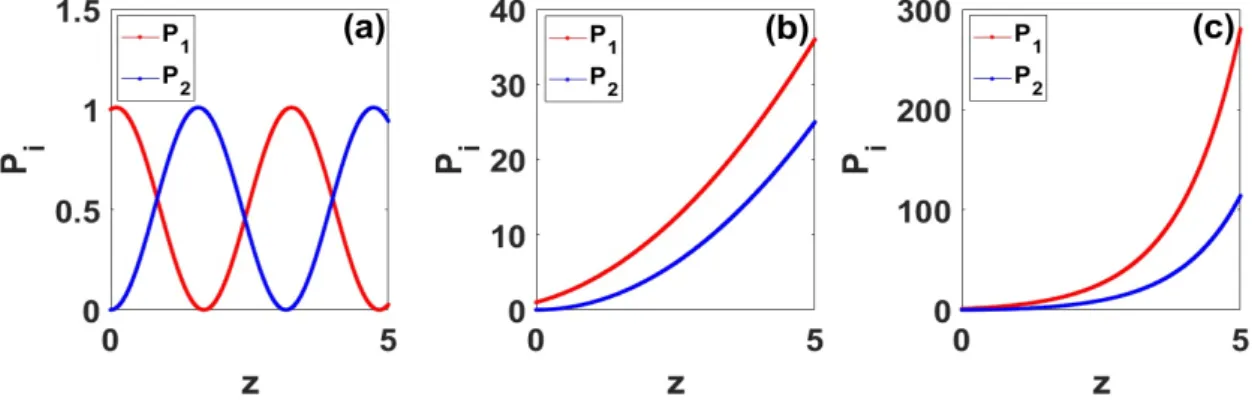
The reason for this can be found in the analysis of the supermodes of the system. We would now study the temporal evolution of the two oscillators in the broken and unbroken PT regimes.
M ETHODOLOGY
- Introduction
- STABILITY ANALYSIS OF NONLINEAR SYSTEMS
- Stability Analysis of Nonlinear Systems
- Quantification of Chaos
- QUANTIFICATION OF CHAOS
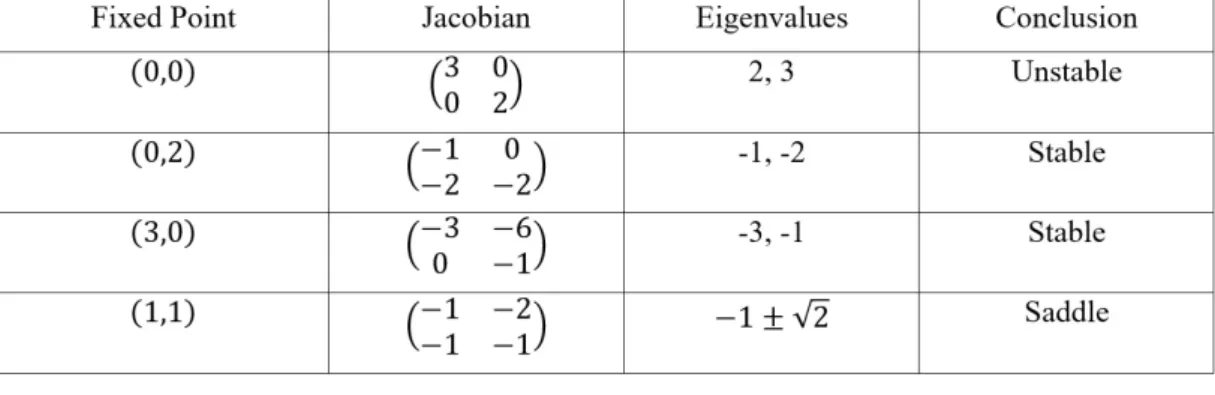
From the eigenspectra of J, the stability of the fixed points is summarized in the table given in Fig. This could be easily seen from the bifurcation diagram of the logistic map in fig. It could be seen that beyond a critical value of parameter α, there is the entry of chaotic dynamics into the system, and this path to chaos is known as the period-doubling cascade to chaos.
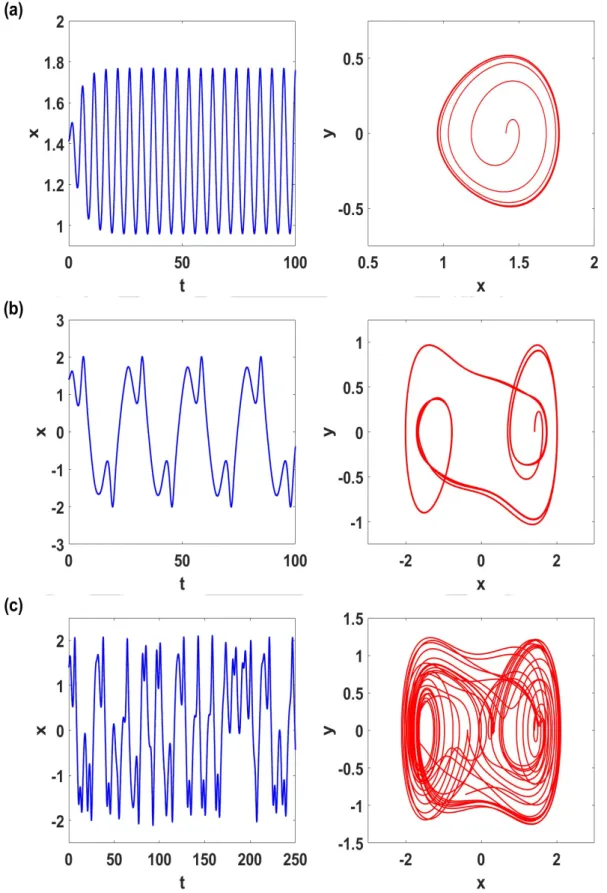
To illustrate these two methods, we will use the Logistic Map and the Duffing Oscillator as examples. The analysis of the stability of the potential extrema gives us a physical picture of why we have chaotic dynamics in the Duffing driven oscillator. Choosing the initial state of the selected system to be (p . −η/β, 0, 0), we have shown it in Fig.
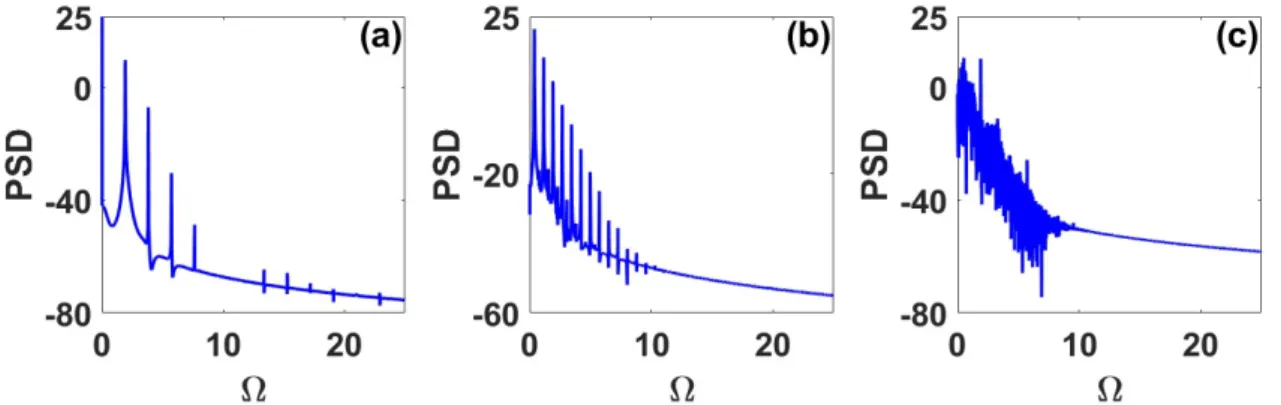
2.5, we plotted the temporal evolution and the phase level of the driven Duffing oscillator for three cases of the driving signal amplitude. This leads us to the conclusion that increasing the amplitude of the driving signal causes the emergence of a chaotic attractor in the driven Duffing oscillator.
P ERTURBATIVE DYNAMICS OF STATIONARY STATES IN A NONLINEAR P T -S YMMETRIC COUPLER
- Introduction
- Modelling
- STABILITY ANALYSIS AND DISCUSSION
- Stability Analysis and Discussion
- Summary
- SUMMARY
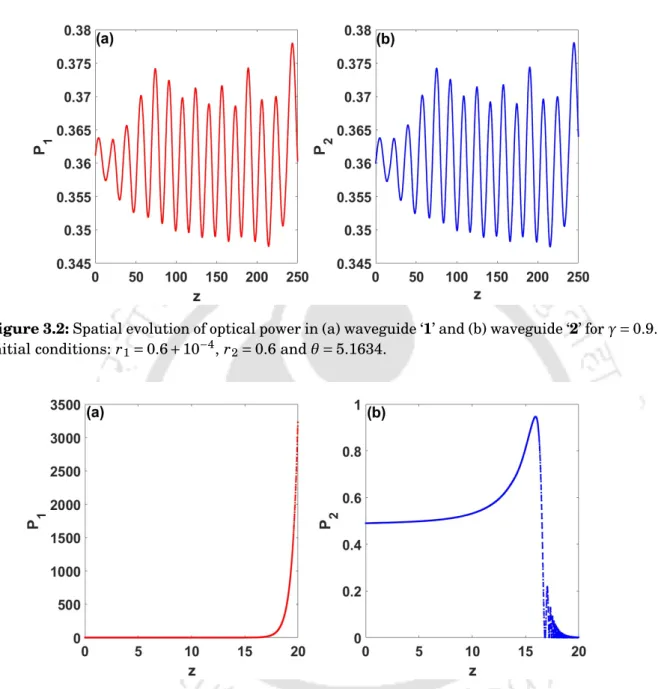
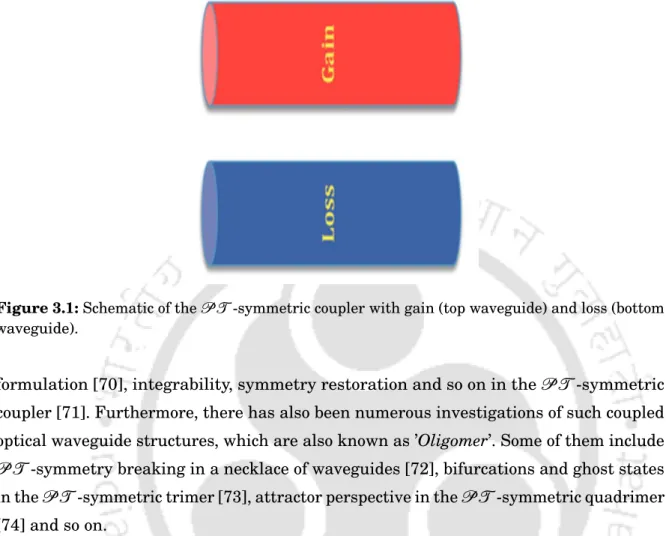
A complete stability analysis of the steady states of the system is performed using the Jacobian linearization approach. We have further studied the effect of fluctuations in the gain/loss ratio of waves as well. From these eigenvalues, we can see that the initial starting conditions represent another threshold in the stability of the system.
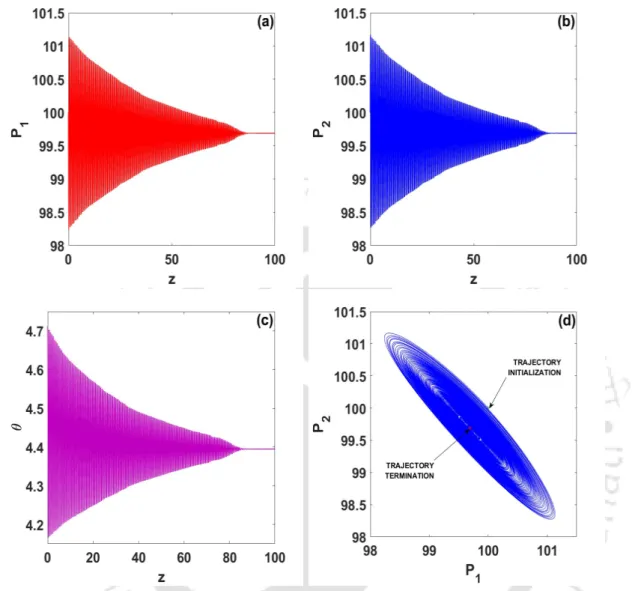
This was done to visualize the stability of the initial launch conditions under the influence of fluctuations. For the analysis according to the dynamics of the system at the P T threshold, we choose C=1. 3.5 (a-c) shows the decline in the oscillations of the development of optical power and relative. phase shift along the propagation distance.
Thus, the dynamics of the real and imaginary components of the field amplitudes could be shown. The attractor behavior of the system was also studied under fluctuations in the profit/loss ratio.
C HAOTIC D YNAMICS IN F IBER R ING R ESONATORS WITH BALANCED GAIN AND LOSS
- Introduction
- Controllable chaotic dynamics in nonlinear fiber ring resonators with balanced gain and loss*
- CONTROLLABLE CHAOTIC DYNAMICS IN NONLINEAR FIBER RING RESONATORS WITH BALANCED GAIN AND LOSS*
- Theoretical Modelling
- Results and Discussion
- Summary
- Optical Power Saturation and Chaotic Dynamics in a P T -Symmetric Double Ring Resonator*
- OPTICAL POWER SATURATION AND CHAOTIC DYNAMICS IN A P T -SYMMETRIC DOUBLE RING RESONATOR*
- Theoretical Modelling
- Results and Discussion
- Summary
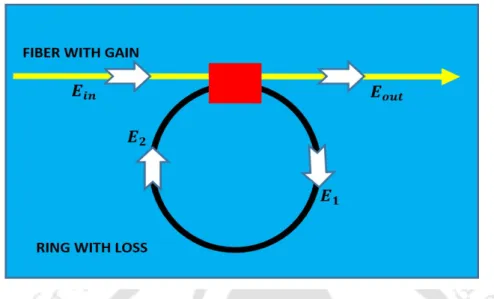
The number of round trips that light takes in the resonator (or iterations) shows how the optical power develops in the resonator. The role of the loss parameter γ can be illustrated by a bifurcation diagram of optical power in the resonatorPres= |E2|2vs. In addition, the fluctuations in the optical power at the output port can be controlled by changing the value of γ.
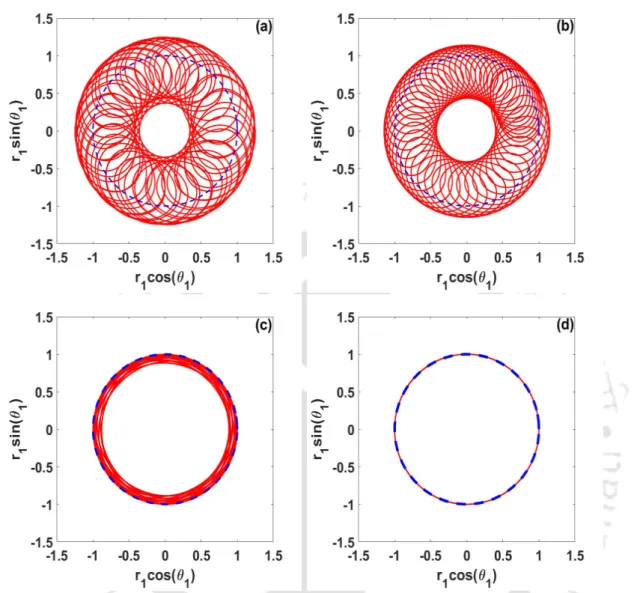
This will lead us to an indirect inference for the cause of optical power saturation in the system. In the unbroken PT regime, however, it could be seen that the radius of the hypersphere is of limited size. On the other hand, in the non-converging region, it will oscillate for a period-N cycles (where N>1).
In the absence of nonlinearity, we observed optical power saturation below the P T threshold and swelling above the P T threshold. We found that optical power saturation occurs in the discontinuous P T regime due to the existence of stable stationary states on the surface of the 4D hypersphere.
H IGHLY A MPLIFIED L IGHT T RANSMISSION IN
P T -S YMMETRIC M ULTILAYERED S TRUCTURE
- Introduction
- Theoretical Modelling
- THEORETICAL MODELLING
- RESULTS AND DISCUSSION
- Results and Discussion
- SUMMARY
- Summary
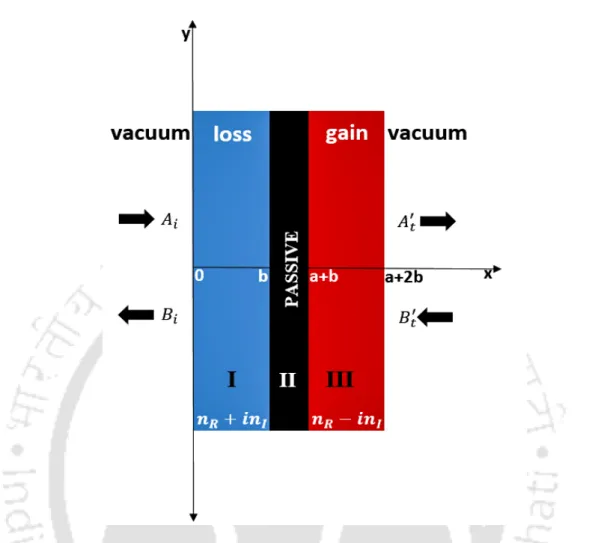
From the transfer matrix, the transmission and reflection of the structure are studied in the broken and unbroken PT regime. The eigenspectra of the transfer matrix are evaluated numerically, followed by a numerical investigation of the transmission and reflection characteristics of the structure and using FDTD simulation in section 5.3. The length of the nanofilm is very small compared to the loss and gain regions.
5.2 we note that as nI increases, the imaginary component of the eigenvalues of the transfer matrix ceases to be imaginary above the threshold P T. 5.7(a) shows the eigenspectra of the transfer matrix as a function of the loss/gain parameter nI. We note that in the range nI the imaginary component of the eigenvalues reverses its sign.
5.7(b), we can see that the transmission coefficient of the structure shows a sharp peak in the same region. Moreover, we can see that the imaginary component of the eigenvalues reverses its sign in the range nI=0.41−0.43.
L IÉNARD S YSTEMS
- Introduction
- MATHEMATICAL MODEL
- Mathematical Model
- Case I: δ = 1
- RESULTS AND DISCUSSION
- Case II: δ = 2
- Experimental Realization
- EXPERIMENTAL REALIZATION
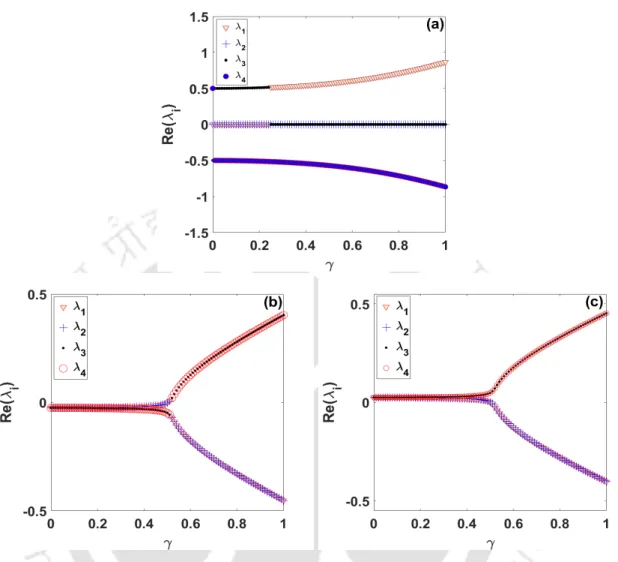
In the first configuration, we study the stability of the steady states under variations in the gain/loss coefficient. Moreover, it could be seen that the initial conditions correspond to the excitation of the gain oscillator. From our study it could be deduced that the temporal dynamics of our system are significantly affected by the strength of the external chirp modulation.
6.4 we have plotted the temporal evolution of the gain oscillator for three cases of the strength of chirped modulation in the external disk. You could see that as we reduce the strength of the external chirp modulation, the inflation dynamics in the gain oscillator ceases to exist and an aperiodic temporal dynamics emerges for ψ=10−5 (Fig. 6.6, we have the phase plane trajectory of the gain oscillator for all three frequencies of the oscillator.
Spectral analysis of the Jacobian showed us that the system has a stable, an unstable and a saddle point. On the other hand, the order-2 model gives rise to the quasi-periodic route to chaos in the neutrally stable regime of the Jacobian eigenspectra.
C ONCLUSION
And then, we showed the appearance of the chaotic growth of the optical power in the nonlinear regime as a result of the extremely high Lyapunov exponent. We mathematically modeled this structure using the transfer matrix formalism, which could be constructed from the boundary conditions of the electric and magnetic fields at each interface. We discussed the optical power propagation characteristics in the continuous and broken P T regime for both cases of the output power from each of the two ports.
Next, we showed how varying the layer length can generate spectral singularities in the eigenspectrum of the S matrix and how this can be attributed to the imaginary component of the eigenvalues of the transfer matrix by reversing its sign. In the first case, the stability analysis of the Jacobian eigenspectrum of the linearization showed us that the systems admit a stable, unstable fixed point and a saddle for our choice of parameters. Subsequently, it was found that a sinusoidal machine with external chirps can control such dynamics and, moreover, such a machine can initiate the appearance of the death of oscillations in the system.
In the second case, the non-trivial stable fixed point of the first configuration has a neutrally stable regime, in which the system is observed to exhibit quasi-periodic time dynamics. Moreover, at a certain value of the oscillator frequency, the temporal dynamics exhibits chaotic trajectories of the phase plane and thus, it can be concluded that the second configuration exhibits the quasi-periodic path to chaos.
Future Aspects
Investigations on Kerr nonlinearity-induced P T threshold and self-stabilizing characteristics of the P T symmetric nonlinear coupler can also be extended to larger and more complicated coupled optical waveguide structures such as the trimmer [20] and quadrimer. Moreover, the collective dynamics of optical power oscillation in passive as well as P T-symmetric coupled waveguide structures is an interesting topic of research for consideration in the future. Furthermore, in the P T-symmetric multilayer structure discussed in this thesis, discussion of the transmission and reflection properties of the system is limited to normal incidence of light.
Thus, the greatly enhanced transmission in the infrared spectrum and the spectral singularity of the structure for other incident angles is definitely a research topic that should be considered. Thus, in conclusion, we could very well say that our work has shed light on various future aspects that could be explored in T-symmetric optical systems from a dynamical perspective, and to report much richer temporal dynamics and interesting properties of such systems.
B IBLIOGRAPHY
Sarisaman: One-way reflectionlessness and invisibility in TE and TM modes of aP T-symmetric plate system, Phys. Sarma: Solitary waves in parity time (P T)-symmetric Bragg grating structures and the existence of optical rogue waves, Europhys. Haelterman: Period doubling bifurcations and modulation instability in a nonlinear annular cavity: An analytical study, Opt.
Chui: Theory of spontaneous decay growth in plasmonic nanoparticles based on a singularity representation of the scattering matrix, Phys. Van der Mark: The heartbeat is considered a relaxation oscillation, and an electrical pattern of the heart, Phil. Selverston: Modeling the central generator of the crayfish gastric mill model with a relaxor-oscillator network, J.
Hilborn: Quantitative measurement of the parameter dependence of crisis onset in a driven nonlinear oscillator, Phys. Thamilmaran: Transient chaos in a globally coupled system of nearly conservative Hamiltonian Duffing oscillators, chaos, solitons and fractals.