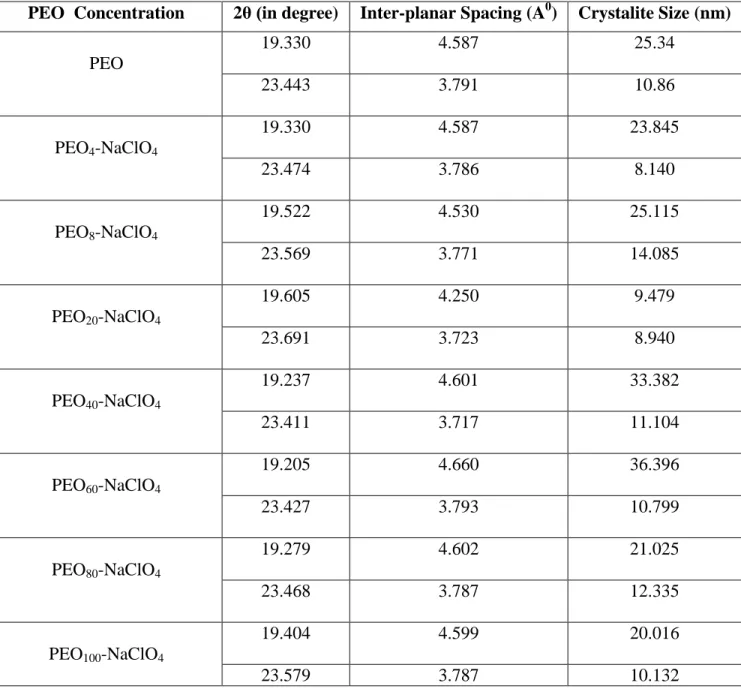
This is to certify that the thesis entitled "Preparation and Characterization of Polymer Electrolytes" submitted by Suchetana Sadhukhan in partial fulfillment of the requirements for the award of the degree of Master of Science in Physics at National Institute of Technology, Rourkela is an authentic is experimental. work carried out by her under our supervision. I am very grateful to all the research scientists of the department and my classmates in particular, Miss Amlan Swetapadma Senapati, for their inspiration and help. The crystallite size and inter-planar spacing of the polymer electrolytes were calculated for XRD data.
The SEM images confirmed the existence of the crystalline spherulite phases separated by an amorphous boundary. Despite the popularity of using liquid electrolytes, there are several significant disadvantages to liquid electrolytes. Due to the flow of the liquids, leakage is the biggest problem with devices that use liquid electrolytes.
The boiling point of the solvent used limits the temperature range of operation of the device. It is much safer due to the absence of flammable organic solvent and lower reactivity of macromolecules towards the alkali metal inhibits the corrosion of the electrodes which consequently increases the lifetime of the device. At the same time, local relaxation at the atomic level provides liquid-like degrees of freedom that are not significantly different from those of the conventional liquid.
Due to the above excellent properties of polymers, the idea of using polymer electrolyte has been conceived by the scientific community compared to other solid electrolytes.
STRUCTURE AND MORPHOLOGY OF POLYEHYLENE OXIDE
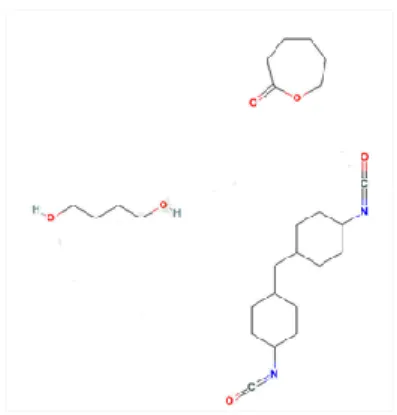
STRUCTURE AND MORPHOLOGY OF POLYURETHANE
LITERATURE SURVEY
A sodium ion conducting polymer electrolyte based on polyvinylpyrrolidone (PVP) complexed with NaClO4 was prepared using the solution casting technique. The ionic conductivity and transfer number measurements were performed to characterize the polymer electrolyte for battery applications [11]. Softened composite polymer electrolyte based on polymer salt complex of PEO-NaClO4, SnO2 asceramic filler and polyethylene glycol (PEG200) as plasticizer was prepared and analyzed.
An improvement in electrical conductivity has also been observed without any sharp deterioration in the thermal, electrochemical and mechanical stability of the PCPE thin films [12]. Blend-based polymer electrolytes of PEO and fully amorphous cross-linked poly(ethylene oxide-co-propylene oxide) were prepared and their thermal behavior, surface morphology, electrical and mechanical properties were systematically investigated.
OBJECTIVES
ORGANIZATION OF THE THESIS – This thesis has been discussed in four chapters
Presents the conclusion drawn from the present work
SAMPLE SYNTHESIS
- DIFFERENT METHODS OF PREPARATION
- PROCEDURE
The essential criteria for selecting a solvent are that it must be anhydrous, have a boiling point not above 65 0C, and at the same time should be a common solvent for both salt and polymer. The main advantage of this method is that drying can be carried out at temperatures of around 65ºC. This is necessary since most polymers used in these studies have a melting point of maximum value around 65ºC. The following steps are involved in this method:
Instead of casting the film onto a substrate, in this method the mixture is dropped onto a substrate and placed in a spin coater that can be rotated at an adjustable rotational speed. The film thickness can be controlled by adjusting either the viscosity (concentration) of the mixture or the speed of rotation. However, this method is only available if the viscosity of the mixture is not too high.
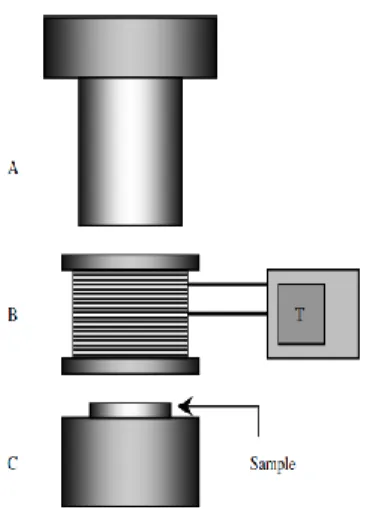
For a gel mixture, the spin coating rotation is not enough to disperse the mixture droplet to form thin film. Hot press technique equipment is illustrated in Figure 2.1. The equipment consists of: (A) weighing cylinder, (B) heating chamber, (C) cellar and (T) temperature controller. The powder mixture is then sandwiched between two sheets of Mylar or other materials and placed in the heating chamber which is controlled at temperatures above the melting point of the polymer.
The sample is then compacted overnight with a pressure that can be controlled by a weighing cylinder. We chose the solution casting method, as it is the simplest of all methods. Another advantage of this method is that it can be used to produce a polymer film from a micrometer to a few millimeters thick.
An appropriate ratio of the polymer host, PEO, was taken and dissolved in 20 mL of acetonitrile and left overnight for swelling. After swelling the polymer in acetonitrile, an appropriate amount of salt was dissolved in the solution. The solution was poured into petridishes and allowed to evaporate slowly at room temperature, followed by vacuum drying.
Salt
CHARACTERIZATION
One can investigate the composition and structure (including defects significant for a particular preparation), and study the properties such as structure, surface morphology, thermal, electrical, mechanical, optical, etc., before using the material with various experimental techniques.
2d sinθ = nλ
RESULTS AND DISCUSSION 1 XRD Analysis
- SCANNING ELECTRON MICROSCOPE ANALYSIS
- INFRARED SPECTROSCOPY STUDY
- STUDY OF ELECTRICAL PROPERTIES
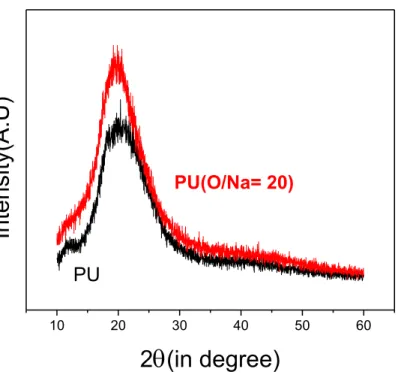
The polymer-lat complexes have similar XRD pattern to that of the host PEO indicating the complexation of polymer with salt. No extra peaks are observed in the XRD patterns of complexes indicating that salt is not precipitated. The XRD patterns of PU and after addition of NaClO4 salt with PU20-NaClO4 are shown in the Fig 3.2.
There is no systematic change in surface morphology with different polymer-to-salt ratios. It is observed from the figures that the surface morphology becomes smoother compared to PU when salt is added to PU. There are significant changes in the peak positions, peak intensities and FWHM of the polymer electrolyte peaks when salts are added to the polymer.
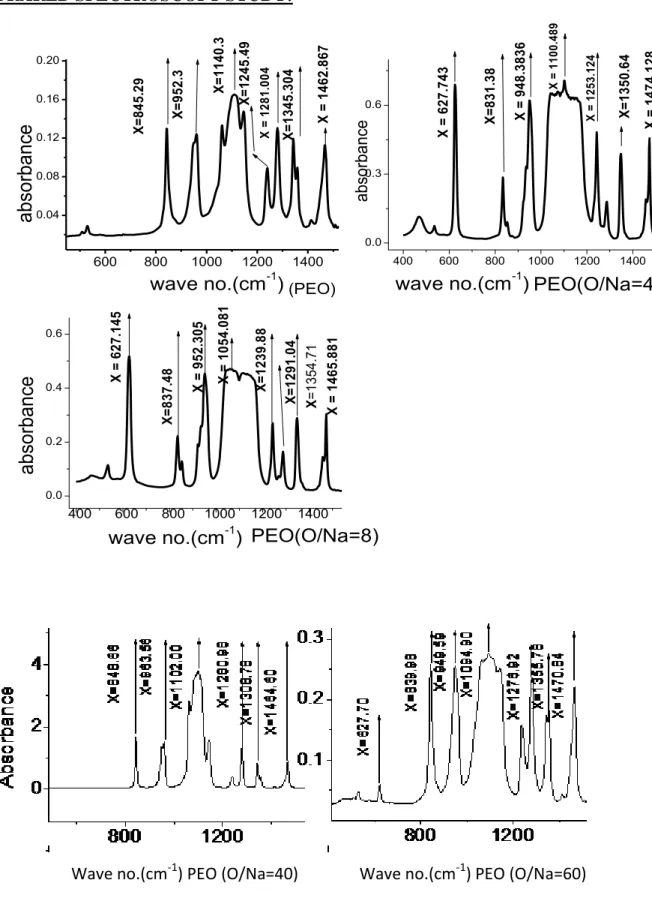
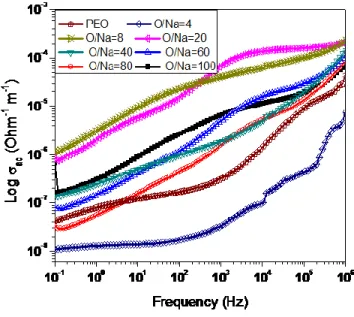
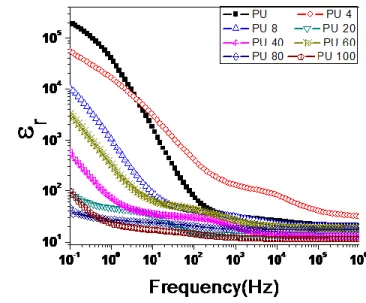
Different types of connections and different types of modes are observed in the IR graphs which are given in the table below. Complex impedance spectroscopy is a powerful technique to study relaxation phenomena in materials and also to calculate d.c. For all cases, the relative dielectric constant decreases significantly in the lower frequency region and shows a frequency-independent value in the higher frequency region, regardless of the polymer to salt ratio.
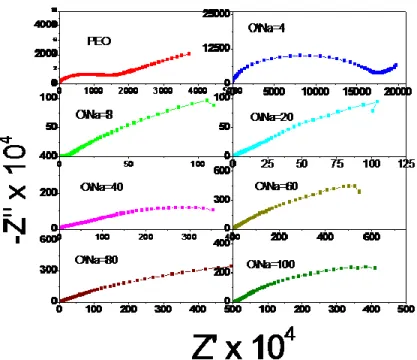
The appearance of peaks for each concentration in the loss spectrum (tangent loss) suggests the presence of relaxing dipoles in the polymer electrolyte. The AC conductivity (ζac) of the material was calculated from measured dielectric data using a relationship. The typical complex impedance spectra (i.e. Nyquist plot) of the samples consist of a broadened semicircle in the high frequency region, followed by a tail (peak) in the lower frequency region for a low polymer-to-salt ratio.
The high-frequency semicircle is due to the bulk properties, while the low-frequency peak arises due to the material-electrode interface of the material. The intersection of the semicircle with the real axis (Z') gives rise to the bulk (ionic) resistance (Rb) of the materials. There is a strong frequency distribution of permittivity is observed in the low frequency region followed by an almost frequency independent behavior at higher frequency region.
The AC conductivity, ζac of the material, is calculated using the measured dielectric data using equation (iii). The structural, microstructural/morphological, vibrational and electrical properties of the polymer electrolyte were studied using various experimental techniques.