I am grateful to Mr. Jayanta Kumar Mout, Junior Technical Superintendent, Department of Chemical Engineering, for his timely assistance both technical and personal, without any hesitation has been invaluable. My sincere thanks to Mr. Ananth Praveen Kumar, researcher of our research group, for his cooperative help in teaching the basics of computer studies and provided me a constant source of encouragement throughout my research operation. I am also grateful to the current members of our research group Mr. Saikiran Cheruku and Mr. Udaya Kiran.
I also want to thank my lab colleagues Mr. Somen Jana, Mr. Venkadaswamy, Mr. Murugavelh, Mr. Manokar, Mr. Shyam Anand, Mr.Ananthkumar, Mr.Eshwaran, Mr.Chokalingam, Mr.T.Kannan, Mr.Someswaran and Mr. Sathishkumar for help, helpful discussion and sharing of feelings. I cannot forget to thank my friends Dr.Gobi, Dr.Senthil, Dr.Perumal, Dr.Sathish, Dr.Santhosh, Mr.Monash, Mr.Subramaniyan, Mr.SanthoshKrishna, Mr.Unes, Mr.Thamaraiselvan, Mr.Arun , Mr.Sureshpandian, Ms.Kohila, Ms.Anjali dasari, Mr.Reddy, Mr.Anoop, Mr.Hari, Mr.Harsha, Mr.Laxmanan and Mr.
PHYSIOCHEMICAL PROPERTIES OF CATALYTIC DEACTIVATING COMPOUNDS AND WATER WITH IMIDAZOLIUM BASED IONIC LIQUID
Properties Effect of composition on excess molar volume Effect of composition on deviation of surface tension Effect of composition on deviation of refractive index Combined effect of temperature and composition on thermodynamic.
TERNARY LIQUID-LIQUID EQUILIBRIA FOR IL + SULPHUR +
LIQUID-LIQUID EQUILIBRIA FOR THE QUATERNARY SYSTEMS OF IMIDAZOLIUM BASED IONIC LIQUID + THIOPHENE + PYRIDINE
Performance index values at infinite dilution for benzothiophene at 298.15 K (Anion number as given in Table 4.5). Selectivity at infinite dilution of aromatic nitrogen and refractory sulfur species in [EMIM] cation-based ILs (X-axis legend: Anion no. mentioned is as in Table 4.5). Selectivity by infinite dilution of aromatic nitrogen and refractory sulfur species in [EPY] cation-based ILs (X-axis legend: Anion no. mentioned is as in Table 4.5).
Selectivity at infinite dilution of aromatic nitrogen and refractory sulfur species in [EPYRO] cation-based ILs (legend on the X-axis: the anion numbers mentioned are according to Table 4.5). Selectivity at infinite dilution of aromatic nitrogen and refractory sulfur species in [EMPIP] cation-based ILs (legend on the X-axis: the anion numbers mentioned are according to Table 4.5). Capacity of [TMPYZO] cation-based ILs for ablation of aromatic nitrogen and refractory sulfur species at infinite dilution.
Introduction
Nd, K)-Mn-O Series
Nd, Na)-Mn-O Series
Charge Order Suppression in Nd0.8Na0.2MnO3
Conclusions
Introduction
Common sulfur compounds have a strong odor and are highly flammable in nature [Wang et al., 2008]. Even processes carried out at high temperatures (> 3000C) [Li et al., 2003], high hydrogen pressures (20 to 100 atm H2), higher active catalyst, longer residence time and heavier consumption hydrogen have failed to remove aromatic sulfur compounds. . NOX is converted to nitrogen dioxide and is an important contributor to the formation of tropospheric ozone [Ferdous et al., 2003].
In addition, aromatic nitrogen compounds are the most difficult challenge for the HDS process [Jayaraman et al., 2006] due to their role in catalytic deactivation. In a recent work, Jiang et al. [1998] reported solvent extraction for nitrogen compounds using a π-complexation carboxylic acid. A dinitrification study using methanol [Bogwon et al., 2002] presented a liquid liquid equilibrium (LLE) of aromatic nitrogen species with hydrocarbons.
Ionic Liquids
In recent years, there has been a significant increase in research into the properties of ionic liquids; especially after being proposed as a reaction medium for chemical reactions. They are also used as lubricants due to its high thermal stability and wide liquidus range [Brennecke et.al., 2001]. In addition, they are good solvents for a wide range of metal catalysts as well as polar organic and aromatic liquids. Most of the studies were focused on ionic liquids containing water- and air-stable anions such as [PF6] and [BF4] with the 1-alkyl-3-alkylimidazolium cation.
The term "ionic liquids" is assigned to organic salts that are liquids at near ambient conditions. Ionic liquids usually consist of relatively large organic cations and inorganic or organic anions (Figure 1.1). Examples of cations are 1-alkyl-3-alkylimidazolium or 1-alkylpyridinium and examples of anions are hexafluorophosphate, tetrafluoroborate (III, a) various organic ions based on fluorinated amides, imides, nitrides and methides. Ionic liquids have negligible vapor pressure at room temperature and are generally stable over a wide temperature range.
Desulphurization and Denitrification of diesel oil using Ionic Liquids
Zhang et al., [2002] studied 1-ethyl-3-methylimidazolium tetrafluoroborate ([EMIM][BF4]), 1-butyl-3-methylimidazolium hexafluorophosphate ([BMIM][PF6]) and 1-butyl-3-methylimidazolium tetrafluoroborate ( [BMIM][BF4]) in the selective sulfur removal from fuels at room temperature. Zhang et al., [2004] showed that 1-alkyl-3-methylimidazolium tetrafluoroborate ([AMIM][BF4]), 1-alkyl-3-methylimidazolium hexafluorophosphate ([AMIM][PF6]) and 1-alkyl-3-methylimidazoliumtrimethylamine hydrochloride ([AMIM][AlCl3-TMAC]) has a remarkably high absorption capacity for aromatics. Alonso et al., [2007] used 1-methyl-3-octylimidazolium tetrafluoroborate ([OMIM][BF4]) to extract thiophene and dibenzothiophene from gasoline.
Alonso et al., [2010] studied that the extraction capacity of nitrogen-containing compounds by using 1-ethyl-3-methylimidazolium ethyl sulfate ([EMIM][EtSO4]), 1-octyl-3-methylimidazolium tetrafluoroborate and 1-octyl-3 - methylimidazolium bis{(trifluoromethyl)sulfonyl}imide. Angueira et al., [2005] studied the effects of ionic liquid structure on the reactivity of toluene carbonylation. Cruz et al., [2007] predicted the proton affinities via HOMO/LUMO energies for a series of aromatic sulfur compounds.
Scope of present study
Get the Ternary Liquid Liquid Equilibrium for the ternary system of imidazolium-based ionic liquids with sulfur (benzothiophene) and petroleum (n-hexane) compounds. The corresponding triangular diagram provides clear information about the change in size and shape of the immiscible region. Further prediction of functional group interaction parameters of mixture containing IL, thiophene and naphtha components using UNIFAC model via regression of experimental data has also been carried out.
New group interaction parameters are regressed using GA from reported tie lines of fluid-fluid equilibrium data of the three component systems. These LLE data will be essential for the design of extraction equipment and also help us to know the thermodynamic limit of separation. Thiophene and pyridine extraction efficiency, selectivity and partition coefficient were also determined from the experimental data.
Thesis Organization
- Ab-initio Methods
- Basis Sets
- Koopmans theory
- Møller-Plesset (MP) Perturbation Theory
- Density Functional Theory
- Interaction energy (IE)
- Partial charges
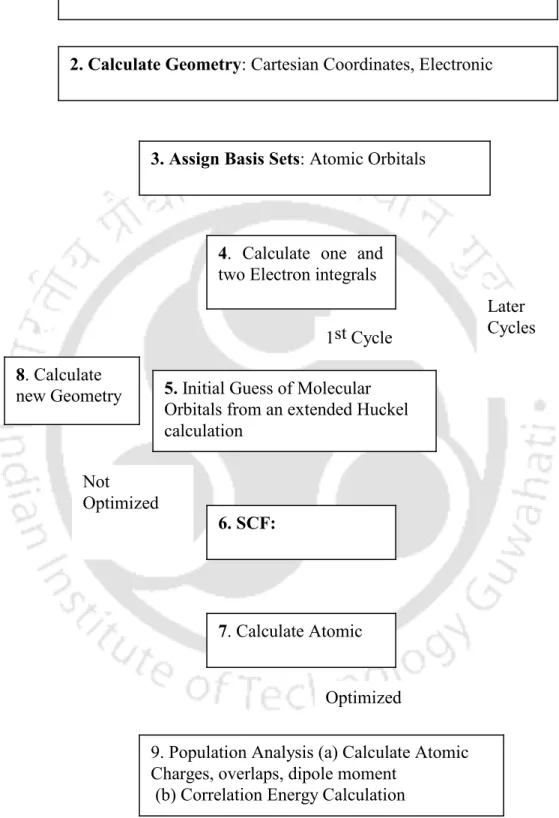
- Working of the Gaussian program
- Calculate one and two Electron integrals
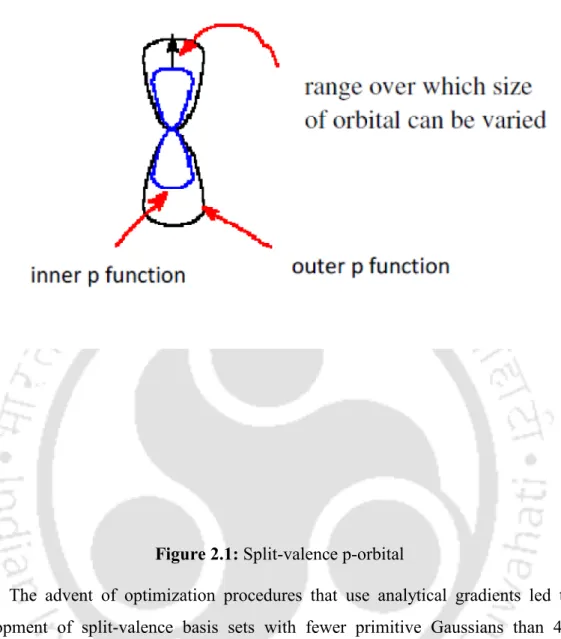
- Calculate Atomic6. SCF
- Initial Guess of Molecular Orbitals from an extended Huckel
- Calculate Geometry: Cartesian Coordinates, Electronic
- Read input: Title, molecular charge, multiplicity, molecular
- Geometry Optimization
- Geometry optimization using Gaussian03
- Forces, Displacement, root mean square forces
- Perform a Vibrational Analysis of
- Are all normal mode
- Locate Errors due to incorrect multiplicity,
- Submit the Job With revised
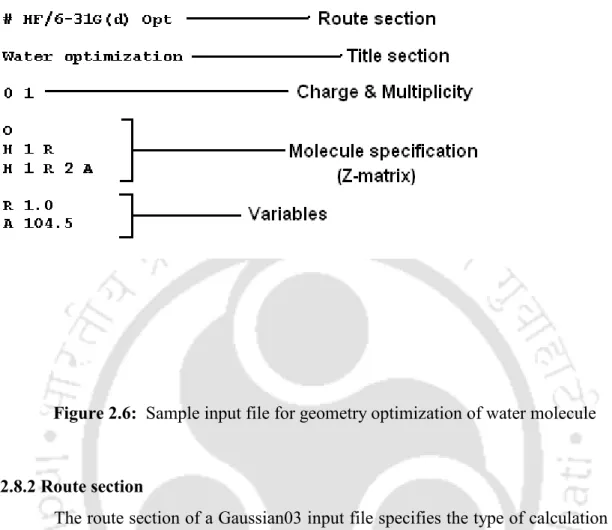
- Route Section: Level of Theory (HF/Semi Empirical/DFT), Basis Set, Job Type (opt,freq)
- Route section
- Z-matrix
- Charge and Multiplicity
- Submission of Job and Convergence Criteria
- Locating and Identifying Error(s)
- Benchmarking with Ionic Liquids
- Results and Discussion
- Introduction
- Theoretical background
- Global Scalar Properties
- Result and Discussion .1 HOMO/LUMO energies
- No ILs Name Global softness (S) Global hardness (η)
- Electrophilicity index and Electro negativity
- No ILs Name Eelectrophilicity (ώ) Electronegativity (χ)
- Combination of Parameters
- Effect of Molecular interaction
- Effect of Partial Charges
- Effect of Interaction Energies
- Introduction
- Conductor-like Screening Model (COSMO)
- Generation of COSMO File by Gaussian03
- σ-profiles and its Algorithm
- COSMO-RS vs Excess Energy Models
- COSMO-RS Methodology
- COSMO-RS predictions
- Infinite Dilution Activity Coefficient (IDAC) Predictions
- Effect of Sigma Profile
- Solvent selction paprameters
- ILs for Desulphurization Studies
Denote here a function that depends on the space and spin coordinates of the spin orbital with electron labeled as '1'. The expression for the Hartree-Fock molecular electronic energy EHF is given by the variational theorem as For the combination of cation and anion in ionic liquid, the basis is used to (1) describe the electrons on C (cations), (2) describe, in part, the electrons involved in the interaction between the cation and anions (Ionic liquids ) ), and (3) help to describe the electrons of A (anions). The same applies to the base collection b. Ionic liquids (IE) with larger basis set describe C or A individually, so are treated more completely, and its energy is lowered, relative to the energy of C or A. Recent applications include the structure of imidazolium-based ionic liquids where insights have been gained from ion pair interactions (Hunt et al., 2007). The interaction between thiophene and ionic liquids (Zhou et al., 2008) has also been attempted recently.
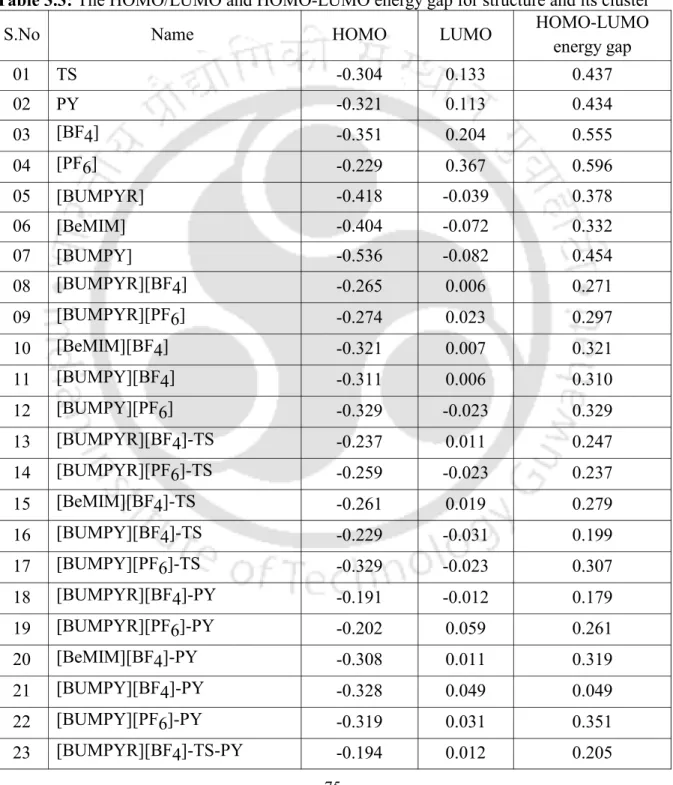
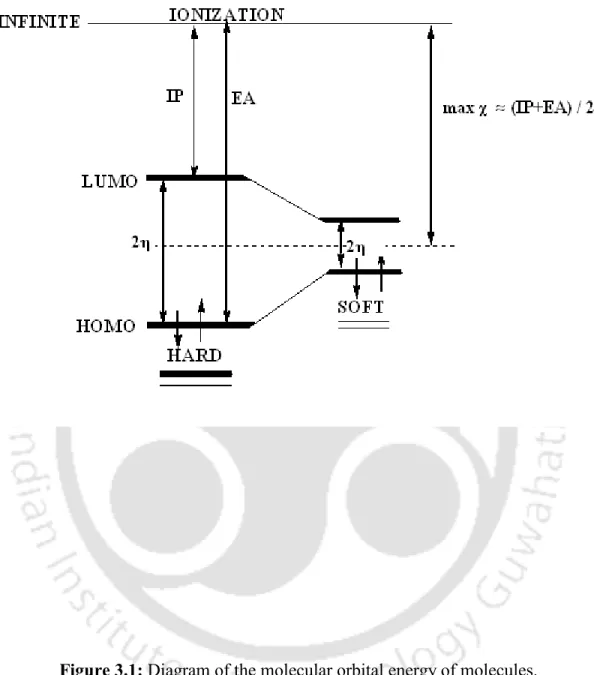
The cations and anions are listed in Table 3.1. The HOMO and LUMO energies of thiophene, pyridine, anions and cations are predicted and shown in Figure 3.3. The HOMO energy of thiophene is -0.30439 Hartrees, which is slightly less than that of pyridine (-0.32104 Hartrees). The LUMO energy of thiophene is 0.13298 while LUMO of pyridine is 0.11255. This indicates that thiophene can slightly more the LUMO energy, more stable the molecule [Karelson et al.,1996]. The simultaneous interaction of ILs with thiophene and pyridine also shows a similar effect (Figure 3.2). The electronegative and electrophilicity values of complex grouping (ILs-thiophene-pyridine) decrease as follows: [BeMIM][BF4] > [BUMPY][PF6] ] >.
This is because the bulky anions such as PF6 prevent BMIM cation from getting close and thus reduce its aromatic current effect. The thiophene molecules are tightly packed, giving rise to high aromatic current density. The partial charge of the sulfur atom in thiophene is -0.06 [Zhou et al., 2008]. The "electron pairs" on the sulfur atom are significantly delocalized in the π-electron system. The interaction of pyridine with the various ionic liquids again occurs through N (heteroaromatic)-H (cation) hydrogen bonds as previously reported [Sygula et al., 2007]. The interaction energies followed the order: [BPY][PF6] >[ BeMIM][BF4] > [BPYRO][BF4] >.
Then the optimized cation and anion combination is used to generate the COSMO file using the implementation available in Gaussian03. The radii of the nine elements are used to define the cavity for the molecule. A MATLAB program is written which takes the molecule name and aeff as input and writes the σ profile as output file. The only parameter that appears in the calculation of σ-profiles is the effective area of a contact segment. Considering a contact in a molecular surface area of area aeff (effective contact area), and that the two neighboring contacting surfaces have ideal average charge densities s' and σ', the interaction energy is the energy that is required to removed the remaining screen charge density σ + σ′ from the contact.
For the prediction, the complete dissociation of ionic liquid is assumed to be equal to the dissociation of cation and anion [Banerjee et al., 2008]. The sigma profile (charge distribution of screening charge densities) [Banerjee et al., 2006a, 2006b, 2008] of ionic liquid is simply the algebraic sum of the sigma profile of cation and anion (Equation 4.18). Here we will consider the ionic liquids as discussed in Chapter 3. The sigma profile for the combination of cations and anions of the ionic liquids:([BPYRO][PF6], [BPY][PF6], [BPYRO][BF4], [ BPY][BF4] and [BeMIM][BF4]) together with thiophene and pyridine will be considered here. The sigma profile for the different combinations of cations and anions of the ionic liquids, thiophene and pyridine, is given in Figures 4.5(a) to 4.5(c). This prompted us to study the prediction of the selectivity and capacity at infinite dilution for the simultaneous removal of TS, BTS and DBTS from diesel oil (Table 4.7). The composition of the diesel oil is given in Table 4.7. The sigma profile of the diesel component will be taken according to the equation;
The selectivity at infinite dilution (using equation 4.20) for TS, BT and DBT with [EMIM],[EPY],[EMMOR],[EPYRO],[EMPIP] and [TMPYZO] based cations along with 28 polynuclear and/or mononuclear anions are predicted with COSMO-RS. The selectivities at infinite dilution are shown in Figure 4.5,4. In general, the aromatity of the sulfur species follows the following order: TS > BT > DBT. The extra aromatic ring in BT and DBT reduces the aromaticity than that of TS.
![Table 2.3: Cartesian coordinates of atoms for optimized structure of [EMIM][OAc]](https://thumb-ap.123doks.com/thumbv2/azpdfnet/10485971.0/89.918.154.776.307.1043/table-cartesian-coordinates-atoms-optimized-structure-emim-oac.webp)
![Table 2.4: Optimized values of bond lengths, bond angles, and dihedral angles for [EMIM][OAc]](https://thumb-ap.123doks.com/thumbv2/azpdfnet/10485971.0/90.918.188.746.308.964/table-optimized-values-lengths-angles-dihedral-angles-emim.webp)

![Figure 3.2: Optimized geometries and partial charges for [BeMIM][BF4]-Thiophene-Pyridine](https://thumb-ap.123doks.com/thumbv2/azpdfnet/10485971.0/107.918.155.839.147.901/figure-optimized-geometries-partial-charges-bemim-thiophene-pyridine.webp)