On average, current smokers in the US die about 10 years younger than their lifelong non-smoking counterparts (Jha et al., 2013). Importantly, a majority of current smokers believe that they will successfully quit smoking at some point in the future (DiClemente, Delahanty, & Fiedler, 2010).
Responding to the Need for a Cost‐effective Treatment
A Bit of History
We strove to condense the many components of ALA's Freedom From Smoking program into a single session format, grounding our intervention in behavioral and cognitive behavioral techniques and adding a component of self-hypnosis. Joseph (Joe) Green (your author) jumped on board in the late 1980s and together we have expanded, updated and refined the program, which we are still doing at the time of writing.
What Motivates our Program: Principles and Practices
Health education in itself appears to be an important ingredient for successful smoking cessation, especially among individuals with low motivation to quit smoking (see Catley et al., 2016). Fortunately, combining a smoking cessation program with cognitive-behavioral strategies to reduce weight gain can be effective (Levine et al., 2010; Perkins et al., 2001).
Overview of the Sessions
The centerpiece of the second session is a "longer and stronger" (approx. 32 min) hypnosis exercise that presents hypnotic suggestions for achieving smoking cessation, with the facilitator reviewing the key educational components of the program. It is our experience that different elements of the program are more effective with some participants than others.
Latest Revisions and Updates to our Winning Edge Program
We present several outcome studies examining the effectiveness of hypnosis and comparing these rates to other intervention approaches. We also present findings from researchers and clinicians who have used previous versions of our program to achieve smoking cessation.
Why Hypnosis? Rationale and Supporting Evidence
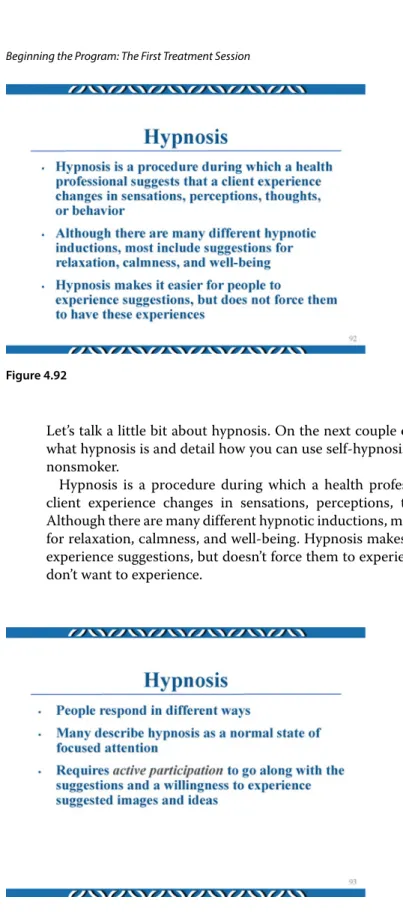
However, we avoid exaggerated claims about the effectiveness of hypnosis and instead use it in a scientifically based way that capitalizes on the potential of hypnosis to improve motivation and expectations (Lynn & Green, 2011; Green & . Lynn, 2017, for ' an extensive discussion of motivational improvement strategies within the framework of our smoking cessation programme). Pre-treatment discussions of hypnosis to form positive attitudes and dispel myths and misconceptions about hypnosis can facilitate rapport, improve comfort and improve adherence to treatment protocols.
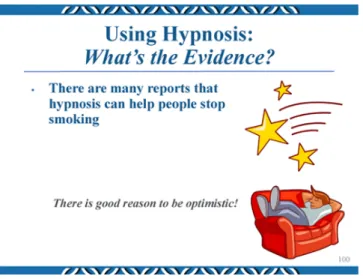
Hypnosis: A Popular Approach Needing More Evidence
We inform participants that it is common for people's attitudes and views toward hypnosis to improve over time as they become more familiar with hypnosis and begin to experience positive effects associated with the technique (Green, 2003; Mendoza et al., 2017). We believe it is premature to state that hypnosis is superior to alternative treatment approaches (Abbot, Stead, White, Barnes, & Ernst, 2008).
Smoking Cessation Success Rates: Hypnosis and Non‐hypnosis Approaches
Using a meta-analysis, Viswesvaran and Schmidt (1992) reviewed 633 studies (following more than 71,000 patients over multiple follow-up periods) and found that smoking cessation treatments with hypnosis appeared to be the most effective, compared with other interventions, with an average success rate. of 36%. The authors concluded that there was no overall evidence of an increase in smoking cessation among participants using NRT.
Indications of Success for our Program
Based on biochemical or proximate confirmation, 26% of individuals in the hypnosis group were abstinent at 6 months compared to 18% in the behavioral group. Interestingly, depressed participants showed a higher (statistically significant) confirmed dropout prevalence rate at 6- and 12-month follow-up in the hypnosis group compared to the counseling group.
Tips from Motivational Interviewing
To be armed with this knowledge will ease the understandable and common questions and anxieties that facilitators experience in their initial forays into working with The Winning Edge. In clinical contexts, we appreciate that it is very important for facilitators to be familiar with the program materials, but to be flexible in delivering content in response to participant questions and concerns that arise at any given moment.
Before You Start: Tips for Facilitators
We aim to promote action-oriented language that reflects commitment to the goal of smoking abstinence and underscores the ability to change (eg, "I can do this. I can complete this program and quit smoking") while challenging participants' statements that emphasizing the desire or need to smoke or the perceived inability to stop smoking (eg, "I really like smoking first thing in the morning" or "I need a cigarette during my work break" or "I will never be able to don't stop"). It is easy to include some scaled questions at the beginning of the program that address the participants' readiness to change (e.g. On the following scale, please indicate your readiness to quit smoking: 1—not at all not ready; 5—somewhat; 10—absolutely ready to make this change) and motivation to change (e.g. On the following scale, please indicate your motivation to quit smoking: 1—not at all motivated; 5 —somewhat; 10— .highly motivated).
Introductions and Room Set Up
Beginning the Program: The First Treatment Session
Session 1
Performers are expected to be well versed in the specifics of the program and have the interpersonal skills to create a warm and inviting atmosphere with a serious and professional approach. The educational materials in the program offer answers to the most common questions.
The Winning Edge DVD
The more skills you use, the greater your chances of achieving your goal. Let people know you are ready to quit and ask for their support.
Coping Model Script
In short, the model provides a testimonial on the effectiveness of the overall program, reinforces a number of topics covered on the DVD, discusses her positive experience with self-hypnosis, and illustrates the importance of making the program work. The coping model interview follows the script below. The interviewer's words (JPG) are presented in normal fonts and the coping model's responses are listed in bold.
Interview with a Coping Model and Self‐Hypnosis Script 1
Even though I don't think I would have smoked in that situation, I didn't even want to risk it. Oh, one more thing, it also helped that I didn't feel like I had to experience a trance to benefit from self-hypnosis.
It wasn't like what you see in the movies; kind of simple, really-simple in a good way. I used the hypnosis to give myself suggestions, and I remember you saying that I don't have to imagine everything perfectly.
Self‐hypnosis Script 1: “Learning Hypnosis”
If you do what I suggest, then it will help you achieve your goal of being a non-smoker for life. Now, if you take a little more time to immerse yourself in whatever you need to do, then it will crystallize your intention to be a non-smoker.
Handouts and Worksheets to Accompany Session 1
On our companion website (www.wiley.com/go/ . green/cbt-mindfulness&hypnosis-for-smoking-cessation), we organize the worksheets into a user-friendly participant workbook. It is quite easy for participants to count the total number of cigarettes they smoke each day.
Postsession Experience Scale
For group leaders interested in more formal data collection and assessment, we have also included a short (i.e., only three items) questionnaire asking about participants' experiences with hypnosis. Please note: When collecting research data, we assign a study number to all participants and use this number in place of names on data collection forms).
Strength of the Habit
Behavioral Contract Not to Smoke
Reasons to Stop Smoking
Top Five” Reasons to Stop Smoking Cards
Identifying Triggers
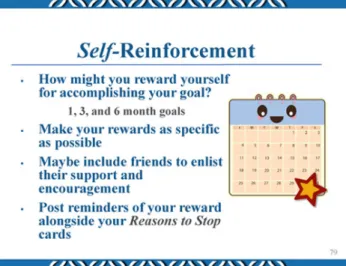
Rewards for Achieving My Goal
Alternative Behaviors
Social Support
My Extra‐Special Buddy
Challenging Counterproductive Beliefs and Myths Handout
Have you ever said this to yourself: "I haven't been able to quit smoking before; you have the willpower and you can succeed this time, even if you haven't been able to quit smoking before .
Acknowledging Feelings of Ambivalence
Deconceptualizing Smoking as a “Friend” and Some Thoughts about Smoking Friends
Two Common Myths Associated with Stopping Smoking
Self‐Monitoring of Smoking (Sample Page)
SELF‐MONITORING SUMMARY: Add up the Total Number of Cigarettes you Smoked Each Day Since our Last Session
Daily Practice of Treatment CD 1: Learning Hypnosis
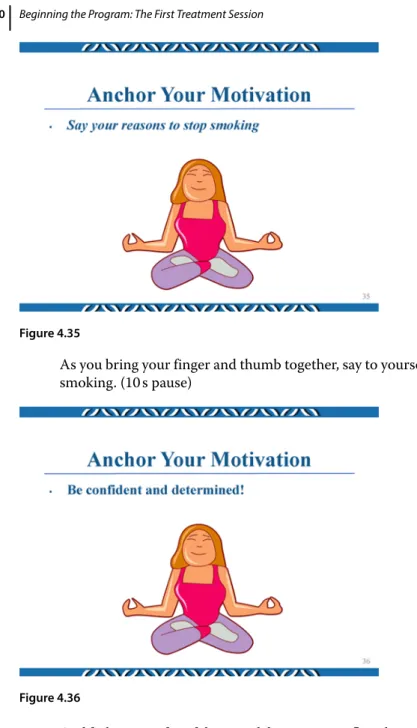
The group leader plays an important role in guiding the discussion and instilling optimism that participants, if they continue with the program, are likely to dramatically reduce, if not eliminate, their smoking behavior (see tips for facilitators in Chapter 3). After the discussion and review of the previous week, we invite the participants to stand up in front of the group and tell their main reason for quitting smoking.
Completing the Program: The Second Treatment Session
Treatment Slides
What did you learn about triggers or situations where you were more likely to smoke?. When you felt the urge to smoke, what behaviors did you do instead of smoking?
Self‐hypnosis Script 2: “Being a Nonsmoker!”
If you practice to get the winning edge, you will discover that you can go 24 hours every day without smoking. And you will probably discover that you can enter self-hypnosis more and more quickly.
Treatment Session 2 Handouts and Follow‐Up Forms
We instruct participants to return these forms to us so that we can evaluate the effectiveness of the program. If not, we remind them of all the tools within the program and point out that some participants take a little longer than others to achieve total abstinence from smoking.
Motivation/Work Questionnaire
In Chapter 10 we illustrate the program in action, provide additional program management tips, and provide a number of templates that might be useful in announcing the program and conducting research (e.g., a consent form template, a frequently asked questions brochure questions, a survey announcement, and examples of additional data collection forms).
Follow‐up Phone Call (General Guidelines)
You can rework the program materials and build on all the gains you've made. We conclude with important information about expanding the program to focus on other issues such as weight loss, rather than smoking cessation.
Gender Differences
In this chapter we provide information for facilitators and therapists working individually or in groups. Typically, participants will express concerns about the content areas covered in this chapter either before, during, or after the intervention.
Common Questions, Individualizing Treatment, and Extensions Beyond Smoking Cessation
Unfortunately, most of the early studies of smoking cessation using hypnosis did not examine gender differences or assess changes in body weight during treatment (Green & Lynn, 2000). Hormonal differences and other biological factors may also contribute to gender differences in smoking cessation outcomes (Weinberger et al., 2015).
Weight Gain and Weight Gain Concerns
In the US, white participants typically express greater concern about weight gain relative to black or Hispanic participants (Beebe & Bush, 2015; Rosenthal et al., 2013). For example, women may be more likely than men to expect that quitting smoking will be difficult, that withdrawal symptoms will necessarily be challenging, and that weight gain is inevitable (Hendricks et al., 2014).
Are Light Cigarettes Safer than Regular Cigarettes?
The Use of e‐cigarettes and the Effects of Nicotine on the Brain
In contrast, opponents of e-cigarettes question their safety and effectiveness, express concerns that they will discourage smoking. The product design of e-cigarettes can significantly increase the potential consequences of an overheated battery.
Water Pipes, Hookah, and Shisha
Passive smoking associated with WPS increases the risk of respiratory and lung diseases (Boskabady, Farhang, Mahmoodinia, Boskabady, & Heydari, 2014; Cobb et al., 2012). Finally, sharing hookah nozzles can result in the contraction and spread of communicable diseases (El-Zaatari et al., 2015).
Medications for Smoking Cessation
With the same number of smokers and the same amount of time, WPS produces a greater concentration of airborne toxins compared to cigarette smoking (Dahar et al., 2010). Current practice guidelines (Fiore et al., 2008) recommend combining medication with some form of behavioral program or smoking cessation counseling to increase intervention effects.
Over‐the‐counter Nicotine Replacement Products
In accordance with current US clinical practice guidelines (see Fiore et al., 2008) and those of 21 other countries (Verbiest et al., 2017), we have advocated the additional use of NRT. program. Nevertheless, we are concerned about issues raised by opponents of NRT and hesitate at this time to make an unqualified recommendation for the use of NRT.
Smoking and Comorbid Conditions
Furthermore, because many people smoke as a maladaptive coping strategy to deal with negative feelings such as anxiety, anger, and depression (Carmody, Vieten, & Astin, 2007; Farris, Zvolensky, Beckham, Vujanovic, & Schmidt, 2014; Mahaffey et al. ., 2016), we emphasize its importance. Encouragingly, quitting smoking does not appear to have a negative impact on the consumption of other drugs, nor on the symptoms of mental illness (Currie et al., 2008). We start from the assumption that addiction programs should offer clients the opportunity to smoke during treatment, for fear that if patients stop smoking they will increase the consumption of other harmful substances or become depressed. encouraging smoking cessation among clients undergoing substance abuse treatment was reinstated. 2014) found no group difference in alcohol use patterns among participants who quit smoking versus those who did not; However, some individuals did increase alcohol consumption after smoking cessation treatment.
Pregnancy
We assure them that there are opportunities to further reduce and quit smoking after the birth of their child. Our approach recognizes that there are many motivations to quit smoking, including doing so for the health of others.
Individualizing the Treatment
Additionally, I assured her that our program addresses the possibility of weight gain through specific strategies, including eating and exercise plans. She seemed extremely relieved that our program anticipated her fear of gaining weight and included strategies to minimize weight gain.
Revising and Extending the Treatment Beyond Smoking Cessation
In an effort to make it easier for clinicians interested in researching the effectiveness of the program, we provide a number of materials in this section, including: (a) a fact sheet about the program, (b) a model consent form, ( c) a baseline assessment inventory and (d) forms to track progress over time. In this first session, we provide an overview of the program and go over the consent form.
Review of Overall Program Scheme and Forms to Aid Research and Data Collection
The following templates are based on an ongoing 7-week intervention program consisting of five faces. Based on their smoking frequency, we provide interested participants with a 2-week supply of nicotine patches.
Three‐month Follow‐up (Approximately 10–15 min)
We ask individual participants how they are doing, whether they smoke, whether they listen to their hypnosis tracks and whether they have any questions. We encourage participants to continue with the program even if they are not immediately able to completely quit smoking.
Six‐, 12‐, 24‐month Follow‐up (Completion Time
Advertising the Program, Fact Sheets, and Follow‐up Forms
Study Notice
At this time, we will provide you with nicotine replacement (ie, the patch) to help curb residual smoking cravings. As an incentive to complete the study, we will provide you with a $25 gift card when you return for your 3-month follow-up appointment.
The Winning Edge Smoking Cessation Program: FACT SHEET Are you finally ready to stop smoking?
In this program you will learn a number of strategies and techniques designed to help you quit smoking. This means that you will receive nicotine patches for a total of 6 weeks during the program.
Need to Be Hypnotizable or Have Prior Experience with Hypnosis?
You are invited to use nicotine gum and nicotine lozenges if you wish (but will need to purchase these products on your own). Although these products are considered safe to use and are available over the counter, you should consult your doctor or pharmacist about whether there is any reason why you should not use these products, or any side effects of using nicotine replacement products.
Have to Use Nicotine Replacement Therapy? Can I Still Participate Without Using the Patch?
We specifically advise that if you are pregnant, have a history of heart disease, or are taking prescription medications, you should consult your physician before beginning nicotine replacement therapy.
Consult my Physician or Pharmacist?
We specifically advise that if you are pregnant, have a history of heart disease, or are taking prescription medications, you should consult your doctor before starting nicotine replacement therapy. and get plenty of rest. As mentioned above, if you are pregnant, have a history of heart disease, or are taking prescription medications, it is advisable to consult your doctor before starting the nicotine patch.
Consent Form Template: Consent to Participate in Research
Why is this study being done?
How many people will take part in this study?
What will happen if I take part in this study?
You will have access to a home practice CD (approximately 14 minutes long) and will be instructed to listen to it every day for 1 week. During these meetings, you will be asked to discuss your progress and we will review the program materials.
You will be asked to watch a DVD by yourself (1 hour) and record your smoking during the first month of treatment. You will be asked to complete a number of questionnaires, monitor and record your smoking behavior and allow us to contact you at various times to discuss your progress.
By signing this form you are not giving up any personal legal rights you may have as a participant in this study. For questions about your rights as a participant in this study or to discuss other research.
CONTACT INFORMATION – PLEASE PRINT NEATLY!
Data Form Samples
How many times on a typical day do you think about your weight (circle one number)?. How motivated are you to quit smoking right now? .. motivated 15) How likely do you think it is that you will completely stop smoking in the next period.
Health Questionnaire
3‐Month Follow‐Up
In the past 3 months, have you used any prescribed medication to help you quit smoking. What were the "key" circumstances for you to stop smoking (or not stop) at this time?
Closing Comments
Companion website: www.wiley.com/go/Green/cbt-mindfulness&hypnosis-for-smoking-cessation Abbot, N. Violent assault, post-traumatic stress disorder and depression: Risk factors for cigarette use among adult women.
Effects of nicotine patch vs varenicline vs combination nicotine replacement therapy on smoking cessation at 26 weeks: a randomized trial. Venturing to the dark side”: The use of imagery interventions by recently qualified cognitive-behavioral therapists.