From the Couch to the Circle: Group-Analytic Psychotherapy in Practice is a handbook of group therapy and guide to the group-analytic model – the prevailing form of group therapy in Europe. It draws on John Schlapobersky’s engagement as a practitioner and the words and experience of people in groups facing psychotherapy’s key challenges – understanding and change.
It provides a manual of practice for therapists’ use including detailed descriptions of groups at work; accounts of therapists’ experience and the issues they face in themselves and their groups. It is devoted to the group-analytic model and brings the other psychody- namic models into a comparative discussion to create an integrated and coherent approach.
The book is divided into three sections:
Foundations – aimed at practitioners using groups of any kind and working at every level providing supportive psychotherapy and groups for psychosis, trauma, people at risk, the elderly and children;
The Group-Analytic Model – defines the group-analytic model at a basic and advanced level;
The Dynamics of Change – aimed at group analysts, psychotherapists and psychologists providing short-term psychotherapy and long-term group analysis.
The book is illustrated with figures, tables and clinical vignettes including incisive, instruc- tive commentaries to explain the concepts in use. It is intended for those seeking psycho- therapy to resolve personal problems or find new sources of meaning; for policy-makers in mental health; and for students of different models of psychotherapy and the psychosocial field. The comparative discussion about methods and models of practice will be of interest to the wider mental health and psychotherapy fields.
The author draws together the inherited wisdom of group analysis since Foulkes’s time and makes his own lasting contribution. From the Couch to the Circle will be an invalu- able, accessible resource for psychotherapists, psychoanalysts, psychologists, family thera- pists, academics, mental health practitioners and teachers in psychotherapy.
John R. Schlapobersky is a Training Analyst, Supervisor and Teacher at the Institute of Group Analysis, London and Research Fellow, Birkbeck, University of London. He is in private practice at the Bloomsbury Psychotherapy Practice and works with individuals, couples and groups. He has trained generations of group analysts, teaches internationally and has many publications. This book is the professional life’s work of a leading British group analyst.
Downloaded by [New York University] at 13:03 29 November 2016
similar to that of a poet or writer in the community . . . receptive to the current problems of his time and creative in expressing them . . . to bring them nearer to the consciousness of those concerned.
(Foulkes 1975, 1986:157) Group-analytic psychotherapy offers an incomparable instrument for under- standing the group mind or psychology of the individual in the group . . . (and though) much weaker . . . than psychoanalysis will need to build a more substantial theoretical superstructure out of the process of communication, of mirroring, of configuration and of translation.
(Anthony 1978:10)
Downloaded by [New York University] at 13:03 29 November 2016
Incredibly rich in clinical vignettes, steeped in heart, mind and scholarship and faithful to how group therapy heals, Schlapobersky’s From Couch to Circle beau- tifully depicts how ‘the troubled group that each individual has within’ is played out among the other group members. A simple testimonial cannot do justice to this monumental effort that is destined to become a classic in the field.
Prof Jerry Gans MD, DLFAGPA, Harvard Medical School, Distinguished Life Fellow, American Group Psychotherapy Association.
Author, Difficult Topics in Group Psychotherapy This unique publication offers the next fine turning point in group education and practice. It covers the wide range of methodology and the complexity of group experience moving from one stage of disciplined work to the next buoyed with intellectual excitement and a deft touch of humor. It draws fluently upon the three ingredients of group: process, theory and practice and will delight Modern Ana- lysts encouraging both new entrants and the most experienced practitioners. Sta- tistics, theory and typology are used with wit and daring as John takes us from the most personal narratives in case studies to varied interpretations of theory offering vivid contrasts between schools of analytic investigation. Few books can achieve the dynamic pace and thrilling results that he uses to carry the reader from one chapter to another.
Phyllis F. Cohen, PhD; FAGPA; National Chair, Group Foundation for Advancing Mental Health;
Former Chair Center for Group Studies, New York;
American Board for Accreditation in Psychoanalysis;
Former Chair, Center for Group Studies John has amassed a rich harvest in the skills by which he applies group analytic theory and technique – a narrative art. Science is in the tabulations, careful catego- rization of diagnoses, treatment results, and illuminating figures. This book will interest and inform readers seeking an introduction and mature practitioners who want to revise their own experience and ideas. Rarely do we read a single author text written with the authority that derives from such rich experience as a practitioner
Downloaded by [New York University] at 13:03 29 November 2016
of former patients gives the final stamp of authority to his work in ‘The last word’.
Malcolm Pines, MRCPsych., Founder, Institute of Group Analysis London, Formerly Consultant Psychotherapist, Maudsley Hospital, St. George’s Hospital, Tavistock Clinic. Author, Circular Reflections Everyone working with groups will benefit from this book from whichever
‘school’ they come and at whatever level of experience. It is a mine of informa- tion about group analytic ideas and how to use them presented accessibly and with an appreciation of their complexity. Theoretical material is compelling and enlightening. The massive strength of the book is the case material that drives it with engaging and often moving examples and incisive, consistently instructive commentaries. John shows acute clinical sensitivity and virtues as a teacher, deploying the concepts to make sense of clinical material . . . and using clini- cal material recursively to flesh out the theoretical concepts . . . a terrific way to work.
Prof Stephen Frosh PhD, Professor of Psychosocial Studies, Birkbeck, University of London. Author, Hauntings: Psychoanalysis and Ghostly Transmissions John’s masterful exposition of Foulksian group analysis and other models gives us their underlying theories, principles and clinical applications in a jargon-free, beautiful language. There shines through the man the writer is: intellectually inquisitive, emotionally engaged and deeply humane in his contact with and care for his patients. This spirit exemplifies a passage by Foulkes quoting a patient saying, ‘What is essential is not what you do but who you are.’ The book extends this spirit for experienced and new practitioners and for students who will find it especially useful. It is relevant and accessible to a wide audience of professionals including teachers, social workers, administrators and – dare one hope – politi- cians. Their reactions would be as welcome as those of John’s former patients in
‘The last word’.
Liesel Hearst, Training Analyst, Institute of Group Analysis, London;
Supervisor and Founding Trainer, Institutes of Group Analysis, Denmark, Norway, GRAS Germany and ZGAZS Switzerland.
Co-author, Group-Analytic Psychotherapy: A Meeting of Minds In his wonderfully well-written textbook John Schlapobersky does a great service for the field of group psychotherapy – a remarkable synthesis of accrued clinical wisdom, cutting-edge knowledge and thoughtful clinical application. The author builds articulate, eloquent bridges between individual and group psychotherapy;
between members and leaders within the therapy group; between European and North American models of group psychotherapy and, most importantly, between
Downloaded by [New York University] at 13:03 29 November 2016
together the worlds of group analysis and group psychotherapy.
Prof Molyn Leszcz MD, FRCPC, DFAGPA.
Professor and Vice-Chair, University of Toronto Department of Psychiatry, Co-author with Irvin Yalom, 5th edition, The Theory and Practice of Group Psychotherapy This book provides ‘the state of the art’ in group-analytic practice and think- ing. A most experienced clinician shares his curative approach and interventions through a wide range of clinical examples in different, touching group experi- ences. It is a joy to learn from this master teacher – he is both a model for group therapists and a theoretical innovator. John’s interest in new formulations, new approaches and a humane way of relating to patients will help the reader grow.
Students as well as experienced practitioners will find the text, the broad field it covers and the depth of its studies applicable to many of their own challenges in group therapy.
Robi Friedman PhD., President, International Group Analytic Society;
Former Chair, Israeli Institute of Group Analysis.
Co-author, Dreams in Group Psychotherapy British group analysts have been waiting for a major contemporary textbook on group-analytic psychotherapy for many years and John Schlapobersky has writ- ten such a book. The term ‘magnum opus’ is highly appropriate for a work that is both theoretically robust and clinically rich. It will be of particular interest to those who work as therapists with victims and perpetrators of violence and I predict that it will become a book that no practicing group therapist will want to be without.
Gwen Adshead, MB ChB; FRCPsych. Group Analyst;
Consultant Forensic Psychiatrist, Ravenswood House.
Co-author, A Matter of Security – Attachment Theory, Psychiatry and Psychotherapy This book sets new standards for the whole group-analytic community and anyone interested in the tradition founded by Foulkes. It integrates practi- cal relevance and scholarship in a carefully elaborated presentation. John Schlapobersky is a staunch ‘Foulkesian’, fully aware of inconsistencies and gaps in Foulkes’s original texts, one of which is the key concept of communi- cation. He breaks new ground here with chapters on the speech forms of the group-analytic process; silence in groups; and metaphors for a ‘language of change’. Readers in the German-speaking world will find especially informa- tive how he documents the origins of group analysis in the German intellec- tual tradition to 1933; then locates its development in the context of British
Downloaded by [New York University] at 13:03 29 November 2016
psychotherapy in the USA.
Thomas Mies PhD., Training Analyst, Institute of Group Analysis, Munster, Germany; Editorial Board, Gruppenpsychotherapie und Gruppendynamik Group analysis has been waiting for a book that integrates the many diverse strands of the theory into a meaningful whole. From the Couch to the Circle is an important step in this direction. Ambitious and scholarly, the book draws on litera- ture and research from the UK, USA and beyond to build a rich and nuanced con- struction of what group analysis is. This dense tapestry is animated throughout by vivid examples in vignettes and commentary that reflect the author’s unwavering commitment to group analysis and his considerable experience and wisdom, his passion and compassion. Beginners in the field, seasoned practitioners and curi- ous non-professionals will gain both essential data and rare insights into a field that holds hope for the future of accessible and equitable mental health practice.
Morris Nitsun, PhD, Consultant NHS Psychologist in Group Psychotherapy; Training Group Analyst, Institute of Group Analysis London and Fitzrovia Group Analytic Practice. Author, The Anti-Group In this substantial work John Schlapobersky turns his thoughtful and meticulous attention to embodying comprehensively the corpus of group-analytic litera- ture. This will become a standard work for consultation as much as for reading, for study as for inspiration. It establishes group analysis as a seriously thought through approach to the practice of psychotherapy in groups. More than that, Foulkes and his early colleagues are properly acknowledged to have originated in and extended the theory and practice of psychoanalysis itself. The psychoanalytic couch and the circle of the group are close cousins. There is a special tension between them that arises out of their mutual dependence and rivalry that John shows has been turned to creative advantage by the long tradition of academic and institutional work. This book leads the beginner towards becoming a sophisticated practitioner and the experienced group analyst towards renewing his acquaintance with his own origins.
Bob Hinshelwood, Psychoanalyst, British Psychoanalytic Society.
Author, What Happens In Groups, and Research On The Couch Much of this book is teachable and would be a great introduction for American readers unfamiliar with group analysis. Theory alone is not enough; something has to catch fire. What is not teachable is exemplified in John’s vivid clinical narratives of how and why people who struggle, succeed, and sometimes fail, in group therapy. He describes Foulkes, founder of group analysis, as a towering figure who attracted and led through great personal creativity and charm, with a
Downloaded by [New York University] at 13:03 29 November 2016
life force in his deeply poetic clinical thinking and writing.
Dominick Grundy PhD, Editor, International Journal of Group Psychotherapy
‘To make soup the cook doesn’t need to get into the pot.’ (Gorky quoted Schla- pobersky, characteristically illustrating the role of the group conductor). This book is the most glorious potpourri of everything one wants to know and feel and experience about group therapy, group analysis, and group dynamics – and more.
It magically combines, theory, science, clinical illustration, personal revelation, anecdote, apposite quotation, allusions from the literary canon, and social and cultural wisdom. Schlapobersky and his book – the literary analogue of a group at its best – are worthy successors to his predecessor giants: Foulkes and Anthony, Yalom, Skynner, Pines. Read him: for instruction, for joy, to live and laugh more fully, more contentedly, more dangerously – and become a better, braver, more compassionate, more confident yet questioning therapist whilst doing so.
Prof Jeremy Holmes MD FRCPsych, University of Exeter, UK. Author, Explorations In Security Foulkes would have been as delighted with this new book as I am.
E.J. Anthony MD, FRCPsych., Co-Author, Group Psychotherapy: The Psychoanalytic Approach
Downloaded by [New York University] at 13:03 29 November 2016
Downloaded by [New York University] at 13:03 29 November 2016
From the Couch to the Circle
Group-Analytic Psychotherapy in Practice
John R. Schlapobersky
Downloaded by [New York University] at 13:03 29 November 2016
2 Park Square, Milton Park, Abingdon, Oxon OX14 4RN And by Routledge
711 Third Avenue, New York, NY 10017
Routledge is an imprint of the Taylor & Francis Group, an informa business
© 2016 John R. Schlapobersky
The right of John R. Schlapobersky to be identified as author of this work has been asserted by him in accordance with sections 77 and 78 of the Copyright, Designs and Patents Act 1988.
All rights reserved. No part of this book may be reprinted or reproduced or utilised in any form or by any electronic, mechanical, or other means, now known or hereafter invented, including photocopying and recording, or in any information storage or retrieval system, without permission in writing from the publishers.
Trademark notice: Product or corporate names may be trademarks or registered trademarks, and are used only for identification and explanation without intent to infringe.
British Library Cataloguing in Publication Data A catalogue record for this book is available from the British Library
Library of Congress Cataloging-in-Publication Data Names: Schlapobersky, John R., author.
Title: From the couch to the circle : group-analytic psychotherapy in progress / John R. Schlapobersky.
Description: Hove, East Sussex ; New York, NY : Routledge, 2016.
Identifiers: LCCN 2015021331 | ISBN 9780415672191 (hardback) Subjects: LCSH: Group psychotherapy. | Group psychoanalysis. | BISAC: PSYCHOLOGY / Movements / Psychoanalysis. | PSYCHOLOGY / Psychotherapy / General. | PSYCHOLOGY / Mental Health.
Classification: LCC RC488 .S25 2016 | DDC 616.89/152—dc23 LC record available at http://lccn.loc.gov/2015021331
ISBN: 978-0-415-67219-1 (hbk) ISBN: 978-0-415-67220-7 (pbk) ISBN: 978-1-315-67009-6 (ebk) Typeset in Times New Roman by Apex CoVantage, LLC
Downloaded by [New York University] at 13:03 29 November 2016
This book is dedicated to the memories of James Anthony, Helen Bamber and Bryan Boswood, who passed away whilst it was being written. They were inspiring colleagues and mentors who became dear friends.
It is dedicated to three groups of living people. First it is dedicated to the next generation of my own family: my daughter Hannah; grandchildren Maia and Leo; stepson Josh; nieces Kate and Diana, Alice and Jane; nephew Simon; and stepnephews James and Andrew; to their children and children to come. May the work described here help to make the world a better place for all our children.
It is dedicated to those I have known in teaching relationships, including students and supervisees in training programmes and institutions in different countries. The Training Convenors of my own institute, the Institute of Group Analysis London, who I have worked with down the years merit special mention.
We worked together to develop a curriculum, write a handbook and establish an MSc programme with our academic partner, Birkbeck College, University of London, now in its 18th year. The introduction to this book by the former head of the Department of Psychosocial Studies at Birkbeck College, Prof. Stephen Frosh, gives one tribute to this work. Another is in the citations and references to our graduates’ theory papers and dissertations written during their training, some of which now inform the literature and many of which have been quoted from with their permission.
It is dedicated with a full heart and deep appreciation to those who have attended my groups – therapy and experiential groups – and the groups of my colleagues and supervisees. Your lives populate the pages of this book. I have drawn on your stories and taken liberties with them and your identities, to re-arrange them and so protect your confidentiality that would allow an authentic portrayal of our work together. This protocol is in line with the code on confidentiality set out by the Institute of Group Analysis and International Psychoanalytic Association.
I have made every effort to reach you, secure your consent to this publication or make amendments to meet your concerns if experience described here was likely to be recognisable. Where called for, vignettes have been amended or removed.
I did not anticipate the active co-operation shown by those approached. Many of you have participated by providing memories that augmented my own records,
Downloaded by [New York University] at 13:03 29 November 2016
allowing me to edit the vignettes and shape them more authentically. I thank you all. The work goes back many years, and there may be some who think they find themselves here who have not heard from me first. Similarities in this material to the actual therapy of anyone – alive or not – is accidental. I trust readers will find that the accounts are set out here on professional terms, first to honour the work we have done together and second to serve the field in good faith. For this I thank you twice.
Downloaded by [New York University] at 13:03 29 November 2016
List of vignettes xv
List of tables xviii
List of figures xxi
Foreword: Stephen Frosh xxiii
Tribute: Malcolm Pines xxvi
Historical Preview: E. James Anthony xxvii
Acknowledgements xxxiv
Introduction 1
SECTION I
Foundations 29 1 Aims and vocabulary of psychotherapy 31 2 Psychotherapy’s three dimensions: Relational, reflective,
reparative 59
3 Personal and group development 84
4 The language of the group: Monologue, dialogue and
discourse in group analysis 112
5 Speech and silence in psychotherapy 135 6 The range of applications in ten studies: Duration,
frequency, setting 158
7 Methods applications and models: The group-analytic
model and its contemporaries 200
Downloaded by [New York University] at 13:03 29 November 2016
SECTION II
The group-analytic model 221 8 A group’s three dimensions: Structure, process
and content 223
9 Structure: Dynamic administration, composition,
selection 235 10 Process: Concepts and applications 247 11 Content: Key questions about narrative, discourse
and the voice of the symbol 278
12 The conductor: Convenor, therapist and group member 301
SECTION III
Dynamics of change 325 13 Four domains of communication: Current,
transference, projective and primordial 328 14 Lost or found in the transference? Transference,
countertransference, projection and identification
in groups 359
15 Longing and belonging in the intermediate territory 393 16 Metaphors and metamorphosis: Symbols, transition
and transformation 418
17 Location, translation, interpretation: The heart of the
group-analytic model 440
18 Conclusion and the last word 459
Index 475
Downloaded by [New York University] at 13:03 29 November 2016
0.1 About Heaven and Hell 5
0.2 Survival and reciprocity 5
0.3 Sipology with soap and bubbles 6
1.1 The seer’s eye in the mirror 33
1.2 Empathic mirroring 34
1.3 Why are we talking about sausages? 36
2.1 My brother, what have they done to you? Some relational
moments 68
2.2 The ‘normals’ in our space capsule 70
2.3 About mayonnaise on the chin 71
2.4 The persecutor and the jangling keys 73
2.5 Separating a mother and baby: The cries of the cow
and her calf 77
3.1 Key phases in the progress of individuals through a group 102
4.1 Who are you talking to? 117
4.2 A good father and an abusive father 119
4.3 How dare you dream about me killing your father!
Projection and projective identification 121
4.4 Envy against progress in the group 123
4.5 An empty house without sexual feeling: Desire can bring the
roof down 128
4.6 Do we discuss the nightmare or ‘the nightmare?’ 130
5.1 Who says it doesn’t work? 137
5.2 Love me or fuck off 141
5.3 You cry for what you’ve lost and me for what I’ve never had 142 5.4 The girl who lived in the heart of stone 145 5.5 A male megaphone silent in protest against a newcomer 149
5.6 Springing a trap 151
8.1 Challenges at the broken boundary: Structural interventions
establishing authority 228
8.2 Poor attendance and the baby at the breast: Process-based
interventions looking for meaning 229
Downloaded by [New York University] at 13:03 29 November 2016
9.1 The story of the wooden spoon 241 10.1 Resonance and valency: The isolate and the avoidant 256 10.2 Mirroring and resonance: One person’s tears as a votive
offering to another’s hidden grief 258
10.3 Desire as a conscious condenser of accessible emotion 260 10.4 Unconscious condenser: He’s not a fucking professor, he’s
my father! 261
10.5 Amplification and condensation after exposure 262 10.6 Signal (simple) resonance 1: Where fear and opportunity
crawl the streets 264
10.7 Signal resonance 2: Where sheep may safely graze 264 10.8 Complex resonance: The wounds of injured experience that
speak without words 265
10.9 ‘Familiarity is the kingdom of the lost’: The woman who found a newcomer in her group: Resonance, condenser
and amplification at work in therapy 267
10.10 The story of four fingers linked to describe partnership –
process dynamics at work in the round during therapy 270 11.1 People’s voices come alongside one another, followed by
their stories 283
11.2 Anger and its monsters: Language, imagery and thematic
development in the content of a therapy group over time 289 11.3 The woman whose birth saved her mother: Content and
thematic development in a short experiential group 296 12.1 Late-night vigil – waiting for parents to return: The conductor
at work 320
13.1 Learning containment: The current domain 329
13.2 Fighting with the ‘wrong’ sister 330
13.3 Something new ‘cooking’ in the group: Projection and change 332 13.4 The living will not be buried with the dead 333 13.5 The triumph of hateful failure in a masochistic protest 336 13.6 The longing to be a ‘princess’ inside and outside the group 341 13.7 The work of the ‘crying group’: Analysis of 25 subjects,
their figurations and the four domains 346
14.1 Reading Fraud and Junk 362
14.2 Who took my place and when was it taken? Location, translation and interpretation of vertical and horizontal
transference 378 14.3 A group dream of Grandfather wearing the conductor’s face:
Positive vertical and complex transference 380 14.4 Disillusionment: Negative vertical transference 383 14.5 Good sisters, bad sisters and good sisters again: Changing
horizontal transference 384
Downloaded by [New York University] at 13:03 29 November 2016
14.6 Dreaming together about the conductor wearing her apron and
withholding delicious soup 386
15.1 Postman Pat: Stepping in and out of each other’s pictures 404 15.2 Was it nice when you kissed the conductor in your dream? 406
15.3 Other people’s babies 410
15.4 So you want us to eat potatoes? No, we’re coming home! 412 16.1 The angel in the torture chamber: Individual psychotherapy 425
16.2 The angel in the family 428
16.3 A band of angels in a group of refugees 431
16.4 Jacob’s Ladder in the group 434
17.1 Where is the conductor’s baton? 441
17.2 On making a home amongst strangers 452
18.1 The patients are the ones who get better and go away 465
Downloaded by [New York University] at 13:03 29 November 2016
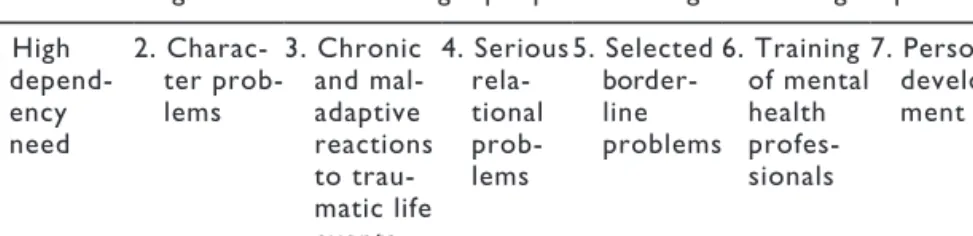
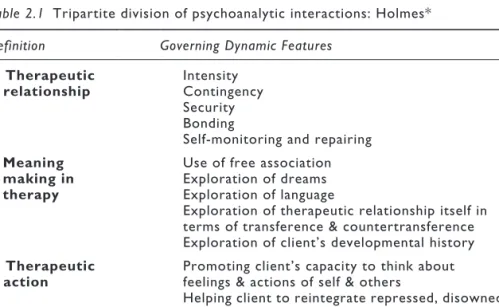
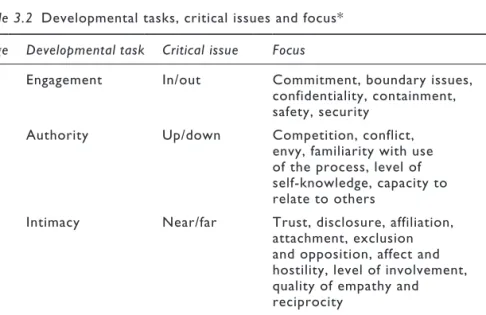
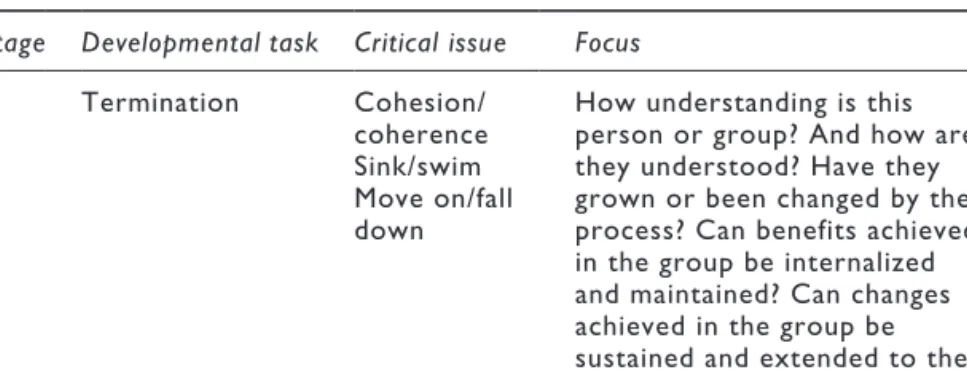
0.1 Elementary principles in group-analytic theory 13 1.1 The important lessons distilled from personal experience: Gans 32 1.2 Basic principles in group-analytic psychotherapy 39 1.3 Categories of need amongst people attending intensive groups 43 1.4 Definition and classification of conductors’ interventions: Roberts 50 2.1 Tripartite division of psychoanalytic interactions: Holmes 62 2.2 Qualities of dependency in groups: von Fraunhofer 64 3.1 Current developmental literature in group-analytic
psychotherapy: Inclusion criteria – key elements in clinical
theory 89 3.2 Developmental tasks, critical issues and focus 96 5.1 The human experience of silence: Haddock 146 5.2 Speech and silence in group psychotherapy 146 6.1 Dick’s phases in group process and content 166 6.2 Specific areas of disturbance in eight parameters of life
situation 166 6.3 Levels of satisfaction/dissatisfaction in eight parameters
rated by patient/therapist 167
6.4 Pre- and post-group rating of total series 168 6.5 Block group therapy: Attendance numbers 186 6.6 Block group therapy: Occupational categories 186 6.7 Categories of need amongst people attending twice-weekly
groups 190 6.8 Basic demographic and clinical data amongst people attending
twice-weekly groups 191
6.9 Basic clinical data for people attending twice-weekly groups:
Ratings on five-point scale (14 and 15) 191
6.10 Twice-weekly group therapy: Occupational categories 192 6.11 Twice-weekly group therapy: Family situation 192 6.12 Twice-weekly group therapy: Referral source 193 6.13 Twice-weekly groups: Presenting problems 193 6.14 Twice-weekly groups: Diagnosis on presentation 193
Downloaded by [New York University] at 13:03 29 November 2016
6.15 Twice-weekly groups: Leaving reasons 194 8.1 Visible elements in the dynamic life of a group 233 8.2 Invisible elements and the emergence of a three-dimensional
model 233 9.1 Basic organising principles for group psychotherapy 236 9.2 Twelve principles and practices of dynamic administration: Behr
and Hearst 237
9.3 Principles for group composition 241
10.1a Foulkes’s original list of group-specific factors 249 10.1b Foulkes and Anthony’s revised list of group-specific factors 249 10.2 A new working list of process dynamics in small group
psychotherapy 251 10.3 Resonance: Simple, complex, descriptive and unconscious 266 10.4 Mirroring in seven forms and ensuing group dynamics 269 11.1 Tyerman’s four questions about non-verbal communication 281 11.2 Working with content: Five therapeutic challenges for the
conductor 282 12.1 Advice to aspiring group analysts: Seven cautionary points 303 12.2 Phases in the cycle of a group’s development: Conductor’s
prevailing identity and responsibilities 313
12.3 Leadership principles for small and median group therapy 315 12.4 Leadership principles for large groups 316 12.5 Requirements for therapeutic competence in group-analytic
psychotherapy 317 12.6 The conductor’s interventions in time and place 318 12.7 Summary of therapeutic principles in group-analytic
psychotherapy: Leadership, analysis and interpretation 319 12.8 Conductor’s therapeutic role mapped against group’s three
dimensions and four domains (refers to Figure ii.1) 320 13.1 Foulkes’s four levels of communication in group: Original and
current formulation 339
13.2 Four ‘regions’ of the group described now as domains: With
conductor’s role responsibilities 341
13.3 Progression of subjects and figurations in ‘The crying group’ 354 13.4 Frequency score of figurations during life of group 357 14.1 The transference situation in psychoanalysis and group
analysis – Foulkes and Anthony 366
14.2 Different forms of transference: Simple, complex, vertical
horizontal 370 14.3 Illustrations of transference and countertransference in the text 376 15.1 Four forms of play in relational life and the authors who
describe them 400
16.1 Brown’s three stages of growth and development:
Self-development through subjective interaction 423
Downloaded by [New York University] at 13:03 29 November 2016
16.2 The dialectics of self-experiencing: Bollas 427 17.1 Twelve features of group psychotherapy arising from the
principle of translation: Foulkes and Anthony (1957/1984)
(Foulkes 1975:55–60) 446
17.2 Interpretation in groups: The who what and why of Foulkes’s approach. Who does the interpreting, what do they interpret
and why do they do it? 448
17.3 Ten basic tenets for conductor’s interpretation in group-analytic psychotherapy from Group Analytic Psychotherapy: Method
and Principles (Foulkes 1975) 449
17.4 Forms of interpretation to be avoided in group-analytic psychotherapy from Group Analytic Psychotherapy: Method
and Principles (Foulkes 1975) 450
Downloaded by [New York University] at 13:03 29 November 2016
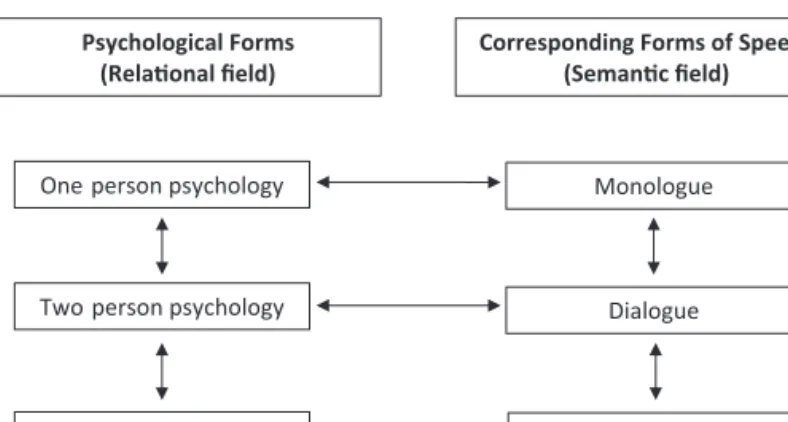
2.1 The three dimensions of psychotherapy 61 3.1 A pentangle of group development and focal issues 97 4.1 Forms of speech in the group and corresponding psychologies 115 7.1 A simple classification of group methods 201
7.2 The elements of a Tavistock group 206
7.3 The elements of an Interpersonal group 208
7.4 The elements of a Group-analytic group 210
7.5 Tools for systematic comparison of leader activity and focus across
models: Rutan, Stone and Shay 214
7.6a Tools for systematic comparison of leader activity across models
response profile A 1–3: therapist’s role 215
7.6b Tools for systematic comparison of leader activity across models:
response profile B 4–9: therapist’s focus in group 216 ii.1 The conductor’s map – Structure, process and content 222
8.1 Defining the group-analytic model 227
9.1 Structural dynamics at work 245
10.1 Process dynamics in small group psychotherapy 251 11.1 Six questions about the language of the group 281 11.2 Content analysis and the modalities of time and place 295 11.3 Progression of group discourse towards resolution and change 296 12.1 The three role functions of the conductor 305 12.2 The conductor as convenor: With their therapeutic and
member-role functions embedded 307
12.3 The conductor as therapist: With their convening and
member-role functions embedded 309
12.4 The conductor as group member: With their convening and
therapeutic role functions embedded 311
13.1 Four levels of a group’s communication described as domains:
Current, transference, projective, primordial 343 13.2 The four domains of a long-term analytic group 344
Downloaded by [New York University] at 13:03 29 November 2016
14.1 Transference and projective levels of experience in a group 368 14.2 Circular and reciprocal movement between layers or domains
of group experience 369
17.1 Three principles of therapeutic intervention in groups: Location,
translation, interpretation 444
Downloaded by [New York University] at 13:03 29 November 2016
The importance of groups as an arena for psychodynamic work and understand- ing has been established for nearly 100 years – at least since Freud’s comment in his Group Psychology and the Analysis of the Ego that ‘In the individual’s mental life someone else is invariably involved, as a model, as an object, as a helper, as an opponent; and so from the very first individual psychology, in this extended but entirely justifiable sense of the words, is at the same time social psychology as well’ (1921:69). Despite this endorsement from the creator of psychoanalysis, however, it was not until the Second World War that group psychotherapy became a significant force in psychotherapy, and it was not until after that war that group analysis, as an organised body of theory and practice, began to develop. It might be said – or at least I might claim – that whilst group analysis has thrived as a sys- tematic practice that seems to have great power and integrity, it has not advanced so much in terms of theory. The great source book, Foulkes and Anthony’s Group Psychotherapy – the Psycho-Analytic Approach (1957, 1984) remains the premier publication in the field, and despite quite a lot of publishing activity since then, it is arguable that the early promise of the work has still to be realised. This seems unlikely to be because there is no call for group psychotherapy, as so much that is offered in clinical and other institutional settings is group-based work; nor is it because the techniques, procedures and concepts employed in group analysis are somehow obvious or mundane. In fact, they are complex and demanding, and the skills required in actually running (or ‘conducting’) groups are very subtle and stretching. Perhaps it is because group analysts have been under-confident about their ability to compete with their psychoanalytic colleagues in the creation of new concepts; or maybe it is simply that in the busy work of a psychotherapeutic practice that is not rooted in universities, it is very hard to find time to step back, make sense of things and move them on.
This is where John Schlapobersky’s new book is of great significance. First, he writes from a position of immense authority in the field, draws expertly on his extensive experience, manifested especially in excellent case material, and holds to an ethical standpoint that will be appreciated by students and practition- ers alike. Indeed, this book is best understood as the product of the professional
Downloaded by [New York University] at 13:03 29 November 2016
life’s work of a leading British group analyst, someone who has trained many generations of other group analysts, someone absolutely immersed in the lived reality of group analysis as a practice and also committed to its conceptualisation and to the advancement of the field through careful observation, new theorisation and, where possible, evaluative research. John’s ambition is vast: basically, to write the book that will draw together what can be seen as the inherited wisdom of group analysis since Foulkes’s time; and also to make it accessible, so that group analysis will be preserved and will advance as a profession, and everyone working with groups, from whichever ‘school’ they come and at whatever level of experi- ence, can benefit. This is a big challenge for a writer, especially one who has his hands full with teaching and clinical work, and it has taken quite a while to come to fruition; but here it is, and it arrives as a very major contribution to the field.
In From the Couch to the Circle, John writes as someone completely at home with the ideas of group analysis and also with the wider context in which they have meaning. This is the context not only of psychotherapy but of relationships between individuals and in societies as a whole. He has an anthropological cast of mind but also a political and a cultural one, by which I mean simply that he understands the importance of frames and contexts, differences and similarities, connections and disjunctions of all kinds. This both makes him a fine guide to what matters in group work and gives him the ability to describe and evaluate key concepts in a way that is both ‘inside’ them in the sense of understanding how they work and ‘outside’ in that he maintains enough distance to evaluate them. Because of this, the book is a mine of information about group-analytic ideas and how to use them, presented accessibly and yet with the weight of an appreciation of their full complexity behind them. I am sure every student of group psychotherapy will find John’s presentation of the theoretical material compelling and enlightening.
But to my mind the absolutely massive strength of the book lies in the way case material is used to drive it forward, with wonderfully engaging and often moving examples and incisive, consistently instructive commentaries on these. These case examples enable John to show his acute clinical sensitivity and also his virtues as a teacher, deploying the concepts he is using to make sense of the clinical mate- rial without detracting from its human (and humane) impact and using the clinical material recursively to flesh out the theoretical concepts. This is a terrific way to work through such a comprehensive account of this mode of psychotherapy, bringing the ideas alive and converting what might have become a very long and technical read into something accessible and consistently absorbing.
As I read the book, every section drew me in, and I felt I lived alongside John as a kind of co-therapist, or perhaps a co-member of his groups, sharing their experiences and yet also able to stand outside them and reflect on them, as he does so beautifully throughout the text. I also realised that I was benefitting from the work of someone who is not only a fine teacher – as I know from direct experi- ence working alongside him in the Group-analytic training that we ran for many years as an MSc between the Institute of Group Analysis in London and Birk- beck – but who also has a teaching, in the sense of an embodied history of clinical
Downloaded by [New York University] at 13:03 29 November 2016
and theoretical wisdom in group analysis. He imparts this in many ways: in his contribution to groups of which he is a member, through supervision of clinical work and also of research in group analysis, as witnessed for instance in the many master’s dissertations that he has supervised, several of which are drawn on in the book. But he also imparts it through his manner, in that everything he presents here is positioned in the context of systemic and dynamically relational principles;
or, to put things simply, he has an idea about what group relationships mean and what we might learn from them. I see this as a powerfully ‘psychosocial’ element in his work and one that links it closely to the approach that my colleagues and I have taken in building a presence of what we are calling psychosocial studies within the university scene.
We should all be grateful for this book. Group analysts need it: if they are new to the work, it will help them understand the history, context and content of group- analytic ideas and will guide them in how to use these ideas in practice. If they are more experienced, it will deepen their understanding and spark a process of reflec- tion on which ideas have staying power and on how different modes of work can extend or challenge them. For readers from the broader world of psychotherapy, the book makes a very strong case for considering group analysis as a method of choice and also articulates how group theory can feed off, challenge and enrich other types of approach. And for readers who are not primarily psychotherapists but are interested in interpersonal and social relations, this book gives tools of inquiry and self-reflection and hints at what will no doubt be in the second vol- ume – ways in which group analysis in clinical settings can be extended to help us make sense of the complex lives of groups wherever they are found.
Stephen Frosh BA, MPhil, PhD Professor of Psychology and
Pro Vice-Master, Birkbeck, University of London Bibliography
Foulkes, S. H., and Anthony, E. J. (1957; reissued 1965, 1984). Group Psychotherapy: The Psychoanalytic Approach. London, Karnac.
Freud, S. (1921). Group Psychology and the Analysis of the Ego. The Standard Edition of the Complete Psychological Works of Sigmund Freud, Volume XVIII (1920–1922):
Beyond the Pleasure Principle, Group Psychology and Other Works, pp. 65–144.
Downloaded by [New York University] at 13:03 29 November 2016
‘Astonish me!’ was the challenge from Serge Diaghilev to Jean Cocteau when he commissioned a new ballet from him. Well, I am astonished by John Schlapober- sky’s monumental text, a work which is both artistic and scientific. From his 35 years of experience in an extraordinarily wide field of group psychotherapy – in group-analytic therapy groups and training groups; group-analytic workshops;
forensic psychotherapy; with victims of torture; and in conference challenges. From all these experiences he has amassed a rich harvest shown by the protocols through which we learn how skilfully he applies group-analytic theory and technique.
This is a narrative art. Science is in the tabulations, the careful categorization of diagnoses, of treatment results, of illuminating diagrams. John has the literary ability to present a wide range of theory in a way that both stimulates and main- tains interest through novelty and challenge, as in these diagrams and tables. He has written a textbook that will interest and inform readers, both those seeking an introduction to group analysis and mature practitioners who want to revise their own experience and ideas.
I have followed the growth of this book over several years, admiring the author’s ambition and the tenacity with which he has reached his goal. Rarely nowadays do we read a single-author text written with the authority that derives from such rich experience as practitioner, as a teacher and as a teacher who enjoys and is able to utilise the work of his students whose writing he quotes from so generously.
One of the book’s striking features is the foreground John gives to movement between monologue, dualogue, dialogue and discourse that is so well brought out in the many clinical illustrations.
I particularly welcome the close attention that he gives to the Foulkes and Anthony ‘Ur-text’ of group analysis and to the subsequent, separate writings of Foulkes and Anthony that have been such fertile ground for his own development in thought and practice.
‘The Last Word’ is a delightful way of closing his text. The writings of some former patients give the final stamp of authority to his work.
Malcolm Pines Founder Member, Institute of Group Analysis, London Formerly Consultant Psychotherapist, St. George’s
Hospital; Maudsley Hospital; Tavistock Clinic
Downloaded by [New York University] at 13:03 29 November 2016
I am very pleased to have been asked to write a Preview for John Schlapobersky’s new handbook that is destined to find its place on both sides of the Atlantic. It will make a valuable contribution to the field of group therapy, and to honour this I will say something here about Group Psychotherapy: The Psychoanalytic Approach that Foulkes and I published in 1957. This allows me to bring forward my own origins in group analysis which American readers might not be familiar with – especially my relationship with Michael Foulkes – and to bring forward American achievements in child and adolescent psychiatry that readers in Europe may not be familiar with.
Resiliency
Our original development of resiliency as a field of study with its concepts of vulnerability and protective factors, based on empirical research, led to a new understanding of the relationship between constitution and environment.
The emergence of a developmental science has its origins in our early work in St. Louis, Missouri, where I took up a professorial appointment. It also has earlier origins in my relationship with Foulkes, for he was the man whose own resil- iency helped me to find mine. In this new book it is heartening to see an emerging focus of two different kinds – on the person and personality of the group analyst and on empirical research in group analysis. They are both critically important for the future.
In recognition of our work in St. Louis, the American Academy of Child and Adolescent Psychiatry (AACAP) honoured me with their Lifetime’s Achieve- ment Award in 2009. It has a place of honour in my office and takes the form of a collage with photographs of three mentors, each of whose personal influence was most important in my own development – Anna Freud, Jean Piaget and Erik Erikson. In 2011 the Group Analytic Society, an organisation I helped to found in 1953, honoured me with their Lifetime’s Achievement Award for my contribu- tion to group analysis. It is written in beautiful calligraphy and also has a place of honour in my office.
Downloaded by [New York University] at 13:03 29 November 2016
My own background: the search for little people
‘The Search for the Little People’ was the title for my acceptance speech on being honoured by the AACAP. The title ‘Little People’ stems from Yeats’s writ- ing about the goblins of Ireland. I fell in love with the term because it conveys my own experience of being ‘a little person’ and I fell in love with little people themselves in all their variety (Yeats 1998). I was born in India and was sent to a boarding school in a Himalayan hill station by my parents at the age of five. Our community of children was a world of little people, and our school looked on to Mt. Kangchenjunga, the third-highest peak in the world. The mountain presided over my childhood and made us aware that we were very, very little people in a vast world. My mother was an operating theatre nurse who decided that I should become a brain surgeon and so, on completing high school, I was dispatched to a medical school in London in the first step of a career that would take me on to work with little people as a psychiatrist.
World War II
My arrival in London coincided with Hitler’s decision to bomb Britain, and we had to contend with a tornado of missiles every night. One of the tasks of new medical students like myself was to evacuate patients from the open wards at St. Thomas’s Hospital to underground shelters at the end of the day. With some elementary counselling on how to communicate with them I found myself a pusher for sick and frightened children, and this experience set me up – in due course and after further such exposure – to become a child psychiatrist.
On qualifying as a doctor through an accelerated training I was seconded to the 9th Essex Battalion as their general medical officer and, by the most extraordinary chance, I was accommodated in a tent with Dr. John Rickman, a British psycho- analyst who had been at the Tavistock Clinic and was very interested in groups. For three weeks we had only one another to talk to, and it was an extraordinary educa- tion. He was a kindly man, a Quaker who told me about Freud, psychoanalytic theory and groups and suggested I put my name down to go to Northfield. This took two years to come through, during which I gave lectures to the troops in my battal- ion on dealing with fear and anxiety and was with them when we crossed the Chan- nel to encounter the German army. I dealt with casualties endlessly before returning to the safer shores of England and to the Northfield posting, the military hospital for shell-shocked soldiers near Birmingham where I met psychiatrists, psychologists and psychoanalysts including Michael Foulkes. I did not know how important he was to become for me, and the most memorable thing I recorded about him then was his skill as a tennis player. He was the fastest man on the court in Birmingham.
When the attack on Japan was devised I travelled on a war ship to reach a country devastated by the first atomic explosions. I was appointed Chief Medical Officer for Southeast Asia and was charged with setting up nurseries and kindergartens for
Downloaded by [New York University] at 13:03 29 November 2016
Japanese adolescents and children who survived the Hiroshima bombing. We used a group approach for the care of these terrified children who, unlike their parents, had escaped that explosion. Later on I saw other children who had to witness Japa- nese adults now ordered to pull the Hong Kong buses, eight to a bus. My concern for children forced to watch this exercise in humiliation confirmed my decision to focus my life on the psychiatric care of children.
When the war ended I was certain of only two things: I wanted to become a psychiatrist-psychoanalyst and I wanted to work with children. At this point life chose to place me on a Foulksian conveyor belt that carried me steadily along as his analysand in a training analysis; as an analyst sharing an office with him; as his student in group dynamics and group psychotherapy; as a co-therapist in an analytically orientated group, as a fellow consultant at the Maudsley Hospital; as a co-author of a book on group therapy from the psychoanalytic point of view;
and finally as joint visiting professors at the University of North Carolina (op. cit.
1978:2).
The Maudsley Hospital
After the war I returned to the UK to take up a training position at the Maudsley Hospital, the main post-graduate centre for psychiatry in Britain. What I gained from my time at the Maudsley equipped me to later take up a position as the world’s first Endowed Professor of Child Psychiatry at Washington Hospital, St. Louis. As well as the benefits that came to me from the formalities of the training, I also met four extraordinary people. The first was Sir Aubrey Lewis, who was laying the foundations for the Institute of Psychiatry. He interviewed and admitted me to the training and later also sent me to work and study with Jean Piaget in Geneva, for which he raised the funds. The second was Foulkes, Head of the Maudsley’s Department of Psychotherapy where I had a posting. It was on discovering his inspiring presence and understanding there that I chose him as my training analyst for admission to the British Psychoanalytic Society, and I began a long analysis. The third was Anna Freud who had been invited by Aubrey Lewis, despite his own commitment to organic psychiatry, to conduct psychoanalytic seminars for us at the Maudsley. She became a mentor and later invited me to work with her at the Hampstead Nursery. This bond laid the founda- tions for a working relationship and friendship that was to last to the end of her life. And the fourth was Malcolm Pines, then a junior registrar, who became a life-long friend. He was also in training analysis with Foulkes, and we are now the last of that generation. As a fellow member of the Group Analytic Society he went on with Foulkes and others to found the training institute, the Institute of Group Analysis, London. There are now IGAs in many parts of the world and a co-ordinating, regulatory body, EGATIN. Malcolm has been a tireless influence fostering group analysis through the development of these training resources in a range of different ways.
Downloaded by [New York University] at 13:03 29 November 2016
S. H. Foulkes
When Foulkes invited me to write Group Psychotherapy: The Psychoanalytic Approach with him, I was honoured but uncomfortable because he had been my training analyst. But we settled down to productive writing together. I had been working in his psychotherapy department at the Maudsley Hospital, where I had also been a member of one of his groups, I went on to co-lead groups with him, and we became accustomed to working together. We wrote the different chapters of the book separately and then discussed each of them with one another and became colleagues in this shared task through a friendship that was to last the rest of his life. Although we had confidence in the book we could not have imagined that it would be continuously in print from 1957 for the next 58 years. I find it extraordinary that the second edition published in 1965 and reissued by Karnac in 1984 remains a best-selling text in group psychotherapy to this day. In my Foulkes lecture given in 1978 I gave an account of
The first and most enduring group lesson that I learned from Foulkes . . . that although the conductor’s perspective is bifocal (focussed on the group and the individual) his interpretations are invariably directed to the group as a whole.
(Anthony 1978:9) And second,
His theory of network . . . has had a major impact on my own investigative work. The way in which the patient represents himself to us (and this is so true of the child) is the symptom of a disturbance that involves a whole net- work of circumstances and people. As Foulkes put it: ‘It is this network of interacting circumstances and persons which is the real operational field for effective and radical therapy’.
(Anthony 1978:15) The problem confronting us then is the same one we face today: ‘How to trace the network into all its ramifications therapeutically’ (Anthony 1978:15).
These principles guided us in our work at the University of Washington when I arrived in St. Louis in 1958. The Department of Child Psychiatry that I founded had a focus on both treatment and research, and we began to develop a body of findings in close collaboration with others to define resiliency and outline those factors that protected children through adversity and those that made them more vulnerable. Today resiliency studies make up a wide field of investigation with relevant bearing on group therapy. Here I will identify only our originating findings. In studying three generations of families with recur- ring psychotic illness we found that the children who did well could be identi- fied if, within their first three years of life, they had one good year; if within a
Downloaded by [New York University] at 13:03 29 November 2016
context of instability or adversity they had one good relationship; and if within their own range of problems and limitations they had one competency they could see as their own.
Foulkes was the man whose resiliency helped me to find mine. He lost so much that had been his own in the Holocaust; he came to the UK to live and take up a professional life in an alien language; he established a war-time service that matured to become a way of understanding people and relationships; and he gen- erated a therapy that opened up for us a whole new field of endeavour that was
‘gradually forged . . . through trial and error using the group as a laboratory situ- ation in which his evolving ideas were continuously put to the test of observa- tion, reformulation and revision’ (1978:8). While doing all this he lived through a World War in an adopted country and alien language, through a divorce with his first wife and the untimely death by cancer of his much loved second wife, Kil- meny. On one of my visits to London he told me of a new, developing symptom that was worrying him and which I encouraged him to have investigated imme- diately as it was a palpable mass. It turned out to be a tumour for which he was being investigated but he died of a heart attack in his own consulting room in the early stages of treatment.
This new book
John’s book embraces many of the key concepts in our original book. It amends the thinking and practice to bring it into line with contemporary developments in attachment and relational theory and in neuropsychology. John documents a wide range of innovative applications with groups for refugees, for couples, in pri- vate practice, mental health and forensic settings; once-weekly, twice-weekly and block group therapy. He deals with the role and concept of the conductor and the matrix and explores the subject of transference – with a big ‘T’ and with a small
‘t’ – in an original way. And he takes up what we called group-specific factors in the phenomenology of the group and re-describes them here as process dynamics.
His accounts will interest all who work with a relational paradigm – group ana- lysts and others. When I first read his manuscript I was at once impressed with the wide range of settings in which he has worked with groups, the breadth of his dif- ferent applications, the depth of his work and his fluency in describing it. His own distinctive contribution in the field begins with a paper he wrote for the Brown/
Zinkin compilation, The Psyche and the Social World in the 1990s titled The Lan- guage of the Group. It is re-issued in this book as Chapter 4. His exploration of human communication through monologue, dialogue and discourse runs through this handbook. It also brings in the writing of others who have followed him into the study of therapeutic language, of silence and of the music of the group. In my Foulkes Lecture I said that:
Every now and then in the history of the therapeutic sciences, certain key words suddenly appear and illuminate the intellectual landscape. Two of
Downloaded by [New York University] at 13:03 29 November 2016
these words that are highly pertinent and have become the basis of metapsy- chology are process and structure. . . . together they generate content (which) can be described as the stories that patients tell within the individual and group situation or the nonverbal messages they convey.
(Anthony 1978:11) I am delighted to see the use to which John has put these terms, structure, pro- cess and content, as deeper dimensions of the group. Each of them has been given its own chapter as a resource for therapeutic guidance of new and experienced group therapists. In 1978 I went on to say that:
We have a pressing need to develop our own metapsychology and to but- tress it with good theory. We further need to look developmentally at the group, observing how its history unfolds and the stages become deline- ated . . . Foulkes and I spoke of the group historian, the member who kept the archives of the group and reminded us of anniversaries, earlier events, developments and traumata. The group analyst, like the psychoanalyst, must carry the history of his patients inside him and from time to time it may be necessary for him to reconstruct the early group experience of the mem- bers – primary family groups, latency groups, early heterosexual groups, homosexual groups, adolescent groups, etc. . . . One speaks of restructuring in psychoanalysis: to what extent can the same term apply to group analysis;
do we see restructuring of the individual members as individuals or do we see a restructuring of their group behaviour or of the behaviour of the group?
This new book addresses these important questions and relies on detailed descriptions in vignettes that show its author to be a fine storyteller as well as a committed group analyst. As I said in my memorial lecture:
Foulkes’ death led me to sense, like Rilke, the ugliness underlying the smil- ing face of existence. But mourning comes to an end as life goes on, as group institutions and societies grow and the young are always coming along to take their share of the load. The death of the leader is a time for grief, for recon- sideration, for re-organization but not for catastrophe. As Freud put it: ‘When once the mourning is over, it will be found that our high opinion of the riches of civilization has lost nothing from our discovery of their fragility. We shall build up again and more lastingly than before’.
(Anthony 1978:18; Freud 1915) Michael Foulkes would have given this message to his successors, and I believe he would have been as delighted with this new book as I am.
E. James Anthony, MD, FRCPsych Co-author with S. H. Foulkes of Group Psychotherapy: The Psychoanalytic Approach
Downloaded by [New York University] at 13:03 29 November 2016
Bibliography
Anthony, E. J. (1978). The Group-Analytic Circle and Its Ambient Network: 2nd Foulkes Lecture. In Group Analysis 11 (Supplement 1): 1–18. http://gaq.sagepub.com/content/
11/2/S1.citation. In Pines, M. (ed.). (1983). The Evolution of Group Analysis. London, Routledge. Reissued 2000, London, Jessica Kingsley, pp. 29–53.
Anthony, E. J. (2010). In Search of the Little People. Presentation Address Given on Receipt of His Lifetime’s Achievement Award. American Academy of Child and Ado- lescent Psychiatry. www.aacap.org/aacap/Life_Members/Life_Member_Archives/Inau gural_Life_Members_Wisdom_Clinical_Perspectives.aspx
Anthony, E. J. (2011). Address Given on Receipt of His Lifetime’s Achievement Award, 15th Symposium. Group Analytic Society International. Goldsmiths College, University of London.
Flapan, D. (1982). The Ongoing Journey of an Extraordinary Man in the Field of Group Psychotherapy – an Interview With E. James Anthony. GROUP 6 (3): 49–58. http://link.
springer.com/article/10.1007/BF01459280#page-1
Foulkes, S. H., and Anthony, E. J. (1957; reissued 1965, 1984). Group Psychotherapy: The Psychoanalytic Approach. London, Karnac.
Freud, S. (1915). On Transience. In (2005) Freud’s Requiem. New York, Riverhead Books.
Schlapobersky, J. (1994; 2000). The Language of the Group: Monologue, Dialogue and Discourse in Group Analysis. In D. Brown and L. Zinkin (Eds.), The Psyche and the Social World. London, Routledge, pp. 211–231.
Yeats, W. B. (1998). Mythologies. London, Harper Collins.
Acknowledgements: Extracts from the Group-Analytic Circle and Its Ambi- ent Network: 2nd Foulkes Lecture first published in Group Analysis 11 (Supple- ment 1): 1–18. http://gaq.sagepub.com/content/11/2/S1.citation. Reprinted by permission of Sage. Reissued in Pines (1983), The Evolution of Group Analy- sis. London, Routledge. Reissued 2000, London, Jessica Kingsley, pp. 29–33.
Downloaded by [New York University] at 13:03 29 November 2016
Personal acknowledgements
The participation of my partner Claudia Arlo in the drafting of this book has been a constant source of renewal, like water for a long-distance runner. This book is a tribute to her and an expression of my deep gratitude. My family have shown immense kindness during these years of investment, and I thank them for their understanding. My daughter Hannah accompanied me to the publisher with the submission of my first manuscript – Selected Papers of Robin Skynner – when she was a teenager. She is now a mother and writer in the field herself, and I thank her for her continuing good faith and patience, which I hope have been vindicated here. If a book can be said to have grandparents the honour goes with my thanks to Phyllis Cohen and Walter Goldstein. Malcolm Pines has been gracious with his consent for the re-issue here of material we drafted together for other papers. I am grateful to him for much more than publishing consent. He was my first teacher in psychotherapy at the Maudsley Hospital in 1976 and has been an enduring source of guidance and friendship. This book has benefited from his influence throughout and his Tribute to it is deeply appreciated. James Anthony befriended this project from afar, and we met in the course of recent years to draft his Historical Preview.
We could not have foreseen that it would be one of the last things he was to write.
My gratitude is in the dedication of this book to his memory. My thanks also go to his widow Virginia and his daughter Sonia, who saw us through the drafting process. My other friends who, as authors, inspired me and offered valuable guid- ance include Robi Friedman, who played an active and vital part supporting me textually and personally. Stephen Frosh took an interest in the book that draws from the psychosocial perspective that he pioneered at Birkbeck College, which he extended to help shape our training at the IGA. He was this book’s first advo- cate, has remained its loyal friend and his Foreword is deeply appreciated. Liesel Hearst was one of my first supervisors and has remained a constant source of assurance in the book’s development. Peter Marshall will be pleased we can walk again in the West Country and perhaps even sail between the writing of his books and mine; Norman Rosenthal’s gift of adversity has been a profound one; Erol Yesilyurt befriended this project and supported it down the years, and I trust its