Ongoing discussions with established FASB advisory groups such as the Financial Accounting Standards Advisory Council (FASAC), Investor Technical Advisory Committee (ITAC), Small Business Advisory Committee (SBAC), Private Company Financial Reporting Committee (PCFRC ) and others about the future of financial reporting in the US; and. Therefore, we believe that, as noted in the Guidance, if the SEC considers mandating the use of IFRS by the U.S.
E FFECTS OF I MPROVED R EPORTING AND D ISCLOSURE Q UALITY
Empirical studies support this argument and provide evidence that better disclosures reduce information asymmetry and increase market liquidity (e.g., Welker, 1995; Healy et al., 1999; Leuz and Verrecchia, 2000; Bushee and Leuz, 2005 ). This effect can directly reduce the required rate of return of an individual security as well as the market risk premium of the entire economy (e.g., Easley and O'Hara, 2004; Lambert et al., 2007 and 2008).
E FFECTS OF M ORE C OMPARABLE R EPORTING P RACTICES
For example, business performance disclosure and governance arrangements provide useful benchmarks that help external investors assess the managerial performance of other firms or potential inter-agency conflicts, thereby reducing monitoring costs. Most of the archival studies dealing with comparability effects have been conducted in the context of firms' choice of accounting standards.
C OST -B ENEFIT T RADEOFF R ELATED TO F IRMS ’ R EPORTING Q UALITY AND C OMPARABILITY C HOICES
ROLE OF ACCOUNTING STANDARDS FOR HIGH-QUALITY AND COMPARABLE
C OMPLEMENTARITIES AMONG THE E LEMENTS OF C OUNTRIES ’ I NSTITUTIONAL F RAMEWORKS
Because of these interdependencies, a well-designed set of accounting standards and other elements of the institutional infrastructure must be complementary, that is, fit and reinforce each other. First, it implies that changes in the accounting standards cannot be considered in isolation from other elements of the institutional infrastructure.
E FFECTS OF IFRS A DOPTION ON R EPORTING Q UALITY AND C OMPARABILITY
- General Arguments on the Effects of IFRS Adoption
- Evidence from Voluntary IFRS Adoptions around the World
- Evidence from Mandatory IFRS Adoptions around the World
With a focus on reporting quality, Barth et al. 2008) analyzes changes in the characteristics of reported earnings around the voluntary adoption of IFRS and presents evidence that companies' reporting quality increases. At present, there is no direct evidence that contemporaneous changes in the institutional environment are responsible for observed capital market outcomes. 2008) shows that the capital market effects surrounding the introduction of mandatory IFRS reporting are not evenly distributed across the countries.
COSTS AND BENEFITS OF IFRS ADOPTION IN THE U.S. 29
C APITAL -M ARKET B ENEFITS OF IFRS R EPORTING IN THE U.S
- Does Reporting Quality Increase with IFRS Adoption?
- Does the Comparability of Reporting Practices Increase with IFRS Adoption?
Based on the arguments and evidence in Section 2, the capital market effects of IFRS adoption in US Standards are only one of many factors that determine reporting outcomes, and even if IFRS were an ambiguous improvement, it does not immediately follow that the adoption of IFRS is beneficial in the US, as the issue of institutional compatibility must be considered (see sections 3.1 and 3.2). A second set of studies investigates foreign firms that are listed on a U.S. stock exchange, prepare financial statements in accordance with IFRS, must provide reconciliations to U.S.
However, there are several factors that limit the magnitude of the comparability benefits of adopting IFRS in the US.
C OSTS OF IFRS A DOPTION AND R EPORTING C OSTS S AVINGS TO U.S. F IRMS
- Transition Costs
- Recurring Costs
- Cost Savings Arising from a Single Global Reporting System
Based on survey data on the mandatory transition to IFRS in the European Union in 2005, it is possible to estimate the costs of preparing consolidated financial statements under IFRS for the first time for listed companies. In subsequent years, the recurring costs of preparing IFRS financial statements are estimated to range from 0.06% of total turnover for small companies to 0.008% of total turnover for very large companies (ICAEW, 2007). Therefore, the transition to IFRS will likely result in a redistribution of wealth among parties in the economy.
28 IFRS reporting for statutory and parent-only accounts is still being debated around the world and therefore this prospect may be far in the future.
W HICH F IRMS A RE L IKELY TO H AVE L ARGER N ET B ENEFITS ( OR C OSTS ) FROM IFRS A DOPTION ?
The costs and benefits of IFRS are therefore not evenly distributed – an issue we discuss in the next section. For example, the argument that firms switch to IFRS to reduce information asymmetry and therefore improve their ability to meet their current and future financing needs does not really apply to the US. We broadly define "multinationals" as firms with foreign subsidiaries or operations, firms that derive a significant portion of their sales abroad, firms considering international expansion, firms with foreign suppliers or customers, and firms with a more international investor base.
Since switching to IFRS is likely to involve a fixed cost component, larger firms will have an advantage.
C OMPATIBILITY OF IFRS WITH U.S. R EGULATORY S YSTEM , L EGAL E NVIRONMENT , AND E CONOMY
- Accounting Discretion and the U.S. Litigation System
- Accounting Differences between U.S. GAAP and IFRS
- IFRS Reporting and U.S. Disclosure Requirements
- IFRS Reporting and the Link to Taxation
One such example is the "forward-looking" risk estimates that companies are required to provide under IFRS. However, as discussed in Section 3.1, the importance of accounting standards for the quality of reported financial figures is often overestimated, and the debate on IFRS adoption in the US A counterargument is that additional disclosure requirements could be used to strengthen the quality of IFRS reporting in the US, if they are extended in the areas where particular IFRS are a problem or considered insufficient.
Although we view high-quality financial reporting and tax compliance as correlated outcomes, it is conceivable that the relatively strict tax enforcement system in the US.
O THER M ACROECONOMIC E FFECTS
- International Competitiveness of U.S. Capital Markets
- Effects on Service Providers
- Effects on Trade Flows and Foreign Direct Investment
- Education System
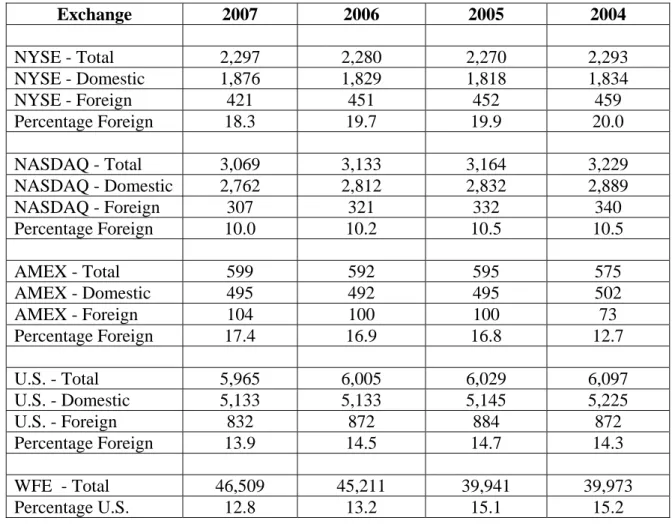
The cross-listing literature suggests that, historically, many foreign firms have chosen to list in the US. Consequently, these elements should be considered "assets" in the regulatory competition with other countries. In the case of the US, these "language" effects on trade are likely to be small because both IFRS and U.S.
GAAP would continue to exist as a separate set of standards even after the adoption of IFRS (for example, for private companies) or if IFRS simply changed to “generally accepted accounting principles” in the US.
STANDARD SETTING AND POLITICAL RAMIFICATIONS OF IFRS ADOPTION IN
P OLITICAL R AMIFICATIONS OF IFRS A DOPTION IN THE U.S
From the preceding discussion, it is clear that the future roles of the SEC and the FASB will need to be redefined if the US. In addition, the SEC will play a role in the IASB's governance structure as part of the newly approved monitoring group. The close cooperation between the IASB and the FASB has been intensified since 2002 with the signing of the Memorandum of Understanding.
As the future governance structure of the IASB is currently being worked out, it is difficult to provide opinions on the likely outcomes.
POSSIBLE FUTURE SCENARIOS FOR U.S. ACCOUNTING STANDARDS 79
M AINTAIN U.S. GAAP WITH C ONTINUED C ONVERGENCE BETWEEN IFRS AND U.S. GAAP
However, it is likely to be significantly weaker due to the existence of a formal convergence process. Moreover, the beneficial effects of competing standards diminish as the remaining material differences between IFRS and U.S.A. On the other hand, the benefits of reporting comparability will also be realized more slowly and there will be continuous changes due to the convergence process (beyond the normal rate) of change in the accounting standards).
Third, this scenario raises a number of implementation issues, including (i) the extension of and changes to the Memorandum of Understanding between the FASB and the IASB, (ii) the resolution of disagreements between the two standard-setting bodies on the convergence of more controversial standards , and (iii) the timeframe for the full convergence of IFRS and U.S.
A LLOW C HOICE BETWEEN IFRS AND U.S. GAAP, BUT R EQUIRE R ECONCILIATION
Another argument in favor of alignment is that it disciplines the implementation of IFRS by reducing incentives to use the discretion inherent in IFRS in an opportunistic manner. However, the counterargument is that companies may have incentives to minimize the reconciliation amounts they must disclose, which in turn may reduce the quality of both IFRS and reconciled US. An argument in favor of reconciliation is that it informs investors about the differences. between IFRS and the US.
It should be noted that there is also the reverse path: let both IFRS and U.S.
A LLOW U NRESTRICTED C HOICE BETWEEN IFRS AND U.S. GAAP
On the one hand, companies may make “low quality” reporting choices, but ultimately they bear the costs of these decisions, for example in the form of higher capital costs or lower valuations. However, in the US, investors are already exposed to different accounting practices, for example by foreign companies that are on a US cross-list. Many of the benefits of moving to a single set of accounting standards come in the form of externalities and network effects—they require a sufficient number of participants and increase network size (see sections 2.2 and 4.2).
With the two standards co-existing in the US, some of these network benefits could disappear or become significantly less.
A DOPT “U.S.- SPECIFIC IFRS”
These institutional forces are expected to persist after the adoption of IFRS, leading to a "US-specific IFRS" scenario. Furthermore, we expect "US-specific IFRS" to be more politically palatable given domestic concerns about relinquishing complete control to the US. With regard to macroeconomic outcomes, the "US-specific IFRS" scenario likely increases the competitive pressure on the US.
In terms of cost consequences, the "US-specific IFRS" scenario should be less costly than unconditional IFRS adoption during the transition phase and in the long term to the extent that many of the elements of current U.S.
S ET C ONDITIONAL T IMETABLE TO F ULLY A DOPT IFRS
For example, auditors learn to make a smooth transition to IFRS, which reduces transition costs for companies that adopt IFRS later. On the other hand, the gradual transition model could introduce uncertainty for companies, investors and other stakeholders, because the final decision and the timing of the mandatory transition to IFRS are not fixed, but depend on the behavior of companies.63 To mitigate this uncertainty, policy makers could set the terms of such a "flexible transition to IFRS" scenario by (i) allowing a certain group of large companies (e.g. S&P 500 companies) to choose between GAAP and IFRS within a predetermined time frame (e.g. three fiscal years) and (ii) ) setting a threshold that, if met, automatically triggers the next stage (eg if more than 50% of large companies decide to adopt IFRS, then require adoption for the remaining large companies, otherwise repeat the first stage), which essentially allows companies and market participants to form and revise expectations about the likelihood of IFRS adoption. Finally, we note that the initial set of firms that have the option of adopting IFRS must be selected sufficiently large because the potential network benefits of a single set of standards only emerge when a large proportion of firms adopt the new set of standards (see Section 4.2.2).
Thus, the current SEC proposal to make only a small number of companies eligible for early adoption of IFRS may be self-defeating because the economies of scale and network effects will not be apparent to such a small group.
C REATE I NTERNATIONAL U.S. GAAP (I-GAAP)
Pincus, 2001, Domestic Accounting Standards, International Accounting Standards, and the Predictability of Earnings, Journal of Accounting Research. Leuz, 2006, International Differences in the Cost of Equity: Do Legal Institutions and Securities Regulation Matter?, Journal of Accounting Research. Lundholm, 1996, Segment reporting to the capital market in the presence of a competitor, Journal of Accounting Research.
Hung, M., 2001, Accounting standards and value relevance of financial statements: An international analysis, Journal of Accounting and Economics. Schipper, 1999, Implications of Accounting Research for the SEC's Consideration of International Accounting Standards, Accounting Horizons. Adoption of IFRS for use in the United States has obvious public policy implications for the SEC.