Securing a
Healthy and Nutrition-
Conscious Young Generation through the School and
Community Education System for Society 5.0
Jesus C. Fernandez, PhD Deputy Director for Program
SEAMEO RECFON
A Brief on SEAMEO RECFON
• One of the 26 specialist centres of the Southeast Asian Ministers of Education Organization (SEAMEO)
• Vision: Be the center of excellence in human resource development in the area of food and nutrition in Southeast Asia
• Mission: To conduct education, capacity building, research and information dissemination in food and nutrition through partnership for sustainable human resources development
Malnutrition is global & multisectoral
Target 2.2. “End malnutrition in all its forms”
2016-2025 as the Decade of Action on Nutrition
Underweight
Overweight Nutrient
Deficiencies Individuals
Households Communities
Triple Burden of Malnutrition
Malnutrition Framework
Malnutrition in Southeast Asia
Source : Global Nutrition Report 2018
Most Vulnerable Sector to Malnutrition:
Under-Five and School-Aged Children
Malnourished children:
• slow or poor brain development
• poor school performance
• limited opportunities to find a decent job during adulthood
• affects the country’s economic growth.
Malnutrition Overlapping in Indonesia among under-five children with high prevalence of stunting (Global Nutrition Report,2014)
Province with Percentage of Poverty 12.02% - 30.05% (Source: BPS, 2014)
PROFILE OF INDONESIA 34 provinces
17.504 islands (BPS 2015) 514 districts
Population 237.641.326 (BPS 2010) NUTRITION PROFILE OF UNDERFIVE (Riskesdas, 2018)
30.8% stunting, 12.1% wasting, 10.2%
underweight, 8% overweight
Stunting prevalence among under-five children in Indonesian, by province (2018)
stunted toddler <20 %
stunted toddler 20 s/d <30 % stunted toddler 30 s/d <40 % stunted toddler ≥40 %
Malnutrition Framework
SEAMEO RECFON’s Approach to Combat Malnutrition in SEA Countries
Objective Target Approach
Problem
MalnutritionMITIGATION
Early Childhood
Prevent later effects of malnutrition
PREVENTION
School-aged children and adolescents
Prevent child born (next generation) from being
malnourished
Brief Overview of SEAMEO RECFON’s Flagship Programs
• A school-based multisectoral program emphasizing the role of schools as effective media for character building education that is centered toward good nutritional
practices both in school and at home
• Aimed at improving
students’ learning outcomes and active participation in school activities by acquiring proper nutrition
▪ A community-based multisectoral intervention aimed at providing a model of integrated implementation of essential components of childcare and parenting to optimize child growth and development
NGTS & ECCNE Program Components
• a “house” which either represents a family, a household, a learning space, or a community wherein these
components could and should operate.
• serves as a nurturing environment for a child to have optimal growth and development.
• symbolizes the
protection and security needed by children.
AWESOME School Children
(Active, Well- Nourished, and
Smart Of Me)
In-Curricular Extra Curricular Policy & Management Support
Nutrition Education
School Environment
School Environment
• Nutrition
Education within and outside the classroom brings about AWESOME School Children together with the proper policy &
management support, and conducive school environment
Brief Overview of SEAMEO RECFON’s Flagship Programs
Target groups: Elementary, Junior, Senior High, &
vocational school students, teachers & principals
Coordinated with Ministry of Education and Culture of
Indonesia
Other Partner Institutions:
Mininstry of Health, Ministry of Religious Affairs, SEAMEO BIOTROP, GIZ, UNICEF, Learning
Institutions
Year Launched: 2017
Target groups: Kindergarten, nursery, daycare children, parents, community health
workers
Coordinated with Ministry of Education and Culture of
Indonesia
Other Partner Institutions:
Ministry of Health, Ministry of Religious Affairs, SEAMEO CECCEP & TROPMED Network,
ECE Teacher Professional Association, Learning
Institutions
Year Launched: 2018
Where we are working at present
• Malang, East Java
• Sambas, West Kalimantan
• Klaten, Jogjakarta
• Cimahi, West Java
• Bogor, West Java
• Cirebon, West Java
• Timor Leste
• Malang, East Java
• Sambas, West Kalimantan
• Jambi, Central Sumatra
• East Lombok, West Nusa Tenggara
• Cambodia
• Lao PDR
• Myanmar
NGTS & ECCNE Types of Interventions & Activities
Nu tri tio n S peci fic Nu tri tio n S en si tiv e
• Generation and implementation of food-based recommendations for from locally available
nutrient-dense food sources
• Food Supplementation
• Mapping of Teachers’ Competencies and School Readiness
• Learning Module Development
• Capacity building of stakeholders
• Advocacy on program
mainstreaming thru partnerships
• Establishment of School Garden
• Establishment of Health School
• School-based Nutrition Promotion Working Group Formation and Functioning
Accomplishments Thus Far
22.20%
77.8 0%
Not Ready Ready
• Trained 396 teachers from 114 partner-schools at all levels from all Program sites on nutrition,
hygiene and sanitation education via face-to-face mode
• Trained 993 teachers from 105 schools via online mode on the same topics
• Conducted 8 research projects on food and nutrition at school settings
Accomplishments thus far
• Produced 5 modules
• Established the Indonesian School-based Nutrition
Promotion (SBNP) Working Group
• Recognized 83 school teachers for implementing their lesson plans on incorporating NGTS components in their classroom and extra curricular activities
ACCOMPLISHMENTS THUS FAR
Mapping of EC
Educators’ Competencies on ECCNE
• Only 22.7% received
health & nutrition training
• Median score of 25 (max 40) on knowledge about child nutrition
• Trained 8 nutritionists, 101 community health
workers, 114 ECE teachers, and 480 mothers in all the Program sites
• Established 3 ECCNE Models:
- Health Centre-based ECCNE Model for Stunting Prevention
- ECE Centre-based ECCNE Model for Stunting Prevention - ECCNE Model for Post-Disaster Recovery
ACCOMPLISHMENTS THUS FAR
• Produced 4 modules for the 3 ECCNE models in 2019
• Finalized the drafts of 8 new modules on Holistic and Integrative Early Childhood Care and
Parenting for printing in 2020
• Formulated and promoted local specific food-
based recommendations for stunting prevention in 2 Program sites for 2 different age groups
ACCOMPLISHMENTS
THUS FAR
Nutrition education sessionby Nutritionist in Community Health
Centers (CHC) (1 CHC = 4 Villages)
Monitoring of FBR implementation by
Cadres twice a month
(1x home visit and 1x during the nutrition
education session)
Community Nutritionist compiles the monitoring results from Cadres once a
month
Assistance by Local Academe (POLTEKKES and District Health Office)
ACCOMPLISHMENTS THUS FAR
• Produced a policy brief in 2019 from the results of the local FBR formulation and promotion in 2 Program sites
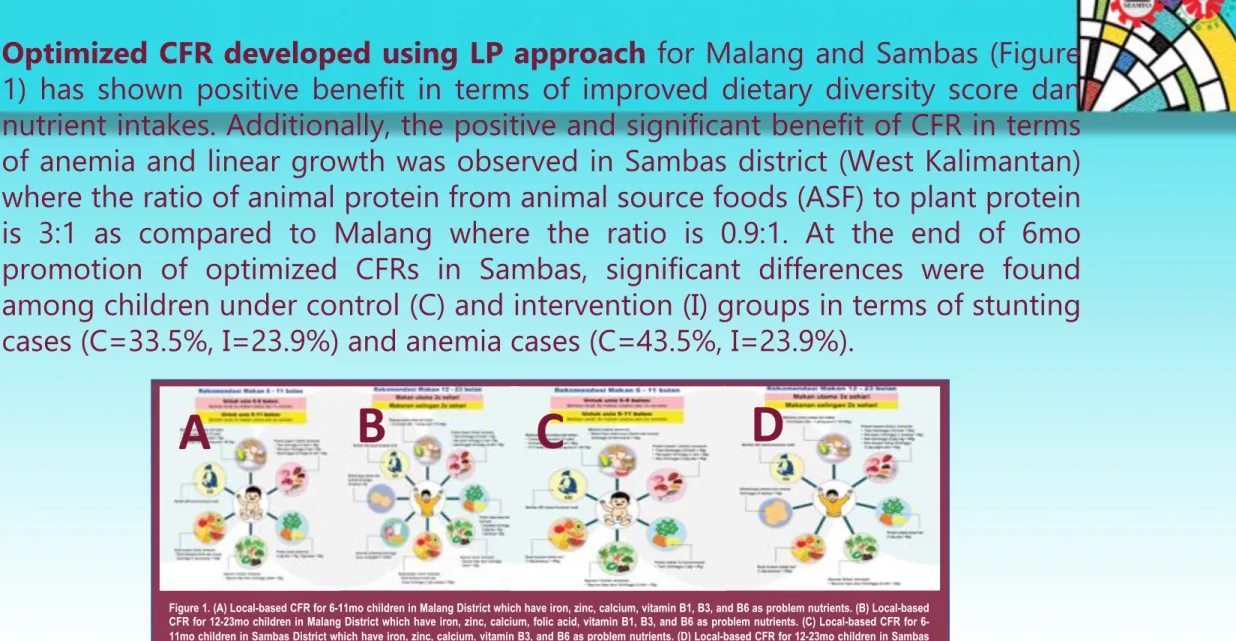
Optimized CFR developed using LP approach for Malang and Sambas (Figure 1) has shown positive benefit in terms of improved dietary diversity score dan nutrient intakes. Additionally, the positive and significant benefit of CFR in terms of anemia and linear growth was observed in Sambas district (West Kalimantan) where the ratio of animal protein from animal source foods (ASF) to plant protein is 3:1 as compared to Malang where the ratio is 0.9:1. At the end of 6mo promotion of optimized CFRs in Sambas, significant differences were found among children under control (C) and intervention (I) groups in terms of stunting cases (C=33.5%, I=23.9%) and anemia cases (C=43.5%, I=23.9%).
A B C D
Figure 1. (A) Local-based CFR for 6-11mo children in Malang District which have iron, zinc, calcium, vitamin B1, B3, and B6 as problem nutrients. (B) Local-based CFR for 12-23mo children in Malang District which have iron, zinc, calcium, folic acid, vitamin B1, B3, and B6 as problem nutrients. (C) Local-based CFR for 6- 11mo children in Sambas District which have iron, zinc, calcium, vitamin B3, and B6 as problem nutrients. (D) Local-based CFR for 12-23mo children in Sambas District which have zinc, calcium, vitamin B1, B3, and B6 as problem nutrients.
• Formed and formulated the road map of the Indonesian ECCNE Working Group composed of representatives
from the Ministries of Education, Health, and Social
Services, local government units, academe, civil society organizations, regional organizations
ACCOMPLISHMENTS
THUS FAR
Impacts Thus Far
• Directorate General of Early Childhood and
Community Education of MOEC Indonesia endorsed the 8 new modules on Holistic & Integrative ECE and Parenting developed by ECCNE Program Team
• MoH Indonesia requested SEAMEO RECFON to develop 3 guidelines on stunting prevention for District/City
Governments, Community Health Centers, & Integrated Family Planning and Health Service Centers
• ECCNE policy brief accepted, in principle, by MoH Indonesia
• Two district governments to formalize partnership
with SEAMEO RECFON to implement ECCNE model on stunting prevention
• MoH Indonesia requested SEAMEO RECFON to train local academe from 37 priority districts for stunting prevention on formulating local specific FBRs for their respective localities
• Ministry of Religious Affairs Indonesia and SEAMEO RECFON agreed to train teachers of Islamic schools on holistic and integrative ECCNE implementation via
online mode
Impacts Thus Far
Impacts Thus Far
• Nutrition concepts and principles integrated in lesson plans for classroom and extra curricular activities and documented by at least 83 schools that received NGTS trainings throughout Indonesia
• Universitas Muhammadiyah of Indonesia sought the partnership of SEAMEO RECFON to initiate NGTS
program to Madrasah schools in Jakarta City in March 2020
• At least 7 partner-schools in 2 Program sites became finalists for the Healthy School Award at district/city, provincial and national levels in Indonesia
Some lessons learned
Painting the bigger picture for stakeholders’
buy-in
Clearer roles & MoU
signing heighten ownership Continuous technical
assistance using social media sustains interest Research for better
evidence/ informed-based decision making
Recognizing efforts of school teachers/
EC educators deepens their personal commitment and advocacy
Thank you
Follow Us
www.seameo-recfon.org
@SeameoRecfon Seameo Recfon Seameo Recfon
@SeameoRecfon
Address
SEAMEO RECFON Building
Jl. Salemba Raya 6, Jakarta 10430 Indonesia
“Excellence in Food and Nutrition for Quality Human Resources”