Keywords: Social security income test; zaishoku rorei nenkin seido, Labor supply of the elderly; Japan; Wage distribution;. The effect of the Social Security income test on the labor supply of older workers has been extensively studied, as evidenced by the vast amount of published literature on the subject. Moreover, the numerous studies conducted in other countries showed that the means test had a significant effect on labor supply.
For example, Ogawa (1998) and Iwamoto (2000) built econometric models to simulate the effect of the earnings test and found a significant effect on labor. Those previous studies on the labor supply effects of the Social Security earnings test use a cluster analysis, a difference-in-differences estimate, or a structural estimate. The Survey on Employment of the Elderly (SEE; Konenreisha Shugyo Jittai Chosa) compiled by the Japanese.
Second, the direct survey responses allow us to distill the labor supply effect of the earnings test separately from the remaining factors. The direct survey responses to the earnings test facilitate the effects of the earnings test on labor supply. 7 The earnings were not tested for workers aged 65 and over after the elimination of the earnings test in 1985.
See Shimizutani and Oshio (2008) for analysis of the effect of the means test on workers aged 65 and over.
Direct survey response and distribution of wage and pension benefits
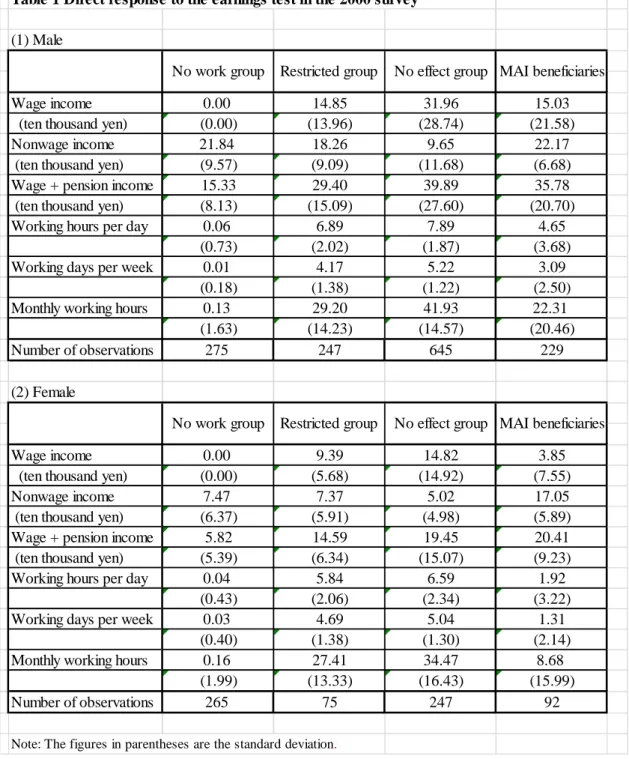
The sum of wage and pension income for the "no work group" is about 40 percent (men) and 30 percent (women) of that of the "no effect group" and three-quarters of that of the "limited group." This difference is also confirmed by comparing the figures for the "no effect group" with the figures for MAI recipients exempt from the earnings test. The table shows that the sum of wage and pension benefits is comparable between the "no effect group" and MAI recipients for both sexes, which confirms that the sum of wage and pension benefits. In contrast, the mean value for women is below the lower threshold (220,000 yen), even for the "no effect group".
220,000 yen, even for the "no effect group". The location of the distribution for each group is also confirmed by the reduction rate, which is defined as the portion of the amount reduced under the test of earnings from untested retirement benefits. The average rate of reduction is zero for the "unemployed group", 42 percent (males) and 35 percent (females) for the "restricted group". Second, wage and pension income and working hours are much lower in both mean and distribution for the "no work group" and the "restricted group", a very important observation regarding the stimulation of labor supply. work for the elderly.
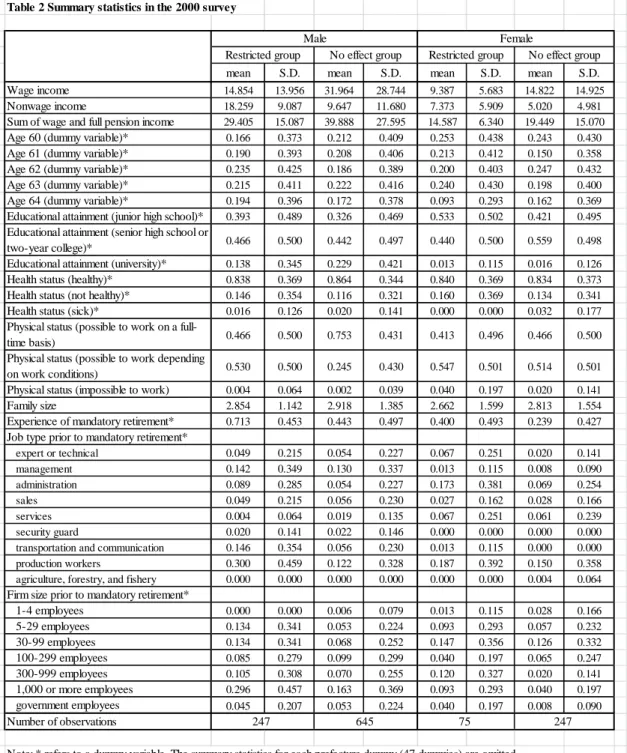
The difference is also observed in self-reported health status, which is worse in the 'limited group' for men and in the 'no effect group' for women. The share of those who entered compulsory retirement is larger for the 'limited group' than the 'no effect group' for both genders, and the share is smaller for women than for men. By designating i as a group, the distributions of wage and pension income for the “restricted group” and the.
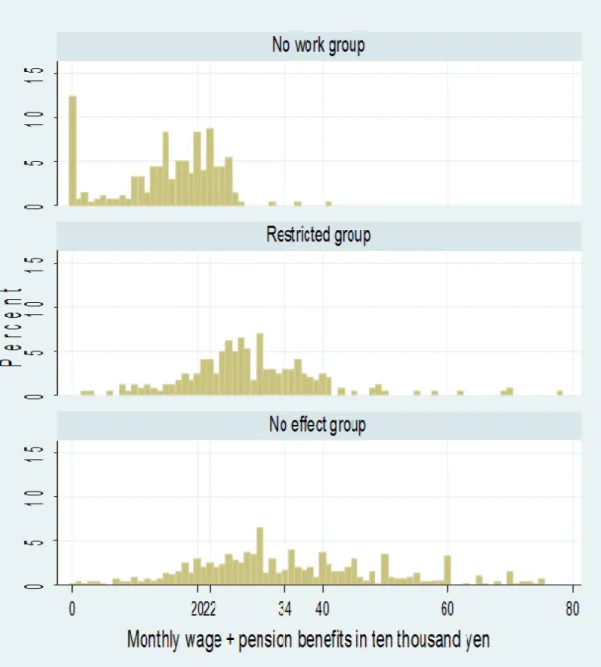
Furthermore, what would be the distribution of the sum of salary and pension income if the distribution of X of the “restricted group” is the same as the distribution of the “no effect group” is written as. For men, when we compare the actual distributions in the two groups, we see that the "peaks" in the distributions of the "restricted group" and the "no effect group" are located at a similar point, but the peak is much smaller for the "no effect group". In contrast, more. In women, the peak of the "restricted group" is located to the left of the peak of the "no effect group", which is consistent with the histogram analysis in v.
In the case of women, we see that the counterfactual distribution is to the right of that of the "limited group". Interestingly, the peak of the counterfactual distribution of the "no effect group" is located near 220,000 yen, the lower threshold, and the peak of the actual distribution of the "limited group" is located at a point much lower than the threshold. Even if the observable characteristics are homogeneous between the two groups, the distribution of the "no effect group" is unchanged and the gap between the two groups remains. These observations reinforce findings on the disincentive effect of the income test on labor supply for individuals who reported being disincentivized by the test.
The disincentive effect of the means test is underestimated because some people in the 'no work group' group, which is excluded in the DFL analysis, are potentially most affected by the means test. We cannot completely rule out that possibility in the 'limited group' in the same way.
Concluding remarks
Unfortunately, we cannot estimate the demand side effect in JVE 2000, but we recognize that there is a possibility that it exists. A more correct formulation of the questionnaire would have allowed us to identify a deterrent effect, especially in the "group without work". Further study should examine the effect of the Social Security earnings test while taking into account other important factors influencing the labor supply decision, such as health status, family relationships, and work-leisure choices, as well as the retirement decision of the elderly. The findings of this study suggest that the abolition of the uniform 20% discount rate in 2005 may have boosted labor supply, especially for women, as the density distribution is more concentrated below ¥220,000 for women than for men.
On the other hand, Shimizutani and Oshio (2008) show that the abolition of the earnings test in 1985 for those aged 65-69 and the abolition of the 20 percent reduction rule did not affect the labor supply of the elderly. Benjamin (1999) "How do pension tests affect older men's labor supply?" Journal of Public Economics Vol.71, No.1, pp Moffitt (1985) "The Joint Choice of Retirement Age and Post-Retirement Work Hours." Journal of Labor Economics Vol.3, pp.
Smith (2002) “The labor supply effect of the abolition of the income rule for older workers in the UK.” Economic Journal Vol. 2000) “The Labor Supply Effects of the Social Security Income Test.”. Orszag (2003) “Does the Social Security Income Test Affect Labor Supply and Benefit Receipt?” National Tax Journal Vol.56, No. 4, pp. Steinmeier (1985) “The 1983 Social Security Reforms and the Long-Term Labor Supply Adjustments of Older Individuals.” Journal of Labor Economics Vol.3, pp.
Loughran (2008) "The Effect of the Social Security Earnings Test on Male Labor Supply: New Evidence from Surveys and Administrative Data." 2000) "Zaishoku Rorei Nenkin Seido to Koureisha no Shugyo Kodo". Kikan Shakai Hosho Kenkyu [Quarterly of Social Security Research] Vol.35, No. 4, p. 2002) "Decomposing Changes in Wage Distribution: A Unified Approach". Oshio (2008) "The Labor Supply Effect of the Social Security Earnings Test Revisited: New Evidence from its Elimination and Revival in Japan." Debate paper no.
Oshio (2010) "New Evidence on Initial Transition from Career Work to Retirement in Japan." Industrial Relations Vol.49, No.2, pp.