Part II Electrical Properties of Materials
Chap. 7 Electrical Conduction in Metals and Alloys Chap. 8 Semiconductors
Chap. 9 Electrical Properties of Polymers, Ceramics,
Dielectrics, and Amorphous Materials
Hybridization of s- and p-states
Two s+p bands, lower filled
higher empty for Ge, Si Group IV
8.1 Band Structure
2
gT g 0
D
T ,
E E
T ξ
= − θ
+
Calculated band structure for Si
Eg (eV) at T=0 K C : 5.48
Si : 1.17 Ge : 0.74 Sn(gray) : 0.08
5 10 eV / K
4, DebyeTem.
ξ ≈ ×
−θ
DThe valence band can accommodate 4Na electrons: one lowest s-state and three p-states (4 sp- hybrids) and empty conduction band of 4 sp- hybrids
8.1 Band Structure
The band gap energy (empirical equation)
At elevated temperatures, semiconductors become conducting.
For intrinsic semiconductors, E
F= − E
g/ 2
8.2 Intrinsic Semiconductors
The Fermi Energy in Semiconductors
For T > 0 K, the same amount of charge carriers can be found in the valence
band as well as in the conduction band. → E
Fshould locate at halfway.
*
( ) , dN = N E dE
( ) 2 ( ) ( ) N E = ⋅ Z E ⋅ F E
3/ 2
1/ 2
2 2
( ) 2 4
V m
Z E E
π
=
F F B
B
( ) 1 exp
exp 1
E E
F E E E k T
k T
−
= − + −
3/ 2
* 1/ 2 F
2 2 0
B
2 exp
2
E E
V m
N E dE
π k T
∞
−
= ⋅ ⋅ −
∫
3/ 2
* F 1/ 2
2 2 0
B B
2 exp exp .
2
E
V m E
N E dE
k T k T
π
∞
= ⋅ ⋅ −
∫
≈
Number of electrons in the conduction band
N
*: number of electrons having an energy equal to or smaller than a given energy E
n.
since E − E
F~ 0.5eV and k
BT ~ 0.025eV at RT
for an energy interval between E and E + dE
8.2 Intrinsic Semiconductors
( )
3/ 2
* F B 1/ 2
2 2 B
B
2 exp
2 2
E k T
V m
N k T
k T π
π
=
3 / 2
B F
2
B
2 exp .
4
mk T E
V
π k T
=
* 3/ 2
15 e 3/ 2 g
e
0 B
4.84 10 exp
2 m E
N T
m k T
∴ = × −
Number of electrons in the conduction band per cm
3Introducing E
F= − E
g/2 and effective mass ratio m
*e/m
0,N
e= N*/V
3/ 2
B F
2
B
2 exp .
4
mk T E
V
π k T
=
8.2 Intrinsic Semiconductors
e e h h
* 3/ 2
15 3/ 2 g
e h
0 B
,
4.84 10 ( ) exp ,
2 N e N e
m E
T e
m k T
σ µ µ
σ µ µ
= +
= × + −
, ,
,
. j
j N e
N e N e µ υ
σ υ
σ υ µ
= Ε
= Ε
=
= =
Ε
Mobility
For intrinsic semiconductor, N
e= N
hOhm ’ s law
8.2 Intrinsic Semiconductors
e e h h
* 3/ 2
15 3/ 2 g
e h
0 B
,
4.84 10 ( ) exp ,
2 N e N e
m E
T e
m k T
σ µ µ
σ µ µ
= +
= × + −
Due to lattice vibration Increasing the number of carriers
8.2 Intrinsic Semiconductors
For intrinsic semiconductor, 109 electrons per cubic centimeter
Doping: adding small amounts of impurities (III or V) to intrinsic semiconductors Dopant in a substitutional manner
8.3 Extrinsic Semiconductors
8.3.1 Donors and Acceptors
P binding E of the fifth electron
= 0.045 eV "donor electrons"
8.3 Extrinsic Semiconductors
CB
VB
Donor electrons
& thermally excited electrons
n-type, major carrier: electrons
donor impurities: P, As, Sb p-type, major carrier: holes
acceptor impurities: B, Al, Ga, In Impurity states; donor or acceptor levels
8.3.2 Band Structure
8.3 Extrinsic Semiconductors
For Si or Ge smiconductors,
acceptor impurities
& thermally excited holes
8.3.3 Temperature Dependence of the Number of Carriers
8.3 Extrinsic Semiconductors
de e
,
σ = N e µ
8.3.4 Conductivity
- For low doping and at low temperature, the conductivity decreases with increasing temperature : lattice vibration → decrease mobility. At higher temperature:
conductivity increase : intrinsic effects → increase number of carriers
- For high doping : temperature dependence on conductivity is less pronounced due to the already higher number of carrier.
8.3 Extrinsic Semiconductors
n-type semiconductor, N
d= 10
16atoms per cubic centimeter
8.3.5 Fermi Energy
8.3 Extrinsic Semiconductors
2 1
* 2
2
.
m d E
dk
−=
8.4 Effective Mass
2 heavy holes : smaller curvature 1 light hole : larger curvature
In 3-d, a spheroid shape:
Longitudinal mass ml* Transverse mass mt*
8.5 Hall Effect
H y
F = − Ε e
L x z
,
F = υ B e
y
υ
xB
z. Ε =
x x
j = − N e υ
Hall field
Hall constant
R
H= − Ne 1 E
x z y x z
x y
y
j B I B L N = − e = − A eV
z x H
y
= R j B
E
8.6 Compound Semiconductors
GaAs (III-V compound)
- Larger band gap compared to Si
- Larger electron mobility due to smaller electron effective mass (Fig 5.24) - Direct band gap (chap 12): optical properties
Applications
- High-frequency devices
- Laser / light-emitting diodes (LED)
Other compound semiconductors
(applications: optoelectronic devices) Group III-V elements
- GaP, GaN, InP, InAs, InSb, AlSb Group II-VI elements
- ZnO, ZnS, ZnSe, CdS, CdTe, HgS Group IV-VI
- PbS, PbSe, and PbTe
Ternary or quaternary alloys
- Al
xGa
1-xAs, Al
xGa
1-xAs
ySb
1-y, GaAs
1-xP
x: LEDs
GaAs
1-xAs also used in modulation-doped field-effect transistors (MODFET) Silicon carbide: Group IV-IV
- Band gap 3eV, very high temperature(700
oC) device - Emit light in the blue end of the visible spectrum
8.6 Compound Semiconductors
(Space charge region)
Holes want to drift upward.
Electrons like to roll downhill.
8.7 Semiconductor Devices
8.7.1 Metal-Semiconductor Contacts
Assuming the surfaces of an n- and p-type semiconductor have been somehow charged negatively and positively, respectively,
.
- Diffusion current: In equilibrium state, electrons from both sides cross the potential barrier.
- Drift current: The e-h pair, thermally created in or near the depletion layer, shows an immediate movement to lower energy state. The electron in the conduction band is swept down the barrier while the hle in the valence band is swept up the barrier.
(Vacuum level)
8.7.2 Rectifying Contacts (Schottky Barrier Contacts)
8.7 Semiconductor Devices
8.7 Semiconductor Devices
Reverse bias Forward bias
8.7 Semiconductor Devices
2 M
MS
exp ,
B
I ACT
k T
φ χ
−
= −
2 M S
SM
exp ,
B
I ACT eV
k T φ φ
− −
= −
참고) Figure 8.13
8.7 Semiconductor Devices
2 M S S
B
exp I ACT
k T φ φ
−
= −
net S
B
exp eV 1 .
I I
k T
= −
SM MS
= −
I
netI I Consists of saturation current and a voltage-dependent term
φ
S≈ χ for low enough temperatures
A few advantages of M/S rectifier over p-n diode - No annihilation of electrons and holes
since a single charge carrier , electron or hole, is involved
- Better heat removal by the metal, suitable for high-power devices
8.7 Semiconductor Devices
φ M < φ S
8.7.3 Ohmic Contacts (Metallizations)
Ohmic contact: no barrier exists for the flow of electrons in either direction (Fig 8.17c)
For the case of metal / n-type semiconductor contact, and φM< φS , electron flow from metal to semiconductor, charging metal positively. (cf, another case : metal / n-type semiconductor contact, and φM> φS )
The band of semiconductor bends “downward” and no barrier
8.7 Semiconductor Devices
8.7.4 p-n Rectifier (Diode)
After p-n contact : electron flow from higher level (n-type) “ down ” into p-type so that p-side is negatively charged.
Conduction band: electron in the p-region diffuse “ down ” into n -region, in
equilibrium state the number of electrons crossing the junction in both directions is identical.
8.7 Semiconductor Devices
e B e
p p
D k T
e
= µ
ep ep ep
, L = D ⋅ τ
Ideal diode law:
Einstein relation:
Chn: concentration of holes in the n-region, Cep : concentration of electrons in the p-region, D: diffusion constant, L: diffusion length
+
=
hn hn hn ep
ep ep
S
L
D C L
D Ae C
I
The minority carrier diffusion length
8.7 Semiconductor Devices
8.7.5 Zener Diode
- Breakdown: when the reverse voltage is increased above a critical value, high electric field causes some electrons to become accelerated with a velocity at which impact ionization occurs
→ avalanching process
- Zener breakdown (Tunneling):
another breakdown process;
when the doping is heavy and thus the barrier width becomes very thin (< 10nm), applying high enough reverse voltage causes the bands to shift to the degree that some electron in the valence band of p-side are
apposite to empty states in the conduction band of n-side and these electron can tunnel through the depletion layer (Fig 8.20b) ; a circuit protection device (Fig 8.20d).
8.7 Semiconductor Devices
8.7.6 Solar Cell (Photodiode)
8.7 Semiconductor Devices
a p-n junction diode
1. Light of high energy fall on or near the depleted area
2. Electrons are lifted from the valence band into the conduction band, leaving holes in the
valence band.
3. The electron in the depleted area
immediately “roll down” into the n-region, whereas the holes are swept into the p-region
exp( )
1 ,
1
W L η α
α
= − −
+
Quantum Efficiency
8.7.6 Solar Cell (Photodiode)
W, L: the width and length of depletion region α: a parameter that determines the degree of photon absorption by the electrons
8.7 Semiconductor Devices
Operated in a high reverse bias mode, at near-breakdown voltage.
Suitable for low-light-level applications because of its high signal-to-noise ratio, and for very high frequencies.
8.7.7 Avalanche Photodiode
8.7 Semiconductor Devices
8.7.8 Tunnel Diode
A p-n junction diode - depleted area is very narrow ;
→ heavy doping Fermi energy extends into the valence band of p-type semiconductor.
- The voltage is increase to 100mV (in Fig 8.24d), the potential barrier might be decreased so much that, opposite to the filled n-conduction state, no
tunneling take place; current decreases with increasing forward voltage: “negative current- voltage characteristic”: c-d region
8.7 Semiconductor Devices
n-p diode p-n diode
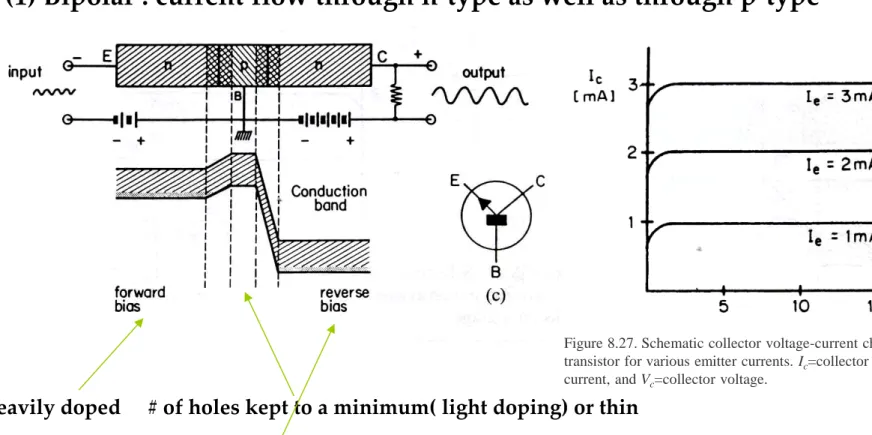
Unbiased n-p-n bipolar junction transistor
For signal amplification
climb diffuse acceleration Smaller and higher resistivity
+ -
Electron flow from E to C can be controlled by the bias voltage on the Base.
8.7.9 Transistors
8.7 Semiconductor Devices
* Diode p − n
참고) Figure 8.19
8.7 Semiconductor Devices
Heavily doped # of holes kept to a minimum( light doping) or thin doping level is not critical
(1) Bipolar : current flow through n-type as well as through p-type
Transistors : amplification of music or voice
electronic switch (on & off) for logic and memory
Figure 8.27. Schematic collector voltage-current characteristics of a transistor for various emitter currents. Ic=collector current, Ie=emitter current, and Vc=collector voltage.
8.7 Semiconductor Devices
Unipolar : current flow only through n-type Two types: depletion-type MOSFET
Can be controlled Electric field can
be controlled
Normally on (2) Metal-Oxide-Semiconductor Field-Effect Transistor (MOSFET)
8.7 Semiconductor Devices
Normally off This type is dominating in IC circuit industry
* Enhancement-type MOSFET
8.7 Semiconductor Devices
N-MOSFET P-MOSFET
If both are integrated on one chip and wired in series, this technology is labeled CMOSFET (complementary MOSEFT)
For information processing, low operating voltage, low power short channel for high speed.
MOSFET = MOST (metal-oxide-semiconductor transistor)
= MISFET (metal-insulator-semiconductor field-effect transistor)
8.7 Semiconductor Devices
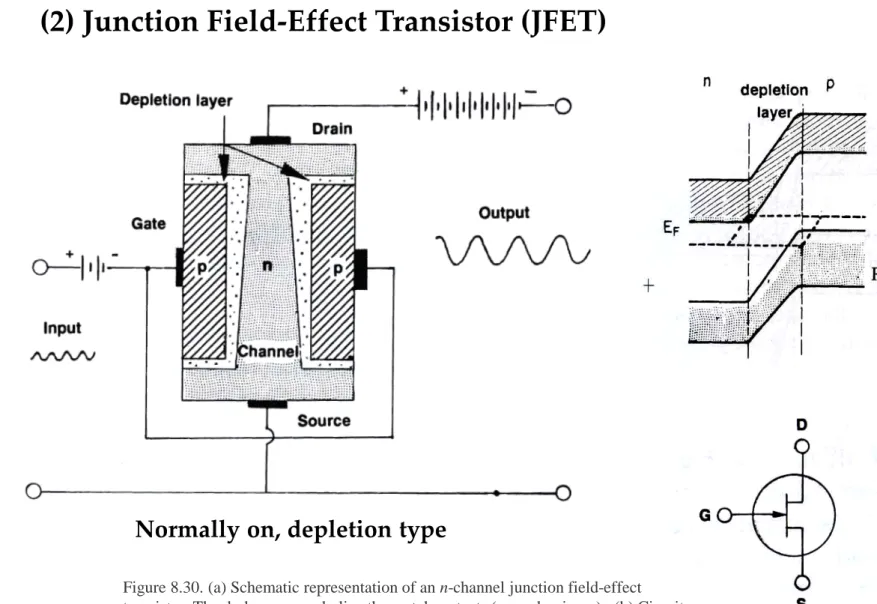
Normally on, depletion type
(2) Junction Field-Effect Transistor (JFET)
Figure 8.30. (a) Schematic representation of an n-channel junction field-effect transistor. The dark areas symbolize the metal contacts (e.g., aluminum). (b) Circuit symbol for an n-channel JFET. Note: In a p-channel JFET the arrow point away from the channel.
8.7 Semiconductor Devices
Transistors
Transistors
8.7 Semiconductor Devices
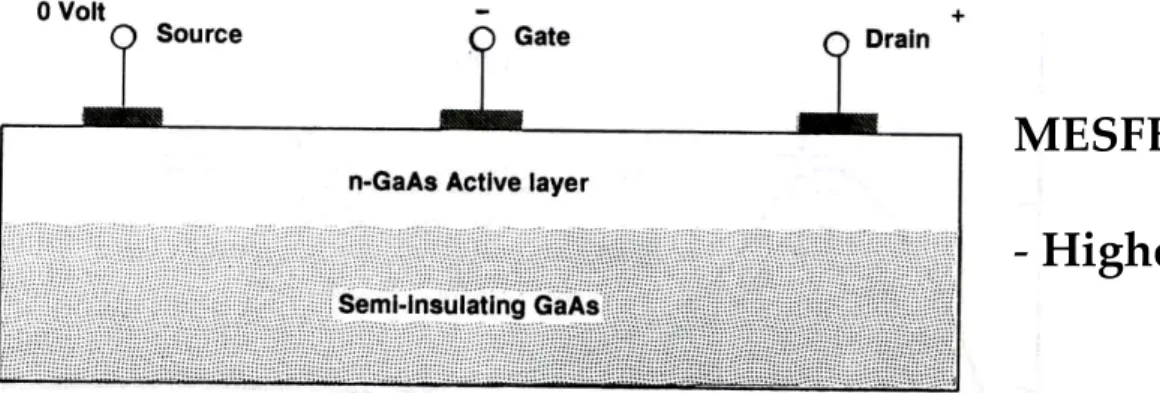
Figure 8.31. Schematic representation of a GaAs MESFET (Metal-semiconductor field-effect transistor). Source and drain metallizations (dark areas) are selected to form ohmic contacts with the n-doped GaAs. The gate metal forms, with the n- doped GaAs, a Schottky –barrier contact.
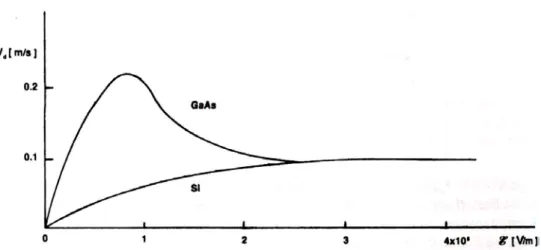
Figure 8.32. Average electron drift velocity as a function of electric field strength for GaAs and silicon.
MESFET(GaAs Metal-Semiconductor FET) - Higher switching speed. (μGaAs~ 6 μSi)
8.7 Semiconductor Devices
8.7.10 Quantum Semiconductor Devices
-To explain the nature of a quantum device:
recall “the behavior of one electron in a potential well (Sec 4.2)”
- Size quantization : dimensions of the
crystalline solid are reduced to the size of the wavelength of electron (e.g., 20nm for GaAs ;
→ density of state, Z(E) is quantized
- A small-band gap material is sandwiched between two layers of a “wide-band gap material (Fig 8.33a,b): the configuration for which all three dimensions of the center materials have values near the electron
wavelength, is called quantum dot (quantum wire for 2-d, quantum well for 1-d
confinement) → potential barrier between two GaAs region
8.7 Semiconductor Devices
- Fig 8.34: If a large voltage is applied to the device, the conduction band of the n-doped GaAs is raised to a level at which its conduction electrons are at the same height as an empty energy state of the center GaAs region.
→ At this point, the electrons are capable of tunneling though the potential barrier formed by the AlGaAs region and thus reach one of these discrete energy state.
8.7 Semiconductor Devices
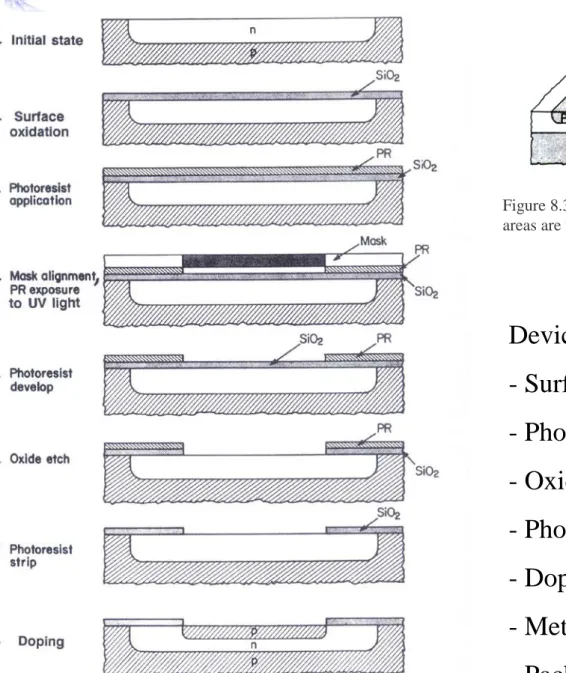
8.7.11 Semiconductor Device Fabrication
8.7 Semiconductor Devices
8.7 Semiconductor Devices
Device fabrication on the wafers - Surface oxidation,
- Photolithography - Oxide Etch
- Photoresist Strip - Doping
- Metallization - Packaging
Figure 8.38. Basic component of integrated circuits (bipolar). The dark areas are the contact pads.
8.7 Semiconductor Devices
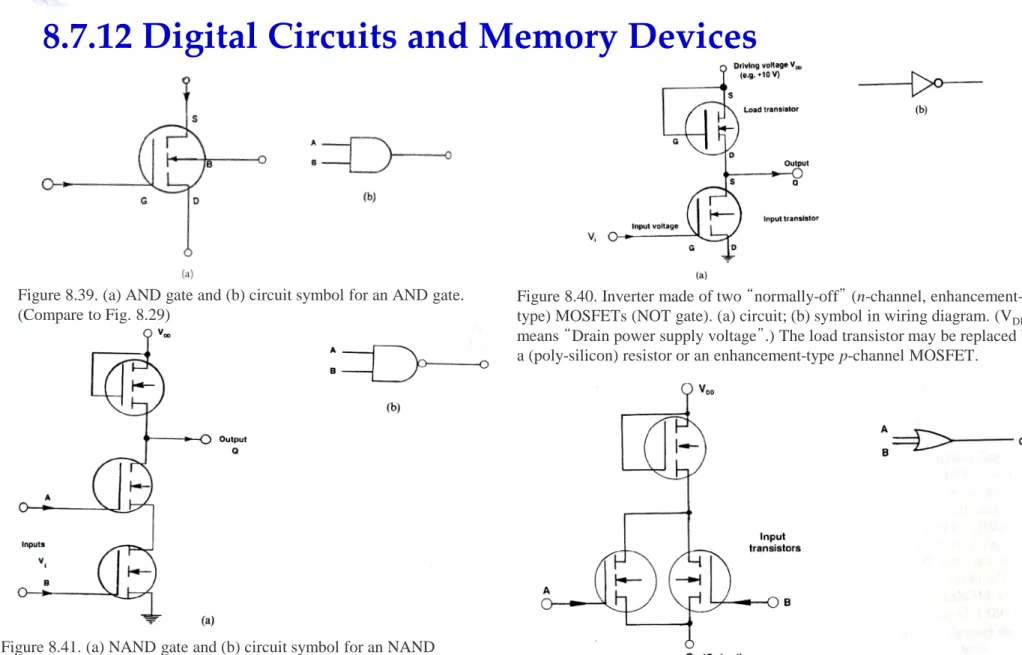
8.7.12 Digital Circuits and Memory Devices
Figure 8.39. (a) AND gate and (b) circuit symbol for an AND gate.
(Compare to Fig. 8.29)
Figure 8.40. Inverter made of two “normally-off” (n-channel, enhancement- type) MOSFETs (NOT gate). (a) circuit; (b) symbol in wiring diagram. (VDD means “Drain power supply voltage”.) The load transistor may be replaced by a (poly-silicon) resistor or an enhancement-type p-channel MOSFET.
Figure 8.41. (a) NAND gate and (b) circuit symbol for an NAND digital function.
Figure 8.42. OR logic circuit with circuit symbol
8.7 Semiconductor Devices
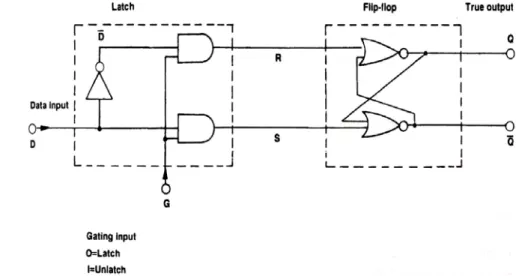
Figure 8.43. NOR logic circuit with circuit symbol Figure 8.44. SRAM memory device called R-S flip-flop with latch.
(The bar on a letter signifies the complement information.)
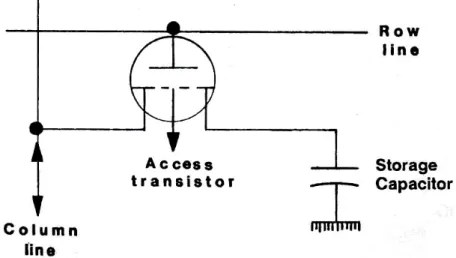
Figure 8.45. Schematic representation of a two-dimensional memory addressing system. By activating the #2 row wire and the #3 column wire, the content of the cross-hatched memory element (situated at their intersection) can be changed.
Figure 8.46. One-transistor dynamic random-access memory (DRAM).
The information flows in and out through the column line.
8.7 Semiconductor Devices
Figure 8.47. Electrically erasable-programmable read-only memory device (EEPR-OM), also called stacked-gate avalanche-injected MOS (SAMOS), or, with some modifications, flash memory device.
8.7 Semiconductor Devices