In this work, multiphysics simulation is performed to investigate not only the polarization of ionic concentration but analyte preconcentration in both microfluidic dual-channel and single-channel devices. Corresponding experimental research shows inherent shortcomings of explaining the complex physical mechanisms of ion concentration polarization (ICP) and pre-concentration as it is difficult to directly measure ionic concentrations, velocity field and electric field strength which are critical to understanding the working mechanisms. The consistency between simulation results and experimental results for a DC-ICP device provides the validity of the simulation, a better understanding of the preconcentration and non-linear vortex flow, which is obtained from the results of velocity field, ionic concentration distribution and electric field strength .
To the best of my knowledge, this work simulates for the first time the preconcentration and nonlinear eddy flow in an SC-ICP device, whose characteristics agree very well with the experimental results and expectations, providing reliable insight into the multiphysics mechanisms in the SC-ICP. Future work would be to optimize analyte preconcentration and demonstrate 3D eddy currents in a SC-ICP device.
Introduction
Introduction to pre-concentration
Previous Experimental Results
- DC-ICP Devices
- SC-ICP Devices
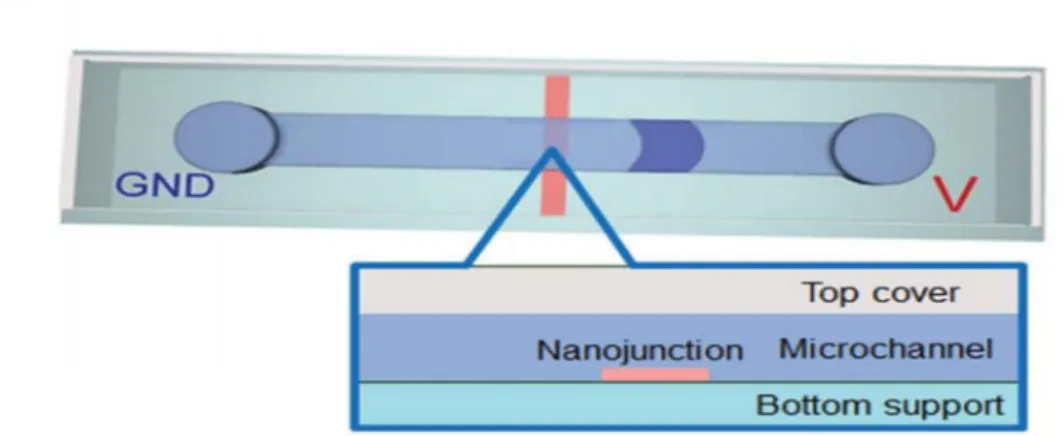
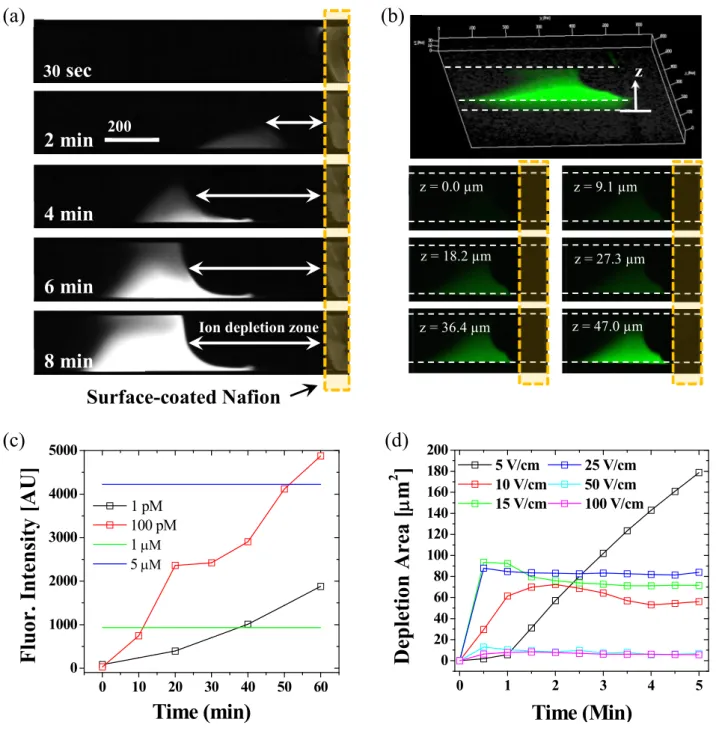
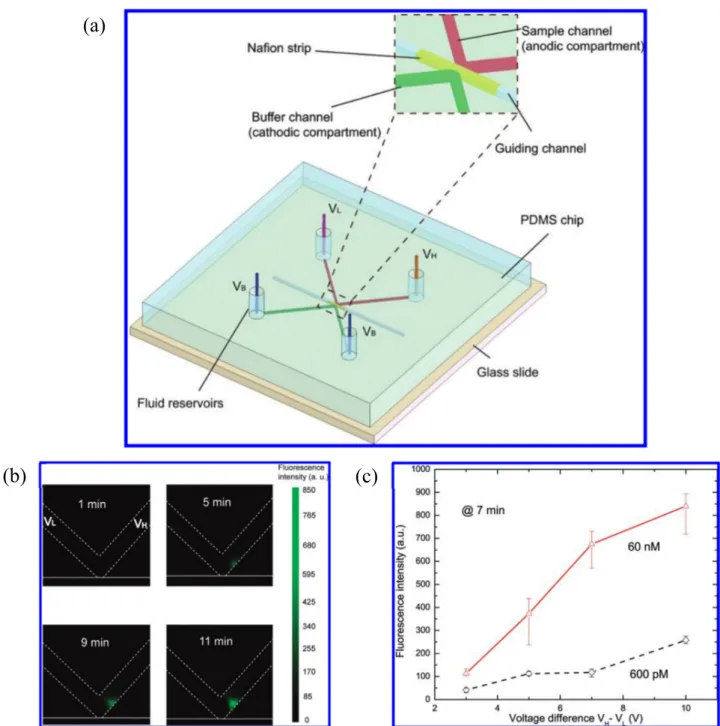
Compared with DC-ICP devices, the SC-ICP device is remarkably simplified; that is, there are only two electrodes and one straight microfluidic channel. The pre-concentration result of the SC-ICP device is almost identical to that of the DC-ICP devices, as there is no essential distinction between the two. The preconcentration is relatively efficient, inducing a 103-fold fluorescence intensity in 30 minutes, as shown in Figure 1.4(c).
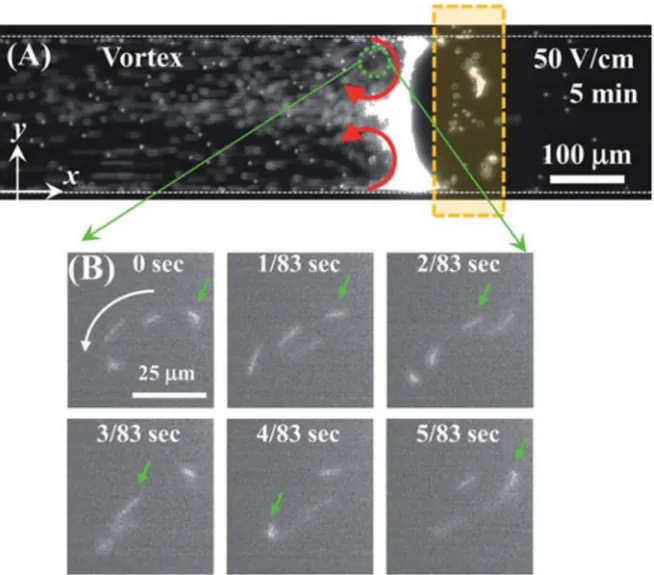
The nonlinear eddy current, whose velocity is very high, is also observed in the SC-ICP device, as shown in Figure 1.5 [16]. Although the experiments showed the expected phenomena, the complex physical mechanisms of ICP and preconcentration are still unclear.
Theoretical Background
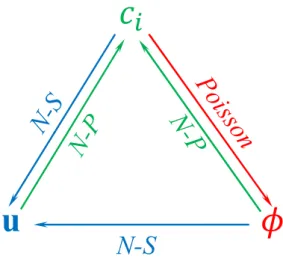
- Governing Equations
- Electroosmotic Flow
- Ion Concentration Polarization
- Pre-concentration
- Vortex flow
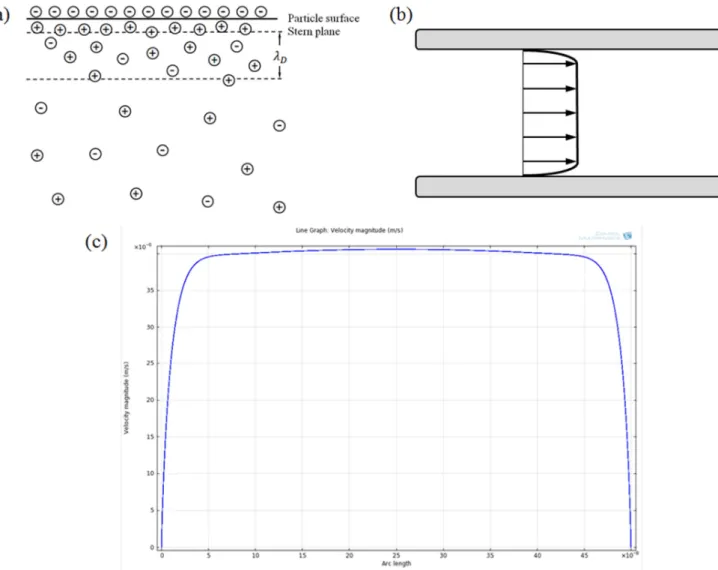
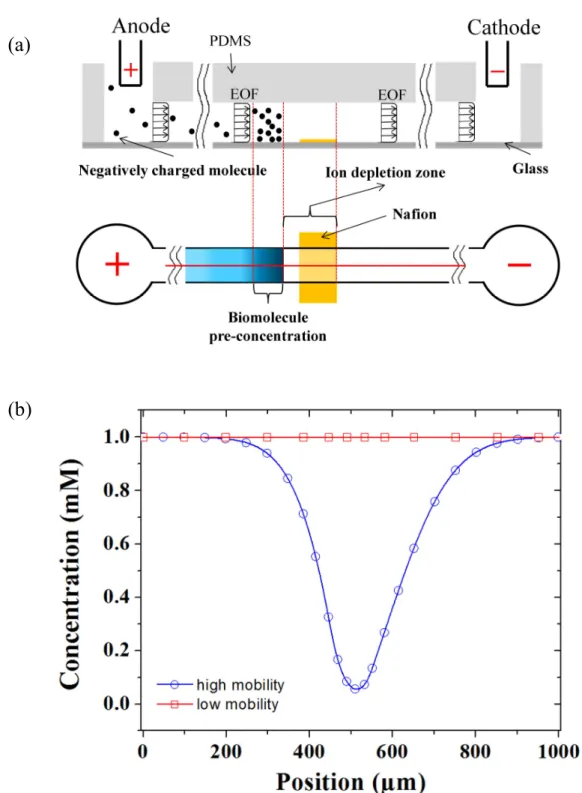
As shown in Figure 2.2(b), the velocity of electroosmotic flow along the channel is almost uniform, except in the region adjacent to the walls. As mentioned earlier, the counterions are dominant in the Debye layer, so there is a large excess of counterions over co-ions, leading to an unbalanced transport between counterions and co-ions when an external electric field is applied. Moreover, the diameter of nanotunnels in the Nafion is about 3~5 nm [3, 14], so the amount of coions in the tunnels is much smaller than that of counterions, which generates the superior ion permselectivity. of the Nafion.
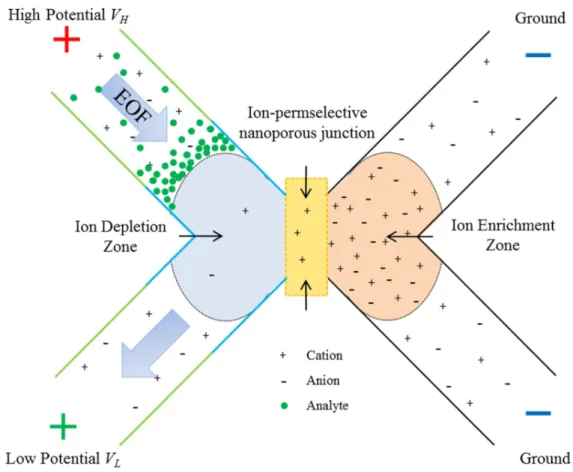
After the external electric field is turned on, the ions begin to move under the influence of electrophoresis. It is called ion depletion zone (IDZ) where the concentration is locally low in the anodic channel while as ion enrichment zone (IEZ) where the concentration is relatively high in the cathodic channel. Basically, the explanations of ICP formation all depend on the different fluxes of ions in the Nafion membrane and in a microfluidic channel, regardless of the double-channel or single-channel case.
In a dual-channel channel, the flux of co-ions in the Nafion membrane is lower than that in a microchannel, which means that the ion concentration in the anodic channel must decrease and the ion concentration in the cathodic channel must increase. On the other hand, in the case of a single channel, the main cause of ICP should be the higher flux of counterions in the membrane rather than that in a microfluidic channel. In the first simulation, the mobilities of counterions and coions in the membrane are both proportional to the local diffusion coefficients, which is the traditional setting in the simulation of ICP.
The only difference in the second simulation is that the mobility of counterions within the membrane is 4 times greater than that in the first simulation. It is clear that without the assumption of the high mobility of counterions in the Nafion, ICP can hardly be formed. It is certain that the electric field strength is sharply enhanced in the IDZ, regardless of the DC-ICP or SC-ICP from which the preconcentration application can be obtained.
As the particles are attracted towards the IDZ, the strength of the local electric field becomes stronger and stronger as mentioned in the previous section. The excess of counter-ions over co-ions breaks the local electroneutrality and causes a significant change in the electric field strength because a high charge density makes a large difference in the local electric field according to Poisson's equation.
Multiphysics Simulation of DC-ICP
Settings of boundary conditions and domain properties
- Boundary Conditions of Navier-Stokes equation
- Boundary conditions of Nernst-Planck and Poisson equations
- Domain properties
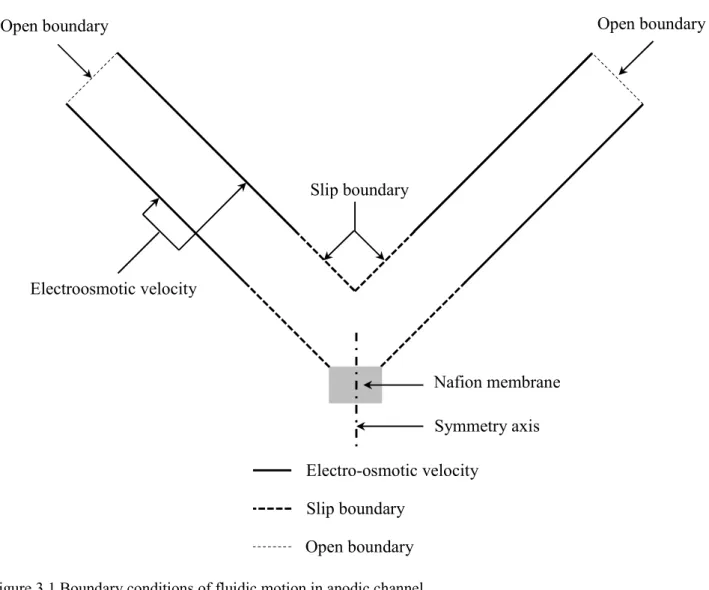
The concentrated analytes are only allowed to exist in anodic channel because their size is larger than the diameter of pores in the Nafion membrane; they cannot penetrate the membrane. Both channel ends of the cathodic channel are connected to ground, resulting in zero electrical potentials. Since the two ends of the cathodic channel are both connected to ground, it is intuitive that the electric field distribution in the cathodic channel is symmetrical as shown in Figure 3.1.
The flow in the Nafion membrane is negligible due to the extremely low permeability of Nafion. To simplify the simulation process, the motion of the flow in the Nafion domain is ignored. Moreover, the distribution of the electric field in the cathodic channel is symmetrical, so that the motion of EOF is also symmetrical and the current direction in each half is towards its own end.
Since the anodic channel and the cathodic channel are blocked and divided by the Nafion membrane, the local loss of liquid in the cathodic channel cannot be complemented by the current in the anodic channel to keep the continuity of the liquid. In this situation, the flow motion inside the cathodic channel is negligible compared to that in the anodic channel, so it can be neglected. Since Nafion is charged, the charge density term in the Poisson equation transfers to + in the Nafion domain, where is the charge density at fixed volume of the Nafion membrane.
Due to the low permeability of the Nafion membrane, the diffusion coefficient in the Nafion domain should be much lower than that in the microfluidic channels. It has been estimated that the diffusion coefficient inside the Nafion membrane is only 1/10 of the value in the normal state [3, 33]. In fact, the buffer solution contains various types of positive ions in the experiment in which proton and potassium ions are widely used.
Simulation Results and Discussion
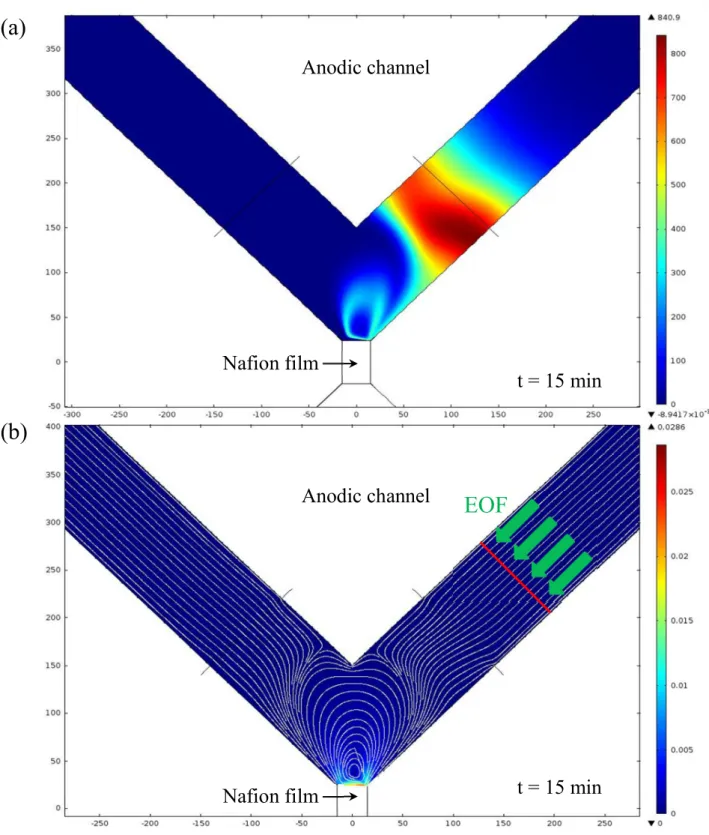
To investigate the preconcentration mechanisms, the ionic concentration of a buffer solution and the electric field distribution near the steady-state IDZ are shown in Figure 3.5. The ionic concentration far from the IDZ is still kept as 1 mM which is the concentration of the buffer solution. It is known that low ionic concentration in an electrolyte solution leads to low electrical conductivity.
To maintain the continuity of electric current, the electric field strength must increase at the location where conductivity decreases. From the point of view of governing equations, the increase in electric field strength is caused by the electric charge density, which is very small compared to the concentration of the buffer solution even in the IDZ, but cannot be neglected. The sharply increased electric field strength significantly increases the electrophoresis effect while the convection effect is limited by the liquid continuity, which results in the analyte particles being concentrated near the IDZ.
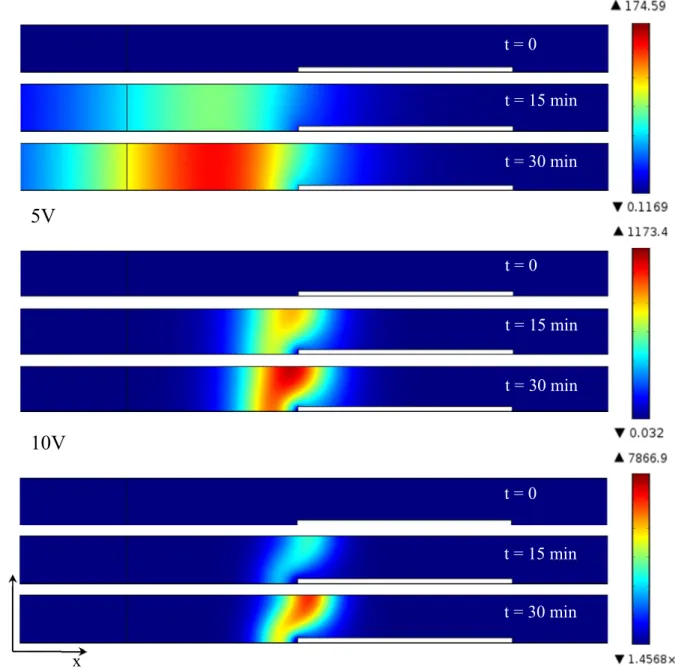
With a higher electric potential at the ends of the anodic channel, a higher concentration factor is expected as the high electric field causes fast EOF which directly improves the preconcentration efficiency. Unfortunately, the high electric potential case is not simulated because it costs much more computing resources due to the request of fine mesh to convergence. The influence of electric field strength on pre-concentration is shown in 2D results of SC-ICP simulation in the next chapter.
Multiphysics Simulation of SC-ICP
Boundary Conditions and Domain Properties
Simulation results of SC-ICP
To validate the settings of boundary conditions and domain properties for simulating eddy flow in the SC-ICP device, a blocked SC-ICP device is simulated. Once the external electric field is applied, an eddy current is created near the membrane, as shown in Figure 4.4. A blocked channel can be simplified as a 2D model, and Figure 4.4 is the top view of the channel.
After simulating the eddy flow using a 2D blocked model, the eddy flow is simulated in a 3D model. There is an eddy current in front of the Nafion film whose rotation direction is the same as that observed in the experimental results in Figure 1.5, so the simulation results would be of good quality. The problem with this result is that the distribution of the velocity field is not symmetric, which is strange because the model and boundary conditions are all symmetric.
Although the simulation results are only approximate results, they show the characteristics of the eddy current very well. The simulation results show good agreement with experimental results on preconcentration and nonlinear eddy flow. Another work to be done is to simulate the nonlinear eddy flow in the SC-ICP device in a 3D manner.
Grass, B., et al., Determination of selenoamino acids by coupled isotachophoresis/capillary zone electrophoresis on a PMMA microchip. Yu, C., et al., Monolithic porous polymer for solid phase extraction and preconcentration on chip fabricated by photoinitiated in situ polymerization in a microfluidic device. Zaltzman, Electro-osmotic slip of a different kind and instability in concentration polarization at electrodialysis membranes.
Hlushkou, D., et al., The influence of membrane ion permselectivity on electrokinetic concentration enrichment in membrane-based preconcentration units. Wang, Y., et al., Numerical analysis of electrokinetic transport in micro-nanofluidic interconnect preconcentrator in hydrodynamic flow.
![Figure 1.2 Four strong vortices in a dual gate ICP device [20].](https://thumb-ap.123doks.com/thumbv2/123dokinfo/10534863.0/11.892.171.725.400.696/figure-strong-vortices-dual-gate-icp-device-20.webp)