
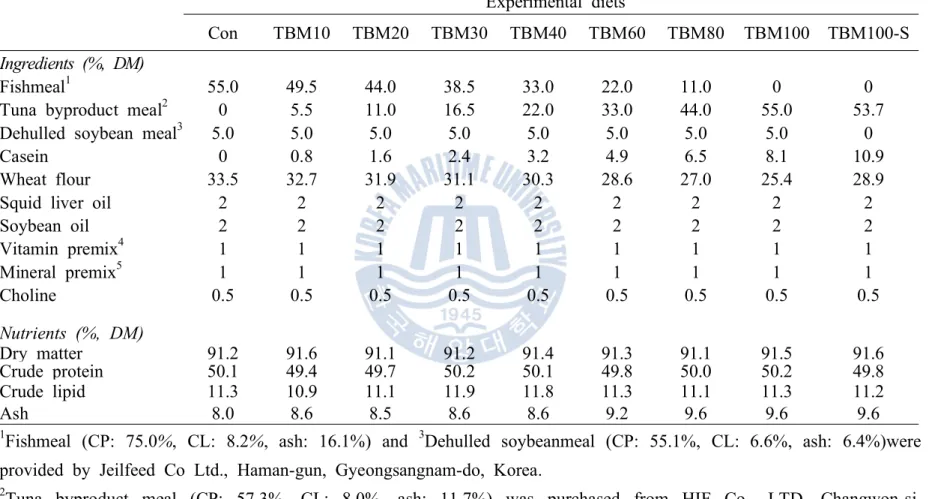
실험음식은 총 9종을 준비하여 실험에 사용하였다. 그러나 TBM10을 투여한 실험군과 대조군 사이에는 유의한 차이가 없었다. TBM30 사료를 먹인 실험군에서는 다른 모든 실험군에 비해 이 수치가 높았다.
TBM 100-S 사료를 먹인 실험군보다는 높았으나, 대조군 사료를 먹인 실험군보다는 높았다.
Experiment
Introduction
Seo and Lee 2008), feeding strategy (Oh et al. 2008), comparison of extruded pellet with raw wet fish-based pellet for performance (Kim et al. 2003) and dietary additive to improve immune response ( Kim et al. 1999; Therefore, several candidate plant products for aquafeed were suggested (Gatlin et al reported that dietary soybean meal can be replaced with up to 20% amino acid-free fishmeal and 30% with supplements for fingerling fish and growth of rockfish, respectively.a new food ingredient that is safe from disease transfer or infection by terrestrial animals and economically cheap to replace fishmeal in the diet for fish farming is much needed.
TBM has recently been developed as the new feed ingredient to replace fishmeal in the diet for fish culture because of it.
Materials and Methods
- Fish and the Experimental Conditions
- Design of the Feeding Trial and Preparation of the Experimental Diets
- Analytical Procedures of the Experimental Diets and Fish
- Statistical Analysis
4V itam in the premix contained the following amount diluted in cellulose (g kg-1 mix): L-ascorbic acid, 121.2; DL-α-tocopheryl acetate, 18.8; thiamine hydrochloride, 2.7; riboflavin, 9.1; pyridoxine hydrochloride, 1.8;. Finally, 100% fish meal and soy meal were replaced with TBM to determine the combined substitution effect of fish meal and soy meal with TBM, called TBM100-S diet. The ingredients of the experimental diets were well mixed with water in a 3:1 ratio and pelletized with a pellet extruder.
All fish were hand-fed to apparent satiation twice daily (08:00 and 17:00 hours) for 7 days per week during the 8-week feeding trial. Fifteen fish from each tank at the termination of the feeding trial were sampled and sacrificed for immediate analysis. Crude protein was determined by the Kjeldahl method (Kjeltec 2100 Distillation Unit, Foss Tecator, Hoganas, Sweden), crude lipid was determined by an ether extraction method (Soxtec TM 2043 Fat Extraction System, Foss Tecator, Sweden), moisture was determined by oven dry at 105°C for 24 hours, fiber was determined using an automatic analyzer (Fibertec, Tecator, Sweden) and ash was determined using a muffle furnace at 550°C for 4 hours, all methods were according to standard AOAC (1990).
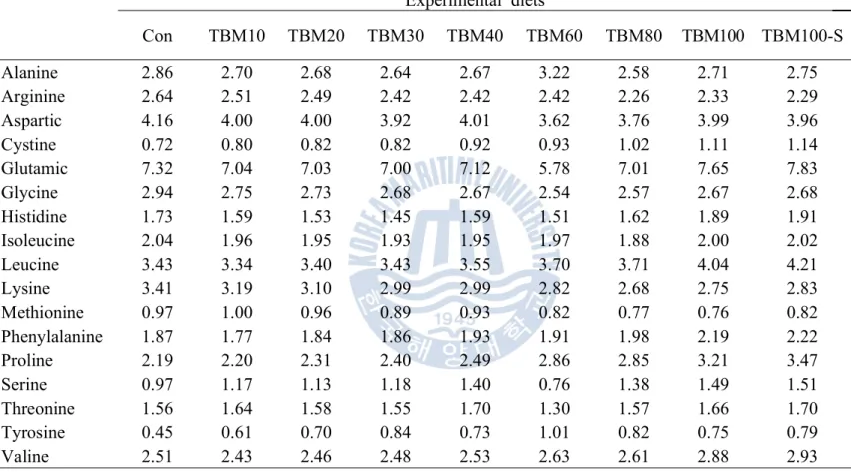
The amino acid composition of the experimental diets was determined using an automatic amino acid analyzer (Sykam S4330, Eresing, Germany) after which the samples were hydrolyzed in 6 N HCl for 22 h at 110°C. Blood samples were taken from the tail vein of seven randomly selected fish from each tank using syringes after they were starved for 24 h at the end of the 8-week feeding trial. Serum was collected after centrifugation (3000 rpm for 10 min), stored frozen at -70°C as separate aliquots for analysis of total protein, glucose, glutamate oxaloacetate transaminase (GOT), glutamate pyruvate transaminase (GPT) and triglycerides, and analyzed by using the automated chemistry system (Vitros DT60 II, Vitros DTE II, DTSC II Chemistry System, Johnson and Johnson Clinical Diagnostics Inc., New York, USA).
One-way ANOVA and Duncan's multiple range test (Duncan 1955) were used to analyze the significance of the difference between the treatment means through SAS version 9.3 (SAS Institute, Cary, NC, USA).
Results and Discussion
Survival (%), weight gain (g/fish) and specific growth rate (SGR) of rockfish fed the experimental diets replacing fishmeal with TBM were presented in Table 3. No significant difference in weight gain and SGR of fish fed the TBM40 and Con diets in this study indicated that fishmeal can be replaced up to 40% with TBM. Feed consumption (g/fish), feed efficiency ratio (FER), protein efficiency ratio (PER) and protein retention (PR) of juvenile rockfish fed the experimental diets replacing fishmeal with TBM are given in Table 4 .
PR of fish fed the TBM10 and TBM20 diets was significantly (P < 0.05) higher than that of fish fed all other diets. No difference in FER and PER of fish fed the diets that replaced fishmeal up to 30% with TBM compared to that of fish fed the Con diet in this study indicated that fishmeal could replace up to 30% with TBM without impairing feed utilization by rockfish. , resulted from an effective improvement in weight gain of fish. Similarly, feed utilization of fish usually improved when fishmeal was successfully replaced with the alternative animal and/or plant protein sources in the diets (Kikuchi 1999;.
No improvement in weight gain, but lower FER and PER of fish fed TBM100-S compared to that of fish fed TBM100 in this study indicated that there was no promising effect of additional replacement of soymeal with TBM on the overall fishmeal replacement in the diet. The estimated composition of the whole fish body at the end of the 8-week feeding trial was shown in Table 5. However, no significant (P > 0.05) difference in ash content was observed in fish fed the experimental diets.
An increased TBM substation in the diets tended to increase the moisture content but decreased the crude protein content of fish in this study. Similarly, the whole body of fish was affected by the different alternative animal and/or plant protein sources for fishmeal in the diets (Deng et al. 2006; Lee et al. 2010; Zhou et al. reported that the whole body composition of fish correlated is) with fish species, water temperature, weight gain, feeding and diet formulation Although the differences in the essential amino acids, such as lysine and methionine content were observed in the experimental diets, this would not lead to a significant change in amino acid profiles of the whole body of fish.
In addition, total protein, triglyceride, and cholesterol concentrations in the serum of flounder would be affected by replacing fishmeal with soybean meal in the diet, although the entire body composition of fish was not affected (Ye et al. 2011).
Conclusion
Acknowledgements
대학원에 입학한 후 동물사료 및 식품공학 연구실에서 연구를 하며 많은 시간을 보냈습니다. 그동안 논문이 나올 때까지 많은 분들이 도움을 주셨습니다. 우선 부족한 저를 학생으로 받아주시고 많은 가르침과 격려를 해주신 조성환 교수님과 많은 조언과 도움을 주신 이상민 교수님 감사드립니다. 연구 프로젝트를 수행하고 논문을 작성하는 과정에서.
또한 수산분야에 대한 많은 지식을 가르쳐 주시고 많은 관심을 가져주신 박인석 교수님, 최철영 교수님, 안종웅 교수님, 서영완 교수님, 임선영 교수님, 강효진 교수님, 강효진 교수님, 학부시절 전공의 기초지식을 열정적으로 가르쳐주신 노일님, 이경은님, 이호진님. 교수님에게도 감사드립니다. 그리고 석사과정 동안 실험에 도움을 주신 국립수산과학원의 많은 박사님들께도 감사의 말씀을 전하고 싶습니다. 또한, 실험 장소를 제공해 주시고 실험에 많은 도움을 주신 강릉원주대학교 최진 박사님과 강릉원주대학교 사료연구소의 형상윤 박사님에게도 감사의 말씀을 전하고 싶습니다.
마지막으로 부족한 저의 모습에도 불구하고 늘 응원해주시는 가족들에게 감사하다는 말씀 전하고 싶습니다. 아직 부족한 점이 많지만, 어디를 가더라도 부끄럽지 않고 자랑스러워할 수 있는 졸업생이 될 수 있도록 열심히 노력하겠습니다.
Use of defatted soybean meal as a substitute for fishmeal in diets of Japanese flounder (Paralichthys olivaceus). Utilization of soybean meal as a protein source in the diet of juvenile flounder, Paralichthys olivaceus. Reassessment of the optimal dietary protein level for maximal growth of juvenile Korean rockfish, Sebastes schlgeli (Hilgendorf).
Effects of feeding frequency and dietary moisture content on growth, body composition and gastric evacuation of juvenile Korean catfish (Sebastes schlegeli). Effects of soluble protein and lipid levels in practical diets on growth, protein utilization and body composition of juvenile rockfish (Sebastes schlegeli). Effects of dehulled soybean meal as a fishmeal substitute in hunting and rearing diets of Korean fish Sebastes schlegeli.
Effects of dietary macronutrient levels and feeding frequency on growth and body composition of juvenile rockfish fish. The sulfur amino acid requirement of juvenile yellow perch fueled the maximum cysteine replacement value for methionine. Evaluation of L-ascorbyl-2-glucose as a source of vitamin C for juvenile Korean redfish Sebastes schlegeli (Hilgendorf).
Effect of partial fishmeal replacement by soybean meal on the growth performance and biochemical indices of juvenile Japanese flounder Paralichthys olivaceus. Meat and bone meal replacement in diets for juvenile gibel carp (Carassius auratus gibelio): effects on growth performance, phosphorus and.
