They promise to bring a lot of input when they make a plan for the development of Vietnam's port system. This research would propose some alternatives in Vietnam's port development as a satisfactory strategy.
INTRODUCTION
- Roles of transportation and particular port systems in economy
- An overview of Viet Nam economy and port systems
- Review of strategies to develop port systems
- Research Aims and Objectives
- Scale and scope
- Outlines of the dissertation
This thesis presents a study on the development of the Vietnamese port system in a transformative period of the national economy. Based on that information, appropriate strategies would be proposed to develop Vietnam's port system.

PROSPECT OF VIET NAM PORT SYSTEM
Viet Nam and ASEAN trade
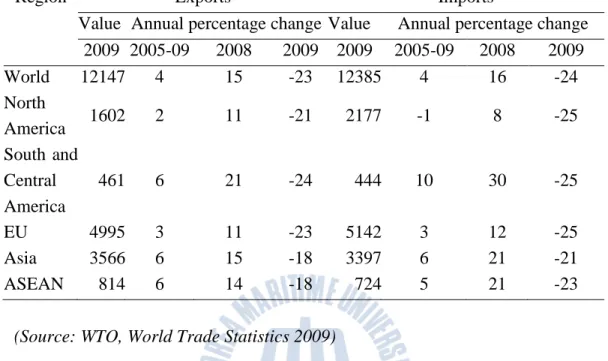
It achieves a trade surplus (exports minus imports) as seen in Figure 2.1, where some important commodities that contribute to the trade surplus include electrical machinery and mineral fuels. Clearly, the above figures have shown that ASEAN had traded more with the rest of the world than among themselves as shown in Figure 2.5 and Figure 2.6.
Classification of Viet Nam ports
Only in one covered area, including Ho Chi Minh City, Dong Nai and Ba Ria-Vung Tau provinces, there are 44 ports, accounting for about 39 percent of the number of Vietnam ports. In addition, the remaining ports in Vietnam can be regarded as domestic feeder ports, including the mentioned four ports in Ho Chi Minh City in the south, Da Nang Port in the center, Hai Phong Port in the north and others.
Container port system
Since 2010, Vietnam has had direct services from SP-PSA International Port (Vietnam's first deep-sea container terminal) to the US East and West coasts. Vietnam is conveniently located in the Indochina region, including Vietnam, Laos and Cambodia. .

Strategic master plan
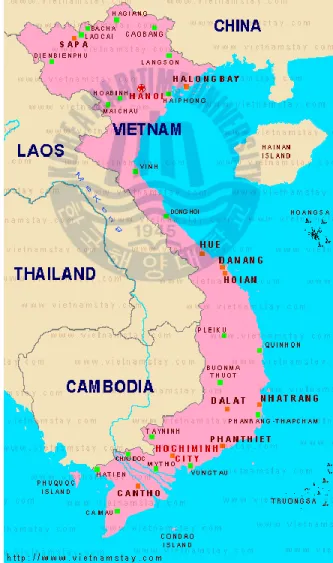
By 2010, the port system of Vietnam included eight groups (as shown in Figure 2. 10) as follows. Phu Quoc Island, located in the Gulf of Thailand, is currently the largest island in Vietnam.

Analysis
Thanks to this network, Vietnam could be closely connected with other countries in the region such as Laos, Cambodia and Thailand. Therefore, some ports in Vietnam could become regional ports, even hubs and/or transit ports, serving not only the country but also some parts of neighboring countries.
Conclusion
METHODOLOGIES
Satisficing strategy
Herbert Simon's ideas have been directly and/or indirectly influenced by researchers studying decision making and entrepreneurship in the large and complex modern business corporation (Minkes et al., 2003). In fact, port development not only in Vietnam but also in any country faces many constraints such as budget, infrastructure, superstructure, technology, labor skills and geography (Do et al., 2009). The satisficing strategy has been applied in many fields such as economics as a determinant of the quality of decision-making in economic organizations with a significant positive impact (Minkes and Foxall, 2003), production where it is used to analyze the performance of a production unit in two directions including utilization of resources versus production performance and unit comparison (Tchangani, 2005), and project management with project compression decision making (Salem et al., 1984).
Herbert Simon's emphasis on processes as determinants of decision-making quality in economic organizations had a significant impact (Minkes and Foxall, 2003).
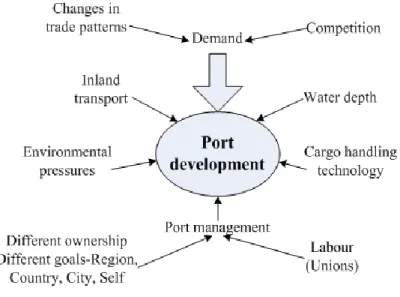
Quick evaluation of port systems
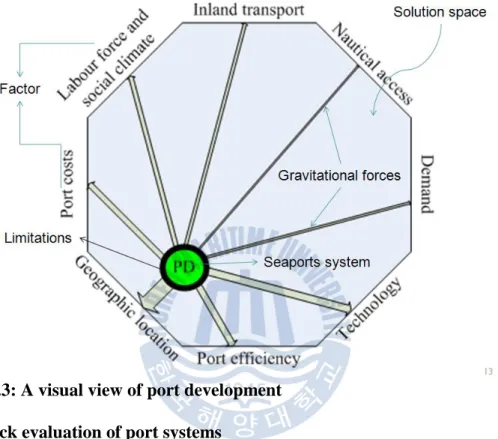
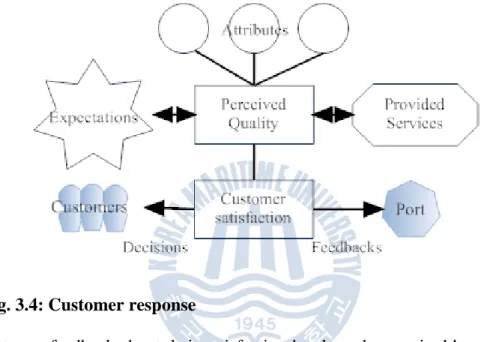
It is not easy to build and maintain a consistent level of customer satisfaction because product/service expectations vary from customer to customer. A model based on fuzzy logic would bring many advantages in determining customer satisfaction in order to evaluate the quality of port services. In order to achieve a successful and accurate measurement of customer satisfaction, the following steps are suggested as shown in Figure 3.5.
The results obtained should be clearly reported to help decision makers decide on the appropriate strategy for achieving customer satisfaction.
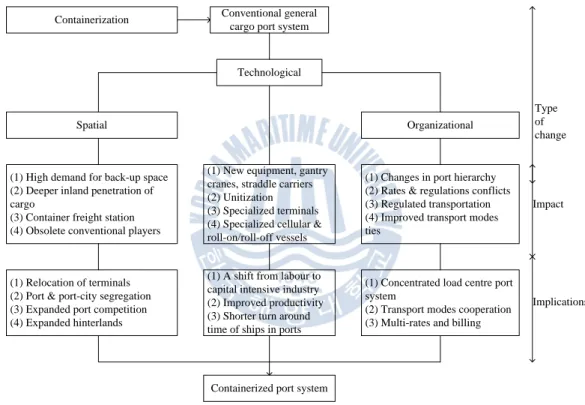
Containerization and transshipment ports
Although the economic relationship between GDP and trade volume is not considered to be a sufficient explanation of container volume growth, it could be usefully considered in forecasting the development of the container sector. However, for prediction purposes, it is necessary to use very simplified relationships, since many causal variables are even more difficult to predict than container volume. It would therefore be reasonable to establish a relationship between container volume and time in order to estimate or predict future volume.
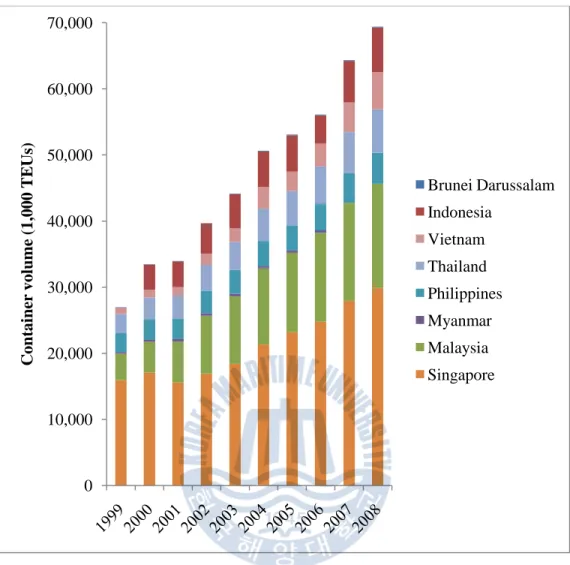
Sixteen of the twenty-five largest container ports are in Asia as seen on Fig 3.12.
Dry port system
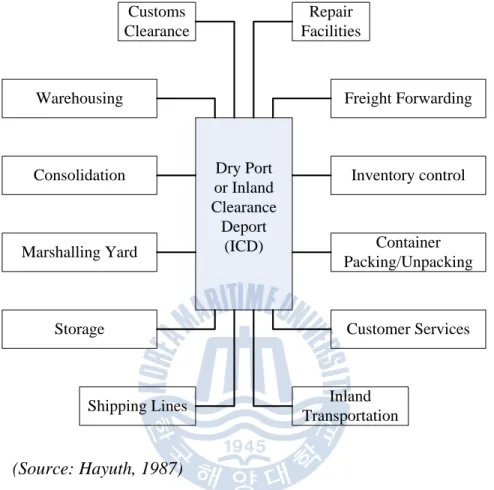
There are many different terms used for an inland terminal facility such as Inland Clearance Depot, Inland Container Depot, Intermodal Freight Centre, Inland Freight Terminal and Inland Port (Thorby, 2004; Jarzemskis, 2007; Roso, 2009). A generalized functional structure of an inland clearance depot or dry port was drawn as shown in fig. 3.15. There are three categories of dry harbor: distant, intermediate and close based on their function and location (Roso et al., 2009) as shown in fig. 3.16.
Many successful applications of dry ports around the world such as Europe (Notteboom, 2002), India, Asia (Adof et al., 2009), Australia (Roso, 2009) and also Africa (Hoyle et al., 1995) support much sure to develop dry port system in Indochina sub-region as an alternative to developing ports in Vietnam.
ZALs, Distriparks, FTZs and FAZs
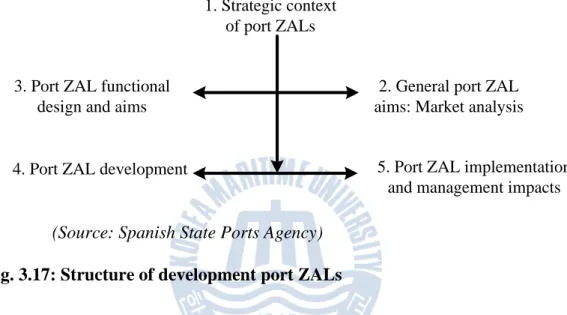
Vietnam's port system plays a vital role in the economy, but it could not compete with others in the Southeast Asian area. The establishment of Distriparks for the future planned transfer port of Van Phong can be considered as a competitive strategy for Vietnam's port system. A Free Trade Zone (FTZ) is a designated area within the territorial jurisdiction of a country where there is either minimal or no customs control on the entry or exit of goods (Source: International Trademark Association, INTA).
It can be regarded as a suitable and satisfactory strategy for the development of Vietnam's port system.
Other strategies
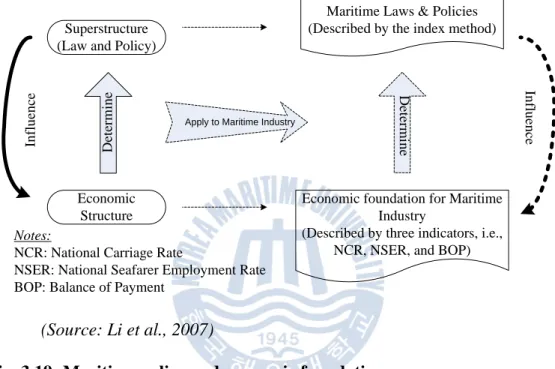
Similarly, maritime policies or strategies will be introduced to Vietnam's port system in flexible ways. And it should be considered to apply for the development port in Vietnam as a preferred strategy. It should be taken into account when making a plan for the development of Vietnam's port system and the proposed dry port system mentioned earlier as a considered alternative.
Therefore, it should concentrate on development as a supporting strategy for Vietnam's port system.
Conclusions
Unfortunately, Vietnam is faced with budget constraints for investment in the transport system and in particular in the port system. Depending on Vietnam's special conditions, they should be applied in flexible and appropriate ways. However, each strategy, alternative or solution is expected to bring its own contribution to the development of Vietnam's port system.
With all of the above mentioned, a satisfactory way was presented as a satisfactory strategy to apply the strengthening strategy for the development of Vietnam's port system.
SATISFICING STRATEGY IN DEVELOPMENT OF VIET
Enhancement of container ports
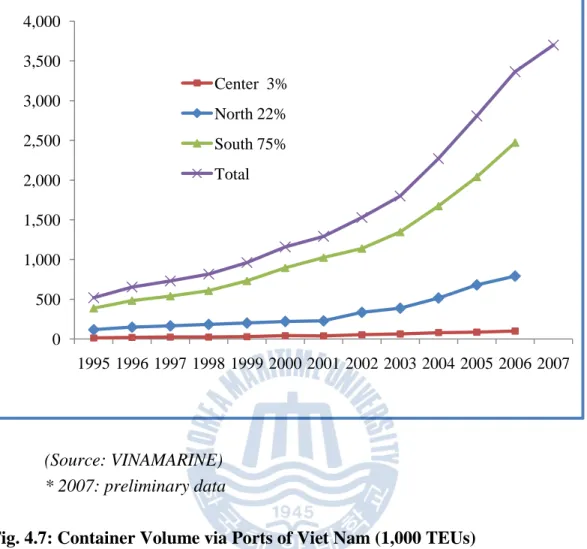
The container volume through Vietnam's ports is summarized as in Figure 4.7, which is temporarily divided into three groups based on Vietnam's geography. The Vietnamese port system in general and container ports in particular could not actually compete with the ports of Singapore, Thailand or Malaysia in the ASEAN region due to some weaknesses. Firstly, the infrastructure and superstructure of most ports in Vietnam are very old and need to be improved.
Vietnam port system and specific container ports will become attractive, efficient, effective and competitive in the near future. d) Threats.
Dry port system
As a result, a proposed dry port system will be presented, which promises to bring many benefits to the Indochina region. Accordingly, substantial dry ports fitting in the Indochina region are proposed as shown on Fig 4.15. There are three dry harbor categories: near, mid-range and far (Roso, 2009), based on the function and the location.
Another example is the near dry port system in Ho Chi Minh City ports of Vietnam, such as Tan Cang-Song Than ICD, Transimex ICD, Tanamexco ICD and Ben Nghe ICD.

ZALs, Distriparks, and FTZs
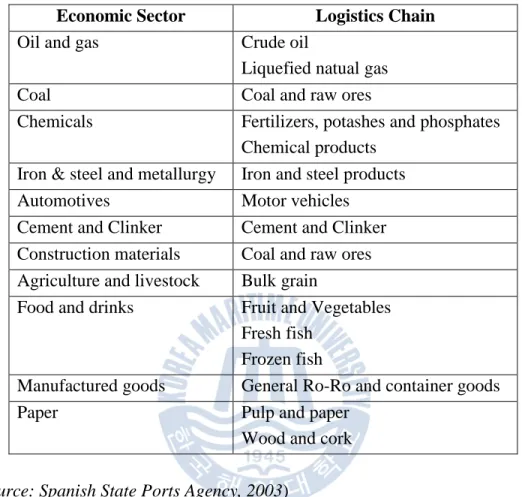
Actually, only specific logistics chains would be analyzed, which can be considered as illustrative demands in Vietnam ports. As mentioned above, container cargo is another important served product of Viet Nam port system. Unfortunately, the Vietnam container port system faced many disadvantages, as previously mentioned.
As mentioned above, Vietnam and ASEAN would benefit greatly if there was at least a container transshipment port in the Indochina region.
Consideration of other strategies
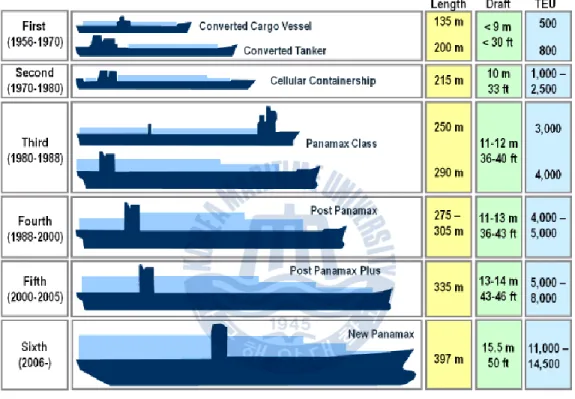
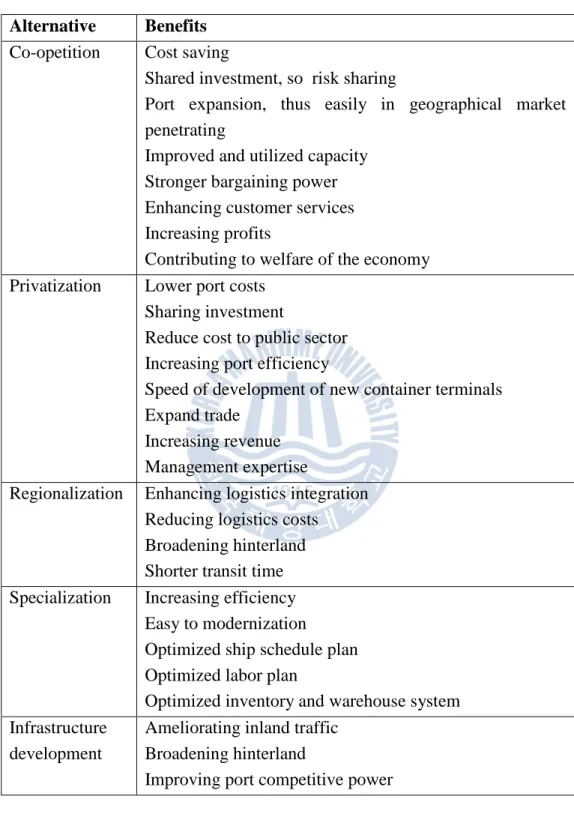
The relationship between the port and the hinterland should be given special attention to the development of the port of Vietnam. Ports in the south of Vietnam are to be moved from Ho Chi Minh City to Vung Tau Province, which meets the required conditions. To improve the competitiveness of Vietnam's container ports, it is necessary to consider specialized container ports that can serve large container vessels.
Accordingly, VPA has projects to build deep water container ports as gateways located in the North, Center and South of Vietnam.
Co-operation strategy in maritime industry: Viet Nam – Korea case study
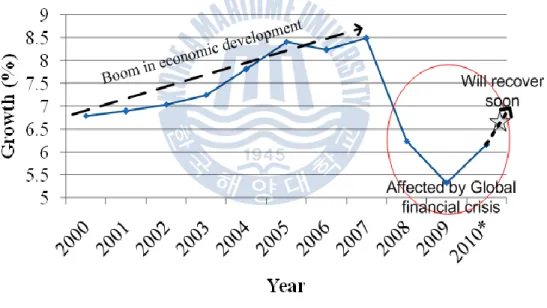
Korean companies have been kept at the top of FDI investors in Vietnam as shown in fig. 4.22. Many important cooperation projects in relation to the marine industry between Vietnam and Korea have been implemented. It is clear that Korean marine companies expect to expand their business in ASEAN, and Vietnam is considered an attractive location.
In particular, ports in Vietnam have been developed and modernized to take on a new role in.
Conclusions
CONCLUSIONS AND SUGGESTIONS
Conclusions
Consequently, a SWOT analysis gave detailed information of Vietnam container ports and explained why they still contribute a little to its economic development. It will generate a link network in the region for cargo transport, help Vietnam ports to expand their hinterland and promises to contribute much more if successfully applied. Furthermore, useful strategies on the development of port system have been introduced, which can be considered as reference ideas for persons responsible for and interested in the development of Vietnam port system.
In addition, a case study of the cooperation strategy between Vietnam and the Republic of Korea in the maritime industry was also presented as an efficient and effective way.
Suggestions
A forecast of container volume was made, which shows that if the container port system were to be executed as planned, it could handle container demands until 2014. Accordingly, a dry port system was studied and proposed to strengthen the seaport system and especially container ports. The construction of Van Phong International Shipping Port should be given high priority according to favorable conditions and essential national requirements.
Actually, a lot of budget is needed to develop Viet Nam effective, efficient and competitive port system.
Future research
2001), “Competition and Competition in International Container Transport: Strategies for Ports”, Maritime Policy and Management, Vol. 1995), “Competition among ports in developing countries:. 2007), “Determinants of Maritime Policy”, Maritime Policy & Management, Taylor & Francis, Vol. 2005), Performance Evaluation of Asian Port Distriparks Using Factor Analysis, Korea Maritime Institute (KMI), Republic of Korea. 2003), “A Disaggregated Analysis of Port Choice”, Transportation Research Part E, Vol. 2005), “Marine Liner Transport and the Transshipment Industry: Market Structure and Competitive Strategies”, Maritime Policy.
Objectives and instruments”, Maritime Policy & Management, Vol. 2000), “Intermodalism: the challenge and the promise”, Transportation Law Journal, Vol. 2006), “A satisfactory game-theoretic approach for group evaluation of production units”, Decision Support Systems, Elsevier, Vol.