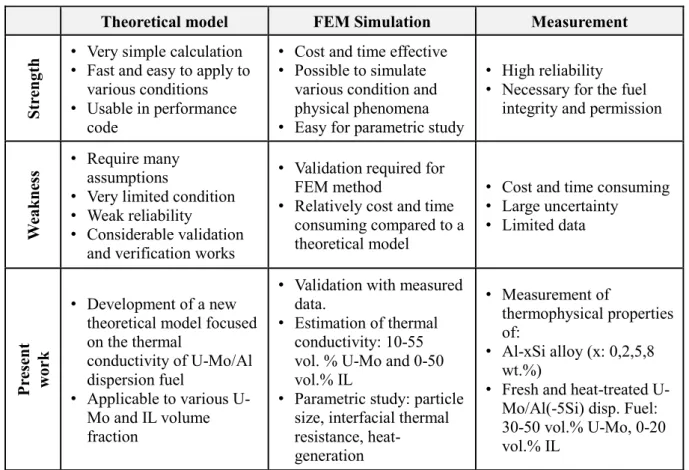
During this study, a comprehensive investigation of the thermal conductivity of U-Mo/Al dispersion type fuel was carried out. This thesis has been contributed to provide a comprehensive insight for the general understanding of the thermal conductivity of U-Mo/Al dispersion fuel.
Introduction
Background
- History of research reactor fuel developments
- U-Mo alloy fuel
- Irradiation behaviors of U-Mo/Al dispersion fuel
It is composed of the fuel meat (or fuel zone) in which the fissile materials are loaded. KJRR is the first research reactor in the world designed to use U-Mo/Al dispersion fuel [38].
![Table 1. Basic properties of uranium intermetallic fuels [7], [8].](https://thumb-ap.123doks.com/thumbv2/123dokinfo/10517166.0/24.892.136.760.789.1074/table-1-basic-properties-of-uranium-intermetallic-fuels.webp)
Thermal conductivity in research reactor fuel
- Role of thermal conductivity in U-Mo/Al dispersion fuel
- Literature survey for the thermal conductivity of U-Mo/Al dispersion fuel
For the thermal conductivity of U-Mo/Al dispersion fuel, the measurement data in the literature are scarce due to the difficulties in sample fabrication and measurements. Until now, many uncertain factors in the thermal conductivity of U-Mo/Al dispersion fuel have not been revealed.
Objectives and scope of the research
Finally, a semi-empirical model was developed to consider various microstructure parameters so that it is applicable to various fuel and irradiation conditions. The model is applied to the fuel performance code and more accurate fuel performance analysis is achieved.
Effective thermal conductivity of composite material
Methodology
Maxwell [48] and Rayleigh [49] were the first to develop a theoretical model for an effective material property based on electrostatic theory. In this case, the actual material property refers to the material property of the composite material when it is homogenized so that the material properties are effectively the same regardless of location within the material.
Descriptions of theoretical models
- Maxwell and Bruggeman model
- Advanced models for a composite material
- Models for a coated material
- Models for a porous material
- Developed models used for U-Mo/Al dispersion fuel
De Zehner and Schlünder [54] developed a semi-empirical expression for the effective thermal conductivity of a packed bed. The thermal conductivity of porous material depends on the thermal conductivity of the pore and the matrix.
Thermophysical properties of U-Mo/Al(-Si) dispersion fuel
Sample fabrication
- Sample fabrication of aluminum-silicon alloys
- Sample fabrication of fresh U-Mo/Al dispersion fuels
- Sample fabrication of heat-treated U-Mo/Al dispersion fuels
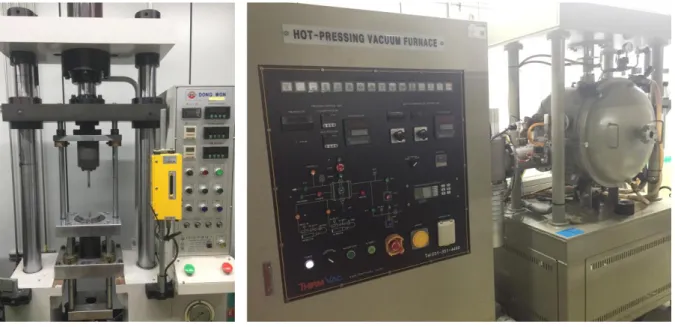
Consequently, the hot-extrusion method was used for the production of the fresh U-Mo/Al and U-Mo/Al-5Si dispersion samples. A comparison between the hot-extrusion and the hot-rolling process for the production of U-Mo/Al dispersion fuel.
Microstructure characterization
- Microstructure analysis of Al-Si alloys
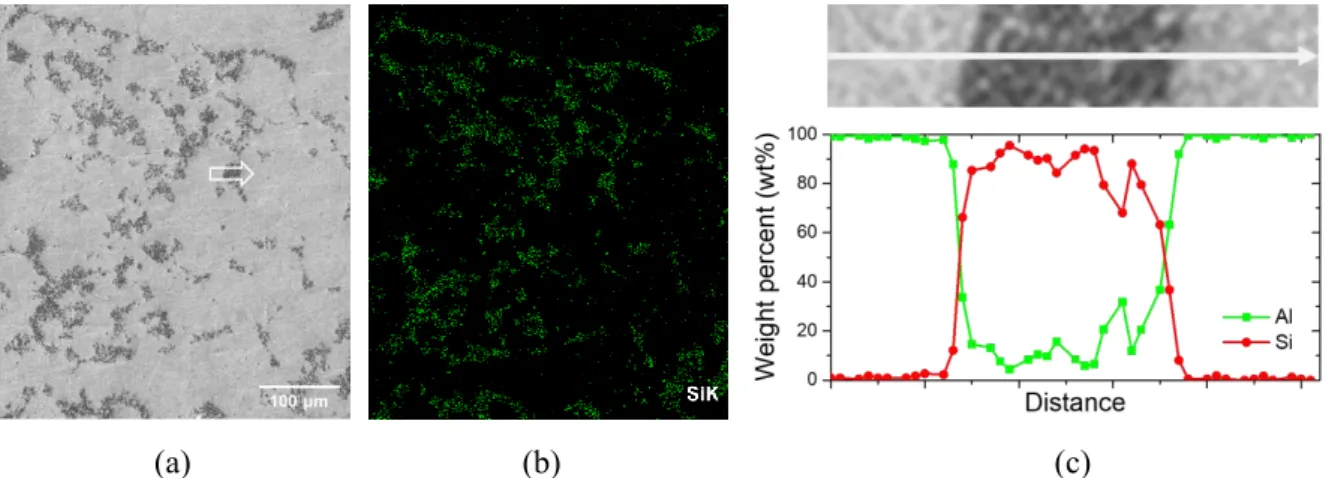
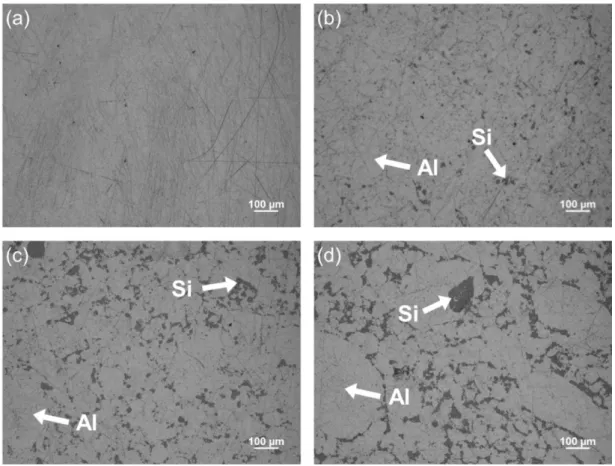
The morphology of Si precipitates in Al-Si alloys has been investigated in the literature [83]- [85]. Microstructure analysis was performed to examine the presence of Si precipitates in the sintered sample.
Measurement techniques
- Density and coefficient of thermal expansion
- Image analysis method
- Laser flash method
- Differential scanning calorimetry (DSC)
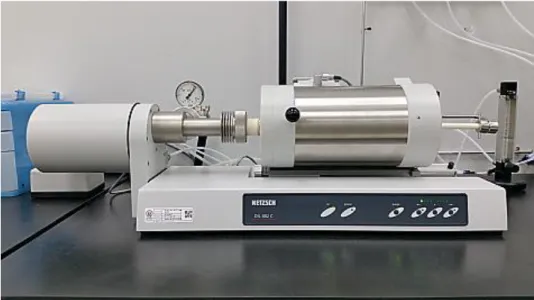
The half time means the time it takes for the sample to heat to half the maximum temperature on the backside. For the thermal diffusivity measurement of Al-Si alloys, the Netzsch LFA 447 model was used (Figure 30 (a)). In general, the DSC measurements for the specific heat capacity analysis require three separate measurements since the specific heat capacity of the samples is unknown (see Figure 32).
First, since the heat was not delivered identically to the reference and sample platforms and the crucibles for the reference and sample have different masses, the base heat flux must be measured. Two platinum (Pt) crucibles were fabricated: one for the sample and the other for the reference.
Thermophysical properties of Al-Si alloy
- Physical information of Al-Si alloy samples
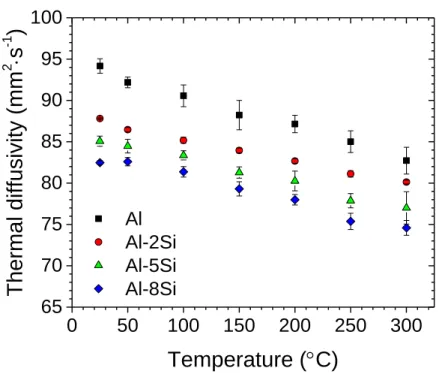
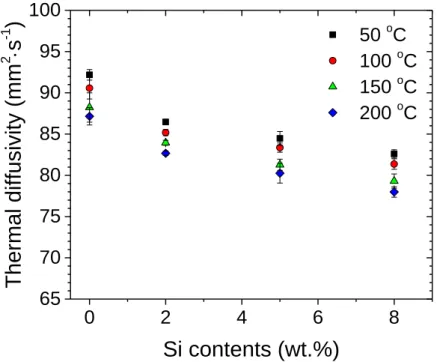
- Thermal diffusivity of Al-Si alloy samples
- Specific heat capacity of Al-Si alloy samples
- Thermal conductivity of Al-Si alloy samples
- Discussion
- Summary
Using the measured data, the thermal diffusivities of sintered Al-Si were fitted to a linear function of temperature:. where α is the thermal diffusivity in mm2·s-1 and T is the temperature in K. The obtained fitting parameters, b1 and b2, are given in table 9 for each of the sample types. From the measured thermophysical data, the thermal conductivity of Al-Si alloy was calculated as a function of temperature and Si content. The differences in the thermal conductivity between Al and Al-Si alloys are predominantly attributed to the difference in the thermal diffusivity.
The measured data for pure Al in Figure 42 was used as the thermal conductivity of Al matrix. Comparison of the thermal conductivity of sintered Al-Si with the predictions of the Bruggeman model at 100 °C.
Thermophysical properties of fresh U-7Mo/Al dispersion fuel
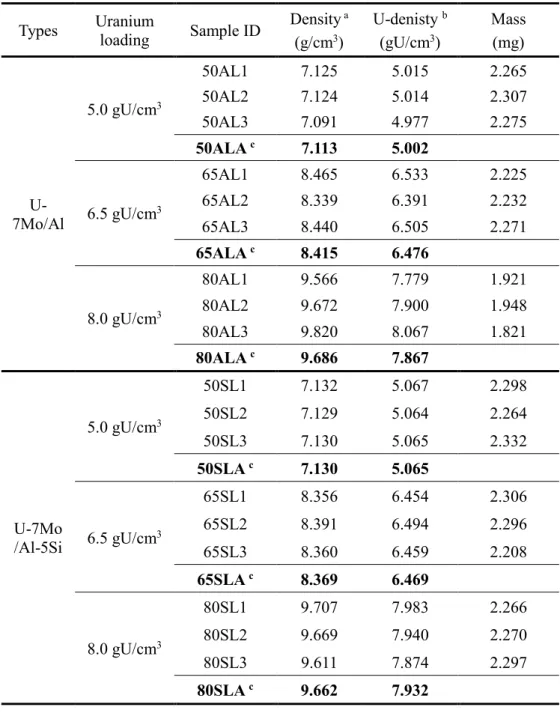
- Physical information of fresh U-7Mo/Al dispersion samples
- Thermal diffusivity of fresh U-7Mo/Al dispersion samples
- Specific heat capacity of fresh U-7Mo/Al dispersion samples
- Thermal conductivity of fresh U-7Mo/Al dispersion samples
- Discussion
- Summary
Density variations of U-7Mo/Al and U-7Mo/Al-5Si dispersion fuels as a function of temperature. Thermal diffusivity of fabricated U-7Mo/Al and U-7Mo/Al-5Si samples as a function of U-Mo volume fraction. Specific heat capacity of fabricated U-7Mo/Al and U-7Mo/Al-5Si samples as a function of temperature.
For U-7Mo/Al-5Si, thermal conductivity increases with temperature for all U-Mo volume fractions. The trend in the thermal conductivity of U-7Mo/Al and U-7Mo/Al-5Si with temperature depends on the U-Mo volume fraction.
Thermophysical properties of heat-treated U-7Mo/Al dispersion fuel
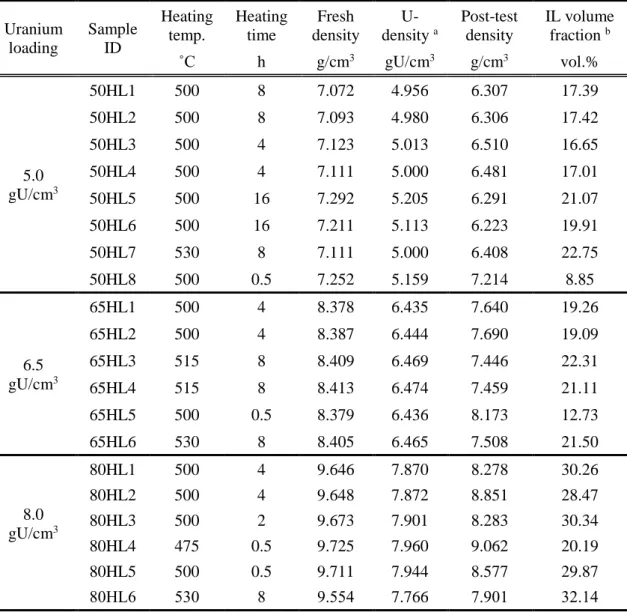
- Physical information of heat-treated U-7Mo/Al dispersion samples
- Thermal diffusivity of the heat-treated U-7Mo/Al dispersion samples
- Specific heat capacity of the heat-treated U-7Mo/Al dispersion samples
- Thermal conductivity of the heat-treated U-7Mo/Al dispersion samples
- Density of interaction layers
- Discussion
- Summary
With respect to all uranium densities, the thermal diffusivity decreases monotonically with the IL volume fraction. Thermal diffusivity of heat-treated U-7Mo/Al dispersion fuel as a function of IL volume fraction. Using the measured data, the thermal conductivity of U-Mo/Al dispersion fuel was calculated as a function of temperature, and IL volume fractions.
Thermal conductivity decreases with U-Mo volume fraction quite linearly over ranges of volume fractions. The decrease in thermal conductivity with IL volume fraction significantly exceeds that of the model prediction.
Heat-transfer simulation using a Finite Element Method
FEM model descriptions
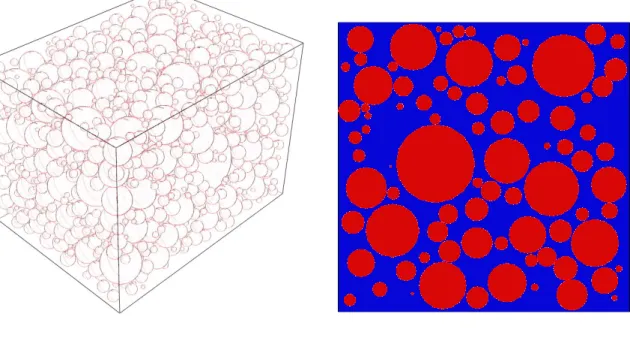
- Geometry
- Boundary conditions and loads
- Calculation of effective thermal conductivity
All other sides are set adiabatically to prevent heat from escaping. This condition allows the heat to flow mainly along the z direction, which represents the direction of the plate thickness. Since the side surfaces were assumed to be adiabatic, heat escapes thoroughly through the top and bottom surfaces.
The heat escaping through the lower and upper surfaces was measured after each analysis to ensure consistency of the sum. For the example of heat generation: the heat generated from the particles and the IL flows out through the top and bottom surfaces.
FEM model verification
- Comparison with the measured data of fresh samples
- Comparison with the measured data of heat-treated samples
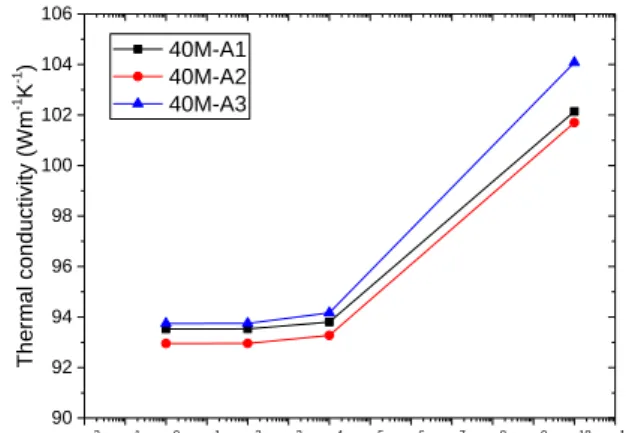
A comparison of thermal conductivity data between simulation predictions and measured data as a function of U-Mo volume fraction. FEM simulation results for the thermal conductivity of U-7Mo/Al(-xSi) dispersion fuel as a function of U-Mo volume fraction. Since the production of IL itself is impossible, the thermal conductivity of IL is left unknown.
The other characteristic point is that the efficiency of IL thermal conductivity becomes larger as the IL volume fraction increases. Comparison of thermal conductivity of U-7Mo/Al dispersion fuels as a function of IL volume fraction between the measured and the simulated results.
Parametric study for the thermal conductivity of U-Mo/Al dispersion fuel
- Effects of particle size
- Effects of heat-generation from U-Mo and IL
- Effects of coating
- Stereography effect
- Effects of porosity
- Conversion of IL thickness to IL volume fraction
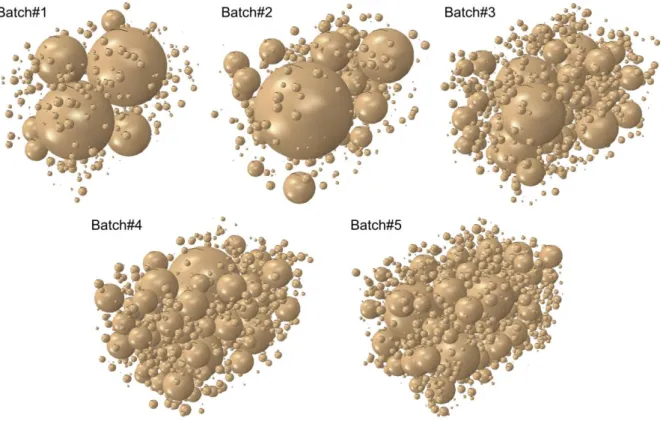
Therefore, the heat generation from U-Mo and IL can lead to an overall deterioration of the thermal conductivity. Thus, the thermal conductivity of three-dimensional cases is higher than that of two-dimensional cases. As the IL volume fraction cannot be directly measured, the IL thickness was alternatively measured from microstructure images.
To convert the IL thickness to the IL volume fraction, a conversion model was developed by Kim et al. From the particle size data used in the simulation, the IL volume fraction was calculated, assuming no subtraction of overlapping areas .
Semi-empirical model development
Model descriptions
- Semi-empirical models for fresh U-Mo/Al dispersion fuel
- Semi-empirical models for IL-formed and coated U-Mo/Al dispersion fuel
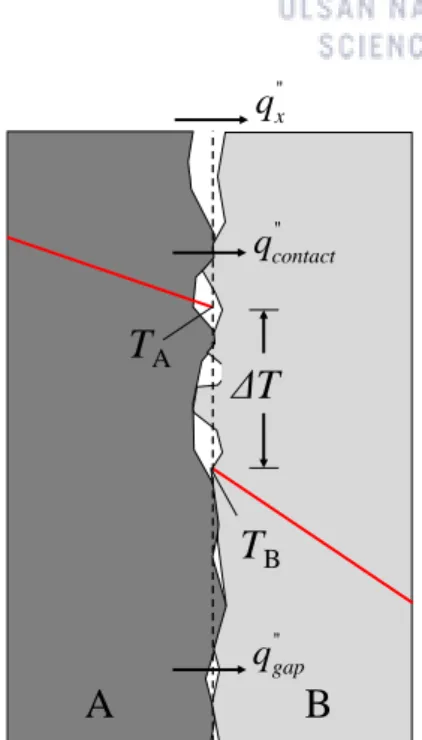
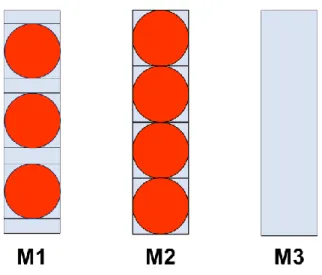
Thus, two-unit-cell modeling for the path #2 and path #3 was performed and the effective thermal conductivity was calculated by solving the heat transfer equation, respectively. After integrating the above equation, the effective thermal conductivity of unit cell is obtained so that:. where km and kp indicate the thermal conductivity of matrix and particle, hc is the thermal resistance of the interface, and d is the length of the unit cell. This unit cell took into account the thermal conductivity between particles and matrix.
Finally, the effective thermal conductivity of unit cell #2 was obtained by a series model assuming two contact cells attached to the top and bottom:. where tc is the thickness of the differential strip for the particle contact described in Figure 93. and it is expressed as: . For calculation of unit cell #1 and #2: the thermal conductivity of particles is changed to the thermal conductivity of layer structured particles.
Model verification
- Prediction of thermal conductivity of as-fabricated U-Mo/Al dispersion fuel
- Prediction of thermal conductivity of IL-formed U-Mo/Al dispersion fuel
- Prediction of thermal conductivity of coated U-Mo/Al dispersion fuel
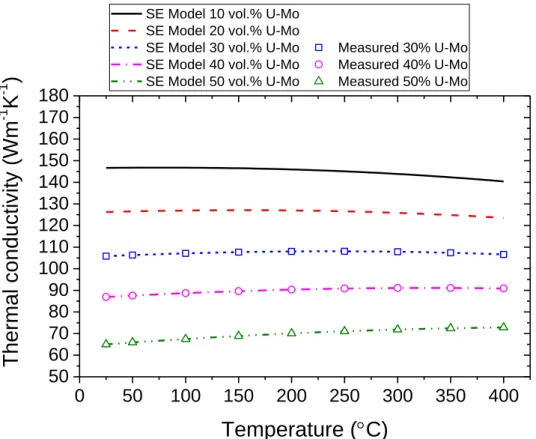
Using the semi-empirical model, the thermal conductivity of IL-formed U-Mo/Al dispersion fuel was estimated. Using the semi-empirical model, the thermal conductivity of coated U-Mo/Al dispersion fuel was estimated. Accordingly, the thermal conductivity of coated U-Mo/Al dispersion fuel decreased linearly with the thickness of the coating layer.
The thermal conductivity of coated U-Mo/Al dispersion fuel was evaluated when the thermal conductivity of coating material varies. However, it showed that the thermal conductivity increased slightly as the thermal conductivity of the coating material increases.
Model application to the RR fuel performance code
- Temperature distribution and change
- Thermal conductivity evolution and IL growth during the irradiation
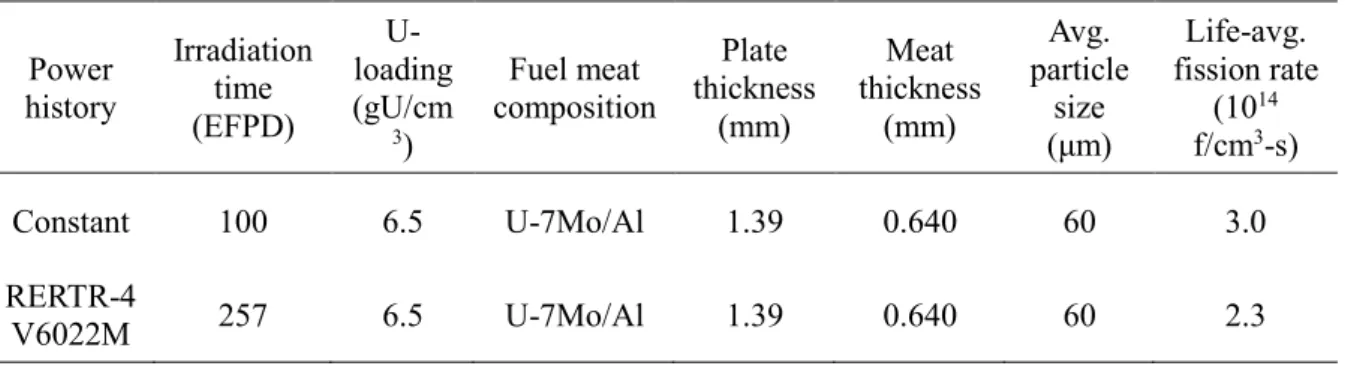
The modified code gave a higher rating for the overall temperature distribution due to the modified thermal conductivity. Both show that the temperature increases as combustion increases, but it can be seen that the temperatures reach their temperature saturation much faster in the case of the modified version. After the modification of the thermal conductivity model, it decreases very quickly with the irradiation time.
In the case of the RERTR-4 current history, the thermal conductivity decreased faster than that of constant power because the operating temperature was much higher than that of constant power. However, it is expected that more distinctive differences will be observed if the conversion model from IL thickness to volume fraction will be implemented. a) Power constant (b) Power variation Figure 112.
Conclusion
Conclusions
The model prediction verified that it gives a very consistent result as a function of U-Mo volume fraction and layer or IL thickness which successfully proved a good reproducibility and reliability. The developed semi-empirical model was implemented for the research reactor fuel performance code, PRIME. The modification in the thermal conductivity models gave some remarkable changes in the thermal conductivity and temperature, while not a characteristic change in the radiation growth due to the rapid growth in the Al matrix.
The implementation of the model in the fuel performance code has some remaining work such as verification and validation. The development of the semi-empirical model and its application will continue in the future.
Future works
Fuel'].rootAssembly.PartFromBooleanCut(cuttingInstances=(TMPassembly), .instanceToBeCut=mdb.models['U-Mo Fuel'].rootAssembly.instances['Merged Interaction layer-1'], name='ILExd'). Fuel'].rootAssembly.PartFromBooleanCut(cuttingInstances=(TMPassembly2), .instanceToBeCut=mdb.models['U-Mo Fuel'].rootAssembly.instances['Merged Interaction layer-1'], name='ILcut'). Fuel'].rootAssembly.PartFromBooleanCut(cuttingInstances=(Particleassembly), instanceToBeCut=mdb.models['U-Mo Fuel'].rootAssembly.instances['ILcut'], name='IL Assembly').
Fuel'].rootAssembly.PartFromBooleanCut(cuttingInstances=(Particleassembly), instanceToBeCut=mdb.models['U-Mo Fuel'].rootAssembly.instances['tmpM-1'], name='tmpM-2'). Fuel'].rootAssembly.PartFromBooleanCut(cuttingInstances=(Particleassembly), instanceToBeCut=mdb.models['U-Mo Fuel'].rootAssembly.instances['tmpM-1'], name='Matrix').
![Figure 1. Phase diagram of uranium-molybdenum alloy (reproduced from Ref. [6]).](https://thumb-ap.123doks.com/thumbv2/123dokinfo/10517166.0/25.892.202.722.132.539/figure-phase-diagram-uranium-molybdenum-alloy-reproduced-ref.webp)