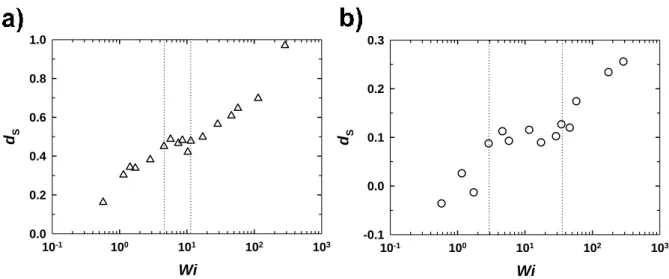
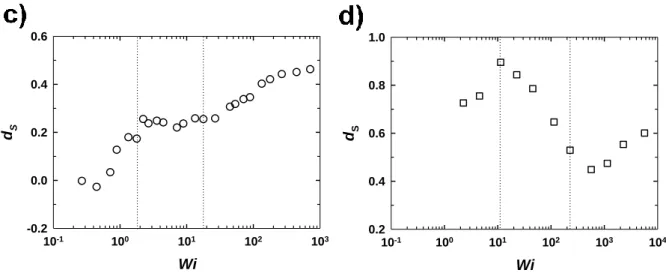
Although numerous researches on the slip phenomenon have appeared in the past, there still remains a critical lack of molecular level understanding about structural and dynamic behavior of polymer chains at interface under an external flow field. The slip phenomena were analyzed in detail with a particular effort to reveal the underlying origin in the microscopic level. In the 1st regime where the yield strength is small, ds appears to keep increasing with increasing shear rate for both C30 and C178 PE melts.
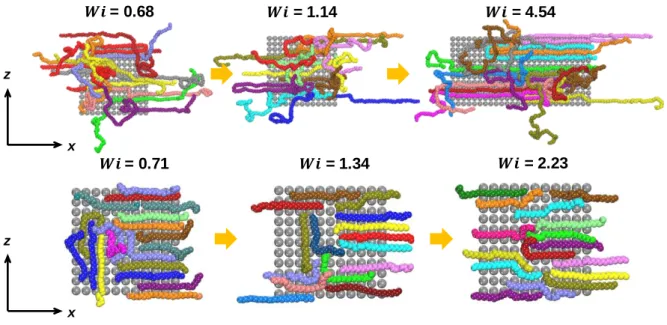
This regime is characterized as a dynamically stable range in chain rotation and tumbling mechanisms due to a competition between the wall friction against the slip of adsorbed chains and the motion of adsorbed chains in the flow direction, enhanced by the surrounding bulk chains that promote the slip. Moreover, in the case of C178 PE melt, it has been found that the degree of entanglement between adsorbed chains and the surrounding chains becomes weaker as the shear rate increases, leading to a decrease in the momentum transfer from the surrounding chains to adsorbed chains and thus the decrease of ds. The vertical dotted lines mark each regime of each system. bottom) melts with ɛwf=4.47 in the first regime of ds, showing the tendency of chain orientation along the flow direction with increasing Wi, leading to a smaller friction with the wall as the flow strength increases in this regime.
Otherwise, it may rotate while being mounted on the wall as shown in the bottom panel.
Nomenclature
- Introduction
- Theoretical background
- Interfacial Slip
- Simulation Methodology and Materials Studied
- Nonequilibrium molecular dynamics simulation
- Results and discussion
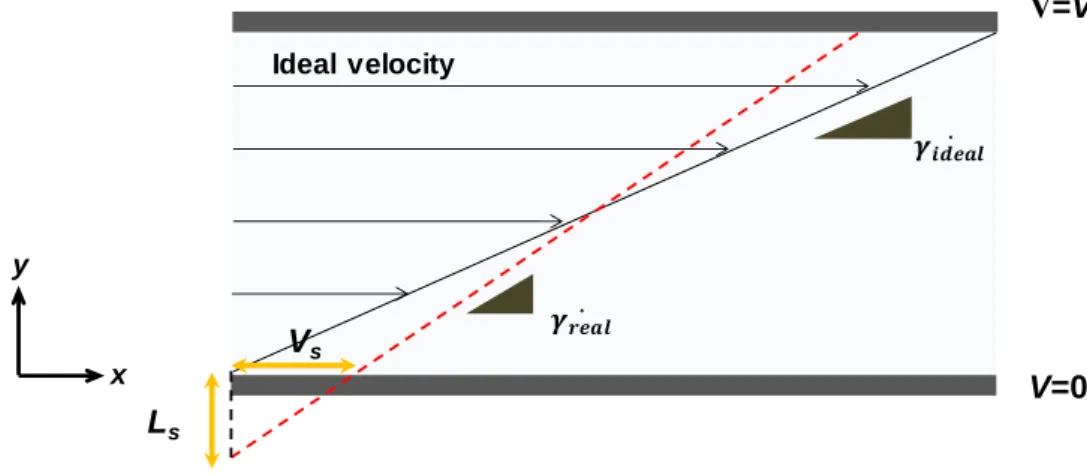
In recent decades, many experimental and computational studies have been carried out on confined fluid. The no-slip boundary condition has been considered one of the most standard boundary conditions applied in the study of fluid mechanics. Slip velocity Vs and slip length Ls have the following relationship in the Navier model (Lamb, 1932).
In complementary experiments, computer simulations have been widely applied to the study of fundamental physicochemical behaviors of complex fluids in bulk or in a confined geometry. To derive the singular moment, the atomic velocity profile was fitted as a 5th order polynomial at each time step. We used the reversible reference system propagation algorithm (r-RESPA) (Tuckerman, 1992) to integrate the evolution equations. 3.2), the discrete time propagator is found as
We see that ds can be categorized into three regimes for each of the three different C30 systems. But an important observation in Figure 4.0.1 is that ds for each system reaches a plateau at intermediate shear rates, which can be interpreted as an indication of constant rate of increase in both input shear rate and real shear rate. In contrast, the result of ds for the C178 PE melt, as shown in Figure 4.0.1d, shows a different behavior than the C30 melt.
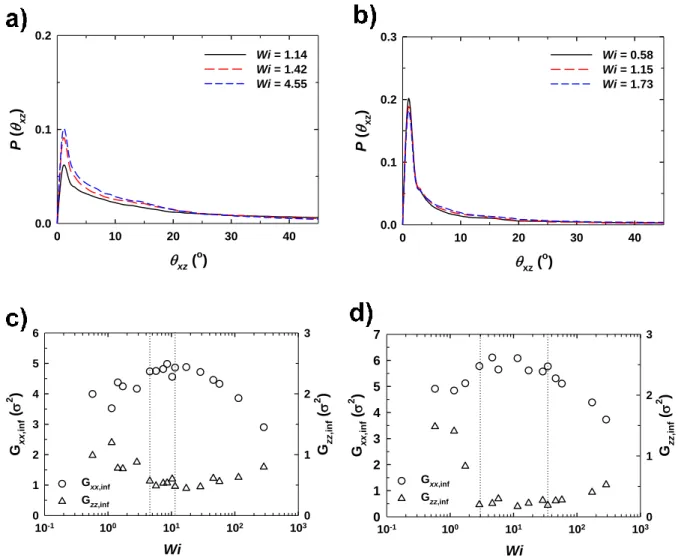
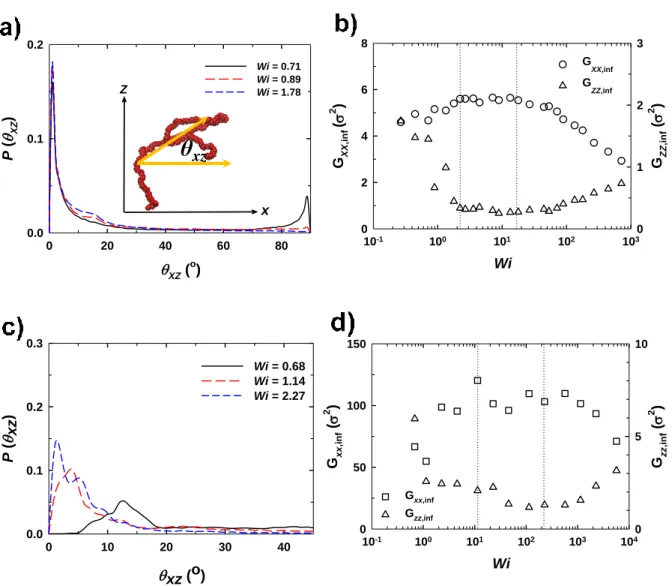
First, we defined the interfacial chains near the wall as the molecules whose y component of the center of mass is within 2.5σ (equal to rcut ) from the bottom wall, as shown in Figure 4.1.1. In Figure 4.1.2a we present the probability distribution function of the angle between the center-to-center vector of interfacial chains, orthogonally projected in the xz-plane, and the x-direction (xz-angle) of C30 (ɛwf = 4.42) at three different Wi numbers within the 1st regime of ds. This trend is well shown in Figure 4.1.2b; with increasing Wi in the first regime of ds, the interface Gxx.
Also, interfacial chains become more ordered, as can be directly seen from the result of the order parameter in Figure 4.1.4a. Due to the wall interaction and the limited geometry, the interfacial chains are likely to be ordered even at low flow rates (Dijkstra,.
To see how chains are arranged in the xz plane, we split an interfacial chain into two equal fragments and calculated the centers of mass of each half. The results show that with increasing the flow strength, chains are aligned more in the x-direction leading to a greater probability around zero degree. This behavior can be understood visually, as shown in the lower pictures of Figure 4.1.5 where interfacial molecules on the lower wall are aligned in x-direction with the increase of the flow field with respect to the xz-plane.
First, we can understand that interfacial chains aligned in the flow direction (x-) tend to slip more than those aligned in the neutral direction (z-direction) due to the less wall friction experienced of the chains oriented in the flow direction than the neutral direction. Furthermore, it has been shown that at low flow rates, thermal motion of chains is comparable to the external flow field, resulting in a relatively small degree of slip in the 1st regime of ds (see Figure 4.0.1). As shown in Figure 4.1.2d, the xx component of the interfacial gyration tensor exhibits an increasing trend, indicating the same orientational process of interfacial chains as those observed in the C30 systems.
The variation of the probability distribution function of the xz angle (Figure 4.1.2c) and the interfacial order parameter (Figure 4.1.4b) further confirms the molecular mechanism of the chain orientation process to the flow direction, which results in a lower friction between the chains and the wall and thus a larger ds in the 1st regime. It is mainly attributed to the large degree of entanglement between chains in the case of C178 PE system, as shown in Figure 4.1.6. In Figure 4.1.6a, we calculated the number of entanglements per chain,
In the 1st regime of ds,
Flow
Thus, the interfacial chains must be pulled away from the surrounding chains at higher flow velocities, leading to a large slip compared to the short C30 melt systems where the entanglement effect does not exist. The left picture depicts a representative example, showing that an attached interfacial chain is entangled with a detached chain.
Entanglement
Conclusion
In particular, we focused on how molecular dynamics are changed depending on the chain length under confinement in terms of the trend of the degree of slip ds. In comparison, ds of the C178 system shows an increasing, then a decreasing and then an increasing trend. At weak flow strengths in the 1st regime, chain orientation near wall is still not saturated.
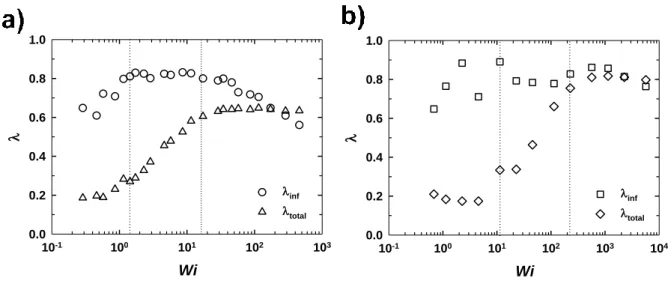
As the shear rate is further increased, chains are stretched and aligned in the flow direction, as can be seen from the results of the interfacial aspiration tensors and the interfacial order parameter for both C30. In addition, in the case of the longer C178 melt, the entanglement between the attached chains and nearby detached chains makes a significant effect to result in greater slip compared to the C30 melt. In the 2nd regime, which is one of the most important observations in the present study, ds reaches a plateau in the case of C30 melts, indicating a dynamic stable state of balancing between the effects of chain rotation and wall interaction.
On the other hand, for the C178 melts, the
In the 1st ds regime, the wall friction is reduced due to alignment of the chain in the x direction from the z direction, resulting in an increase in ds. In ds regime 2, chain rotation strength and wall interaction are comparable to each other and the corresponding factor, Nnst/N, in dinf maintains the plateau. In the 3rd ds regime, the chains can easily leave the vicinity of the wall, leading to a decrease in and and thus an increase in dinf.
1971) Polymer melt flow instability in extrusion: study of the mechanism and material and geometric variables. 2004) Control of the sharkskin instability in the extrusion of polymer melts using induced temperature gradients. 1997). The effect of matrix materials and pressure-dependent slip on the extrusion of linear low-density polyethylene. 2000) Effect of wall roughness on slip and rheological properties of hexadecane in molecular dynamics simulation of Couette shear flow between two sinusoidal walls.
2007) Effect of surface roughness on velocity-dependent slip in simple fluids. 2004) Effects of interface wettability on microscale flow by molecular dynamics simulation. 2005). Slip behavior in liquid films on surfaces with patterned wettability: A comparison between continuum and molecular dynamics simulations. 1990). Shear flow near solids: Epitaxial order and flow boundary conditions. 1997) Bounded thin films of linear and branched alkanes. 1997) Shear behavior of squalane and tetracosane in extreme confinement.
Molecular simulation of the transition from liquid-like to solid-like behavior in complex fluids confined to nanoscale gaps. A general boundary condition for fluid flow at solid surfaces. 2005) Friction and slip at simple liquid-solid interfaces: the roles of the molecular shape and the solid-liquid interaction. Slip in entangled polymer solutions. polymer melt/solid interface: structure, density and conformation of a thin film of polyethylene melt adsorbed on graphite.
2003) Molecular dynamics study of the effect of solid interfaces on the structure and dynamics of poly(ethylene oxide). 2005) Molecular dynamics simulation of the polymer melt/solid interface: local dynamics and chain mobility in a thin film of polyethylene melt adsorbed on graphite. 2007). Molecular dynamics simulation and quantum chemical study of the interactions of poly(dimethylsiloxane) and silica nanoparticles. 2010) Single molecule dynamics of linear polyethylene fluids under shear: atomistic simulation and comparison with a freely drained ball-rod chain. Effects of flow on the melt structure and entanglement network of linear polymers: results from a non-equilibrium simulation study of the molecular dynamics of a polyethylene melt under uniform shear.