A specialty. submitted to the Graduate School of UNIST as partial fulfillment of .. the requirements for the degree of Master of Science. It has been seven years since I entered UNIST as one of the first undergraduate students. I owe a special thank you to all the professors from the Department of Industrial Design at the School of Design and Human Engineering.
When it comes to packaging design, most previous studies have focused on examining visual elements for attractive packaging at the purchase stage, but there is little research testing packaging design in relation to unboxing interaction. Table 14 Coding results of the associative metaphor of type C packaging (wealth of motor actions) --- 41.
Background
It suggests that the role of product packaging is not limited to protecting the inside of the product, but extends to the extent that it defines the image of the brand and affects the profits of the company. One possible way to create value is to understand and improve the moment of unpacking, which acts as a gateway by marking the start of product use. The act of unboxing was depicted as “performing the ritual of a free product for the first use” that evoked strong emotions (Dazarola, Torán, & Sendra, 2012).
The moment of opening a package is a very critical point, as it is the starting point of product use as well as being very emotionally-bound. However, there has been little research into the influence of unboxing on emotional experience and the significance of unboxing packaging for the product experience.
Research aims and objectives
Research questions
Research design
Thesis outline
Theoretical framework
Unboxing experience
- The unboxing phenomenon
- Out of the Box Experience (OOBE)
First and usually the only interaction with the product's aesthetic properties before purchase. The user interacts with the product idea that already owns, recalls its features, user experience, etc. Storage Longer period where the product is stored and not used for a while.
Moment when the product is moved or manipulated to facilitate or enable its use. Maintenance event where the product is subject to simple repairs or replacement of parts.
Emotional experience of unboxing
- Emotional experience
- Unboxing as an emotion lever
Patrick (2014) quoted in his article by Filip Weymans, director of label and packaging marketing at Xeikon, "triggering personal emotional response has become as important a function of packaging as conveying information about the product." He predicted "the emergence of an emotional age in which brand owners and their service providers will find new ways to use packages and labels as emotional levers." Liao (2012) testified whether packaging could evoke emotional response and measured it with three different types of tools: skin conductance, facial electromyography (EMG) and self-rating scales. In addition, the term "interaction aesthetics" referred to "the qualities of a design that lead to the feelings, emotions, and behaviors that result from these types of interactions". The main goal of the experiment was to obtain the user's emotional response to the unboxing experience.
In the case of Type B, none of the negative emotions appeared noticeably, which was a noticeable result compared to the other types. Table 8_ ANOVA test results with variables for the SD group of 'Social value and position' (n=5). The results of the mold quality assessment also differed between the product packaging types.
In the case of packaging A, the semantic adjectives of 'low-tech', 'impractical', 'organic' 'asymmetrical', 'immature' and 'interesting'. The results resembled the SD results that “high class” and “expensive” were dominant in the semantic evaluations of the product. These perceptions would have influenced the first impression of the product being "difficult to use", "confusing" and even "dangerous" to use.
It also explains why online articles describe unboxing as “boxes of delight” and even “the new nerd porn.” Finally, the results of the product personality assessment show that types of unboxing interaction can be associated with different types of semantics. It could explain why the semantic adjectives such as 'elegant' and 'high quality' prevailed, as the first impression of the product in terms of quality of the product design and its features would probably be.
Aesthetic interaction in product packaging
- Packaging design elements for unboxing
- Aesthetic interaction in unboxing packaging
Methods
- Experiment design
- Experiment Stimuli
- Design guideline
- The three packaging prototypes
- Inside product
- Materials for measurement
- Measuring emotional responses
- Measuring first impression of the product
- Procedure
- Samples and experiment environment
First, they examined existing packaging types to understand different ways of unpacking existing packaging. Interaction Pattern: The confluence of movement between the user's actions and the response to the package. Freedom of interaction' (coded Type A) was created to focus on a multi-way to take the product out of the packaging without providing clear affordability.
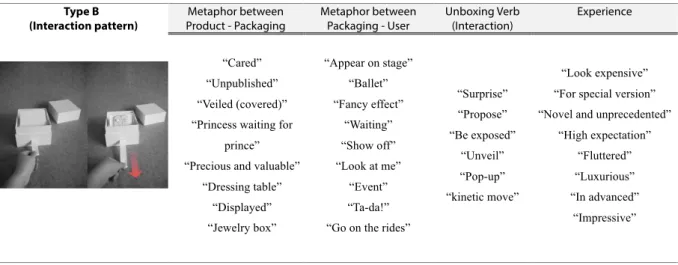
In the case of the “interaction pattern” (coded type B), the main point of the ideas was the correspondence between input (user action) and output (packaging action) in terms of timing and movement. According to the operational definitions of three different aspects of aesthetic interaction, three types of packaging were developed and prototyped: freedom of interaction (Type A), interaction pattern (Type B), and richness of motor action (Type C). Because the size of the packaging could lead to a distorted result, the same dimensions (140 mm x 140 mm x 120 mm) were used for all three designs.
In the case of type B, the main design work was aimed at achieving the coincidence of movement between the user's action and the packaging's response. By the operational definition, the coincidence should naturally involve timing and current movement. When people pull the string quickly, the inner box connected to the string also rotates quickly.
Then the panel with five-point scales (from 0 to 4) appears on the right side of the character. On the right side of the panel, it was composed of 58 adjective cards with 29 bipolar adjectives. It was explained to them that the purpose of the experiment was to assess emotional reactions to the different types of packaging.
Results
Emotional responses
The semantics of 'attractive', 'futuristic', 'feminine' and 'friendly' emerged remarkably when assessing products in type B, in contrast to the other types. Discover”, “Find”, “Eliminate” and “Play” with the product and its activity reminded them of “Treasure hunt”, “Hide and seek”, “Make fun of me”, “Surprise gift” and “Draw a lot”. It may explain why toy and decorative products whose characteristics are usually 'organic', 'asymmetrical', 'immature' and 'interesting' were associated with packaging type A.
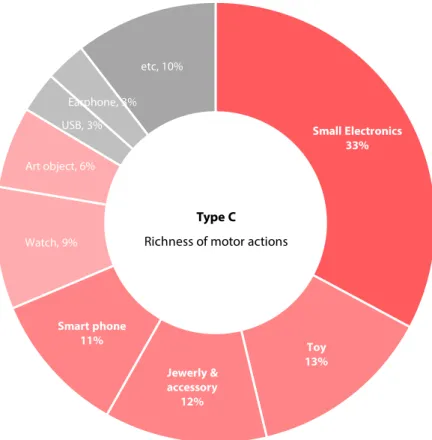
Among the respondents' many answers to product types, the most frequently answered product category was 'Small electronics', and it took up a third of the answers. Participants described the act of unboxing as verbs such as "excavate", "operate", "take off", "repeat", "peel" and "behave logically". On the other hand, there were negative reactions to the product packaging with many tasks causing "annoying", "boring" and "excessive" feelings.
Furthermore, 'boredom' and 'contempt' were much more associated with Type C than with the other types. It indicates that it is possible to give a product a feeling of 'luxury' and 'high quality' by interacting with the packaging. For example, Type B was rated much higher as 'expensive', 'high class' and 'contemporary' compared to the other two packaging designs.
Unlike the other two package types, the experience of Type C was negatively rated as "difficult to use" and "confusing". Regarding the association, 'toy' and 'decorative product' were mentioned as the best product for the packaging interaction (Figure 22). The result of Type B also shows the similar trend: due to the association induced by unboxing interaction, products related to the context of giving a gift and suggestions were mentioned, such as jewelry and accessories (Figure 23), and the interaction was described with verbs such as 'Surprise', 'Suggest', 'Be revealed' and 'Disclose'.
Appraisal of first impression of the product
- Semantic Differentials scale
- Metaphor of unboxing interaction
Discussion
- Emotional arousal by unboxing packaging
- The influence of unboxing to the first impression on product
- Design implications
- Limitations and further study
It shows that the act of unboxing itself would be the main contributor that evokes positive emotions regardless of the types of aesthetic interaction. Figure 21_an example of unboxing videos: a man unboxing an Apple iMac (Source from the article "Unboxing: The New Geek Porn"). By comparing the emotions elicited by the three types of product packaging, the results provide evidence to show that the interaction of unboxing in packaging design can attract different types and intensities of emotions.
The positive reaction to the unloading mode - intuitive yet unique in a sense that the inner box holding the product rotates according to the opening action of the participants - can be the main contributor that surprises the participants and gives unexpected positive emotions. To understand the influence of the dressing interaction on the first impression of the product, 29 adjectives of differential product semantic scales were measured and the product categories that would be most suitable for each type of packaging were identified. First of all, the results show that each type of unboxing interaction significantly influenced participants' evaluation of the semantics of the packaged product.
Figure 22_ The unboxing interaction metaphor of Type A (left), Representative product category of Type A (right). Figure 23_ The unboxing interaction metaphor of Type B (left), Representative product category of Type B (right). Figure 24_ The unboxing interaction metaphor of Type C (left), Representative product category of Type C (right).
The results show that the packaging interaction in unpacking would be related to certain contexts and metaphors. If the product cannot directly give such meanings to consumers, the articulate interaction of the packaging that would be unpacked would result in a specific association to communicate with people. Therefore, further studies should investigate how the evaluation of different products and product categories can be influenced by different types of aesthetic interactions in terms of the unboxing experience.
Conclusions
Examining the influence of packaging shape and color on consumer expectations of dairy desserts using word association and conjoint analysis. Strong packaging, strong taste: The impact of packaging design on taste impressions and product evaluations. Retrieved November 18, 2015, from https://www.thinkwithgoogle.com/articles/youtube-insights-stats-data-trends-vol7.html.
Comparing semantic intention and realization in product design: a study of high-quality furniture impressions. Retrieved November 20, 2015, from https://www.wizishop.io/blog/resources/110-keys-to-create-a-real-unboxing-experience. DIS '04 Proceedings of the 5th Conference on Designing Interactive Systems: Processes, Practices, Methods, and Techniques.
Retrieved November 20, 2015, from http://www.forbes.com/sites/rogerdooley how-your-packaging-improves-customer-experience/. Packaging as brand communication: The effects of product images on consumer responses to packaging and branding. Consumer packaging design: The effects of manipulating shape, orientation, and alignment of graphic shapes on consumer evaluations.