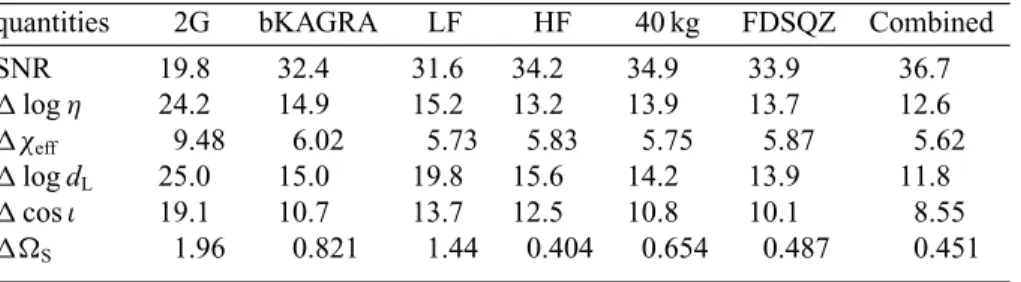
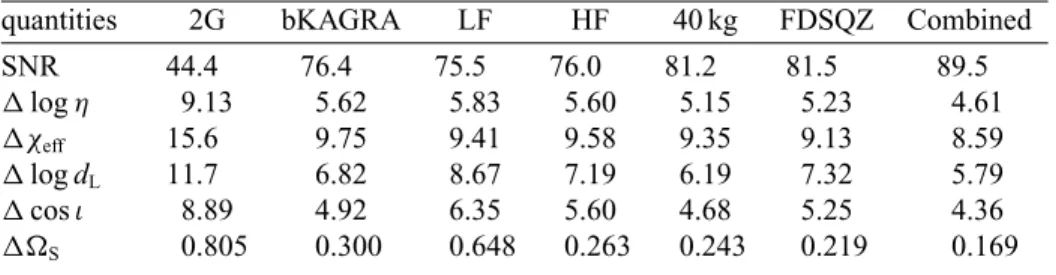
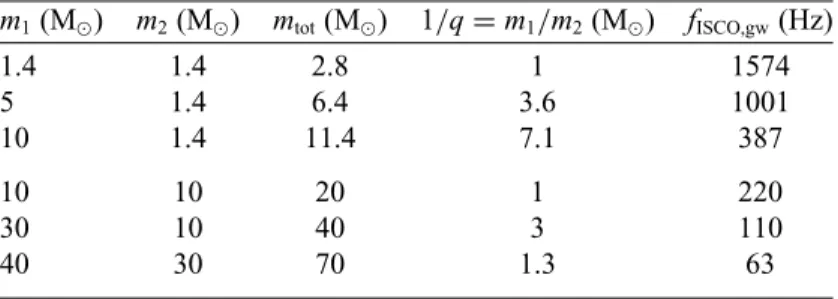
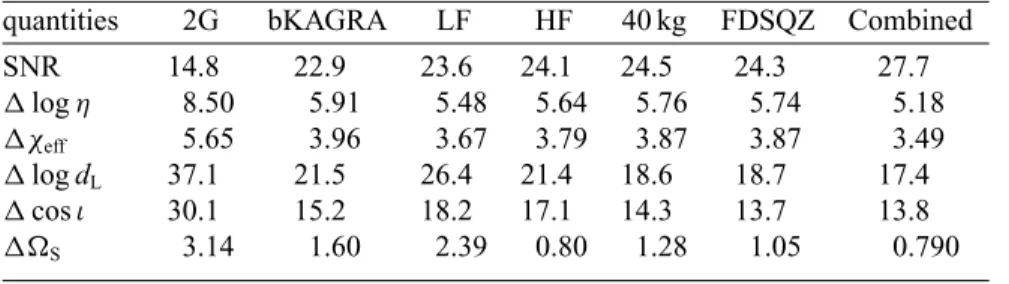
Because of the uncertainty in the early universe scenario, it would be difficult to distinguish PBH origins from astrophysical ones. Expected sensitivity of the network of aLIGO and AdV to a GWB from BBHs in the fiducial model in Ref. The ISCO frequency, fISCO depends mainly on the mass and spin of the central BH.
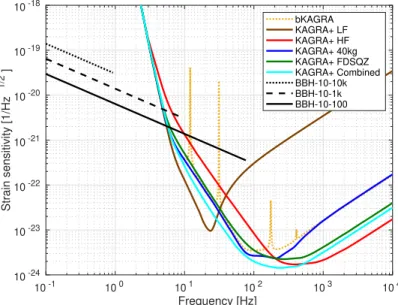
![Fig. 1. Sensitivity curves for bKAGRA and upgrade candidates for KAGRA+. Sensitivity curves for aLIGO, A+, and bKAGRA are shown for comparison [10].](https://thumb-ap.123doks.com/thumbv2/123dokinfo/10485951.0/5.918.284.635.94.313/sensitivity-curves-bkagra-upgrade-candidates-kagra-sensitivity-comparison.webp)
Neutron-star binaries 1. Binary evolution
The tidal deformability originating from the matter effect encodes the NS EOS information. We found that the accuracy of measuring tidal deformability can be slightly improved for HF, but not for LF. For example, the finding that the tidal deformability of a post-merger object is very different from that estimated from inspiration can hint at phase transitions in high-density matter (see Ref. [109] for a review).
Accreting binaries
To optimize CW searches from X-ray binaries and especially Sco X–1, the best frequencies should be from a few tens to a few hundred Hz. Data integration for weak signals of the order of h ~ 10−25 or less requires a stable (high duty cycle) long-term (months to years) observation. Unless we know the rotational frequency of the NS from EM observations, we have to search a wide frequency range, which places a high demand on computational time.
Isolated neutron stars 1. Pulsar ellipticity
The detection of "oscillation mode" CWs provides information on the interactions between the crust and liquid core of the NS. If both oscillating-mode and mountain-mode GWs are detected by a single NS, one may be able to determine its mass [ 174 ]. The detection of "r-mode" CWs gives us information on the evolutionary history of the star, as the decay timescale depends on the internal temperature.
8π/15Q22where I3 is the moment of inertia of the star with respect to its axis of rotation. The properties and mechanisms of the eruption are currently uncertain due to the limited number of events. Some GWs of NSs are classified in the same way as the oscillations of the usual (Newtonian) stars.
That is, the fundamental (f) and the pressure (pi) modes are excited as acoustic oscillations of NSs, while the gravity (gi) modes are excited by the buoyant force due to the existence of density discontinuity or compositional gradients in the star. . On the other hand, g-mode GWs might tell us the existence of density discontinuity due to the phase transition, or they might become more important in newborn NSs or proton neutron stars (PNSs) [198–200]. That is, cold NSs can be constructed with the EOS at zero temperature, that is, the relationship between energy density and pressure, while one must consider the distribution of the electron fraction and entropy per baryon together with the pressure distribution as a function of the density. to construct the PNS models.
In practice, the time evolution of the identified frequencies is considered as a consequence of the change of the PNS mass and radius, i.e. the mass increases due to accretion and the radius decreases due to both the relativistic effect and neutrino -cooling, with.
![Fig. 5. The detector sensitivity curves as well as the figures of merit for the pulsars that the LIGO–Virgo Collaboration has searched for using O2 data [178]](https://thumb-ap.123doks.com/thumbv2/123dokinfo/10485951.0/23.918.247.667.88.432/detector-sensitivity-curves-figures-pulsars-virgo-collaboration-searched.webp)
Supernovae
229] presented an analysis of the GW polarization using results from 3D general relativistic simulations of a non-rotating 15Mstar [222]. It was shown that the amplitude of the GW polarization increased for the 3D general relativistic model showing strong SASI activity. If discovered, it will give us a new study of SASI activity in the supernova core before the explosion.
Note that spiral SASI develops primarily outside the PNS, so that the circular polarization from spiral SASI has different features in the spectrogram compared to the stochastic, weak circular polarization from PNS oscillations that have no preferred direction of development [229]. By estimating the SNR of the GW polarization, they raised the possibility that the circular polarization detection horizon could be extended by more than a factor of several times longer compared to the GW amplitude. The GW signatures described in this section typically appear in the 100–1000 Hz frequency range in recent CCSNe simulations.
The characteristic frequencies of the fundamental (f/g) modes depend predominantly on the PNS mass (M) and radius (R), albeit in a non-trivial way [206]. To break the degeneracy, detection of other eigenmodes (p,w modes) of the PNS oscillations is mandatory. The GWs due to the SASI of a galactic event can be detected with the SNR of the GW signals predicted in the latest 3D CCSN models in the −4–10 range for aLIGO [ 221 ].
If the spectra of the supernovae are assumed to be flat in the frequency range 100 Hz-1 kHz, we can quantitatively compare the performance of different configurations of possible KAGRA upgrades by defining the SNR ratiora/β ≡rα/rβ ratio for the efirα-and- defigurations. 5) and a similar equation holds for the β-configuration.
The early Universe 1. GWs from inflation
There will be a chance for the ground-based detectors to detect inflationary GWs if the spectral index of the spectrum is greater than ~0.5. Another possibility for the ground-based detectors is to probe a non-standard Hubble expansion history of the early Universe [259–264] . Information about the expansion rate, which is determined by the dominant component of the Universe, is imprinted in the spectrum of inflationary GWs.
For a scale-invariant primordial spectrum, the spectral dependence of the stochastic background becomes GW ∝f2(3w−1)/(3w+1), where EOS of the Universe. The overlap reduction function γIJ(f) is given by the detector responses of the two polarization modesF+andF×as. As seen in the overlap reduction function, the SNR depends on the distance and relative orientation of the detectors.
The baryon asymmetry of the universe can be explained by electroweak baryogenesis, which requires a strong first-order electroweak phase transition. A standard data analysis only provides information about the amplitude and tilt of the spectrum. The spectral shape of the stochastic background depends strongly on its origin and can generally be used to distinguish a wide range of generation models.
In general, a higher SNR is required not only to determine the spectral shape, but also to obtain the additional properties of the stochastic background mentioned above.
Test of gravity
Since the GW data are noisy, obtaining a meaningful constraint requires an appropriate projection of the data in the direction predicted by the possible gravity modification. The leading post-Newtonian order of the phase correction according to the quadrupole formula is shown. One is the conservative part of the gravitational interaction and the other is the dissipative effects of radiation.
Here we list representative possible modifications of gravity with the post-Newtonian order of the forward correction in phase in Table 8. On the other hand, the extra scalar degree of freedom changes the conservative part of the force, but there is no such improvement in the sense of post-Newtonian order. If the mass is in the range between these two, the existence of the extra degree of freedom can only be probed by GWs.
The amplitude damping rate is equivalent to the variation of the gravitational constant for GWs and allows us to test the equivalence principle. In Table 11 we show the SNR of the QNM GWs in the case of Mrem = 60 and 700 M for different detector configurations. SNRs versus the real part of the (=m =2) QNM frequency for the mass ratiosq =1 (left) and 2 (right), assuming the optimal source direction.
Next, we discuss the effects of the shape of noise curves on the QNM parameter extraction.

Late-time cosmology
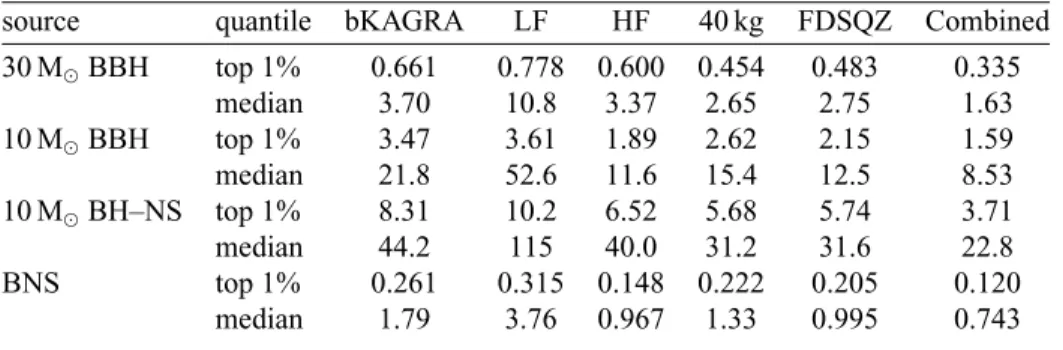
We estimate the measurement errors of the air localization volume with the Fisher information matrix [322]. Based on our results from the sky localization volume, BNSs are much better than BH-NS binaries. In addition, there will be potential contributions from systematic errors, e.g. the modeling of the EM counterparts and the calibration errors of GW detectors.
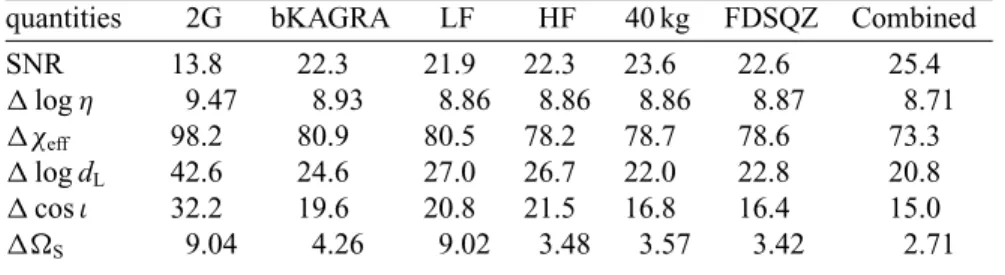
Thus, the detection of EM counterparts will play an important role in the identification of the host galaxy. In addition, the light curves of EM samples at <1 day are of particular interest. Tables 4 and 5 show that the determination of the slope angle is improved by up to ≈23%.
The detection of the GW event GW170817 [4] and its associated EM counterparts [361] revolutionized the situation. The inclination (or viewing angle) of the merging binary is also a crucial parameter for sGRB studies. The central engine of the relativistic jet is also unclear, but it is highly likely.
Such gravitational radiation has a 'memory'; i.e. the metric perturbation does not return to the original value at the end of the jet acceleration [470].
Others
Because the field of view of radio telescopes is relatively small (e.g. ~0.1 degrees for Parkes), better sky localization with KAGRA is, as always, crucial. have a high frequency cutoff due to the bundled nature of the signal. In the case of a BH spacetime, these hidden degrees of freedom are within the BH horizon. However, this is unlikely, although it is true that the explicit calculation of the Hawking radiation based on field theory in curved spacetime is only given in perturbative calculations with weak coupling.
From the point of view of relativity, the horizon is not a special surface at all, unless we care about the global structure of spacetime. A simple but radical possibility is that the BH horizon is covered by a wall that reflects all low-energy excitations including GWs. Ordinary matter whose energy scale is much higher than the energy of the typical gravitons excited in the binary system will be absorbed by BHs, while the quanta whose energy is comparable to or lower than TH, i.e. whose wavelength is as long as the BH size is selectively reflected by the wall.
It is difficult to predict the exact waveform of the expected echoes because the theoretical background is not very reliable. A possible answer about the properties of the wall is that the reflection rate at the wall is unity and that the wall is placed approximately at Planck distance from the horizon. In fact, our reanalysis indicates that the meaning of the echo signal does not survive once we replace the template with a slightly more realistic one [501]; that is, it uses the reflection velocity at the angular momentum barrier, calculated using BH perturbation theory.
As the number of events increases, the nature of the signal that appears to exist will surely be revealed in the near future.
Conclusion