
By using lead shielding, the dose limit was met regardless of the distance between close workers. Otherwise, the realistic annual doses were less than the dose limit in the area of close work. The conservative and realistic annual dose for the remote worker was 1.33E+01 mSv and 3.00E+00 mSv, which was less than the average dose limit.
Otherwise, the annual dose of worker with APF was less than the dose limit regardless of outflow rate and leakage part (maximum dose: 1.83E+01 mSv).
Introduction
In order to dispose of radioactive waste, it must be less than the disposal regulatory value of the Nuclear Safety Act, however the radioactivity concentration of 14C in the used resin exceeds the intermediate disposal concentration (2.22E+05 Bq/g) and cannot be disposed of [22]. Therefore, it is important to dispose of spent resin by reducing its volume and radioactivity concentration through various treatment methods [31]. In this study, to compensate for these shortcomings, a facility for desorbing 14C without generating secondary waste by immediate microwave heating of the spent resin mixture is being developed.
With this development, the radioactivity concentration of the spent resin can be reduced below the criteria for low or very low level disposal.
![Table 1. Characteristics of Wolsong NPP in Korea [2]](https://thumb-ap.123doks.com/thumbv2/123dokinfo/10487519.0/15.892.106.789.153.393/table-1-characteristics-wolsong-npp-korea-2.webp)
Literature Review
- Storage Characteristics of Spent resin mixture and Storage tank
- Sampling of the Spent resin mixture
- Dose Assessment for Transportation of the Spent resin mixture
- Dose Assessment for Accidents in the LILW Temporary storage facility
- Dose Assessment for Treatment of the Activated concrete
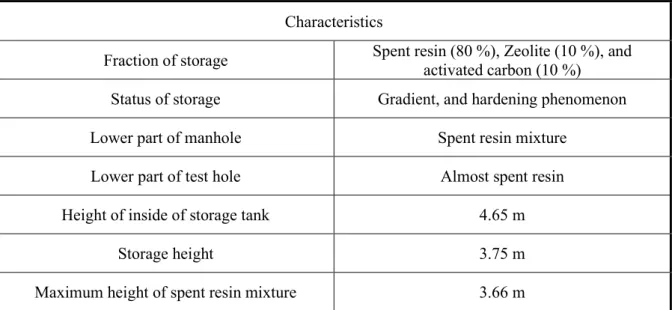
In the spent resin storage tank, the spent resin can be collected using a sampler as shown in Fig. Sampling location of spent resin storage tank by height is divided into wells. The surface dose rate of the spent resin storage tank was derived using Microshield version 10.
In the literature review, the characteristics of the spent resin mixture in the spent resin storage tank and the case of dose assessment for sampling, transportation and temporary storage facilities were presented.
Method of Dose assessment
External Dose Assessment: VISIPLAN Code
The first phase is the stage of information gathering and model building, which is the stage of gathering overall information about the radiation work environment. The second step is the general analysis stage, which makes it possible to calculate the dose distribution in the work environment and obtain information about the source that affects the dose. Additionally, the dose distribution can be expressed in color patterns to infer the dose by location.
The third step is a detailed planning phase, which enables dose assessment of workers according to the work scenario. Based on the worker's working time, location, task description, distribution and geometry of the source term, the worker's dose and accumulated dose can be evaluated. Since the uncertainty of the working time can also be taken into account, upper and lower limits can be calculated for the acquired dose.
In addition, it is possible to derive an optimal scenario by comparing the scenarios, taking into account economic and technical aspects. The fourth step is the follow-up phase, which allows a complete assessment through the dose graph and work information derived from the detailed planning phase [48-49]. The method for evaluating the exposure dose using VISIPLAN is the point-kernel integration method taking into account the accrual factor.
The photon fluence rate for the volume source can be calculated as Equation (3) by integrating by volume based on the point source. In addition, the source, which passes through materials and emits different energies and photon fluxes, can be expressed as equation (5) by considering the energy groups in VISIPLAN.
![Figure 16. Various steps of VISIPLAN in the ALARA analysis [49]](https://thumb-ap.123doks.com/thumbv2/123dokinfo/10487519.0/37.892.112.794.122.505/figure-16-various-steps-visiplan-alara-analysis-49.webp)
Internal Dose Assessment
Research Design
Source term of the Facility
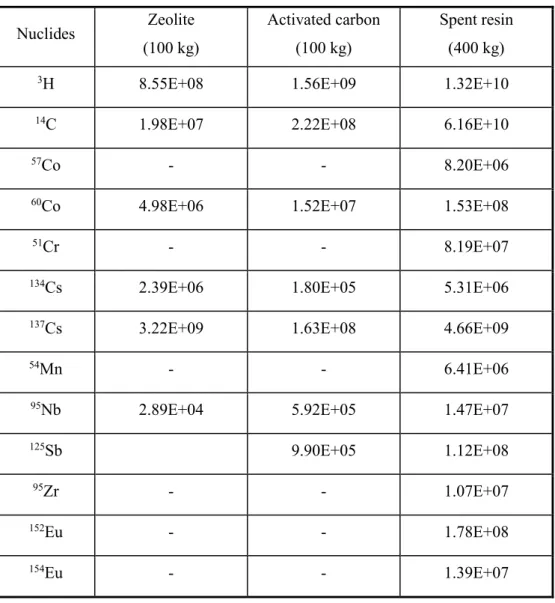
By sampling Wolsong Unit 1 spent resin storage tank #2, the radionuclide inventory was obtained. The maximum amount that can actually remain inside the facility is 600 kg, and the distribution of the source term by part of the facility is shown in fig.
Working Scenario
Operating Scenario for the Facility
Radiological Safety Assessment of Worker
Assessment of Exposure Dose in Normal condition
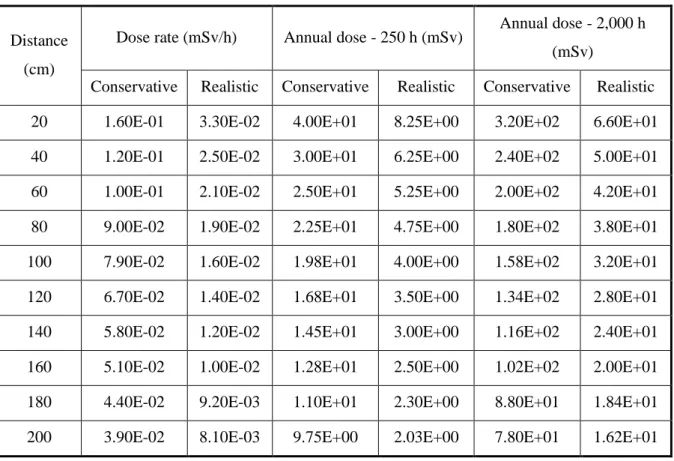
In close work, dose assessment according to the location was carried out at 20 cm intervals in the range of 20 cm ~ 200 cm. The annual dose for 250 hours per year may be less than 20 mSv, which is the average annual dose limit for workers if workers work from a distance of 100 cm or more. The dose for 2,000 hours per year in the area of close work exceeded the worker's dose limit.
Doses for 2000 hours per year were exceeded limit doses up to 160 cm from the facility. Estimated effective doses for 5% of 14C leakage during normal operation were derived as 3.77E-02 mSv for a conservative estimate and 7.85E-03 mSv for a realistic estimate (an APF value of 10 was considered for normal operation). In the case of normal operation, it was confirmed that external exposure had a greater effect than internal.
The dose rates for the remote room worker were derived as 7.20E-03 mSv/h for a conservative estimate and 1.50E-03 mSv/h for a realistic estimate. Therefore, the teleworker's annual dose met the dose limit regardless of working hours. When working remotely during normal operation, internal exposure was not taken into account because the work took place in a separate room.
Assessment of Exposure Dose considering Lead shielding
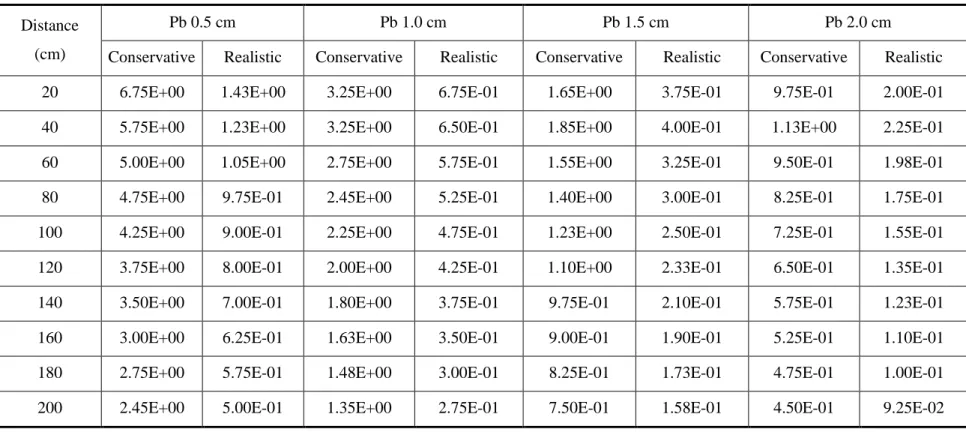
However, in a realistic assessment, the dose limit was met regardless of lead thickness and working distance. In the case of normal operation, even if 14C gas escapes from the facility, internal inhalation exposure was not considered because the lead shield provides secondary protection. Therefore, taking into account the lead protection in the facility, it was confirmed that the dose limit can be conservatively met despite 2000 hours of remote work.
Annual dose of remote workers according to the thickness of the lead shield Distance (cm) Rating. Through the derived values, it is essential to derive the optimal thickness of lead, taking into account the economy and the shielding effect when manufacturing the plant in the future.
Ratio of Nuclides causing Exposure
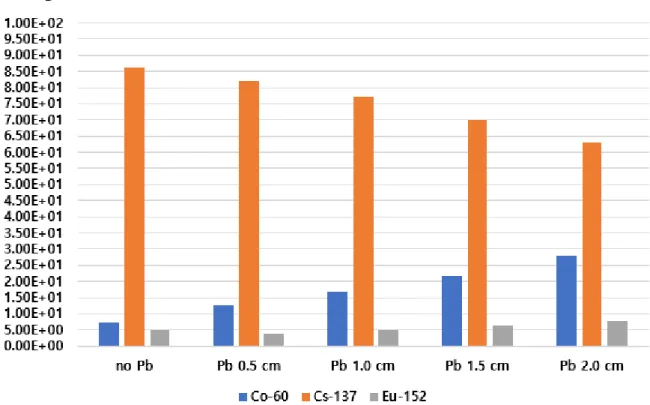
As the thickness of the lead shielding increased, the ratio of 137Cs decreased while the ratio of 60Co increased. In other words, since the energy of the gamma ray is lower, the attenuation coefficient is greater, so the attenuation occurs more when the thickness of the lead shielding increases, and the effect on the worker is relatively reduced. Change of impact conditions (60Co, 137Cs and 152Eu) according to the thickness of the lead shielding.
Assessment of Exposure Dose according to Operating time
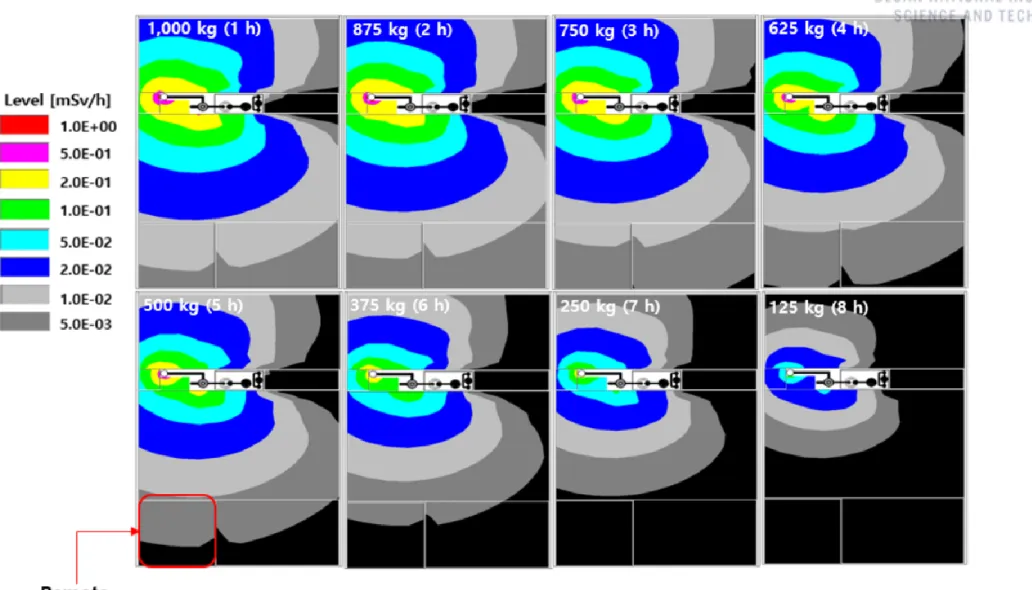
The distance worker dose was derived as 5.33E-02 mSv, which was relatively less than the dose of close workers. The annual teleworker dose was derived as 1.33E+01 mSv, which was less than the average annual dose limit of workers. Exposure dose of workers by operating time in case of remote work Weight in facility Dose rate (mSv/h).
Assessment of Exposure Dose according to Outflow rate
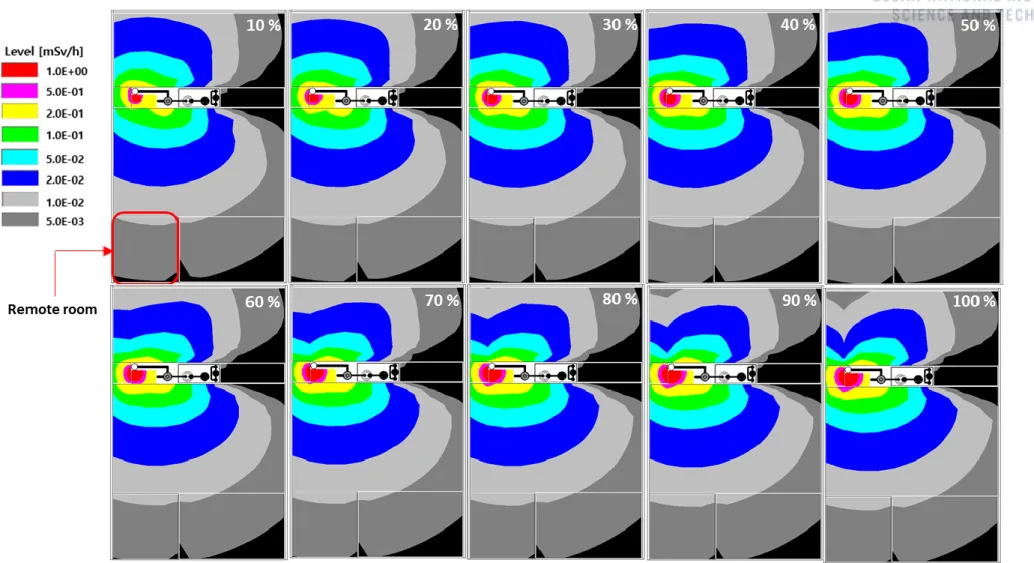
In case of leakage of the finished resin mixture from the installation, a dose assessment of the workers was carried out. The annual doses (1.04E+01 mSv ~ 1.82E+01 mSv) were lower than the dose limit in terms of external exposure, regardless of the outflow rate and leakage portion. Dose rate of workers during the removal of radioactive materials according to the outflow rate due to leakage in the treatment facility (mSv/h).
Annual doses (2000 hours) of the teleworker were less than the dose limit, which was conservatively estimated, regardless of exit rate. Dose rate of workers in the remote room by exit rate due to leaks in the treatment facility (mSv/h). Annual dose (mSv) of workers in the remote room by leakage rate due to inflow.
Comparison of annual dose of workers in remote spaces according to outflow rate and leakage fraction - 2,000 hours (unit: mSv). A committed effective dose was evaluated for the worker removing spent resin mixture leaked from the spent resin processing facility, taking into account conservative and realistic assessment. Assessments were made for the cases where the worker wore and did not wear air-purifying respirators, and for each part the efflux rate that exceeded the worker's annual dose limit was derived.
Although the APF was not taken into account, the annual dose limit was all met, regardless of outflow rate and leakage fraction. Estimated effective dose of workers without an air cleaning respirator based on the discharge rate due to a leak in the treatment plant (mSv). Estimated effective dose of workers wearing an air-purifying respirator based on discharge rate due to a leak in the treatment plant (mSv).
In SRMS, ZAST, SRST, and SRFH, the worker's dose limit was met regardless of exit rate.
Conclusion
The internal dose of the worker who performed the work of removing the leaked spent resin mixture without wearing an air-purifying respirator met the dose limit regardless of outflow velocity and leakage part (highest doses of conservative and realistic assessment were 1.88E+01 mSv and 3.92 E+ 00 mSv). In the case of the worker wearing an air-purifying respirator, the internal dose to the worker was also less than the dose limit. The dose of the worker wearing an air-purifying respirator for 250 hours per year, evaluated conservatively, met the annual dose limit in the case of outflow from SRMS, ZAST, SRST, SRFH and 20% of outflow from MWR.
Under realistic conditions, the dose limit was met regardless of the outflow rate and leakage portion in terms of internal exposure. In the case of a close associate wearing an air purifying respirator under the same conditions, the dose limit was met regardless of the maximum outflow rate in all parts. Process-oriented dose estimation model for 14C resulting from emissions during normal operation of a nuclear power plant.
An estimate of carbon-14 inventory at Wolsong nuclear power plant in the Republic of Korea. Final Comparative Environmental Assessment of Alternatives for the Management of Low-Level Radioactive Waste Spent Ion Exchange Resins from Commercial Nuclear Power Plants. Application of ion exchange processes for the treatment of radioactive waste and management of spent ion exchangers.
PAVAN: An Atmospheric Dispersion Program for Evaluating Accidental Releases of Radioactive Materials from Nuclear Power Plants on a Design Basis (No. NUREG/CR-2858; PNL-4413). Basic document for the HANARO Basic Emergency Planning Area and its associated facilities (No. KAERI/TR.
![Figure 2. Generation ratio of 14 C by system in heavy-water reactors [13]](https://thumb-ap.123doks.com/thumbv2/123dokinfo/10487519.0/16.892.230.766.124.638/figure-generation-ratio-14-c-heavy-water-reactors.webp)
![Table 3. Classification of radioactive waste according to radioactivity concentration of 14 C [22]](https://thumb-ap.123doks.com/thumbv2/123dokinfo/10487519.0/17.892.111.784.184.806/table-classification-radioactive-waste-according-radioactivity-concentration-14.webp)
![Figure 5. Schematic of spent resin mixture storage tank and composition of spent resin mixture [33]](https://thumb-ap.123doks.com/thumbv2/123dokinfo/10487519.0/20.892.154.738.508.891/figure-schematic-spent-resin-mixture-storage-composition-mixture.webp)
![Figure 6. Spent Resin Sampler for in-station storage tank within Wolsong NPP [35]](https://thumb-ap.123doks.com/thumbv2/123dokinfo/10487519.0/22.892.183.716.460.796/figure-spent-resin-sampler-station-storage-tank-wolsong.webp)
![Figure 9. Release rate according to waste and radionuclide (a) dropping, (b) fire [40]](https://thumb-ap.123doks.com/thumbv2/123dokinfo/10487519.0/27.892.134.784.417.805/figure-release-rate-according-waste-radionuclide-dropping-40.webp)
![Figure 10. Characteristics of annual wind based on meteorological data at Kori NPP [40]](https://thumb-ap.123doks.com/thumbv2/123dokinfo/10487519.0/28.892.116.789.238.895/figure-characteristics-annual-wind-based-meteorological-data-kori.webp)
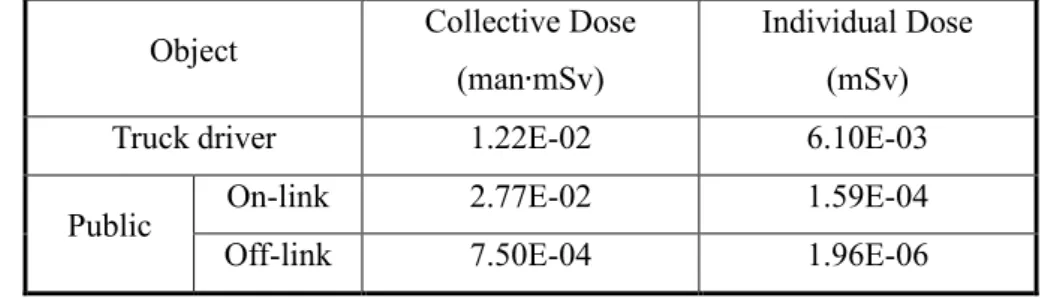
![Figure 12. The effective dose and thyroid dose due to the dropping (a) worker, (b) public [40]](https://thumb-ap.123doks.com/thumbv2/123dokinfo/10487519.0/31.892.116.777.133.728/figure-effective-dose-thyroid-dose-dropping-worker-public.webp)
![Figure 13. The effective dose and thyroid dose due to the fire (a) worker, (b) public [40]](https://thumb-ap.123doks.com/thumbv2/123dokinfo/10487519.0/32.892.120.787.131.713/figure-13-effective-dose-thyroid-dose-worker-public.webp)
