Introduction
Lithium-oxygen battery
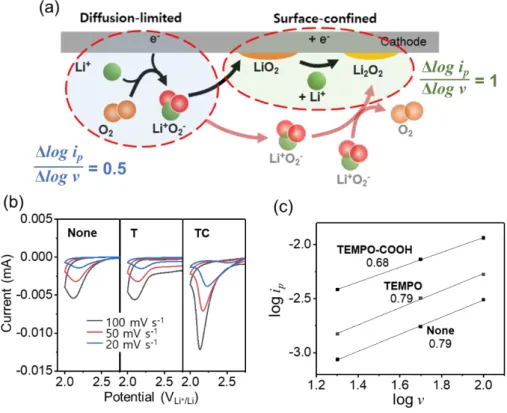
The discharge capacity is determined by which dissolution mechanism or surface mechanism is predominant, since the morphology of the discharge product determines the amount of Li2O2 that can be formed during discharge. During charging, due to the non-conductive nature of Li2O2, the electron transfer from the discharge product to the cathode is not easy and leads to a high overpotential.
Superoxide dismutase (SOD)
Superoxide radicals (O2−) generated by electrochemical reduction of oxygen are deposited on the electrode surface and/or dissolved in the electrolyte. The peroxide (O22−) combines with Li+ captured by MA-C60 to form toroidal Li2O2 on the electrode surface.
Redox mediator
- Charge redox mediator (CRM)
- Discharge redox mediator (DRM)
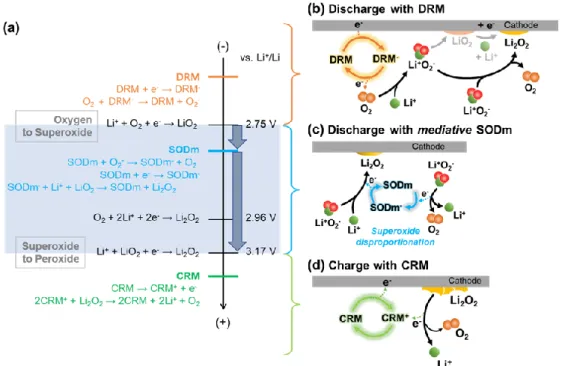
DRM mediates electron transfer between cathode and oxygen by having lower redox potential compared to the discharge reaction (Scheme 3). In many cases, the use of DRM improves the discharge capacity because O2- is formed in the solution instead of the electrode surface, increasing the possibility of disproportionation in the solution, leading to discharge by the solution mechanism.
Biological redox mediation in the electron transport chain of bacteria for oxygen reduction reaction catalysts in lithium-oxygen batteries.
TEMPO derivatives as bifunctional SODm
Research background
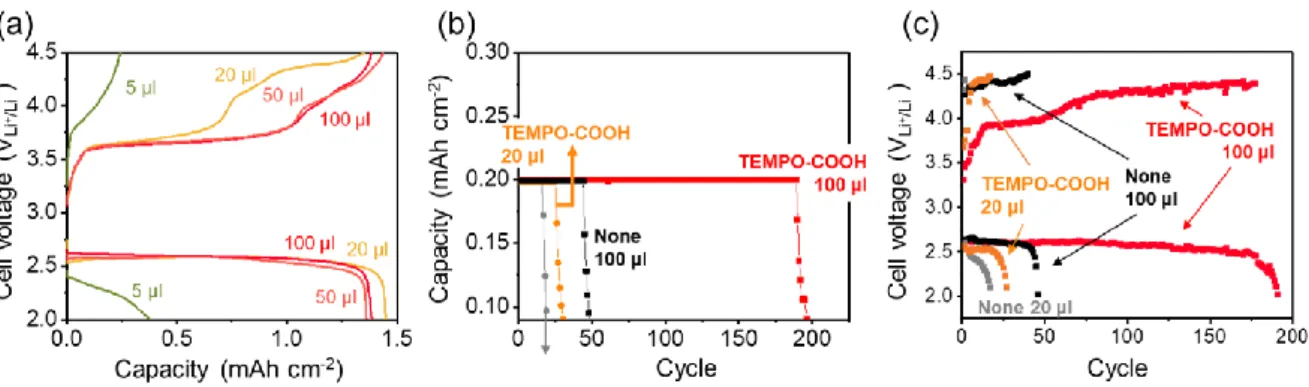
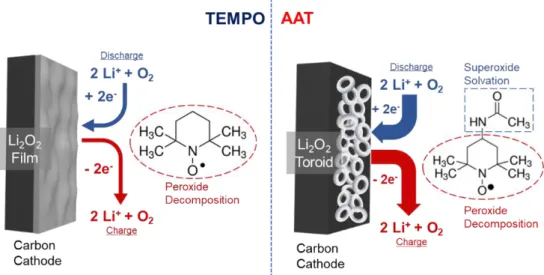
Discharge redox mediators (DRMs) act as a charge carrier between the cathode and O2 dissolved in electrolyte during discharge, making the electrolyte richer in O2- and facilitating the dissolution mechanism.21 DRMs therefore reduce the discharge overpotential and increase the capacitance. Charge redox mediators (CRMs) also act as charge carriers between the cathode and Li2O2 during charging.22-25 The CRMs reduce charge overpotential and mitigate the oxidative degradation of the cathode and electrolyte, thereby extending the life of the LOB.

Results and discussion
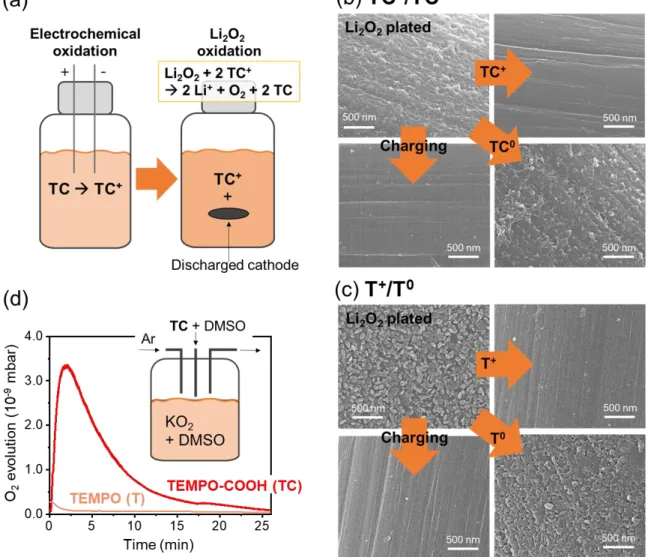
Oxygen was evolved from a solution of potassium superoxide (KO2) in dimethyl sulfoxide (DMSO) in the presence of TEMPO-COOH (TC0 in Figure 1.3d). The non-toroidal morphology of Li2O2 developed in the presence of TEMPO-COOH was interesting (Figure 1.6b and c).
Conclusion
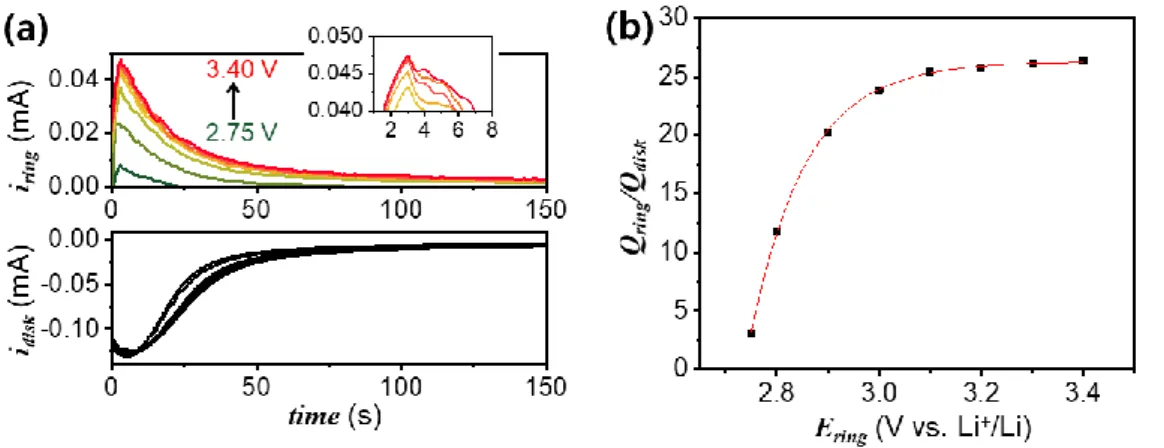
Spin-polarized DFT calculations were performed with the DMol3 program [1, 2] The Perdew-Burke-Ernzerhof (PBE) functional [3] with Grimme dispersion correction [4] was used to calculate adsorption energies and reaction pathways. Note that we followed the basic steps for the solution mechanism reaction pathway proposed by Zhang et al. [5]. The hybrid Becke-Lee-Yang Parr (B3LYP) functional was used to calculate the molecular energy levels, as the GGA-type calculation is commonly known to result in an inaccurate band gap [6, 7] An implicit solvation environment was used using a conductor-like. scheme of the screening model (COSMO) with TEGDME dielectric constant (i.e. ε The convergence criterion of the self-consistent field was set to 1.0 × 10-. Carbon paper with a gas diffusion layer of H2315 was used as the air cathode of the LOB cell. a ) SEM image of the discharged air cathodes. The reduced oxygen species produced from the disc electrode (e.g., superoxide) were oxidized at the ring electrode. b) Superoxide disproportionation rates calculated by (Qd – Qr) / Qd / Δt, where Δt = time interval between the onset and the saturation time of the disk current (id); Q = charges accumulated during Δt; indices d and r = disk and ring, respectively.
For 'LiO2(sol)' and '{LiO2}2(sol)', the minimum distances between TEMPO and its adsorbate are labeled in Å. The same additive-containing solutions in Figure S2 were used. a) UV-Vis spectra of 150 μM 9,10-dimethylanthracene (DMA) in the electrolyte media used in this work in the presence of 5 μM eosin Y. The decrease in signal indicates that DMA was converted to DMA-O2 upon reaction by 102. The standard reduction potential (Eo) for superoxide formation (O2/LiO2 in Eq. 1) was reported to depend on the donor number (DN) of solvents in a range of 2.6 to 2.9 VLi (2.75 VLi for dimethylsulfoxide or DMSO in figure 3.2 VLi = V versus Li+/Li),5 which was more negative than 2.96 VLi of peroxide formation (O2/Li2O2 in equation 2).6 The reduction potential for superoxide-to-peroxide conversion (LiO2/Li2O2 in equation 3) was estimated in the range of 3.0 to 3.3 VLi, which was calculated from the peroxide and superoxide formation reactions (Materials and Methods in Supporting Information).
Therefore, we used (2,2,6,6-Tetramethylpiperidin-1-yl)oxyl (TEMPO) as a CRM16 in the presence of the quinone additives in LOB cells.

Supplementary note
Research background
In the presence of low DN solvents, lithium superoxide is readily adsorbed on the electrode surface. Therefore, the conversion of LiO2 to Li2O2 takes place on the surface of the electrode (LiO2 + Li+ + e- → Li2O2, surface mechanism), and a uniform and thin film is formed on the surface of the cathode. The solution mechanism has an advantage over the surface mechanism for achieving a higher discharge capacity because it allowed a larger amount of Li2O2 to be loaded onto the limited electrode surface.
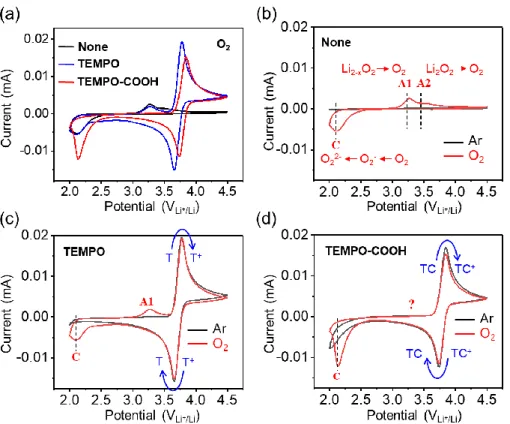
Charged redox mediators (RMs) have been used to solve the problem of limited decomposition of Tetramethylpiperidin-1-yl)oxyl peroxide or TEMPO, as charge representative RMs, is oxidized to TEMPO+ on the electrode surface at 3.74 V vs. the result, the charge overpotential of the LOB was significantly reduced while the discharge products on the electrode surface were clearly erased.
Experimental method
To measure the concentration change of TEMPO and AAT after stirring with K02, a UV-Vis spectrophotometer (S-3100, Scinco) was used. The mixture was filtered using a syringe filter to obtain the transparent solution and the filtered solution was measured in a quartz cuvette. For the molecular energy level calculations, spin-polarized calculations with Becke-Lee-Yang-Parr (B3LYP) hybrid exchange correlation functional were performed18-19.
The redox potential (Ered) of Li/Li+ was calculated to be 1.67 V vs. absolute vacuum scale (AVS). Given that the HOMO energy level is generally identical to the first ionization energy, the HOMO energy levels of the studied molecules (e.g., TEMPO, acetamido-TEMPO, and TEGDME) were converted to the oxidation potentials vs Li/Li + .
Results and discussion
The thermodynamic barrier of RDS was smaller in the presence of AAT although it was unexpected that TEMPO also lowered the barrier. Divalency (Q2-) is required to reduce molecular oxygen to superoxide in the presence of ortho, while monovalency (Q-) is sufficient for the first DRM function. The benefit of ortho SODm functionality to convert reactive oxygen species (superoxide) to less harmful oxygen species (oxygen and peroxide) was clearly confirmed in the presence of CRM.
The functionality of SODm ortho was confirmed by X-ray photoelectron spectra (XPS in Figure 3.4a). On the other hand, in the presence of Li2O2 ortho deposition, a layer with agglomerated fine particles of several nanometers in size was formed (DB-o-BQ in Fig. 3.4b and Fig. S3.7).

Conclusion
The first electron transfer (Q/Q-) pair form responsible for the DRM function of DB-p-BQ played the role of the redox-active function of SODm when it was isomeric. To evaluate the criterion between DRM and SODm functions or the upper limit of SODm function (Figure 3.1a), the reduction potential of superoxide formation (O2/LiO2 in equation 1) was measured. On the other hand, the charge-to-discharge efficiency of ortho was higher than that of para (Figure S3.3).
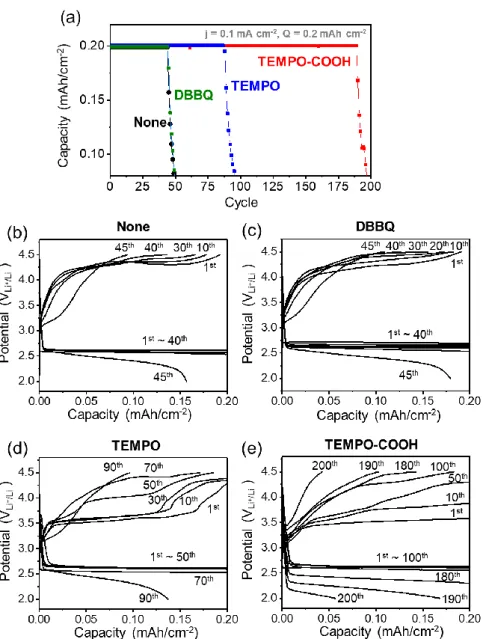
On the other hand, as expected based on the SODm functionality of ortho, ortho outperformed para in terms of durability, even if the improvement with quinone additions was not very significant (Figures 3.3b and S3.4). The ORR-promoting functionality of the ortho form increased the LOB discharge capacity and reduced the ORR overvoltage.
Supplementary note
Quinone derivatives as bifunctional SODm
Research background
On the other hand, there were redox-active molecules whose reduction potential is more positive than the superoxide conversion potential to peroxide (LiO2/Li2O2). Based on a simple consideration of the reduction potential cascade (SODm in Figure 3.1a; Figure 3.1c), electron transfer was feasibly mediated between two reactions (O2/LiO2 and LiO2/Li2O2) with a redox-active species having an intermediate reduction potential. The redox-active species would (1) take electrons from lithium superoxide, driving the reverse superoxide formation reaction (Eq. 4) and then (2) donate electrons to lithium superoxide, driving the forward peroxide formation reaction (Eq. 5). ) (Figure 3.1c).
Based on the above discussion, we confirmed that the redox-active species whose reduction potential was between O2/LiO2 and LiO2/Li2O2 could be proposed as the redox-active version of the chemo-catalytic SODm. The target reaction of a redox-active quinone derivative (di-tert-butyl-benzoquinone or DB-p-BQ) changed from ORR to SODR by tuning the isomeric configuration from para (DB-p-BQ) to ortho (DB-o ). -BQ).
Results and discussion
The electrochemical fingerprints of two different isomers of the benzoquinone derivative (DB-p-BQ and DB-o-BQ) were identified voltammetrically (Figures 3.2b to d). For these reasons, Q2-ortho was produced less than Q-para, so ortho was not superior to para in terms of DRM function. The superiority of ortho over vapor would only be recognized when the discharge process determined the endurance of the cell without problems relevant to the charge process.
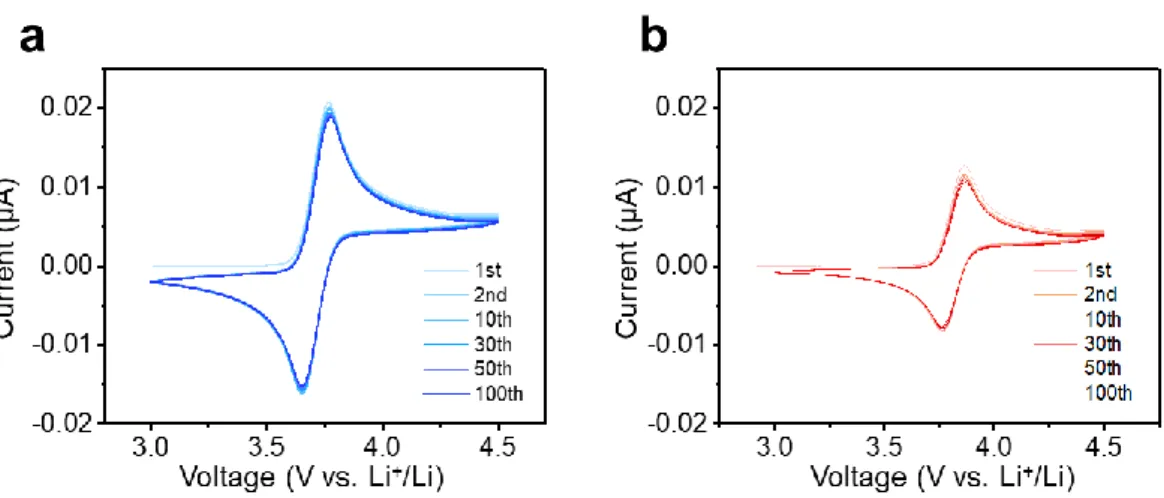
Cyclic voltammograms (Figure 3.3c) showed insignificant changes in the Q/Q-/Q2- electrochemistry of the para and the ortho in the presence of TEMPO while TEMPO showed its reversible redox activity at Eo = ~3.8 VLi in the CRM region (> 3.17 VLi in Figure 3.1). The TEMPO improved the durable rechargeability of the LOB cells with the quinone additives, more importantly, enhancing the difference between the ortho and the para.

Conclusion
Cyclic voltammograms (CVs) were obtained from two-electrode airtight beaker cells that had a gold disk electrode as the working electrode with Li metal as the reference and platinum foil as the counter. 1 M LiTFSI was used as the electrolyte in a TEGDME with a P50 carbon electrode as an air cathode. 1 M LiTFSI was used as electrolyte in TEGDME with H23 carbon electrode as air cathode.
1 M LiTFSI in TEGDME with or without 30 mM DB-o-BQ or DB-p-BQ was used as the electrolyte with the P50 carbon electrode as the air cathode. 1 M LiTFSI in TEGDME with 30 mM DB-o-BQ was used as the electrolyte with the H23 carbon electrode as the air cathode.
Supplementary note
Conclusion


![Figure 1.7 DFT calculations. (a) Oxidation potentials of [TEMPO-COOH], [TEMPO-COOH] + and TEGDME (vs](https://thumb-ap.123doks.com/thumbv2/123dokinfo/10496426.0/45.892.122.765.132.483/figure-calculations-oxidation-potentials-tempo-cooh-tempo-tegdme.webp)