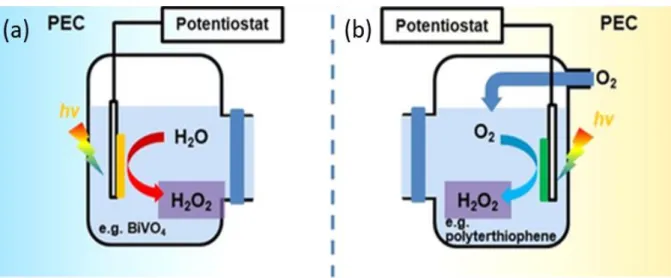
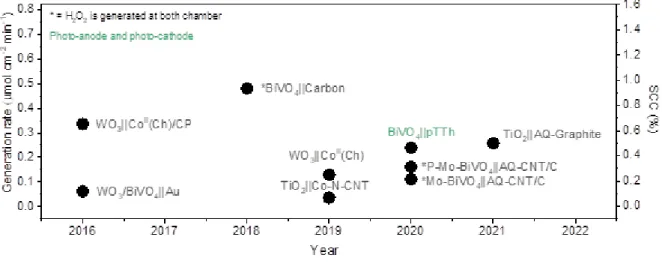
Currently, approximately 80% of the world's energy consumption is met from non-renewable resources such as fossil fuels. Countries around the world are anticipating a low-carbon future by substituting renewable energy such as solar, biomass, wind, geothermal and other renewable energy sources. For this reason, other environmentally friendly methods of H2O2 production such as electrochemical processes and photocatalyst methods have been developed.
PV-based materials such as perovskite and dye-sensitized solar cell (DSSC) have been used to overcome the limitations of the low current and efficiency of the typical metal oxide materials. In chapter 2, an inorganic perovskite photoanode was fabricated to improve charge transfer, and high selectivity towards H2O2 from oxygen reduction reaction (ORR) was generated using a reduced graphene oxide (rGO) electrocatalyst. In cathode part, carbon-based electrocatalysts such as rGO, which are cheap and have high performance, have been applied instead of a commonly used noble metal catalyst to control the cost aspect.
To overcome this problem, a simple passivation structure using nickel foil was used to improve performance and stability under alkaline conditions. As a result, he was able to generate high efficiency H2O2 using DSPEC with high performance and stability in the aqueous state.
List of Tables
List of Abbreviations
Introduction
- Hydrogen peroxide .1 Introduction
- Photovoltaic devices .1 Working Princip
- Outline
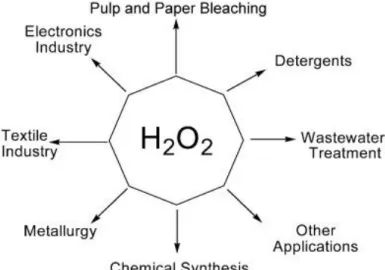
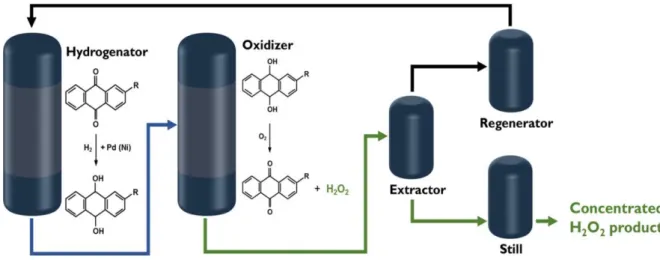
The production of hydrogen through water splitting is an eco-friendly beneficial approach that can largely replace the current method, which relies on the burning of fossil fuels. The best known for the production of hydrogen peroxide on a large scale is the anthraquinone oxidation (AO) process in the current industry. The most used anthraquinone oxidation (AO) method has numerous problems, therefore it is essential to develop a new alternative for hydrogen peroxide production7.
In addition, in many cases, catalysts with low selectivity for hydrogen peroxide can cause one-electron reduction of oxygen, blocking the two-electron reduction pathway. The photoelectrochemical (PEC) water splitting can be applied to water splitting by converting solar energy into electrical energy using semiconductors12. The PEC water splitting is the conversion of photons incident on a semiconductor surface with energy higher than the band gap of a semiconductor into electrochemical energy that can directly split water into H2 and O2 molecules13.
The entire water splitting requires a standard free energy change of 237.2 KJ/mol or potential of 1.23 eV per to drive a water splitting reaction.15 However, the water oxidation and reduction processes involve several steps and act as activation barriers in the charge transfer process between the photocatalyst and water. Therefore, the band gap of 1.23 eV is not sufficient to drive the overall water splitting with the practical value of 1.6–2.4 eV. Since discovered by Fujishima and Honda, PEC water splitting has received much attention because of a cheap and clean method of producing hydrogen.
Due to the abundance on Earth and the large band gap, high photovoltages are required for the splitting of water. With these characteristics, metal oxides are widely used as an efficient water-splitting material. Hydrogen peroxide from photoelectrochemical (PEC) production has attracted interest due to its potential in terms of cost and safety.
Alternatively, solar energy can also be stored as chemical energy with hydrogen via a solar-powered water splitting process. Recently, solar cells such as silicon, perovskite and organic have attracted for conversion into PEC cells for direct solar water splitting by increasing STH efficiency. With this method, the limitation of low performance was overcome by using PV-based material that has suitable band gap for water splitting and high efficiency compared to metal oxides.
Unassisted solar hydrogen peroxide production by stable inorganic perovskite photoanode
- Introduction .1 Perovskite
- Measurements
- Results & Discussions
- Characterization and performance of perovskite photoanode
- Conclusion
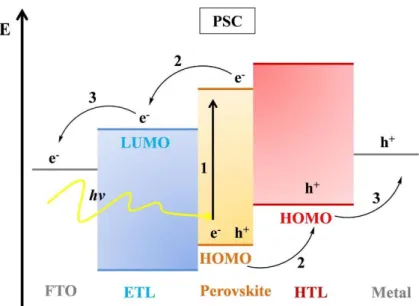
When exposed to sunlight, the perovskite layer absorbs photons to generate a pair of electrons and holes (excitons). These excitons can form free carriers (free electrons and holes) by difference in the exciton binding energy of the perovskite materials. In addition to water splitting, the perovskite photoelectrode can be used in various application fields such as ammonia, hydrogen peroxide and carbon dioxide energy conversion reactions.
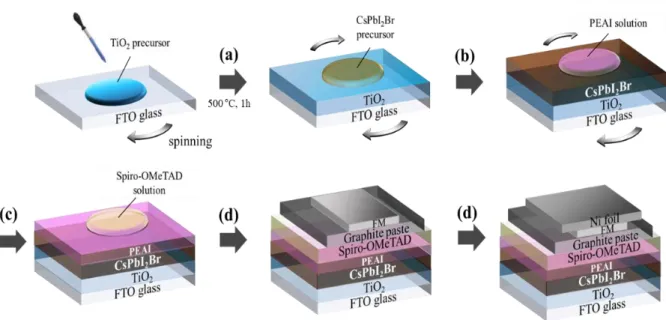
The perovskite layer was spin-coated with 20 mM PEAI dissolved in IPA for 40 s at 5000 rpm. To protect the perovskite from air conditions, an FM plate was melted onto the substrate and simultaneously covered with nickel foil and epoxy resin to obtain an active surface area of 0.125 cm2. A 300 W xenon lamp with a solar filter was used to illuminate the perovskite photoanode at an intensity of 100 mW cm-2 (AM1.5G).
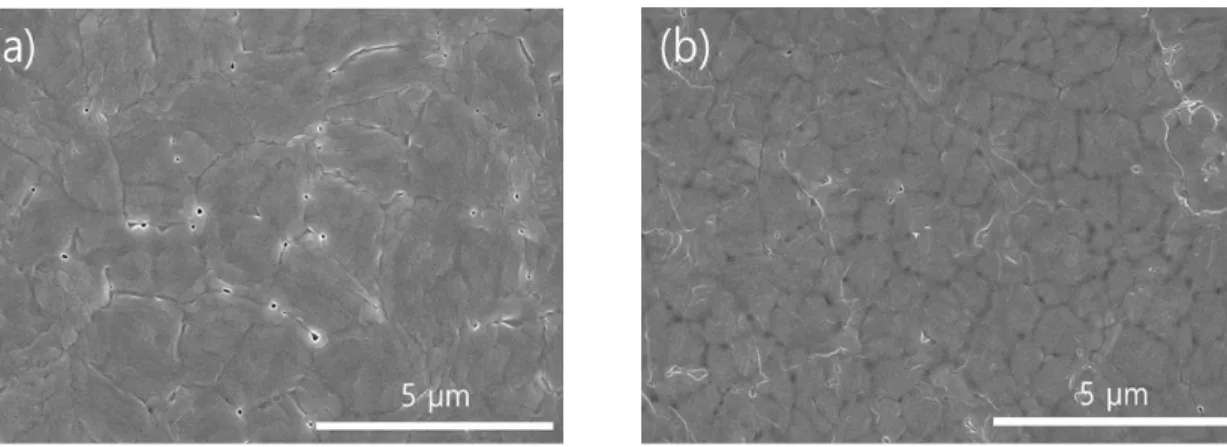
This unwanted phenomenon can make way for moisture and oxygen to attack the perovskite material. Also, residual excess PbI2 on the perovskite layer or at the grain boundary can induce charge recombination forming I-type band alignment23. To prevent this, various studies related to additive layer such as polymeric organic halide applied on the perovskite surface were performed.
The PEAI salt solution on the perovskite layer can fill the vacant iodine sites and the grain boundary on the surface. As shown in fig. 2.4 (b) by introducing PEAI layer, the pinhole was almost covered and the surface defects were passivated. The photoelectrochemical (PEC) performance of CsPbI2Br perovskite photoanode was performed in three-electrode system under stimulated 1 solar irradiation with 0.125 cm2 active area.
In Figure 2.11, GO shows the low current density due to the excessive oxygen functional groups. The as-prepared CsPbI2Br perovskite photoanode and rGO/CP cathode were combined in a two-electrode system to produce membrane H2O2 (Fig. 2.12). The cross current and potential between the perovskite photoanode and the rGO/CP cathode are 2.73 mA cm-2 and 0.64 V vs.
In Fig 2.13 (b), the concentration of H2O2 increased linearly with time and reached 390 μmol cm-2 after 6 hours of continuous illumination. In the Nafion membrane two-compartment system, rGO received the electron from the high-performance CsPbI2Br perovskite photoanode under 1.5G illumination.
Development of Dye-sensitized photoelectrochemical cell for solar hydrogen peroxide production for solar hydrogen peroxide production
- Introduction
- Experimental method .1 Methods
- Conclusion
Ni, Fe, which are earth-rich materials, are used in alkaline electrolyte, especially in the form of NiFe-LDH. NiFe-LDH shows good OER activity under alkaline conditions, which can be explained by the optical electron configuration and the reaction energy in the rate-determining step due to the synergistic interaction between Ni2+ and Fe+3.38 Water and cations are intercalated between the layers of NiFe-LDH, which are formed as a phase of γ -NiOOH type39. After completion of the reaction held at 120 ℃ for 12 hours, the remains of any unreacted particles agglomerated on the nickel foil were washed gently with ethanol and dried at 60 °C.
For nickel foil (0.025mm thick), pt is deposited at 1min 30s and 4cycles by sputtering method instead of the conventional FTO to generate oxygen directly. All potentials were measured using the Hg/HgO reference electrode, and converted to reversible hydrogen electrode (RHE) by comparison of E (V vs. RHE) = E(V vs. A larger nanoparticle layer acts as the back optical scattering and reflection for improving the use of the incident light, while a smaller nanoparticle layer provides a large surface area for dye absorption, as shown in Fig.
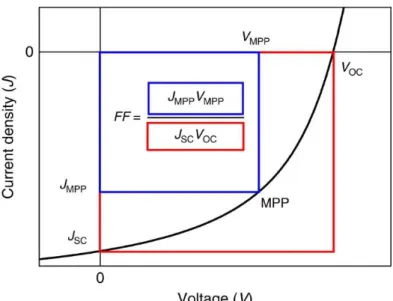
DSPEC with Iodine electrolyte achieved 0.72V, Co-DSPEC has a value of 0.89V and Cu-DSPEC has a value of 1.05V giving the highest Voc while maintaining the current density around 14 mA cm-2. The onset potential of the photoelectrode was also similar to the trend of Voc in the solar cell under 1 solar illumination (100mW cm 2 ). As shown in Fig 3.7 (a), the photocurrent density of I-DSPEC for water oxidation was 14 mA cm-2 with the onset potential of 0.7 V vs.
The photocurrent density of Co-DSPEC was 14.8 mA cm-2 with an initial potential of 0.6 V vs. Cu-DSPEC is similar to the above current density, but shows an initial potential of 0.4 V vs. This data showed that the NiFe-LDH catalyst is good for OER performance by boosting charge transfer.
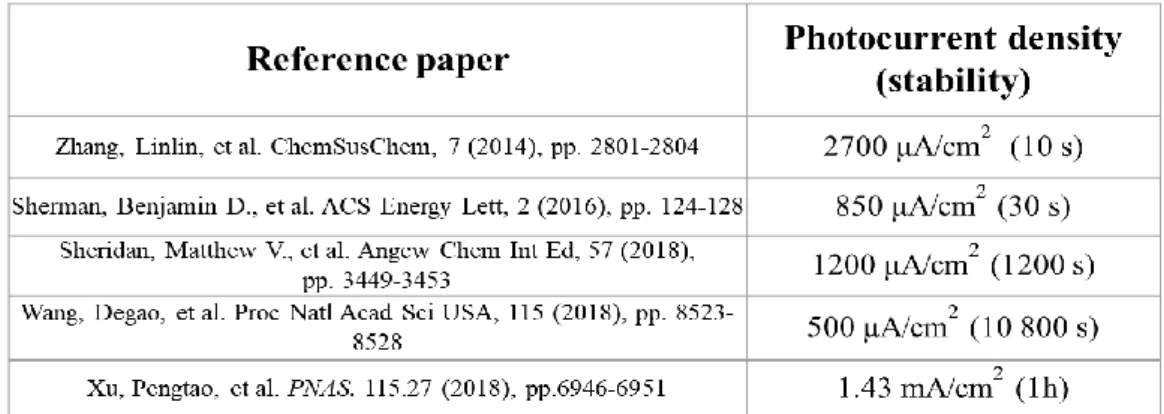
In particular, Co-DSPEC showed stability for 30 hours, but Cu-DSPEC still showed low stability due to the size and kinetic problems of the copper metal complex under continuous illumination (AM1.5G) shown in Figure 3.11 (b). DSPEC with Co(bpy)3 electrolyte (Co-DSPEC) and O-BP was integrated into a two-component Nafion membrane H2O2 production system (Figure 3.14). In Figure 3.15 (b), the concentration of H2O2 increased linearly with time and reached 590 μmol cm-2 after 10 hours of continuous illumination.
More impressively, the maximum output voltage was changed by different redox potentials of the electrolyte, which affects the kinetics of the charge transfer reaction at the interface between the dye and the electrolyte. At the crossing point of the two electrodes, the amount of 590μmol H2O2 was formed for 10h, with an average faradaic efficiency (FE) of 85%.
Summary
It is possible to work bifunctionally with solar cells and photoelectrodes using nickel foil passivation, and it has high stability by protecting dyes from harsh water conditions. Three different electrolytes such as I, Co(bpy)3, Cu(tmpy)2 with different band positions were used to investigate performance changes depending on the electrolyte. The DSPEC using Cu-based metal complex electrolyte had the best starting potential and performance, but its stability is low due to the large metal complex size and slow kinetics.
On the other hand, DSPEC showed the best stability using the cobalt metal complex electrolyte. An electrocatalyst with a nickel-iron layered double hydroxide structure (NiFe-LDH) is used to maximize charge transfer and overcome the low stability of nickel foil. The catalyst was grown on nickel foil by a hydrothermal method to fabricate the device, and the initial potential was shifted approximately -0.2 V versus approximately -0.2 V.
The developed DSPEC was applied to the two-compartment system with O-BP for H2O2 production in 1M NaOH (pH 13.7).
M.; Devices, A new sustainable green protocol for the production of reduced graphene oxide and its gas sensing properties. C.; Engineering, construction of a compatible electrode system for efficient electrochemical oxygen evolution reaction: Direct growth of nickel/iron/selenide nanohybrids on nickel foil.
Acknowledgement