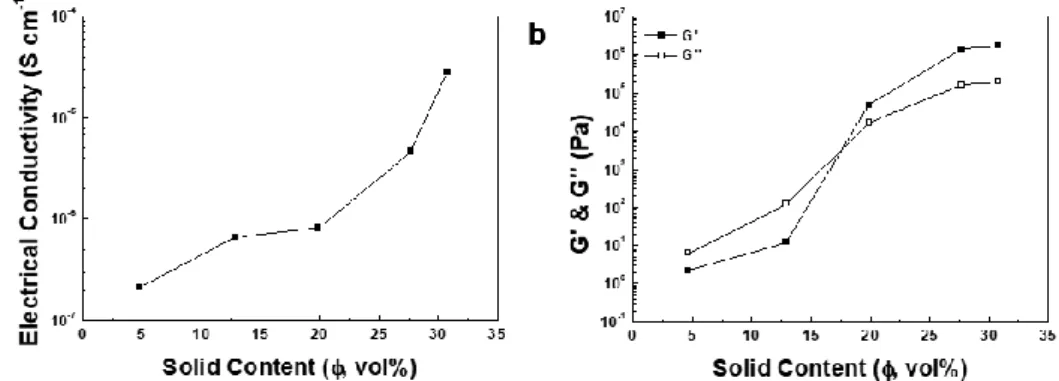
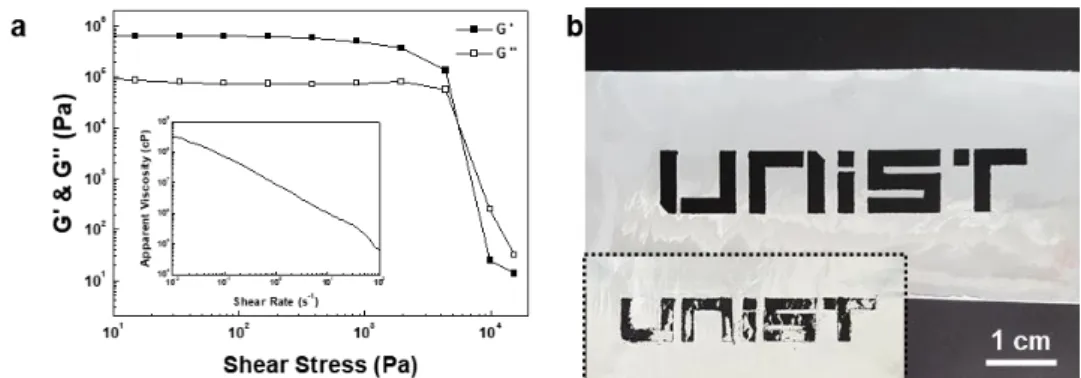
Inset is the apparent viscosity of the electrode pastes as a function of shear rate. Yield stress and capillary force of the electrode colors as a function of the solids content. C) 3ITT profiles (change of G' and G" as a function of elapsed time) of the electrode ink.
Schematic depiction of the fabrication of the click-crosslinked, DIW-printed solid electrolyte ([BMIM][PF6]/thiol-a polymer scaffold/hydrophobic SiO2 nanoparticles). Rheological properties of the electrolyte paint (SiO2 content = 40 vol.%). B) Apparent viscosity as a function of shear rate. Cycling performance (at an areal current density of 1.0 mA cm-2) of the DIW-printed ASCs with different form factors (circle, triangle, and square).
Introduction
Motivation
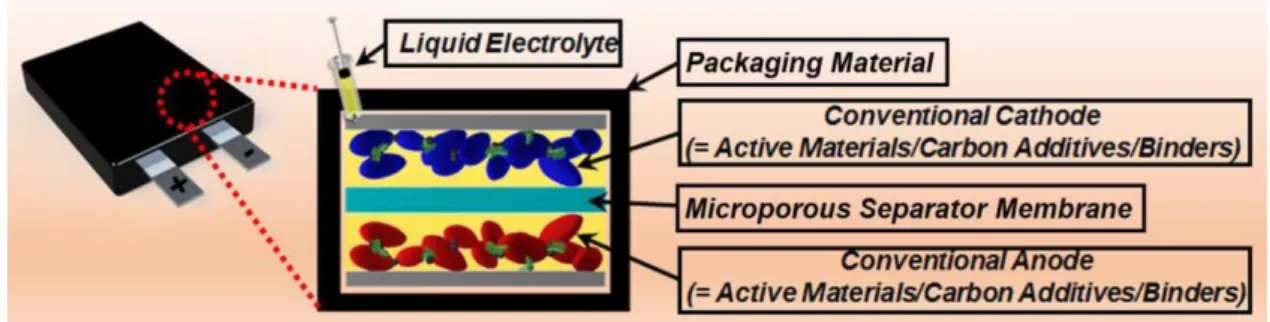
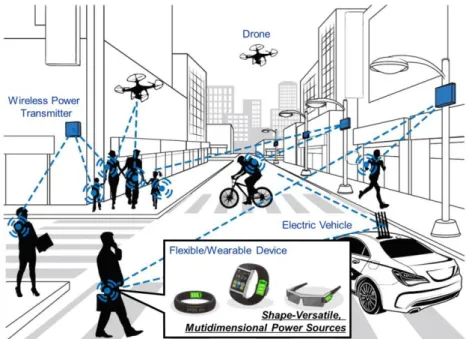
Schematic illustration of a conventional power source consisting of electrodes, a separation membrane, and a liquid electrolyte in a packaging material of predetermined shape and size. "Printed Power Supplies" have recently emerged as a new power supply system to address the above-mentioned aesthetic versatility issues. Their important features include diverse form factors, form conformance, and monolithic integration with target devices, which are difficult to achieve with conventional power source technologies.[4, 5] Recently, much research on printed power sources has been devoted to exploring suitable active electrode materials. . with a special focus on materials science and nanotechnology to improve cell performance.
In addition to electrodes, electrolytes play a major role in the electrochemical reaction of energy sources. However, the development of electrolytes lags far behind the corresponding work with electrodes in most printed energy sources. As mentioned above, liquid electrolytes impose challenges to fabricate power sources with form factor/design flexibility and reliability.
To realize printed current sources with different form factors, most cell components, including electrode, electrolyte, current collector and packaging, should be prepared through printing processes.
Objectives and Strategies
Background of Printed Supercapacitors
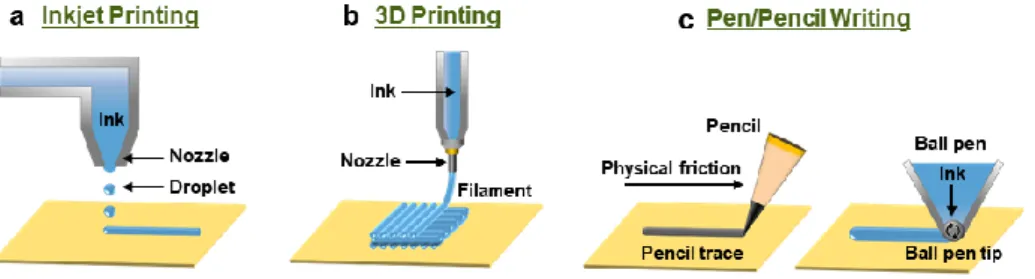
Printing Techniques
- Mask-Based Printing
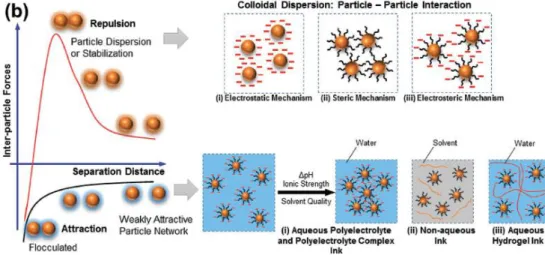
- Colloidal Interaction
Many DIW printers use small nozzles that are susceptible to clogging, often resulting in narrow print windows compared to mask-based printing. In the case of a pencil, the graphite components are rubbed off by physical friction between the tip of the pencil and the substrate (Figure 4c). Therefore, an in-depth understanding of the colloidal chemistry in the ink suspension is crucial.
Attractive forces are applied to induce weak bridging flocculation of the well-dispersed colloids to obtain suspensions with suitable rheological properties (bottom image). Specifically, in inkjet printing, the particle size must be less than 1/50 of the inside diameter of the nozzles to avoid clogging phenomena.[6] Surface tension is also very crucial for obtaining printable inks. To ensure reliable inkjet printing, it is preferable to have an apparent viscosity and surface tension varying in the range of 1–25 mPa s and 25–50 mN m−1, respectively.
In the case of low-viscosity inks, the coffee ring effect is an undesirable phenomenon that inhibits uniform high-resolution patterns.[7] Among the many approaches to limit the coffee ring effect [8] is to increase the inward Marangoni current that is generated. Supercapacitors (SCs) have received considerable attention due to their excellent performance, such as high power density, fast charge/discharge, and long lifetime compared to traditional capacitors and batteries.[10] Typically, typical supercapacitors are sandwich structures consisting of two electrodes, an electrolyte, and a separation membrane that electrically isolates the two electrodes.[11] One of the important components of SC is the active materials of the electrode.
Shape-Versatile, Multidimensional Solid-State Supercapacitors
Wearable Supercapacitors Printed on Garments
- Introduction
- Experimental Section
- Preparation of the Printed Gel Electrolytes and Electrodes
- Click Chemistry-Based Synthesis and Characterization of Printed Gel
- References
The UV curing reaction of the printed gel electrolyte was examined with an FT-IR spectrometer (Alpha, Bruker) with a spectral resolution of 4 cm−1. The rheological properties of the printable electrolyte and electrode pastes were measured with a rheometer (Haake MARS III, Thermo Electron GmbH). In addition, the mechanical deformability of the printed gel electrolytes and electrodes was further characterized after being wound around cylindrical glass rods (diameter = 5 mm).
The thermal stability of the printed gel electrolytes was investigated using TGA measurements (SDT Q600, TA Instruments) at a heating rate of 10 °C min−1 under a nitrogen atmosphere. Details on the fabrication, components, structure and characteristics of the printed SC are described below. The structural/physicochemical properties of the printed gel electrolytes were investigated with a focus on the thiolene polymer network skeleton and the SiO2 colloidal network structure.
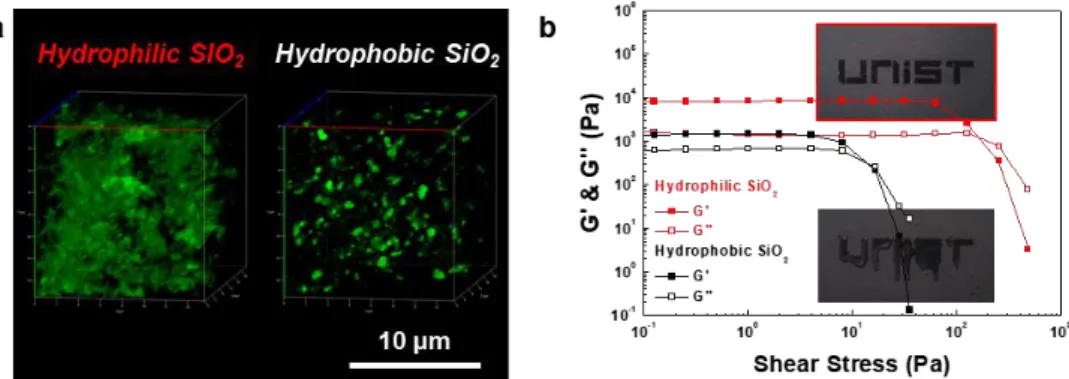
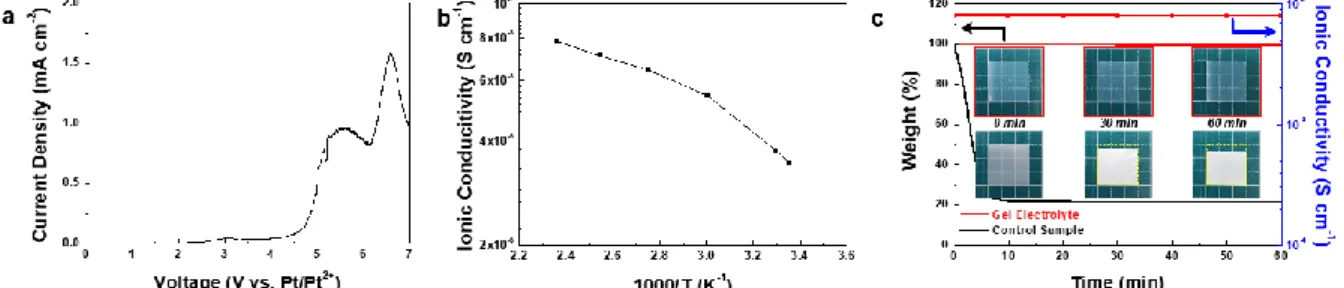
This difference in the microstructures affected the rheological properties of the printable electrolyte paste (Figure 11b). This excellent flexibility of the printed gel electrolyte film was quantitatively verified as a function of the bending radius (Rb and 1.0 mm). The electrochemical stability of the printed gel electrolyte was investigated using the linear scanning voltammetry (LSV) technique.
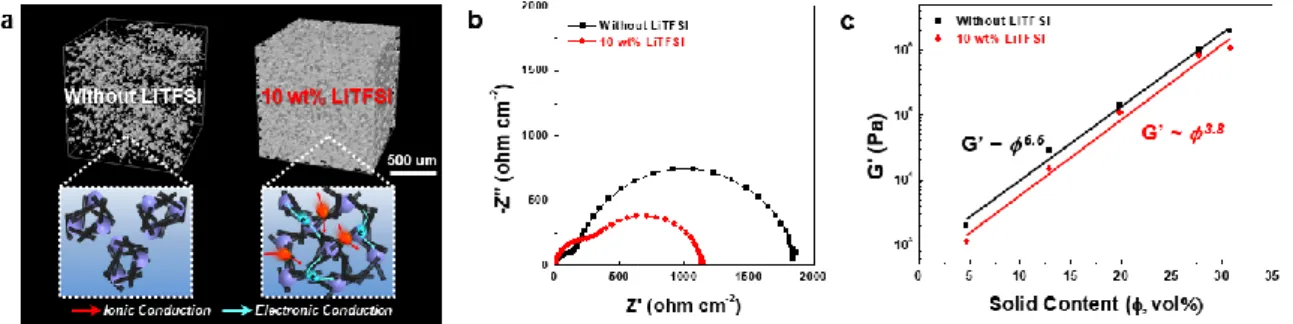
In contrast, the control sample (i.e., a common carbonate electrolyte (1 m tetraethylammonium tetrafluoroborate (TEABF4) in a polypropylene separator impregnated with propylene carbonate (PC) [47]) shrank and lost 78.5 wt%. b) Ionic conductivity of the printed gel electrolyte depending on the temperature (up to 150 °C). A conceptual representation of the structure of the colloid network is shown in the insets of Fig. 15a. The optimization of the LiTFSI content in the printing electrodes will be carried out in our future studies.
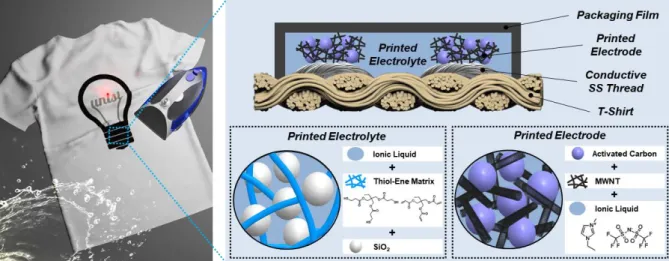
Based on the understanding of printed gel electrolytes and electrodes with colloidal network microstructure, we fabricated SC coated on cotton T-shirts using a template printing technique. The water permeability of the packaging films was analyzed as a function of their thickness (ranging from 300 to 1000 μm) according to ASTM E96-95,[58] and the weight gain of the desiccant absorbents in a flask was measured over time. at 25 ° C and 60% relative humidity (Figure 19a, Figure 19b). These results demonstrate the electrochemical validity of the printed SC as a new wearable energy source.
This result demonstrates on-demand voltage and current control in printed SCs. Photos of the SC Print T-Shirt after exposure to the various test wear modes (walking, running, washing, spinning, ironing and folding) found in everyday wear.
All-Direct-Ink-Writing of Artistic Supercapacitors: Toward On-Demand Embodied Power
- Introduction
- Experimental Section
- Preparation of Electrode and Electrolyte inks for the DIW Printing
- DIW-Printed Electrodes with Embedded Ni Current Collectors
- References
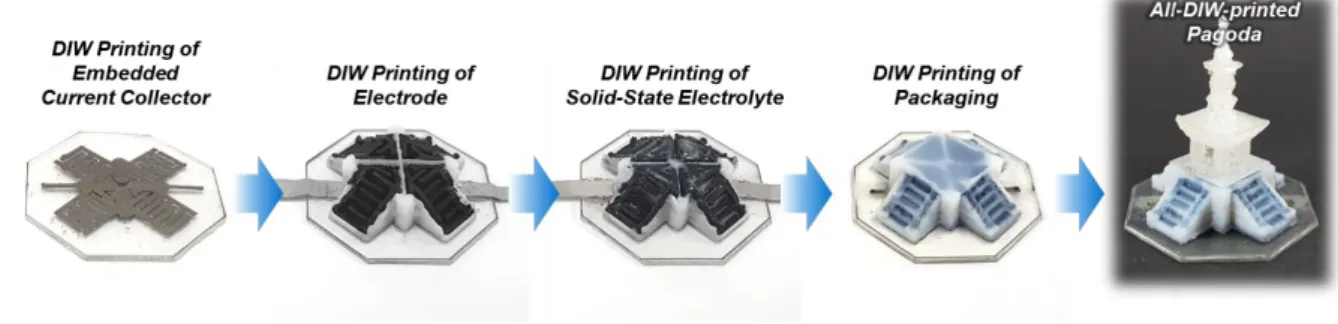
The electrode ink was printed on top of the printed Ni current collectors using the DIW printing. The rheological properties of the electrode and electrolyte ink were measured using a rheometer (Haake MARS III, Thermo Electron GmbH). Schematic illustration depicting the fabrication procedure of the DIW-printed Ni current collector embedded in a PU support layer and the resulting DIW-printed electrodes.
Photo No letter-shaped DIW ("3D PRINTING") current collectors embedded in the PU carrier layer. Rheological properties of electrode ink (solids content = 17 vol%). a) Apparent viscosity as a function of shear rate. Electrochemical properties of DIW-printed semiconductor electrolyte. a) Ionic conductivity as a function of temperature.
The shape diversity of DIW-printed ASCs was explored by fabricating circular, triangular, and square-shaped ASCs with identical footprint dimensions ( Figure 41a ). Another benefit of DIW-printed conformal packaging is the efficient use of space of the resulting ASCs. First, the DIW-printed ASC (its cell configuration is shown in Figure 48b) was fabricated as a bottom part of the 3D miniature pagoda.
Conclusion

![Figure 10. a) Schematic illustration depicting the synthesis of thiol-ene polymer networks via a click reaction of UV-crosslinkable TMPTMP (as a thiol monomer) and TMPTA (as an ene monomer) in the presence of [EMIM][TFSI]](https://thumb-ap.123doks.com/thumbv2/123dokinfo/10497031.0/34.892.170.705.488.679/schematic-illustration-depicting-synthesis-networks-reaction-crosslinkable-presence.webp)