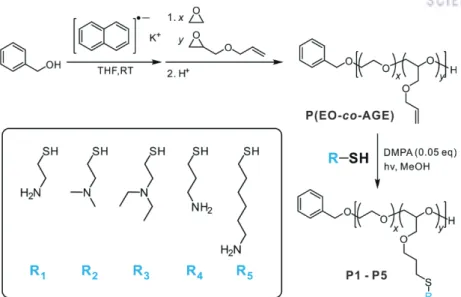
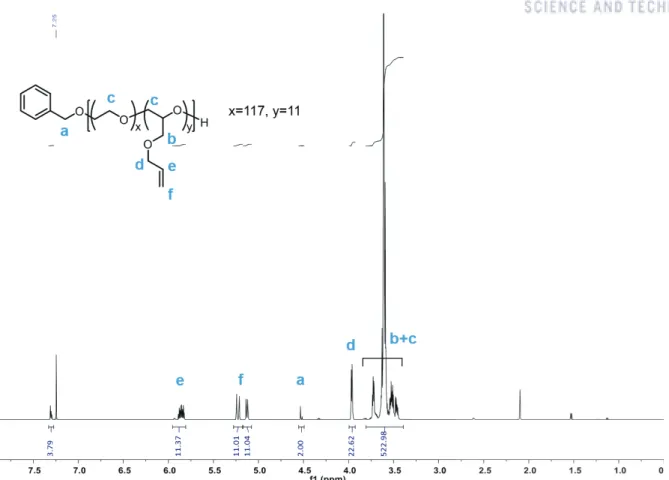
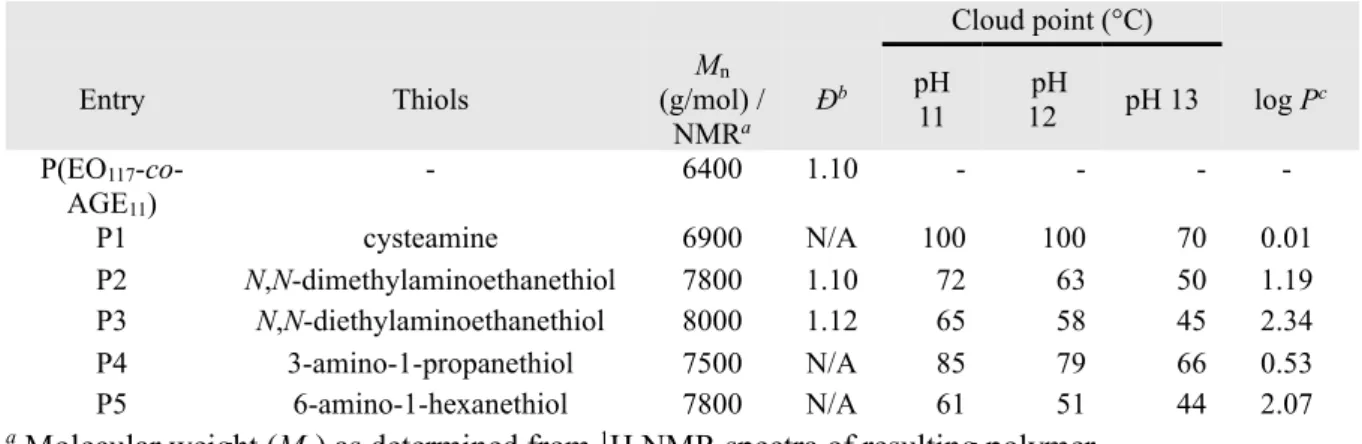
In this regard, the design and synthesis of functional epoxide monomers need to be explored for the preparation of various multifunctional polyethers, which have the potential for wide applications. This thesis describes the design and synthesis of functional epoxide monomers, followed by the synthesis of multifunctional polyethers using these monomers.
General Introduction
- Poly(ethylene glycol) (PEG): The most famous class of polyethers
- Synthesis of Multifunctional PEG
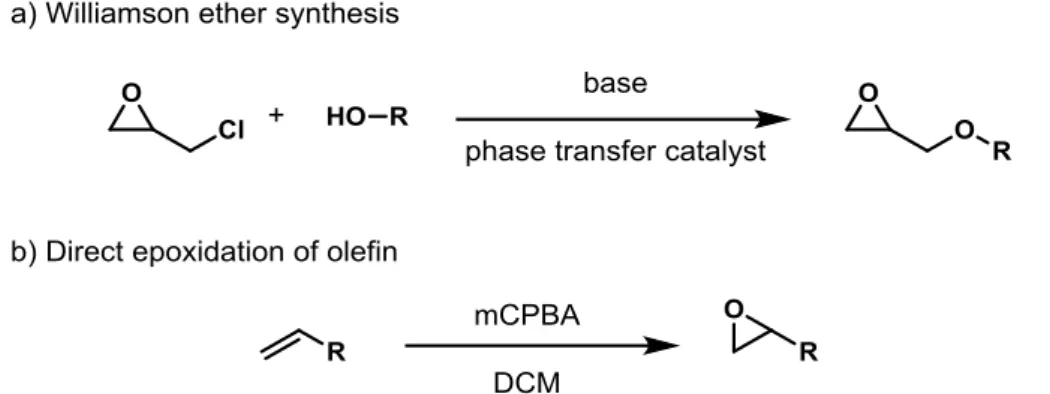
- Synthesis of Functional Epoxide Monomers
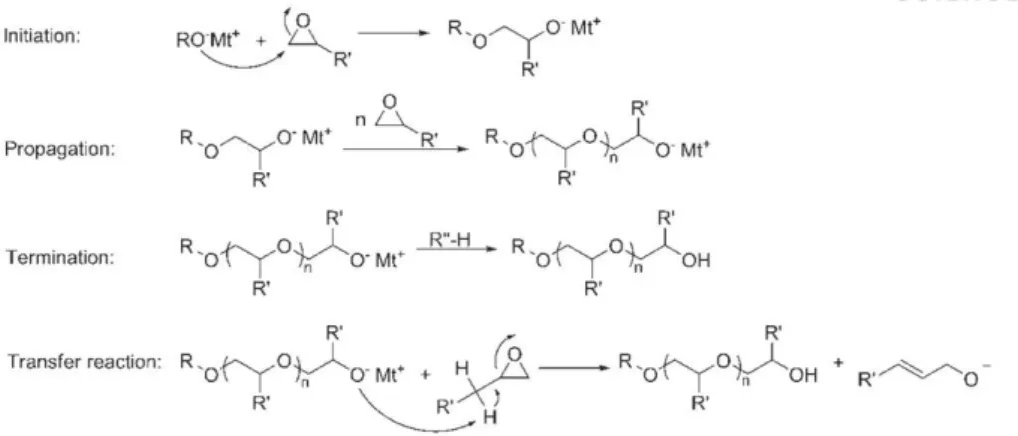
- Anionic Ring-Opening Polymerization
- Post-Polymerization Modification
- Hyperbranched Polyglycerols: The Promising PEG Alternatives
- Synthesis of Hyperbranched and Linear Polyglycerol
- Overview of The Thesis
- References
Mechanistic pathway of the base-catalyzed ring-opening polymerization of glycidol and the structure of the resulting hyperbranched PG (a small fragment of the actual polymer structure). a).
Abstract
Introduction
Experimental Section
Results and Discussion
Conclusion
Hyperbranched Copolymers Based on Glycidol and Amino Glycidyl Ether: Highly
Abstract
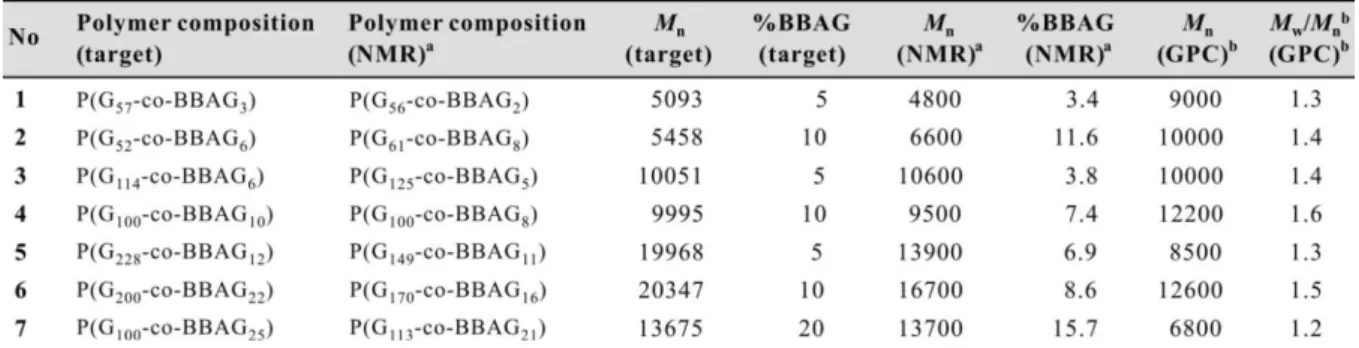
Functional hyperbranched polyglycerols (PGs) have recently attracted considerable interest due to their potential in biomedical applications. Here, we present a one-pot synthesis of hyperbranched PGs bearing amine functionality using a novel amino glycidyl ether monomer. A Boc-protected butanolamine glycidyl ether (BBAG) monomer was designed and polymerized with glycidol (G) by anionic multibranched ring-opening polymerization to form a series of hyperbranched P(G-co-BBAG) with controlled molecular weight g/mol ) and relatively low molecular weight distributions (1.2−1.6).
Copolymerization and subsequent deprotection chemistry allow the incorporation of a tunable fraction of primary amine moieties (typically 5–20% of the monomer ratio) within the hyperbranched PG frameworks, providing opportunities for varying charge densities and functionality in PGs. The free amine groups in the unprotected copolymer P(G-co-BAG) were further used for facile conjugation chemistry with a model molecule in a quantitative manner. Taken together, the biocompatibility with the facile conjugation chemistry of free amine groups encased within hyperbranched PGs has the potential to advance biological and biomedical applications.
Introduction
The free amine groups in the unprotected P(G-co-BAG) copolymers were further used for facile conjugation chemistry with a model molecule in a quantitative manner.
Experimental Section
The organic phase was concentrated under reduced pressure and the residue was purified by flash column chromatography using CH 2 Cl 2 /hexane (1:100 v/v) as eluent, yielding 11.2 g (60%) of the BBAG monomer as a colorless oil. Excess methanol was removed using a rotary evaporator and the resulting product was dried in a vacuum oven at 90 °C for 3 h, yielding a white salt of the initiator. The resulting P(G56-co-BBAG2) copolymer was dissolved in 1.0 mL of methanol; the homogeneous polymer solution was then precipitated in excess diethyl ether and the precipitate was washed twice with diethyl ether.
Considering the range of NMR integration errors, we used 4800 g/mol as the Mn value of polymer 1. The reaction mixture was concentrated under reduced pressure, and the resulting deprotected polymer was dissolved in 1.0 mL of methanol; the homogeneous polymer solution was then precipitated in excess diethyl ether and the precipitate was washed twice using diethyl ether. Excess methanol was removed using a rotary evaporator and the resulting product was dried in a vacuum oven at 90 °C for 3 h to give a white salt of the initiator.
After transferring 100 μL of each sample to 96-well plates, the absorbance of the solution was recorded at a wavelength of 540 nm using 620 nm as a reference.
Results and Discussion
In addition to these spectroscopic analyses, a simple ninhydrin assay confirmed the successful recovery of the primary amine groups. We found that there was no significant change in the chemical structure of the model compound under high temperature treatment at 90 °C for 24 h (Figure 3.15). During bulk polymerization, a quantitative 13C NMR spectrum can be obtained within minutes due to the sufficient abundance of the 13C isotope.
MALDI-ToF spectrometry was performed to confirm the incorporation of G and BAG monomers within the copolymer backbone and the successful deprotection of the Boc group as well (Figure 3.20). The Tg of the copolymers generally increased with increasing BAG content and decreasing molecular weights. 13C NMR spectra of the in situ copolymerization kinetics of G and BBAG monomers (1:1 initial monomer ratio).
The spacing of the signals corresponds to the mass of the corresponding monomers in the copolymer (G:74.08 g/mol and BAG: 145.2 g/mol).
Conclusion
ArchitectureǦControlled Synthesis of Redox Hyperbranched Polyglycerol Block CopolymersǦHyperbranched Polyglycerol Block Copolymers and Structural Implications of Their Degradation. Poly(glycidylamine) repeating units and copolymers with glycidol and glycidyl amine: synthesis and characterization. Square acid-mediated synthesis and biological activity of a library of linear and hyperbranched poly(glycerol)-protein conjugates.
Synthesis of new poly(ethylene glycol) derivatives with pendant amino groups and aggregation behavior of their mixture with fatty acid in water. One-pot synthesis of linear-hyperbranched amphiphilic block copolymers based on polyglycerol derivatives and their micelles. Hyperbranched double hydrophilic block copolymer micelles of poly(ethylene oxide) and polyglycerol for pH-responsive drug delivery.
Synthesis and biological evaluation of radio- and dye-labeled aminofunctionalized dendritic polyglycerol sulfates as multivalent anti-inflammatory compounds.
Abstract
Introduction
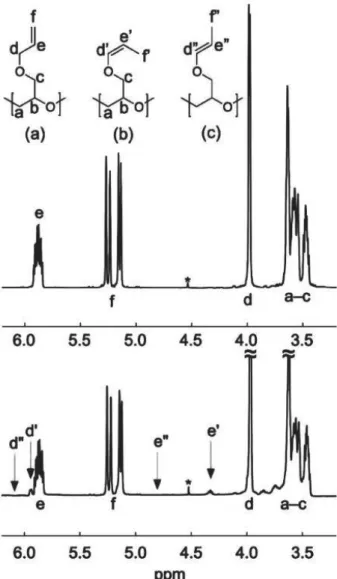
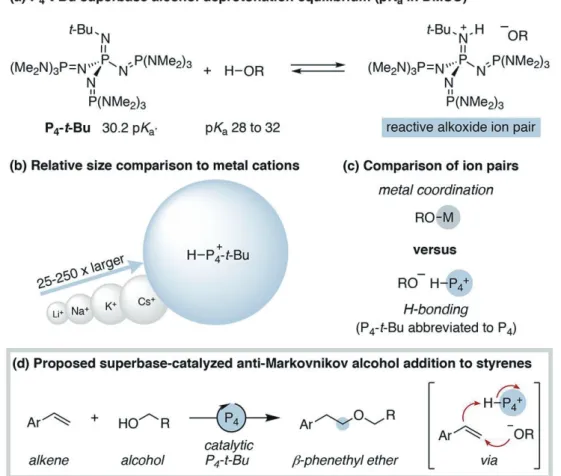
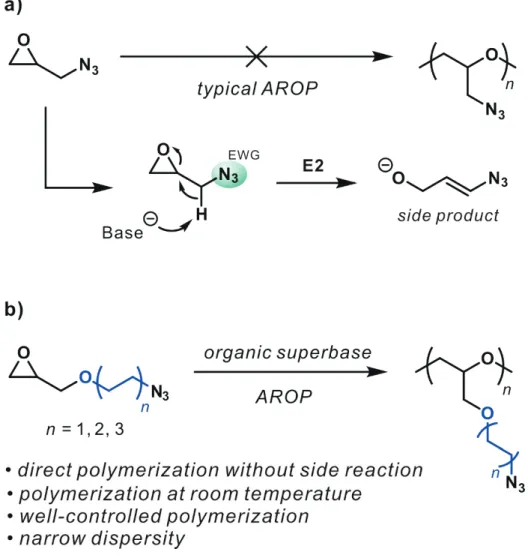
Not only are allyl groups stable under typical AROP conditions, but they can also react with functional thiols via the thiol-ene reaction, to decorate polyethers with numerous pendant functionalities.24–26 Intensive studies and various applications of AGE-based polymers by the Hawker and the Lynd group have had a significant impact on the post-polymerization modification of several polyethers.27-35 Recently, Frey and co-workers also developed a new epoxide monomer, 3,3-dimethoxypropanyl glycidyl ether, for homopolymerization or copolymerization with ethylene oxide to PEG exhibiting multiple aldehyde functionalities .36. Inspired by the advent of click chemistry, the azide functionality is considered a good candidate for the post-polymerization modification of polyethers due to its potential to undergo further modification by Cu-catalyzed azide-alkyne cycloaddition (CuAAC) or Staudinger reduction. As part of our ongoing efforts in developing a novel functional glycidyl ether monomer library, we herein introduce a series of novel azide-functional glycidyl ether monomers, azidoethyl glycidyl ether (AEGE), azidobutyl glycidyl ether (ABGE), and azidohexyl glycidyl ether (AHGE) that can be polymerizable under organic superbase-catalyzed AROP conditions.
Among them, AHGE was chosen as a model monomer to create a modular and versatile synthetic route to polymerization-modified polyethers (Figure 4.1). AHGE polymerization provides functional polyethers bearing pendant azide groups that can be further reacted with functional alkynes to install a wide range of functionalities along the polymer backbone. In addition, Staudinger reduction of the azide group can allow a dangling primary amine group, which is otherwise not acceptable under typical AROP conditions.
Post-polymerization modification of azide-functionalized polyethers via copper-catalyzed azide-alkyne cycloaddition (CuAAC) and Staudinger reduction.
Experimental Section
2-Azido-1-ethanol was prepared using 2-bromo-1-ethanol (1a) as starting material, following the same procedure as described in the synthesis of 3b in 85% yield. AEGE was prepared using 2-azido-1-ethanol (1b) as starting material, according to the same procedure as described in the synthesis of AHGE in 45% yield. 4-azido-1-butanol was prepared using distilled 4-chloro-1-ethanol (2a) as starting material, following the same procedure as described in the synthesis of 3b in 60% yield.
ABGE was prepared using 4-azido-1-butanol (2b) as a starting material according to the same procedure as described in the synthesis of AHGE in 41% yield. A mixture of benzyl alcohol (1.0 equiv) and monomer (20 equiv) in toluene-d8 (1.0 M to the monomer) was transferred by syringe into a conventional NMR tube sealed with a rubber septum. To the NMR tube was added t-BuP4 (1.0 equiv) and shaken to homogenize the mixture before placing in the NMR spectrometer.
Additional allyl glycidyl ether (AGE) (343.5 mg, 3.01 mmol) was added to the reaction mixture and the reaction was monitored by 1 H NMR to determine residual epoxide signals.
Results and Discussion
The linear correlation between ln([M]0/[M]t) and reaction time supported the successful living properties of the polymerization of azidoalkyl glycidyl ethers (Figure 4.32). Investigations of the synthesis of the polyethers with pendant primary amine groups along the polymer backbone are limited. FT-IR analyzes showed the disappearance of the characteristic azide peak at 2088 cm-1, providing further evidence supporting the successful reduction (Figure 4.36b).
Complete shift of the SEC traces to the higher molecular weight diblock copolymer P(AHGE)-b-P(AGE) was observed, with no presence of the unreacted P(AHGE) chain end (Figure 4.42). The slightly lower reactivity of AHGE compared to AGE may originate from the steric effect of the longer alkyl chain. 1H NMR spectroscopy was used to verify the success of the CuAAC reaction by observing the large downshift of the peak corresponding to the methylene unit adjacent to the azide from 3.26 to 4.3 ppm (Figure 4.44a, peaks a and a').
-IR analysis showed the smooth progress of the sequential reactions, evidenced by the disappearance of the band corresponding to the azide (2088 cm-1) and the appearance of a new band at 1691 cm-1 corresponding to the thioester group (Figure 4.44b) . 1H NMR spectra of the reaction mixture of 1-azido-6-methoxyhexane with t-BuP4 and benzyl alcohol over 3 days at room temperature (400 MHz, CDCl3). Superior biocompatibility of the polymer was achieved by amines coated on hyperbranched polyglycerols.
Conclusion
Summary
Polyether, one of the synthetic polymers, has attracted considerable interest in a wide range of fields, while it is still challenging to synthesize various functional polyethers. In this context, this thesis describes our efforts to produce countless functional polyethers through the rational design and synthesis of functional epoxide monomers. First, we introduced the synthesis and properties of pH-tunable thermoresponsive polyethers containing different pendant amine groups.
Finally, a series of new azide-functionalized epoxide monomers are presented as universal candidates for the preparation of platform polymers for post-polymerization modification. Superbase-catalyzed nonionic organic anionic ring-opening polymerization (AROP) was demonstrated to provide well-controlled functional azide polyethers. In conclusion, versatile functional polyethers were synthesized using commercially available epoxy monomers and newly designed new monomers.
We anticipate that the work described in this thesis will greatly expand the field of functional epoxy monomers for the preparation of valuable polymeric materials.