Negotiation with the Nordic countries has been the agreed policy of the USA, South Korea and Japan. Surrender of the North Korean regime cannot be bought by the richer South or even the United States.
BEYOND COLLAPSE - CONTINUITY AND CHANGE IN NORTH KOREA
Also, given North Korea's Confucian legacy, Kim Jong Il's filial piety would be suspect and his legitimacy severely eroded. North Korea's economic decline is not a result of shortcomings in its ideology and failures of its leadership, claims Kim Jong Il. Foreign Relations: As mentioned earlier, external forces began to change North Korea's foreign relations before Kim Jong Il's succession.
Congressional Republicans have long been vocal critics of the Clinton administration's North Korea policy.
EU-NORTH KOREAN RELATIONS
NO EFFORT WITHOUT REASON*
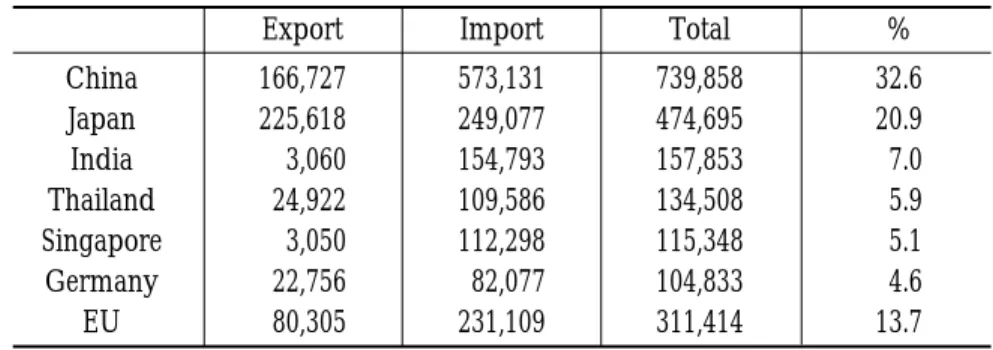
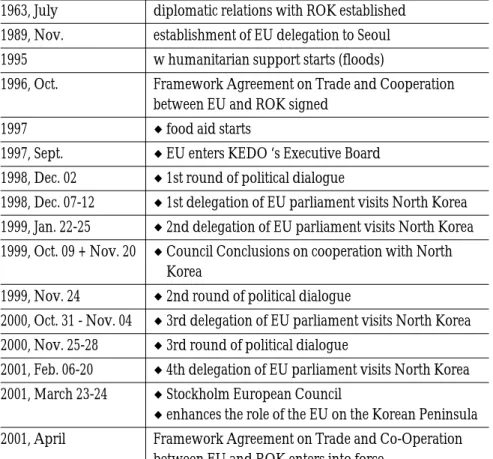
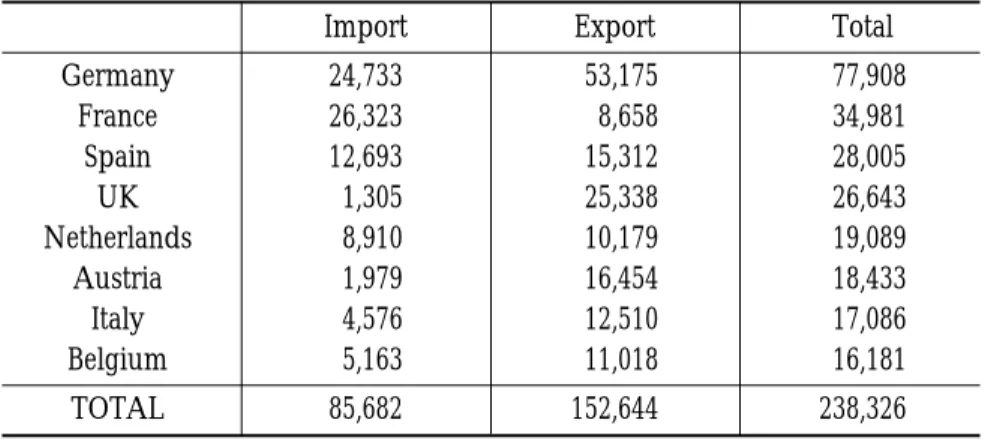
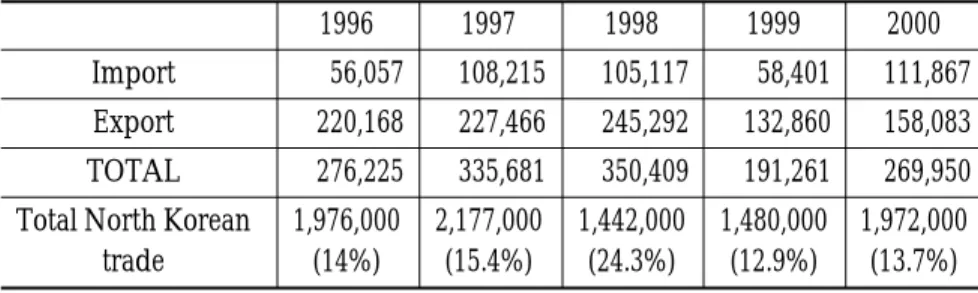
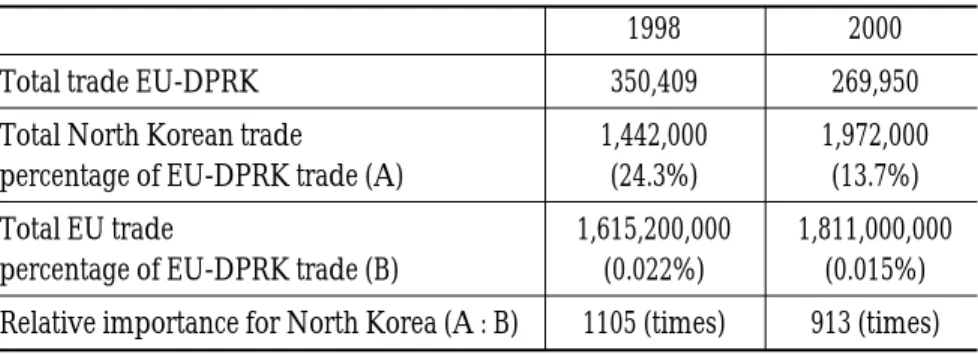
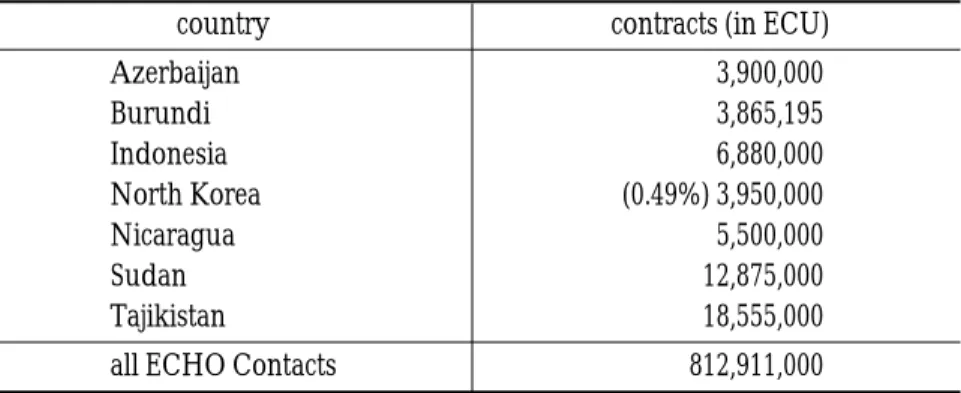
The EU's main export items to the DPRK are agricultural machinery, cars, steel, electronic and electrical equipment, measuring instruments, medical supplies and rough diamonds. The EU's main import items from the DPRK are clothing, electronic and electrical products, jewellery, machinery, plastic products and salt. The EU's basic approach is to provide (1) technical assistance and (2) additional market access opportunities to the DPRK (EU 2002b: . 18).
A pilot project of the same scale is proposed for the energy sector and natural resources. 4 For the full text of the agreement, see http://europa.eu.int/eur-lex/pri/en/oj/dat/. Organization of a study trip to the EU for a small number of selected officials towards the end of the project.
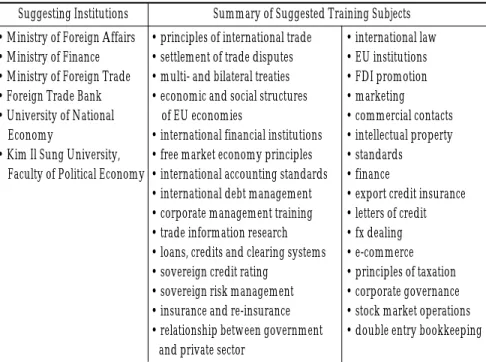
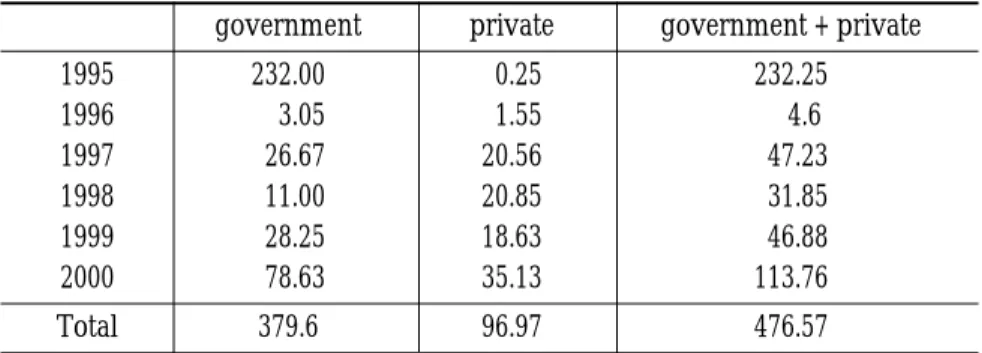
Technical assistance is given top priority in EU policy towards the DPRK. only) 1 million Euro allocated to each of the two EuropeAid pilot projects. As a recent study by the German Marshall Fund of the United States and the Chicago Council on Foreign Relations shows, 65% of Europeans trust the EU. Source: German Marshall Fund of the United States and the Chicago Council on Foreign Relations, in: Worldviews 2002.

THE PUTIN ADMINISTRATION’S NORTH KOREAN POLICY
By the mid-1990s, however, North Korea had begun to come around to the Russian point of view. These Russian efforts to restore normal relations with North Korea coincided with the initiation of the Primakov Doctrine. 16 Jae-nam Ko, “The Russia-North Korea Summit and Beyond: The Role of Russia on the Korean Peninsula,” East Asian Review, Vol.
Russia is also ready to provide diplomatic support to help alleviate North Korea's security concerns. The main culprit in the drastic reduction in the Russian-North Korean arms trade is in fact North Korea's lack of hard currency. During the Pyongyang summit, the Russian and North Korean leaders focused on the possibility of Russia supplying equipment to North Korea.
It is clear that Putin was trying to appease Kim Jong-il in exchange for securing North Korea's cooperation in building the railway. Security cooperation between Russia and North Korea An important question is whether and how Russian foreign policy towards North Korea contributes to reducing tensions on the Korean Peninsula. As such, South Korea must assist in the new Russian foreign policy towards North Korea, enthusiastically launched by President Putin in this uncertain situation.
THE FOOD CRISIS IN THE DPRK
PROSPECTS FOR POLICY REFORM
Finally, I make some suggestions as to what role the international community can best play in alleviating the crisis. Agricultural productivity has also been hit hard by the effects of the more general crisis in the DPRK's economy. Much of the agricultural machinery in the countryside is now old and much of it is no longer usable.
However, Eberstadt suggests that the characteristics of the current famine in the DPRK do not fit this earlier pattern. The famine's human impact and death toll were exacerbated by the overall deterioration in the level and availability of health services in the DPRK. However, the symbolic importance of food, especially rice, in the regime's rhetoric cannot be denied.
This is certainly true, but the UNDP has worked with the government of the DPRK over the years to find out what is needed, especially in the production area. However, Moon recognizes the problems inherent in the rapid scrapping of the cooperative and state farm systems. I have tried to show that the very serious food situation was one of the most important catalysts for changes in policy in the DPRK.
SEVEN YEARS OF “HUMANITARIAN” AID
A BALANCE AND A POSSIBLE WAY FORWARD
Taking Stock of Seven Years of “Humanitarian” Aid
This would mean an excess of deaths, roughly equivalent to one percent of the entire population. However, the relative weight of the various elements in the chain of events that led to the famine, and its actual scale, remain a subject of considerable debate. The main UN actor in North Korea is the World Food Program (WFP), the food aid arm of the UN system.
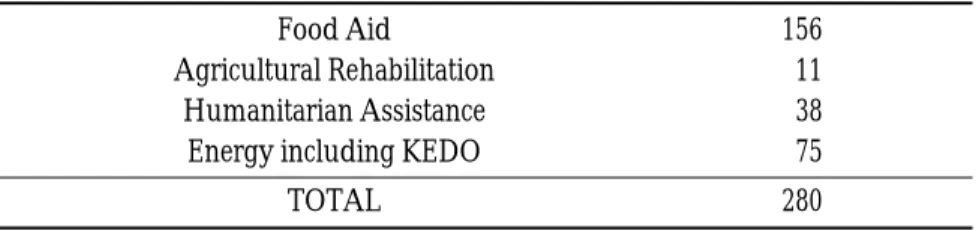
The above statistics also prove that so-called "humanitarian" food aid has increased in recent years, when the height of the hunger crisis was over. Et pour cause—preserving power is the primary, if not unique, concern of the North Korean leadership. First of all, after seven years of massive, mostly food aid, it must be admitted that the realities of North Korea's famine, and its end, remain elusive.
What share of agricultural crops is really left to those who actually produce them? It has often been observed that all aid agencies in the country, and not just those in the UN system, have been “reluctant to challenge the continuation of the North Korean regime's irrational policies.” Only a very small part of the total aid to North Korea can therefore be qualified as truly humanitarian, quote-unquote.
A Possible Way Forward for Foreign Aid
The second, somewhat subsidiary objective of the "sunshine" policy is to encourage North Korea to reform, leading it to a so-called. After seven years since the flood disaster, it is time for the FDRC to disband. At the same time, foreigners are prevented from learning about the real situation and needs of the local population.
Aid has been an essential component of the policy of engagement, and the rationale for providing aid to North Korea remains valid as long as a policy of engagement continues. But it is argued here that important tactical changes should be implemented in both parts of the two-pronged approach to which foreign aid is delivered. No better proof of the effectiveness of the policy advocated here can be given than the divergent positions of the North Korean authorities at various levels.
The real structure of North Korean society should not be forgotten, and a constant effort to reach the least protected sections of the population should be the guiding principle of foreign aid that wishes to be truly humanitarian. Donors, and in particular those who provide most of the crowdfunding. Aid is one of the tools that foreign countries have in trying to put pressure on the DPRK.
HUNGARIAN LESSONS FOR NORTH KOREA’S ECONOMIC TRANSITION
Hungary, to increase the low efficiency of the economy, the government ordered a change from above. To begin with, the paper summarizes the core of these reforms and then provides a detailed analysis of the changes introduced within the framework of the NEM. In Kornai's view, the most spectacular trend in the Hungarian reform process was the growth of the private sector.
On the contrary, Japan's economic power has been one of the important factors responsible for causing the unrest. Below I would like to share my views on some of the key dilemmas that countries face on the path of transition. A good example could be the announcement of the devaluation or appreciation of the national currency.).
One of the most important dilemmas is between the role of the market and that of the state. I believe that this dilemma is typical not only of countries in transition, but of virtually every economy. In the case of Hungary, the role of the market was perhaps overemphasized after the system change.
RECONCILIATION OR NORMALIZATION IN KOREA
The constitution of the DPRK states in article 1: "The Democratic People's Republic of Korea is an independent socialist state representing the interests of all the Korean people."2 A similar view related to liberalism is contained in article 4 in the constitution of the Republic of Korea. In the last UN session, the DPRK delegate announced, “the 15 June North-South Joint Declaration is. In January 2001, the DPRK repeated the same: a beginning of reconciliation in side-by-side existence, and then moving on to "the coexistence of different systems in one unified state."12 But it now belongs in the basket of successful wishful thinking or tactical maneuvers.
Six months later, Kim Dae Jung mentioned what he had left out of the meeting: “The South and the North should build a robust foundation for peace until the end of the Cold War and strengthen economic ties this year.”15. 16 “The Sunshine Policy can be defined as a proactive policy to bring about incremental and voluntary changes in North Korea for peace, openness and reform through a patient pursuit of reconciliation, exchange and cooperation.” 21 'diplomacy' such as Bush's decision to convince Kim Jong Il 'that he must disarm' does not seem convincing, The Washington Post, October 10, 2002.
But as a basis for further relations, it did not contain so often claimed "all conditions for normalization". The shortcoming was the absence of substantial state-to-state regulation. For example: "The confederate state must cut the military strength of both sides respectively. This would be a coexistence as a peaceful balance of different forces and not the ideal of "cooperative coexistence". The sides are able to ' build a mutual sober trust, but cannot ensure survival for the other regime.
A HISTORICAL SURVEY OF
NORTH KOREA’S ECONOMIC DEVELOPMENT AND TRADE, 1945-1984*
- Plan (1957-1960)
- Plan (1954-1956)
- Plan (1961-1967)
- Plan (1971-1976)
North Korean agriculture was underdeveloped due to its colonial legacy, which concentrated the production of heavy machinery in the northern part of the peninsula. The central government designated 1960 as an "interim year" to complete the 5-year plan. North Korea's trade with the OECD (Organization for Economic Co-operation and Development) increased as the country sought to diversify its trading partners.
The first half of the 1970s was an era of dramatic change in North Korea's commercial activities. North Korea's lack of credibility as a debtor in the eyes of the West also made its prospects bleak. One of the most visible aspects of North Korea's relationship with Third World countries is its support for their military actions.
North Korea's trade with Western countries continued to increase in the first half of the 1980s. These contradictory actions (economic openness and ideological indoctrination) reveal the essence of North Korea's dilemma. China's 1978 initiation of its successful economic reform program, "the Open Door Policy," appears to have motivated the Kim Il Sung regime to implement a similar plan.