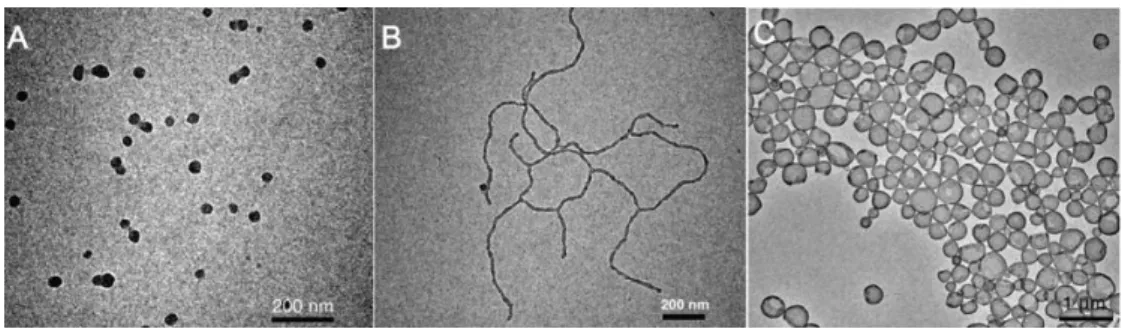
A three-armed PEG initiator was synthesized in four steps from PEG550, PEG 750, and block copolymers of three-armed poly(ethylene glycol) (PEG) initiator and poly(styrene) (PS) were synthesized by the atom transfer radical polymerization (ATRP). ) method and anionic polymerization and cycloaddition. Thus the amphiphilic block copolymers, Tri-arm PEG-b-PSx, self-assembled into a variety of nanostructures including spherical and cylindrical micelles, polymer vesicles, inverse cubic mesophase (cubosomes) and inverse hexagonal phase according to the degree of polymerization of the PSx block in water. The PEG end of the linear block copolymer has SH, N3 and NH2, which contain dye, enzyme and DNA.
The internal network structure of the self-assembled inverse cubic mesophases is modified by mixing the linear block copolymer and the solvent effect. Amounts of linear block copolymer increase the internal network structure, which turns D-minimum surfaces (Pn3m) into Schwartz P-minimals (Im3m) in aqueous solution. The internal network of water channels could be used as a platform to accommodate guest molecules such as protein complexes, and the monolith was also shown as a framework for the synthesis of 3-D skeletal nanostructures of inorganic oxides with hierarchical porous networks.
Based on the experimental results, the inverse cubic mesophase in cubosomes and monolithic film was observed. It showed large surface area, stronger than lipid cubosomes and long path length showing promise for enzyme reactor, separation, filtering, desalination, proteocubosome and replica template.
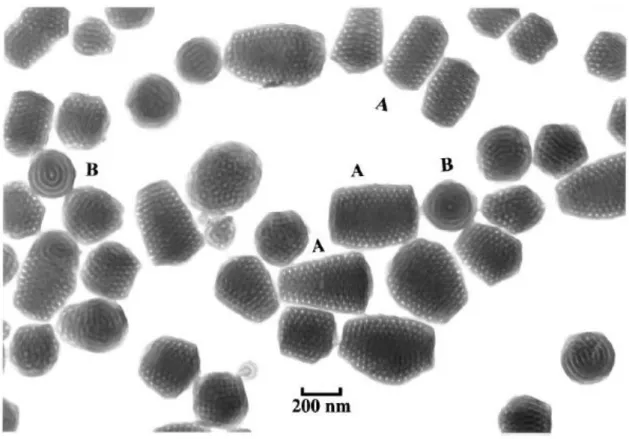
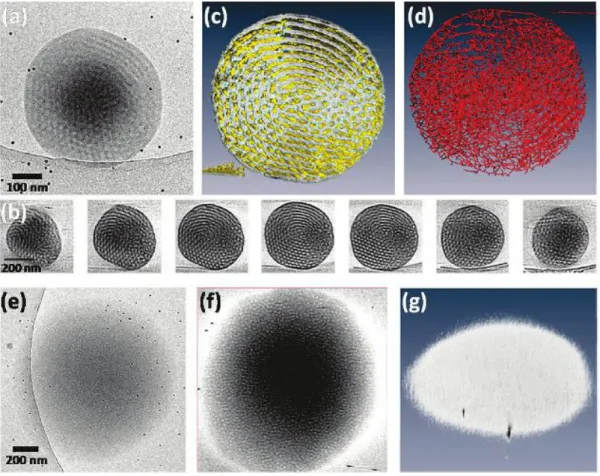
Enlarged image of internal structures (pn3m). C) TEM image of the internal structure of 7503-PS390 polymeric cubosomes (left). Insets represent a magnified view of surface pores (scale bar, 300 nm). surface area and pore size distributions observed by N2 adsorption experiment.
List of Abbreviation
Introduction
Well- Defined Amphiphilic Block Copolymer
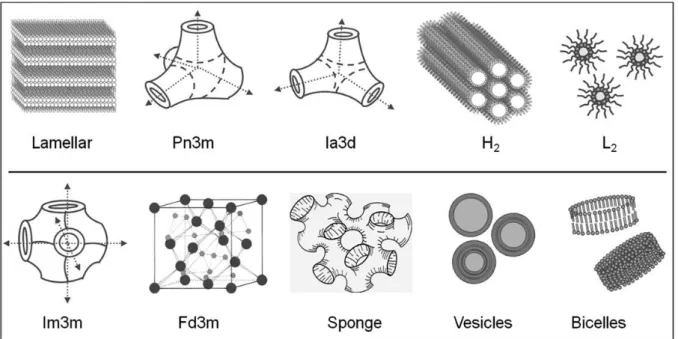
Solution self-assembly of BCPs into Cubosome(inverse bicontinuous cubic mesophase)
Where the critical packing factor (P) of the lipid is defined by P = V/aolc, where V is the hydrophobic part of the volume, ao is the molecular are per hydrophobic part, and lc is the length of the hydrophobic part. Tiberg and co-workers discovered lipid cubosomes that have an inverse bicontinuous cubic phase of lipid self-assembly.28 (Figure 1.4). Eisenberg and co-workers reported inverse hexagonal phases within self-assembled nanoparticles (hexosomes) of poly(acrylic acid)-b-polystyrene (PAA-b-PS) in solution. (Figure 1.5)10.
Sommerdijk and colleagues showed that the nanoparticles have internal bicontinuous porous networks due to the self-assembly of the block copolymers, consisting of a linear poly(ethylene glycol) and brushed hydrophobic blocks in water. (Figure 1.6)29. In solution, BCPs have been shown to form inverse mesophases similar to those exhibited by lipid self-assembly. The internal structures of the polymer cubosomes showed great similarity to the corresponding structures of lipids.
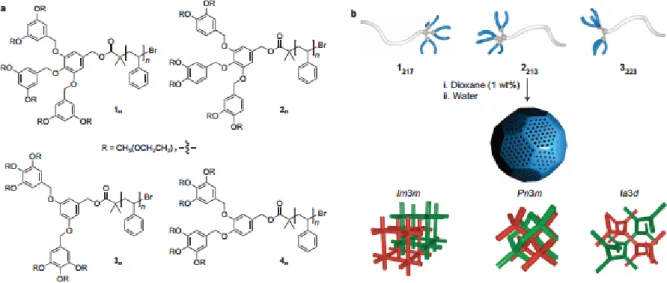
The TPMSs of the BCP bilayer with Schwartz P, D, and Schoen G structures were observed from polymer cubosomes depending on the architecture of the dendritic hydrophilic block. (Figure 1.7)30. Peinemann and co-workers also reported the formation of polymer cubosomes consisting of the minimal P surface of PAA-b-PS in a toluene/methanol mixture at dilute concentration (<5 wt%), and showed that these polymer cubosomes were able to host protein guests on a stimuli-responsive manner. (Figure 1.8)31.

Thesis Summary
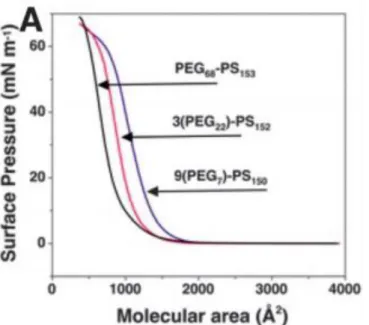
This means that the branched hydrophilic parts have a higher molecular area than linear hydrophilic parts.
Well-Defined Periodic Minimal Surfaces of Block Copolymer Bilayers. Bilayers
- ABSTRACT
Self-assembly of amphiphilic block copolymers (BCPs) has been an important strategy in creating nanostructures with desired physicochemical functions and morphologies. The structural parameters of the BCPs, such as the chemical structures of the constituent polymer blocks, the molecular weight of each polymer block, and the molecular weight ratio of the incompatible polymer blocks, directly influence the self-assembly behavior of the polymer building blocks.1 -2 Control over these structural parameters is mainly achieved through the synthesis of BCPs in a well-controlled manner, which directly dictates the morphology, size, and physicochemical function of the resulting self-assembled nanostructures. Furthermore, manipulation of the kinetic pathways of the self-assembly process resulted in the creation of nanostructures that may not be formed by relying on thermodynamics alone.
Recently, Peinemann and co-workers have also shown that a linear BCP, poly(acrylic acid)-polystyrene, self-assembles into polymer cubosomes with Schwartz P internal structure.9 Despite these reports, the underlying mechanism of the self-assembly to reverse mesophases of BCPs have not been fully understood and thus the structural parameters of the BCPs that lead to the formation of reversed bicontinuous phases have not been clearly proposed. Here, we report our discovery of the formation of polymer cubosomes consisting of TPMSs of the self-assembled bilayer of the BCPs with a branched hydrophilic block and a linear hydrophobic block. Our results suggest that the presence of branched architecture in the hydrophilic block is a crucial structural requirement for the self-assembly of BCPs into inverse mesophases.
The TPMS surface can also be easily functionalized by co-assembling end-functionalized linear block copolymers and tri-armed linear block copolymers with the same block ratio. We also show that the crystal structure of TPMS BCPs can be controlled to have the desired symmetry by simple co-assembly of two BCPs13 and by the solvent effect using small amounts of DMF10-11. The large surface area of the internal pore networks has shown that it can accommodate large.
The molecular weight of the PEG segment is R=13 1650 g/mol, R=17 2250 g/mol, small cubosome internal structure is Im3m large cubosome internal structure is Pn3m. The molecular weight of the block copolymers was measured on an Agilent 1260 Infinity GPC system equipped with a PL gel 5 μm mixed D column (Polymer Laboratories)) and differential refractive index detectors. The mixed solution of the analyte and matrix (0.5 μL) was loaded onto the MALDI plate (MTP 384 target plate ground steel) and dried at 23 °C before being placed in the vacuum chamber of the MALDI instrument.
The laser steps and voltages applied were adjusted depending on both the molecular weight and the nature of the analyte. In the experiment, 40 μL of the polymer solution, which is composed of polymer CHCl3 and (1 mg/ml) was evenly loaded on the water surface in small droplets. The porous structures of the samples were characterized by a nitrogen adsorption experiment at -196 °C using a BEL BELSORP-Max system.
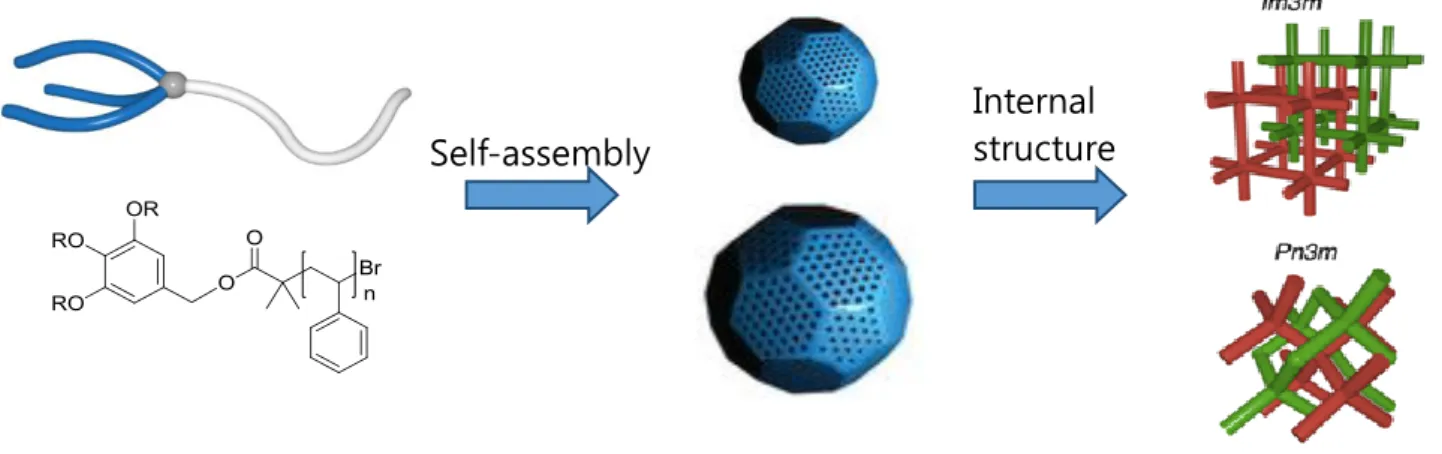
Synthesis of Tri-arm ATRP and Click initiator
After removal of the solvent by rotavap, the crude mixture was purified by silica gel column chromatography (MC/MeOH 93:7, v/v). After removing the solvent from the rotavap, the crude mixture was purified by silica gel column. The reaction mixture was extracted with EA and washed with 100 mL of brine and Na2CO3.

Synthesis of Block-copolymers(tri-arm, linear PS) via Atom Transfer Radical Polymerization
Synthesis of Block-copolymers(tri-arm, linear PS) via Anionic Polymerization & Click reaction
- Result and discussion
- Summary
- referenece
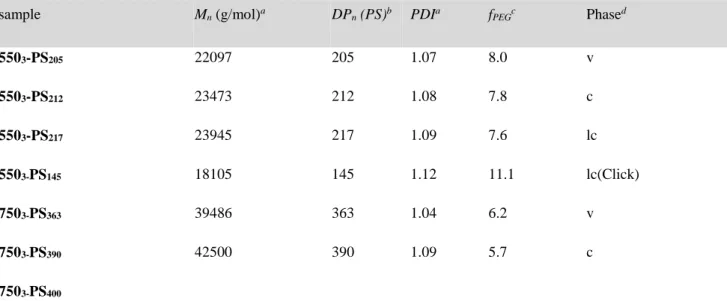
Thus, the fPEG of block copolymer is slightly changed, increasing the length of the hydrophobic chain. From the self-assembly of 5503-PSn with an fPEG value of 8%, the polymer cubosomes with an average diameter of almost 5 µm were formed. The average diameter of the polymer cubosomes of 5503-PSn increased with the increase of the molecular weight of the PS block (a decreased fPEG value).
Scanning electron microscopy (SEM) and transmission electron microscopy (TEM) of the polymer cubosomes of 5503-PSn showed the well-defined bicontinuous cubic structures contained within the polymer cubosomes. The detailed structure of the polymer cubosomes was observed using transmission electron microscopy (TEM) and scanning electron microscopy (SEM). It is a similar TEM image to lipid cubosomes.25 The SEM images of the polymer cubosomes of 5503-PS212.
Magnified image of internal structures (Im3m). B) TEM image of the internal structure of polymer cubosomes of 5503-PS231 (left). Interestingly, the diameter of polymer cubosomes of 5503-PS231/ PEG45-PS210, measured by SEM, gradually decreased with increasing weight percentage of PEG45-PS210 compared to 5503-PS231. We wondered if a similar effect could be observed in decreasing the diameter of polymer cubosomes by applying more PEG45-PS210 as a stabilizer.
SAXS results of the polymer cubosomes clearly showed a transition from Pn3m phase present in the larger polymer cubosomes to Im3m only observed smaller polymer cubosomes self-assembled from 5503-PS231/PEG45-PS210. This result suggested that the surface energy of the polymer cubosomes plays an important role in determining internal bicontinuous cubic phases of the polymer cubosomes. Monolith film has triple periodic minimal surface (TPMS) of the BCP bilayer. The method to make monolith film is Solvent Diffusion-Evaporation Mediated Self-assembly (SDEMS).
This finding suggests that the branched architecture of the hydrophilic block contributes to the increase in the P value of BCP. These results indicate that the branched architecture of the bPEG-PS hydrophilic block is responsible for the significantly higher surface area occupied by BCP in the self-assembled bilayer. We suspected that the increased molecular surface occupied by the branched hydrophilic block in the bilayer might influence the self-assembly behavior of BCP.
According to the hydrophilic part of the branching effect, for comparison, the TEM images of the 7503-PS390 polymer cubosomes showed that the thickness of the bilayer constituted the inverse cubic mesophases. The internal structure changes according to the change in the length of the hydrophobic part (im3m, pn3m).