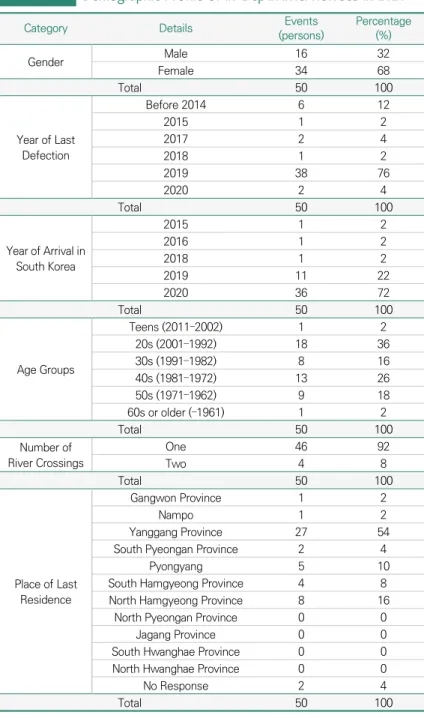
The White Paper on Human Rights in North Korea 2021 is based on interviews with 50 North Korean defectors. The White Paper on Human Rights in North Korea 2021 is written in accordance with the following principles:.

Extrajudicial, Summary or Arbitrary Execution
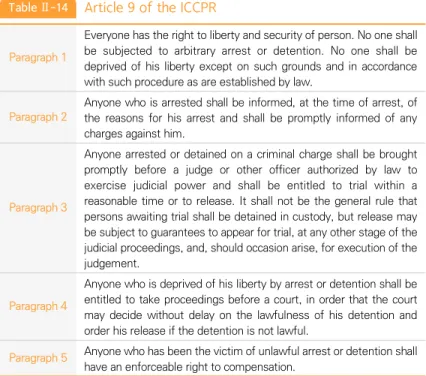
In all cases, amnesty, pardon or commutation of the death sentence may be granted. Pursuant to the provisions of Article 6 of the ICCPR, Article 14 of the ICCPR (which provides for the right to a fair trial) and Article 15 of the ICCPR (which provides for the principle of non-retroactivity of punishment), extrajudicial, summary or arbitrary execution is prohibited.
Broad Application of the Death Penalty for Offenses
In particular, it should be noted that the death penalty has been added as a legal penalty for crimes related to the cultivation of opium and the production of narcotics in the Criminal Law of 2013. In cases where the offense in paragraph 3 is particularly serious, the person will is subject to the penalty of indefinite correctional labor or the death penalty.

Death Sentence for Juvenile Offenders and Execution of Pregnant Women
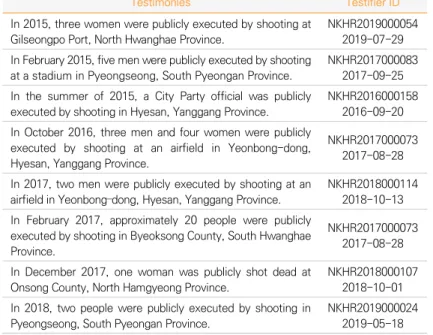
He further stated that he had heard that Kim Jong Un had ordered a policy of banning public executions.29 Despite such testimony, a 2020 investigation obtained testimony that public executions were carried out in 2015 and 2018.
Other Infringements of the Right to Life
Evaluation
Although specific grounds for carrying out the death penalty have not been identified, there have been cases where the death penalty was carried out for possessing copies of the Bible, distributing propaganda leaflets and practicing acts of superstition. As in the UDHR, Article 7 of the ICCPR also prohibits torture and inhuman treatment, and even goes a step further by expressly prohibiting non-consensual medical or scientific experimentation.
Torture and Inhuman Treatment in the Handling of Criminal Cases
In February 2015, the MSS District Branch in Onsong County, North Hamgyeong Province investigated a North Korean defector for human trafficking and was frequently beaten during the investigation process. In November 2016, a North Korean defector was frequently beaten while detained for 20 days at the MSS District Branch in Onsong County, North Hamgyeong Province.
Public Execution of the Death Penalty
Article 421 of the North Korean Criminal Procedure Law stipulates that the death penalty shall be carried out by the criminal enforcement agency that received the order for the execution of the death penalty and a certified copy of the written judgment of the Central Court. In general, however, public execution of the death penalty appears to occur more often in border areas than inland, and in cities than in rural areas.
Enforced Disappearances and Deaths in Detention Facilities
It has been analyzed that this trend may be because there are relatively more illegal activities in border regions and cities, and the North Korean authorities are trying to warn and incite fear among residents of these regions. Therefore, both the people subject to enforced disappearances and their families are victims of torture and/or inhumane treatment.
Evaluation
However, it was identified that public executions are still carried out for political and ideological crimes or superstition. No one shall be held in slavery; slavery and the slave trade in all their forms must be prohibited.
Labor Training Punishment for Minor Offenses
Penalties depriving personal liberty and imposing forced labor in the Criminal Law of North Korea include the penalty of corrective labor—that is, the penalty of indefinite corrective labor and the penalty of limited corrective labor—and the penalty of training work (Article 27). 2017 his co-worker was sentenced to six months of work training for absenteeism without notice.
Re-Educational Labor Discipline
Prosecution institutions may impose re-educational labor discipline, fines, demands for compensation, confiscation or suspension for illegal acts identified in the process of prosecutorial supervision. People's security institutions may impose re-educational labor discipline, fines, demands for compensation, confiscation or suspension due to illegal acts discovered in the process of security enforcement.
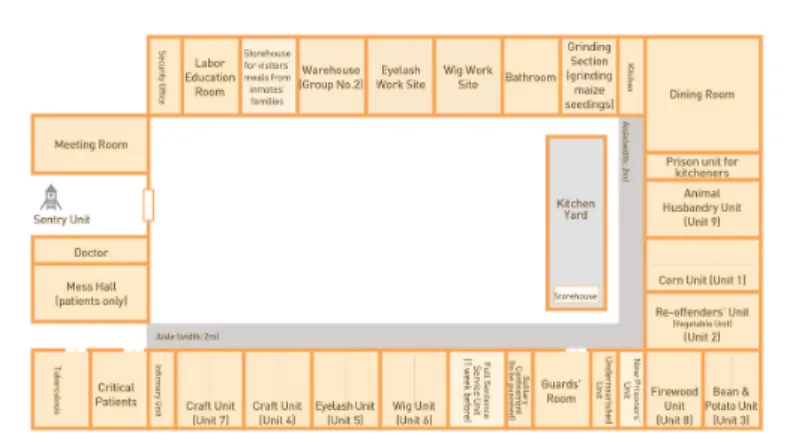
Labor Exploitation of Detainees in Holding Centers ( Jipkyulso)
A North Korean defector who was held in a detention center (jipkyulso) in Chongjin, North Hamgyeong Province from July to August 2018 testified that he/she was not investigated and did farm work, construction. In 2015, the witness was mobilized for the production of cement and prefabricated paving when he was detained in a detention center (jipkyulso) in Ranam District in Chongjin, North Hamgyeong Province.
Arbitrary or Unlawful Arrest or Detention
Arbitrary or illegal arrests or detentions were found to continue in North Korea. Arrest or detention without complying with the relevant provisions of the North Korean Criminal Procedure Law would constitute illegal arrest or detention.
Insufficient Procedural Guarantee of Liberty and Security of Person
The preliminary review of a criminal case is completed within two months from the day the preliminary review of the case begins. In the case of a complex criminal case that requires longer detention, the detention of the interrogator may be extended by two months with the consent of the head of the State Prosecutor's Office.
Evaluation
Juvenile delinquents should be kept separate from adults and provided with treatment appropriate to their age and legal status. This chapter examines key issues related to the situation of human rights violations in North Korea regarding the right to humane treatment of persons in detention.
Inhuman Treatment of Persons Deprived of Liberty
From March to June 2014, the witness was detained at a detention center (jipkyulso) in Chongjin, North Hamgyeong Province. While detained at the MSS City Detention Center (guryujang) in Hyesan, Yanggang Province in 2016, the witness was forced to maintain a fixed posture.

Issues Related to the Treatment of Unconvicted Prisoners
The reality of civil and political rights, 3. The right not to be forced to work), and that access to a defense attorney is not effectively guaranteed (II. The Reality of Civil and Political Rights, 7. Right to a Fair Trial) , it is considered that the guarantee for fair treatment of non-convicts is insufficient.
Issues Related to the Treatment of Convicted Prisoners
The witness practitioner was severely beaten and not allowed to sleep because he/she did not perform the assigned work properly. August 2016 the witness was working pulling three meter long trees as he/she was very weak.
Issues Related to the Treatment of Unconvicted and Convicted Juvenile Prisoners
The use of violence and cruel treatment in detention facilities may also constitute a violation of Article 7 of the ICCPR (which prohibits torture and inhuman treatment), and deaths in detention facilities may constitute a violation of Article 6 of the ICCPR (which provides for the protection of the right for life). The right to freedom of movement and residence is one of the basic human rights.
Using Travel Permits to Control People and Restrict Movement
In 2015, the witness traveled from Hyesan, Yanggang Province to South Hamgyeong Province without a travel permit. In 2018, the witness received a travel permit to Yanggang Province for his/her blueberry business.
Restriction of Access to Certain Areas and Forced Deportation
Such broad restrictions on public access to various specific districts constitute a violation of the right to freedom of movement and residence. Restricting access to certain areas through a strict and complicated process of issuing a travel permit and carrying out forced deportation are acts that violate the right to freedom of movement and residence.
Restrictions on Entry to Border Areas and Prohibition against the Freedom to Leave
According to Article 13 of the Immigration Law, North Korean residents may be issued an immigration document in the border area for official or private purposes. However, this does not mean that the human rights situation in North Korea has improved; rather, the decline is believed to be the result of the North Korean authorities' insufficient capacity to resettle expelled residents.
Denial of Judicial Independence
People's jurors participate in trials at first instance (Article 9 of the Law on Courts). Judgments and decisions are adopted by the majority of the judges and jurors participating in the trial (Article 17 of the Law on Courts).
Unfair Trials
A North Korean defector who went through a preliminary examination and trial in Onsong County, North Hamgyeong Province from March to July 2010 testified. There is inconsistent testimony from North Korean defectors about whether judges, prosecutors, defense attorneys, and lay jurors attended the trials.
Operation of Quasi-Judicial Systems
However, evidence has been collected indicating that, contrary to the applicable provisions of the Criminal Procedure Act, hearings are conducted by state security institutions. According to the witness, if the prosecution bureau determines that the suspect did commit the criminal act, he/she is tried at the place where the preliminary investigation was conducted, and in that hearing a prosecutor from the MSS prosecution bureau delivers a verdict in the name of the Central Court.
Infringement of the Right to Defense
In addition, the North Korean Lawyer Law states that a defense lawyer has the right to talk or correspond with a pretrial interrogator or a person accused of a crime (Article 9, paragraph 1). The witness said that when he/she told the defense attorney that he/she could not offer a bribe, the defense attorney sided with the prosecutor during the actual trial.
Insufficient Guarantee of the Right to Appeal and Perfunctory Operation of the Appeal System
A North Korean defector ○○○ tried in August 2014 in Samjiyeon, Yanggang Province did not appeal his/her conviction because he/she thought that the appeal process could take another year or two and that he a long time in the detention center (guryujang) where proper meals were not provided would cause him/her to suffer from malnutrition.228 A North Korean defector ○○○ who underwent a trial in Kimjongsuk. County, Yanggang Province testified in April 2014 that he/she gave up an appeal because the process would require three to four months of detention, and he/she was not sure if he/she could endure it.229 This it was identified that appeals for these reasons are rarely recorded.
Infringement of Foreigners’ Right to Trial
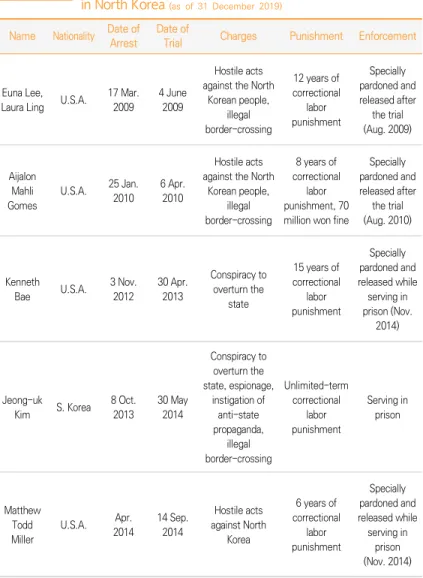
Treatment of Americans detained in North Korea worsens..Longest block of consular access,” VOA, August 8, 2016; "The United States on the other hand, for South Koreans detained in North Korea, there appears to be a violation of the general right to a fair trial, including the right to obtain assistance from a lawyer.
Evaluation
As far as South Korean people are concerned, there is a complete violation of the right to a fair trial and the right to receive assistance from a lawyer. Everyone has the right to the protection of the law against such interference or attacks." Article 17 of the ICCPR also provides for the right to privacy.
Infringement of Privacy through the Resident Monitoring System
The Resident Administration Law245 issued in 2010 specifies in Article 9 that “a People's Unit (inminban) is the basic unit of the state and society and the basis of residents' lives in North Korea.” According to Article 9 of the Resident Management Act, the number of households to be grouped into a People's Unit (inminban) is determined by the Cabinet.