Building on the discourse analysis of qualitative interviews with Kazakhstani women (59–69 years old), this study points to multiple, complex and contradictory discourses around old age, aging and gender that permeate and shape the social lives of older women in contemporary Kazakhstan. Nevertheless, this research also shows that older women are not passive recipients of societal discourses about gender and aging. First, this study points to multiple, complex, and contradictory discourses around old age, aging, and gender that permeate and shape the social lives of older women in contemporary Kazakhstan.
Second, this study reveals fluid and varying discursive self-representation strategies that older women use to negotiate their identities and roles. This study also shows that older women are not passive recipients of societal discourses about gender and aging. Additionally, this study contributes to the literature on older women's caregiving to others.
How do older women in Kazakhstan relate to the dominant societal discourses on aging and gender. What discursive strategies do older women use to negotiate aging and gender roles and identities as older women.
Methodology and Literature Review Research design and methods Research design and methods
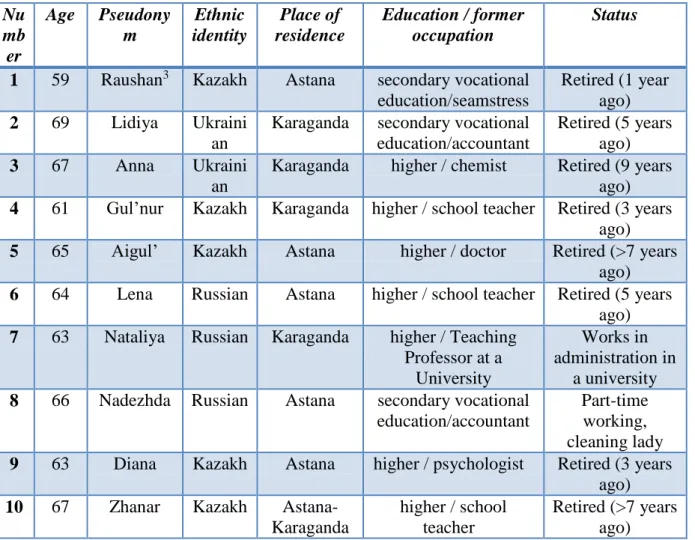
It turned out that women of the relevant age approached on the streets were suspicious and busy to a degree I did not expect (which points to my stereotypes about elderly women who are talkative and have a lot of free time). Therefore, due to a snowball recruitment strategy, most of the study participants are well educated (7 have higher education and 3 have a secondary vocational education). The risks to participants were assessed as minimal due to the nature of interview questions.
However, it is important to note that I understand that aging, as well as family, and memories of the past can be sensitive and even intimate topics for some individuals. So, I suppose that I am a key instrument in the analysis of the study, because it is my point of view, response and interpretation of the issues under consideration. This leads us to the spread of the stereotype that aging is a degradation of the body.
Thus, one of the important discourses of ageism in relation to the biomedicalization dictates that it is normal that one inevitably becomes abnormal with aging regardless of diversity of experiences, diseases and cases. However, criticism of the idea of aging positively and successfully points to its blindness to the diversity of aging experiences. This underlines the importance of paying attention to historical and cultural patterns that also shape the experience of ageing.
The analysis of the interview data points to the discursive construction of oldness that is contextual. Here, the woman agrees that she is older because of the health problems that she considers to be a result of aging. Yet, due to the persistence of ageist stereotypes, Lena shifts the identity towards the one who is "sick" of old age.
This is an example of fluid identity in research participants around different understandings of oldness. She differs from the women in the same age category who come to the festivities and then just sit, eat and discuss what is going on. Inability to even represent someone who is not old is undesirable at her age because of the stereotypes of the others.
Gul'nur shifts the responsibility for the "dress code" of the elderly to their family members, who should help them materially or give them advice on appearance. Although aging women are not completely freed from the dictates of beauty and femininity due to anti-aging discourses, due to certain socio-cultural expectations about later life, they are able to liberate themselves by shifting their identity against limitations. life period.
Caregiving: Negotiating Ageing, Gender Roles, Society and Culture
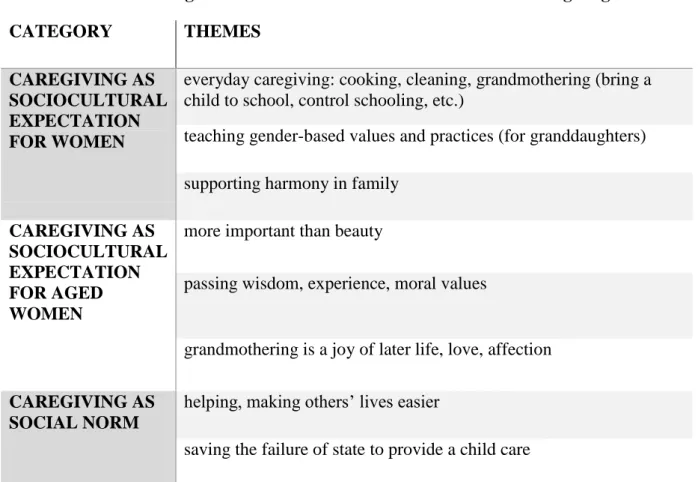
Second, the arguments about the importance and complexity of negotiating care are outlined. Domestic duties make up much of the older women's time, even if they have husbands who are also retired. But later in the conversation, talking about herself, she admits that she does not like to cook, but has to do it because of the various reasons that make up the complexity of care.
Furthermore, some of the research participants who have grandchildren emphasize the need to pass on caregiving skills to them. In general, caregiving as a grandmother is a significant facet of the aging experience for the women in this study because it fulfills cultural life course expectations well. Some of the participants who are involved in the care as a grandmother highlight the importance of the positively interpreted emotions such as love, affection,.
In addition, the older women in the study support the ideal image of an elderly person who takes responsibility for solving some problems instead of being a burden to her family. He believes that one of the reasons for this is general social anxiety and insecurity. In the part of the interview that relates to this discussion, Gul'nur shows that the well-being of her family is more important than her own comfort and pleasure.
Regarding everything related to money, many of the research participants, while discussing their financial situation, immediately made a connection with their families and emphasized the "giving" aspect. Many of the older women in the study emphasize the themes of time off from work and the desire to provide their families with perfect conditions to compensate for the difficulties of the outside world. These intentions would be impossible if the women continued to be involved in the labor market due to the time issue.
Thus, one significant reason for grandmothering is that while parents must work, it is the elderly women who save the failure of the state to provide accessible and affordable care for children. Therefore, some of the research participants acknowledge their contribution as educators to the success of their grandchildren. However, such a specific model where a grandmother is a participant in the educational process of her grandchildren does not work for all elderly people in the study and, unlike Anna, many of the research participants play a more indirect educational role.
Finally, in addition to the intention for the intellectual development of grandchildren, the research participants emphasize moral development as an important part of being a grandmother. In the same way, most participants interpret caring practices as something that gives meaning to their lives compared to older men who often lose purpose in retirement.
Discussion of analyzed data
- PARTICIPANTS, DATA
- RECRUITMENT OF PARTICIPANTS
- COMPENSATION
- POSSIBLE RISKS
- POSSIBLE BENEFITS
- CONSENT PROCESS
- PARTICIPANT WITHDRAWAL
- CONFIDENTIALITY
Although research participants may insist on continuity initially, when they shift their age identity to understand it as a later life stage, they reassess the extent of continuity and its boundaries. They may assure that without makeup they will not go out anywhere, but later insist on makeup that should not be too bright due to age limits. Participants internalized the division into private and public domains where women should normally be good at housework and family-oriented, even though most participants are educated and involved in the labor market in Soviet and post-Soviet times. the Soviet Union successfully balancing both. spheres.
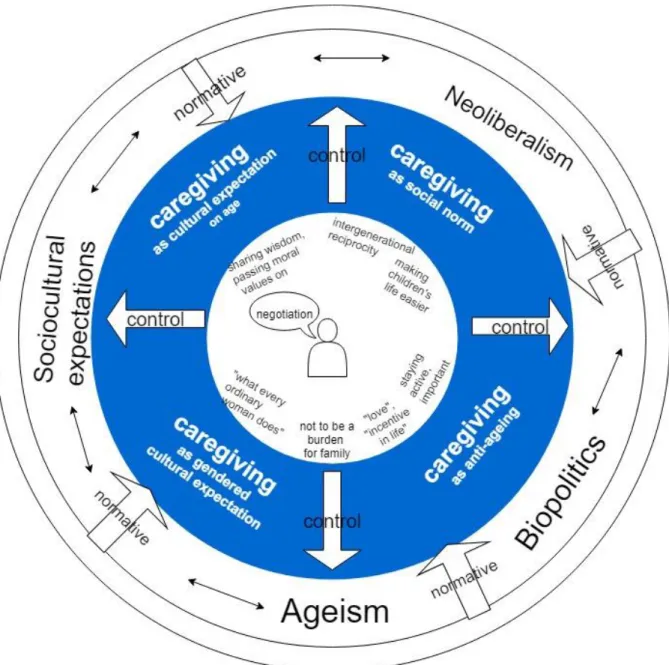
While cultural expectations based on older age dictate a woman to change lifestyles and, in the words of the research participants, "to act the age," this is not about caregiving. One can interpret the diagram from the center of the circle or from the larger one because societal discourses and the research participants' discursive strategies of self-representation and representation of others work both ways and interconnected. The outer circle that illustrates social discourses is by no means fixed, rather it is in constant motion because ageism, sociocultural expectations, biopolitics, neoliberal values permeate the entire experience of the elderly women in Kazakhstan.
Instead, they remain qualitatively different from Western anti-aging expectations due to the respect for and limitations of the sociocultural environment in which they live. Furthermore, this dissertation contributes to the literature on caregiving as it highlights the importance of older women as caregivers. and the complexity of healthcare practices and negotiations in general. This study also points to future research among older women that will focus more attention on the research participants who are older (70+), as it is primarily a different cohort, which is an important determinant in studies of social become older.
Also, the emphasis should be placed on the economic situation of the research participants from diverse socio-economic backgrounds because I believe the results can differ significantly when one experiences a serious lack of money. The making of the aged body In C. Busy bodies: Activity, aging and the management of everyday life. However, confidentiality of the personally identifiable information will be maintained throughout the research and thereafter.
There will be no difficulty in understanding informed consent, because it will be given in a language convenient for the participant (Russian or Kazakh), printed in large font, and all necessary procedures will be carried out to ensure that all points in consent is clear. First, the researcher will approach people in my neighborhood, local mini-bazaars, public transport and explain the description of the research and its purpose, qualified criteria for it and invitation to participate. DATA SECURITY, STORAGE AND ACCESS. a) Data (including written records and audio recordings) will be protected by password-protected software during the conduct of the study and dissemination of results.