To my friends in the Nazarbayev University community, I am grateful for the meaningful discussions, constructive debates, and invaluable advice we have shared about our career aspirations. I am also grateful to my soccer team (Aspi & NUIS) and my roommates, James, Bright, Shakur, Emeka (coach), Adil, Halmat, Fatai, Tooeb and others for the cherished memories and the opportunity to lead you into every game. In addition, I would like to express my appreciation to my colleagues in the mining engineering department, especially Nuiralym, Aida, Milena, Almas and Olhaz, for making me feel welcome as an international student.
INTRODUCTION
- Problem Statement
- Aims and Objectives
- Method
- Originality of the Thesis
- Significant of the Thesis
- Scope of the Thesis
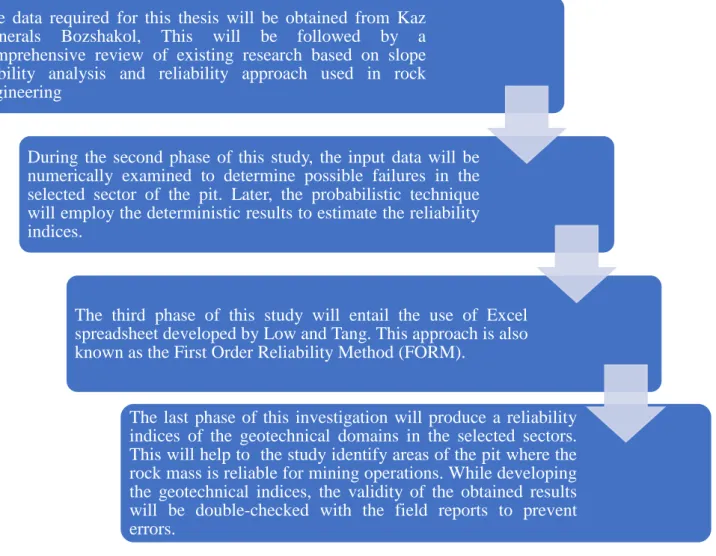
5 To provide recommendations for the Bozshakol mine based on the analyzed results to increase the reliability of the pit slope for safety during operations. To determine the reliability indices of the slope design in each domain, the integrated table of the first-order reliability method developed by (Low & Tang, 1997) is used. The final phase of this investigation will produce a reliability indicator of the geotechnical fields in the selected sectors.
LITERATURE REVIEW
- General Concept and Principle of Pit Design
- Slope Stability Analysis
- Failure Mechanism
- Wedge Failure
- Planar Failure
- Toppling Failure
- Circular Failure
- Geotechnical Domain Modelling
- Geotechnical Pit Slopes Design Methods
- Empirical Methods
- Analytical Methods
- Numerical Methods
- Observation Methods
- Survey Monitoring
- Uncertainties in Geotechnical Engineering
- Concepts of Reliability Analysis Approach
- Second Order Reliability Method (SORM)
- Monte Carlos Simulation Method
- Existing Reliability Approach for Pit Slope Analysis
However, it is essential to carefully determine the slope angle to avoid the risk of the rock formation collapsing. Rock mass properties include the physical and mechanical properties of the rock mass, such as strength, durability, and deformation behavior. However, the reliability of pit slope design can be affected by various factors, including ore geometry, rock mass conditions, and financial constraints during ore extraction.
However, one of the disadvantages of this approach is that the results of the rock slope design will not give the best results. However, the reliability of the slope design will not provide accurate results due to.
DESCRIPTION OF BOZSHAKOL MINE
- Introduction
- Geology of Case Study Area and Reserve
- Mining Operations at Bozshakol Mines
- Drilling and Blasting Operation at Bozshakol Mines
- Geotechnical Sectors at Bozshakol Mines
- Field Data Collection
- Data from Slope Monitoring System
- Data Description
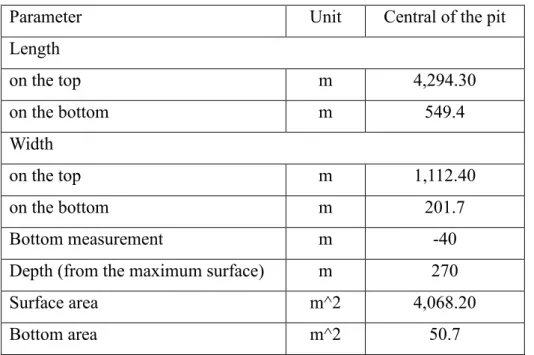
The development of the deposit is carried out with 10 m edges, and several intermediate elements define the limits of the pit. Due to the characteristics of the deposits, different slope orientations for the proposed cave slope wall within the structural domains must be considered. Most of the geotechnical information used for the feasibility assessment was collected from 21 boreholes sunk specifically for geotechnical investigations.
The goal was to develop a comprehensive geotechnical model that could effectively assess the stability of the pit slope. These data sets were carefully examined and processed to identify patterns, trends and anomalies that could affect the stability of the pit slope. The results of these analyzes provided critical insights into the characteristics of the rock mass, which were crucial to the development of the geotechnical model.
The stone mass assessment, which acts as an indicator of the competence of the stone mass, has been found to vary from good to very good. This discrepancy between the field observations and the radar reports raises questions about the actual stability of the rock mass in this sector. The results of such an analysis would provide valuable insights for developing effective mitigation measures and ensuring the safe and sustainable operation of the Bozshakol mine.
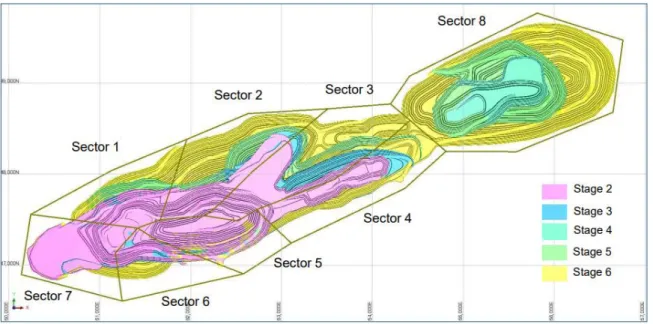
The selected data for this thesis will be obtained in Sectors 2 and 6 of the deposit.
NUMERICAL MODELLING
Introduction
Limit Equilibrium Method with SLIDE 2 (LEM)
- Procedure of Slope Stability Analysis with Slide 2
- Results
- Discussions
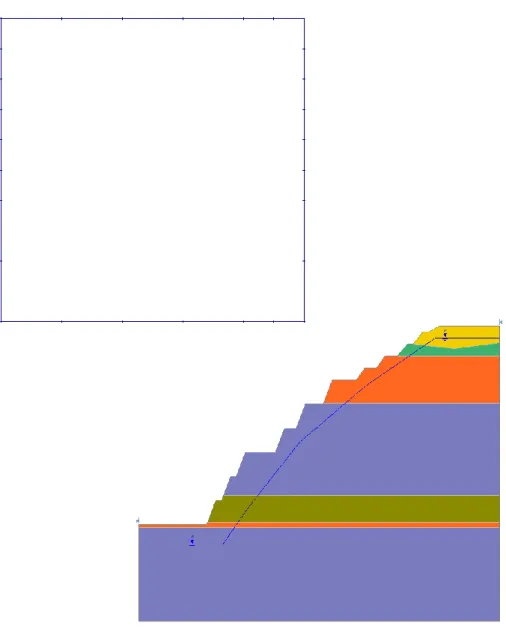
The geometry of the model of the selected sectors was outlined based on the geometry and topography of the cave. Based on the value of the input parameter, as shown in Table 3.4, the model is therefore assigned according to their boundaries and material properties;. Figures 4.2 and 4.6 provide a visual representation of the Sector 6 and Sector 2 models used for slope analysis in the current study.
These parameters are critical in determining the behavior of materials under different conditions and play an important role in slope stability analysis. Accurate assignment of material properties is essential in capturing true slope behavior and providing reliable results. Additionally, to include the effect of water in the borehole, piezometric lines of the borehole geometry indicating the presence of a water layer were integrated into the model beyond the material boundaries.
This allows for a more realistic representation of the behavior of the slope, as the presence of water can significantly affect the stability of the slope. The results, as illustrated in Figure 4.8, showed that an increase in the depth during ridge analysis led to an increase in the values of the factor of safety. This observation highlights the importance of considering weak zones and their characteristics during slope stability analysis to accurately assess slope stability and develop effective mitigation strategies.
This additional step adds robustness to the analysis and provides a thorough understanding of the potential risks associated with slope stability.
Finite Element Method with SR2
- Model Set-up
- Results
- Discussion
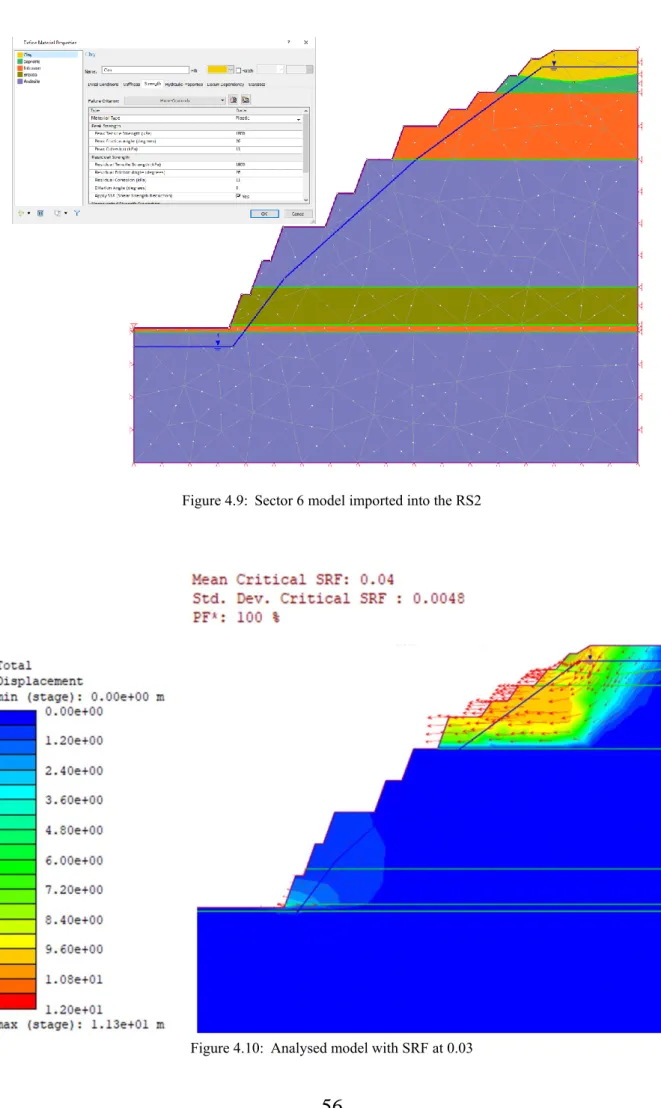
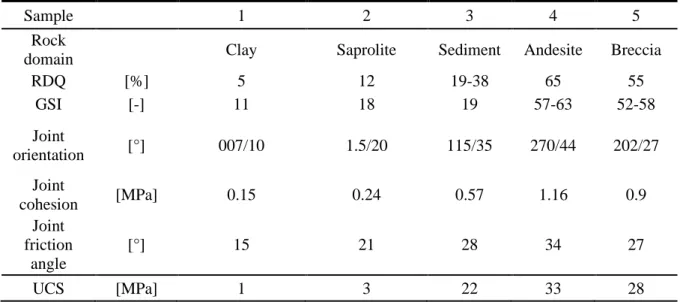
The figures presented in Section 4.3.2 provide a comprehensive overview of the RS 2 simulation, shedding light on the results obtained. In particular, Figure 4.9 visually shows the import of the Slide 2 model, which consists of almost 500 meshes, showing the complexity of the simulation. Furthermore, Table 3.5 provides valuable information about the allocated ranges of values for the input parameters corresponding to the different rock properties in the case study area.
Upon careful analysis, it is clear that there are significant differences in the geotechnical properties of the rock mass in different domains. This information is critical to understanding the behavior of the rock mass and the potential for slope instability in different domains. The impact of these geotechnical properties on the stability of the slopes is evident in the simulation results.
This highlights the sensitivity of the slopes to changes in the critical SRF and the need for careful consideration of this parameter when analyzing slope stability. In conclusion, the RS 2 simulation results provide valuable insights into the geotechnical properties and slope stability of different domains in the case study area. The assumed values of input parameters, based on available data, emphasize the need for further investigation and accurate characterization of the rock mass.
Proper pit design, planning and careful consideration of critical SRF are essential to reduce the risk of slope instability and ensure safe mining in the study area.
RELIABILITY ANALYSIS
- Introduction
- Reliability Analysis with FORM
- Method Set-Up
- Discussions
- Results Comparison
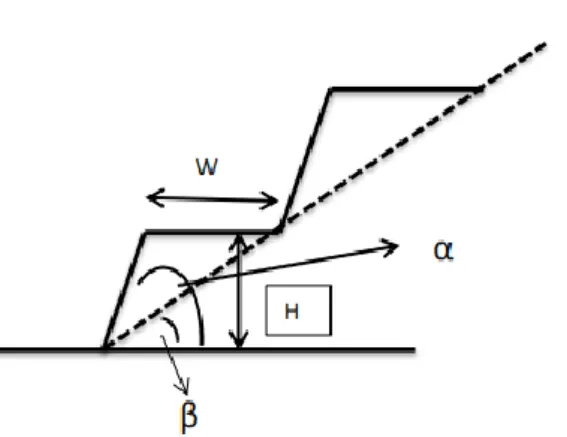
These input parameters were carefully selected based on their importance in determining the stability of the slope. The spreadsheet uses these input parameters to estimate the stability and reliability of the pit slope design. The designations for the input parameters in the FORM spreadsheet are as follows: RQD/Jn is given as P1, joint friction angle φ as P2, and pit bench width/height ratio (W/H) as P3, as shown. in figure 5.1.
The mean values and standard deviations of the input parameters are assigned to cells C2:C4 and D2:D4, respectively. To estimate the reliability index (β) for the selected sectors, the design point 𝑥∗ is initially assigned as the average values of the input parameters. The use of the FORM spreadsheet and the selection of input parameters based on the geotechnical data and their correlations are crucial for accurately estimating the reliability indices (β) of the geotechnical sectors in the well slope design.
This information provides valuable insights for decision-making and risk assessment in overall stability analysis and pit slope management, ensuring safe and sustainable mining. A summary of the estimated reliability and probability of failure indices for Sector 6 is clearly and concisely presented in Table 5.6, providing valuable insight into the performance of the various geotechnical areas within the sector. However, the propagation of this rock mass movement has not had a significant impact on the mining activities in the geotechnical sectors, as the velocity of the materials tends to re-stabilize rapidly at 0.65 mm/h, as shown in Fig.
In addition, laboratory tests performed on intact rock mass properties further supported the field observations and strengthened the validity of the findings.
CONCLUSIONS AND RECOMMENDATIONS
Conclusions
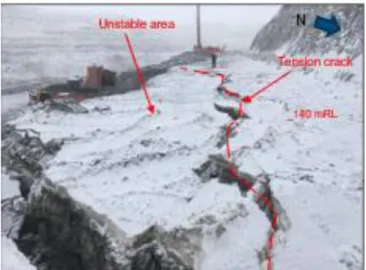
Additionally, other factors such as snowfall, weathering, and erosion may also play a role in weakening the rock mass in domains #1 and #2. The presence of snow during the winter period, for example, can cause cracks and fractures in rock due to the expansion and contraction of water as it freezes and melts, respectively. Also, occurring over time due to exposure to atmospheric conditions, it can change the properties of the rock mass and reduce its strength.
Furthermore, erosion caused by water or wind action can remove the protective soil cover from the slope, exposing the rock mass to potential failure mechanisms, leading to the possibility of rock falling from the upper bench, posing a risk to mine personnel and mining operations. activities in the immediate area.
Recommendations
However, because this slope stability analysis is a complex and multi-faceted field, there are other factors in addition to the input parameters that can influence the instability of this rock mass. For example, ground vibrations caused by explosions, changes in the strength of rocks due to weathering or geological processes, and the orientation and characteristics of rock joints can all affect slope stability. Therefore, further research is needed to better understand the complexities of slope stability analyzes and to consider other influencing factors to ensure safe and economically viable slope designs in mining and geotechnical engineering practices.
Uncertainty and reliability analysis of open pit rock slopes: a critical review of analysis methods. Stability analysis of the northeast slope of Daralou copper open pit mine against a secondary tilting fault. Reliability analysis of a rock slope based on plastic limit analysis theory with multiple failure modes.
Paper præsenteret på Slope Stability 2007: Proceedings of the 2007 International Symposium on Rock Slope Stability in Open Pit Mining and Civil Engineering.