The EEU policies simplified the procedure to obtain legal labor status for labor migrants from the member states. This thesis analyzes the EEU and Kazakhstani legislation regarding labor migration as well as opinions and experiences of Kyrgyz workers, experts and officials. It aims to clarify which factors prevent a positive effect of the EEU policies on legal low-skilled labor migration from Kyrgyzstan to Kazakhstan.
The EEU has not promoted the acquisition of legal labor status among Kyrgyz workers as many of them continue to work without employment contracts. The gap between law and reality is determined by a discrepancy between EEU policies and Kazakhstan's domestic legislation. The issues of self-employment and permanent residence, which are critical for labor migrants working in Kazakhstan's commercial sector, are not addressed by the EEU treaty.
The EEU as A New Opportunity for Labor Migrants
Citizens of the EEU should have easier access to a labor market in any member state. Therefore, I am interested in what obstacles prevent EEU policies from having a positive effect on legal low-skilled labor immigration from Kyrgyzstan to Kazakhstan. In light of the EU example, EEU member states could expect EEU policies to encourage an increase in legal migration of low-skilled workers.
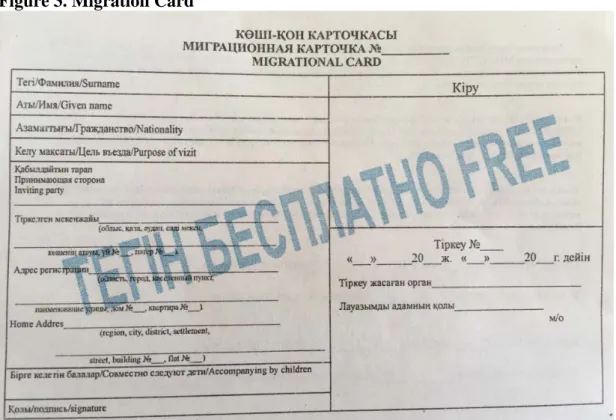
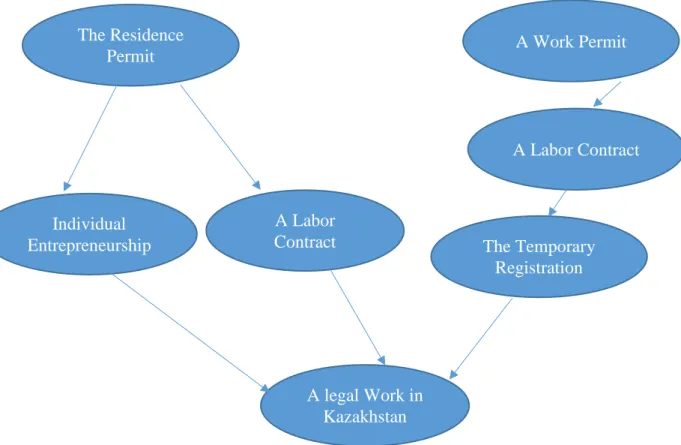
I argue that the EEU has not facilitated the acquisition of legal status among Kyrgyz labor migrants, as they continue to work without employment contracts. Citizens of EEU member states receive a migration card when entering Kazakhstan at the border crossing. Labor migrants from EEU member states have two options for legal work in Kazakhstan.
Overall, I am interested in whether EEU policies encourage low-skilled migrant workers to obtain legal employment status in a receiving country. This chapter then describes how the EEU simplifies the procedure for obtaining legal employment status for migrant workers from member states.

Setting Expectations for Migration Patterns
The difference between free trade agreements and a free movement of workers zone is that increased migration flows arise unintentionally from a decline in wages and unemployment, partly caused by free trade agreements and more generally by economic and demographic factors in the former case; Meanwhile, the second is a special policy designed to ensure that people from Member States have access to work throughout the territory of the zone. The migration process in the Eurasian region has been widespread since Soviet times (Laruelle 2007). The Eurasian Economic Union, as the regional organization that promotes the free movement of goods, capital and labor, could fit into the model of free movement of workers like the EU.
Thus, I address a gap in the existing literature and propose a question that needs to be explored: what are the factors that hinder a positive effect of Eurasian Economic Union policies on Kyrgyz legal low-skilled labor migration to Kazakhstan. The role of the state in regulating labor migration is mainly restrictive in nature and concerns a sufficient number of workplaces and the level of wages for natives (Chang 1998; Massey 1999). In the next section, we narrow our focus to free trade agreements and a free movement of labor zone to see how immigration policy works in such a framework.
In the next section of literature, I distinguish free trade agreements from free movement of workers zones. Free movement of workers is one of the primary principles written in the Treaty on the Functioning of the European Union, Article 45. In the EU case, it is interesting to observe the effect of the free movement of workers after an accession of new members in 2004 and 2007.
As we can see, the difference between FTAs and an area of free movement of workers is that increased migration flows inadvertently result from a decrease in wages and unemployment caused partly by free trade agreements and more generally by economic factors and demographics in the first case. The expected findings suggest that EEU member countries would expect EEU policies to increase the number of legal migrants with low labor skills. However, the visa-free regime between EEU countries makes it easier for unauthorized employment migration to continue in the region.
Therefore, I am interested in the barriers to a positive effect on legal high-skilled labor migrants from Kyrgyzstan to Kazakhstan after the change in labor migration regulations.
The Gap Between Legal Prescriptions and the Reality on the Ground
I will observe how the EEU's labor migration policy should be implemented – the law, the vision of state institutions and experts. First, I discuss the details of Kazakhstan's domestic legislation on the registration of Kazakh citizens and foreigners. Foreign workers” are immigrants invited by employers to work on the territory of the Republic of Kazakhstan (including intra.
The establishment of the Eurasian Economic Union serves, in theory, to simplify access to work and legal status for migrant workers. In the following subsections, I consider the main components of the EEU's policies on labor migration that are important in the context of my research. On paper, there are a number of advantages for migrant workers' opportunities to work officially in one of the EEU member states.
The new EEU policy simplifies the procedure to become legal workers for nationals of member states. To enjoy the benefits of the new EEU policy, migrant workers must follow the above procedures. It must be taken into account that only foreign workers with “work” can obtain legal employment status under the conditions of the EEU.
The duration of the temporary registration depends on a term of these employment contracts.13 (EEU Treaty, Article 97). The new EEU policies promise many advantages for labor migrants from member countries, especially the simplification of the procedure for obtaining legal work status. Interviews with key EEU policy actors, labor migrants from Kyrgyzstan, show that membership in this regional organization has little or no impact on improving their legal status in Kazakhstan.
The introduction of the EEU simplified the legal status of paper work in the following way. After that, citizens of EEU states can register within 30 days for the duration of their employment agreements. Experts of the non-governmental organization claim that many Kyrgyz labor migrants are poorly educated and therefore lack legal knowledge.
Exploring the Life of Kyrgyz Labor Migrants in Bazaars: What Hinders Their
Many Kyrgyz working in the bazaars would like to obtain legal employment status.31 Legal employment status would allow migrants to stay in Kazakhstan for the duration of their work. 28 Interview with one expert of an international organization working on migration research in the region, Astana, December 2016. Thus, Kyrgyz labor migrants continue to work without the required papers in bazaars in Kazakhstan.
In the next section, I will look at how the misinterpretation of the new EEU policies can affect Kyrgyz labor migration. In the case of Kyrgyz labor migration in Kazakhstan's trade sector, bureaucrats' misinterpretation of new EEU policies led to complications in obtaining legal work status. However, in interviews conducted in Astana bazaars, I found that many Kyrgyz workers in the retail sector are aware of Kazakhstan's labor migration laws.
One factor that may influence a lack of legalization among Kyrgyz workers in the trade sector may be misinterpretation of the new EEU policy by government officials. My evidence may only indicate that labor migrants have the opportunity to work legally in the bazaars if individual entrepreneurs (citizens or residents of Kazakhstan) hire them and sign employment contracts. The necessary amount of money in a bank account to obtain the residence permit is enormous for many Kyrgyz women who work in the bazaars.
Therefore, many Kyrgyz workers continue to sell their goods without the required documents in the bazaars. Meanwhile, some employers in Kazakhstan's markets are unwilling to hire migrant workers due to the administrative burden of obtaining legal status for them. Although migrant workers in the bazaars are entitled to a labor contract, the official institution may hinder the process of their legalization by misinterpreting the new EEU policy.
Specifically, the issues of sole proprietorship and residence are not addressed in the EEU treaty.
Concluding Remarks, Issues for Further Research, and Contribution
Kyrgyzs working in Kazakhstan's bazaars are willing to work legally but face obstacles in obtaining legal employment status. The EEU does not address the issues of individual entrepreneurship and residence, which are necessary to legally sell goods in the bazaars. Therefore, many Kyrgyz workers prefer to sell their goods at the bazaars without the required documents.
The EEU does not address the issues of individual entrepreneurship and residency needed to legally sell goods in the bazaars. So they continue to work in the trade sector of Kazakhstan without the required documents. First, I conduct the interviews with Kyrgyz labor migrants and employers who work only in the trade sector in Kazakhstan.
Another improvement that can be achieved in the next studies on low-skilled labor migration within the EEU is to obtain more quantitative data. We have to wait and observe some improvements and changes in EEU policies over a longer period of time. Migration in the CIS Region: Common Problems and Mutual Benefits.” Presented at the International Symposium on International Migration and Development, Turin.
The impact of the global economic crisis on remittances in the Commonwealth of Independent States.” Eurasian. On the rules for confirming the solvency of foreigners and stateless persons who apply for a permanent residence permit in the Republic of Kazakhstan, during their stay in the Republic of Kazakhstan. November 25. On the approval of the standard for the provision of public services for issuing certificates to stateless persons and residence permits for foreigners permanently living in the Republic of Kazakhstan." December 14.
Migration to the countries of the former Soviet Union". Prepared for the Policy Analysis and Research Program of the Global Commission on International Migration.