Linara Akeshova
Managing Stakeholder Expectations in ensuring Democratic Elections: The Case of Kazakhstan and the European Union
Thesis Spring 2023
Degree Programme International Business Management (IBM)
THESIS ABSTRACT
SEINÄJOKI UNIVERSITY OF APPLIED SCIENCES
Degree Programme: International Business Management (MBA) Author: Linara Akeshova
Title of thesis: Managing Stakeholder Expectations in Ensuring Democratic Elections: The Case of Kazakhstan and the European Union
Supervisor: Aho Anne-Maria
Year: 2023 Number of pages:73 Number of appendices: 9
1
The focus of this thesis is on businesses’ involvement in the electoral process of Kazakhstan.
The aim is to examine the role of the business sector in the electoral process and to identify the pros, cons, and tactics of its involvement in the elections, which will positively impact the democratization process of Kazakhstan and improve the management of stakeholders’
expectations regarding the electoral process.
Therefore, this thesis attempts to answer questions on the impact of the involvement of the business sector on the electoral process, whether it should be involved in the electoral process, as well as how the involvement of the business sector in the electoral process could be improved. The thesis study was conducted using research methods such as content analysis, literature review, case study, the PEST method, and survey. The theoretical background of the study consisted of an analysis of the overall picture of elections in good governance, a deep analysis of pros, cons of businesses’ involvement in the electoral process, and it sheds light on the issues of business-state relations, tactics for businesses’ participation, and the impact of businesses’ involvement in the electoral process. Within the framework of the empirical analysis of the study, a survey was conducted among business representatives from Kazakhstan to examine the current situation of the election process in Kazakhstan and the involvement of business in this process.
In conclusion, the author suggests that the business sector should support its involvement in the electoral process and agrees on its positive impact on business development as well as on the economic conditions of the country. At the end of the thesis, practical recommendations to further improvement businesses’ involvement are proposed.
Keywords: electoral process, Kazakhstan, business sector, lobbying
ACKNOWLEDGMENTS
I would like to express my special gratitude to my both supervisors from Kazakhstan and Fin- land Aigul Bedelbayevna KOSHERBAYEVA and Anne-Maria AHO for their time and efforts they provided throughout the year. Their useful advice and suggestions were helpful to me during the Master Project completion. In this regard, I am grateful to both of them.
Also, I would like to take this opportunity to thank my mentors from Kazakhstan and Finland Baurzhan Nurlanovich BOKAYEV and Harrison OKUOGUME for their contribution during the preparing process.
Finally, to my caring, loving and supportive family: my deepest gratitude. They supported me in this difficult decision to go far from home to improve my knowledge and skills both in the public policy and international business spheres.
TABLE OF CONTENTS
ACKNOWLEDGMENTS ... 3
TABLE OF CONTENTS ... 4
Pictures, Figures and Tables ... 6
Terms and Abbreviations ... 7
1 INTRODUCTION ... 8
1.1 Background of the study ... 9
1.2 Purpose of the study ... 10
1.3 Research problem and research question ... 11
1.4 Research methods ... 12
1.5 Structure of the study ... 13
2 THEORETICAL BACKGROUND – BUSINESSES’ POLITICAL PARTICIPATION: PROS, CONS AND TACTICS ... 15
2.1 The role of elections in good governance ... 15
2.2 Interaction of business and government ... 17
2.3 Pros of businesses participation in the election process ... 21
2.4 Cons of businesses participation in the election process ... 23
2.5 Tactics for businesses participation in the election process ... 25
2.6 International experience of involvement businesses in the election process ... 28
3 METHODOLOGICAL APPROACH OF THE THESIS ... 32
3.1 Research methods ... 32
3.2 Data collection ... 33
3.3 Data analysis ... 35
3.4 Reliability of the study and limitations ... 37
4 EMPIRICAL ANALYSIS OF INVOLVEMENT OF BUSINESS IN THE ELECTION PROCESS ... 39
4.1 Election process in Kazakhstan ... 39
4.2 Participation of business in the election process of Kazakhstan ... 45
4.3 Results and analysis ... 50
5 CONCLUSIONS AND RECOMMENDATIONS ... 61
5.1 Recommendations ... 61
5.2 Conclusion ... 63
5.3 Suggestions for further study ... 68
BIBLIOGRAPHY ... 68
APPENDICES ... 75
Survey quesstionnaire ... 75
Pictures, Figures and Tables
Figure 1. The process of answering to research questions……….10
Picture 1. Age of respondents………...32
Picture 2. Period of functioning of respondents’ companies………32
Picture 3. Monthly turnover of businesses...33
Picture 4. Necessary conditions for the involvement of business...48
Picture 5. Assessment of the involvement of the business in the election process...48
Table 1. Voluntary donation limits...39
Table 2. Funding of political parties...42
Table 3. Results of parliamentary elections 2023...44
Table 4. Distribution of deputies among political parties...45
Table 5. PEST-analysis...46
Table 6. The impact of businesses participation in the election process...49
Table 7. Main results of the thesis...49
Terms and Abbreviations
CEC Central Election Commission
TEC Territorial Election Commission UNDP United Nation Development Program
OSCE Organization for Security and Co-operation in Europe SCO Shanghai Cooperation Organization
CIS Commonwealth of Independent States
Mazhilis of the Parliament Lower house of the Parliament of the RK Senate of the Parliament Upper house of the Parliament of the RK Maslikhat Local representative body of the Parliament
1 INTRODUCTION
To start with main principles of democracy include respect for human rights and funda- mental freedoms as well as the principle of holding transparent and democratic elections.
According to Katz (1997) participation in political and public life plays a crucial role in pro- moting democratic governance, the rule of law, social inclusion and economic develop- ment as well as promoting human rights. Thus, one of the main goals of the state is to en- sure participation of citizens in the election process in order to develop democracy and empower the rights of citizens and other interested parties in the political system.
It is worth noting that electoral systems and processes are considered one of the main characteristics of democracy and the fundamental difference between democratic and au- thoritarian states is that in democratic states decisions are made directly (at referendums) or indirectly (through alternative elections) and approved by citizens (Rosanvallon, 2018).
Therefore, electoral activity in the political culture of citizens is the most massive and legiti- mate form of political activity.
Moreover, Kjaer (2023) states political values create the core of good governance and de- rives in democratic political culture. Thus, political pluralism, transparent government and fair election processes are crucial factor in strengthening good governance (Kjaer, 2023;
Rothstein, 2012). However, international community has aim to ensure human-centered development and fundamental human rights through good governance since citizen or man play the key role in building strong state ecosystem.
Election process is considered as democratic tool that ensures direct citizens’ participation and one the fundamental constitutional right to take part in decision-making process.
Election process as a complex issue in Kazakhstan includes involvement of multiple stakeholders such as central and regional state bodies, NGOs, political parties,
international organizations, citizens and business actor. The role of every stakeholder is crucial in implementing transparent, democratic and fair elections that directly affects further development of the state. Therefore, managing stakeholders’ expectations includes provision with all necessary information on election cycle, enhancing legitimacy, increasing participation rate and other related issues.
Moreover, according to the international experience businesses plays crucial role in the election process and impacts political decisions, however in Kazakhstani context the pro- cess of businesses involvement in the election cycle is understudied by scholars and this thesis attempts to deeply analyze the role of business in the election process of Kazakh- stan and how to improve their participation.
1.1 Background of the study
The main figure in the election process is citizen and according to the Article 3 of the Con- stitution of the Republic of Kazakhstan (1995).
1. The people shall be the only source of governmental power.
2. The people shall exercise power directly through national referendum and free elec- tions, as well as delegate the execution of their ability to state institutions.
Considering this human-centered politics could be assumed to be accountable when it holds elections, especially when ensures free and fair election process. Following this, the Constitution covers fundamental human rights enshrined by giving rights to voters to par- ticipate in decision making process of the country.
Moreover, Clawson et.al. (1986) argue participation rights are also inextricably linked to other rights such as the rights to peaceful assembly and association, freedom of opinion and expression and the rights to education and information. However, election process is complex issue that include different stakeholders and not only citizens, state bodies,
NGOs, international community that are the part of election process, there is also business actors should be involved in election process (Clawson et. al.,1986). Therefore, managing stakeholders’ expectations includes provision with all necessary information on election cy- cle, enhancing legitimacy, increasing participation rate and other related issues.
If we come to the issue of interaction of business and government is widely discussed among scholars since evolution of market economy shows us trends of highly connected government-business relationships that directly affect national economy and legal frame- work of state policies. According to Henderson (2005) business plays vital role in creating workplaces, decreasing the role of state as donor for governmental programs as well as
business are providers of social services and even could help to state apparatus to in- crease welfare of citizens. As it was mentioned before, the election process is the basis of creating democratic and prosperous state the role of business in election process is crucial (Henderson, 2005).
It should be mentioned that Kazakhstan as post-Soviet country is considered to be more state regulated and involvement of business in state policy or election process is new phe- nomena that emerged in recent decade. Even though Kazakhstani government was mostly authoritarian government and involvement of business in election process could increase citizens’ trust to governmental decisions and expand hope for beneficial changes in politi- cal system (Bilyalova, 2019). Therefore, there are several reasons for business to partici- pate in election process such as presenting the will of citizens or business actors as well as maximizing profit by lobbying own interests in legislative branch of the government (Bromley & Meyer, 2017).
Moreover, business could diversify the political representation in parliament and increase competition among political parties since the main goal in election process is to win and get more places in legislative body. However, there are also drawbacks for business ac- tors in involving in election process since business with high profit could have more oppor- tunities to protect own interests rather than small business, thus the involvement of busi- ness in election process is not constant and equal. Thus, government and business should implement mechanism of interaction in election process that provide equal opportunities for stakeholders and maximize the effectiveness of legislative branch as well as hold trans- parent and fair elections. Here it should be mentioned that the process of business in- volvement should be supported by state that creates diversity of choices for citizens during election process and it requires collaborative work for common goal of the state rather than reaching own goal of the political party or business actor.
1.2 Purpose of the study
The main purpose of the study is to evaluate participation of business in the election pro- cess in case of Kazakhstan, examine its role and impact on the democratization process and develop practical recommendations.
In order to reach the main purpose of the study, following objectives were identified:
− to analyze theoretical aspects of involvement of business in the election process;
− to study international experience of involvement businesses in the election process;
− to analyze impact of businesses’ involvement in the election process on political de- cisions;
− to examine current situation of business’ participation in the election process in Ka- zakhstan including legal framework;
− to analyze motives and incentives of involvement business in election process;
− to develop proposals based on the abovementioned analysis;
1.3 Research problem and research question
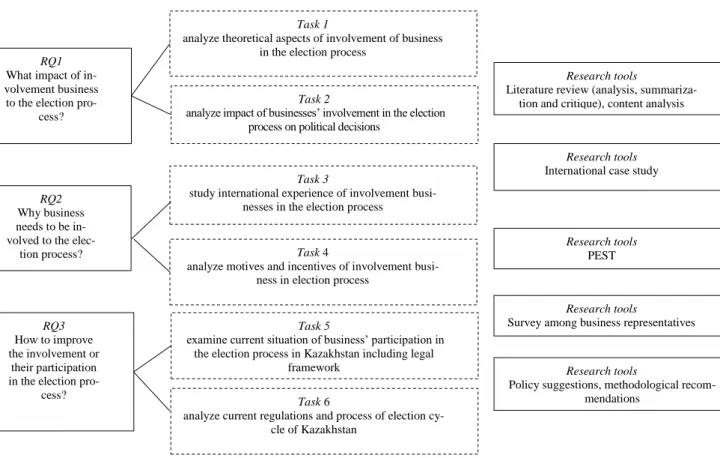
Considering the fact that business is one of the main stakeholders of the election process, there is still a need to clarify the impact of businesses’ involvement in the election process of Kazakhstan in the context of effective governance and role in political and economic de- velopment. There is a need to gain comprehensive reasons of business involvement in the election cycle, identify pros and cons, tactics of their involvement as well as understand whether business need to be involved or not. Moreover, this thesis attempts to shield the light on complex issue of state-business relationships and answering to previous questions will result in practical recommendations that attempts to improve business involvement in the election process and contribute to the literature on this field.
Figure 1. The process of answering to the research questions.
1.4 Research methods
Since the study of the interaction of business and government contains various perspec- tives of public administration, both qualitative and quantitative research methods such as content analysis, literature review, case study, PEST method and survey were applied.
The data collection techniques will consist of primary data that is survey results. Survey is conducted amongst business representatives to analyze their attitudes towards election process in Kazakhstan, used tactics and strategies to involve in this process as well as recommendations).
The secondary data included:
− governmental documents and legal acts that regulate the election process in the var- ious countries.
− scholarly journals, articles and academic books that were adapted from online data- bases and libraries.
− reports on non-governmental organizations that examined business in the election process.
Task 1
analyze theoretical aspects of involvement of business in the election process
Task 3
study international experience of involvement busi- nesses in the election process
Task 2
analyze impact of businesses’ involvement in the election process on political decisions
Task 4
analyze motives and incentives of involvement busi- ness in election process
Task 5
examine current situation of business’ participation in the election process in Kazakhstan including legal
framework RQ1
What impact of in- volvement business
to the election pro- cess?
RQ3 How to improve the involvement or
their participation in the election pro-
cess?
Research tools PEST Research tools
Literature review (analysis, summariza- tion and critique), content analysis
Research tools International case study
Research tools
Policy suggestions, methodological recom- mendations
RQ2 Why business needs to be in- volved to the elec-
tion process?
the good govern- ance of election
system?
Task 6
analyze current regulations and process of election cy- cle of Kazakhstan
Research tools
Survey among business representatives
− media sources that also presented business in the election process.
Moreover, in using secondary data, the researcher firstly analyzed the sources and used only reliable and relevant sources to the research topic.
In order to study international experience, the case study method was applied, and it is widely used in public administration studies since concentrates on current events, also it is applicable to study unique events in public administration (Van Thiel, 2014).
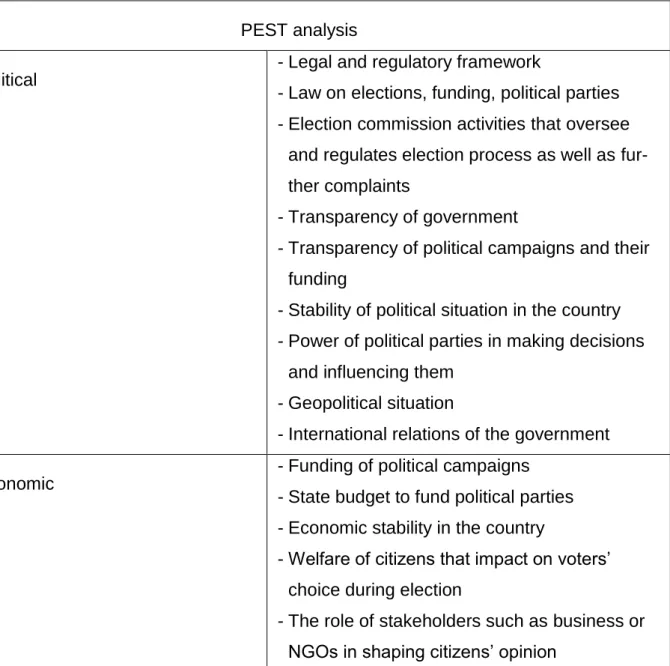
Moreover, PEST analysis could be useful to formulate strategic approach and explore ex- ternal factors of good governance concept in studied three areas since it contains analysis of Political (P), Economic (E), Social (S) and Technological (T) factors that influence to the object of the study (Ho, 2014).
1.5 Structure of the study
Chapter 1 is an introduction and covers background of the study and gives general over- view on significance of study involvement of business in the election process, identifies re- search problem and questions as well as objectives in answering them. In order to reach the abovementioned purposes and answer research questions this thesis has 5 chapters.
Chapter 2 firstly covers a theoretical approach to businesses’ political participation that co- vers tactics, pros, cons as well as international practice of involving business will be stud- ied based on literature review of scholarly articles, books, publication also official country reports of international organizations. Moreover, Chapter 2 aims to draw up theoretical background of the impact of businesses’ involvement in the election process and contrib- utes to the basis of further recommendations.
Following this, Chapter 3 is focused on describing applied research methods to study busi- ness involvement in the election process of Kazakhstan, data collection techniques, analy- sis of respondents of survey among business representatives, PEST analysis. In addition, Chapter 3 presents reliability and validity of the thesis.
Further, based on the results of qualitative and quantitative analysis, Chapter 4 covers em- pirical analysis of current situation of election process in Kazakhstan, legal basis of the election process, analysis of recently held election and the role of business in the election process of Kazakhstan. In addition, Chapter 4 aims to explore the issue political parties’
funding and its possible impact on the election results.
Finally, Chapter 5 concludes the findings of the previous chapters and summarizes main results of the theoretical and empirical analysis in order to develop policy suggestions to improve the involvement of business in the election process and proposes recommenda- tions for enhancing involving business in election process of Kazakhstan. Chapter 5 also provides author’s suggestions for further studies in this field.
2 THEORETICAL BACKGROUND – BUSINESSES’ POLITICAL PARTICIPA- TION: PROS, CONS AND TACTICS
The Chapter 2 of the thesis will be focused on the theoretical background of the businesses’
political participation in the decision-making processes that is widely discussed and could be considered as controversial topic among scholars.
First of all, Chapter 2 aims to answer questions on what is the role of elections in good gov- ernance? What are main relationships between business and state? The next aim of this part of the thesis is to examine literature on the advantages and disadvantages of businesses in- volvement in the election process that will help to answer research question on whether busi- ness needs to be involved in the election process.
Moreover, theoretical background of businesses’ used tactics in the election cycle as well as international experience on business participation in the election process will be examined in order to answer questions on businesses impact on decision-making process as well as to draw up recommendations on improving their involvement.
2.1 The role of elections in good governance
The concepts of governance and good governance were widely studied by scholars and Rothstein (2012) highlighted its importance in enhancing rule of law, democracy as well as fair election processes. In order to investigate and analyze the role of business in political participation it is needed to give definition of good governance, then pros, cons and tactics of business’s political participation will be discussed further in this section.
To start with, United Nations Development Program (UNDP) was one of the first organiza- tions who started to promote good governance worldwide according to its definition “good governance is decision making process and the process by which decisions are imple- mented and ensures that corruption does not occur, voices of minority and vulnerable members of society are accounted for, and that decision making is responsive to current and future needs of society” (Qudrat-I Elahi, 2009).
Moreover, political values create the core of good governance and derives in democratic political culture. Thus, political pluralism, transparent government and fair election pro- cesses are crucial factor in strengthening good governance (Kjaer, 2023; Rothstein, 2012).
Following this, according to Rothstein (2012) good governance covers various aspects of political system, however, this thesis will consider only business as a part of good govern- ance. As it was said good governance term also considers issues of cooperation and con- nections between government and non-governmental bodies such as NGOs or business actors since they contribute to the delivery of the public services through provision of maintenance, construction, advocacy, emergency help and so on. Consequently, in ensur- ing delivery of public goods to citizens and in increasing economy as well as effective state apparatus it is relevant also to consider the role of business in good governance that is central figure to analyze in this thesis.
In addition, good governance also implies to the phenomena of establishing networks of NGOs and other actors in contributing to the policy making processes, thus governance not only the way how states implement public policy, but how they maintain relationships with non-governmental bodies in ensuring economic and democratic development in the country (Smith, 2007).
However, there are 8 principles of democratic government such as freedom of expression, forming organizations, right to vote, free elections, holding political campaigns, diversity of information sources and public policy based on the need of citizens (Trebilcock & Chital- kar, 2009). Thus, in the same work author mention that election process could be consid- ered as main goal in democratization process of the country and it should include diverse stakeholders in ensuring transparent elections (op. cit.). During election process the true interests of citizens as well as interested groups could be observed, thus citizens vote for the party that more deeply express citizens’ needs and trust in further implementation of announced objectives. As a result, according to Schedler (2002) holding elections is one of the most important principles of democracy and openness of government that give oppor- tunities to express opinions of citizens could be assessed through fair and free elections.
The next issue is the development of political pluralism during election process, it means that group of people could form political party to express opinions and protect own inter- ests (Norris, 2003). Therefore, political pluralism helps to promote democracy, protect
rights of vulnerable groups of citizens as well as enhancing political participation through providing fundamental right of freedom of associations.
2.2 Interaction of business and government
Before proceeding to the study of the issues of involvement of between business in elec- tion processes, it is necessary to reveal the main conceptual aspects of the research topic and determine the essence of the category "interaction between the state and business".
Despite the fact that in recent years the government, business and scientists have made significant progress towards a common understanding of the term "interaction between the state and business", as before, there are many different points of view on its essence and content. Moreover, there is often no distinction between these concepts.
Poulantzas (2000) in his work mentions that Government has various functions such as investment source, catalyst for economic processes, provision of social services, planning and forecasting, stimulation of scientific and technological progress, creation of an innova- tion system, creation of a stable credit and financial system. Thus, government acts as the guarantee of economic and social rights of the population, environmental protection, elimi- nation of regional disproportions, differentiation of tax rates, etc. are the prerogatives of the state.
Within the framework of this study, state power will be considered as the ability of state au- thorities to regulate and coordinate in order to determine strategic guidelines in social and economic development, creation of basic conditions for business, increasing the economy as well as development and implementation projects at national level and scale (Osborne, 1993).
Whereas considering literature sources, business could be understood as the process of
"... self-renewal and self-organization of individuals and enterprises, carried out in interac- tion with the micro- and macro-environment of their functioning." (Rutland, 2018). This defi- nition shifts the focus from profit maximization to maximizing the businessman’s opportuni- ties
"... to satisfy the complex of his socio-economic needs within the framework of an unbalanced dynamic balance of conflicting socio-economic interests of the partic- ipants in this process - individuals, organizations and society as a whole.” (op. cit.).
Moreover, according to Frazier & Howell (1983) business is main driver of the national economy, the main donor of the state budget; leader of scientific and technological pro- gress, a large employer that significantly affects both the level of employment and the level of wages and the system of social and labor relations; an important factor in shaping the country's image in international community.
According to Needle & Burns (2010) functions of business could be considered as follow- ing:
− networking and operations between business and other actors in the economic sys- tem, for instance, consumers;
− exchange between different businesses and management of this process;
− develop new technological tools and processes, consumer products;
− government relations that consider interactions with state bodies or managing rela- tions with media.
In addition to certain functions, modern researchers distinguish innovative, modernizing, developing and social functions of business (Needle & Burns, 2010).
Therefore, under the “business” sector, we will understand entrepreneurial organizations of any form of ownership and amount of capital that are actively operating within the
corresponding administrative-territorial unit.
Considering this business and government interactions are intertwined with economy and possess mechanism for interaction of legislative and executive authorities with the
business community. This interaction finds its real embodiment in the unity of the diversity of various forms and directions: the creation of the infrastructure of the economic system directly, the provision of favorable conditions for the effective functioning of the economy;
formation and implementation of industrial policy; placement of state and municipal orders;
institutionalization of lobbying activities of business structures; institutional design of the corporate sector, etc.
Moreover, business and government interactions could also reflect the interests of society in order to regulate market relations, thus the state cannot do without business, just as business cannot exist without the state. The choice of ways and mechanisms to achieve effective interaction between business and government in is becoming in ensuring democ- racy and development of national economy. Thus, interaction between business and the state should be developed in optimal forms for political democracy and a market economy (Maxfield & Schneider, 1997). This means that the system of representation of business interests in public authorities must be flexible and have the ability to express not only aggregated, but also individualized interests. A legitimate place in it should be given to both big business and small business associations, the sector of microstructures and independent intermediaries.
No doubts that there could the problem in the relationship between business and
government, however, there is no consensus on the proper principles of relations between these actors of social life. The spread ranges from views on the state as an institution hostile to business, exercising its strict control and regulation, to ideas about the purely benevolent attitude of the authorities towards entrepreneurship, protecting it from
manifestations of foreign competition, about its technical and market support, cheap loans, etc.
Maxfield and Schneider (1997) argue that there could be opinions that the state that creates the conditions for the development of the economy and private entrepreneurship, also sets the parameters to the influence of entrepreneurs on social life. Thus, it seems absolutely natural and logical for business to participate in the formation of state policy.
To start with, Smith (2007) says that the state creates regulatory norms to carry out eco- nomic activities and conditions for free markets. In addition, individuals and corporations have not only agreements to carry out work, but also there are state laws and rules that actually make it possible to implement these agreements between economic agents, and state bodies give them legal authority and guarantee the execution of concluded contracts.
Moreover, according to Smith (2007), the state could use various tools such as reducing or raising taxes, tightening or weakening environmental legislation, rules for granting loans, increasing or reducing social programs, etc. in order to create economic market model to carry out business activities. Thus, these regulations and legal framework as well as state
tools could vary from country to country and vulnerable to changes according to existing trends in the society and economic situation in the country.
Furthermore, as Smith (2007) and Fisman and Khanna (2004) mention the state could be considered as the largest consumer and in many countries control at least a third of the gross domestic product. Although most of their activities are related to the redistribution of funds from taxpayers to recipients of state pensions, allowances, subsidies, etc., the role of the customer-buyer remains no less important. Next issue is that the state provides normal economic conditions for the work of entrepreneurs, maintaining an acceptable level of inflation and unemployment. For example, in the post-war period, many Western
countries pursued what is known as Keynesian policies, alternating between periods of increased spending and tax cuts to reduce unemployment, and phases of cutting social programs and raising taxes to fight inflation.
Doner and Schneider (2000) argue that political participation of business is highly related to economic and political situation in the country, even as a result of business participation could be increase in economic growth and efficiency of political system. However, the for- mation of certain models of interaction between business structures and public authorities depends on the previous experience of the country's development, the existing political culture and the established social, economic and political institutions.
It should be noted that the participation of business in politics can be direct and indirect.
Direct participation implies the arrival of a business representative in the executive and legislative authorities when he holds a public position. Whereas indirect participation ranges from financing the election campaign of a political party to lobbying the interests of a firm through an official for a certain fee (Maclean et.al., 2006).
Interest in the problem of interaction between business structures and public authorities is also associated with management tasks. Building an effective model of interaction be- tween business structures and public authorities requires the formation of appropriate insti- tutional foundations for such interaction as well as the development of mechanisms for their implementation in practice.
Overall, participation of business in political activities of the country could follow uncertain- ties since business could highly interfere the political processes, whereas on the one hand,
the state largely occupies business sector. Thus, business representatives not only lobby their interests in the regional authorities, but also directly participate in politics. On the other hand, regional authorities dominate in determining the rules of the game in the mar- ket, therefore further sections will investigate the pros and cons of business participation and determine some tactics of business.
2.3 Pros of businesses participation in the election process
To start with Zardkoohi (1985), the political participation of business has roots for a long time ago, for instance in 1970s in the United States federal act ensured participation full expansion of business activities in electoral process. The reason for this could be that par- liament or elected officials in government they perform regulatory functions that directly af- fect business sector; thus, business is highly interested in somehow affecting legal regula- tions and influence to the electoral process.
Furthermore, there are studies that argue election process open boundaries to business to establish interaction with politicians and further to have opportunity to influence political decisions. Overall, election process could have positive economic effect to business and enrich political capital these are main reasons to participate and donate to elections (Feng et.al., 2015).
Zardkoohi (1985) considers that political party is central figure in election processes and their based on their success the number of distributed seats in representative institutions, thus many business actors are interested to establish close ties with them. The closer these organizations were to each other in terms of their socio-economic and political-ideo- logical characteristics, the stronger was their mutual attraction. Mainly ties between busi- ness and parties are based on the form of financial support of parties and individual candi- dates, allocating funds to hold election campaigns.
The direct participation of entrepreneurs in politics through election to parliamentary as- semblies can be assessed as a strategy to ensure their interests. The main interest for the owner, as mentioned above, is stable conditions for the implementation of property rights.
Entrepreneurs with a deputy mandate unlike other market participants, independently mini- mize the risks that arise for business due to the fact that political status and the opportuni- ties arising from it allow them to avoid “rules for everyone” (Clawson et.al., 1986).
Entrepreneurs with a mandate are more successful in accumulating social capital and maintaining sustainable relationships with politicians and officials. Participation in political process can give opportunity to business to avoid violations and even if they are, violations could be insignificant (Shiau, 2016).
Considering this we can draw up hypothesis that stronger business has higher degree of political participation and main thing for business remains as ability to convert accumulated economic resources into political influence.
Feng et.al. (2015) proposed hypothesis that political participation by an entrepreneur will result in a preferential treatment of firms under his or her control. They argue that previous studies suggested that political networks can improve firms’ access to capital and even some banks provide some benefits for those who make large contributions election cam- paigns. Thus, business actors that have high level of participation could have access in long-term debt financing. Moreover, Szakonyi (2020) argues that some of potential ways for the government to facilitate such preferential treatment could for example be through government subsidies or lower taxes. It could be through industry subsidies or debt capital, we thus conjecture that political participation may have a significant effect on firm perfor- mance through more government subsidies, lower effective tax rates, and better access to regulated industries.
According to Roth (1998) and Szakonyi (2020), in order to get further advantages of partic- ipation in election process, business actors could make political investments in various ways, such as:
• lobbying for the appointment of certain persons to senior positions in executive power structures, i.е., buying a place in the power hierarchy;
• victory for one's candidate in all kinds of elections at the local, regional and higher lev- els (or buying “passing” places on party lists);
• buying and financing the activities of political parties.
In other words, within the framework of the “investment” strategy of business and govern- ment, not power (administrative) service is bought, but the obligations of a politician who then elected (appointed to a position) will have to ensure the power aspects of the devel- opment of a particular business (Roth, 1998; Szakonyi, 2020).
Overall, Roth (1998) and Szakonyi (2020) argue that from the business side there are vari- ous advantages of participation in election process and mostly they consider economic and administrative benefits, then resulting in suitable policies and legal framework. How- ever, government officials seem to also benefit from this situation since they get victory by the help of business donations or help. Even though, this seems to be win-win situation for both business and government, still there could arise issues of lobbying or illegal elections since some parties could have more opportunities to win.
Duffy (2007) says that there are several ways for business to participate in the election process. First of all, business can facilitate citizens’ participation by encouraging voters to vote. For instance, business representatives could inform workers on ongoing elections, registration process and where to go for voting as well as provision of special time for vot- ing on election day.
The next way to participate is donations to political parties in holding campaigns through political action committees or donation to candidates and some states establish limits on voluntary funding of political parties.
Still many business companies use election as tool for lobbying their interests and influ- ence policy decisions in order to develop own business and eliminate legal acts that could have negative influence on their business (Duffy, 2007; Szakonyi, 2020).
It should be mentioned that business can act as advocate for certain problems in society and support or oppose political decision and parties. However, in abovementioned pro- cesses business should comply with finance laws and act according to legal framework of election process.
2.4 Cons of businesses participation in the election process
This subsection will consider what are disadvantages for business to participate in election process. For instance, in small regions business has to pay a considerable price to get success in the market, thus successful lobbyists financially support the region, getting the opportunity to influence the decision-making process. At the same time, they face corrup- tion and unfair competition. Some Sinha and Wyatt (2019) argue that regional politicians could invisibly control and establish ‘entry’ to the market and businesspeople are forced to
finance government initiatives, from social to commercial, sometimes under pressure from the authorities.
There are evidence of disadvantages for business in political processes such as taking property of business or raiding that is a serious threat to the realization of property rights (Sinha & Wyatt, 2019).
Moreover, Smith (2000) argues that business sector with political power has more rights to get subsidies or other privileges aimed to help growing economy by stimulating business.
Indeed, businessmen with a parliamentary mandate in comparison with other market par- ticipants occupy a privileged position and we can observe unfair conditions. The motives were not obvious. A businessman seeks to receive a state order, because, unlike a private construction site, he guarantees the reliability of investments and compliance with the con- tract on the part of the customer.
The situation with property rights, especially for small and medium-sized businesses, is such that economic agents are guided by the independent protection of their interests through activities in the field of politics. According to the Szakonyi (2020) entrepreneurs purposefully go into politics, despite the costs of time, effort and even money associated with this. Since formal institutions (laws and legal norms, agreements, and contracts) are not sufficient to ensure the stable development of business and the risks of economic ac- tivity can sometimes be eliminated only by being close to the authorities. A paradoxical sit- uation arises in which an effective way for the owner to avoid the risks posed by the state and its representatives is the actual inclusion in the number of agents of the state. In other words, being vulnerable in the face of a state that arbitrarily applies rules and is unable to create an equal and safe business environment, entrepreneurs reinforce the situation of inequality in the market: the dominant position is occupied by owners close to power (Sza- konyi, 2020).
However, Smith (2000) also mentions that not only small medium business can have neg- ative consequences from participation in election process, also influence of lobbying movements can destabilize democratic processes and the necessary change in opportuni- ties to work effectively, the government, in turn, is engaged in serving the interests of vari- ous shadow elites.
Moreover, Bernhagen (2007) states that participation of business in election process also could have negative consequences such as negative impact on company branding in case of supporting particular political party. Thus, in fact company loses customers that have different political opinions and decrease on revenues or bad image in front of customers.
Next, Bernhagen (2007) points out that the election process business should follow all rules, procedures of election process as well as stay in the limit of donation and possible framework of lobbying law in order to avoid regulatory and legal risks.
As well as business could badly to influence to their image since sometimes could act as lobbying own interests, thus it could negatively affect consumers’ perception and viewed as unethical (Szakonyi, 2020).
In addition, to this businesses participation in election process could also lead to some misunderstandings if employee and head of the company have different political views on some issues, thus employee could leave workplace or show lower results during worktime and overall productivity of business could decrease.
Last but not the least, Cheeseman (2011) argues that business could suffer from loss of economical and time resources during participation in election process that’s distracts from main activities and even sometimes efforts of businesses could be unsuccessful after elec- tion results.
Overall, businesses for themselves should weight out risks and possibilities of participation in election process as well as balancing with main activities.
2.5 Tactics for businesses participation in the election process
This section will review tactics for business to participate in the election process. First of all, business contribute own resources such as funding, human resources and time in or- der to support political parties or topical issues on their interest.
The next fact is that business try to lobby directly or indirectly their own political concerns on certain issues as regulatory or legal framework, thus influence political decisions that could positively affect own business (Bernhagen, 2007).
Szakonyi (2020) says that one more tactic includes political advertisement that is using media, printed sources or open platforms in order to support political figures that have sim- ilar interest with business’s objectives. Here also we can include voter education and fund- ing of media participants to shape public opinion on particular interested political issues.
However, according to Kraft and Kamieniecki (2007) mostly big businesses implement huge activities in encouraging political participation of citizens since they have many em- ployees who could be stimulated by participating in the elections and business could agi- tate during worktime on their interested political decision and propose candidates to vote.
Overall, Duffy (2007) argues that the above-mentioned business tactics arise from the in- centives such as protection of own interests that could benefit them, establishing commu- nication and network with governmental authorities as well as social responsibility of busi- ness and work on increasing own reputation among citizens.
Around the globe business actors are represent members of legislative bodies, for in- stance, the most business actors are represented in the US legislative bodies, in the US this number is approximately 20%, whereas similar picture could be observed Italy, Ger- many, the UK and Canada. Szakonyi (2020) argues that for business actors participating in election process by giving own candidacy is the most effective may of influence in policy making process.
According to Romeijn (2021) there are different reasons for business actors to participate in election process and leave main activities in business sector that provide opportunities to earn money. One of the main tactics of business to participate in election process is do- nations to political parties to carry out political campaigns. The relationship between gov- ernment and business in the issue of financing election campaigns could be both in legal and shadow political and economic activities. At the same time, depending on the form of interaction there is a strengthening or weakening of the role that business itself plays in fi- nancing election campaigns (op. cit.). The availability of financial resources has a signifi- cant impact on the results of the election campaign. Therefore, a significant role should be assigned to the legislative regulation of the financing of election campaigns.
Van Biezen (2003) says that across the globe funding of election campaigns could be pub- lic, private or mixed and law establishes permission or prohibition on anonymous dona- tions or funding from individuals, legal entities as well as donations from foreign organiza- tions. At present, the increase in the costs of conducting election campaigns and lobbying activities of economic entities increases the dependence of their results on the interests of wealthy groups (op. cit.).
Moreover, business actors have opportunity to influence on political parties to promote own power through donations during election campaigns. Among legitimate ways to fi- nance election campaigns, it is needed to distinguish between two complementary sources of subsidies: public and private funding. Their combination is practiced in most countries.
According to Geddis (2001), public funding from the federal budget is carried out in various ways in different countries and is largely seen as a means of preventing corruption and limiting the influence of private capital. Indirect public funding (for example, free airtime on radio and television, rental of premises, media space, or tax breaks) often benefits only the ruling party. To regulate private investment, the legislation of various countries provides for a ban on funding from certain sources, limiting the amount of donations, prohibiting or lim- iting spending, full or public disclosure of information (op. cit.).
Metear (2004) argues that during direct participation of business, one representative is chosen and appointed in the board of directors of the company or already was head of the business, thus in other words, it is called businessperson candidacy. All efforts of political party are focused on winning of businessperson in election process. However, business actors face challenges in choosing what strategy to use direct or indirect since in second choice there is no guarantee that business will reach own goals after elections and they can face some uncertainties. Lobbying could be done in different ways such as big busi- ness hire employees to carry out government relations, use outsourcing and others could form trade unions or another forms of business community that could represent their inter- ests in legislative body of the country (op. cit.).
Overall, according to Hall (2014) lobbying implies a practice and a system for realizing the interests of different groups of citizens through organized influence on the activities of state authorities. It should be noted that lobbying mostly occurs as a result of the social dif- ferentiation of society that has diversity of interests, also lobbying could happen on the ba-
sis of political pluralism and access to power is expanding. For instance, state representa- tives could not satisfy all needs of society and prioritize it, thus some groups of people start to protect their interests that beneficial to them through lobbying (Hall, 2014; Van Biezen, 2003).
According to You (2022), the strengthening of the role of lobbying leads to the transfor- mation of democracy from civil representation to the representation of interests that hap- pens through emergence of influential political agents that have an impact on the authori- ties, often directly, without participating in elections. Lobbyism is not only one of the main mechanisms for the development and adoption of state decisions, but also a significant op- erating mechanism in the formation of a pluralistic democracy due to the influence on pub- lic authorities.
The laws governing the financing of election campaigns of candidates and political parties are aimed at achieving specific goals: providing candidates with equal opportunities to be elected; transparency of funding and public access to relevant information by setting cam- paign financial reporting requirements; limiting overall spending on political events.
2.6 International experience of involvement businesses in the election process This section of the thesis will consider international experience of involvement business in the election process and as a prominent example of democratic country with high variety of interest groups in politics, the USA experience will be analyzed.
According to Klumpp et.al. (2016) in the USA business can donate money to the election process through political action committees as well as directly to political candidates within legal framework. Moreover, in the USA lobbying is widespread, in some cases businesses could lobby own beneficial interests and to influence political decisions. It is important to note that while businesses can participate in the election process, there are regulations and reporting requirements that they must follow to ensure transparency and accountabil- ity. These include requirements to disclose political contributions and lobbying activities, and restrictions on contributions from foreign entities. Additionally, some businesses may choose to refrain from engaging in political activities to avoid any potential negative conse- quences on their brand or reputation (op. cit.).
Among the normative sources, mention should be made of the US Constitution, which guarantees freedom of speech. The First Amendment to the Constitution guarantees the right of the people to petition state authorities, arguing for the existence of interest groups and being the basis for further legal regulation of their activities. The legal basis for the functioning of interest groups and their lobbying activities are the Federal Lobbying Act of 1946, the Lobbying Transparency Act of 1995, the American League of Lobbyists Code of Ethics, amendments to the Federal Lobbying Transparency Act Lobbying Disclosure Tech- nical Amendments Act 1998, Lobbying Transparency and Accountability Act 2006, Honest Leadership and Open Government Act 2007 , Internal Revenue Code (IRC), Ensuring Re- sponsible Spending of Recovery Act of 2009, Ensuring Responsible Spending of Recovery Act Funds, Executive Lobbyist and Power Broker Rules the United States and both houses of Congress (Fried et.al., 2011; Luneburg, 2009; Straus, 2010, 2015).
Legislative acts of some states supplement and clarify the rules for conducting lobbying activities, but for the most part duplicate federal legislation. The federal law on election campaigns, decisions of the Supreme Court, comments of the Federal Election Commis- sion on the current legislation are the legal basis for financing the election process by in- terest groups (Truman, 1951).
Garret (2009) states that each state has its own specific political structure and considering the institution of lobbying and the influence of interest groups on the electoral process, one can testify to the functioning of an effective pluralistic institution for the formation of political decisions. The US experience shows that the legislative regulation of lobbying has
changed very significantly over the past decades towards stricter and even tougher regula- tion, which should ensure maximum openness of lobbying and comply with democratic procedures. Conducting the study was partly hampered by the fact that purely ethical as- pects are inevitably affected, a lot depends on how the accents are placed: one can talk about both legalized bribery of politicians and one of the channels of communication be- tween civil society and state institutions. This is also indicated by the very high cost of the election campaign, which nullifies the principle of equality of opportunity (Garret, 2009;
Luneburg, 2009).
Compared to other countries, Szakonyi (2020) argues that US interest groups play a par- ticularly prominent role in political life. About 30% of Americans in one way or another, on
a partial or full basis, participate in the activities of various interest groups; in addition, join- ing groups and solving community problems with their help is more characteristic of the United States than other countries. Therefore, it is not surprising that political scientists writing about interest groups focus on the United States as the most obvious example of a political system in which interests are represented in this way. Many view interest groups as the building blocks that make up American political life. There are differing views in Western political science as to why groups are so important in American society and poli- tics. It is also worth noting that the United States is a community of many different commu- nities, representing different races, nationalities, religions, cultures and languages, so this diversity is a constant reminder of the existence and functioning of groups involved in vari- ous activities to protect and promote well-being. its members (Anzia, 2011; Szakonyi, 2020).
Anzia (2011) and Szakonyi (2020) say that campaign financing in the United States has traditionally been one of the main methods of lobbying. Almost from the very beginning of American statehood, interest groups have seen giving money in elections as an effective way to ensure subsequent influence on politicians and ultimately get officials to make the decisions they want. With the strengthening of the powers of the head of the executive branch, more and more interest groups began to pay significant attention to the financing of presidential elections. Historically, the leading role in this process has been played by big business - the US monopoly capital. The trends that emerged in the American electoral mechanism in the 21st century, namely the rapid increase in the cost of campaigns with a high degree of dependence of the election result on monetary costs, forced candidates to pay increasing attention to finding sources of funding and, accordingly, become more de- pendent on interest groups that have the necessary funds (Anzia, 2011; Szakonyi, 2020).
Whereas Franz (2008) said that the search for funds during this period became especially relevant for candidates applying for the presidency for the first time: superior campaign spending allowed them to more or less successfully compete with a competitor already in the White House. The rising costs of election campaigns, among other things, contributed to the strengthening of the two-party system: representatives of third parties and independ- ent candidates were unable to raise the necessary funds and make any serious competi- tion to the candidates from the leading parties. At the same time, the two main US parties,
which did not have a sufficient financial base, could not help but become financially de- pendent on interested groups. These trends, exacerbated by the almost complete non-in- tervention of the state in this area, created the conditions for the active participation of in- terest groups in election campaigns (Franz, 2008, 2013).
In discussing the election process in the USA, it should be noted about stakeholder’s the- ory that includes interests of stakeholders such as community, citizens, politicians, various organizations, companies and so on. This theory argues that organizations have a respon- sibility to balance the competing demands of different stakeholders and create value for all of them (Moriarty, 2014).
Thus, Friedman and Miles (2006) state that in examining the impact of business on the election process stakeholder’s theory draws valuable framework for it since we could as- sess impact by examining businesses engagement in political activities, parties, voters, political participation and other connected issues. As it was mentioned before, business can participate in the election process by lobbying or funding political parties, however, it could have negative or positive impact on the society as a whole or on political decision as well as undermine or increase trust in the state bodies (Friedman & Miles, 2006).
Moreover, it could be argued that in stakeholder theory every part of the process needs to balance their contributions and follow ethics, transparency and accountability as well as according to the legal framework without conflict of interests. Therefore, it is better for busi- ness to shape public opinion in promoting welfare and development of the country rather than just following own interests and goals since business is very powerful tool that could easily shape citizens’ opinion.
3 METHODOLOGICAL APPROACH OF THE THESIS
The main purpose of the study is to evaluate participation of business in the election pro- cess in case of Kazakhstan and develop practical recommendations in improving involve- ment of business in the election process. This could be reached by examining the impact of involvement business to the election process and studying reasons of their participation.
Based on the literature review and content analysis that was done in previous Chapter, main trends of theoretical background on businesses’ involvement. One of the main findings is that businesses participate in the election process to protect own interests and provide comforta- ble conditions for business development, however, they could experience obstacles such as regulatory framework or reputational risks of participating in the election. Overall, elections cycle is one of the principles of good governance as well as state-business relationships in- cludes collaboration for reaching common goals. Thus, election process in highly connected with stakeholders’ cooperation in ensuring legitimacy, transparency, creation of diverse politi- cal culture with actors with different backgrounds.
Chapter 3 aims to explain used research methods in this thesis as well as gives overall un- derstanding of data collection techniques, analysis of background information on survey re- spondents and provides reliability of the study.
3.1 Research methods
Considering research questions of the thesis both quantitative and qualitative research techniques were applied. First of all, the quantitive approach allows studying statistical data to make conclusions, and in this case a survey was conducted among business rep- resentatives.
Thus, in order to gain a comprehensive understanding of research question mixed method approach was implemented. Since the study of interaction of business and government contains various perspectives of public administration research methods such as content analysis, literature review, case study. PEST method and survey was applied. Both con- tent analysis and literature review on existing scholarly works on the participation of busi- ness in the election process as well as their impact on political decisions.
The research approach used in the thesis is descriptive since its purpose to identify the outcomes of involving business in the electoral process and how to increase it based on the collected survey data.
In order to study international experience, the case study method was applied, and it is widely used in public administration studies since concentrates on current events, also it is applicable to study unique events in public administration (Van Thiel, 2014).
Moreover, PEST analysis could be useful to formulate strategic approach and explore ex- ternal factors of good governance concept in studied three areas since it contains analysis of Political (P), Economic (E), Social (S) and Technological (T) factors that influence to the object of the study (Ho, 2014).
3.2 Data collection
First of all, data collection techniques will consist of primary data that is survey among businesses.
According to Fowler (2013), the implementation of a survey could be done in several steps, such as:
1. Defining the research questions that the survey aims to answer. What are the im- pacts of the involvement of business in the election process? What is the level of trust of business in the election process? What are barriers that limit the involvement of business in the election process?
2. The target population as business was identified. The main selection criterion is em- ployment in business structures and entrepreneurs.
3. In this study, a simple random sampling of respondents among business representa- tives was conducted. In addition, the sampling was carried out according to the ran- dom (spontaneous) method by choosing the “first comer” in the topic under study.
The sample must be representative, i.e., reflect the main characteristics of the gen- eral population.
4. A survey questionnaire was developed according to the results of done literature re- view and topical issues regarding business in the election process as well as varia- bles that impact this process were identified and based on its questionnaire was de- veloped. The questions in the questionnaire are classified according to the following criteria:
5. Content - questions about the facts of consciousness and behavior of the respond- ent's personality;
6. Form - open (without pre-formulated answers), semi-closed (along with the proposed answers, free answers are provided), closed (with pre-formulated answers);
7. Functions - basic (aimed at collecting information on the topic), non-core (filter ques- tions to identify the addressee of the main question and control questions to check the sincerity of the respondent)
8. The draft of the survey was tested among students of master’s degree and profes- sionals in the field of public policy.
9. The data was collected through Google forms platform for the convenience of re- spondents and data interpretation. The questionnaire contains questions with the correct formulation, which are formulated clearly, unambiguously, accessible, in ac- cordance with the solution of the research objectives.
10. A qualitative analysis of data was carried out in order to identify the main trends that answer to developed questions and describe business participation in the election process.
11. Further, the data was interpreted and presented in the thesis in order to draw up rec- ommendations.
12. In ensuring the reliability and validity of survey results, the researcher conducted survey according to academic and ethical standards without direct contact or influ- ence on the respondents.
Moreover, in writing this thesis, included analysis of secondary data that is already existing materials in electronic databases and libraries. Secondary data analysis gives opportunity to look through the election process from historical and comparative perspective to the re- searched area.
Secondary data included:
− governmental documents and legal acts that regulate the election process in the var- ious countries.
− scholarly journals, articles and academic books that were adapted from online data- bases and libraries.
− reports on non-governmental organizations that examined business in the election process.
− media sources that also presented business in the election process.
Moreover, in using secondary data, the researcher firstly analyzed the sources and used only reliable and relevant sources to the research topic.
3.3 Data analysis
In this section, data analysis of background of survey respondents will be presented. To start with survey was conducted to identify businesses engagement in the election process as well as their awareness on election, donations, methods, tactics, techniques and expe- rience in participating elections.
155 business representatives of big, medium-sized, and small companies took part in the survey from all the regions of Kazakhstan. The age of participants is shown in picture be- low.
Picture 1. Age of respondents.
According to Picture 1, we can see that most of respondents are aged between 35–45 that is 43.2% (67), whereas second category is 18–35 years old – 39.4% or 61 respondents.
Also, a minority of the respondents represent business aged 44–55 years old and over 55 years old, 12.3% (19) and 5.2% (8) respectively.
The next issue to discuss is the period of the activity of the company that could affect to their participation in the election process (Picture 2).
Picture 2. Period of functioning of respondents’ companies
According to Picture 2, most companies could be characterized as small enterprises that has functioning less than 3 years that is 43.9% (68), also 38 companies (24.5%) have ac- tivities less than 5 years. Moreover, only 29 business structures or 18.7% of companies could be characterized as big companies with more than 10 years of experience and 20 companies has experience between 5-10 years.
Moreover, monthly turnover of business representatives also varies across respondents that is seen in Picture 3 below.
Picture 3. Monthly turnover of businesses
According to the data presented on the Picture 3, we can observe that most of businesses (56.8%) has turnover 5 million tenge (about 10,5 thousand Euros) or less (at least 2,100 Euros). It should be mentioned that only 11% of respondents has monthly turnover less than 21,141 Euros and 14.2% of businesses have monthly turnover at the level of 20,000 Euros.
That is our respondents represent average entrepreneur that has medium business and from various types of industries such as consulting, hospitality, groceries, real estate, tour- ism, cleaning, project management, engineering, construction, provision of various ser- vices to people. Further empirical analysis of survey results will be presented in Chapter 4.
Moreover, data collection techniques include analysis of legal acts in the field of elections in Kazakhstan that considers process, regulations of involvement stakeholders in the elec- tion process, examination of previous elections in Kazakhstan. In addition, data collection was done on election funding in Kazakhstan, also information on current representation of business in the legislative body was done.
3.4 Reliability of the study and limitations
Validity and reliability are important concepts in the research study, where reliability refers to the stability of results that could be obtained in different circumstances. For instance, Brink (1991) states that results of this study could be interpreted again in another similar studies, thus reliability of the study mainly connected to correctly chosen research methods and de- fined variables.