Students’ perceptions on the role of their NIS experience in their current academic performance at Nazarbayev University
Ainur Almukhambetova
Submitted in partial fulfillment of the requirements for the degree of Master of Science
In Educational Leadership
Nazarbayev University Graduate School of Education July, 2014
Word count: 18107
ii
NUGSE RESEARCH APPROVAL DECISION LETTER
The NUGSE Research Committee reviewed the project entitled Students' perceptions on how their NIS learning experiences related to their academic performance at university by Ainur Almukhambetova and decided:
☐
To grant approval for this study
To grant approval for this study subject to minor changes, to be signed off by supervisor☐
To request additional information/clarification to determine approval☐
To refer the application for IREC reviewMinor changes and approval: The study is approved subject to minor changes. Your supervisor has a record of the revisions that need to be made. You need to discuss these changes with your supervisor, revise your proposal accordingly, and then ask your supervisor to check the revised proposal and sign and date it. The revised proposal will be kept on file.
Once these changes are made, the approval is effective for the life of the study. However, any time you change any aspect of your project (e.g., recruitment process, administering materials, collecting data, gaining consent, changing participants) you will need to submit a request for modification to the NUGSE Research Committee. Make sure to address all of the information requested on the request for modification form(s). Please be advised that in some circumstances, changes to the protocol may disqualify the project from approval.
Sincerely,
NUGSE Research Committee
iii I hereby declare that this submission is my own work and to the best of my knowledge it
contains no materials previously published or written by another person, or substantial
proportions of material which have been submitted for the award of any other course or degree at NU or any other educational institution, except where due acknowledgement is made in the thesis. This thesis is the result of my own independent work, except where otherwise stated, and the views expressed here are my own.
Signed:
Date:
iv Abstract
Government support of gifted children in Kazakhstan is based in understanding human capital as a main component of the country’s further successful economic development. In 2009, the government of Kazakhstan launched a project of intellectual schools, a policy which has the aim to accelerate the development of education system and in turn, the country. Since 2010,
graduates of NIS have been entering higher education institutions in Kazakhstan and abroad. It is thus interesting to examine how the students undergo their transition from secondary school to post-secondary education and how well they are prepared to study at the university. This study seeks to understand the ways NIS graduates value their educational experience in terms of developing necessary skills for education at the university. Results of this mixed methods research study indicate that NIS graduates value greatly the knowledge and skills that they received at school and highly rate their preparedness for academic rigors at the university.
However, findings also indicate that there are some areas that need improvement. The study also reveals that NIS graduates, like the majority of other students, face a set of challenges within the transition period from school to university. This study contributes to the understanding of gifted children education in Kazakhstan by providing information on how NIS graduates assess their school experience in terms of preparation for university. Findings of the research have
implications for the teachers and administrators of NIS, university administrators and policy- analysts.
v Acknowledgements
First of all, I would like to express my gratitude to my supervisor, Professor Duishon Shamatov, who gave me his support, advice, assistance and guidance throughout the study.
Secondly, I would like to express my gratitude to Professor Daniel Hernandes-Torrano, who being my tutor, helped me to choose the topic of the research and gave me his valuable assistance throughout the study, almost for its every stage and, especially, for its quantitative part.
My special thanks are to Professor Jason Sparks, who made a great contribution to the development of my academic writing and conceptual understanding of the study. Also, I would like to thank the participants of this study, who kindly agreed to participate in this research and shared their valuable insights with me.
And finally, I would like to thank my family, my husband and sons, who patiently supported and helped me throughout this project.
.
NUGSE RESEARCH APPROVAL DECISION LETTER ... ii
Acknowledgements ... v
Table of Contents ... xi
Chapter One: Introduction ... 1
Contextual Background ... 1
Nazarbayev Intellectual Schools (NIS) ... 5
Significance of the Study ... 6
Purpose of the Study ... 8
Research Questions ... 8
Chapter Two: Literature Review ... 10
Developing 21st Century Skills at Schools ... 10
Gifted Education ... 13
Transition from Secondary School to University ... 14
Relationship between School Background and Academic Performance at the University ... 16
Chapter Three: Methodology... 19
Research Design ... 19
Sampling ... 19
Data Collection Instruments ... 23
Piloting ... 26
Data Analysis ... 26
Ethical Considerations ... 28
Chapter Four. Findings and Discussion ... 30
Graduates‘ Perceptions about Knowledge, Skills and Competencies at NIS ... 30
Factors that Enabled Students‘ Learning ... 43
NIS Graduates‘ Perceptions of Transition to University ... 47
Role of NIS School Experience in University Performance ... 49
Discussion ... 53
Chapter Five: Conclusion and Implications ... 59
Implications for the Further Improvement of NIS... 60
Policy Implications ... 61
Suggestions for the Further Research ... 62
Limitations of the Study ... 63
The Researcher‘s Final Reflection of the Study ... 64
References ... 65
Appendixes ... 71
Chapter One: Introduction
This study is about the perceptions of Nazarbayev Intellectual Schools‘ (NIS) graduates on their schools experience. Nazarbayev Intellectual Schools is an ambitious project of the network of the special Intellectual schools for gifted children, which is one of the major reforms in the secondary education in Kazakhstan.NIS started to operate in 2009 and since 2010 the first graduates of NIS have started entering the higher education institutions in Kazakhstan and abroad. I conducted the study at Nazarbayev University in Astana city. The participants of the study are the first graduates of NIS.
This study allowed the NIS graduates, through their unique experience of being the first cohort, to provide insights into their preparedness to the academic rigors of the university life, the quality of knowledge and skills, they had got at NIS, their transition from school to university and their reflection on how their school experience relates their current performance at the
university of international standard.
This chapter briefly discusses the setting of the study, the background information about the implementation of the reform, explains the rationale behind this study and presents the purpose of the study, the research questions and the main limitations of the study. The chapter concludes, outlining the whole structure of the study.
Contextual Background
Kazakhstan, which is a size of Western Europe, is the biggest country of the Central Asia, bordering with Russia, China, Kyrgyzstan, Turkmenistan (Asanova, 2007). According to
international reports, Kazakhstan belongs to the group of upper-middle income economies.
According to the certain results, in 2011 Kazakhstan ranks N 49th among 192 countries of the world with a GDP of 186.198 million US dollars (National Report on Education, 2012).
Nowadays, Kazakhstan with its enormous oil and gas resources after gaining its independence
2 appears in the global economy as one of the major places in Central Asia and it has been called one of the most politically and economically developed countries of the region (Asanova, 2007).
The breakup of the Union in 1991 led to ―a severe economic downturn that persisted throughout the 1990s‖ (OECD report, 2014, p.28). Since 1999, Kazakhstan has been involved in rapid economic growth because of the profitable conditions for the export of oil and new discoveries of oil and gas (Pomfret, 2012). The oil-boom of the millennium and higher prices of oil and gas has provided a wonderful opportunity to ―overcome the errors and missed opportunities of 1990s‖ (Pomfret, 2012, p. 871), and to sufficiently improve the economic situation and to experience rapid economic growth. Up to date, Kazakhstan is experiencing greater economic stability and economic growth in comparison to other countries of the Middle Asian region (Zhunisbai, 2010).
Simultaneously, Kazakhstan is striving to place itself on a political map. Owning the 9th world‘s largest territory and having favorable geographic position, in the 2000s Kazakhstan started to play an important role in international business and politics. Nowadays, Kazakhstan is building political relations with world community and international organizations. Since 1992, Kazakhstan has a member of the United Nations, and actively participates in its initiatives.
Kazakhstan has become a visible player on the world political stage. Both the economic and political successes of Kazakhstan are recognized internationally. For instance, Kazakhstan was chosen as a chair nation at both the OSCE and the Organization of Islamic Cooperation
(Zhumagulov, 2012)
According to the scholarly debates, Kazakhstan‘s development was shaped by ―…past traditions, local dynamics, and the broader context of globalization‖ (Asanova, 2007, p. 73). In 2010 Kazakhstan joined the Bologna process and immediately became a member of international
―world intellectual progress‖ (Gurevich, 2011, p.65). Kazakhstan is attempting to make
3 sufficient reforms in its educational system to meet the demand of the new socio-cultural and education environment as it finds itself in the modern arena. It is making a great attempt to achieve a high quality of education in order to integrate into shifting economic and social environment.
Kazakhstan‘s attempt to radically reform its education system is aimed to meet the needs of a knowledge-driven society. Kazakhstan, as a recently independent country, sees itself part of as westernized and globalized, geopolitical, industrial and educational nexus of socio-economic demands. These new demands dictate the urgent need to modernize the education system (Bekishev, 2011, p. 594). The main aim of educational reforms in Kazakhstan is to reform the educational system so it meets the requirements of the social and economic circumstances of the contemporary world. That is why the country‘s President, Nursultan Nazarbayev initiated extensive reforms in the educational system, as they are seen as important component of Kazakhstan‘s attempt to join the club of the fifty most competitive countries (Lillis, 2007).
Another rationale for the urgency of a radical reform of educational system of
Kazakhstan is a lack of skilled professionals with a high level of ICT, language and leadership competency able to contribute to the accelerated socio-economic development of Kazakhstan. In modern world, education is one of the strategic sectors, investments to which are considered to be the most profitable instruments, as it is a basis of success of the whole country, its ‗societal capital‘ (Coleman, 1988).
In the preceding transition period to a new economic and socio-political dispensation, Kazakhstani universities have been unable to accommodate to the needs of the recently
independent country. According to Stetar and Kurakbayev (2010),after the breakup of the Soviet Union, Kazakhstani universities ―suffered from poor resources, low faculty salaries, and an outdated choice of specialties‖ (p.28). It was the period when Kazakhstan was at ―its deepest
4 economic recession in its recent history‖ (Dairova, Higher Education Leaders Forum,
2013).Under these circumstances, the President of the Republic of Kazakhstan created the
―Bolashak‖ international scholarship program via national resolution dated November 5, 1993.
In its various stages, the ―Bolashak‖ scholarship was aimed matching the needs of the country reflecting the socio-economic changes taking place in the society.
To ensure that new workforce will fit the demands of social and economic circumstances of new era of globalization the government has implemented some other reform initiatives. In 2010, the government of Kazakhstan has launched the National Program of Education
Development for 2011-2020. This national Program of Education defined its main purpose – ―to increase the competitiveness of education, to develop human capital through providing the accessibility of the quality education for stable growth of economy‖ (National report on the state and development of educational system, 2012, p.16)
Another initiative, suggested by the President Nazarbayev - ―Intelligent Nation-2020‖
project, aimed to educate leaders with core skills, who would be able to lead the others behind themselves. The Presidential Decree on State Support and Development of Schools for Gifted Children has brought the work done with the gifted children to a new level (Bekishev, 2013). At that time a new ―Daryn‖ (which is translated as ―Gift‖ from Kazakh language) centre was
established and there are 34 schools for gifted students, dependent to the Daryn centre (Bekishev, 2013). The establishment of this centre and schools for gifted children was a fundamental basis for the further radical reforms of the secondary education in Kazakhstan.
All the above mentioned initiatives of the Government served as a starting point to change the overall strategy of educational reform in Kazakhstan. There was a great need of a driving force, ‗a vehicle‘ that could lift up the whole system of Kazakhstani secondary education to a new level (Yakavets, 2013, p.10).
5 Nazarbayev Intellectual Schools (NIS)
In this great striving forward to reform the current system of education in Kazakhstan, the implementation of a new project on the establishment of 20 intellectual schools with physical- and mathematical and chemical-and-biological specializations has started in 2009. According to Bekishev (2013), the main idea of these new intellectual schools is aimed at quality education of the future scientific elite, top managers and leaders for all the spheres of the Kazakhstani
economy. The schools were given a status of autonomous organizations, as the experience of special schools for gifted children was used, and the negative impact of being dependent to MOES and ―Daryn‖ centre and generalized curriculum was widely explored. There is much freedom in choosing the curriculum and textbooks and many other innovative methods of teaching and upbringing. The schools are expected to transfer successful experience and practices to the wider system of education in Kazakhstan.
The NIS model of gifted education is characterized with the following distinctive features:
1) These schools are state-funded, full-day schools with two specializations: in physics and mathematics and chemistry–biology and one school has an internationally recognized curriculum (the IB-International Baccalaureate).
2) The system of governance of NIS is completely different from the mainstream schools, schools are not dependent to the Ministry of Education and Science and the High Board of Trustees and a Board of Trustees are the main executive body. The NIS Board of Trustees consists of the key figures from the Government such as the former Vice- Minister, Minister of Finance, and also an international member. According to Yakavets (2013), the vision behind this strategy is ‗to provide a high level of support, expertise, accountability and transparency to the process of reform and development of project‘ (p.
12).
6 3) The NIS have academic freedom (for instance, in selecting their own curricula and
choosing textbooks)
4) The schools have implemented trilingual policy.
5) The NIS have established strategic partnerships with major international educational providers.
The mission of the NIS is to contribute to the development of the nation‘s ‗intellectual elite‘ by offering a curriculum based on internationally recognized standards (Yakavets, 2013, p.14). The NIS state, that graduate of the school is ―an individual with high intellectual capacity, able to think critically and creatively, strong in spirit, able to apply his/her knowledge for the benefit of social progress‖ (NIS Annual Report, 2011, p.14).
Significance of the Study
There are no in-depth studies in Kazakhstan of the graduates‘ perceptions on f their school experience. Thus, I hope this study will fill this gap. The study seeks to understand the ways NIS graduates assess their educational experience in terms of development of necessary skills for achievement at university. The study also explores how the NIS graduates study at the university of international standard and how they assess the skills that they got at school.
The study also contributes to the general discussion of the skills agenda in the 21st century, what skills and competencies are important for the graduates in different levels of education. There is a dearth of literature on the issue of the graduates‘ preparedness to higher education, study and employability skills in Kazakhstani context. A better understanding of the important skills and competencies can help the educators to prepare highly qualified specialists for all the sectors of Kazakhstani economy.
This study is significant for my career. I have been a University teacher for 16 years.
During my work, I noticed that the students differ because of the level of their preparedness to
7 university life. Some students come to the university very prepared, possessing necessary
knowledge and skills. The others, who are not, have to cope with a lot of challenges, affecting their academic performance. Also, I have noticed that the graduates of the schools for gifted children are completely different from the graduates from mainstream schools. Thus, my interest in exploring the school background of the university students, have arisen from informal
discussions with the students and my own observations. I hoped to gain an in-depth
understanding of the quality of the knowledge and skills the NIS graduates got; the challenges the gifted students were coping within transition from school to university and their overall reflections of their unique school experience. I hope this study will help me to become a more effective educator.
The study also contributes the literature on the students‘ transitions from school to
postsecondary education and more specifically to the gifted students ‘experience in Kazakhstan.
This study enables the graduates of NIS, participating in this study to express their views and concerns. This is very important, as knowing graduates‘ perceptions about their school experience; it is possible to make conclusions about the lack or presence of some core skills and knowledge that are necessary at the university level. The results of this study are especially important, as it is expected that these NIS graduates, after graduating from university, will become future leaders in all the sectors of Kazakhstani economy (Bekishev, 2013).
The results of the research can be interesting for the teachers, administrators and school officials of Nazarbayev Intellectual Schools, the university faculty. The results provide the information for discussion, debates on effectiveness of NIS in preparedness to university. The study can have policy implications. The study might be of substantial value to the policy-makers, as it, to some extent, analyses the outcomes of the reforms in the field of Gifted Education and it may help to draw conclusions to improve the further implementation of the NIS project.
8 The study can make a contribution to the general development of empirical literature in Kazakhstani context. There is a lack of research-based literature, devoted to the educational reforms in Kazakhstan, especially in the field of Gifted Education.
The study might be interesting for other researchers, to make some analysis and conduct further research.
Purpose of the Study
It is very important to know if the gifted students are provided with necessary knowledge and skills, required for the modern world, during their study at the special schools for gifted students. The reform outcomes should be supported by the research studies as without the
scientific evidence it is impossible to draw any conclusion about the effectiveness of the reform.
Devoting time, money and attention to their education does not necessarily imply that the effort is being utilized wisely or profitably. Thus, the purpose of this study is to examine NIS
graduates‘ perceptions about the role of their school experience for current academic performance at university of international standard.
Research Questions
In order to achieve the identified research purpose, three research questions were employed:
1. What are the NIS graduates‘ perceptions of the knowledge and skills that they got at school?
2. What are the NIS graduates‘ perceptions about their transition from school to university?
3. How do NIS graduates assess their NIS school experience in terms of preparation for further successful performance at the university of international standard?
9 Structurally, the work consists of five chapters, including introduction and conclusion chapters. The first chapter introduced the study. The second chapter is devoted to the literature review, the third focuses on the methodology, adopted in the study and data collection
instruments, also covering the sampling procedure and ethical considerations of the study. The fourth chapter presents the major findings of the study and discussion. The fifth Chapter presents the conclusion, the limitations and the implications of the research.
10 Chapter Two: Literature Review
This chapter presents the review of the literature, relevant to my study. The chapter has four sections: one examines the literature on the developing the 21st century skills at school; the second discusses the international and Kazakhstani experience on education of the gifted
students; the third and the fourth sections discuss the literature sources on the students transition from school to university and the relationship between the school background and performance at the university respectively.
Developing 21st Century Skills at Schools
Nowadays, considerable changes are taking place at the global economy and societal life of the people in the 21st century. The most important underlying reason is the great expansion of information and communication technology (ICT) (Claxton, 2008). These new trends in the information technology along with the new requirements at the transforming labor market and development of competitive economies demand the advanced skills and competencies of the new workforce (Partnership for 21st century skills, 2011). In the contemporary reality of quickly changing world, people need to possess different advanced skills, which are necessary ‗for work, citizenship and self-actualization‘ (Dede, 2010, p. 51) in comparison with the previous one hundred years. There is a shared opinion across the people that these new ‗21st century skills‘ are needed for new globalized economies of the 21st century. The supporters of the ‗skills agenda‘ in industry and government claim, that changes toward understanding the ‗key skills‘ are needed, as they prepare the graduates for employment and life-long learning in the reality of great
transformations in the modern knowledge (Washer, 2007, p.58).
Social and economic transformations, happening in the twenty first century are posing new demands and consequently, new challenges on the education policies and practices
11 (Johnston, Conneely, Murchan & Tangney, 2014). It is becoming evident, that the certain
educational strategies should be aimed at the development of new learners with a high level of new competencies and dispositions which include certain skills and deep basic knowledge (Johnston et al., 2014). According to Claxton (2006), the education needs to be aimed at the development of the people, able to learn and possessing transferable learning competencies rather than those, who are able just to receive and reproduce received information.
Thus, the 21st century education got an emphasis to the development of certain skills and dispositions and there is a certain number of conceptual frameworks and resources dedicated to this idea and which have been developed ‗to delineate content and processes that teachers should convey as part of students‘ schooling‘ (Dede, 2010, p.51). The most famous ones are Partnership for 21st century skills in the USA (2006, 2011) and Organization of Economic Cooperation and Development (OECD) Definition and Selection of Competencies (DeSeCo) project, eight ‗key competences‘ for tomorrow‘s world, elaborated by the European Commission (OECD, 2013) and Tony Wagner‘s ‗seven survival skills‘ (Wagner, 2008). According to the Partnership for 21st century skills, the key competencies are collected under umbrella categories as ‗learning and innovation skills‘; ‗information, media and technology skills‘ and ‗life and career skills‖ (Partnership for 21st century skills, 2011). Wagner‘s seven survival skills are :
‗critical thinking and problem solving‘; ‗collaboration across networks and leading by influence‘; ‗agility and adaptability‘; ‗initiative and entrepreneurship‘; ‗ effective oral and written communication‘; ‗accessing and analyzing the information‘ and ‗curiosity and
imagination‘ (Wagner, 2008). Eight competencies for lifelong learning are : ‗communication in the mother tongue‘; ‗communication in the foreign language‘, ‗mathematical competence‘;
‗digital competence‘; ‗learning to learn‘; ‗social and civic competencies‘; ‗sense of initiative and entrepreneurship‘ and ‗cultural awareness and expression‘ (OECD, 2013).
12 It is important to mention that the term ‗key skills‘ was introduced in Dearing Report in Higher Education in the Learning Society (Murphy & Macintosh, 1999). The key skills,
mentioned in the project were: ‗communication‘, ‗numeracy‘, ‗the use of information technology‘ and ‗learning how to learn‘. It is interesting that most of the frameworks and resources about the key skills and dispositions are very similar to each other and mostly discuss the same notions and competencies. But yet, there is no single exact definition of the ‗key skills‘
for use in both secondary and higher education and this fact causes a number of debates across the ‗skills agenda‘ about the definition of these skills (Washer, 2007). Moreover, the terms
‗generic skills‘, ‗core skills‘, ‗personality skills‘, ‗employability skills‘ are often used
―interchangeably‖ along with such words as ‗competencies‘, ‗capabilities‘ and ‗dispositions‘
(Washer, 2007, p.58).
After understanding that there are some key skills and dispositions, necessary for the new economic and social demands, it is important to mention, that mostly the scholars agree that graduates are lacking these core skills. Symonds (2011) in his study argues that US employers increasingly complain that young adults lack 21st century skills. According to Leese (2010), sometimes students lack some essential skills while entering the university and she mentioned ICT skills in particular. According to Breivic (2005), to be successful in preparing contemporary students for lifelong learning in the 21st century, there must be an ―unprecedented cooperative effort‖ between higher education and secondary schools ―to incorporate‖ some key skills into the basic curriculum (p. 27).
So, taking into account the current state of research in this field, we can conclude that in the today‘s shifting and quickly developing economic environment, even before entering the university, the school graduates should possess a certain range of skills and knowledge that are
13 hugely important for further academic and professional development of the person and his or her successful future.
Gifted Education
The current education reform agenda in Kazakhstan is inspired by the argument that
―investment in human capital through elite institutions for gifted children can lift up the whole system of education‖ (Yakavets, 2013, p. 1). There is a common opinion that gifted people are the generators of the most innovative ideas (Savinina, 2009, as cited in Yakavets, 2013).
Tomlinson (2008) presents another dimension of current reform agenda: that behind the policies to select gifted students and provide them with special education, there is one idea, that the modern world is now a global knowledge economy (p. 67).
The Europe 2020 strategy, adopted by European heads of state and governments in 2010, is focused on human capital as ―a key component of European development‖ (Ederer et al. 2011, as cited in Yakavets, 2013). According to one definition, the concept of human capital refers to
‗the knowledge, skills, competencies and attributes embodied in individuals that facilitate the creation of social and economic well-being‘ (OECD, 2001), and this sort of capital is seen as an important factor in the development of economic competiveness in the form of investment through education.
If to look to international experience, the education for gifted and talented is provided in most of the developed countries. For example, ―Europe is ambivalent towards selecting and providing for gifted students‖ (Persson, 2009, p.1). Giftedness is a notion actively promoted by UK authorities (Persson, 2009). According to Persson (2009), The United Kingdom is the leading country in the Europe in terms of Gifted Education. 1997 in the Great Britain was marked by the launch of the National program for support of gifted children: Education of Gifted and Talented Youth. In England the policy of the government is inspired by the ideology that investment into
14 human capital are will help the country to succeed in the conditions of knowledge-based
economy (Tomlinson,2008).
In Spain, gifted students are given support by a Royal Decree (1995). But Spain, together with Germany, Italy, France, Portugal and Switzerland, is considered to be inclusive, in the question of Gifted Education (Persson, 2009). Several legislations and acts exist in support of gifted in Hungary. In 2001 Australian Senate recommended a strategy to work with gifted and coordinate the programs across the states. Taiwan‘s government exclusively supports special education, including programs for gifted (Karnes & Stephens, 2009). The United States have been developing special educational programs for gifted children since 1970s (Karnes &
Stephens, 2009).
One of the previous researches was focused on the topic of education of the gifted in Kazakhstan; it examined the problem of reforming society through education of gifted (Yakavets, 2013). It presented descriptive data about the implementation of the legislation, which gave the academic freedom for Nazarbayev Intellectual Schools to use the new innovative educational programs and use the best international practice in Gifted Education (Yakavets, 2013). According to Yakavets (2013), project of NIS was launched after intensive preparatory work which involved searching for the best national and international practices. Policies and programs in the Russian Federation, the UK, Singapore, Finland, Japan, Switzerland, the Netherlands, Luxemburg and many others countries were throughly explored and applied (Yakavets, 2013).
Transition from Secondary School to University
Students‘ transitions from school to university can be compared with entrance to
unknown alien environment (Askham, 2008) and are likely to have a sufficient impact on further university achievement of the students. Successful transition from school to university is a
15 crucial factor for further successful academic performance of the student at the university (Nel et al., 2009). It is very important to study the students‘ experience within the transition from school to university, because the majority of them do not perceive this transition as a positive
experience (Lowe & Cook, 2003). According to Parkinson and Forrester (2004), the reason of this negative perception is because of the ‗gap‘ between their expectations of the university life and the real experience at university. Most of the scholars agree, that the majority of the students remember their first year at university, as an unpleasant period, and reflect, that this negative experience might be a reason of their loss of confidence and low self-esteem (Longden, 2004;
Haggis, 2006).
Students‘ abilities to adapt to university life and factors that are predictors of successful transitions have been of great interest the last decades as the higher education administrators have a great desire to improve their retention rates (Hurtado, Carter & Spuler, 1996). Most of the withdrawals occur during the first year at the university, it is the most difficult time for the ‗new students‘ experience, causing certain difficulties adjusting to a new academic environment (Tinto, 1993). Roberts and Higgins‘ study (1992) revealed that those students who attended schools with similar regimes with the university, perceived the transition from secondary school to university relatively easily. Lowe and Cook‘s study‘s (2010) findings showed that there was a certain amount of the students, who had academic and psychological challenges at the university and perceived their transition to university life as negative experience. Unsuccessful transitions have a negative impact on students‘ academic performance at the university, which can lead to sufficient loss in academic achievement with ‗accompanying levels of psychological distress‘
(Mendaglio, 2013, p.3).
Surprisingly, very few studies were found that explored the transition of gifted students to university. According to Mendaglio (2013), the first year at university is unexpectedly
16 challenging period for gifted students. Smith (2006) investigated the predictive effect of
achievement loss in the transition from middle school to high school. He found that those gifted students who experienced achievement loss in the transition from secondary school to university, were more likely to leave the college they attended. Gomez-Arizada and Conejeros-Solar‘s study (2013) explored the perceptions of the gifted students of their success and failure within their first year at university. The study revealed that gifted school graduates experienced certain initial problems, fitting to a new academic environment. However, the study also revealed that gifted students displayed strong motivational and personal traits to be successful in their studies. The results of this study are consistent with Hummond, McBee and Hebert‘s study (2007), which claims that the motivation and academic achievement of gifted students are linked to each other.
Thus, the current state of the literature tells us that the first year at university is in general a very important stage for all ‗new students‘ , though very little research was aimed to reveal gifted students‘ challenges after exiting secondary school. We know very little how gifted students adapt and adjust to university life; cope with all of the challenges within this important stage- transition to university, since these issues were addressed only partially by the previous research.
Relationship between School Background and Academic Performance at the University Students‘ educational outcome and academic success is greatly influenced by the type of school which they attend. Usually the school the students attends, is the certain environment that sets the certain parameter of a students‘ learning experience. The environment, that the school provides, can influence further academic achievement (Kyoshaba, 2009). This echoes what Considine and Zappala (2002) claim in their study that the type of school a child attended, influences further academic success or failure. The way, how the students are prepared in their schools definitely influences students‘ expectations of higher education (Clark & Ramsey, 1990).
17 Lowe and Cook‘s study (2010) was aimed to compare the pre-school expectations of school graduates with their experience after one year at the university. The results of the study indicated that most of the students expected that academic requirements of the university would be similar to those they had at their schools. Previous research has also revealed that school study habits influence academic performance at the university. Abbott-Chapman, Hughes and Wyld‘s study (1992) has revealed that those students who didn‘t possess strong study habits at school are more likely to fail at the university or have some problems while adjusting the university life.
According to Berger (2009), during the period of study at the middle school and the early years of high school, appropriate strategies can assist students in further academic performance.
An academic plan, effective work-study habits, a highly developed time-management, decision- making, critical thinking skills will help the students to establish a sense of direction for further university performance (p.152). This echoes another study: according to Entwistle and Ramsden (1983), productive study habits are characterized by good time management skills and strategic studying.
According to Adelman‘s study (2006), the quality of school curriculum had more influence on the graduates‘ success during their first year at the university, than the scholastic aptitude test (SAT) or their college test scores. Muratori, Colangelo, & Assouline (2003) in their research concluded that most of the gifted college students were not satisfied with the academic preparation they got at school, due to some factors as lack of teachers‘ preparation and
knowledge, a big number of meaningless assignments and slow pace of study in their classes.
Another finding of this study is that giftedness itself is not enough to be successful at the
university, there is a certain set of skills that help the graduates to organize their process of study and reach academic success is more important.
18 Gomez-Arizada and Conejeros-Solar‘s study (2013), has also found out that most of the graduates‘ who studied at vocational high schools experienced a certain level of discomfort with their academic preparedness to university life. They displayed difficulties while adjusting to a new academic environment and felt themselves ‗less‘ gifted than their peers.
Coleman‘s study (2002) revealed that gifted students perceived the transition to university as a hard process, because at school they used to be successful with little personal effort. This author found out that gifted students were shocked with the high demands and academic rigor at the university and this strongly affected their understanding what kind of skills they possess. Another study (Hertzog, 2003), indicated that those students who participated in the special programs for the gifted children, were very satisfied with their preparation and the skills that they have developed within this special programs and appreciated this experience, reflecting that it increased their self-esteem.
So, based on literature we can say that academic performance at university is dependent to the school background, but we need to know what skills are important for university life. The literature review has also revealed that there is relatively little research on the students‘ transition from school to university and the relationship between the school experience and academic performance at the university. And there is a certain lack of the literature the gifted students‘
experience on these topics. Moreover, there is a dearth of literature on the gifted student‘s perceptions on their learning experience, the development of the ‗key skills‘ and students‘
transition from school to postsecondary education in Kazakhstani context. Thus, reviewing the literature, I have shaped the research questions to address the lack of the literature in this field.
19 Chapter Three: Methodology
This chapter presents the research design and methodology that guided the study. I discuss my rationale for a mixed method design. Then I describe sampling and my selection of participants. Next, I present the data collection instruments, how I collected data and how analyzed the data. The chapter also outlines the ethical consideration. The chapter closes with a brief summary.
Research Design
To explore the NIS graduates‘ perceptions about the role of their school experience for university performance, I employed explanatory sequential mixed methods research design. A mixed methods research design is a procedure for collecting, analyzing, and ―mixing‖ both quantitative and qualitative methods in a single study or a series of studies to understand a research problem (Creswell & Plano Clark, 2011).When one combines quantitative and
qualitative data; ―we have a very powerful mix‖ (Miles & Huberman, 1994, p. 42). By assessing both outcomes of a study (quantitative and qualitative), I can develop ―a complex‖ picture of social phenomenon (Greene & Caracelli, 1997). According to Muijs (2011), quantitative approach will fail when we want to explore the problem in depth, in this case they are ―too shallow‖. So, to really ―get under the skin of the phenomenon‖, the researcher will also need to go for interviews or other qualitative techniques (Muijs, 2011, p.7). Thus, first I conducted the quantitative phase of my research, developed the general picture of the phenomena, then to get better understanding of the research problem, I conducted the qualitative phase of my research (Creswell, 2012).
Sampling
20 Sampling involves decisions of the researcher about how to use time within the data collection period, who will be participants of the study. I started sample selection immediately after gaining clearance from the NUGSE Ethics Committee. For qualitative part, I selected 10 students with the help of purposeful sampling. According to Creswell, purposeful sampling identifies participants and sites based on the places and people, ―who can best help us to understand the central phenomena‖ (p. 205). Thus, it was agreed to study the perceptions of Nazarbayev University students, who graduated from the Nazarbayev Intellectual schools. I selected two categories of participants for this study. Ten students had participated in two focus group interviews. For quantitative research, my sample included 74 students of Nazarbayev University.
I contacted Nazarbayev University‘s Registrar‘s office to obtain details of the NU students, who came from Nazarbayev Intellectual Schools.
Respondents of quantitative research.
First, I contacted Nazarbayev University‘s Registrar‘s office to obtain details of the NU students, who came from Nazarbayev Intellectual Schools. According to the data, provided by the
Registrar Office of Nazarbayev University, there are 113 graduates of Nazarbayev Intellectual Schools, who are elder than 18, studying at Nazarbayev University. I then contacted those students by e-mail, asking their consent for participation in my study.
A cover letter explaining the purpose and nature of my study was also shared with the students. I inquired if they would agree to participate in an on-line questionnaire. Those 74 students, who responded are students of both male and female gender, and are approximately aged between 18 and 20 years.
21 In total there are 15 Nazarbayev Intellectual Schools for gifted children operating
currently in different regions of Kazakhstan, but the study embraces only the graduates of five Nazarbayev Intellectual Schools, who study at the moment at Nazarbayev University: NIS Astana, NIS Oskemen, NIS Semey, NIS Kokshetau, NIS Taldykorgan, as these were the first NIS schools and operate since 2009.
In total, 74 students responded to the survey and these were the students of 5 Nazarbayev Intellectuals Schools from NIS Astana, NIS Semey, NIS Uralsk, NIS Kokshetau and NIS
Taldykorgan. The response rate to the survey consisted 65.5%, which is a rate, sufficiently high for on-line survey (Nulty, 2008).
I used SPSS descriptive statistics to present the data about the respondents to the survey questionnaire, as there were three background questions about their year of study, school at Nazarbayev University and school, they have graduated from.
Table 1 presents the percentage of students, participated in the study according to the year of study.
Table 1: students’ background
Year Number Percent
1 year 45 60,8
2 year 22 29,7
3 year 7 9,5
Total 74 100,0
Thus, majority of the students, who responded to the survey, are first year students of NU, while 29.7 % are the second year students and 9.5 % are the third year students.
22 Table 2 presents the percentage of the students, participated in the study, according to the
schools at Nazarbayev University.
Table 2: Students according to their schools
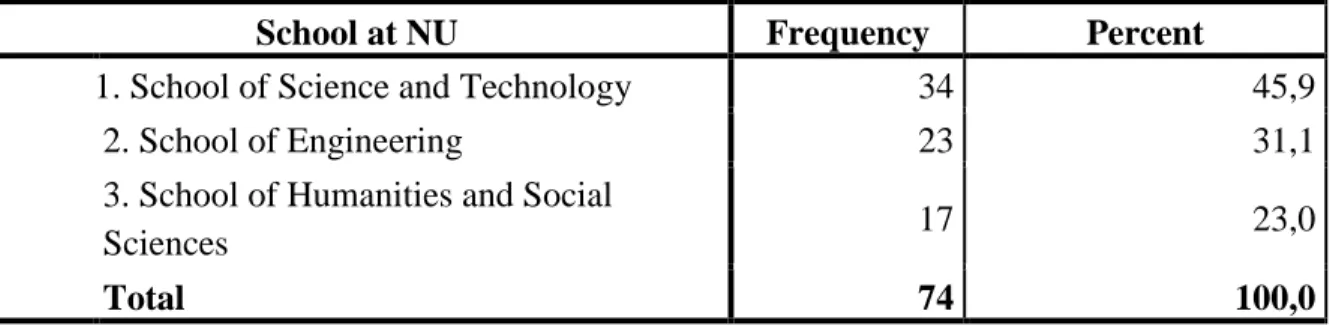
School at NU Frequency Percent
1. School of Science and Technology 34 45,9
2. School of Engineering 23 31,1
3. School of Humanities and Social
Sciences 17 23,0
Total 74 100,0
The data indicates that 45.9 % of the NIS graduates, participated in the study, are the students of the School of Science and Technology, 31.1% study participants are from the School of
Engineering and 23% are from the School of Humanities and Social Sciences. Table 3 reports percentage of the students, participated in the study, according to the type of school they graduated from.
Table 3: Students and their NIS schools in Kazakhstan
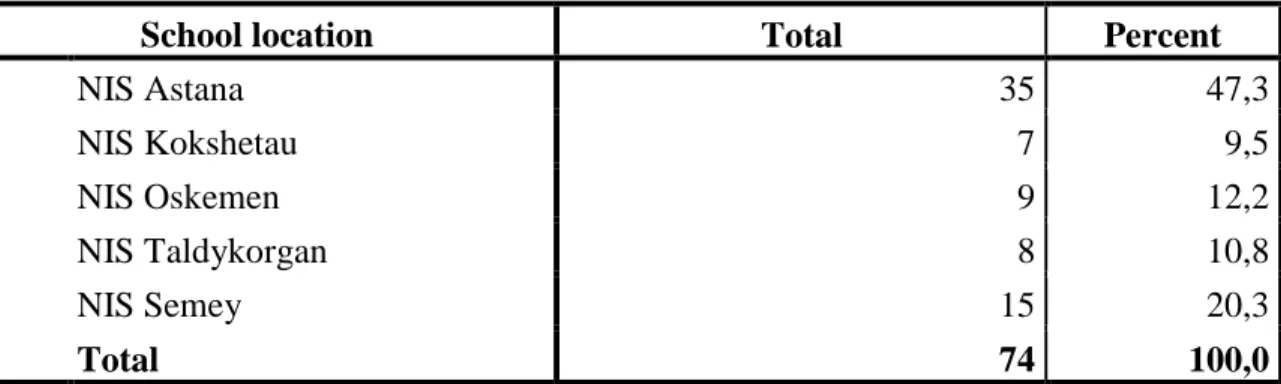
School location Total Percent
NIS Astana 35 47,3
NIS Kokshetau 7 9,5
NIS Oskemen 9 12,2
NIS Taldykorgan 8 10,8
NIS Semey 15 20,3
Total 74 100,0
The data reports that majority of the NIS graduates (47.3%),who participated in the study, are from NIS Astana. 20.3% are from NIS Semey and only 9.5 % are from NIS Kokshetau.
23 Particpants for qualitative research.
The participants for the qualitative research were invited to participate in the interview by placing a letter on the announcement board at Nazarbayev University and with the help of snowball sampling, when some NIS graduates came to participate, then, suggested the names of other students to be included. Initially, it was planned to conduct individual interviews, but then I changed it into focus group interviews in which to get diverse ideas of the students in more informal discussion form. This was very successful, as I think that the study benefited greatly from the focus group discussions, as the students felt free agreeing and disagreeing with each other and expressing their own opinions.
Data Collection Instruments
To answer the research questions and to collect data, I have used such instruments as survey questionnaire and interview. The combination of these instruments to collect the data is justified in terms of methodological triangulation, which leads to higher reliability and validity and lets the researcher get the in-depth understanding of the researched topic (Gorard and Taylor, 2004).
Survey questionnaire.
Questionnaire, based on the survey design was implemented in the first part of the study to address the research questions. Questionnaires are often used by the researchers as it is a less time consuming instrument, than other instruments, but it allows collecting data from the considerably large number of respondents (Muijs, 2004). Using the survey approach also allows the researcher a possibility to generalize the results of the survey to a larger population (Nardi, 2002). Also, surveys are usually used by the researchers, whose main purpose is to explore people‘s attitudes, beliefs and perceptions toward definite issue or phenomenon (Neuman, 2003).
24 By using questionnaire in this study I also maintained the anonymity of the respondents, as the respondents did not need to write their names on questionnaire. The usage of the questionnaire has one more advantage, as once collected, it can be very easily analyzed by the researcher because of its ―structured and manageable form‖ (Wilkinson and Birmingham, 2003, p.7).
Close-ended questionnaire was used as instrument for quantitative part of the research. It included 2 types of questions: background questions and questions related to obtaining opinions or attitude (see Appendix A for the questionnaire items).
The survey instrument included a total of 22 questions, 19 required responses in a five point Likert scale from ‗strongly agree‘ to ‗strongly disagree‘; 3 questions required a simple check box response. The main questions of the survey could be divided into three groups: questions from 1 to 7 were the questions, grouped as ‗learning and innovation skills‘; questions from 8 to 10 were ‗ICT and information literacy skills‘ and questions from 9 to 18 were grouped as questions about ‗life and career skills‘. In the question #19, the students were asked to rate the quality of knowledge and skills that they gained at NIS from 1 to 5.
Despite the abovementioned advantages, the questionnaires have particular disadvantages, which should be taken into consideration while analyzing them. The questionnaire is often limited in its length and the obtained data is of standardized character and may prevent the researcher to get the in-depth understanding of the researched issue (Muijs, 2004). To address the issue of limited data, I used interviews as a tool for collecting qualitative data.
Interviews.
Qualitative interview-based research design was implemented in the second part of my study.. In the second part of the study I was focusing on a smaller number of people and that enabled me to study them in depth and get richer data from them.
25 Open-ended questions were used for the focus group interviews with Nazarbayev University students, who have already graduated from the Nazarbayev Intellectual Schools (see Appendix B for the interview questions).The interview is often the best way for the researcher to get detailed information about the topic of interest (Wilkinson & Birmingham, 2003). As for the interview type, the semi-structured interview was used. This type of interview is characterized by the number of established questions, but allows the researcher to be flexible about the order and content of the questions, if there is an issue, that according to the researcher‘s opinion, needs some clarification (Pole& Lampard, 2002). It allowed me to address some points, which have been arisen during the interviews with the students and helped me to cover some unexpected additional issues.
The discussions were held separately, using pre-established questions and sought the participants‘ opinion on their perceptions on how their NIS school experience relates their successful performance at Nazarbayev University, their level of satisfaction with the
development of generic skills, which are necessary for their performance at university and their recommendations on the further improvement of NIS preparation of its graduates for the entrance to Nazarbayev University. The interviews enabled me to get the rich detailed and descriptive data in the participants‘ own words. Initially, it was planned to conduct the interview in English, as the NU students have English as a language of instruction, but during the interview it was decided to conduct it in Russian for the participants‘ convenience. The advantage of the focus group interviews is in the possibility for the participants to interact with each other, agree or disagree about some issues and highlight some aspects, which seem to be more interesting for them (Bell, 2010). The focus group interviews gave me the possibility to be not only the
interviewer, but also a facilitator of the interesting discussion.
26 The interviews were conducted in the participants‘ natural settings in the Nazarbayev University campus. Each discussion was audio-taped, with the permission of the participants, and later transcribed for thematic analysis. I also took notes during the discussion as it helped me to record the ideas that emerged during the interviews.
Piloting
According to Bell (2010), the data collection instruments need to be piloted, as the researcher needs to know how long it takes the respondents to complete them. The questionnaire needs to be of appropriate length in order not to lose the respondents‘ interest, which may result in missing data and incomplete questionnaires (Oppenheim, 1992). The questionnaire was piloted twice, before it was emailed to the students, once with one of the Master students, who also is a graduate of special school for gifted children and also with one of the NIS graduates, who study at Nazarbayev University at the foundation course. Piloting was also very useful for avoiding the ambiguous questions and choosing the right wording of the questions.
Data Analysis
Data analysis process is a long and comprehensive process of systematic analysis and arrangement of collected data (Bogdan & Bicklen, 1998). The data, to be analyzed were obtained with the help of questionnaires that were completed by 74 people and two focus interviews with 10 participants.
The quantitative data was analyzed with the help of SPSS Statistics software. SPSS is known as one of the most commonly used and reliable software for descriptive statistics in educational research (Muijs, 2004). The descriptive statistics is used to describe
numerical data and the simplest way to do it is using frequency distribution. Frequency distribution tables are used to show the number of cases in each category (Neuman, 2006).
27 The answers were pre-coded before entering them to the SPSS database. For
example, for Likert scale questions with options as ‗strongly agree‘, ‗agree‘, neither agree or disagree‘, ‗disagree‘ and ‗strongly disagree‘, the answers were coded as ‗strongly agree‘= 1,‗agree‘=2, disagree‘=3, neither agree or disagree‘=3, ‗disagree‘=4 and ‗strongly disagree‘=5. So, when entering the data to SPSS database, only the numbers from 1 to 5 were entered.
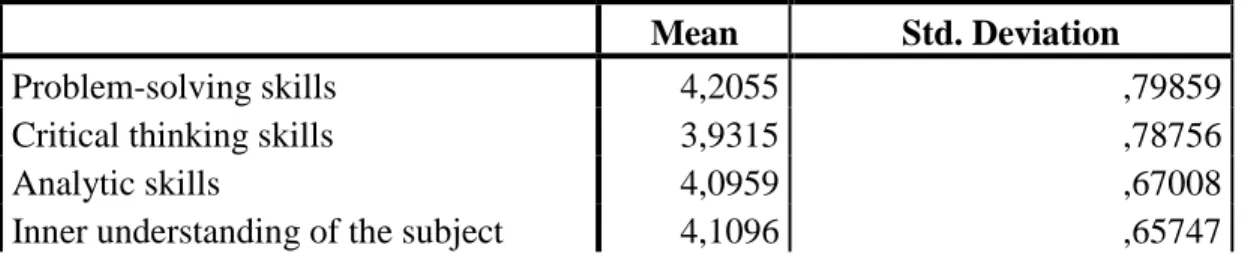
For quantitative analysis, I used SPSS descriptive statistics to calculate the mean and standard deviation of the responses. Cronbach‘s α coefficient for quantitative data was .89.
For the qualitative data analysis, I first organized the data, transcribed the interviews and translated them from Russian into English. The quality of the recorded data was also an issue, because I tried to take the interviews in the students‘ natural settings at the campus of the university, because the data collection period was during the students‘ examination session.
Then, I obtained the general idea of the material and coded the data. The data was coded into the themes and categories, which were connected to the proposed research questions and empirical literature, discussed in the Literature review chapter (see Apeendix C for codes and themes).
After the inductive analysis, I developed deeper understanding of students‘ perceptions of their school experience.
When both the quantitative and qualitative data were coded and categorized, the overall information, gathered by two research instruments was triangulated in order to reach the higher reliability and validity. The analysis of the overall data was conducted with connection to the proposed research questions and as a result, categorized, according to the following themes:
students' perceptions of knowledge and skills gained at NIS, students‘ perceptions of the factors that enabled their learning at NIS; perceptions on their experience of transition to university and perceptions of the value of their NIS preparation for studying at a university.
28 Ethical Considerations
Throughout the study I followed the ethical standards and considerations, bearing in mind all the researchers‘ ethical principles. According to Hartas (2010), the informed consent form is the ―heart of the ethical research practice‖ and incorporates all the basic research principles, as
―clarity of purpose, trust, honesty and integrity‖ (p. 118). Therefore, the first step to collect the data from the participants is to provide them with informed consent form (see Appendix D for informed consent form). Participants were selected on a volunteer basis and they were fully informed of the purpose and nature of the study. As the participants were the students of
Nazarbayev University, who are elder than 18, there was no need to get signed informed consent forms from their parents. Participants also were explained that they would have a right to
withdraw from the study at any time if they wished to do so. They were also explained that in case they choose to withdraw from the study, all information they provided (including tapes) would be destroyed after the study is completed. In order to provide higher response rate for the survey, I sent the NU students a cover letter, which explained the purpose of the study and suggested the participants sharing the results of the study when it is fully completed, in case they are interested (Wilkinson & Birmingham, 2003).
After getting the informed consent form, it was necessary to maintain the issues with assurance of anonymity and confidentiality. In terms of anonymity, as it was mentioned before, the questionnaires are the perfect tools for gathering the data, as they do not require any personal information to be included to the responses and it is impossible ―to match particular responses with individual subjects‖ (Grey et al., 2007, p.86). As for the interviews, though the identities of the participant are known for the researcher, I assured the participants that I would keep any information about participants private and use pseudonyms instead of names. I also have ensured participants that the tapes and questionnaires will be kept in a safe place, locked with a key, other
29 people would not have an access to the place. Assuring anonymity allows the respondents to be more honest, expressing their opinions and perceptions, which as a result will lead to higher reliability and validity of the results (Cohen et al., 2005).
I provided the participants with the information that they may receive a copy of the study when it is finished if they wish to and they were very interested in the results of the study.
In this chapter, I discussed the research design and methodology that guided this study, explained the rationale for the sampling procedure and presented the data collection instruments, statistical data about the respondents of the survey questionnaire and ethical considerations of the study.
30 Chapter Four. Findings and Discussion
This chapter presents the findings of the study which explored the perceptions of
Nazarbayev University students who graduated from Nazarbayev Intellectual Schools about the knowledge and skills they got at NIS and about how they were prepared to study at a university when studying at NIS. In this chapter, I present the findings from focus group interviews and survey questionnaires conducted with the students of Nazarbayev University who graduated from NIS schools across Kazakhstan. The findings are described according to the following three sections: (a) graduates‘ perceptions about the knowledge, skills and competencies that they got at NIS; (b) the factors that enabled students‘ learning; (c) NIS graduates‘ perceptions on their transition from school to university and (d) value of the NIS school experience for current performance at the university.
Graduates’ Perceptions about Knowledge, Skills and Competencies at NIS
The quality of the knowledge and skills that the student gets at school, has a significant impact at further academic performance at the university, further professional development of the person and his or her successful future. The study showed that the participants of the study, who are the students of Nazarbayev University and were graduates of Nazarbayev Intellectual Schools (NIS), strongly assessed their education they got at NIS. The findings are categorized around the following themes: knowledge and skills related to the school subjects; critical thinking, problem solving and analytical skills; English language competencies; research skills;
ICT and information literacy skills and life and career skills.
31 Knowledge and skills related to the school subjects.
The students shared that they got very good knowledge at NIS and they particular appreciated that they got in-depth understanding of subjects. One student stated:
My interest to Physics developed at NIS, I started to love Physics namely at school. I didn‘t like it much before. Exactly the teachers and extended curriculum in Physics helped me to improve my knowledge in Math and Physics (personal communication, March, 2014).
Another student agreed, ―I can tell you that level of teaching of Physics and Math was very high at NIS‖. One more graduate reflected on his experience at NIS:
Before NIS, I studied at school with Physics and Math direction and I can tell that my Math abilities developed sufficiently at NIS. Now I am a student of Engineering
Department at Nazarbayev University. All that I have studied at NIS, all this knowledge now helps me here at NU (personal communication, March, 2014).
They felt that their knowledge and skills have improved a lot since they joined NIS, and they appreciated the teaching of their NIS teachers. The students compared their education with the students from other schools. For example some students felt that they have in-depth knowledge in comparison with the students from Kazakh-Turkish schools. A student said:
In some schools for example in Kazakh-Turkish Lyceums, if the student is good at one subject, he takes part in Olympiads and wins, he is allowed not to study such subjects as Geography, History and he doesn‘t have deep knowledge in these subjects. At NIS we didn‘t have such practice. If you have for example, Geography, you must know this subject. The same is History and other subjects. Nobody cared about how many Olympiads you won (personal communication, March, 2014).
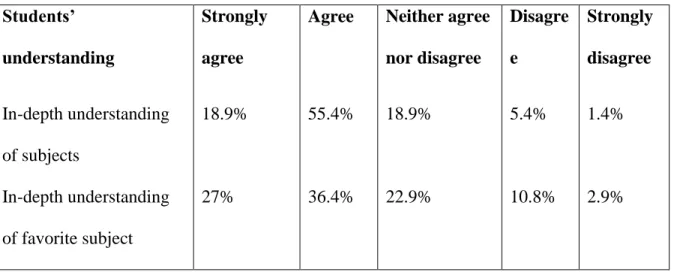
32 This is also confirmed by the quantitative data. The following table demonstrates the responses of the survey respondents to the questions about the effects of NIS on their in-depth
understanding of all subjects and their favorite subjects.
Table 4: percentage ratio of the answers Students’
understanding
In-depth understanding of subjects
In-depth understanding of favorite subject
Strongly agree 18.9%
27%
Agree
55.4%
36.4%
Neither agree nor disagree 18.9%
22.9%
Disagre e 5.4%
10.8%
Strongly disagree 1.4%
2.9%
Thus, majority (74.3 %) of the respondents shared that NIS helped them to develop in- depth understanding of the subjects, while 18.9% of the students strongly agreed that they had developed in-depth understanding of the subjects. The respondents were asked the same question about the role of NIS in developing their in-depth understanding of their favorite subjects. Almost the same portion (73.4%) of students shared that they had developed in-depth understanding in their favorite subjects at NIS and only 13.7 % disagreed with this statement.
Developing critical thinking, analytical and problem solving skills.
The students observed that they had developed their critical thinking, analytical and problem-solving skills at NIS. They noted, that their schools focused much on the development of such skills as ability to use the knowledge creatively and problem-solving skills. They shared that at NIS they had a number of special activities in everyday school life, aimed at the
development of these skills. As one of the participants commented:
33 At NIS we had very creative teachers, who constantly tried to develop our creativity by posing unusual tasks and assignments. We had also creative projects in many subjects, even ordinary subjects as Russian Literature and History were designed creatively, not as dull as we used to have them in my old school. Very often we had even drama and problem-solving tasks in our lessons (personal communication, March, 2014).
The students also said that unlike their previous teachers from the mainstream schools, their teachers at NIS had developed their students‘ higher order thinking skills according to Benjamin Bloom. Thus, the students did not simply memorize and retell their understanding of the
material, on the contrary, they were encouraged to share their own opinions and seek alternative solutions.
The study participants commented that their teachers had used many tasks which developed their creativity and critical thinking, and they have examples of critical thinking essays, debates and other activities. One student said, ―Our teachers developed our critical thinking in critical thinking lessons, but they also did so in all other ordinary classes too‖.
Another student added ―Our teachers tried to integrate critical thinking into every subject we had‖.
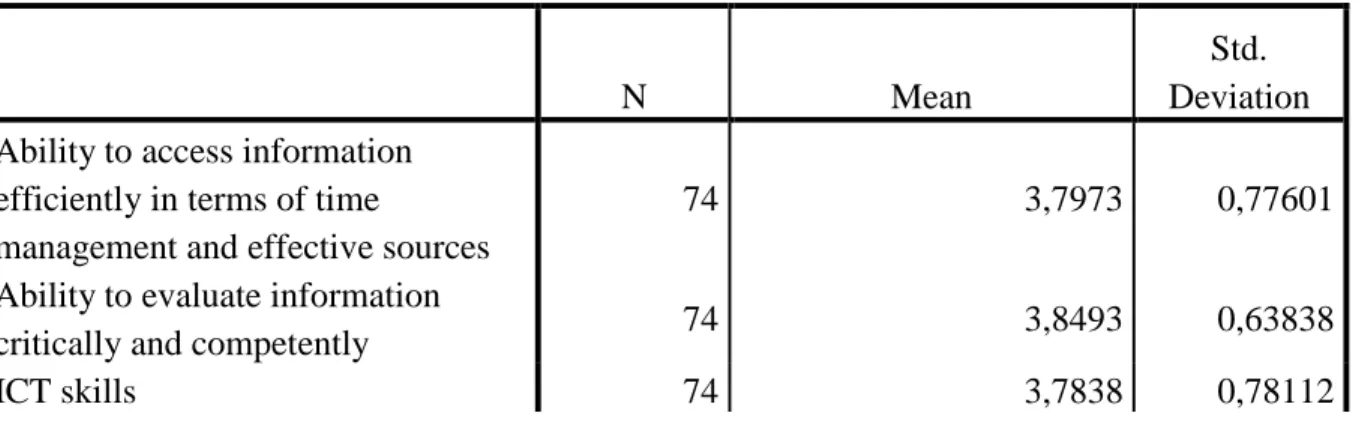
The findings from the quantitative data also confirmed this. The respondents of the survey questionnaire also scored highly on the effects of their NIS learning experiences in developing their critical thinking and problem-solving skills. The following table presents the students‘ responses.
Table 5: the percentage ratio of the answers:
34 A high percentage of the students recognized that their problem solving skills were
developed in NIS: and that was 75.8% in total who scored ―strongly agree‖ and ―agree‖, with 35.1 % responded ‗strongly agree‘; 40.7 % responded ‗agree‘.
Almost the same number of graduates (71%) agreed that NIS developed their analytic skills, while slightly lower percentage of the students (56%) responded that they ―strongly agree‖
and ―agree‖ to the question whether they had developed their critical thinking skills at NIS.
Thus, the students who graduated from NIS greatly appreciate the fact that they had developed their critical thinking, analytic and problem-solving skills while at NIS. The students‘
responses on their critical thinking skills were lower than their analytic and problem-solving skills, although in reality these are very closely connected concepts.
At the same time, some participants of the focus group interviews commented about difficulties of teaching critical thinking. One of them said that ‗it is impossible to teach the student critical thinking, it is not a subject, it is something when the person is able to think critically or not‘. Another participant commented, that integration of critical thinking to other subjects ‗was not very successful sometimes‘; another commented that ‗because of that Skills
Problem-solving skills Critical thinking skills Analytical skills
Strongly agree 35.1 % 15%
23.2%
Agree
40.7 % 41%
47.9%
Neither agree nor disagree 17.5 % 29%
19.1%
Disag ree 4%
12.3%
8.2%
Strongly disagree 2.7%
2.7%
1.6%
35 integration, critical thinking, our tasks were sometimes strange‘. These comments confirm the survey responses about critical thinking skills.
Developing English competencies.
Another important area that the students valued about their learning at NIS was their competency of English language. As a matter of fact, medium of instruction at NIS is English and students really appreciated that they improved their English at NIS. They agreed that competences improved to an extent that they could successfully enter and study at Nazarbayev University. They recognized that they would not be able to study at NU if they had not
developed their English at NIS. In particular, they appreciated the fact that their teachers had very good English and also they used very good textbooks. Plus, facilities were also enabling for them to master English. One student observed, ―Well, we had English language preparation on a high level‖; while another student said, ―my level of English sufficiently improved after I entered NIS‖. One more student observed, ―I took additional language courses after school hours as I had higher motivation to study English. I realized the importance of English language, knew what is IELTS and other English tests. Namely at NIS I learnt all these things and they helped me to improve‖.
However, there were some students who felt that their English skills were not well developed at NIS. One student said, ―Sometimes foreign teachers‘ lessons were not effective, because they just talked with us on different topics‖. Another student agreed, ―It was an interesting experience to have a foreign teacher of English, it is interesting to talk to a person who is from different country, but as a language preparation it was not effective‖. Another student remarked ―I didn‘t like my English teachers at NIS, both Kazakhstani and foreign. I studied English myself in the language courses outside school‖. One of the students commented on the reasons why their knowledge was not good.