Қазақстан Республикасы
Ұлттық инженерлiк академиясының
ХАБАРШЫСЫ
ВЕСТНИК
Национальной инженерной академии Республики Казахстан
№ 2 (88)
Алматы
2023
МЕЖДУНАРОДНЫЙ
НАУЧНО-ТЕХНИЧЕСКИЙ ЖУРНАЛ
ВЕСТНИК НАЦИОНАЛЬНОЙ ИНЖЕНЕРНОЙ АКАДЕМИИ РК
ГЛАВНЫЙ РЕДАКТОР aкадемик Б. Т. ЖУМАГУЛОВ РЕДАКЦИОННАЯ КОЛЛЕГИЯ:
Н. М. Темирбеков – академик, заместитель главного редактора; Е. И. Имангалиев – ответственный секретарь; академик Ж. М. Адилов, академик А. Ч. Джомартов, академик Р. А. Алшанов, академик М. Ж. Битимбаев, академик А. В. Болотов, академик А. И. Васильев (Украина), академик Б. В. Гусев (Россия), академик Г. Ж. Жолтаев, аакадемик В. Ч. Вуйцик (Польша), академик К. К. Кадыржанов, академик К. С. Кулажанов, академик А. А. Кулибаев, академик М. М. Мырзахметов, ака- демик Х. Милошевич (Сербия), академик Г. А. Медиева, академик А. М. Паша- ев (Азербайджан), академик А. К. Тулешов, академик Б. Б. Телтаев, академик Ю. И. Шокин (Россия).
INTERNATIONAL
SCIENTIFICALLY-TECHNICAL JOURNAL HERALD TO NATIONAL ENGINEERING ACADEMY
OF THE REPUBLIC OF KAZAKHSTAN
B. T. ZHUMAGULOV Editor-in-Chief, academician
THE EDITORIAL BOARD:
N. M. Temirbekov – academician, Deputy Editor; Y. I. Imangaliyev – Managing Editor;
Zh. M. Adilov, academician; A. Ch. Dzhomartov, academician; R. A. Alshanov, academician; M. Zh. Bitimbayev, academician; A. V. Bolotov, academician; A. I. Vasilyev, academician (Ukraine); B. V. Gusev, academician (Russia); G. Zh. Zholtayev, acade- mician; Wójcik Waldemar academician (Poland); K. K. Kadyrzhanov, academician;
K. S. Kulazhanov, academician; A. A. Kulibayev, academician; M. M. Myrzakhmetov, academician; H. Miloshevich, academician (Serbiya); G. A. Mediyeva, academician;
A. M. Pashayev, academician (Azerbaijan); A. K. Tuleshov, academician; B. B. Teltayev, academician; Yu. I. Shokin, academician (Russia).
УЧРЕДИТЕЛЬ:
Республиканское общественное объединение
«Национальная инженерная академия Республики Казахстан».
Издается с 1997 года.
Выходит 4 раза в год.
Свидетельство о регистрации издания № 287 от 14.11.1996 г.,
выдано Национальным агентством по делам печати и массовой информации Республики Казахстан.
Свидетельство о перерегистрации № 4636-Ж от 22.01.2004 г., выдано Министерством информации Республики Казахстан.
Журнал включен Комитетом науки Министерства образования и науки Республики Казахстан в перечень изданий для публикации основных результатов научно-технических работ соис- кателей ученых степеней доктора философии PhD и доктора по профилю и ученых званий доцента и профессора.
Журнал включен в международную англоязычную базу реферативных данных по техниче- ским наукам INSPEC.
Подписку на журнал можно оформить в отделениях связи АО «Казпочта», ТОО Агентстве «Евразия пресс» и ТОО Агентстве «Еврика пресс».
Подписной индекс:
для физических лиц – 75188, для юридических лиц – 25188.
Подписка продолжается в течение года.
Адрес редакции: 050010, г. Алматы, ул. Богенбай батыра, 80, к. 415.
Тел. 8-7272-915290, факс: 8-7272-915190,
e-mail: [email protected], [email protected], www.neark.kz
© Национальная инженерная академия Республики Казахстан, 2023
ISSN 2709–4693
FOUNDER:
Republic public association
“National Engineering Academy of the Republic of Kazakhstan”.
Published since 1997 year.
Issued 4 times a year.
Certificate about registration the edition N 287, November, 14, 1996, was given by National agency on affaires of press and mass information of the Republic of Kazakhstan.
Certificate about re-registration N 4636-Zh, January, 22, 2004, was given by Ministry of information of the Republic of Kazakhstan.
The Committee of Science of Ministry of Education and Science of the Republic of Kazakhstan has included the Journal into the list of issues for publication of the main results of scientific-technical investigations of applicants for scientific degrees ( Doctor philosophy PhD, Doctor on specialization) and academic ranks (Professor and Associate professor).
The Journal was included into international English-language abstracts database on technical sciences
“INSPEC”.
Subscription to journal may be drawn up at post offices of OJSC “Kazpochta”, in PLL Agency “Evraziya press” and PLL Agency “Evrika press” .
Subscription index:
for natural persons – 75188, for juristic persons – 25188.
Subscription continues during a year.
Address of editorial offices: 050010, Almaty city, Bogenbay Batyr str., 80, off. 415.
Tel. 8-7272-915290, fax: 8-7272-915190,
e-mail: [email protected], [email protected], www.neark.kz
© National Engineering Academy of the Republic of Kazakhstan, 2023 ISSN 2709–4693
К 70-летию главного редактора журнала
«Вестник Национальной инженерной академии Республики Казахстан», президента Национальной инженерной академии РК,
лауреата Государственной премии Республики Казахстан в области науки, техники и образования, Заслуженного деятеля Казахстана,
доктора технических наук, профессора,
академика Национальной академии наук Республики Казахстан, Национальной инженерной академии Республики Казахстан,
Международной инженерной академии ЖУМАГУЛОВА
БАКЫТЖАНА ТУРСЫНОВИЧА
18 августа 2023 г. – юбилей Бакытжана Турсыновича Жумагулова, главного редактора журнала «Вестник НИА РК», выдающегося ученого, видного государ- ственного, политического и общественного деятеля Казахстана, крупного органи- затора науки и образования Казахстана, президента Национальной инженерной академии Республики Казахстан, президента Математического общества тюрк- ского мира (TWMS) и Казахстанского математического общества, лауреата Госу- дарственной премии Республики Казахстан в области науки, техники и образова- ния, Заслуженного деятеля Казахстана, доктора технических наук, профессора,
Вестник Национальной инженерной академии Республики Казахстан. 2023. № 2 (88) 6
академика Национальной академии наук Республики Казахстан, Национальной инженерной академии Республики Казахстан, Международной инженерной акаде- мии, почетного профессора ряда зарубежных университетов, академика академий стран ближнего и дальнего зарубежья, члена международных научно-инженерных сообществ.
Трудовая деятельность выпускника факультета механики и прикладной матема- тики Казахского государственного университета им. С.М. Кирова (ныне Казахского национального университета им. аль-Фараби), профессора Б.Т.Жумагулова связана со служением науке и образованию. Родному университету он посвятил многие годы плодотворной деятельности, пройдя в нем путь от ассистента до профессора, заве- дующего кафедрой и ректора. В годы учебы в университете на рубеже 1970-1980-х гг. определился круг основных научных интересов Б.Т. Жумагулова, связанных с во- просами математического моделирования и разработки информационных систем.
Именно в университете сложился коллектив учеников и единомышленников, вместе с которыми впоследствии Б.Т. Жумагулов получил весомые научные результаты.
Выбранное научное направление получило интенсивное развитие в Инженер- ной академии Республики Казахстан, где Б.Т. Жумагулов возглавил исследования по математическому моделированию процессов нефтедобычи. Именно им, наряду с общепринятыми моделями Дарси, Маскета-Леверетта и тепловой моделью Маскета- Леверетта, подробно изучены модели Навье-Стокса и Жуковского, а также ряд новых моделей для оптимизации процессов регулирования и прогнозов нефтедобычи не- фтяных месторождений. Создана классификация и выполнен анализ рассмотренных моделей.
Результатом многолетних исследований в этом направлении явилась докторская диссертация на тему «Математические модели фильтрации неоднородной жидкости и их приложение в компьютерных технологиях для нефтяных месторождений», вы- полненная в Институте гидродинамики Сибирского отделения РАН (г. Новосибирск) и защищённая Б.Т. Жумагуловым в 1997 году. Научными консультантами являлись академик РАН В.Н. Монахов и профессор Ш.С. Смагулов.
Его диссертация определила новое научное направление его деятельности и по- ложила основу для целого ряда разработок в данной отрасли.
В настоящее время академик Б.Т. Жумагулов – крупный ученый в области вы- числительной математики, разработки и применения информационных технологий, математического моделирования и математических методов при решении задач ги- дродинамики и практических задач нефтегазовой отрасли.
Его талант математика-прикладника ярко проявился в такой сложной проблеме, как математическое моделирование технологических процессов нефтедобычи, соз- дание компьютерной системы автоматизированного анализа разработки нефтяных месторождений. Им заложены основы и создана казахстанская научная школа по вычислительной гидродинамике,математического моделирования технологических процессов разведки, добычи и транспортирования углеводородов, которая сегодня успешно развивается его учениками и последователями, активно сотрудничающие с ведущими профессорами из России, Германии, Китая, США, Франции. Ученые име- ют совместные публикации, ведут подготовку молодых ученых на базе международ-
7 ных научных центров и вузов, активно обогащая научный опыт разных стран. Среди его учеников более 20 кандидатов и докторов наук.
Юбиляр является автором более 400 научных работ и 12 монографий, опублико- ванных в Казахстане и зарубежных странах, 8 учебников.
Результаты исследований и разработок по теоретическому и численному изучению основных моделей подземной гидродинамики были обобщены в монографии «Гидро- динамика нефтедобычи». Этот труд стал настольной книгой специалистов и ученых, занимающихся проблемами подземной гидродинамики не только в Казахстане, но и за рубежом и был переиздан на английском языке по заказу компании AgipKCO в 2003 году в Милане (Италия) «The Fluiddynamicsofoilproduction», а в 2013 г. переиздана на английском языке (Elsevier, Нидерланды).
Профессор Б.Т. Жумагулов – автор научного открытия «Явление низкотемпера- турной вакуумно-волновой гидроконверсии нефтяного сырья».
Выдающийся ученый и талантливый организатор науки Б.Т. Жумагулов является одним из основателей Национальной инженерной академии Республики Казахстан, Союза инженеров Казахстана.
Именно в Национальной инженерной академии РКв 90-е годы прошлого века Ба- кытжан Жумагулов как руководитель, ученый и патриот казахстанской науки внёс большой вклад в реализацию реформ и научно-технической политики страны. Десять лет он возглавлял Межотраслевой научно-технический совет по проблемам развития машиностроения, энергетики, строительства, транспорта и коммуникаций, который был создан в 1993 году по предложению Президента страны, при поддержке Мини- стерства науки и новых технологий и Инженерной академии РК. Деятельность МНТС под его руководством позволила сохранить прикладную науку, помочь ученым, ин- женерам, научно-исследовательским институтам и конструкторским бюро выжить в трудное время экономических реформ и преобразований в Казахстане.
Под руководством Академии и МНТС в 1993-2000 годы было выполнено 16 респу- бликанских научно-технических программ и более 400 проектов в области машиностро- ения, энергетики, транспорта и коммуникаций, горнодобывающей промышленности и металлургии, геологии и охраны недр, экологии, легкой и пищевой промышленности, химических и нефтегазовых технологий, информационных технологий, экономики, ар- хитектуры, строительства, технологий строительных материалов.
В апреле 2008 года распоряжением Президента РК Б.Т. Жумагулов был назначен ректором Казахского национального университета имени аль-Фараби. Под его руко- водством была сформирована и реализована принципиально новая Стратегия разви- тия университета по качественному изменению подготовки специалистов, росту их конкурентоспособности, приближения казахстанского образования к европейским стандартам и интеграции в Болонский процесс.Создана уникальная система элек- тронного университета «Универ» на базе портала университета, которая позволила на качественно новом уровне осуществить переход на новые технологии обучения, обеспечить прозрачность учебного процесса, искоренить субъективные проявления при проведении экзаменов.
В 2010 году был назначен Министром образования и науки Республики Казахстан.
Руководил принципиальной модернизацией всей научно-образовательной сферы, Бакытжан Турсынович Жумагулов (к 70-летию со дня рождения)
Вестник Национальной инженерной академии Республики Казахстан. 2023. № 2 (88) 8
разработкой новой Государственной программы развития образования на 2011-2020 гг., коренным совершенствованием Закона РК «Об образовании», созданием нового Закона РК «О науке», внедрением принципиально новой модели управления и финан- сирования науки.
В 2017 году Указом Главы государства назначен депутатом Сената Парламента Республики Казахстан.
Бакытжан Турсынович – активный участник международного научного со- общества. Его тесные связи с российскими учеными способствуют развитию научно-технического сотрудничества Казахстана и России. Является первым вице- президентом Международной инженерной академии (штаб-квартира в г. Москве, РФ).
В 2011 году избран президентом Федерации инженерных академий Исламских стран (FEIIC). Президент Казахстанского математического общества (с 2009 г.). Президент Математического общества тюркского мира (с. 2009 г.). С 1999 года является членом Высшей научно-технической комиссии при Правительстве Республики Казахстан.
Свой юбилей Бакытжан Турсынович Жумагулов встречает полным энергии и творческих сил. От всей души желаем юбиляру доброго здоровья, новых больших успехов в его разносторонней научной и организационной деятельности, неутоми- мого мужества в реализации новых творческих проектов и, конечно, счастья и всех благ!
Редколлегия журнала
«Вестник НИА РК»
ИНфоРмАцИоНН0-КоммуНИКАцИоННЫЕ ТЕХНологИИ
УДК 51-76; 004.11
https://doi.org/10.47533/2023.1606-146X.1
Zh. M. AliMZhAnovA1, n. P. AZAnov1, G. Z. ZiyAtbekovA1,2*, Zh. n. AbilkhAnovA1, S. Zh. ZhunuSbAyevA1, b. M. turGAMbAy1
1Al–Farabi Kazakh National University, Almaty, Kazakhstan
2RSE Institute of Information and Computational Technologies MSHE RK CS, Almaty, Kazakhstan
DEVELOPMENT AND RESEARCH OF RELIABILITY ASSESSMENT OF LINEAR WIRELESS SENSOR NETWORKS
The article is devoted to the issue of estimating the reliability of linear wireless sensor networks. Sci- entific research in the field of forecasting is given. This article discusses the Internet of Things (IoT) tech- nology, which is growing by 15-20%, actively developing in all directions and its principles of operation.
The area with the greatest potential for the application of the Internet of Things in Kazakhstan is smart control of resource consumption, including in the sphere of housing and communal services. Использова- ны методы построения и управления смарт-систем. Also describes the increase in comfort, thanks to IoT technology. User-friendly interface is used. Mainly considered the system of automation of business structures depending on the scale. All currently available methods have been suggested, which are key factors in optimizing all processes. Also considered options for modeling and system development, taking into account all the relevant problems of technology automation. The importance of the scientific topic affects the high potential for the development of IoT technology and the lack of uniform standards for de- vices included in these systems. The system is scalable, allowing it to be used for almost any purpose. This paper proposes an approach to solving a number of problems arising in the monitoring of long pipelines using wireless sensor networks. In order to take full advantage of the potential of IoT technologies, the architectural basis of which is formed by wireless sensor networks, it is necessary to develop tools to as- sess and ensure the reliability of these networks. Thus, the focus of the study is on the application-specific formalized reliability criteria for wireless sensor networks.
key words: IoT sensors, internet of things technology, wireless sensor network, network evaluation and reliability.
Introduction. Internet of Things (IoT) technologies are in the focus of not only leading commercial companies, research centers, but also the governments of many countries. IoT-sensors can already effectively analyze water, heat, electricity, gas consumption, monitor emergency situations in real time, remotely control a huge number of city functions - from streetlights
* Е-mail корреспондирующего автора: [email protected]
Вестник Национальной инженерной академии Республики Казахстан. 2023. № 2 (88) 10
and skylights to security cameras with face recognition function. With the development of IoT, ensuring the safety and comfort of urban residents is becoming much easier. It is safe to say that the digitalization of urban services and infrastructure is of strategic importance for the development of a civilized society. Many IoT architecture solutions are based on the results of wireless sensor network research, in particular the proposals within the Internet of Things- Architecture (IoT-A) project of the European Union’s 7th Framework Programme for the Development of Research and Technology [1-2]. Vital infrastructure monitoring systems based on wireless sensor networks (WSNs) are one of the most popular IoT technologies, since proper monitoring will reduce damage from natural and man-made disasters, timely respond to the consequences of infrastructure deterioration, reduce environmental and economic risks.
Corporations and government agencies, especially in the U.S., Europe and the Middle East, are currently making major efforts to research, develop and patent wireless sensor network-based technologies for monitoring long pipelines of various applications.
Specifically, research on the use of WSNs for pipeline monitoring was conducted as part of joint research projects between Stanford University, the University of Southern California, and Chevron Corporation. The competition for pipeline monitoring solutions was run by a U.S. federal government agency (Bureau of Reclamation) on the crowdsourcing platform Innocentive. According to a GlobeNewswire analysis report, even for a private task such as monitoring water pipes for leak detection, the solution market reaches a billion dollars and is growing at 5% per year. WSNs can continuously monitor critical infrastructure, detect and report any anomalies, but there are a number of challenges to overcome, such as node placement, energy optimization, efficient data flow, etc., which require reliability and life- time assessment techniques for WSNs.
It should be noted that experts in the field of information put forward reasonable doubts about the reliability of IoT technologies, in general, and the ultimate benefit to society from their implementation. It is noted that companies specializing in IoT tech- nologies, seeking to occupy as much of the market as possible and prioritize the earliest release of products, without paying enough attention to issues of reliability and safety.
In order to fully exploit the potential of IoT technologies, it is necessary to develop ap- propriate tools to assess and ensure their reliability. Particularly applicable to pipeline monitoring systems using WSNs, since these networks may operate in harsh climatic conditions and network nodes may be located in places that are not readily accessible for routine inspections. The main role of sensor nodes in WSNs used for monitoring is to periodically collect and transmit data to an intelligent central base station (sink), where the collected data is processed to detect a variety of anomalous events. In large-scale WSNs used to monitor long sites, such as pipelines, most sensor nodes are geographi- cally remote from the base station and are usually equipped with relatively low-capacity, low-cost self-contained batteries. This fact largely determines the main disadvantages of long-haul WSNs, since the periodic transmission of raw data over long distances through several transitions to the base station leads to a rapid drain on the battery of sensor nodes and reduces the service life of the network. Other disadvantages include low reliability of wireless channels, high cost of bandwidth, low level of data security [3-4]. Thus, there is a need to solve the optimization problems of extended WSNs, where the target function or constraints include the reliability indicator.
11 Alimzhanova ZH. M. е. а. Development and research of reliability assessment of linear ...
Experimental. A typical scenario used in a number of recent publications on the subject is discussed [6-8]. A WSNs consists of several (n) sensor nodes placed on the surface of the pipe, the topology is a simple chain at the end of which is a base station. Sensors are responsible for collecting data, periodically sending packets to the base station. All nodes play an important role in data forwarding, the node closest to the base station transmits data to the stock directly, intermediate nodes are used to transmit packets from other nodes, i.e., the data sent by the sender to the stock is retransmitted by nodes located between the sender and the stock. The main power consumption is caused by transmitting traffic. Obviously, this leads to excessive waste of en- ergy of sensor nodes located closer to the base station because of the high asymmetric load on these nodes. Each sensor node performs periodic monitoring within its sensitivity range. All sensor nodes are initially in the same environment, have similar communication capabilities, power consumption, and their behavior is described by the same conceptual models. Each node transmits its packet to its neighbor node in the direction of the base station. Distances between neighboring nodes differ slightly. The appropriate software module deployed in the base station receives data from all sensor nodes, decides whether or not there is a problem on its own, or transmits the data via a highly reliable IP network to a decision-making center.
Results and Discussion. The load generated by the sensor node will be modeled by a Poisson process, which is also not only a commonly used assumption, but has also been repeatedly verified experimentally. We denote the intensity of the flow given from sensor j by Aj. For homogeneous nodes: Aj = A Vj = 1 ...n. The current node battery capacity (C) is conveniently measured in the number of potentially possible packet transmissions. Thus, the lifetime of a node is modeled by a Markov chain with continuous time:
C(t), t > 0.
Initial battery capacity is sufficient to transmit С0 packets. Let us introduce the probabilities of states,
P fk( )<P C f[ ( )<k], k =0 1, ...C0. Then the Kolmogorov equations for this system:
dC t
dtk( )= −λC tk( )+λCk+1( ),t 0< <k C0, dC t
dtC0( ) P tC0 ( ),
= −λ
P k C
k( ) ,k C 0 1,
0
0 0
= =
<
The normalization condition must also be met:
∑k kP t( )=1.
This process is a variation of the process of death and reproduction, contains an absorptive state, transitions from state to state are possible only in the direction of population decrease.
The solution of the system of Kolmogorov equations in this case takes the form:
Вестник Национальной инженерной академии Республики Казахстан. 2023. № 2 (88) 12
P t t
C k e k C
k
C k t
( ) ( )
( )! , .
= λ −0− −λ < <
0 0 0
Hence,
P t e t
k t k k
k
( ) C ( )
! .
= −1 −
∑
=−00 1
λ λ
The obtained function describes the probability that the sensor battery will be discharged by time t, i.e. P0(t) allows to calculate the sensor lifetime and formalize various criteria of network reliability.
Using the results of the previous section for the sensor with energy reserve C we obtain the average lifetime of the sensor: C/2; Taking into account the properties of the Poisson process we obtain that for a homogeneous WSNs the average lifetime of the sensors (from the far sensor to the near sensor to the drain) will be:
C C C
n λ λ, ,..., λ,
2
because the intermediate sensor needs to transmit packets of all sensors that are further away from the rack. The network will become unconnected for a time n times shorter than the lifetime of the far node. To balance the lifetime of the nodes it is necessary to abandon the use of nodes that are homogeneous in energy reserve, i.e. for a node that is separated from the drain by j hops the battery capacity should be: (n j− +1)C .
Also, based on the criterion of average node lifetime, it can be concluded that the ap- proach to optimization and balancing of power consumption of linear WSNs proposed in the article [5], according to which nodes are divided into clusters of 3 nodes, one of the nodes aggregates traffic and forwards it to a symmetric node in the next cluster. If the middle node is taken as the cluster head, indeed, the average lifetime of the other two nodes in the cluster will be C
λ . However, the head node must transmit data over a distance increased threefold.
Taking into account the fact that the growth of power consumption for data transmission increases in proportion to the square of the distance, the capacity of this node will no longer be C, but C
9 , respectively, the average lifetime of the head node without regard to retrans- mission of cross-traffic will decrease to C
27λ .
Even if we take total energy cost as a criterion rather than reliability in some way, the clustering from [5] is still of limited use. Let e1 be the energy cost of transmitting a packet at 1-hop distance, and e2 be the energy cost of transmitting a packet between cluster head nodes, and
e2 =ae1, a<1.
Then we get the following condition of benefit of the considered method of clustering:
a< −n + 7 3
6 3.
13 Alimzhanova ZH. M. е. а. Development and research of reliability assessment of linear ...
As noted above, in many applications a≤9 , i.e., degradation of signal-to-noise ratio is inevitable.
The formula P0(f) can be applied to formalize other reliability criteria, for exam- ple, the probability of failure-free operation during the prescribed time. Also, using sub-models for l and C, one can evaluate different approaches to traffic aggregation [9-11].
Conclusions. An approach to the formalization of the reliability criterion of extended wireless sensor networks is proposed. It is shown that homogeneous wireless sensor networks are structurally imbalanced in the energy consumption of nodes. The recently proposed approach to energy conservation of linear wireless sensor networks using clustering [5], generally speaking, is not tenable and entails degradation of network reliability. To ensure the required level of reliability of linear wireless sensor networks, it seems promising to use base stations on an unmanned aerial vehicle, and it is predicted that the total system energy costs will increase. Also, good prospects are seen in the application of traffic aggregation schemes using noise coding.
RefeRences
1 Uckelmann, D., Harrison, M., Michahelles, F. Architecting the Internet of Things; Springer:
Berlin/Heidelberg, Germany, 2011. (in Eng)
2 Quintana-Suarez, M., Sanchez-Rodriguez, D., I. Alonso-Gonzalez, and J. Alonso-Hernandez.
A Low Cost Wireless Acoustic Sensor for Ambient Assisted Living Systems. – Applied Sciences, 2017. – Vol. 7. – No. 9. – 877 p. (in Eng)
3 Nkemeni, V., Mieyeville, F. and Tsafack, P. A Distributed Computing Solution Based on Distributed Kalman Filter for Leak Detection in WSN-Based Water Pipeline Monitoring. Sensors, 2020. – Vol. 20. – No. 18. – 5204 p. (in Eng)
4 Ali S. et al. SimpliMote: A Wireless Sensor Network Monitoring Platform for Oil and Gas Pipelines. In IEEE Systems Journal, 2018. – Vol. 12. – No. 1. – Pp. 778-789. (in Eng)
5 Albaseer A. and Baroudi, U. Cluster-Based Node Placement Approach for Linear Pipeline Monitoring. In IEEE Access, 2019. – Vol. 7. – Pp. 92388-92397. (in Eng)
6 Tong, F., He S. and Pan, J. Modeling and Analysis for Data Collection in Duty-Cycled Linear Sensor Networks With Pipelined-Forwarding Feature. In IEEE Internet of Things Journal, 2019. – Vol. 6. – No. 6. – Pp. 9489-9502. (in Eng)
7 Shakhov V.V., Yurgenson A.N. (2021) Towards Edge Computing Based Monitoring for Smart Ports. Springer Lecture Notes in Computer Science, 2021. – Vol. 12. – 956 p. (in Russ)
8 Marco Schwartz. The Internet of Things with ESP8266. - BHV, 2016. – 191 p. (in Russ) 9 Perry Lee. The Architecture of the Internet of Things. – DMK Press, 2018. – 456 p. (in Russ)
10 Maciej Krantz: The Internet of Things the New Technological Revolution. – Exmo, 2017. – 330 p. (in Russ)
11 Lichtzinder. B.Y. Wireless sensor networks. Textbook for universities. – St. Petersburg State University of Technology, 2020. – 236 p. (in Russ)
Вестник Национальной инженерной академии Республики Казахстан. 2023. № 2 (88) 14
Ж. М. АлиМЖАновА1, н. П. АзАнов1, Г. з. зиятбековА1,2, Ж. н. АбилхАновА1, С. Ж. ЖүнүСбАевА1, б. М. турГАМбАй1
1әл-Фараби атындағы Қазақ ұлттық университеті, Алматы, Қазақстан
2Қазақстан Республикасы Ғылым және жоғары білім министрлігі Ақпараттық және есептеуіш технологиялар институты, Алматы, Қазақстан
СЫЗЫҚТЫ СЫМСЫЗ СЕНСОРЛЫҚ ЖЕЛІЛЕРДІҢ СЕНІМДІЛІГІН БАҒАЛАУДЫ ӘЗІРЛЕУ ЖӘНЕ ЗЕРТТЕУ
Мақала сызықты сымсыз сенсорлық желілердің сенімділігін бағалау мәселесіне арналған.
Мұнда болжау саласындағы ғылыми зерттеулер келтірілген. Бұл мақалада заттардың интернеті (IoT) технологиясы қарастырылады, оның жұмыс принциптері де барлық бағыттарда белсенді дамиды әрі ол 15-20%-ға дейін өсе алады. Қазақстанда заттар интернетін қолданудың ең үлкен әлеуеті бар сала тұрғын үй-коммуналдық шаруашылық саласында қолданылатын ресурстар- ды тұтынуды мұқият бақылау болып табылады. Ғылыми жұмыста смарт жүйелерді құру және басқару әдістері қолданылды. IoT технологиясының арқасында жайлылықтың артуы да сипатталған. Пайдаланушыға ыңғайлы интерфейс қолданылды. Негізінен масштабқа байланы- сты бизнес-құрылымдарды автоматтандыру жүйесі қарастырылады. Қазіргі уақытта барлық процестерді оңтайландырудың негізгі факторлары болып табылатын барлық қол жетімді әдістер ұсынылды. Технологиялық процестерді автоматтандырудың барлық өзекті мәселелерін ескере отырып, жүйені модельдеу және әзірлеу нұсқалары да қарастырылады. Ғылыми тақырыптың маңыздылығы IoT технологиясының жоғары даму әлеуетіне және осы жүйелерге енгізілген құрылғылардың бірыңғай стандарттарының болмауына әсер етеді. Жалпы жүйе масштабта- лады, бұл оны кез-келген мақсатта пайдалануға мүмкіндік береді. Жұмыста сымсыз сенсорлық желілерді қолдана отырып, кеңейтілген құбырларды бақылау кезінде туындайтын бірқатар мәселелерді шешуге оң көзқарас ұсынылады. Архитектуралық негізін сымсыз сенсорлық желілер қалыптастыратын Заттар интернеті технологияларының әлеуетін толық пайдалану үшін аталған желілердің сенімділігін бағалау және қамтамасыз ету құралдарын әзірлеу қажет. Осы- лайша зерттеудің фокусы қолданбаның ерекшелігін ескере отырып рәсімделген сымсыз сенсорлық желілердің сенімділік критерийлері болып табылады.
түйін сөздер: IoT сенсорлары, интернет заттары технологиясы, сымсыз сенсорлық желі, желіні бағалау және сенімділік.
Ж. М. АлиМЖАновА1, н. П. АзАнов1, Г. з. зиятбековА1,2, Ж. н. АбилхАновА1, С. Ж. ЖунуСбАевА1, б. М. турГАМбАй1
1Казахский национальный университет имени аль-Фараби, Алматы, Казахстан
2Институт информационных и вычислительных технологий КН МНВО РК, Алматы, Казахстан
РАЗРАБОТКА И ИССЛЕДОВАНИЕ ОЦЕНКИ НАДЕЖНОСТИ ЛИНЕЙНЫХ БЕСПРОВОДНЫХ СЕНСОРНЫХ СЕТЕЙ
Статья посвящена вопросу оценки надёжности линейных беспроводных сенсорных сетей.
Приведены научные исследования в области прогнозирования. В данной статье рассматривается технология Интернета вещей (IoT), которая растет на 15-20%, активно развиваясь во всех на- правлениях и её принципы работы. Сферой с наибольшим потенциалом применения Интернета ве-
15 Alimzhanova ZH. M. е. а. Development and research of reliability assessment of linear ...
щей в Казахстане является умный контроль потребления ресурсов, применяемый в том числе и в сфере жилищно-коммунального хозяйства. Использованы методы построения и управления смарт- систем. Также описывается повышение комфортности, благодаря технологии IoT. Использован удобный интерфейс для пользователя. Главным образом рассматривается система автоматиза- ции бизнес-структур в зависимости от масштаба. Были предложены все доступные методы на данный момент, которые являются ключевыми факторами в оптимизации всех процессов. Также рассмотрены варианты моделирования и разработки системы, учитывая все актуальные проблемы автоматизации технологии. Важность научной темы влияет на высокий потенциал развития тех- нологии IoT и на отсутствие единых стандартов устройств, включенных в эти системы. Система является масштабируемой, что позволяет использовать её практически для любых целей. В работе предлагается подход к решению ряда задач, возникающих при мониторинге протяженных трубо- проводов с использованием беспроводных сенсорных сетей. Для того чтобы в полной мере восполь- зоваться потенциалом технологий Интернета вещей, архитектурную основу которого формируют беспроводные сенсорные сети, необходимо разработать средства оценки и обеспечения надежно- сти указанных сетей. Таким образом, в фокусе исследования находятся формализованные с учетом специфики приложения критерии надежности беспроводных сенсорных сетей.
ключевые слова: IoT-датчики, технология Интернета вещей, беспроводная сенсорная сеть, оценка и надежность сети.
UDK 004: 811.512.11
https://doi.org/10.47533/2023.1606-146X.2
y. n. AMirGAliyev1,2, S. b. MukhAnov1*, D. b. Zhexenov1, n. k. kAlZhiGitov1, A. S. li1, D. D. yevDokiMov1 , C. kenShiMov2
1International University of Information Technologies, Almaty, Kazakhstan
2Institute of Information and Computer Technologies, Almaty, Kazakhstan A COMPARATIVE ANALYSIS OF NEURAL NETWORK MODELS FOR
HAND GESTURE RECOGNITION METHODS
In recent years, gesture recognition methods have undergone major changes. Because the very demand for it has reached a different level. Humans have increasingly begun using various areas of human activity. The purpose of gesture recognition is to record gestures formed in a certain way and then tracked by a device such as a camera. Hand gestures can be used as a form of communication within many different applications. It can be used by people with various disabilities, including those with hearing and speech impairments, to communicate and interact socially with others. Our research demonstrates various methods for implementing hand gesture recognition based on Hidden Markov Model (HMM), Convolutional Neural Network (CNN), Diffractive Deep Neural Network (D2NN) and other neural networks. This research reviews previous approaches and results of hand gesture recognition methods, hypotheses, diagrams, as well as a comparative review between various gesture recognition methods are given in this paper.
key words: Hand gesture recognition, gesture recognition video-chat, neural networks, dynamic gestures.
Introduction. Nowadays in Kazakhstan there are more than 200 thousand mute people, 80 thousand deaf people, and in the world more than 430 million people suffer from hearing loss, and the number of mute people exceeds more than 70 million [1]. For many of them, this is a problem they face every day. Many of these people suffer in terms of communication and are often forced to use the services of an interpreter for normal communication. And the solution to this problem is too expensive for many. The average price of a hearing aid is 300,000 tenge and more, not to mention how often they must be changed. This problem covers a huge contingent of people, so we decided to take on the solution to this problem.
We thought of different ways to help the deaf and mute people. The key problem for mute and deaf people was communicating with ordinary people and being unable to support or understand them.
We have considered different solutions to this problem:
1. Online site for learning sign language 2. Gesture recognition and translation
3. Platform for finding people as sign language interpreters 4. Video chat with gesture recognition
After much deliberation, our choice fell on the fourth option. Since quite a few people today use chat roulette for fun, we decided to use a fun learning method. We plan to embed gesture recognition into online chat, where the user will be able to communicate with mute or deaf people. Thus, users can learn sign language in a playful and conversational way. In
* Е-mail корреспондирующего автора: [email protected]
17 addition, it is also useful for - most mute or deaf people, they will be able to learn various sign languages such as Kazakh, world and Russian and even those who do not know sign language themselves.
Goal: Development of a convenient platform for real-time hand gesture recognition.
Hypothesis:
1. The topic of research is the recognition of sign language or dactyl alphabet based on the training of neural networks.
2. Analysis of analogues and recognition systems in different sign languages.
3. Selection and training of various neural network architecture models, as well as a comparative analysis of gesture recognition methods.
4. Designing an application for sign language recognition.
An Overview of Gesture Capture and Recognition Techniques And Methods. In our research, the Python pipeline library was used directly to capture hand gestures. The remaining methods, and the methodology of further work itself, were used based on the works of other authors. Because a lot of work has been done on gesture recognition.
Maria Abastillas in Real Time Hand Gesture Recognition and Classification Technique (June 17, 2011) this work is discussed, a way to recognize and classify hand movements performed by healthy subjects in real time. In addition, the analysis of the choice of the simplest features and the best classifier for the indicated hand movements is discussed.
2 hand movement modes: relaxed hand and closing hand are classified on the Lab View platform. The classifier model was trained using 75% of the data as the training set and the remaining 25% as model test/validation data. The results show that the proposed model is an efficient and accurate method for classifying hand movements with approximately 96.58% accuracy for offline classification. The classified model was also implemented in the LabView software by pairing it with Python. Thomas Bravenek, Thomas Friza in
“Multiplatform Hand Gesture Recognition System” (2019). This article collects available gestures and finger detection in still images and video snapshots. The document also contains a quick test of various approaches to convenient gesture detection, including because the platform implementation is an application written in Python using the OpenCV and PyTorch libraries that will display a specific image or play a video sequence with highlighted recognized gestures.
Google company’s project GoogleAI shows an approach to accurate and effective hand and finger tracking using machine learning on the MediaPipe cross-platform framework, which in turn builds data processing pipelines (video, audio, and time series) [2]. The authors use models such as a palm detector (blazePalm), a model for determining key points on the hand, and a gesture recognition algorithm. These models form a single basis of the above structure. Every model is unique and defines the key points for identifying special elements in gesture recognition.
The authors of the Russian Sign Language Dactyl Recognition article compared several real-time sign language recognition systems and presented a new model based on deep convolutional neural networks. These systems are capable of recognizing letters of the Russian alphabet represented as static characters in Russian Sign Language used by people Amirgaliyev Y. N. е. а. A comparative analysis of neural network models for hand gesture ...
Вестник Национальной инженерной академии Республики Казахстан. 2023. № 2 (88) 18
from the deaf community. In this approach, they recognize Russian natural language words represented by successive gestures of each letter. The authors evaluate their approach to Russian Sign Language (RSL), for which they collected their own dataset and evaluated dactyl recognition [3].
A. Dhawan et al [5] focus on only one camera as an input source, while H.S. Yeo et al [4] compare image recognition results with a single camera and a depth camera. In H.S. Yeo et al [4] have proven that a user can interact with a computer without using any physical controllers. Another discovery of H.S. Yeo et al [4], the single camera performs poorly in low light conditions. To solve this problem, there is a wide range of - YCbCr thresholds. be used. However, this limitation does not occur when using the Kinect Depth Camera due to its robustness to preserve the contours of the hand by applying a fixed depth threshold. Table 1 summarizes of some hand gesture recognition systems: a comparison of methods in which hand gesture recognition methods are used.
table 1 – Results of Hand Gesture Recognition Systems Using Different Types of Cameras.
Research Method Detection Feature Extraction Recognition (%) M.M. Hassan,
P.K. Mishra Vision-based using single camera
HSV color Threshold method
Classical normalization:
Divide the hand image into blocks of intensity features, which is then being extract by using edge information technique
Classical normalization 91%
M.M. Hassan
& P.K. Mishra Vision-based using single camera
HSV color Threshold method
Comparison between classical normalization technique and block scaling using center of mass normalization technique
Classical normalization 83.3%
Block scaling normalization using center of mass 96.6%
Ginus Thomas Vision-based using single camera
RGB color Otsu threshold method
Image captured are being tested in few methods:
а) Pixel by pixel comparison b) Edges method
Pixel by pixel method 86%, Edges method 92%
Orientation Based on the table above, we can conclude that applying different image processing techniques, the results of recognition success will be different, according to this the best option can be chosen for your system.
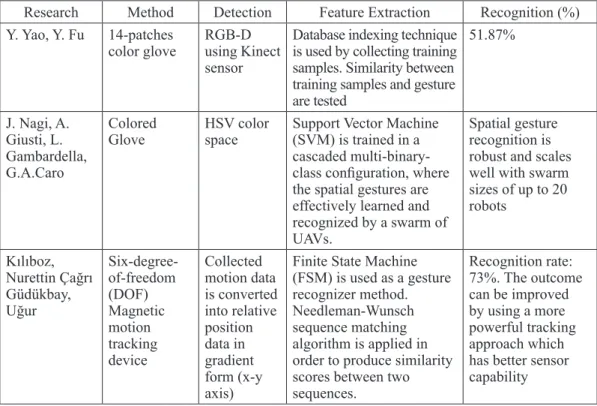
Table illustrates number of researchers, recognition methods of a system that used other tracking devices such as gloves, detection, feature extraction and percentage of recognition.
19 Amirgaliyev Y. N. е. а. A comparative analysis of neural network models for hand gesture ...
table 2 – Summary of Hand Gesture Recognition Systems Using Tracking Devices.
Research Method Detection Feature Extraction Recognition (%) Y. Yao, Y. Fu 14-patches
color glove RGB-D using Kinect sensor
Database indexing technique is used by collecting training samples. Similarity between training samples and gesture are tested
51.87%
J. Nagi, A.
Giusti, L.
Gambardella, G.A.Caro
Colored
Glove HSV color
space Support Vector Machine (SVM) is trained in a cascaded multi-binary- class configuration, where the spatial gestures are effectively learned and recognized by a swarm of UAVs.
Spatial gesture recognition is robust and scales well with swarm sizes of up to 20 robots
Kılıboz, Nurettin Çağrı Güdükbay, Uğur
Six-degree- of-freedom (DOF) Magnetic motion tracking device
Collected motion data is converted into relative position data in gradient form (x-y axis)
Finite State Machine (FSM) is used as a gesture recognizer method.
Needleman-Wunsch sequence matching algorithm is applied in order to produce similarity scores between two sequences.
Recognition rate:
73%. The outcome can be improved by using a more powerful tracking approach which has better sensor capability
Convolutional neural network, hidden markov model and diffractive deep neural network architectures. Based on the data of these tables and to obtain our own results, we have studied some models and types of Neural Network (NN). So, Convolutional Neural Network (CNN) is a neural network consisting of several layers that perform convolutional calculations based on mathematical algorithms. The CNN consists of convolutional layers, pooling layers, and fully connected layers. These layers create feature maps, after which they use special operations and rules to reduce the sample size of these features step by step.
Further, information about the objects remaining after the previous operations is collected in the layers of the union. The CNN has good learning abilities, qualitatively extracting convolutional features and classifying related layers [6].
Benefits of Using CNN for Deep Learning:
For image recognition applications, CNNs are especially useful as they provide highly accurate results, especially when a large amount of input data is used. Such training removes the need for self-extraction of features.
CNN can be retrained for completely different recognition goals and built based on existing networks. Thanks to this, you can use this type of network, and it will not be very resource intensive.
CNNs are more computationally efficient than regular neural networks because they share parameters. These models are easy to deploy and able to run on any device.
The Hidden Markov Model (HMM) is a model in which the system being modeled is treated as a Markov process with hidden states. The HMM gives us the ability to consider
Вестник Национальной инженерной академии Республики Казахстан. 2023. № 2 (88) 20
observable and hidden events that are contained in our model. One of the main applications of this model is gesture recognition.
Benefits of HMM model:
HMM has a strong statistical foundation and efficient learning algorithms where learning can be done from the raw sequence data.
It provides the ability to sequentially handle insertion and deletion penalties as locally trained methods and can handle variable length inputs.
It can also perform a large number of operations, including multiple alignment, data analysis and classification, structural analysis, and pattern detection.
It is also easy to combine this model into libraries.
An Optical Neural Network (ONN) is a physical implementation of an artificial neural network with optical components.
In the ONN architecture, the neural network is physically formed by multiple diffractive surfaces working together to perform an arbitrary function. The ONN takes characteristics of input information with amplitude, phase and light intensity based on optical modulation.
Although the inference and prediction of a physical network is entirely optical, the part of the training that determines its design can be performed by computers.
Meanwhile, different The ONN models have emerged, among them, Diffractive Deep Neural Network (D2NN), based on the all-optical structure of machine learning, provides an extremely high degree of freedom for model training, and facilitates important applications in a wide range of fields.
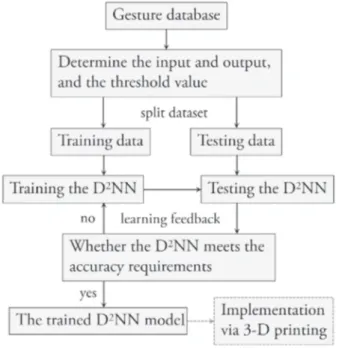
The Diffractive Deep Neural Network (D2NN) has demonstrated its importance in performing various all-optical machine learning tasks, such as classification, segmentation, etc, the operation algorithm of this network is shown in Figure 1.
Figure 1 – Flow chart of the algorithm for the proposed D2 NN model
21 Amirgaliyev Y. N. е. а. A comparative analysis of neural network models for hand gesture ...
In D2NN framework, each neuron has a complex transmission coefficient, i.e.,
til (xi, yi, zi) = ail (xi, yi, zi) exp (jφil (xi, yi, zi)), (1) where i and l denote the neuron and diffractive layer number, respectively. ail and φil are represented during the network training as functions of two latent variables, a and b, de- fined in the following form:
ail = sigmoid (αil ), (2) φil = 2p × sigmoid (βil), (3)
where, sigmoid x e e
x
( )= x
+1 , is a non-linear, differentiable function. In fact, the trainable parameters of a D2NN are these latent variables, αil and βil , and eq. (1) defines how they are related to the physical parameters (ail and φil ) of a diffractive optical network. When we combine D2NN training related changes reported in the earlier sub-section on the pa- rametrization of neuron modulation (eq. (2)), with the cross-entropy loss outlined above, a significant improvement in the classification performance of an all-optical diffractive neural network is achieved [7, 8].
Authors in the research [9] used real-time tracking and hidden Markov models to track the moving hand and extract the region of the hand. They then used the Fourier descriptor to characterize the spatial features.
A scheme for extracting and classifying 2D motion in an image sequence based on motion trajectories was presented by the authors in the paper [10]. They used multi-scale segmentation, affine transformations, and a time-delayed neural network to show that hand gesture motion patterns can be extracted and accurately recognized using motion trajectories.
The authors [11] presented an algorithm for extracting and classifying 2D motion in an image sequence based on a motion trajectory. First, multi-scale segmentation is performed to create homogeneous regions in each frame. Regions between, then consecutive frames are matched to obtain two kinds of matches. Affine transforms are computed for each pair of matching regions to determine pixel matches. The pixel hits in successive pairs of images are combined to obtain the pixel level of the motion path through the sequence of images.
Motion patterns are learned from the extracted trajectories using a neural network with a time delay. They applied the proposed method to recognize 40 American Sign Language hand gestures. Experimental results show that hand gesture motion patterns can be extracted and accurately recognized using motion trajectories.
The authors used the glove in [12] to create a hand-machine interface. The glove is supposed to be equipped with sophisticated sensors capable of detecting bending movements, measuring finger flexion, etc. The position and orientation of the hand are measured either by ultrasound, which provides five degrees of freedom, or by magnetic flux sensors, which provide six degrees of freedom. Thus, the glove owner will have an interface to the visual programming language.
Вестник Национальной инженерной академии Республики Казахстан. 2023. № 2 (88) 22
In research [13] the authors proposed a two-level approach to solving the problem of classifying hand gestures based on real-time vision. The bottom layer of the approach implements pose recognition with Haar-like features and the AdaBoost learning algorithm.
The top layer implements linguistic hand gesture recognition using grammar-based context- free parsing. Given an input gesture based on the extracted poses, composite gestures can be parsed and recognized using a set of primitives and production rules.
Paul S. Heckbert has presented a seed-fill algorithm in the paper [14]. Authors in the research [15] have presented a modified new seed-fill algorithm. Authors of this research proposes a two-level approach to solving Hand gesture classification problems based on real- time vision The lower level of the approach implements posture recognition with Haar-like features and the AdaBoost learning algorithm. With this algorithm, real-time performance, and high recognition accuracy it might work. The top level implements linguistic hand gesture recognition using a context-free syntax based on grammar parsing. Given an input gesture based on the extracted poses, composite gestures can be parsed and recognized using a set of primitives and production rules [14].
Authors proposed various methodologies for detecting and finding out whether pixels are aligned in a straight line or not [16, 17, 18]. Our method uses a very cheap device that includes LEDs and a glove to implement a hand gesture recognition library. These gestures can be used to simulate various mouse operations. The methods used are simple, efficient and easy to implement as they do not require too many complicated operations.
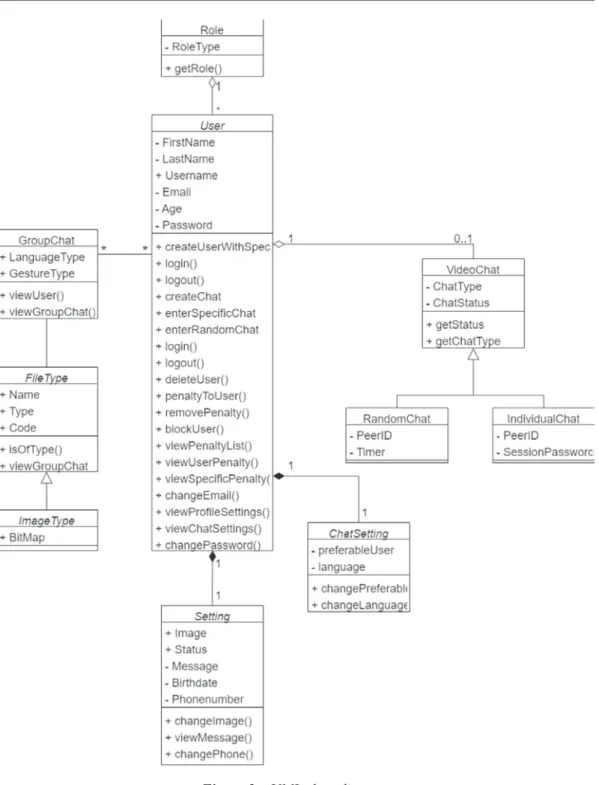
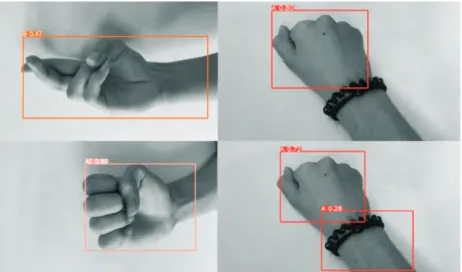
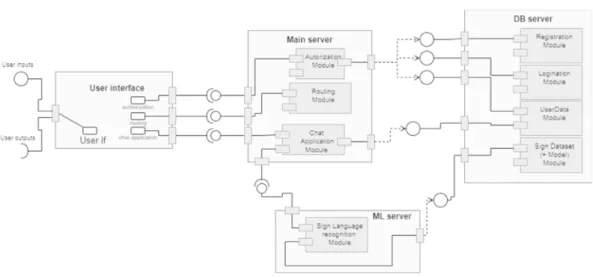
Results. Based on the research of other authors and the literature review, as well as through our experiments, we have determined the approximate architecture of our application. For clarity, various types of UML diagrams were created, they are shown below. These schemes do not describe the methods and ways of recognition of gestures, they describe the main functions, components, and principles of interaction of these components with each other.
Those, in the future, regardless of the chosen method of working with gestures, according to these schemes, it will be possible to create a fully functioning application.

![table 1 – Tools that are used in processes of CERTs [15]](https://thumb-ap.123doks.com/thumbv2/azdokorg/11147416.0/30.756.84.688.340.565/table-1-tools-used-processes-certs-15.webp)

![Figure 1 – Number of information security incidents that were processed in first half of 2022[16]](https://thumb-ap.123doks.com/thumbv2/azdokorg/11147416.0/33.756.113.626.221.505/figure-number-information-security-incidents-processed-half-2022.webp)