To grant approval for this study subject to minor changes to be signed off by supervisor. I would also like to thank the teacher assistants of the Graduate School of Education, especially Kuralay Bozymbekova, for their help, advice and support. I would also like to thank all participants in this study: the directors and teachers of the schools where the research was conducted.
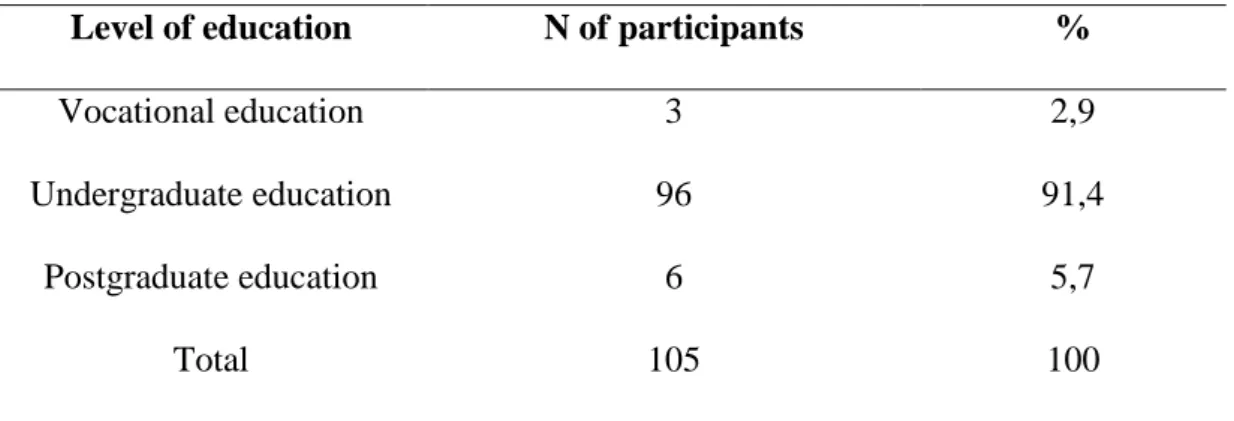
However, researchers and educators still know little about the nature of the relationship between Trait EI and leadership styles. Thus, the main topic of this study is to investigate whether there is any relationship between the emotional intelligence traits of secondary teachers and their leadership style, and whether this relationship also depends on the teachers' education. The sample for this study consists of 105 teachers, selected by convenience sampling, from six public secondary schools located in Astana.
Introduction
Investigating the nature of the relationship between teachers' Trait Emotional Intelligence and the Leadership Style they use in working with pupils. It identifies whether the style of teacher's leadership depends on their characteristic emotional intelligence or not;. Furthermore, there are only a few studies focused on the relationship between Trait Emotional Intelligence and Leadership Style of teachers in secondary schools.
The second purpose of this thesis responds to the paucity of literature on factors influencing teachers' characteristics, emotional intelligence, and leadership style. What is the effect of teachers' characteristics of emotional intelligence on their leadership style (authoritarian, democratic or laissez-faire). The main concepts used in the study are Trait Emotional Intelligence and Teacher Leadership, which are defined as follows.
Review of the Literature
The second section ("The Conceptual Models of Emotional Intelligence") will focus on literature on existing approaches to the concept of Emotional Intelligence and describe them thoroughly. Finally, the last section of the chapter is "Relationship between Emotional Intelligence and Leadership", which aims to review the literature on the relationship between Emotional Intelligence and Leadership. Moreover, level of emotional intelligence has an impact on the style the teacher chooses to work with pupils.
The roots of the concept of emotional intelligence go back to the construct of social intelligence. This model of emotional intelligence is defined by researchers as the skills-based model of EI. Goleman and Bar-On both defined emotional intelligence as a combination of emotional and social competencies.
As mentioned above, this study examines the relationship between emotional intelligence and leadership style of secondary school teachers. Therefore, the next section of this chapter provides a review of the literature on the relationship between emotional intelligence and leadership. Several research efforts have been made to investigate the relationship between emotional intelligence and leadership (Antonakis, 2009;.
Esfahani and Gheze Soflu (2011) investigated the relationship between emotional intelligence and transformational leadership of physical education managers in Golestan state. The findings of the study show that “overall emotional intelligence has a significant correlation with effective leadership and only one dimension of EI, viz. Consequently, Hamidi and Azizi (2012) found that there is a strong correlation between emotional intelligence and open leadership styles. .
In conclusion, it is clear from the literature review that the topic of emotional intelligence and leadership is still of great concern among educators and researchers.
Methodology
The first part of the questionnaires focused on demographic information about the participants, the second part aimed to measure the level of emotional intelligence of the participants' traits and the third part identified the leadership style of the respondents. The "Methodology" chapter provides a full description of the methods and procedures used to conduct the research. A full description of the schools, their location and the conditions of the data collection process is provided in this section.
The second section of the chapter (“Sample/Participants”) provides a general description of the sampling plan that was used in the study. Most school principals were predominantly female; This is a very common fact. Therefore, the total number of respondents in my study is 105, although it was originally expected to be 150.
However, the initial plan failed due to a number of limitations that will be described at the end of the current chapter. This section provides a complete description of the tools or instruments that were used to collect the data for the study. This section consists of two parts - the first part is about the instruments measuring emotional intelligence traits, and the second is about the tool that identifies the leadership style of the respondents.
Application form is completed to obtain the approval, with a detailed description of the study, its. The results of analysis were presented according to the research questions mentioned at the beginning of the present chapter. The next section of the descriptive analysis deals with the identification of participants' most common leadership style.
The main limitation of the study is the relatively short duration of the data collection period.
Findings
The second part of the questionnaires measures the level of the participants' own emotional intelligence, while the third part of the questionnaires determines the leadership style of the participants. In addition, participants' levels of emotional intelligence will be compared based on years of experience and level of education. In addition, according to the results of the questionnaires, the participants' levels of emotional intelligence traits and their leadership style.
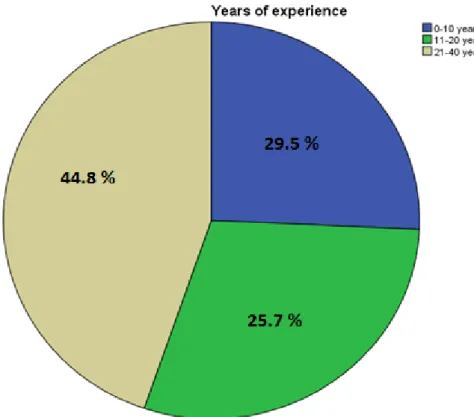
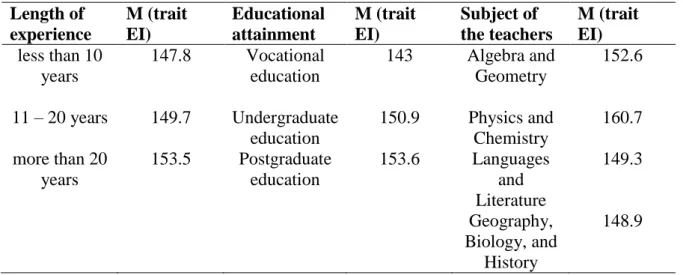
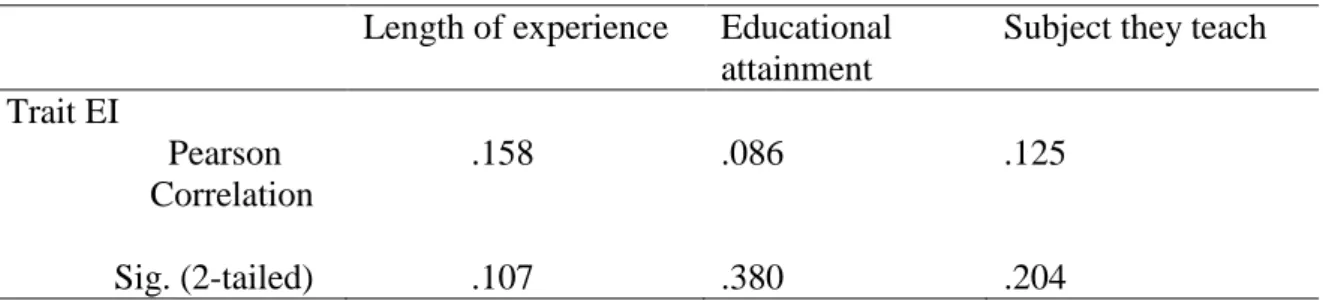
According to the data, the minimum level of trait emotional intelligence among the participants is 112, while the maximum level is 184. Thus, it is concluded from the data that there is a gradual increase in the level of trait emotional intelligence as the experience period is higher. Moreover, if the participants' emotional intelligence is analyzed through their educational levels, I get another interesting picture.
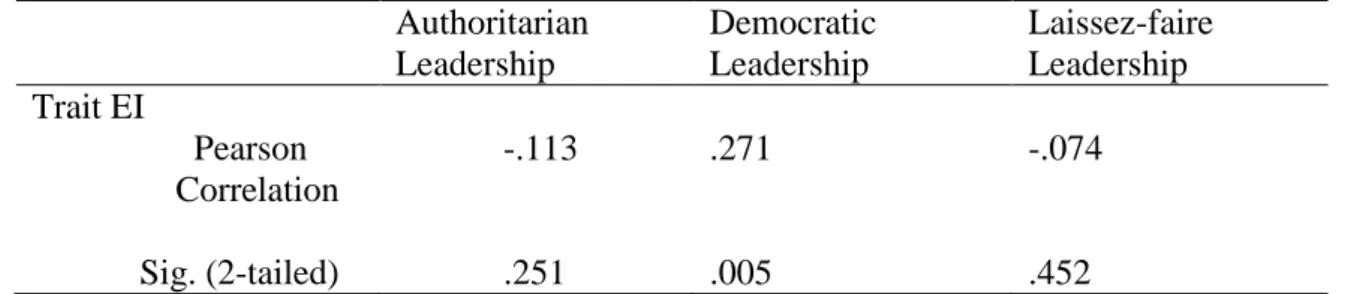
Finally, the emotional intelligence trait of the participants can also be viewed in terms of the subject/s they teach. Thus, in this case we need Pearson r to get information about the nature of the relationship between teachers' emotional intelligence traits and leadership style. It means that teachers with high emotional intelligence traits apply more democratic leadership style.
The result also shows that there is a negative relationship between trait emotional intelligence and authoritarian leadership (r = -.113). This also means that the teachers with high trait emotional intelligence apply laissez-faire leadership less. The results show that there is no relationship between the participants' trait emotional intelligence and educational attainment; this is indicated by the correlation (r = .086).
Another interesting result from one-way between-groups analyzes of variance (ANOVA) is the average level of emotional intelligence of the participants.

Discussion
The results of the study show that there is a positive correlation between emotional intelligence traits and democratic leadership style, which indicates that teachers with democratic leadership style have higher trait emotional intelligence. Thus, we can consider that the teacher with high emotional intelligence is expected to be a democratic teacher. Consequently, Kazakhstan's school principals, or school administrators, should be aware of the importance of developing emotional intelligence traits among teachers.
The findings of the current study also suggest that there is a small positive correlation between length of experience and emotional intelligence traits. To paraphrase the idea, more experienced teachers are likely to have higher trait emotional intelligence. Apart from the positive relationship between teachers' emotional intelligence traits and their length of experience, this study suggests that there is no relationship between teachers' emotional intelligence traits and educational achievement.
The TEIQue is designed to measure only Trait Emotional Intelligence, which is a model of the Emotional Intelligence concept. The reason it is important is that educational attainment can be a factor in a person's self-esteem, which is part of a construct of emotional intelligence. In fact, there are almost no studies on the relationship between teachers' characteristics of emotional intelligence and the subject they teach.
However, the similar concern was at the heart of the study conducted by Tariq et al. 2013), who explored the roles of Emotional Intelligence (EI) and Emotional Self-Efficacy (ESE) in In fact, it is a very interesting result of the current study because there was no initial intention to correlate the participants Trait Emotional Intelligence with subject/s they teach. Additionally, as analysis of the data shows, emotional intelligence mostly correlates with democratic leadership style rather than authoritarian or laissez-faire.
Despite the results of this study indicating that the more democratic a teacher is, the higher his/her attributes of emotional intelligence, it is strongly believed that an experienced teacher should use different leadership styles according to the situation.
Conclusion
There are other factors that influence leadership style, such as personal values and beliefs, national cultures or emotional intelligence. It would be interesting to investigate whether there is a connection between Emotional Intelligence and Physical Sciences. If there is a connection, the concept of emotional intelligence will take on another dimension in the academic community.
Therefore, the relationship between emotional intelligence and duration of experience or level of education could be reexamined. An examination of the relationships between distributed leadership, teacher academic optimism, and student achievement in Taiwanese primary schools. Emotional intelligence: why it may matter more than IQ for character, health, and lifelong achievement.
An empirical study of the role of emotional intelligence and effective leadership in a changing workplace environment. Assessing the correlation between emotional intelligence (EI) and effective leadership (EL) among managers in the Miri Shipbuilding Industry.