© 2020 by The International Islamic University Malaysia
ANALYZING THE ASYMMETRIC EFFECTS OF INFLATION AND EXCHANGE RATE
MISALIGNMENTS ON PETROCHEMICAL STOCK INDEX: THE CASE OF IRAN
Samira Zarei
Department of Accounting, West Tehran Branch, Islamic Azad University, Tehran, Iran. (Email: [email protected])
ABSTRACT
To investigate whether the exchange rate misalignments and inflation are significant indicators of changes in the petrochemical stock index in Iran, this paper based on time series data from January 2012 to January 2020 uses an asymmetric and nonlinear framework, NARDL. The empirical results provethe existence of asymmetric and significant relationships between the variables, and also confirm the impacts of negative components of exchange rate misalignments and, conversely, positive components of inflation have been stronger than the effects of their decomposed counterparts both in the long run and short run. Moreover, the results suggest that the longer the period of exchange rate undervaluation, the cheaper the export of Iranian petrochemical products; consequently, the higher the return to petrochemical industry shareholders, and vice versa. Therefore, as long as evidence exists of an exchange rate undervaluation in the economy, investing in export- oriented sectors such as the petrochemical industry would be relatively profitable. In terms of inflation, an increase in this variable can, on average, lead to more growth in the stock index than the effects of a decline of the same amount of inflation. Hence, considering the behavior of the central bank in determining the exchange rate, the exchange rate misalignments together with the inflation trend can make high profits for petrochemical companies as well as the industry shareholders.
JEL Classification: G11, G17, F31, E31, C22
Key words: Petrochemical stock index, Exchange rate misalignments, Inflation, NARDL model
1. INTRODUCTION
As a transitional economy traditionally heavily dependent on oil- and gas-related revenues, thanks to its rich oil and gas reserves, Iran is recognized as one of the most strategic investment destinations especially for its energy sector (Farzanegan and Krieger, 2019; Parsa, Keshavarz, and Mohamad Taghvaeeorcid, 2019). Among the subsectors of oil and gas industries, the petrochemical industry plays a pivotal role in Iran’s “Five-Year Economic, Cultural, and Social Development Plan” to prevent the economy from suffering exogenous oil and gas price shocks (Sedaghat Kalmarzi, Fattahi, Soheili, 2020).
This prominent position is attributed to some specific features including Revealed Comparative Advantage, RCA, in producing petrochemical-oriented products, remarkable share in Iran's non-oil exports and total foreign currency revenues, high value-added products, stable job creation in the middle and downstream units, high domestic and international demand, and so forth (Khosrowzadeh et al., 2020). In line with this, essential questions must be answered, why should the petrochemical index be investigated? What is the importance of examining this indicator?
Some compelling reasons can answer these questions. First of all, since the largest active petrochemical companies (almost all of them) have issued their shares in the Tehran Stock Exchange (TSE), monitoring the TSE Petrochemical stock index would depict the performance of petrochemical companies in Iran so that all analysis of this study will be related to the petrochemical stock index in the Tehran stock market. Second, considering the impressive characteristic and particular condition of this industry in the Iranian economy, investigating the effects of significant influential factors can improve its performance; consequently, the status of both this industry and its related professions in Iran. Finally, to delineate the importance of this industry in the TSE, the following reasons are considered: the total investment volume in this industry which is far more than each of other competing areas, the significant number of petrochemical companies (over 30 percent) among the top 50 companies by early 2020, the remarkable ratio of the industry’s daily trade volume to the total traded shares in the TSE, being among the most in demand stocks (even during the sanctions) and so forth. To have a stable and profitable investment from the investor perspective and manage a thriving and promising industry, with stable profitability and minimal vulnerability to international exogenous shocks, from the managers' viewpoint, analyzing effects of the most critical factors in this industry
will be especially important (Khosrowzadeh et al., 2020; Shavvalpour et al., 2017; Eshraghi, Ghaffari, and Mohammadi, 2017; Baseri, Abbassi, and Morakabati, 2016; Nayeb, Hadinejad, and Shams Safa, 2016).
This study analyzes how inflation and exchange rate misalignments, as two of the critical sources of Iran's economic shocks, affect the petrochemical stock in the Tehran stock market.
Since most of Iran's national income is obtained through oil and petrochemical exports, in dollars, exchange rate changes and inflation are perpetually intertwined with this country's crucial shocks.
Therefore, considering the impacts of these variables on the petrochemical stock index would benefit both policy-makers and investors who can nullify ramifications of these two economically significant variables. A key question raised is: what does this type of analysis have to do with the current conditions of the Iranian economy? Answering this question requires clarifying the general economic conditions of Iran, which will be presented in the theoretical framework part. To answer the main question, monthly data from January 2012 to January 2020 and the NARDL model will be applied.
In what follows, section 2 provides further details on the Theoretical Framework, section 3 includes Methodology and Data. In section 4, the empirical results are reported. Finally, section 5 concludes the work.
2. THEORETICAL FRAMEWORK
In this part, the primary concept of exchange rate misalignments, Iran's general economic conditions based on which the hypotheses of this study are raised, and finally, the trends in different research variables will be illustrated.
2.1 EXCHANGE RATE MISALIGNMENTS
On the one hand, exchange rate mostly has a direct relationship with the relative prices of tradable and non-tradable goods which can send out some significant signals about resource allocation between these sectors. The exchange rate can be considered as a measure to assess effectiveness of macroeconomic policies in different sectors and also determine the status of an economy's international trade balance. On the other hand, the exchange rate is usually a volatile indicator and, unfortunately, domestic currency policies seem to be unsound in some developing countries. Consequently, policy-makers in such countries
try to make some adjustments in this factor, based on the level of economic power, especially in producing goods and services. These adjustments include two different types: exchange rate undervaluation (e.g., in China) and overvaluation (e.g., in Latin American Countries, CFA zone of Africa, and Turkey after World War II, or Japan and Switzerland in 2011); taken together, that means exchange rate misalignments.
Moreover, the main rationales behind these policies include supporting agents mainly trading in tradable goods, promoting domestic producers and exporters to increase net exports, expanding economic growth and public welfare, and so forth (Kubota, 2009;
Shatz and Tarr, 2000; Huizinga, 1997). However, although scholars and policy-makers disagree on how to implement these policies, how far these policies have succeeded in different countries, and also ramifications of implementing them in various sectors are issues worth considering.
2.2 GENERAL ECONOMIC CONDITIONS OF IRAN AND THE MAIN CONCERNS OF THIS STUDY
It is undeniable that in the general economic conditions of Iran the role of imbalances in oil, gas, and related industries.have long plagued its macroeconomics.In recent decades, a significant portion of Iran's total investment, infrastructure, GDP, government budget, per-capita income, and public welfare have depended on exports of oil-oriented industries (Farzanegan and Krieger, 2019). Crude oil exports and the revenues of related sectors, such as petrochemicals, have not only been crucial factors sustaining Iran's economy, but their remarkable role in macroeconomic and political issues have significant ramifications (such as sustaining economic growth, per capita income, and employment rate in comparison with similar countries with fewer natural resources), that can be named as a kind of “resource curse" or
“paradox of plenty” (Nademi, 2017).
Despite being aware of these devastating consequences, the executive authorities and the macro-decision makers of the country have not succeeded in significantly reducing the share of oil-related revenues in Iran’s economic growth. The main reasons are attributed to: (i) the large public sector, (ii) the lack of efficient financial and money markets, (iii) the continuous and inefficient macro- policymaking in the foreign exchange market such as applying currency manipulating approach in determining foreign exchange
value instead of the market determining procedure, (iv) lack of attention to the investment and production sectors during different decades; consequently, the existence of severe dependence on imported goods and services, and more importantly, (v) the existence of international economic sanctions (Nademi and Baharvand, 2019;
Parsa et al., 2019; Reed, Najarzadeh, and Sadati, 2019; Komijani, Naderi Abbandani, and Gandali Alikhani, 2014). As a result, such conditions have made the oil market exogenous shocks the primary source of macroeconomic fluctuations in Iran, no matter whether these shocks are increasing or decreasing. As proven in many studies, both types of shocks generally have had adverse effects on different economic indicators of countries facing similar challenges (Farzanegan and Krieger, 2019). However, it seems that different industry types (i.e., international trade-oriented industries and domestic-centered ones) respond significantly differently to oil price shocks. Therefore, dissimilar results are expected when monitoring long-run effects of oil price or other exogenous shocks on various sectors in the Tehran stock market (Haj Ghanbar Viliani, Ghaffari, and Hojhabr Kiani, 2019).
Considering the general economic conditions in Iran, the primary channels through which impacts of domestic and international shocks can be transmitted (pass-through or spillover) to different TSE indices can be attributed to movements in the foreign exchange market and inflation.
As the most critical link between the domestic and international economy, the foreign exchange market is the first key variable in transmitting effects of the global and exogenous shocks, e.g. oil price shocks, to the domestic economy (Shahrestani and Rafei, 2020). The main issue in Iran, is the lack of sustainable equilibrium in the foreign exchange market which comes from the mistrust of market rules in determining the equilibrium exchange rate or manipulation of the foreign currency value. This problem can make the oil price shock more destructive and also negate planning for sustainable growth, regardless of the fragility of Iran's economy and its excessive dependence on the oil industry (Haj Ghanbar Viliani et al., 2019).
Such conditions can be attributed to different causes in Iran's economy such as (i) the consequences of international sanctions against Iran that significantly reduce foreign currency supply; (ii) anomalous increase in the monetary base components (government borrowing from the central bank subsequently increasing the money supply) which usually can lead to increased inflation rate and decreased power purchase parity, PPP, in comparison with the other
foreign currencies (Sedaghat Kalmarzi et al., 2020; Farzanegan and Krieger, 2019). The main ramifications of exchange rate misalignment, which is mostly seen in the form of exchange rate undervaluation in Iran, include unreliable relative prices, unbalanced imports and exports, negatively affected investment horizons of almost all investors and also destabilized financial markets resulting from changes in expectations of both suppliers and investors (especially in the tradable goods sector), adversely affected total production that can disrupt the aggregate demand and supply equilibrium; consequently, leading to spread of instability in different economic sectors (Mozayani and Parvizi, 2016). For instance, Iran’s
“Five-Year Economic, Cultural, and Social Development Plans” have, to some extent, not reached reasonable result. Many experimental studies have proven that the lack of attention to foreign exchange market stabilization was the main reason for these failures in development plans (Nademi and Baharvand, 2019; Motahari, Lotfalipour, and Ahmadai Shadmehri, 2018). These facts of Iran's economy indicate that exchange rate misalignments and the significant foreign exchange market inefficiencies (such as a multiple exchange rate system) have been critical in affecting different sectors and this should be investigated. Since this study examines exchange rate misalignments effect on the petrochemical industry through the TSE, the first concerns of this study are:
H1: Exchange rate misalignments can significantly affect the petrochemical industry performance in Iran.
H2: The behavior of the petrochemical industry index in Iran can be asymmetrically (as well as significantly) affected by exchange rate misalignments.
While Iran's economy is considered as a perfect example of applying exchange rate misalignment, deviation of the real exchange rate from equilibrium level is a critical issue in most developing countries (Mahraddika, 2020; Raymond, Coulibaly, and Omgba, 2017; Sekkat, 2016; Owoundi, 2016; Nouira and Sekkat, 2015;
Coulibaly and Gnimassoun, 2013). To control crucial economic factors, developing countries’ central banks adjust the exchange rate so that their monetary policies – under-evaluation or appreciation -- can achieve the set targets. Many studies (e.g., Mahraddika, 2020;
Senay and Sutherland, 2019; Comunale, 2018; Pasrun et al., 2017;
Raymond et al., 2017; Olowookere, 2017; Owoundi, 2016; Nouira and Sekkat, 2015; Nwokoye, Zubairu, and Ayuba, 2015) illustrate how
exchange rate misalignment affects economic growth, financial markets, exports, oil revenues, stock price, inflation and so forth. What most studies show is the intertwined relationship between exchange rate misalignments and inflation (Senay and Sutherland, 2019;
Comunale, 2017; Nouira and Sekkat, 2015; Giannellis and Koukouritakis, 2013; Caputo and Magendzo, 2009; Masters and Ianchovichina, 1998).
In recent years, inflation has become a fundamental problem in the Iranian economy; analyzing its side effects in any economic sector requires dynamic and continuous analysis. More precisely, features such as (i) Negatively affected expectations as a result of different international shocks, (ii), anomalous increases in liquidity and money supply as the primary stimulus of rising inflation in Iran, (iii) lack of monetary and financial discipline, (iv) besides the persistent budget deficit which has mainly culminated in government borrowing from the central bank, enhancing the money supply, and finally, increasing inflation has been the main characteristics of Iran's economy (Ghorbani Dastgerdi, Yusof, and Shahbaz, 2018; Davari and Kamalian, 2018). These conditions act as a relatively stable vicious cycle usually perceived as an increase in the inflation rate having negative effect on different sectors. Hence, a brief review of the high inflation rates and their significant fluctuations over the past four decades, compared to most of the comparable countries in the world, indicates the lack of effective and efficient policies to control and reduce inflation (Mohseni and Jouzaryan, 2016). As a result, if petrochemical industry investors and managers aim at analyzing the performance, formulate stability programs, expand profitability, and adopt development strategies for this industry, they should have a compelling response to this concern:
H3: The inflation rate can significantly explain the changes in the petrochemical index.
Moreover, the literature has paid remarkable attention to the relationship between stock indices and inflation (Boons et al., 2020;
Salisu, Ndako, and Akanni, 2019; Lopez, 2018; Farooq and Ahmed, 2018; Antonakakis, Gupta, and Tiwari, 2017; Iqbal, 2017; Brown, Huang, and Wang, 2016). Although some economists have, traditionally, speculated that this idea would work in describing the relationship between stock returns and inflation, analyzing the empirical studies in this area shows no consensus exists among researchers about the inflation-stock market return relationship in
different countries (Boons et al., 2019; Antonakakis et al., 2017;
Pingui and Yonggen, 2016). Based on this, the differing views among researchers in this field and also the contradictory results in different periods and case studies can provide some compelling pieces of evidence of an existing asymmetric relationship between these variables. Analyzing this claim can propel us toward the following hypothesis:
H4: The relationship between the petrochemical industry index and the inflation rate is not only significant but asymmetric as well.
In the following part, trends in Iran's foreign exchange market and inflation, during the research period, are presented to enhance the perception of the critical changes in these variables.
2.3 TRENDS IN DIFFERENT RESEARCH VARIABLES In this section, the most important events of different variables (Exchange Rate, Inflation, and Petrochemical Index) during the research period will be examined. For this purpose, we present the time-series graphs of these variables.
FIGURE 1
Evolution of Exchange Rate
Source: The Databank of the Central Bank of Iran 0
20000 40000 60000 80000 100000 120000 140000 160000
2012M01 2012M06 2012M11 2013M04 2013M09 2014M02 2014M07 2014M12 2015M05 2015M10 2016M03 2016M08 2017M01 2017M06 2017M11 2018M04 2018M09 2019M02 2019M07 2019M12
Date
A Dollar to Rials
FIGURE 2
Evolution of Inflation Rate
Source: The Databank of the Central Bank of Iran
By looking closely at these two graphs depicting evolution of exchange rate (IRR to USD) and inflation, their movements can, approximately, be classified into three different periods:
a. An increase in inflation and exchange rate from early 2012 by mid-2013 resulting from the subsidy reform ramifications and also erratic expansionary monetary policies in the previous years, intensified by international and commercial sanctions imposed against Iran.
b. From mid-2013 to mid-2018 economic conditions of Iran had experienced stability and relative improvement particularly as a result of an international compromise reached with 5+1 countries (the United Kingdom, the United States, France, China, Russia; plus Germany) on the nuclear issue under the JCPOA1 agreement. Although this period was accompanied by considerable decrease in inflation (from around 40 to 9 percent), the exchange rate was subjected to a gradual and smooth increase (from 32000 up to 42000 Rial) showing a kind of stability in this market for around five years.
c. The period of exponential increase in both exchange rate and inflation from the mid-2018 to the beginning of 2020 mainly due to the uncertainty caused by the United States withdrawal 0
5 10 15 20 25 30 35 40 45 50
2012M01 2012M06 2012M11 2013M04 2013M09 2014M02 2014M07 2014M12 2015M05 2015M10 2016M03 2016M08 2017M01 2017M06 2017M11 2018M04 2018M09 2019M02 2019M07 2019M12
Percent
Date
from the JCPOA international agreement, re-imposing the previous economic sanctions against Iran titled "Maximum Pressure" policy particularly in international trade and financial transactions, the ramification of widespread social discontent at the beginning of 2018, exchange rate manipulation, and the isolation of Iran's economy in the international arena.
After analyzing the movements of exogenous variables2, i.e.
inflation and exchange rate, the main question here is whether any considerable similarities exist between the time series data of the exogenous variables and petrochemical index that can be highlighted.
To make this graphical comparison, we present the time-series graph of the petrochemical index:
FIGURE 3
Evolution of Petrochemical Index
Source: The Databank of the Tehran Stock Exchange Organization
By comparing this graph with that of the exchange rate and inflation, it is noted that the general behavior of these variables has a remarkable structural resemblance. In short, the mentioned three classified periods for both the exchange rate and inflation could be approximately applied for this index as well. However, there are some little differences including:
a. It seems that the length of the three classified periods on the petrochemical industry index case is slightly longer. This can
0 200000 400000 600000 800000 1000000 1200000 1400000 1600000
2012M01 2012M06 2012M11 2013M04 2013M09 2014M02 2014M07 2014M12 2015M05 2015M10 2016M03 2016M08 2017M01 2017M06 2017M11 2018M04 2018M09 2019M02 2019M07 2019M12
Unit
Date
be attributed to the transmission (pass-through) time (the required time for transmitting the impacts of movements in the exchange rate, inflation, and other influential macro-factors into the petrochemical index).
b. In the second classified period, the story was a little complicated for the petrochemical stock index because, unlike exchange rate and inflation that have had a particular trend (rising and falling respectively), this index has had a slight and smoothing mix of rising and falling trends.
c. In some special times, such as late 2018, the petrochemical index behavior became different and was marked by a very sharp increase. The reason behind this event is the achievement of some successive new records resulting from a chain of causes including increasing inflation, manipulated foreign currency market through foreign exchange intervention, inefficient monetary markets, economic uncertainties following international sanctions on investors (Hot Money), lack of alternative investment markets, and so forth. However, speculative activities and over-weighing the real impact of the sanctions doubled the pressure on the stock price to fall after reaching its historical record, in less than three months.
3. METHODOLOGY
In this study, to investigate the relationship between Iran's petrochemical stock index, inflation, and exchange rate misalignments, a nonlinear and asymmetric ARDL method, NARDL, will be used on the grounds that this model gives some unique opportunity to researchers for analyzing the relationship between variables from assorted aspects. The NARDL model, like the ARDL one, considers various time horizons (both dynamic short and long - run). It is a subclass of Error Correction Models (ECM) which can figure out an adaptation velocity of instability in equilibrium path among short-run to long-run horizons. Furthermore, this model can distinctively determine the exact numbers of lag distribution for either dependent and independent variables3 so that the NARDL model can avoid unnecessarily losing the degree of freedom. Moreover, the remarkable features of NARDL are the possibility of analyzing nonlinear and asymmetric relationships between different variables, make a distinction between the asymmetric effects of positive and negative changes in exogenous variables on endogenous one
separately and in the form of divided coefficients (Motahari et al., 2018).
Although the NARDL model has different abilities to evaluate the relationship between variables accurately, it has some pre- requirements; if they are ignored, the results of the NARDL estimation would not be valid and reliable. One of the essential prerequisites of this model is examining the non-stationary nature of variables.
Accordingly, like the other ECM estimations, the NARDL model can be used for non-stationary variables to have different horizons' estimates. The model's other pre-requirement is probing the existence of co-integration, or stable long-run relationship among non-stationary variables. After confirming the presence of long-run relationship among the variables, two stages based on which the NARDL model estimates, i.e. separately estimating the long-run and short-run relationships, will be presented (Shin, Yu, and Greenwood-Nimmo, 2014). In line with this, the general form of long-run relationship, in the NARDL framework, is evaluated as follows:
(1)
t Equation Run Long The
t t
t q
k k
q
i i p
j j t
X X
Y X
X Y
C Y Equation run
Short Dynamic The
k t
i t j
t
1 1 1 2 1
0
0 1
4
2
1
:
For more information about the model and related calculation, like ECT, refer to Hussain et al., 2019; Hamid and Kamalian, 2018;
Shin et al., 2014. It should be noted that exchange rate misalignments time series data are reached by differences in the exchange rate trend data, calculated by Hodrick Prescott filter, from its actual ones. In other words, the computed exchange rate trend is considered the equilibrium exchange rate. This way, the differences in the actual exchange rate from the equilibrium amounts in each period is supposed as the exchange rate misalignments.
4. EMPIRICAL RESULTS
Considering the primary purpose of the research, using the NARDL model, the monthly logarithmic data of the Petrochemical stock index, inflation and exchange rate misalignments, from 2012:01 to 2020:01, have been applied. These data, respectively, were gathered from the official websites of the Tehran stock exchange4, Iran's statistics
center5, and the Islamic Republic Iran central bank6. In this regard, the abbreviations of applied variables in this study are as follows:
TABLE 1
Introducing the Research Variables
Raw Variable Description
1 LPI The Logarithm of Petrochemical stock index 2 dLPI The first difference of LPI
3 LEXMt The logarithm of exchange rate misalignments 4 LEXM+t The positive component of LEXM based on the
NARDL decomposition process
5 LEXM-t The negative component of LEXM based on the NARDL decomposition process
6 dLEXM+t The first difference of LEXM+t
7 dLEXM-t The first difference of LEXM-t
8 LINFt The logarithm of inflation
9 LINF+t The positive component of LINF based on the NARDL decomposition process
10 LINF-t The negative component of LINF based on the NARDL decomposition process
11 dLINF+t The first difference of LINF+t
12 dLINF-t The first difference of LINF-t
At first, the exogenous variables must be decomposed according to the NARDL model structure. Based on this, before estimating the NARDL model, a question to be answered is: what is the practical concept of inflation's positive and negative components and exchange rate misalignment? To answer this, it is interesting to know that while the LEXM+refers to the amount of exchange rate that is valued more than its actual value, the LEXM- represents the under- valued exchange rate. Besides, the LINF+ includes the increase in inflation and, conversely, LINF- represents the decrease in inflation.
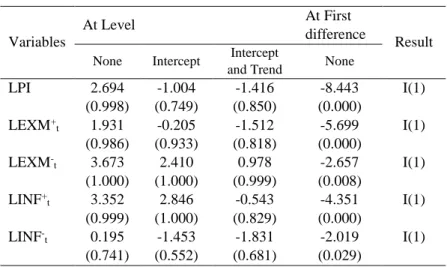
Every general statistical modelling process consists of three different parts: pre-modelling tests, modelling, and diagnostic tests. In this part, the pre-modelling tests presents unit-root and co-integration tests. Then, the results of modelling and the diagnostic tests will be provided. In this regard, the essential pre-modelling test in using time series data is a unit root that should be done to avoid spurious regression. In line with this, the ADF stationary test, introduced by Dicky and Fuller (1979), has been exerted on the research variables, as follows:
TABLE 2 Unit-Root Test
Result At First
difference At Level
Variables
Intercept None and Trend Intercept
None
I(1) -8.443
(0.000) -1.416
(0.850) -1.004
(0.749) 2.694
(0.998) LPI
I(1) -5.699
(0.000) -1.512
(0.818) -0.205
(0.933) 1.931
(0.986) LEXM+t
I(1) -2.657
(0.008) 0.978
(0.999) 2.410
(1.000) 3.673
(1.000) LEXM-t
I(1) -4.351
(0.000) -0.543
(0.829) 2.846
(1.000) 3.352
(0.999) LINF+t
I(1) -2.019
(0.029) -1.831
(0.681) -1.453
(0.552) 0.195
(0.741) LINF-t
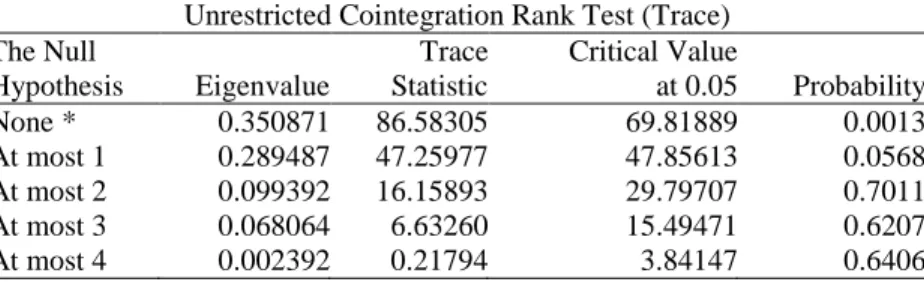
Table 2 illustrates that all research variables are first difference integrated, i.e. I(1). This issue corroborates the error correction models' conditions because, in such models, at least two non-stationary variables are required to have long and dynamic short- run relationships. Furthermore, there should be at least one co- integration vector among non-stationary variables to have convergence dynamic short-run and stable long-run relationships.
Therefore, in Table 3, the co-integration among LPI, LEXM-, LEXM+, LINF+, and LINF- will be tested by the Johansen- Juelius method, proposed in 1990.
TABLE 3
Trace Co-Integration Test Unrestricted Cointegration Rank Test (Trace) The Null
Hypothesis Eigenvalue
Trace Statistic
Critical Value
at 0.05 Probability None * 0.350871 86.58305 69.81889 0.0013 At most 1 0.289487 47.25977 47.85613 0.0568 At most 2 0.099392 16.15893 29.79707 0.7011 At most 3 0.068064 6.63260 15.49471 0.6207 At most 4 0.002392 0.21794 3.84147 0.6406
According to the results in Table 4, based on Trace and Max- Eigenvalue tests, at least one and two co-integration relationships, respectively, are in existence among the non-stationary research variables. Thus, applying the NARDL model to estimate relationship among the research variables is allowed.
TABLE 4
Maximum Eigenvalue Co-Integration Test
Unrestricted Cointegration Rank Test (Maximum Eigenvalue) The Null
Hypothesis Eigenvalue
Max-Eigen Statistic
Critical Value
at 0.05 Probability
None * 0.350871 39.32328 33.87687 0.0101
At most 1 * 0.289487 31.10084 27.58434 0.0169 At most 2 0.099392 9.52633 21.13162 0.7878 At most 3 0.068064 6.41466 14.26460 0.5606 At most 4 0.002392 0.21793 3.84147 0.6406 Concerning the Table 5 results, it can be seen that the coefficients of all variables are statistically significant at the 95 percent confidence level, except for the coefficient of LEXM+t in the long term which is significant at the 90 percent confidence level. In this regard, the amount of Adjusted R-squared and F statistics of the model, in order, presenting that 0.97 percent of dependent variable behavior is explained by the independent research variables and the explicit form of the estimated model is significant, is consistent with the coefficients probability of variables. Based on the results of F- bound test, the null hypothesis of this test which is "there is no significant stability in the long-run equation of the NARDL model" is rejected. Moreover, the statistics and probability of the Ljung-Box test, like Durbin Watson statistics, prove that the number of lag distribution is accurately determined. This is because there is no serial correlation between the estimated model' residuals. Besides, the results of the ARCH test demonstrate no heteroscedasticity in the model residuals. Hence, the estimated NARDL model finding is valid and reliable. Although the diagnostic tests have proven the reliability and validity of the estimated model presented in Table 5, the graphic tests, like CUSUM and CUSUM square ones, have been done, with the results presented in Figures 3 and Figure 4.
TABLE 5
NARDL Estimation Results Long-Run
The Dependent Variable: LPI
Coefficient Independent
Variables Coefficient Name in the
Equation
10.53*
C C(1)
2.36***
LEXM+t
C(2)
-3.21*
LEXM-t
C(3)
-2.58*
LINF+t
C(4)
1.52*
LINF-t
C(5)
4.65* F-Bound
Diagnostic criteria
0.9700 Adjusted R-squared
667.1330 F-statistics
(0.0000) F-Probability
0.0084 Ljung-Box [Q-Statistics (1)]
(0.9270) Q-Probability
0.3890 ARCH (1)
(0.5340) ARCH-Probability
1.9981 Durbin Watson statistics
Dynamic Short-Run The Dependent Variable: dLPI
Coefficient Independent
Variables Coefficient Name in the
Equation
-0.837*
LPIt-1
C(7)
0.118*
LEXM+t-1
C(8)
-0.133*
LEXM-t-1
C(9)
-0.083*
LINF+t-1
C(10)
0.059**
LINF-t-1
C(11)
0.630*
dLPIt-1
C(12)
0.210**
dLPIt-2
C(13)
0.380**
dLEXM+t
C(14)
-0.450*
dLEXM-t C(15)
-0.080*
dLEXM-t-1
C(16)
-0.320*
dLINF+t
C(17)
-0.110*
dLINF+t-1
C(18)
0.190*
dLINF-t
C(19)
0.060*
dLINF-t-1
C(20)
1.760*
C C(6)
Notes: *, **, *** indicate level of significance at 99%, 95%, and 90% respectively.
FIGURE 3 Graph of CUSUM Test
-30 -20 -10 0 10 20 30
II III IV I II III IV I II III IV I II III IV I II III IV I II III IV
2014 2015 2016 2017 2018 2019
CUSUM 5% Significance
FIGURE 4
Graph of CUSUM Square test
-0.2 0.0 0.2 0.4 0.6 0.8 1.0 1.2
II III IV I II III IV I II III IV I II III IV I II III IV I II III IV
2014 2015 2016 2017 2018 2019
CUSUM of Squares 5% Significance
As can be seen in Figure 3 and Figure 4, the results of CUSUM and CUSUM Square tests verify the existence of stability in the estimated model because the model's residuals in both figures are located in the threshold bound which (based on the theoretical background of this test) means the standard errors and squared standard errors of the estimated model are low enough to justify trust in its results.
Therefore, the test results corroborate the authenticity of the model's findings; the coefficients of variables are significantly
consistent with the economic theories and Iran's real experiments.
More interestingly, after achieving an accurate estimation and results, analyzing the coefficients of each component of the independent variables (mainly based on theories and empirical pieces of evidence) confirms that the relationships between the independent variables and petrochemical index are asymmetric. To provide another proof, the most critical terms of the NARDL model, ECT, are presented in Table 6. Generally, the results of ECT coefficients which shows the dynamic relationship in the estimated model, indicates that if an exogenous positive or negative shock (from each component of independent variables) makes the model lose its long-term equilibrium path, the impact of this shock (i.e. its longevity) will disappear or be neutralized, respectively, after how many periods (these times can be calculated through reversing the coefficients of positive and negative ECTs). Based on these concepts, the longevity of any independent shocks, produced by each of LEXM-, LEXM+, LINF+, and LINF- variables, will be measured and analyzed.
TABLE 6
Calculating ECT of the NARDL Estimation
Variable ECT Longevity
LEXM+t-1 -0.14098 7.09322
LEXM-t-1 -0.15890 6.29323
LINF+t-1 -0.09916 10.08434
LINF-t-1 -0.07049 14.18644
Based on the NARDL framework, ECT for each of the independent components, i.e. positive and negative, is a derivative of LPIt-1 relativeto that variable as shown in the following equations:
(2) 0.14098
) 7 (
) 8 (
0
1
C C LEXM
ECT LPI m
h
r t r
r t h
(3) -0.15890
) 7 (
) 9 (
0
1
C C LEXM
ECT LPI m
h
r t r
r t h
(4) -0.09916
) 7 (
) 10 (
0
2
C C LINF
ECT LPI m
h
r t r
r t h
(5) -0.07049
) 7 (
) 11 (
0
2
C C LINF ECT LPI
m
h
r t r
r t h
In Table 5, if the shock rises from positive changes in exchange rate misalignments, the ECT can be measured through equation 2. The interpretation is: if a shock from LEXM+t-1 leads to instability of long-run relationship, 0.14 of the instability will be eliminated in each period; consequently, after seven periods (days), the new long-run equilibrium will be reached. This process is the same for the other independent variables. To statistically evaluate authenticity of applying NARDL, the final test (Wald test) should be done. This test considers H0 and Chi-square statistics and examines whether the coefficients of the variables are equal or whether significant difference exists between two coefficients of the variables.
To assess the validity and accuracy of the estimated NARDL model, existence of an asymmetric relationship between the positive and negative components of exchange rate misalignments and inflation (separately) in the long-run, dynamic short-run, and error correction model will be tested in Table 7.
TABLE 7
Testing Asymmetric Coefficients
Results Probability
Chi-square Value
H0
Long-Run
Rejected 0.0009
9.830796 5.58655
C(2)-C(3) =0
Rejected 0.0024
8.104115 -4.11454
C(4)-C(5) =0
Dynamic Short-Run
Rejected 0.0178
4.675237 0.924957
11 0 q
i
i -
2
1 0 q
k
k =0
Rejected 0.0059
6.542356 -0.70695
12 0 q
i
i -
2
2 0 q
k
k =0
Error Correction Model
Rejected 0.0113
5.431245 -0.30093
h1
m -
h1
m =0
Rejected 0.0164
4.81195 0.170757
h2
m -
h2
m =0
The Wald test shows that there are statistically significant asymmetric relationships between positive and negative components of the exchange rate and inflation in all the mentioned equations.
5. CONCLUSION
Using the monthly period of January 2012 to January 2020, the primary contribution of this research to the literature is asymmetrically considering the recent fluctuations of economic indices through changes in the foreign exchange market (in the form of changes in exchange rate misalignments) and also inflation by applying a dynamic and nonlinear framework, namely NARDL. Overall, the results of Wald test both in long-run and dynamic short-run along with the stability of the results based on the Cusum and Cusum square tests have proven the main concerns of this study, on the grounds that both exchange rate misalignments and inflation have had significant asymmetric effects on the petrochemical stock index.
In both the long-run and short-run, the total effects of exchange rate misalignments have exceeded that of inflation, implying that this industry is more significantly affected by exchange market movements. This is because of the role of international trade in this business like exporting its products and importing the raw materials and technologies, on the one hand; relatively low dependence on the industry's most essential inputs (e.g. subsidized natural gas prices) on the changes in the general price level or inflation, on the other hand.
Moreover, providing asymmetric analysis is another attractive finding of applying the NARDL model. In the exchange rate misalignments- petrochemical stock index relationship, the effects of negative components of exchange rate misalignments exceed that of its positive components. It means that, generally, exchange rate undervaluation has more impact on the petrochemical index rate of returns than its overvaluation. This result aligns with the results of studies by Mahraddika (2020), Senay and Sutherland (2019), Raymond et al.
(2017), Olowookere (2017), Nouira and Sekkat (2015) and Nwokoye et al. (2015). Although it may have occurred due to the frequency of exchange rate undervaluation in Iran, there can be a direct relationship between currency valuation and export-oriented industries. The longer the period of exchange rate undervaluation, the cheaper the export of Iranian petrochemical products to foreign buyers, the higher the returns for petrochemical industry shareholders, and vice versa. As long as an exchange rate undervaluation exists in the Iranian economy, investing in export-oriented industries such as the petrochemical industry would be relatively profitable.
To provide more accurate analysis about the relationship between inflation and the petrochemical stock index, however, it should be considered that the positive components of inflation have
had more impacts on the stock index than its negative components.
This finding shows that an increase in inflation can on average lead to more decrease in the stock index than the effects of the same amount decline in inflation. From the empirical results analysis perspective, the relationships between inflation components (positive and negative) and petrochemical stock price contradict each other. The result is consistent with the findings of Boons et al. (2020), Salisu et al. (2019), Lopez (2018), Iqbal (2017), Aktürk (2016), Valcarcel (2012), Mousa et al. (2012), Douglaso (2010) and Quayes and Jamal (2008). Therefore, investors and brokers in Iran must take a more proactive response to rising inflation. Besides, another attractive finding of this study is that the high level of validity and statistical reliability of the results shows that applying nonlinear and asymmetrical analysis can be considered as a significant cause for the lack of consensus among empirical studies on the inflation-stock return relationship.
The results show that the roots of existing nonlinear and asymmetric relationships among different components of independent variables with the petrochemical stock index are so strong that changes in time horizons, from the short run to long run, have also been unable to change the type of relationship between these variables as well as the difference in magnitude of positive and negative component effects of the independent variables on the stock index. The findings based on the ECM demonstrate that longevity of exchange rate misalignments components shocks, generally will disappear faster than the impacts of the shocks from inflation components. This means that not only do investors and brokers respond more strongly to foreign currency market movements in comparison with changes in inflation, they also react quickly to foreign currency market movements.
Not only has nonlinear modelling been able to significantly model the relationships of different components of exchange rate misalignments and inflation with the petrochemical stock index, but combining this modelling technique with asymmetric analysis has shown it can lead to more reliable results. This finding indicates as long as the economic sanctions and especially the “Maximum Pressure” policy is underway, the central bank does not apply market rules to regulate the foreign currency market, and existing inflationary monetary policies are not corrected and implemented, behaviors of economic agents cannot follow a linear and symmetric structure.
Consequently, to overcome the concerns about bias in making efficient economic and financial decisions and optimizing the
investment portfolio in the Tehran Stock Market, using the nonlinear and asymmetrical approach would bring significant results.
ENDNOTES
1. The Joint Comprehensive Plan of Action, JCPOA.
2. Independent variables
3. Endogenous and Exogenous Variables 4. www.irbourse.com
5. www.amar.org.ir 6. www.cbi.ir
REFERENCES
Aktürk, H. “Do Stock Returns Provide a Good Hedge Against Inflation? An Empirical Assessment Using Turkish Data During Periods of Structural Change.” International Review of Economics and Finance 45 (2016): 230-46.
Antonakakis, N., R. Gupta, and A.K. Tiwari. “Has the Correlation of Inflation and Stock Prices Changed in the United States Over The Last Two Centuries?” Research in International Business and Finance 42 (2017): 1-8.
Baseri, B., Gh. Abbassi, and M.R. Morakabati. “The Responsiveness of Stock Market Returns to Exchange Rate and Inflation Variations in Iran (The Case Study of Chemical and Petrochemical Companies).” Journal of Financial Economics (Financial Economics and Development) 10, no. 35 (2016):
172-90.
Boons, M., F. Duarte, F. de Roon, and M. Szymanowska. “Time- varying Inflation Risk and Stock Returns.” Journal of Financial Economics (2019): In Press.
______. “Time-Varying Inflation Risk and Stock Returns.” Journal of Financial Economics 136, no. 2 (2020): 444-70.
Brown, W. O., D. Huang, and F. Wang. “Inflation Illusion and Stock Returns.” Journal of Empirical Finance 35 (2016): 14-24.
Caputo, R., and I. Magendzo. “Do Exchange Rate Regimes Matter for Inflation And Exchange Rate Dynamics? The Case of Central America.” Central Bank of ChileWorking Paper, June, 2009.
Comunale, M. “Dutch Disease, Real Effective Exchange Rate Misalignments and Their Effect on GDP Growth in EU.”
Journal of International Money and Finance 73, Part B (2017):
350-70.
______. “Current Account and Real Effective Exchange Rate Misalignments in Central Eastern EU Countries: An Update Using the Macroeconomic Balanced Approach.” Economic Systems 42, no. 3 (2018): 414-36.
Coulibaly, I., and B. Gnimassoun. “Optimality of a Monetary Union:
New Evidence from Exchange Rate Misalignments in West Africa.” Economic Modelling 32 (2013): 463-82.
Douglason G.A. “Relationship between Inflation and Stock Market Returns: Evidence from Nigeria.” CBN Journal of Applied Statistics 1, no. 1 (2010): 1-15.
Eshraghi, M., F. Ghaffari, and T. Mohammadi. “Forecasting Return of Petrochemical Industry Index in Tehran Stock Market Using ARIMA and ARFIMA Models.” Iranian Journal of Applied Economics 6, no. 4 (2017): 15-26.
Farooq, O., and N. Ahmed. “Does Inflation Affect the Sensitivity of Investment to Stock Prices? Evidence from Emerging Markets.” Finance Research Letters 25 (2018): 160-4.
Farzanegan, M. R., and T. Krieger. “Oil Booms and Inequality in Iran.” Review of Economic Development 23, no. 2 (2019): 830- 59.
Ghorbani Dastgerdi, H., Z. Yusof, and M. Shahbaz. “Nexus between Economic Sanctions and Inflation: A Case Study in Iran.”
Applied Economics 50, no. 49 (2018): 5316-34.
Giannellis, N., and M. Koukouritakis. “Exchange Rate Misalignment And Inflation Rate Persistence: Evidence from Latin American countries.” International Review of Economics and Finance 25 (2013): 202-18.
Haj Ghanbar Viliani, Sh., F. Ghaffari, and K. Hojhabr Kiani. “Does Oil Price Asymmetrically Pass-Through Banking Stock Index in Iran?.” Iranian Economic Review 23, no. 3 (2019): 659-74.
Hamid, D., and A. Kamalian. “Oil Price and Inflation in Iran:
Nonlinear ARDL Approach.” International Journal of Energy Economics and Policy 8, no. 3 (2018): 295-300.
Huizinga, H. “Real Exchange Rate Misalignment and Redistribution.”
European Economic Review 4 (1997): 259-77.
Hussain, I., L. Chen, H.T. Mirza, K. Xing, and G. Chen. “A Comparative Study of Sonification Methods to Represent Distance and Forward-Direction in Pedestrian Navigation.”
International Journal of Human-Computer Interaction 30, no.
9 (2019): 740-51.
Iqbal, J. “Does Gold Hedge Stock Market, Inflation and Exchange Rate Risks? An Econometric Investigation.” International Review of Economics and Finance 48 (2017): 1-17.
Khosrowzadeh, A., A. Alirezaei, R. Tehrani, and Gh. Hashemzadeh Khourasgani. “Does Exchange Rate Non-Linear Movements Matter for Analyzing Investment Risk? Evidence from Investing in Iran's Petrochemical Industry.” Advances in Mathematical Finance and Applications 5, no. 1 (2020): 11-28.
Komijani, A., E. Naderi Abbandani, and N. Gandali Alikhani. “A Hybrid Approach for Forecasting of Oil Prices Volatility.”
OPEC Energy Review 38, no. 3 (2014): 323-40.
Kubota, M. “Real Exchange Rate Misalignments: Theoretical Modeling and Empirical Evidence.” The University of York Discussion Paper (2009): 1-64.
Lopez, P. “A New Keynesian Q Theory and the Link between Inflation and the Stock Market.” Review of Economic Dynamics 29 (2018): 85-105.
Masters, W.A., and E. Ianchovichina. “Measuring Exchange Rate Misalignment: Inflation Differentials and Domestic Relative Prices.” World Development 26, no. 3 (1998): 465-77.
Mohseni, M., and F. Jouzaryan. “Examining the Effects of Inflation and Unemployment on Economic Growth in Iran (1996-2012).
Procedia Economics and Finance 36 (2016): 381-9.
Motahari, M.A., M.R. Lotfalipour, and M.T. Ahmadai Shadmehri.
“The Effects of Real Exchange Rate on Economic Growth in Iran: New Findings with Nonlinear Approach.” Quarterly Journal of Applied Theories of Economics 4, no. 4 (2018): 175- 98.
Mousa, S.N., W.A. Safi, A.B. Hasoneh, and M.M. Abo-orabi. “The Relationship Between Inflation and Stock Prices (A Case of Jordan).” International Journal of Recent Research and Applied Studies 10, no. 1 (2012): 46-52.
Mozayani, A.H., and S. Parvizi. “Exchange Rate Misalignment in Oil Exporting Countries (OPEC): Focusing on Iran.” Iranian Economic Review 20, no. 2 (2016): 261-76.
Nademi, Y. “The Resource Curse and Income Inequality in Iran.”
Quality and Quantity International Journal of Methodology 52 (2017): 1159-72.
Nademi, Y., and N. Baharvand. “Modeling the Effective Factors on Economic Growth in Iran: Markov Switching GARCH Approach.” Quarterly Journal of Fiscal and Economic Policies 6, no. 24 (2019): 33-58.