Universiti Malaysia Sarawak Kota Samarahan
Fk
BORANG PENYERAHAN TESIS
Judul: SOLID WASTE TREATMENT AND DISPOSAL FOR RURAL AREA
SESI PENGAJIAN: 2002 - 2006
Saya DIANA ANAK LAJA
(HURUF BESAR)
mengaku membenarkan laporan projek ini disimpan di Pusat Khidmat Maklumat Akademik. Universiti Malaysia Sarawak dengan syarat-syarat kegunaan seperti berikut:
1. Hakmilik kertas projek adalah di baNvah nama penulis melainkan penulisan sebagai projek bersama clan dibiayai oleh UNIMAS, hakmiliknya adalah kepunyaan UNIMAS.
2. Naskhah salinan di dalam bentuk kertas atau mikro hanya boleh dibuat dengan kebenaran bertulis daripada penulis.
3. Pusat Khidmat Maklumat Akademik, UNIMAS dibenarkan membuat salinan untuk pengajian mereka.
4. Kertas projek hanya boleh diterbitkan dengan kebenaran penulis. Bayaran royalti adalah mengikut kadar yang dipersetujui kelak.
5. * Saya membenarkan/tidak membenarkan Perpustakaan membuat salinan kertas projek ini sebagai bahan pertukaran di antara institusi pengajian tinggi.
6. ** Sila tandakan ( \ )
ý SULEF (Mengandungi maklumat yang berdarjah keselamatan atau kepentingan Malaysia seperti yang termaktub di dalam AKTA RAHSIA RASMI 1972).
ý TERHAD (Mengandungi maklumat TERHAD yang telah ditentukan oleh organisasi/
badan di mana penyelidikan dijalankan).
TIDAK TERHAD
P' ahkan oleh 41a`
(TANDATA GAN PENULIS) (TANDATAN AN PENYELIA)
Alamat tetap: D/A LAJA ANAK PANG,
LEMBAGA PELABUHAN RAJANG. EN. JETHRO HENRI ADAM
( Nama Penyelia 96000 SIBU. SARAWAK
I'arikh:
ý ý' ý ý ý
Tarikh: k Ot
CATATAI
**
Potong yang tidak berkenaan.
Jika Kertas Projek ini St! EIT atau TERHAD, sila lampirkan surat daripada pihak berkuasa/
organisasi berkenaan dengan menyertakan sekali tempoh kertas projek. Ini perlu dikelaskan sebagai St'LIT atau TERHAD.
Demo (Visit http://www.pdfsplitmerger.com)
The following Final Year Project Report:
Title : SOLID WASTE TREATMENT AND DISPOSAL FOR
RURAL AREA
Author's Name : DIANA ANAK LAJA
Matric No. : 8137
has been read and approved by:
Date Supervisor
Demo (Visit http://www.pdfsplitmerger.com)
Pusat Khidmat Maklumat Akademiic UNIVERSITI MALAYSIASARAWAK.
P. KMIDMAT MAKLUMAT AKADEMIK UNIMAS
111111111111111
1000165986mmum
SOLID WASTE TREATMENT AND DISPOSAL FOR RURAL AREA
DIANA ANAK LAJA
This project is submitted in partial fulfillment of
the requirements for the degree of Bachelor of Engineering with Honours (Civil Engineering)
Faculty of Engineering
UNIVERSITI MALAYSIA SARAWAK 2006
Demo (Visit http://www.pdfsplitmerger.com)
Dedicated to my beloved parent, Laja and Menda, My two siblings, Dolly and Vincent,
Last but not least, especially for my husband, Ignitius Wellington
Demo (Visit http://www.pdfsplitmerger.com)
ACKNOWLEDGEMENT
Thanks to God for giving me His blessing in doing this project. I wish to acknowledge with gratitude to my supervisor, Mr. Jethro Henri Adam. His expertise and comments had been guidance me through out this entire project.
I also would like to give my appreciation to Mr. Tan Lock Kia from Depo DBKU Kuching, Mr. Mason Barau and Ms. Janet Balong from Trienekens (Sarawak) Sdn Bhd, for their kindly help in finding the information regarding this project.
Nevertheless, helpful friends are a very valuelable gift and I would like to thanks Felicia Suling Emang, Sharon Tan, Sophia Gitor, Nurafina Safri, Priscillina Petrus, Farina Unus, Azrina Madihi, Dayang Suhaila Awang Suhaili, Nalizam Elah, Mohammad Nazif Rizduan and Khairul Khuzaimah for their help in any ways.
Finally yet importantly, I would like to thank my beloved parents, brother and sister and especially to my husband for giving me their financial and moral support.
Demo (Visit http://www.pdfsplitmerger.com)
ABSTRAK
Kajian ini dibuat untuk lebih memahami mengenai pengurusan sampah pepejal.
Kehidupan seharian tidak dapat dipisahkan dengan bahan buangan seperti sampah.
Tanpa pengurusan sampah yang betul, masalah pembuangan sampah yang tidak teratur boleh menyebabkan pencemaran. Penduduk kampong yang mengalami masalah ini untuk sekian lamanya melupuskan sampah-sarap mereka dengan membakar atau menanam serta membuang sampah tersebut di dalam sungai dengan harapan sampah-sarap tersebut akan hanyut dibawa arus. Tetapi mereka tidak menyedari bahawa perbuatan mereka ini telah mendatangkan pencemaran alam sekitar. Jarak kampung yang jauh dari kawasan bandar serta ketiadaan jalan dan keadaan jalan yang rosak menyukarkan lagi kerja pemunggutan sampah yang dijalan kan oleh majlis daerah sesebuah kawasan. Di dalam kajian ini, terdapat empat kaedah yang boleh digunakan untuk menguruskan sampah pepejal ini. Kaedah-kaedah tersebut ialah kitar semula, pemerapan sampah sebagai baja, penimbusan sampah menggunakan tanah dan pusat penggumpulan sampah. Pelbagai faktor penting yang perlu dalam kaedah-kaedah ini telah diambil kira dalam kajian ini. Ini adalah untuk mengenalpasti samada sesuatu kaedah tersebut bersesuaian untuk diguna pakai di kawasan luar bandar. Populasi penduduk sesebuah kawasan luar bandar adalah penting untuk membuat anggaran jumlah sampah yang dibuang di kawasan tersebut setiap hari. Jenis-jenis sampah yang dibuang juga di ambil kira bagi menentukan jenis sampah yang selalu dibuang oleh penduduk. Tahap pengetahuan para penduduk juga perlu dititikberatkan. Ini kerana tanpa pengetahuan yang mencukupi dalam kaedah- kaedah ini, sesuatu kaedah itu tidak dapat dijayakan. Di akhir kajian ini, bagi kawasan yang mempunyai peratusan sampah makanan yang tinggi, kaedah pemerapan sampah sebagai baja adalah paling bersesuaian.
III
Demo (Visit http://www.pdfsplitmerger.com)
ABSTRACT
This thesis was conducted to get more understanding about solid waste management.
Everyday life cannot be separated from discarded things such as domestic wastes.
Without a good management in solid waste, the dumping of the wastes will contributed to the pollution. Residents in rural area facing this problem for a long term banish the domestic waste by burning it or buried it and also throwing the waste into the river with a hope that the wastes will be carried away by the river flow. This resident was not realized that their attitudes are causing the environment pollution.
The distance of the rural areas that is too far from the urban areas and also a bad condition of the road or not accessible by the public collection service from the city council made this problem become worse. There are four methods that can be use to manage the solid waste in this thesis. There are recycling, composting, mini landfilling and bin centre. Some important factors that must be consider in doing this thesis. These factors are important to see whether these methods are suitable or not to implement in the rural areas. The population of the resident must be determined because it important to estimate the solid waste that generated everyday. The type of waste that their thrown is also important to know what type of waste that their usually throw away. Besides that, the knowledge base of the residents needs to be identified.
It is because without the knowledge about these methods, the implementation of these methods will not be successful. At the end of this thesis, for the area that contributed high percentage of food waste, the composting method is the most suitable method.
Demo (Visit http://www.pdfsplitmerger.com)
uN'v , r MALAYSIA SARAWAK.
LIST OF CONTENT
CONTENT
APPROVAL LETTER APPROVAL SHEET TITLE PAGE
DEDICATION
ACKNOWLEDGEMENT ABSTRAK
ABSTRACT
LIST OF CONTENTS LIST OF TABLES LIST OF FIGURES LIST OF SYMBOLS
PAGE
i ii iii iv V
XI
xv
xvi
V
Demo (Visit http://www.pdfsplitmerger.com)
CHAPTER 1 INTRODUCTION
1.1 Waste 1.2 Solid Waste
1.3 Solid Waste Management
1.4 Integrated Solid Waste Management 1.5 Treatment and Disposal
1.6 Objectives
1.7 Problem Statement
CHAPTER 2 LITERATURE REVIEW
2.1 Introduction
2.2 Solid Waste Management 2.3 Rural Waste Management 2.4 Waste Treatment
2.5 Waste Disposal 2.6 Recycling
2.6.1 Recycling Bin 2.6.2 Recycles Item 2.6.3 How to Recycles 2.7 Sanitary Landfilling
I 3 6 7 10
11 11
12 12 15 17
18
19 22 23 24 26
Demo (Visit http://www.pdfsplitmerger.com)
2.7.1 Important Factors to Consider in the
Design of landfill 29
2.7.2 Equipment 33
2.8 Incineration 36
2.9 Composting 37
2.9.1 Design and Operational Considerations 40
CHAPTER 3 METHODOLOGY
3.1 Introduction
3.2 Literature Reading 3.3 Interview
3.4 Observation
3.5 Location Characteristics
CHAPTER 4 RESULTS AND DISCUSSION
48 48 49 50 51
4.1 Introduction 52
4.2 Kampung Bako, Kuching 54
4.2.1 Organization structure of Solid Waste Disposal 55
4.2.2 Type of Waste Disposal 57
vii
Demo (Visit http://www.pdfsplitmerger.com)
4.2.3 Waste Disposal Behavior 59 4.2.4 Existing Waste Treatment and Disposal 60
4.2.4.1 Bin Centre 61
4.2.4.2 Recycling 64
4.2.4.3 Composting 64
4.2.5 Mini Landfill Requirement 66
4.3 Kampung Salak, Kuching 69
4.3.1 Organization structure of Solid Waste Disposal 70
4.3.2 Type of Waste Disposal 71
4.3.3 Existing Waste Treatment and Disposal 73
4.3.3.1 Bin Centre 73
4.3.3.2 Recycling 74
4.3.5 Mini Landfill Requirement 74
4.4 Discussion 76
CHAPTER 5 CONCLUSION AND RECOMMENDATION
5.1 Conclusion 81
5.2 Recommendation 84
Demo (Visit http://www.pdfsplitmerger.com)
REFERENCES 86
APPENDICES
A The example of survey form for public collection services 90 B The example of survey form for the villagers 93
C Zoning map; Bako Healthy Village 95
ix
Demo (Visit http://www.pdfsplitmerger.com)
LIST OF TABLE
TABLE PAGE
1.1 Sources of solid wastes within community 2.1 Recycling Terminologies
2.2 Important factors to consider in the design of landfills 2.3 Important factors that must be considered in the
operation of landfills
2.4 Typical equipment requirements for sanitary landfills 2.5 Important design considerations for aerobic composting
process
4.1 Comparisson Data between Kampung Bako and Kampung Salak
4 21 29
32
3638
76
Demo (Visit http://www.pdfsplitmerger.com)
LIST OF FIGURE
FIGURE PAGE
1.1 Waste types and their interrelationship
1.2 Relationships between the management options comprising integrated waste management: (a) interactive, and (b) hierarchical
2.1 Simplified diagram showing the interrelationships between the functional elements in a solid waste management system
2.2 Universal Recycling Symbol
2.3 Recycling Bins
2.4 How to Recycle Paper 2.5 How to Recycle Bottle 2.6 How to Recycle Aluminium 2.7 How to Recycle Plastic Bottles
2.8 Trench method
2.9 Area Method
2.10 Sectional views through a sanitary landfill
3
8
13 22 23 24 25 25 26 27 28 29
Xll
Demo (Visit http://www.pdfsplitmerger.com)
2.11 Typical equipment used at landfills for the placement and covering of solid waste
2.12 Views of equipment used at landfills: (a) crawler tractor with dozer blade, (b) high track crawler tractor with trash blade, (c) steel wheel compactor
with trash blade-engine in the unit is air cooled, (d) self-loading scraper, (e) water wagon used for dust control, and (f) drag line.
2.13 Tipping organic wastes into a pit; they spread out into an even layer (straw mixture)
2.14 Micro-organisms (EM)- based quick composting in Myanmar (A unit consist of nine pits
measuring about 180 cm (length) x 90 cm
(depth), enclosed by low walls and covered with a roof)
2.15 Compost pits (The pit is covered with a plastic sheet)
2.16 Compost pile in preparation (The pile is sprinkled with water for adequate moisture content)
2.17 The pile is covered with a plastic sheet after attaining the desired height
2.18 The pile is being turned after two weeks
34
35
45
45
46
46
47 47
Demo (Visit http://www.pdfsplitmerger.com)
4.1 The location of Kampung Bako 54 4.2 Organization Structure of Solid Waste disposal in
Bako Village 56
4.3 Quantity of Waste Disposal in Kampung Bako 57
4.4 Waste Distribution at Kampung Bako 58
4.5 (a, b) Waste dumped on Land Area Between Houses 59 4.6 Bin Placed at Waste Collection Zones
(a, b, c, d, e, f, g, h, i) 61
4.7 (a, b, c, d) The Collection of Solid Waste at Kampung Bako 63
4.8 Sketching Drawing of Compost Bin 66
4.9 The Location of Kampung Salak 69
4.10 Organization Structure of Solid Waste Disposal
in Salak Village 70
4.11 Quantity of Waste Disposal in Kampung Salak 71
4.12 Waste Distributions at Kampung Salak 72
4.13 The green waste which is not be crushing will be
naturally compost 77
4.14 The green waste which has been blending using
grader machine 78
4.15 Green waste compost 78
4.16 The result of the green waste compost which will
be use as a compost fertilizer 79
XIV
Demo (Visit http://www.pdfsplitmerger.com)
4.17 The Schematic Drawing of Mini Landfill Area
Required in Kampung Bako 80
Demo (Visit http://www.pdfsplitmerger.com)
LIST OF SYMBOLS
C Cm
C/N d
Fft
h in lb Kg Mm pH yd yr%
0
Celsius Centimeter
Carbon-to-Nitrogen Ratio Day
Fahrenheit Feet Hour Inch Pound Kilograms Millimeters
Potential of Hydrogen Yard (= 3 feet) Year (= 365 day) Percent
degree
xvi
Demo (Visit http://www.pdfsplitmerger.com)
CHAPTER 1
INTRODUCTION
1.1 Waste
Waste has always been a result of our daily activities, but mostly viewed as an undesirable by product. Because of that, view people manage the waste with the quickest and cheapest way. Nevertheless, they not realize that this way of management will effect the environment.
Under the heading 'waste matter, refuse', the Oxford English Dictionary (OED) defines `refuse matter' as `unserviceable material remaining over from any process of manufacture: the useless by-products of any industrial process; material or manufactured articles so damaged as to be useless or unsaleable'.
Demo (Visit http://www.pdfsplitmerger.com)
Webster's New International Dictionary (3rd Edition) echoes the OED in considering waste as `damaged, defective or superfluous material produced during or left over from a manufacturing process or industrial operation' and, having used the word `superfluous', proceeds to add, `material not usable for the ordinary or main purpose of manufacture'.
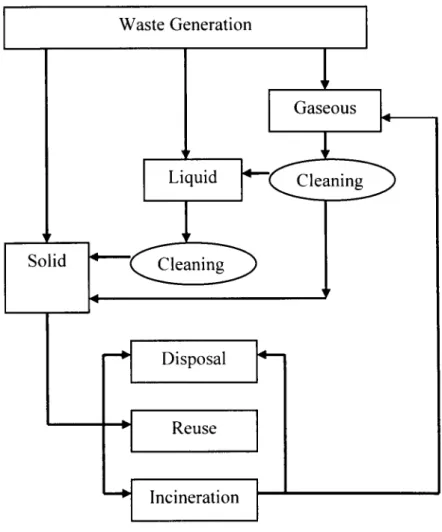
There a three forms of waste from all sources. A waste can be in liquid, gaseous or solid in form. However, these three forms are closely related by a conversion cycle. The liquid waste can be transformed to solid waste form after it was generated. The gaseous waste holds the same procedure. In turn, after the solid waste when to incinerated, it wills outcome in the fabrication of gaseous and liquid wastes (Figure 1.1).
ý
Demo (Visit http://www.pdfsplitmerger.com)
Waste Generation
t
Solid
Liquid
Cleaning
Disposal
Reuse
Incineration
Gaseous
Cleaning
Figure 1.1 Waste types and their interrelationship. (Ishwar P. Murarka, 2000)
1.2 Solid Waste
The Solid Waste Disposal Act of 1965 [Title II, P. L. 89-272, 89`h Congress, October 20, 1965, Section 203 (4)] defines solid waste as garbage, refuse, and other discarded solid materials, including solid waste materials resulting from industrial, commercial and agricultural operations, and from community activities, but does not include solids or dissolved materials in domestic sewage or other significant pollutants in water resources, such as silt, dissolved or suspended
Demo (Visit http://www.pdfsplitmerger.com)
solids in industrial wastewater effluents, dissolved materials in irrigation return flows or other common water pollutants.
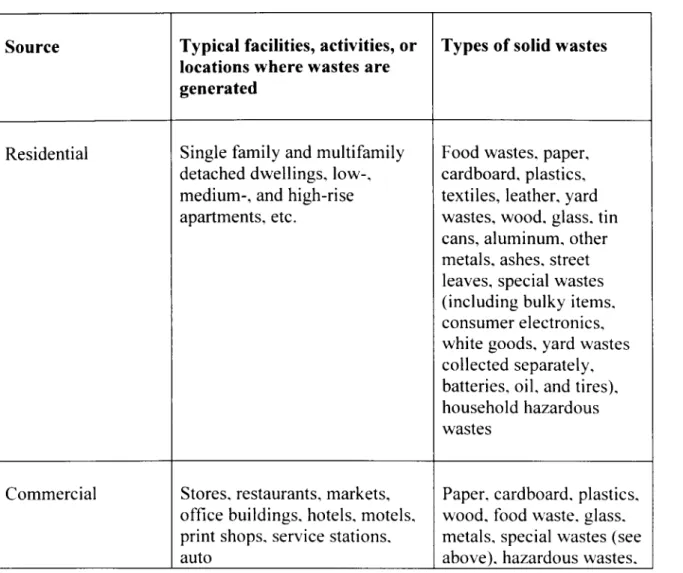
Solid wastes include garbage, old newspaper, yard waste, packaging materials and the other item that are discarded by the typical household. There are eight categories of sources classification of solid wastes in a community (Table 1.1) which are residential, commercial, institutional, construction and demolition, municipal services, treatment plant sites, industrial and agricultural.
(Tchobanoglous, Theisen and Vigil, 1993)
Table 1.1 Sources of solid wastes within a community
Source Typical facilities, activities, or locations where wastes are generated
Types of solid wastes
Residential Single family and multifamily Food wastes, paper, detached dwellings, low-, cardboard, plastics,
medium-, and high-rise textiles, leather, yard
apartments, etc. wastes, wood, glass, tincans, aluminum, other metals, ashes, street leaves, special wastes (including bulky items, consumer electronics, white goods, yard wastes collected separately, batteries, oil, and tires), household hazardous wastes
Commercial Stores, restaurants, markets, Paper, cardboard, plastics, office buildings, hotels, motels, wood, food waste, glass, print shops, service stations, metals, special wastes (see
auto above), hazardous wastes,
4
Demo (Visit http://www.pdfsplitmerger.com)
repair shops, etc. etc.
Institutional Schools, hospitals, prisons, As above in commercial government centers
Construction and New construction sites, road Wood, steel, concrete, demolition repair/renovation sites, razing of dirt, etc.
buildings, broken pavement
Municipal services Street cleaning, landscaping, Special wastes, rubbish, (excluding treatment catch basin cleaning, parks and street sweepings,
facilities) beaches, other recreational areas landscape and tree trimmings, catch basin debris, general wastes
from parks, beaches, and
recreational areasTreatment plant Water, wastewater, and Treatment plant wastes, sites; municipal industrial treatment processes, principally composed of
incinerators etc. residual sludges
Municipal solid All of above All of the above
waste
Industrial Construction, fabrication, light Industrial process wastes,
and heavy manufacturing, scrap materials, etc. Non- refineries, chemical plants, industrial wastes including power plants, demolition, etc. food wastes, rubbish,ashes, demolition and construction wastes, special wastes, hazardous wastes
Agricultural Field and raw crops, orchards, Spoiled food wastes,
vineyards, dairies, feedlots, agricultural wastes,
farms, etc. rubbish, hazardous wastes
Source: Tchobanoglous, Theisen and Vigil, 1993
Demo (Visit http://www.pdfsplitmerger.com)
1.3 Solid Waste Management
Tchobanoglous, Theisen and Vigil (1993), defined the solid waste management as the discipline associated with the control of generation, storage, collection, transfer and transport, processing, and disposal of solid waste in a manner that is in accord with the best principles of public health, economics, engineering, conversation, aesthetics, and other environmental considerations, and that is also responsive to public attitudes.
An efficiency waste management becomes important since nineteenth century. Unfortunately, waste management in rural area is mismanaged.
According to M. Joe and B. Alison (2001), `rural' is a relative term used to describe geographically based characteristics, circumstances and practices which are not urban. By comparison, `urban' refers to that commonly found in towns and cities. Rural implies landscapes characterized by open space, vegetation and natural physical features, land use characterized by farmed land and a relative low incidence of built property and infrastructure. Rural also implies human socio- cultural norms captured in labels such as `conservatism; and `traditionalism', with social attitudes and behavior strongly influenced by the patterns of natural processes and a shared sense of heritage and belonging. The residents in the rural area throw they rubbish into the river or burning the waste besides buried it in the soil. Furthermore, this practice will lead to pollution.
6