CHAPTER 1
INTRODUCTION
1.1 Introduction
With the advancement of science and technology, the scope of the documents is expanding and not only focusing on physical forms alone. The characteristics of the document, which are durable and consistent even over a long period, make it suitable as evidence in everyday life. For that reason, some parties take advantage of the document’s strength by forging it for their mere advantage. The forgery of documents occurs not only in the civil court but also in the Syariah court, such as the forgery of marriage certificates, signatures, and false accounts to marry. This study focuses on document forgery, particularly in marriage cases by examining the existing provisions under the jurisdiction of Syariah law of Malaysia (for Syariah court) and Malaysian law (for civil court) related to the offence of document forgery in marriage cases, as well as some related cases were analysed in order to gain an understanding of the practice in Syariah courts and civil courts when dealing with such cases. By comparing both courts, some recommendations for improving the Malaysian Syariah court’s position in dealing with cases or issues involving document falsification can be made by referring to the Malaysian civil court’s model.
1.2 Background of Study
The background of the study is important in determining the suitability of research problems and the required method to conduct a study. This study is based on the following research backgrounds:
1.2.1 The Need to Examine the Concept of Documentary Evidence and Related Issues such as Document Forgery according to Syariah Law of Malaysia and Malaysian Law Perspectives
The documentary evidence is heavily debated in Malaysian law and widely used in civil courts. However, under Malaysian Syariah law, the concept and application of the document in the Syariah court are not discussed in detail. This is because the method of proof in the process of conviction and denial widely used under Syariah law of Malaysia is syahadah, iqrar, qarinah, and oath. Not only that, but the previous fiqh scholars have also never discussed documents as a method of proof in a separate title.
Instead, the document was only spoken in a narrow scope and a short title. In addition, most scholars’ arguments rejecting the use of documents are that the documents are prone to forgery (Ibnu Al-Qayyim, 1991: p. 204; Al-Syiraziyy, 1995: p. 401; Ibnu Farhun, 1995: p. 304; Ibnu Qudamah, 1996: p. 605). As a result, the previous scholars were significantly less focused on the law of documents and their falsification in their writing. In Islam, idolatry and forgery of documents are included in major sins. Allah S.W.T says in Surah al-Hajj verse 30:
َلْ تُ ي اَم هلاِإ ُماَعْ نَْلأا ُمُكَل ْتهلِحُأَو ِهِ بَر َدنِع ُههل ٌْيرَخ َوُهَ ف ِهللَّا ِتاَمُرُح ْمِ ظَعُ ي نَمَو َكِلَذ﴿
ى
ُبِنَتْجاَف ْمُكْيَلَع
﴾ِروُّزلا َلْوَ ق اوُبِنَتْجاَو ِنَثَْوَْلأا َنِم َسْجِ رلا او
Translation: “That [has been commanded], and whoever honors the sacred ordinances of Allah – it is best form him in the sight of his Lord.
And permitted to you are the grazing livestock, except what is recited to you. So avoid the uncleanliness of idols and avoid false words.”1
(Al-Qur’an. Al-Hajj 22:30)
This verse is one of the arguments why the scholars at that time forbade the forgery of documents (Ibn ‘Abidin, 1995: p. 435). The story of the assassination of Sayidina Uthman was also one of the factors that led to the refusal of the use of documents at the time of previous scholars. However, Ibn Al-Qayyim (2007: p. 173) and Ibn Farhun (1995: p. 303) were passionate about expressing the strength of the documentary evidence. Then, the later scholars’ acceptance of documents as a means of proof is more appropriate and practical (Wan Ismail et al., 2015). Therefore, whether it is traditional or electronic forms, the use of documents can be used as the primary reference in any daily affair. The document should be regarded from a broader perspective, in terms of its function, rather than just the form and equipment utilised;
what is important is that the information to be transmitted can be understood.
However, it does not mean that this kind of method of proof will be escaped from the element of document falsification. Significantly, it is necessary to carry out a specific study on the concept of documentary evidence and document falsification according to the Syariah law of Malaysia and Malaysian law perspectives to ensure the document’s authenticity is used in the court proceedings.
1.2.2 The Need to Analyse the Provision for the Offense of Document Falsification in Marriage Cases under the Syariah Law of Malaysia and Malaysian Law
Falsification is one of the challenges when admitting the documentary evidence in a trial proceeding (Yahya et al., 2017). In the study of Wan Ismail et al., (2019), the authors mentioned several forms of forgery that usually occur in a court such as forgery of marriage certificates, testimony, and forgery by adding false statements. Although many forms of forgery are recorded in the courts, either by the Syariah courts or by civil courts, the most frequent fraud reported involve fraudulent signatures, and other forms of forgery, such as forgery of marriage documents. Therefore, the researcher focuses on document falsification in marriage cases as a study sample for this study. First, the result of the interview in the study of Wan Ismail (2015), the Syariah court judge mentioned that the most forgery cases that occur in the Syariah court are the forgery of a marriage certificate. Secondly, according to this study, one of the Syarie lawyers with extensive experience said that the most common forgery is the signature of a marriage certificate.
For offenses involving document falsification in marriage cases under Syariah law of Malaysia, the researcher referred to the provisions of the Islamic Family Law (Federal Territory) Act 1984 (Act 303) (from now on referred to as the IFLA) and the Syariah Court Civil Procedure (Federal Territories) Act 1998 (Act 585).
The researcher also discovered several cases involving forged document marriages in a civil court. For example, in the case Deputy Public Prosecutor v Pasupathy A/L Kanagasaby [1995] MLJU 541. In this case, the defendant was summoned for having been suspected of committing an offense related to the forgery of a marriage certificate, as this offense is included in the offense under the Penal Code (Act 574). This case has shown a specific punishment under Malaysian law for
falsifying documents in marriage issues. For offenses involving document falsification in marriage cases under Malaysian law, the researcher had referred to the provisions of the Penal Code (Act 574) and Law Reform (Marriage and Divorce) Act 1976 (Act 164) (from now on referred to as the LRA). This study aims to analyse the provision for the offense of forgery in marital cases under civil and Syariah courts in Malaysia. The result of the study will also be an indirect reference for legal practitioners when handling this kind of case.
1.2.3 Improving the Malaysian Syariah Law Position in Dealing with Cases or Issues Involving Document Falsification by Reference to the Malaysian Civil Court’s Model
Generally, civil courts have dealt with cases involving the forgery of documents for a long time, and their experience is also quite extensive compared to Syariah courts (Ahmad et al., 2019). Instead, when it comes to dealing with matters involving document falsification, Syariah courts fall considerably behind civil courts (Wan Ismail
& Asutay, 2017). This is because the Syariah legal practitioners are rarely exposed to related cases (Yahya et al., 2017). As a result, some recommendations have been made to strengthen the Syariah court, particularly when handling cases involving document falsification based on the civil court’s evaluation approach. Besides, it will indirectly increase the position of the Syariah court on a par with the civil court, specifically in cases involving forgery of documents.
1.3 Statement of Problem
The research problem is one of the essential parts of any study. This is because the research problem will introduce the gap in the study. Several gaps have been identified based on earlier literature and studies’ backgrounds. These statements should be read together with the background of the study for better understanding.
First and foremost, there is a lack of literature on the concept of documentary evidence and its challenges, such as document falsification, from the perspectives of Malaysian Syariah law and Malaysian law. This is because the resources available to ancient scholars affected their understanding of the concept of document, its practice, and their confidence in its credibility as evidence (Wan Ismail et al., 2021). Most methods of proof used at that time were only focused on iqrar, syahadah, qarinah, and oaths (Rapini & Md Noor, 2016). In addition, some of fiqh’s scholars have rejected the documentary evidence because its use is prone to forgery. The story of Sayidina Uthman’s murder due to the issue of document forgery was also one of the arguments for scholars at that time to reject the use of documents (Ibn Al-Qayyim, 1995; Al- Syiraziyy, 1995; Ibn Farhun, 1995; Ibn Qudamah, 1996). With the growth of technology, the document has become one of the most crucial methods of proof compared to other types of proof, whether in Syariah courts or civil courts. In fact, despite the time brought changes, the proof through documents will remain in its original circumstances, and it can prevent witnesses from changing their witness arbitrarily or due to death (Wan Ismail et al., 2015). However, this does not mean that documents will be saved from being tainted with falsehoods that eventually favour wrongdoers at the expense of the righteous (Alias et al., 2021). Past studies have shown that no specific study was found that discuss in depth on the concept of a document as
a means of proof and document falsification from Syariah law of Malaysia and Malaysian law. Therefore, it is necessary to study the concept of documentary evidence and related issues, such as document forgery, from the perspectives of Syariah law of Malaysia and Malaysian law which may serve as a reference to the Malaysian judges, legal practitioners, policy makers, academicians, other researchers, and the general public.
Secondly, forgery of marriage documents is one of the most common forms of forgery in court, especially in the Syariah court (Wan Ismail et al., 2019). This is because the function of marriage documents is generally used to confirm the marital status of the husband and wife. Therefore, if a marriage document is forged, it cannot be used as proof to show that they are legally married. Besides that, there are also cases involving the forgery of signatures for polygamy. According to Sanusi (2021), in an article titled “Tiada Kompromi dengan Scam Poligami”, the author states that for polygamy applications, Section 23(5) of Islamic Family Law (State of Selangor) Enactment 2003 requires the court shall summon the applicant, his existing wife or wives, the woman to be wedded, the wali of the woman to be wedded if any, and other persons who in the opinion of the court may provide information relating to the proposed marriage to be present at the hearing of the application. Therefore, if the husband takes the easy way out by using incorrect documents or engaging in polygamy abroad, he is irresponsible and breaks the law, and the court will take action against him. For example, in the case of Kholed bin Dinyati v Melaka Chief Syarie Prosecutor (2009) 29 JH 2, the husband made a false declaration for polygamy. In contrast with Malaysian law, fraudulent certificates and documents can be considered as one of the criminal offenses and can be investigated and prosecuted under the Penal Code (Act
574). Therefore, the issue of the fraudulent use of certificates or fake documents must be taken seriously by all parties especially the authorities in charge. This is to prevent the guilty who make this offense from regretting it later because they may face severe punishment (Mallow, 2019). In this study, the researcher focuses on document falsification in marriage cases as a case study. The researcher then examined the provisions regarding document forgery in marriage cases before both courts for better understanding the differences of the jurisdiction between Syariah and civil courts in Malaysia in relation to document forgery issues.
Finally, document forgery is one of the challenges when admitting documentary evidence before a court either Syariah court or civil court. As early as the 1950s, Syariah courts were far behind civil courts in dealing with cases involving documents, such as document falsification. Different scenarios occur in Syariah courts, where Syariah law practitioners are rarely exposed to cases involving document forgery (Ahmad et al., 2020). This is because the cases related to document forgery are handled mainly by civil courts rather than the Syariah courts. For example, in the case of Idris bin Hassan v Lembaga Pertubuhan Peladang Perlis and Others [2007] 6 MLJ 147; [2007] MLJU 266; [2007] 4 AMR 100; [2007] 4 CLJ 803, the case was dismissed as the accused was found guilty for falsifying documents as it had violated employment discipline. This is because the decision to dismiss the plaintiff from the authority’s services indicates that the disciplinary committee had considered extraneous matter or, more specifically, any charge relating to document falsification. This situation is supported by Mallow (2019);
“forgery of documents can face dismissal action because it becomes an act of misconduct that can excuse the offender from being dismissed (dismissal)”. This contrast with the situation in the Syariah court where Malaysian law discusses the
forgery of documents in more detail, while the Syariah court only refers to the concept and practice of takzir in general by giving the judge greater power in making decisions (Wan Ismail, 2020). This thesis explored the practice of civil and Syariah court related to document falsification in marriage cases as a sample and how the legal practitioners deal with this kind of case. By analysing the practice of both courts related to such cases, it had provided some improvements that can be made under the existing Syariah law of Malaysia on the matter involving document falsification by referring to the civil court’s model.
1.4 Research Questions
i. What is the concept of documentary evidence and related issues, such as document falsification from Syariah law of Malaysia and Malaysian law perspectives?
ii. What legal provisions provided for the offense of document falsification in marital cases under Syariah law of Malaysia and Malaysian law?
iii. How does the Syariah and civil court in Malaysia deal with the issue of document falsification in marriage cases?
iv. What areas of improvement can be made under the existing Malaysian Syariah laws on the matter involving document falsification?
1.5 Research Objectives
This research attempts to achieve several objectives. These objectives must be considered to ensure that findings are precise with what the researcher is trying to find out. Below are the objectives of this research:
i. To study the concept of documentary evidence and related issues, such as document falsification from the perspective of Syariah law of Malaysia and Malaysian law.
ii. To explore the legal provisions provided for the offense of document falsification in marital cases under Syariah law of Malaysia and Malaysian law.
iii. To analyse the practice of Syariah and civil court in Malaysia when dealing with the issue of document falsification in marriage cases.
iv. To suggest improvements that can be made under the existing Malaysian Syariah laws on document falsification.
1.6 Methodology
A systematic study employs a certain approach. It encompasses tools and techniques to conduct thorough research or finding. These approaches ensure that the study results are correct and unaffected by external factors. Therefore, it is crucial to select a method that must be matched to the research objective (Neuman, 2006). In this section, the researcher describes the selection of suitable methodology for this research:
research design, data collection, and data analysis.
1.6.1 Research Design
Research design can be described as the main scheme and research plan (Baharuddin, 2017). It also can be defined as a master plan specifying the methods and procedures for collecting and analysing the needed information (William, 1988).
According to Akhtar (2016), a research design can be considered the research structure.
It is the “glue” that holds all of the elements in a research project together. In short, it is a plan of the proposed research work. This is because research design is vital in guiding the research until the objectives are achieved (Baharuddin, 2017). Therefore, building a good research design will lead the research until the objective is achieved.
1.6.1.1 Qualitative Research Design
This research adopts a qualitative research approach. Undoubtedly, qualitative research is used to explore and develop a complex understanding of selected issues. The qualitative research design enables the researcher to investigate a topic in an open-ended manner in which no predetermined factors or specific relationships exist (Creswell &
Creswell, 2017). This thesis is important because the researcher must comprehend the level of Syariah and civil practice in Malaysia regarding the issue of document falsification. To fulfil this study’s aims, the researcher adopts a qualitative research design to answer the research questions.
There are numerous reasons why the qualitative approach was chosen for this study. Three rationales supported the use of a qualitative approach in this study as justifications:
i. First and foremost, the strength of qualitative research stems from its ability to provide complex textual descriptions of how people experience specific research problems. This type of research encourages the ability to infer meaning from patterns and develop ideas across contexts.
According to (Johnson, 1997), qualitative research is best suited for exploratory research.
ii. Second, this approach is appropriate for making a subjective interpretation of the content of text material via a systematic classification process of coding.
iii. Finally, this strategy is frequently utilised to grasp people's perspectives and perceptions. It provides viewpoints on various issues and aids in the formulation of concepts or theories for a possible quantitative study. The qualitative technique, which uses analysis to delve deeper into problems, aids in discovering fresh ideas and individual points of view (Carol, 2016).
Specifically, this research explored the general practices of the Syariah and civil courts in Malaysia in dealing with the issue of document falsification by analysing marriage cases. By using this research design, the researcher had examined and interpreted the content related to this topic obtained from the holy Qur’an, hadith, Islamic legal maxims, turath books, legal books, cases, statutory materials, internet sources, and newspapers. Hence several improvements have been made under the Malaysian Syariah courts in dealing with cases or issues involving the falsification of documents by reference to the Malaysian civil court’ model.
14
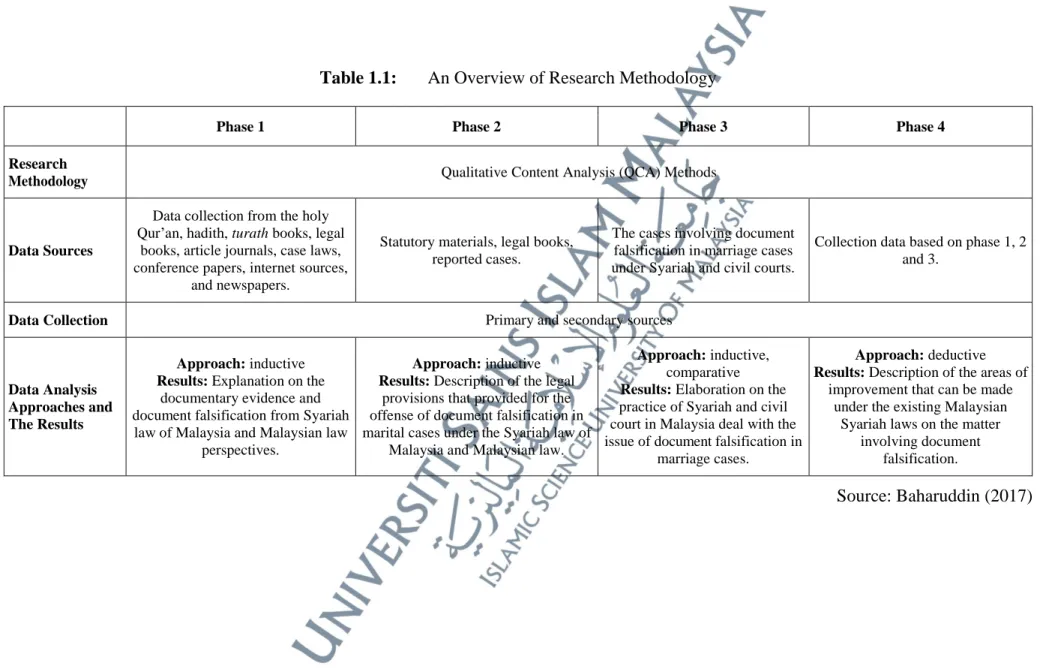
Table 1.1: An Overview of Research Methodology
Phase 1 Phase 2 Phase 3 Phase 4
Research
Methodology Qualitative Content Analysis (QCA) Methods
Data Sources
Data collection from the holy Qur’an, hadith, turath books, legal
books, article journals, case laws, conference papers, internet sources,
and newspapers.
Statutory materials, legal books, reported cases.
The cases involving document falsification in marriage cases under Syariah and civil courts.
Collection data based on phase 1, 2 and 3.
Data Collection Primary and secondary sources
Data Analysis Approaches and The Results
Approach: inductive Results: Explanation on the
documentary evidence and document falsification from Syariah
law of Malaysia and Malaysian law perspectives.
Approach: inductive Results: Description of the legal
provisions that provided for the offense of document falsification in marital cases under the Syariah law of
Malaysia and Malaysian law.
Approach: inductive, comparative Results: Elaboration on the practice of Syariah and civil court in Malaysia deal with the issue of document falsification in
marriage cases.
Approach: deductive Results: Description of the areas of
improvement that can be made under the existing Malaysian
Syariah laws on the matter involving document
falsification.
Source: Baharuddin (2017)
The research methodology used in this study was summarised in Table 1.1, which includes the study’s phase, data collecting and its sources, data analysis approaches, and the results. This study comprises a four-phase analysis that used the Qualitative Content Analysis (QCA) method. For data collection, the researcher collects data from primary and secondary sources. The collected data were then analysed using inductive, comparative, and deductive approaches.
1.6.2 Data Collection Method
Data collection is the systematic approach in gathering and measuring information from various sources to obtain a complete and accurate picture of the area of interest (Sajjad Kabir, 2016). It is very important in any research study. It involves collecting data and then making sense of it by grouping data segments into codes, themes, and a broader perspective. This is important in any study as it allows the researcher to answer the relevant questions and evaluate the research outcomes. For example, since the researcher needs to examine all references related to the issue of document forgery, the researcher used a qualitative content analysis method to obtain material and information relevant to the scope of the study.
As for QCA’s method, the collected data is classified into primary and secondary data. The primary data included the holy Qur’an, hadith, Islamic legal maxims (Qawaid Fiqhiyyah), and statutory materials in this study. This is because these data sources are clear, reliable, and authentic. Meanwhile, the secondary source is the data already collected or produced by others (Ajayi, 2017). The data sources from secondary sources include article journals, books, turath books, reported cases, thesis dissertations,
1.6.3 Data Analysis
This section is about analysing the data from the data collection phase. Data analysis is a crucial segment of every research. This is because it is the process of gathering and organizing data in order to draw useful conclusions from it. Furthermore, the data collected were analysed to ensure that it is truly genuine and valuable to help conclude at the end of the study (Awang, 2009). To extract information from data, the process of data analysis employs analytical and logical reasoning. The researcher used the following methods for this study:
1.6.3.1 Inductive Approach
The inductive approach aims to generate new knowledge relating to this topic.
Using this method, the researcher analysed the data generated by the theories by drawing general conclusions from general data to draw specific conclusions. Typically, data is used to unravel the research problem, theoretical framework, and other data through document analysis. In addition, the researcher had concluded the data in the cases that the researcher had discovered.
Therefore, the researcher analysed the literature from various reliable sources to achieve this study's first, second, and third objectives. A researcher began by analysing classical sources, modern sources, legal books and analysing the opinions of fiqh's scholars to draw a clear description regarding the concept of a documentary evidence and its falsification from the perception of Syariah law of Malaysia and Malaysian law.
The researcher also looked for legal provisions involving documents forgery in marriage cases from Syariah law of Malaysia and Malaysian law and then examined
collected cases involving forgery of documents in marriage cases under Syariah courts and civil courts to analyse the practice of both courts dealing with the issue of document falsification by making a marriage case as a sample. The researcher used this inductive approach to answer the first, second, and third objectives of this study.
1.6.3.2 Comparative Method
According to MokhtarianPour (2016), a comparative method is a type of method that is used to analyse phenomena and then group them in order to discover points of differentiation or similarity. For this study, the researcher also adapted the comparative method by comparing cases of document forgery in marriage cases decided in Syariah and civil courts. The researcher examined such cases to determine the extent of the practice in both courts when dealing with such cases to draw conclusions and determine the difference between the two jurisdictions. This method has been used in the fourth chapter of this thesis.
1.6.3.3 Deductive Method
This method describes the process of analysing data to find the results of specific evidence to reach a general conclusion. First, the researcher had to collect information using a key and then apply the theory to explain the data. Then, it was used to answer the fourth objective of this study, which was to draw accurate conclusions after gathering the information and answering the first, second, and third objectives. The conclusions include some suggestions for improvements to the existing Malaysian Syariah laws on document falsification.
1.7 Literature Review
1.7.1 The General Concept of Documentary Evidence
Before conducting this research, only a few studies discussed the concept of documentary evidence. As a result, researchers and legal practitioners have not found concrete references to the concept of using documents as a means of proof by Syariah law of Malaysia and Malaysian law viewpoints. In my opinion, the previous studies highlighted that many versions of the document appeared current age and that it may be utilised as a proof technique in court. However, no specific study has been conducted examining its notion as a form of proof from two perspectives, the Syariah law of Malaysia and Malaysian law.
In the study by Wan Ismail (2016), the document is one of the essential methods of proof in this era, whether employed in Syariah courts or civil courts. In the past, the document did not have its correct place in the Syariah law of evidence because scholars had never examined the document as a means of proof in a distinct title. Instead, the document is only spoken in a limited scope. It is divided into subheadings under other evidence, such as documentary confession under the title of pledge, written testimony under the label of testimony, and so on (Wan Ismail et al., 2021). Arbouna (1999) in his book entitled “Islamic Law of Evidence: The Function of Official Documents in Evidence (A Comparative Study with Common Law)”, the author generally discusses the concept of documentary evidence according to Islamic law without focus its concept from the perspective of Syariah law of Malaysia.
On the other hand, Sulaiman Marqus (1981: p. 198) believes that a document should be considered in the context of its function, not merely in the form of documents
communicated through the document is understood. As a result, the concept of a document is no longer restricted to printed material or something recorded on its own.
However, electronic documents such as closed-circuit television (CCTV), photo recording, digital video, disc usage, compact discs, and the internet are also included in the definition of documents (Al-Mubarak, 2005). The authors of these studies emphasise that the definition of a document should now be evaluated in a broader context. However, the researcher observed that the previous studies did not discuss the concept of documentary evidence from Syariah law of Malaysia and Malaysian law perspectives.
This contrasts with civil courts, which have lagged well behind Syariah courts in receiving documented evidence since the 1950s and continue to be commonly used today (Ahmad et al., 2020). Therefore, based on current facilities and technological developments, documents can be defined as explaining or describing something by using writing, sketches, or copies that are outward in shape, either in a classical form like using paper, wood, or the like, or in a modern form like using diskettes, compact discs, internet, and the like are included in the definition of documents to be used in civil and Syariah courts (Wan Ismail, 2020).
However, a range of new document types will indirectly pose a challenge for legal practitioners when they seek to admit the document either conventionally or digitally;
the document will be vulnerable to forgery (Yahya et al., 2017; Mohamed & Ramlee, 2014). This is because, in modern’s growth, the originality or falsehood of a photograph and the result of capturing sound or image can be manufactured by others. This is due to irresponsible attitudes or people with low moral and religious values (Al-Mubarak,
Not only that, the facilities available to ancient scholars influenced their grasp of the concept of the document, practice, and conviction in its efficacy as proof. This is since most of the earlier literature is not holistic, as, at the time, the most common technique of proof was the pledge, syahadah, and oath. Today, the situation is significantly different, as documents have become one of the primary methods of evidence, and numerous sorts of documents have appeared at this time. This is because if the document is not acknowledged as a method of proof, it will make it impossible for many daily affairs, which is currently being widely used for evidence in many things (Wan Ismail, 2020). Due to the necessity of ensuring the validity of documents used in court, this subject is highly significant to analyse in detail connected to the notion of a document as evidence according to Syariah law of Malaysia and Malaysian law’s views.
1.7.2 The Admissibility of Documentary Evidence and Its Challenge in Court Proceeding
Another important aspect of the document is the admissibility of documentary evidence before a court. In general, both the Syariah and civil courts have begun to accept the document as one of the new forms of evidence. Several case studies that the use document as evidence have been listed in Syariah courts, including fasakh claims cases, marriage confirmation applications, nusyuz claims, and cheering claims. This study demonstrates that Syariah courts began to accept documents as evidence (Yahya et al., 2017).
On the other hand, according to Urus and Azhar (2018), the authors discovered that the document is recognised as evidence under the Syariah courts by the Syariah principles. This is since this description aids in support of the other facts presented in
court. The authors also present several cases where the Syariah court accepts documentary evidence, such as Halijah Abdul Rahman v Zambree Baharom [2009] 1 CLJ (SYA) 402. In this case, the court upheld and convicted the divorced spouse through a Short Message Service (SMS) when the husband texted for a divorce. The court has referred to the divorce case through the views of the ulama, including the decision of the 59th The Muzakarah (discussion) Committee of the National Council for Islamic Religious Affairs (MKI) on 27 August 2003 that divorce through SMS as a new form of the document is valid if it is accompanied by intent. It shows that digital data, such as a text message submitted in a Syariah court, can be used to certify a husband and wife’s divorce.
The other case is Nor Aniza binti Idris v Mohammad Fauzi bin Ahmad [2006] 3 SHLR 102, in which the accused had sent an SMS to his wife for a divorce. The accused claimed that the previous SMS was not intended for divorce. However, the judge has previously cited the SMS as solid evidence that the divorce was valid even though the accused had no intention of divorce. This demonstrates that document descriptions, such as SMS are a digital form of evidence and are also utilized in Syariah courts (Wan Ismail et al., 2020). The previous study also demonstrates that the document is acceptable in the Syariah court to reinforce the facts, persuade the court to accept the facts, and decide (Yahya et al., 2017).
Accepting documents as proof presents several challenges, including the admissibility of evidence in the absence of witnesses or experts and the clarity of the evidence. This is because it is intended to convict a case, particularly in criminal cases such as khalwat cases where further evidence is needed to reinforce the evidence to be
entitled “Keterangan Dokumen dalam Bentuk Digital di Mahkamah Syariah: Analisis Berkaitan Definisi serta Kebolehterimaannya di Sisi Prinsip Syariah di Malaysia” by Yahya et al., (2017), the authors generally mention several challenges when admitting a digital document as a method of proof in a Syariah court, such as a forged document.
However, the authors do not detail the concept of document falsification in Syariah law of Malaysia and Malaysian law.
Then, the previous literature only mentioned the general admissibility of the documentary under the Syariah court, such as what cases were reported that used documentary evidence and its function as a method of proof in court. The previous study also does not detail the issue of this type of method, such as the concept of a forged document, which is one of the challenges when admitting this type of proof method. As a result, it is critical to investigate the concept of document forgery from Syariah law of Malaysia and Malaysian law standpoint.
On the other hand, in the article entitled “Admissibility and Authenticity of Electronic Evidence in The Courts of Malaysia and United Kingdom” by Mohamad (2019), the author has discussed the admissibility of electronic evidence, which has been classified as one of the new forms of a document in the Malaysian courts. In that article, the author also discusses Sections 90A, 90B and 90C of the Evidence Act 1950 (Act 56), which provide the admissibility of a document produced from a computer. In addition, the author also generally mentions that fraud and forgery are challenging when using the document.
In another research by Radhakrishna (2016), the author highlighted the admissibility of documents in electronic form in the civil courts of Malaysia. In this
1950 (Act 56) concerning the general admissibility of a document produced by a computer. In addition, the author also mentions forgery as a challenge when admitting electronic documents in general. However, according to the above studies, the study on document falsification as one of the difficulties when admitting the document as evidence in a civil court is still not thoroughly discussed.
Previously, the authors only addressed the admissibility of documentary evidence before a court and the difficulty of admitting documents as evidence due to forgery in general. As a result, the researcher stated that it is critical to research the concept of document falsification from Syariah law of Malaysia and Malaysian law, as it is one of the challenges when admitting documentary evidence in a trial.
1.7.3 Document Marriage and its Importance in General
In this study, the researcher focuses on forgery cases in marriage documents as a sample to analyse how the Syariah and civil courts handle related cases. Generally, document marriage as marriage certificates is important for husband and wife to show that they are legally married. Those documents can also be used as evidence in court for various purposes, including divorce, polygamy, and others. A marriage certificate is a document that proves a marriage took place. It is frequently used in a variety of legal contexts. As a result, a marriage certificate is a legal document that brings together two people who want to live together for the rest of their lives (Butt, 2017).
However, in the article entitled “People's Unawareness of the Importance of Marriage Certificate” written by Jamilah et al., (2019), there are also people who still do not care or take the issue of documents in marriage as marriage certificates lightly.
This was due to their lack of understanding of the importance of a marriage certificate and their low educational and economic backgrounds; therefore, their marriage was unregistered. The disadvantage of not having a marriage certificate is that the children will lack a birth certificate, the parents will lack proof of legal marriage, the wives will lack inheritance rights from the husband as well as the right to child custody, and people will be unable to apply for jobs, and the family will lack any family registration certificate. As a result, it is critical to have documents like marriage certificates in the marriage and keep them safe from forgery. If the document is falsified, the marriage is null and void.
In addition, document forgery in marriage also can occur when the husband forges the wife’s signature for polygamy. According to an article in the newspaper Harian Metro Online (2021) titled “Pemalsuan Dokumen untuk Berpoligami adalah Kesalahan Jenayah”, the act of falsifying documents or signatures in the case of polygamy forgery is a criminal offense that can be prosecuted in court. According to Muhamad Akmal Arif Shamsul Kahar (lawyer), although the Syariah Court lacks jurisdiction to hear, consider, or decide cases involving forgery and fraudulent signatures, the individual can be prosecuted in civil court. This is since the forgery of documents or signatures implies that the marriage appears to occur according to the husband's will. He desires polygamy without regard for the rights of the first wife. As a result of the breakdown of family institutions, the first wife will experience emotional stress.
In the newspaper Berita Harian Online (2017), in an article titled “2 Kakitangan JHEAT Mengaku Terima Suapan, Palsu Sijil Nikah”, it was reported that three men, including two Terengganu Religious Affairs Department (JHEAT) employees, were
guilty to four charges of accepting bribes and forging marriage certificates. This demonstrated the importance of maintaining the validity of marriage documents for the marriage of husband and wife to be legally valid. However, there is still a gap in the literature discussing the significance of documents in marital cases, causing the community to underestimate the importance of marriage documents such as marriage certificates. As a result, the document is easy to forget. Therefore, this study indirectly contributed to the literature on the subject.
1.7.4 The Concept of Document Falsification and Its Form in General
Previously, most of the available literature was restricted to the general concept and its admissibility in Syariah and civil courts. As a result, there has been no proper research on the practice of Syariah and civil courts concerning document falsification, particularly in marriage cases. On the other hand, the previous study only discusses the general concept of document falsification and the type of forgery that is currently occurring in general.
In the article entitled “Understanding of Syariah Practitioners in Malaysia on Document Forgery” by Wan Ismail et al., (2019), The authors emphasised the various types of falsification and forgery that exist today, like forgery of a marriage certificate, an official letter’s signature, and other forms of forgery. The authors also state that the Syariah court must collaborate with the civil court to handle document forgery issues, as the civil court has its expert and specific provision on this offense. On the other hand, the practice of civil courts regarding document authentication should be used as a model in Syariah courts (Wan Ismail & Asutay, 2017).
In addition, based on a study had been done by Wan Ismail et al., (2015), the authors are interviewing to gather data from the opinion of law practitioners and academics on the document forms recorded in the Syariah court. As a result of the interview, one of the respondents, Officer A, an academician with over 20 years of experience in forensics before entering the academic field, argued that the most common forgery cases involve signatures and other documents. He claims that forgery of a document is common in Syariah courts, citing a case involving the forgery of a marriage certificate.
One of the Syariah court judges, Officer C, argued that one case involving forgery of a marriage certificate had occurred in the early 1990s in the Federal Territories. The case shows that the prosecutor failed to prosecute the case based on weak evidence, and the defendant won the case in the end. On the other hand, officer D, one of Syarie’s lawyers who has a great deal of experience, said that a forgery case occurred, involving a signature and a marriage certificate. The interview results in this article show that the most common document falsification recorded by Syariah law practitioners is a marriage certificate.
However, the preceding study merely addresses the general type of fake document commonly found in Syariah courts. These studies do not detail the requirements of Syariah law on counterfeit marriage certificates, the penalty for this offence, and how far Syariah legal practitioners go when dealing with these types of situations. As a result, little research has been conducted on the practice of Syariah legal practitioners when dealing with situations involving document falsification, particularly in marriage proceedings.
On the other hand, in the article “Legal Perspectives Towards Forgery, Fraud and Falsification of Documents: Recent Development” by Abdul Hadi & Paino (2016), it is stated that falsification of documents is considered to be a crime where the intention is to commit fraud. The authors also discuss on Section 477A of the Penal Code (Act 574), which leads to the development of two offences, namely account falsification and the risk of fraudulent entry. Not only that, but the writers have found various circumstances in which these offences come under this clause. This article only focuses on the general concept of forgery, fraud, and falsification and discusses Section 477A of the Penal Code (Act 574). Instead, the authors do not discuss the provision regarding forged marriage cases in civil court.
Besides, in the article entitled “The Legal Overview on Falsification, Fraud and Forgery” written by Abdul Hadi et al., (2015), the authors also discuss in detail Section 477A of the Penal Code (Act 574), which is discussed in an accounting context. It is usually referred to as false accounting, which is the concealing or destruction of records and is usually used to dupe individuals into parting with money or other property or to cover up what has been done by falsifying the account (Shah et al., 2011; Rantanlal &
Dhirajlal, 2007). However, there is no specific study to be discussed in Section 466 of the Penal Code (Act 574) that discusses the offenses of forgery of a court or public register of births or marriages and other cases of forged marriage in a civil court.
As a result, most of the available material is limited to the general notion of a document, its admissibility and challenges in court, and the basic notion of document fabrication and its forms. However, little research has been conducted to investigate the practice of civil and Syariah court-related document falsification in marriage cases.
falsification from Syariah law of Malaysia and Malaysian law perspectives, the legal provisions for the offence of forged document marriage under the Malaysian law and Malaysian Syariah law, and the practice of document falsification in marriage cases under the civil and Syariah courts in Malaysia. In addition, this study will indirectly assist Syariah officers in dealing with situations involving document falsification/forgery by referring to civil court experience and will serve as a reference for other researchers.
1.8 Significance of Study
Each research should impact at the end, so there is value for the research. It is a similar circumstance for this study. Therefore, it is believed that this study shall significantly impact the academic literature and legal authorities.
1.8.1 Significance to Academic Literature
This study will provide references and contribute to the literature on the concepts of documentary evidence and document falsification from two perspectives: Syariah law of Malaysia and Malaysian law.
1.8.2 Significance to Legal Authorities
This research is also important to identify any weaknesses in the existing laws and practices regarding the document falsification under Syariah and civil courts and make a proposal to improve these weaknesses. The results of this research indirectly can close any existing loopholes on document falsification, especially in the Malaysian
Syariah court, and act as a reference to the legal authorities such as Syariah officers, judges, policy-makers, and legal practitioners.
1.9 Scope of Study
To achieve the objectives of this study, the scope of the study is only focused to several areas;
i. The discussion on the concept of documentary evidence and document falsification from the perspectives of Syariah law of Malaysia and Malaysian law.
ii. As a sample of the study, the researcher focuses on document forgery issues in marriage cases under the Syariah and civils’ court in Malaysia by analysing provisions and cases.
iii. The researcher only suggests improvements that can be made under Malaysian Syariah court institutions when handling forgery cases in the future by referring to civil court institutions as a model.
iv. This research is limited to the document analysis method in data collection (analysing documents, statutes and cases reported in court) due to time and monetary constraints and Movement Control Order (MCO) because of COVID-19.
1.10 Conclusion
In conclusion, this chapter covers the introductory portion of this study, which includes the background of the study, statement of problems, research questions and objectives, methodology used in this study, literature review, the significance of the research, and the scope of the study. Three issues have been highlighted in the background of the study that formed the statement of problems. This study also aims to accomplish and respond to four research questions and objections. Hopefully, the elaboration in this chapter provides an overall picture of the research.