ISSN 1648-3898
/Print/ISSN 2538-7138
/Online/A COMPARISON OF SCHOOL CLIMATE WITH TIMSS 2015
SCIENCE ACHIEVEMENT AMONG SOUTH-EAST AND EAST ASIAN COUNTRIES
Yoon Fah Lay, Khar Thoe Ng
Introduction
School climate not only influences students’ academic achievement but is also related to teacher variables such as teacher job satisfaction. Ac- cording to Dicke et al. (2020), students perceive that there is a relationship between teachers general job satisfaction with the disciplinary climate.
However, for both teachers and principals, there is a relationship between teachers’ working environment job satisfaction factor with student achieve- ment. Benbenishty et al. (2016) found that school domains of climate, performance and violence are highly connected gradually. Employing a cross lagged research design, Benbenishty et al. (2016) found that greater school performance at the first phase of study led to reduced incidence of school violence as well as greater school climate at the second wave of measurement. The above studies inspired the researchers to conduct a comparative study on school climate and TIMSS 2015 science achieve- ment of eight graders from South-east Asian (including country with high achiever such as Singapore) and East Asian countries (with high achievers such as Japan and Korea).
Benchmarking Study through Trends in International Mathematics and Sci- ence Study (TIMSS)
The International Association for the Assessment of Educational Achievement (hereafter abbreviated as IEA) was the pioneer for interna- tional level of comparative evaluation of educational achievements in the 1960s as an attempt to obtain more in-depth understanding of the impact of educational policies and procedures across various school systems. Trends in International Mathematics and Science Study (hereafter abbreviated Yoon Fah Lay
University of Malaysia Sabah, Malaysia Khar Thoe Ng SEAMEO RECSAM, Malaysia Abstract. Since 1995, the International Association for the Evaluation of Educa- tional Achievement (IEA) implemented the
Trends in International Mathematics and Science Study (TIMSS) as an international comparative study. This article aims at identifying the correlations of science classroom instructions with TIMSS science achievement of eighth graders among countries in Southeast Asia and East Asia.
The freely downloadable secondary data were analyzed using a plug-in for SPSS, i.e., the International Database (IDB) Analyzer (version 4.0) of IEA using an imputation methodology involving plausible values so that student’s performance can be reported. This study found that Southeast and East Asian countries with high average science achievement adequately empha- sized academic success, have teachers with job satisfactions well as facing few challenges, have students with sense of belonging to school. Based on the research findings, policy recommendations were made to the Malaysian Ministry of Educa- tion to boost Malaysian eighth graders’
science performance in the forthcoming TIMSS studies.
Keywords: Classroom instructions, comparative study, leadership motivation, science achievement, TIMSS
as TIMSS), one of the international comparative assessments, is directed by the International Study Center for TIMSS & PIRLS of IEA at Boston College.
TIMSS seeks to help the participating countries make better decisions on how to improve the teaching and learning of mathematics and science. However, there were also a number of reservations about TIMSS and its underlying political influence and criticisms from academics such as Sjöberg (2015). Since 1995, TIMSS was administered every four years as a regular student assessment program in grades four and eight. The partici- pating countries are provided by TIMSS with much information about trends in the science and mathematics knowledge as well as skills of the students in their respective countries. A diverse range of state-of-the-art as- sessment is provided in TIMSS on how good students master the essential science and mathematics concepts, content, as well as procedures that countries expect students to learn when they advance through primary and lower secondary level of education. Some of the aforementioned studies were reported by Ong and Gonzalez (2013) as well as Ong et al. (2014).
Problem Statement
Teacher job satisfaction and school climate may have an impact on student’s achievement. Dicke et al.
(2020) examined data provided by 142,280 teachers and 8,869 school principals from 32 countries that were part of the Teaching and Learning International Survey (TALIS) 2013 – Program for International Student As- sessment (PISA) 2012 sample. The climate of school discipline showed the most positive significant relationship with teacher’s satisfaction on job, while student achievement was found to be positively related to teachers’
(r = 0.35) and principals’ (r = 0.16) satisfaction with the working environment (Dicke et al., 2020). However, Lay and Chandrasegaran (2018)confidence in teaching science and career satisfaction found that Malaysian science teachers’ years of experience in teaching, confidence to teach science and satisfaction towards their career did not significantly contribute to eighth grade students’ achievement in science. Malaysian eighth grade students were taught by science teachers with more experience who were more confident in science teaching and more satisfied with their teaching career as compared to eighth grade science teachers in Singapore, but these attributes did not translate into higher achievement for the Malaysian students (Lay & Chandrasegaran, 2018)confidence in teaching science and career satisfaction. There is a need to look at the psychological aspect of educators who contribute much towards students’ achievement. However, the study by Lay and Chandrasegaran (2018) did not really show teachers’ confidence contribute to students’ achievement. So, there must be multifaceted factors from the diverse learning culture and environment that affect achievement, hence this study aims to compare these factors in SEAMEO countries and beyond.
Science education, which transcends the pervasive divide between natural sciences and social sciences, is potentially unique in its ability to promote the awareness and participation of new generations as well as to address the social, economic, and environmental aspects of global challenges. Therefore, addressing diversity and equity-related priorities of science education is of vital significance in the light of the global picture of a rapidly evolving world.
Malaysia joined TIMSS studies since 1999 at the eighth-grade level with averagely good mean score from 1999 to 2007, however the country showed deterioration (the country was placed in the bottom third) in performance from 2011 to 2015. Malaysia with a mean score of 492 was ranked 22nd place in 1999 among 38 participating countries, 21st place in 2003 among 46 countries that participated with an average score of 510, 21st place in 2007 among 59 countries that participated with an average score of 471, 32nd place in 2011 among 63 participating countries with an average score of 426, and 24th place in 2015 among 63 countries that par- ticipated with an average score of 471 (Table 1). Hence awareness was raised among academic and researchers in Malaysia on the needs to study the performance of the country in comparison with other higher performed countries as discussed below.
The results of the latest TIMSS 2015 phase indicate that in the fourth and eighth grades, Singapore, Korea, and Japan are the best ranked nations in science and mathematics education. Table 1 shows the TIMSS science scores for Southeast Asian and East Asian Eighth Grade Students from 1995 to 2015.
Therefore, this study is inspired to be conducted to compare the school climate with more in-depth examination of possible underlying factors that may contribute to the excellent performance of students’ sci- ence achievement in countries like Singapore, Japan, and Korea.
Table 1
TIMSS (Grade 8) Science Scores for Southeast Asian and East Asian Countries (1995 – 2015)
Year No. of countries participated
TIMSS science scores of grade 8 students
Malaysia Singapore Thailand Japan Korea Hong Kong, Chinese Taipei Average
1995 45 - 580 - 554 546 510 - N.A.
1999 38 492 568 482 550 549 530 569 488
2003 46 510 578 - 552 558 556 571 474
2007 59 471 567 471 554 553 530 561 500
2011 63 426 590 451 558 560 535 564 500
2015 63 471 597 456 571 556 546 569 500
Literature Review
This study is anchored on the leadership motivation theory that focused on modified behavior through rein- forcement theory based on Thorndike’s Law of Effect as reported by Onjoro et al. (2015). The leadership motivation theory explains well on the important roles of principals and teachers as leaders to motivate students’ learning in the school environment that are the aspects emphasized by TIMSS, i.e., school emphasis on academic success, teacher job satisfaction, challenges facing teachers and students’ sense of school belonging.
School Emphasis on Academic Success
School climate or learning environment can act as a contributing factor to students’ achievement. Benben- ishty et al. (2016) states that when school climate and safety are encompassed in systems for accountability, also are valued as important aspects of the functioning of school, these variables may receive more priority from the school leaders and may have a more impact on the school performance academically. Anchored on the leadership motivation theory, the academic success in school is emphasized by teachers, parents, and priority of students as well as ambition for the success academically (Badri, 2019). Measurement was made on the perception of school leaders on teachers, parents, and students in relation to students’ performances based on the data from Trends in Mathematics and Science Study (TIMSS) 2015 carried out in the United Arab Emirates. Badri (2019) found that attitudes and behavior of teachers, parents, as well as students were significantly related to students’ performance.
His study also found that there was a powerful relationship between the expectations of parent as well as students’
achievement in education.
Badri (2019) suggests that future research regarding school emphasis on academic success should consider the effect of background, SES reflected by parents’ education and other variables such as home resources including number of books available at home’, all of which can be obtained from the students’ questionnaire in TIMSS. In a study by Badri (2019)parents, and students` priority and ambition for academic success. The school questionnaire items related to school leaders` perception of teachers, parents, and students were used for the analysis (13 items, the school emphasis on academic success as shown by teachers, parents, and priority of students as well as ambi- tion for success academically in the United Arab Emirates was analyzed using the TIMSS 2015 data.
A powerful direct relationship was shown between the type of involvement by parent and achievement academically. The dimension of involvement by parent played a main role, directly and indirectly, in the achieve- ment of student. Teachers show a significant direct influence on students’ achievement (Badri, 2019)parents, and students` priority and ambition for academic success. The school questionnaire items related to school leaders`
perception of teachers, parents, and students were used for the analysis (13 items. The teacher’s role is not limited to providing class instruction to students but also inspiring the students and having high expectations for their achievement as reflected in the analysis involved in school survey items related to perception of school leaders on
teachers, parents, and students (Badri, 2019)parents, and students` priority and ambition for academic success. The school questionnaire items related to school leaders` perception of teachers, parents, and students were used for the analysis (13 items. The findings revealed the significance of attitudes as well as behavior of teachers, students, and parents. There were significant relationships between teachers and students, also between parents with both students as well as scores of TIMSS, also from students to scores of TIMSS (Badri, 2019)parents, and students` pri- ority and ambition for academic success. The school questionnaire items related to school leaders` perception of teachers, parents, and students were used for the analysis (13 items. The study by Conner et al. (2014) also found that the development of scientific literacy, reading and thinking skills during the early years of schooling are among the factors contributing to performance and quality education.
Teacher Job Satisfaction
Teacher’s job satisfaction or sense of achievement towards their career is an important aspect which could have affected their teaching performance and subsequently impacted on students’ academic performance. The job satisfaction of teachers can be positive or negatively correlated with many factors. It is found to be positively related to school and personal consonance of value, support from principal, relations with colleagues, relations with parents, as well as sense of belonging (Skaalvik & Skaaliik, 2011). However, Skaalvik and Skaalvik (2011) also found that teacher’s job satisfaction was negatively related to pressure regarding time, problems of discipline, exhaustion emotionally, and motivation to leave the teaching job.
Teacher career satisfaction, confidence in teaching science and having more years of experience were linked to Singaporean eighth grade students’ higher achievement in science (Lay & Chandrasegaran, 2018)confidence in teaching science and career satisfaction. The study aimed to examine the predictive effects of preparation of teacher (in terms of science teachers’ formal education, their majors in science and education, their experience in teaching, their professional development, their preparedness to teach the science topics of TIMSS, their confidence in science teaching, and their satisfaction towards their career) on science achievement among Malaysian and Singaporean eighth grade students who participated in the TIMSS 2011 assessment.
Challenges Facing Teachers
Teacher’s psychological readiness to face the challenges ahead could have contributed to their teaching per- formance. There are several challenges which teachers have to deal with on a day-to-day basis. These challenges facing science teachers stem from dissimilarity in family support, differential access to resources, as well as sensitivity to the needs of learners who are diverse and their communities (Linn et al., 2016). The increasing diversification of schools’ culture, rapid turnover rate of teachers and demands to prepare students dealing with issues globally show challenges that are complex specific to science education (Linn et al., 2016).
Teaching is one of the occupations that is the most stressful. According to Schonert-Reichl (2017), stress in the classroom is contagious: teachers who are stressed-out tend to have students who are stressed-out. It appears that a classroom environment which is without adequate resources has the potential to lead to greater stress levels in a teacher (Milkie & Warner, 2011).
According to Mahmud et al. (2018), teacher education institutions in Malaysia are facing many challenges to prepare science teachers who are skilled to meet current and future challenges in the digital era with increas- ing needs to incorporating blended learning platforms (Ng & Nyunt, 2010) as well as open and distant education (Gil-Jaurena & Malek, 2013). In addition, Mahmud et al. (2018), Chin et al. (2018), Loganathan et al. (2019), Pang et al. (2019) and Ng et al. (2020) indicated that the challenges facing science teachers in Malaysia are linked to the visible role of science teachers to promote STEM in addition to other challenges faced. These included the English proficiency level necessary to teach dual language programmes (DLP), integrating computational thinking-based science learning in the classroom, promoting higher order thinking skills among students as well as upgrading Information Communication and Technology (ICT) skills.
Students’ Sense of School Belonging
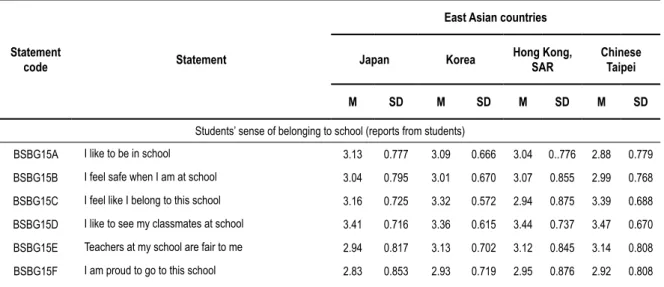
Students’ sense of school belonging was deemed a contributing factor to students’ academic achievement.
performance if the school learning environment is good for them e.g., the school is proven to be a safe place to study. According to Lay and Ng (2019), the safety of school as an important learning environment also played a major role in determining students’ science achievement. Studies suggest that who students are (i.e., their social identities of race and gender) is related to how they experience STEM and view their current as well as long-term participation in the STEM workforce (Burt et al., 2020). According to Burt et al. (2020) when students do not feel a sense of belonging in STEM, they may not view themselves as future contributors to the STEM workforce. In the study by Rjosk et al. (2017), students in classes with a higher proportion of ethnic minority students showed achievement and feeling of belonging with one’s peers that are slightly lower, even if there is student equality in terms of the socioeconomic status, the immigrant background of the family, cognitive ability, and gender. Rjosk et al. (2017) found that there is a positive relationship between the math test scores and a more ethnically diverse classroom environment. However, it could not be interpreted as a causal relationship probably attributed to the cross-sectional design (Rjosk et al., 2017).
Research Objectives
This study embarked on the following objectives:
1. To compare the findings of the TIMSS 2015 pertaining to the science achievement of Grade 8 students among South-east Asian and East Asian countries namely Malaysia, Singapore, and Thailand with reference to:
(a) school emphasis on academic success;
(b) teacher job satisfaction;
(c) challenges facing teachers;
(d) students’ sense of school belonging.
2. To make policy recommendations to the Ministry of Education to boost science performance of Ma- laysian Grade 8 students in the forthcoming TIMSS assessments.
Research Methodology
General Background
Data for the study were extracted from the database of TIMSS 2015 (http://timssandpirls.bc.edu/timss2015/
international-database/). A two-stage stratified sampling approach was implemented in TIMSS. Firstly, sample schools were chosen based on the probability proportional to the school’s size. The classrooms inside the chosen schools were then randomly selected. Due to the scheme of sampling of TIMSS, the surveyed samples can represent the whole population in the participating countries. More information concerning data and sampling techniques of TIMSS can be found in the technical reports by Martin et al. (2016). In TIMSS secondary data analysis, responses from the groups of respondents were assigned sampling weights to adjust for over- or under-representation dur- ing the sampling of a particular group. The use of sampling weights is necessary for the computation of sound, nationally representative estimates (Martin et al., 2016)
Science Achievement
The TIMSS 2015 scale for science achievement was focused on science subjects like information (Biology, Chemistry, Earth Science, Physics) and cognitive (Knowing, Implementing, Reasoning) domains. To report student results, TIMSS uses a synthetic data approach, which requires plausible values. Realistic values are natural factors from either the set of ratings, consists of a process proposed by Mislevy and Sheehan (1987, 1989) and based on Rubin’s (1987) principle of imputation (i.e., draws randomly from the marginal posterior of the latent distribution used as a measure of achievement in science). A plug-in for SPSS, the IEA International Database (IDB) Analyzer for TIMSS, had been used to aggregate the five plausible values and to generate their weighted mean as well as to address standard errors.
Research Results
Emphasis of School on Success Academically (Principals’ Reports)
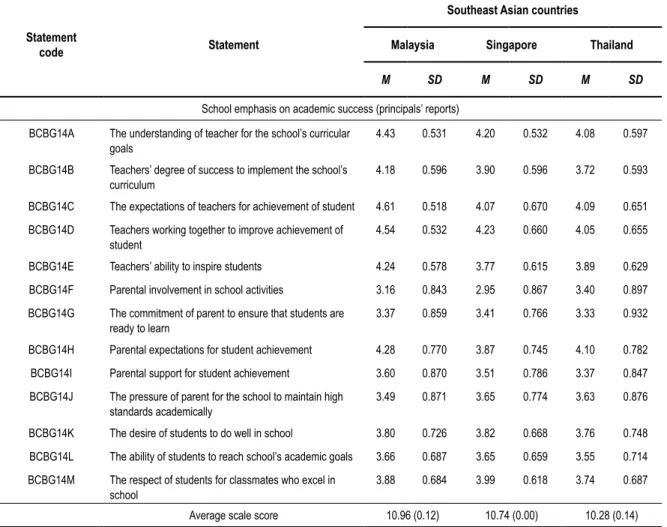
Table 2 summarizes the descriptive statistics (weighted) with mean scores for the school emphasis on academic success as reported by the principals in Southeast Asian countries. According to the analysis based on principal’s reports, Malaysia was the Southeast Asian country with the highest average scale score of emphasis of school on success academically (10.96), followed by Singapore (10.74) and Thailand (10.28).
Malaysia had the highest mean scores for ‘expectations of teachers for achievement of student (M = 4.61),
‘teachers working together to improve achievement of student’ (M = 4.54), ‘teachers’ understanding of the goals of school’s curriculum’ (M = 4.43), ‘parental expectations for achievement of student’ (M = 4.28), ‘teachers’ ability to inspire students’ (M = 4.24), and ‘teachers’ success degree to implement the curriculum of school’ (M = 4.18).
Singapore had the highest mean score for ‘students’ respect for classmates who excel in school’ (3.99), ‘students’
desire to do well in school (M = 3.82), ‘parental pressure for the school to maintain high standards academically (M = 3.65), and ‘commitment of parents to ensure that students are ready to learn’ (M = 3.41). However, Thailand had the highest mean score for ‘parental involvement in school activities’ (M = 3.40).
Table 2
Descriptive Statistics (Weighted) with Average Scale Scores for Southeast Asian School Emphasis on Academic Success (Prin- cipals’ Reports)
Statement
code Statement
Southeast Asian countries
Malaysia Singapore Thailand
M SD M SD M SD
School emphasis on academic success (principals’ reports) BCBG14A The understanding of teacher for the school’s curricular
goals 4.43 0.531 4.20 0.532 4.08 0.597
BCBG14B Teachers’ degree of success to implement the school’s
curriculum 4.18 0.596 3.90 0.596 3.72 0.593
BCBG14C The expectations of teachers for achievement of student 4.61 0.518 4.07 0.670 4.09 0.651 BCBG14D Teachers working together to improve achievement of
student 4.54 0.532 4.23 0.660 4.05 0.655
BCBG14E Teachers’ ability to inspire students 4.24 0.578 3.77 0.615 3.89 0.629
BCBG14F Parental involvement in school activities 3.16 0.843 2.95 0.867 3.40 0.897
BCBG14G The commitment of parent to ensure that students are
ready to learn 3.37 0.859 3.41 0.766 3.33 0.932
BCBG14H Parental expectations for student achievement 4.28 0.770 3.87 0.745 4.10 0.782
BCBG14I Parental support for student achievement 3.60 0.870 3.51 0.786 3.37 0.847
BCBG14J The pressure of parent for the school to maintain high
standards academically 3.49 0.871 3.65 0.774 3.63 0.876
BCBG14K The desire of students to do well in school 3.80 0.726 3.82 0.668 3.76 0.748
BCBG14L The ability of students to reach school’s academic goals 3.66 0.687 3.65 0.659 3.55 0.714 BCBG14M The respect of students for classmates who excel in
school 3.88 0.684 3.99 0.618 3.74 0.687
Average scale score 10.96 (0.12) 10.74 (0.00) 10.28 (0.14)
Note. 1 = Very Low; 5 = Very High; standard errors appear in parentheses.
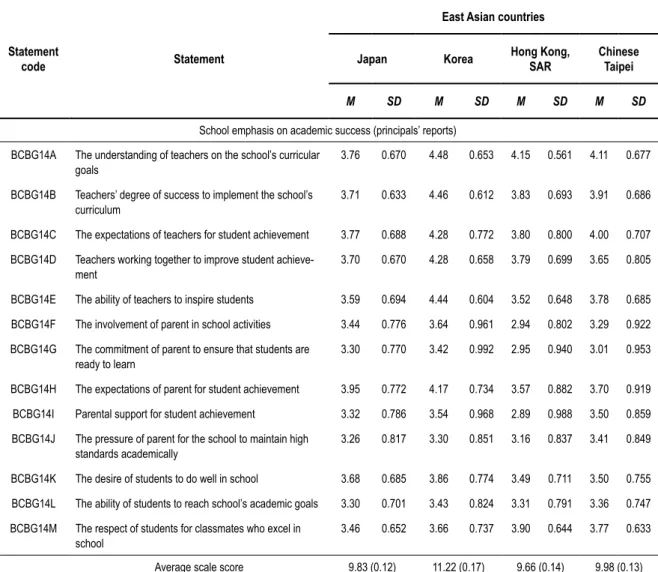
Table 3 illustrates the descriptive statistics (weighted) with mean scores for the emphasis of school on aca- demic success as reported by the principals in East Asian countries. According to the analysis based on principal’s reports, Korea was the East Asian country with the highest average scale score of school emphasis on academic success (11.22), followed by Chinese Taipei (9.98), Japan (9.83), and Hong Kong SAR (9.66).
Korea had the highest mean scores for all the statements in the scale of Emphasis of School on Success Aca- demically except ‘pressure of parents for the school to maintain high standards academically’ (Chinese Taipei, M = 3.41) and ‘respect of students for classmates who excel in school’ (Hong Kong SAR, M = 3.90). Korea had the highest mean scores for ‘understanding of teachers on the school’s curricular goals’ (M = 4.48), ‘teachers’ degree of success to implement the school’s curriculum’ (M = 4.46), ‘ability of teachers to inspire students’ (M = 4.44), ‘expectations of teachers for student achievement’ (M = 4.28), ‘teachers working together to improve student achievement’ (M
= 4.28), and ‘parental expectations for student achievement’ (M = 4.17).
Table 3
Descriptive Statistics (Weighted) with Average Scale Scores for East Asian School Emphasis on Academic Success (Principals’
Reports)
Statement
code Statement
East Asian countries
Japan Korea Hong Kong,
SAR Chinese
Taipei
M SD M SD M SD M SD
School emphasis on academic success (principals’ reports) BCBG14A The understanding of teachers on the school’s curricular
goals 3.76 0.670 4.48 0.653 4.15 0.561 4.11 0.677
BCBG14B Teachers’ degree of success to implement the school’s
curriculum 3.71 0.633 4.46 0.612 3.83 0.693 3.91 0.686
BCBG14C The expectations of teachers for student achievement 3.77 0.688 4.28 0.772 3.80 0.800 4.00 0.707 BCBG14D Teachers working together to improve student achieve-
ment 3.70 0.670 4.28 0.658 3.79 0.699 3.65 0.805
BCBG14E The ability of teachers to inspire students 3.59 0.694 4.44 0.604 3.52 0.648 3.78 0.685 BCBG14F The involvement of parent in school activities 3.44 0.776 3.64 0.961 2.94 0.802 3.29 0.922 BCBG14G The commitment of parent to ensure that students are
ready to learn 3.30 0.770 3.42 0.992 2.95 0.940 3.01 0.953
BCBG14H The expectations of parent for student achievement 3.95 0.772 4.17 0.734 3.57 0.882 3.70 0.919 BCBG14I Parental support for student achievement 3.32 0.786 3.54 0.968 2.89 0.988 3.50 0.859 BCBG14J The pressure of parent for the school to maintain high
standards academically 3.26 0.817 3.30 0.851 3.16 0.837 3.41 0.849
BCBG14K The desire of students to do well in school 3.68 0.685 3.86 0.774 3.49 0.711 3.50 0.755 BCBG14L The ability of students to reach school’s academic goals 3.30 0.701 3.43 0.824 3.31 0.791 3.36 0.747 BCBG14M The respect of students for classmates who excel in
school 3.46 0.652 3.66 0.737 3.90 0.644 3.77 0.633
Average scale score 9.83 (0.12) 11.22 (0.17) 9.66 (0.14) 9.98 (0.13) Note. 1 = Very Low; 5 = Very High; standard errors appear in parentheses.
The analysis results in Table 4 revealed that Korea (16.54%) had the highest percentage of students attended schools with very high emphasis on success academically with a mean science achievement of 566.76. This was followed by Malaysia (10.00%) with an average science achievement of 523.83.
Korea (65.43%) also had the highest percentage of students attended schools with high emphasis on success academically with a mean science achievement of 557.41. This was followed by Malaysia (65.17%) with an average science achievement of 471.21. However, Hong Kong SAR (55.55%) and Chinese Taipei (46.97%) had the highest percentage of students attended schools with medium emphasis on success academically with a mean science achievement of 523.76 and 552.48, respectively.
Table 4
School Emphasis on Success Academically – Principals’ Reports
Country
Emphasize very much High emphasis Medium emphasis
scale Avg score
% of
students Avg.
SA % of
students Avg.
SA % of
students Avg.
SA
Malaysia 10.00
(2.11) 523.83
(12.14) 65.17
(3.62) 471.21
(5.64) 24.83
(3.86) 448.36
(7.63)
10.96 (0.12)
Singapore 9.71
(0.00) 661.09
(8.73) 64.27
(0.00) 601.20
(4.45) 26.03
(0.00) 561.84
(6.08)
10.74 (0.00)
Thailand 4.57
(1.54) 478.76
(27.04) 61.19
(4.01) 467.22
(5.44) 34.24
(3.83) 432.46
(5.54) 10.28
(0.14)
Japan 2.15
(1.24) 599.42
(23.37) 52.84
(3.95) 580.75
(2.29) 45.01
(4.04) 557.98
(2.63)
9.83 (0.12)
Korea 16.54
(3.53) 566.76
(6.21) 65.43
(4.29) 557.41
(2.68) 18.03
(3.39) 538.78
(3.39) 11.22
(0.17) Hong Kong, SAR 5.61
(1.25) 586.43
(11.63) 38.84
(3.80) 567.86
(5.60) 55.55
(3.76) 523.76
(5.27)
9.66 (0.14) Chinese Taipei 6.97
(1.93) 620.71
(7.68) 46.06
(3.77) 579.06
(3.00) 46.97
(3.54) 552.48
(3.44) 9.98
(0.13)
Intern. Avg 7 (0.3) 533 (3.0) 48 (0.6) 499 (1.0) 45 (0.5) 466 (0.9)
Note. Reported by principals. Standard errors appear in parentheses. Avg. SA = Average Science Achievement
School Emphasis on Academic Success (Teachers’ Reports)
Table 5 summarizes the descriptive statistics (weighted) with mean scores for the school emphasis on success academically as reported by the teachers in Southeast Asian countries. According to the analysis based on teach- ers’ reports, Malaysia was the Southeast Asian country with the highest average scale score of school emphasis on academic success (11.06), followed by Thailand (10.30), and Singapore (10.25).
Malaysia had the highest mean scores for all the statements in the Emphasis of School on Academic Success Scale except ‘parental involvement in school activities’ in which Thailand had the highest mean score (M = 3.33).
Malaysia had the highest mean scores for ‘expectations of teachers for student achievement (M = 4.62), ‘teachers working together to improve achievement of student’ (M = 4.49), ‘parental expectations for student achievement’
(M = 4.30), ‘collaboration between school leadership and teachers to plan instruction’ (M = 4.29), ‘teachers’ ability to inspire students’ (M = 4.25), and ‘understanding of teachers on the school’s curricular goals’ (M = 4.19).
Table 5
Descriptive Statistics (Weighted) with Mean Scores of Scale for Southeast Asian School Emphasis on Academic Success (Teach- ers’ Reports)
Statement
code Statement
Southeast Asian countries
Malaysia Singapore Thailand
M SD M SD M SD
School emphasis on academic success (teachers’ reports) BTBG06A The understanding of teachers on the school’s curricular
goals 4.19 0.585 4.03 0.553 4.05 0.595
BTBG06B Teachers’ degree of success to implement the school’s
curriculum 4.03 0.566 3.83 0.598 3.75 0.609
BTBG06C The expectations of teachers for achievement of student 4.62 0.535 4.00 0.605 4.05 0.650 BTBG06D Teachers working together to improve achievement of
student 4.49 0.558 4.06 0.658 4.02 0.594
BTBG06E The ability of teachers to inspire students 4.25 0.574 3.81 0.613 3.86 0.611
BTBG06F The involvement of parents in school activities 3.26 0.757 3.09 0.921 3.33 0.849 BTBG06G The commitment of parents to ensure that students are
ready to learn 3.35 0.782 3.18 0.848 3.27 0.868
BTBG06H The expectations of parents for achievement of student 4.30 0.757 3.67 0.799 3.98 0.784
BTBG06I Parental support for achievement of student 3.76 0.826 3.26 0.801 3.46 0.871
BTBG06J The pressure of parents for the school to maintain high
academic standards 3.48 0.810 3.46 0.866 3.44 0.832
BTBG06K The desire of students to do well in school 3.93 0.778 3.55 0.687 3.60 0.718
BTBG06L The ability of students to reach school’s academic goals 3.61 0.723 3.34 0.704 3.38 0.673 BTBG06M The respect of students for classmates who excel in
school 3.68 0.739 3.57 0.699 3.62 0.708
BTBG06O The collaboration between leadership in school and
teachers to plan instruction 4.29 0.637 3.59 0.786 4.04 0.685
Average scale score 11.06 (0.12) 10.25 (0.08) 10.30 (0.12)
Note. 1 = Very Low, 5 = Very High; standard errors appear in parentheses.
Table 6 illustrates the descriptive statistics (weighted) with average scale scores for the school emphasis on academic success as reported by the teachers in East Asian countries. According to the analysis based on principal’s reports, Korea is the East Asian country with the highest average scale score of school emphasis on academic suc- cess (11.23), followed by Chinese Taipei (9.91), Japan (9.63), and Hong Kong SAR (9.58).
Korea has the highest mean scores for all the statements in the Emphasis of School on Academic Success scale except ‘teachers’ degree of success to implement the school’s curriculum (Chinese Taipei, M = 4.29). Korea has the highest mean scores for ‘understanding of teachers on the school’s curricular goals’ (M = 4.35), ‘ability of teachers to inspire students’ (M = 4.34), ‘teachers working together to improve achievement of student’ (M = 4.25), ‘collabo- ration between leadership in school and teachers to plan instruction’ (M = 4.05), and ‘expectations of teachers for achievement of student’ (M = 4.03).
Table 6
Descriptive Statistics (Weighted) with Mean Scores of Scale for East Asian Emphasis of School on Academic Success (Teachers’
Reports)
Statement
code Statement
East Asian countries
Japan Korea Hong Kong,
SAR Chinese
Taipei
M SD M SD M SD M SD
School emphasis on academic success (teachers’ reports) BTBG06A The understanding of teachers on the school’s curricular
goals 3.62 0.602 4.35 0.630 4.06 0.534 4.23 0.582
BTBG06B Teachers’ degree of success to implement the school’s
curriculum 3.63 0.624 4.27 0.626 3.83 0.577 4.29 0.674
BTBG06C The expectations of teachers for student achievement 3.59 0.682 4.03 0.749 3.64 0.661 3.91 0.695 BTBG06D Teachers working together to improve student achieve-
ment 3.88 0.648 4.25 0.718 3.71 0.700 3.71 0.754
BTBG06E The ability of teachers to inspire students 3.73 0.641 4.34 0.599 3.63 0.649 3.82 0.702 BTBG06F Parental involvement in school activities 3.30 0.903 3.61 0.908 3.01 0.861 3.19 0.962 BTBG06G The commitment of parent to ensure that students are
ready to learn 3.14 0.825 3.25 0.924 2.95 0.918 2.90 0.925
BTBG06H Parental expectations for student achievement 3.83 0.789 3.96 0.847 3.53 0.771 3.55 0.887 BTBG06I Parental support for student achievement 3.23 0.830 3.47 0.926 3.02 0.910 3.42 0.848 BTBG06J The pressure of parent for the school to maintain high
academic standards 3.31 0.814 3.43 0.818 3.11 0.853 3.29 0.877
BTBG06K The desire of students to do well in school 3.60 0.800 3.92 0.770 3.36 0.717 3.30 0.752 BTBG06L The ability of students to reach school’s academic goals 3.03 0.806 3.49 0.803 3.09 0.736 3.23 0.688 BTBG06M The respect of students for classmates who excel in
school 3.37 0.728 3.91 0.667 3.59 0.726 3.56 0.772
BTBG06O Collaboration between leadership in school and teachers
to plan instruction 3.45 0.818 4.05 0.756 3.53 0.792 3.56 0.888
Average scale score 9.63 (0.12) 11.23 (0.17) 9.58 (0.15) 9.91 (0.14) Note. 1 = Very Low, 5 = Very High; standard errors appear in parentheses.
The analysis results in Table 7 revealed that Korea (13.13%) has the highest percentage of students attended schools with very high emphasis on success academically with a mean science achievement of 566.23. This is fol- lowed by Malaysia (8.71%) with an average science achievement of 480.53.
Malaysia (67.67%) also has the highest percentage of students attended schools with high emphasis on suc- cess academically with a mean science achievement of 474.18. This is followed by Korea (60.70%) with an average science achievement of 557.94. However, Japan (60.13%) and Hong Kong (56.28%) have the highest percentage of students attended schools with medium emphasis on success academically with a mean science achievement of 562.72 and 530.84, respectively.
Table 7
Emphasis of School on Academic Success – Teachers’ Reports
Country
Very high emphasis High emphasis Medium emphasis
Avg scale score
% of
students Avg.
SA % of
students Avg.
SA % of
students Avg.
SA
Malaysia 8.71
(1.90) 480.53
(16.90) 67.67
(3.29) 474.18
(4.97) 23.62
(3.19) 446.74
(11.19) 11.06 (0.12)
Singapore 3.78
(1.06) 628.90
(18.11) 52.97
(2.74) 620.68
(4.65) 43.26
(2.67) 564.40
(5.69) 10.25
(0.08)
Thailand 3.96
(1.46) 498.28
(29.05) 52.51
(3.67) 462.89
(5.83) 43.53
(3.69) 443.48
(5.97) 10.30
(0.12)
Japan 3.67
(1.29) 579.38
(14.28) 36.20
(3.86) 583.94
(3.16) 60.13
(3.92) 562.72
(2.24) 9.63 (0.12)
Korea 13.13
(2.69) 566.23
(6.11) 60.70
(26.17) 557.94
(2.82) 26.17
(3.50) 544.84
(3.19) 11.23 (0.17) Hong Kong, SAR 1.62
(1.43) 630.78
(7.67) 42.10
(4.10) 561.58
(5.59) 56.28
(4.26) 530.84
(4.58) 9.58 (0.15) Chinese Taipei 6.29
(1.78) 599.21
(9.58) 37.71
(3.94) 587.87
(4.12) 55.99
(3.92) 553.74
(2.96) 9.91 (0.14)
Intern. Avg 5 (0.2) 520 (3.5) 46 (0.5) 499 (0.9) 49 (0.5) 471 (0.8)
Note. Reported by teachers. Standard errors appear in parentheses.
Teacher Job Satisfaction
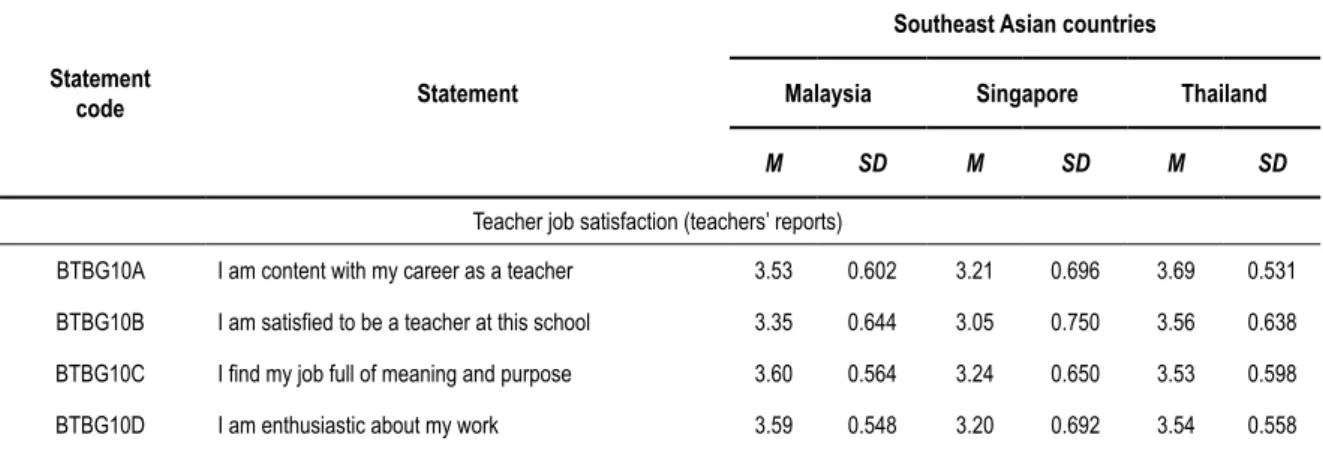
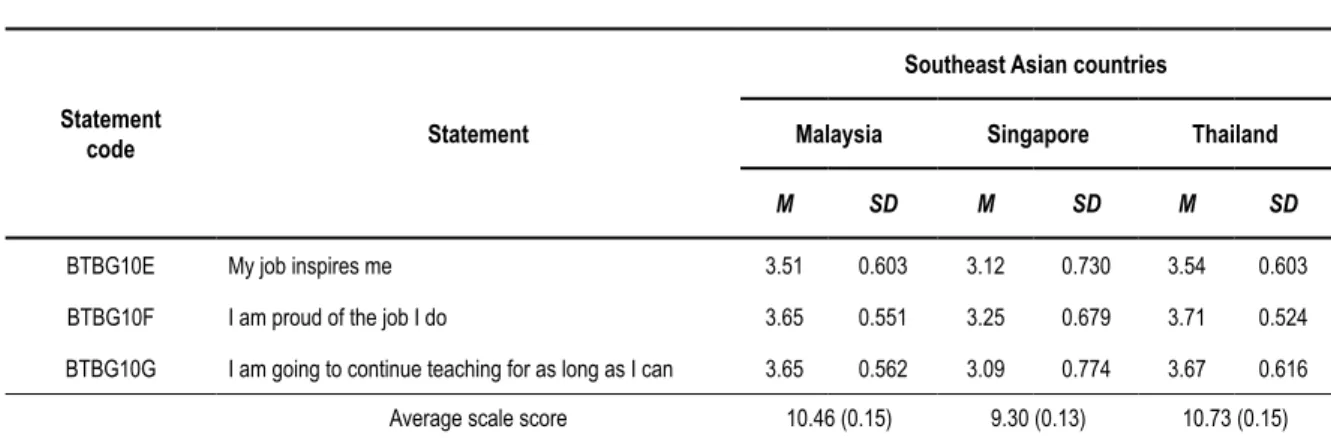
Table 8 illustrates the descriptive statistics (weighted) with mean scores for teacher job satisfaction as reported by teachers in Southeast Asian countries. The analysis of teachers’ reports reveals that Thailand is the country with the highest average scale score for teacher job satisfaction (10.73), followed by Malaysia (10.46), and Singapore (9.30).
Thailand has the highest mean scores for ‘I am proud of the work I do’ (M = 3.71), ‘I am content with my pro- fession as a teacher’ (M = 3.69), ‘I am going to continue teaching for as long as I can’ (M = 3.67), ’I am satisfied to be a teacher at this school (M = 3.56); My work inspires me (M = 3.54), ‘I am satisfied to be a teacher at this school’
(M = 3.56), and ‘my work inspires me’ (M = 3.54). However, Malaysia has the highest mean scores for ‘I find my job full of meaning and purpose’ (M = 3.60) and ‘I am enthusiastic about my work’ (M = 3.59)’.
Table 8
Descriptive Statistics (Weighted) with Mean Scores of Scale for Southeast Asian Teachers’ Job Satisfaction (Teachers’ Reports)
Statement
code Statement
Southeast Asian countries
Malaysia Singapore Thailand
M SD M SD M SD
Teacher job satisfaction (teachers’ reports)
BTBG10A I am content with my career as a teacher 3.53 0.602 3.21 0.696 3.69 0.531
BTBG10B I am satisfied to be a teacher at this school 3.35 0.644 3.05 0.750 3.56 0.638
BTBG10C I find my job full of meaning and purpose 3.60 0.564 3.24 0.650 3.53 0.598
BTBG10D I am enthusiastic about my work 3.59 0.548 3.20 0.692 3.54 0.558
Statement
code Statement
Southeast Asian countries
Malaysia Singapore Thailand
M SD M SD M SD
BTBG10E My job inspires me 3.51 0.603 3.12 0.730 3.54 0.603
BTBG10F I am proud of the job I do 3.65 0.551 3.25 0.679 3.71 0.524
BTBG10G I am going to continue teaching for as long as I can 3.65 0.562 3.09 0.774 3.67 0.616
Average scale score 10.46 (0.15) 9.30 (0.13) 10.73 (0.15)
Note. 1 =Never or Almost Never, 4 = Very Often; standard errors appear in parentheses.
Table 9 summarizes the descriptive statistics (weighted) with mean scores for teacher job satisfaction as reported by teachers in East Asian countries. The analysis of teachers’ reports reveals that Chinese Taipei is the country with the highest average scale score of teacher job satisfaction (9.61), followed by Korea (9.50), Hong Kong SAR (9.15), and Japan (8.71).
Chinese Taipei has the highest mean scores for ‘I am content with my career as a teacher (M = 3.38); ‘I am proud of the job I do’ (M = 3.32), ‘I find my job full of meaning and purpose’ (M = 3.26), and ‘I am satisfied to be a teacher at this school’ (M = 3.13). Korea has the highest mean scores for ‘I am enthusiastic about my work’ (M = 3.36), ‘I am going to continue for as long as I can’ (M = 3.32), and ‘my work inspires me’ (M = 3.26).
Table 9
Descriptive Statistic’s (Weighted) with Average Scale Scores for East Asian Teachers’ Job Satisfaction (Teachers’ Reports)
Statement
code Statement
East Asian countries
Japan Korea Hong Kong,
SAR Chinese
Taipei
M SD M SD M SD M SD
Teacher job satisfaction (teachers’ reports)
BTBG10A I am content with my career as a teacher 2.92 0.790 3.14 0.707 3.16 0.733 3.38 0.730 BTBG10B I am satisfied to be a teacher at this school 2.91 0.819 3.05 0.827 2.94 0.820 3.13 0.834 BTBG10C I find my job full of meaning and purpose 3.07 0.731 3.19 0.721 3.13 0.748 3.26 0.760
BTBG10D I am enthusiastic about my work 2.97 0.727 3.36 0.642 3.26 0.709 3.25 0.751
BTBG10E My job inspires me 2.91 0.755 3.26 0.695 3.01 0.757 3.12 0.851
BTBG10F I am proud of the job I do 3.09 0.768 3.28 0.689 3.01 0.845 3.32 0.755
BTBG10G I am going to continue teaching for as long as I can 3.09 0.813 3.32 0.667 3.27 0.721 3.25 0.822
Average scale score 8.71 (0.14) 9.50 (0.14) 9.15 (0.18) 9.61 (0.17)
Note. 1 = Never or Almost Never, 4 = Very Often; standard errors appear in parentheses.
The analysis of teachers’ reports in Table 10 reveals that Thailand (64.54%) has the highest percentage of students whose teachers were very satisfied with an average science achievement of 461.23. This is followed by Malaysia (60.71%) with an average science achievement of 465.02. Japan (60.93%) has the highest percentage of students whose teachers were satisfied with an average science achievement of 570.49. This is followed by Singapore (54.02%) with an average science achievement of 593.98. On the contrary, Japan (19.57%) and Hong
Table 10
Teacher Job Satisfaction – Teachers’ Reports
Country
Very satisfied Satisfied Less than satisfied
Avg scale score
% of
students Avg.
SA % of
students Avg.
SA % of
students Avg.
SA
Malaysia 60.71
(3.98) 465.02
(5.90) 36.68
(3.95) 473.12
(7.61) 2.62
(1.15) 449.24
(39.11) 10.46
(0.15)
Singapore 32.72
(2.89) 603.72
(6.62) 54.02
(3.01) 593.98
(5.67) 13.27
(1.84) 590.05
(11.56) 9.30 (0.13)
Thailand 64.54
(4.08) 461.23
(5.22) 31.96
(3.83) 447.45
(6.81) 3.49
(1.43) 443.31
(21.91) 10.73
(0.15)
Japan 19.49
(2.96) 580.15
(3.83) 60.93
(3.84) 570.49
(2.28) 19.57
(3.02) 563.32
(3.65) 8.71 (0.14)
Korea 38.77
(3.56) 556.91
(3.05) 49.44
(3.94) 554.77
(2.96) 11.79
(2.41) 554.77
(7.32) 9.50 (0.14) Hong Kong, SAR 33.89
(4.09) 562.02
(7.12) 47.60
(5.05) 540.92
(5.44) 18.51
(3.72) 523.49
(9.98) 9.15 (0.18) Chinese Taipei 42.12
(3.50) 575.33
(3.55) 42.92
(3.39) 564.74
(3.58) 14.96
(2.46) 563.91
(7.14) 9.61 (0.17)
Intern. Avg 49 (.5) 492 (0.8) 42 (0.5) 483 (1.0) 9 (0.3) 478 (2.2)
Note. Reported by teachers. Standard errors appear in parentheses.
Challenges Facing Teachers
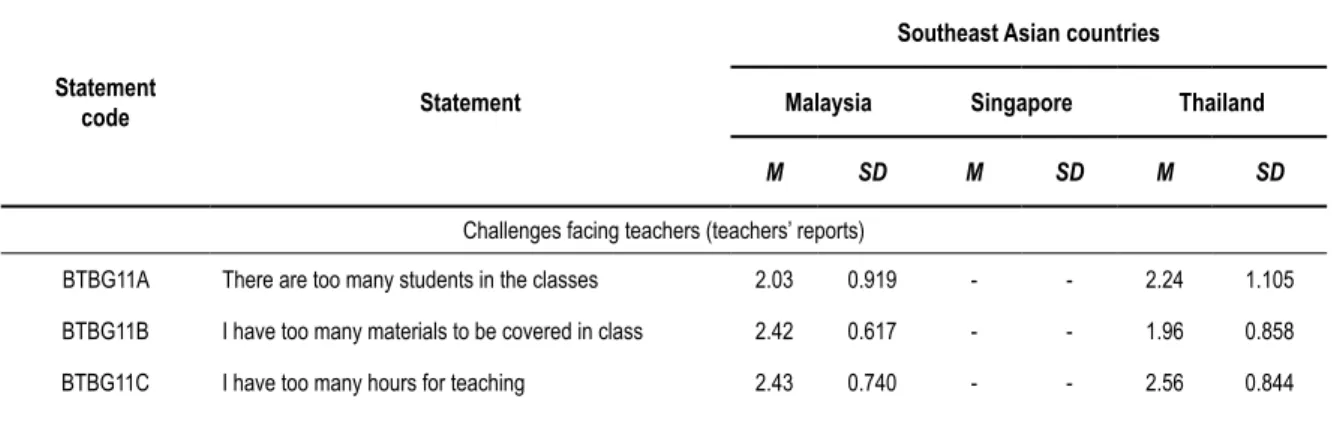
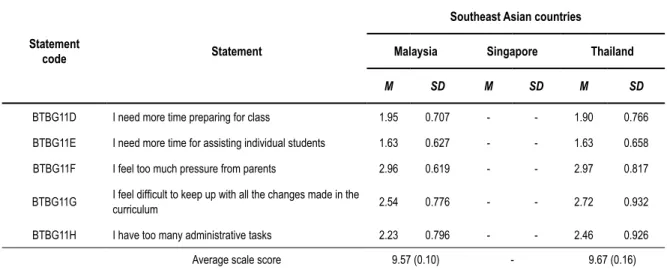
Table 11 summarizes the descriptive statistics (weighted) with mean scores for challenges facing teachers as reported by the teachers in Southeast Asian countries. The analysis reveals that Malaysia is the country with the lowest average scale score for challenges facing teachers (9.57), followed by Thailand (9.67) (lower average scale score indicates more challenges facing teachers). Challenges facing Malaysian teachers were: ‘I need more time to help individual students’ (M = 1.63), ‘there are too many students in the classes’ (M = 2.03), ‘I have too many tasks on administration’ (M = 2.23), ‘I have too many teaching hours’ (M = 2.43), ‘I have difficulty to keep up with all the changes to the curriculum’ (M = 2.54), and ‘I feel too much parental pressure’ (M = 2.96). On the contrary, Thai teach- ers were facing challenges in terms of ‘I need more time to help individual students’ (M = 1.63), ‘I need more time to prepare for class’ (M = 1.90), and ‘I have too many materials to cover in class’ (M = 1.96).
Table 11
Descriptive Statistics (Weighted) with Mean Scores of Scale for Challenges Facing Teachers in Southeast Asian (Teachers’ Reports)
Statement
code Statement
Southeast Asian countries
Malaysia Singapore Thailand
M SD M SD M SD
Challenges facing teachers (teachers’ reports)
BTBG11A There are too many students in the classes 2.03 0.919 - - 2.24 1.105
BTBG11B I have too many materials to be covered in class 2.42 0.617 - - 1.96 0.858
BTBG11C I have too many hours for teaching 2.43 0.740 - - 2.56 0.844
Statement
code Statement
Southeast Asian countries
Malaysia Singapore Thailand
M SD M SD M SD
BTBG11D I need more time preparing for class 1.95 0.707 - - 1.90 0.766
BTBG11E I need more time for assisting individual students 1.63 0.627 - - 1.63 0.658
BTBG11F I feel too much pressure from parents 2.96 0.619 - - 2.97 0.817
BTBG11G I feel difficult to keep up with all the changes made in the
curriculum 2.54 0.776 - - 2.72 0.932
BTBG11H I have too many administrative tasks 2.23 0.796 - - 2.46 0.926
Average scale score 9.57 (0.10) - 9.67 (0.16)
Note. 1 = Agree a lot, 4 = Disagree a lot [lower average scale score indicates more challenges facing teachers]; standard errors appear in parentheses; -comparable data not available
Table 12 shows the descriptive statistics (weighted) with mean scores for challenges facing teachers as reported by the teachers in East Asian countries. The analysis of teachers’ reports reveals that Korea (8.47) has the lowest average scale score for challenges facing teachers, followed by Hong Kong (9.52), Japan (9.95), and Chinese Taipei (10.60) (lower average scale score indicates more challenges facing teachers).
Korean teachers were facing challenges in terms of ‘I have too many administrative tasks’ (M = 1.72), ‘I need more time preparing for class’ (M = 1.77), ‘I have too many materials to be covered in class’ (M = 1.83), ‘there are too many students in the classes’ (M = 1.86), ‘I have too many hours for teaching’ (M = 1.96), ‘I feel difficult to keep up with all the changes made in the curriculum (M = 2.44), and ‘I feel too much pressure from parents’ (M = 2.76).
Challenge facing teachers in Hong Kong SAR was ‘I need more time for assisting individual students’ (M = 1.52).
Table 12
Descriptive Statistics (Weighted) with Mean Scores for Scale for Challenges Facing Teachers in East Asian (Teachers’ Reports)
Statement
code Statement
East Asian countries
Japan Korea Hong Kong,
SAR Chinese
Taipei
M SD M SD M SD M SD
Challenges facing teachers (teachers’ reports)
BTBG11A There are too many students in the classes 2.16 0.911 1.86 0.722 2.13 0.859 2.36 0.873 BTBG11B I have too many materials to be covered in class 2.66 0.758 1.83 0.733 2.06 0.758 2.13 0.830
BTBG11C I have too many hours for teaching 2.66 0.822 1.96 0.801 2.90 0.877 2.63 0.919
BTBG11D I need more time preparing for class 1.90 0.739 1.77 0.638 1.79 0.708 2.34 0.861
BTBG11E I need more time assisting individual students 1.69 0.609 1.63 0.595 1.52 0.629 1.77 0.693
BTBG11F I feel too much parental pressure 3.08 0.725 2.76 0.653 2.78 0.654 2.83 0.832
BTBG11G I feel difficult to keep up with all the changes made in the
curriculum 2.89 0.690 2.44 0.780 2.83 0.713 3.27 0.631
BTBG11H I have too many tasks for administration 2.11 0.829 1.72 0.645 2.12 0.851 3.00 0.908
Average scale score 9.95 (0.12) 8.47 (0.13) 9.52 (0.13) 10.60 (0.15)