68
THE DEVELOPMENT OF THE LEGAL FRAMEWORK GOVERNING THE SHARĪᶜAH COMMITTEE OF THE ISLAMIC BANKING AND TAKAFUL INSTITUTIONS IN
MALAYSIA
Mohammad Azam Hussain School of Law, Universiti Utara Malaysia,
06010 Sintok, Kedah, Malaysia Email: [email protected]
Date submitted: 11th August 2016; Date accepted: 4th Dec 2016 In Malaysia, the Sharῑᶜah Committee established by Islamic banks and takāful operators are subject to the legal framework as set out by the legislations governing Islamic financial services. The legal framework of the Sharῑᶜah committee existed since the enforcement of Islamic Banking Act 1983 (Act 276) in year 1983.
Since that, improvements have been made by the government to strengthen such legal framework via a series of legal amendments as well as the introduction of new legislations. Apart from that, the Sharῑᶜah Committee is also governed by the Guidelines issued by Central Bank of Malaysia to ensure sustainability of Islamic banking and takāful industry in Malaysia. This article adopted historical and comparative methods in order to analyse the development of the legal framework governing the Sharῑᶜah Committee of the Islamic banking and takāful institutions in Malaysia. The study found that the legal framework of the Sharῑᶜah Committee is mainly governed by Islamic Financial Services Act 2013 (Act 759) and Sharῑᶜah Governance Framework for Islamic Financial Institutions (CBM/RH/GL 012-3).
Keywords: Sharῑᶜah Committee, Islamic banking, takāful, Islamic Financial Services Act
INTRODUCTION
The
SharῑᶜahCommittee (hereinafter referred to as “SC”) can be defined as people
entrusted with ensuring the compliance aspects of particular products and instruments used
69
in the Islamic finance industry which broadly includes banking, capital market and takāful (Mohamad Akram Laldin, 2008). A more specific definition has been given by Rusni Hassan, Agus Triyanta and Adnan Yusoff (2001). According to them, SC is an independent body of specialist jurists in
Fiqh al-Muᶜāmalāt (Islamic transaction/commercial law)entrusted with the duty of directing, reviewing, supervising and/or approving the activities of IFIs in order to ensure compliance with Sharῑᶜah rules and principles.
Accounting and Auditing Organisation for Islamic Financial Institutions (hereinafter referred to as
“AAOIFI”) termed SC as Sharῑᶜah Supervisory Board which has the following meaning:
A Shari’a supervisory board is an independent body of specialized jurists in
fiqh almua’malat(Islamic commercial jurisprudence). However, the Shari’a supervisory board may include a member other than those specialized in fiqh almua’malat, but who should be an expert in the field of Islamic financial institutions and with knowledge of
fiqh almua’malat.The Shari’a supervisory board is entrusted with the duty of duty of directing, reviewing and supervising the activities of the Islamic financial institution in order to ensure that they are in compliance with Islamic Shari’a rules and principles. The
fatwas, and rulings of the Shari’asupervisory board shall be binding on the Islamic financial institutions.
In addition, the SC is entrusted with the duties and responsibilities to ensure that the Islamic banking and
takāful institutions comply with the Sharῑᶜah principles in all areas of theiroperations and business activities. This includes financial facilities and services offered by the Islamic banking and
takāful institutions, the investments or projects in which theinstitution has interests and the institution is managed in line with Islamic principles (Ibrahim Warde, 2000). In addition they are entrusted with the duty of directing, reviewing and supervising the activities of the Islamic banking and
takāful institutions in order toensure that the institutions are in compliance with Islamic rules (Engku Rabiah Adawiah Engku Ali & Hassan Scott P. Odierno, 2008).
Statutes Regulating the Sharῑᶜah Committee of Islamic Banking and Takāful Institutions
Historically, the idea to establish the SC in Malaysia is not new. It was among the
recommendations made by the National Steering Committee on Islamic banking appointed
by the Government of Malaysia on 30
thJuly 1981 with the function to study the possibility
of establishing an Islamic bank in Malaysia. Other recommendations include: (a) an Islamic
70
bank whose operations are in accordance with the
Sharīᶜah principles should be establish;(b) the Islamic bank shall be incorporated as a company under the auspices of the Companies Act 1965 (Act 125); (c) a new banking act, Islamic Banking Act 1982 must be introduced to licence and supervise Islamic banks; and (d) the supervision and administration of this new Act shall be the responsibility of CBM (Sudin Haron & Wan Nursofiza Wan Azmi, 2009).
Such recommendation then, was included in Islamic Banking Act 1983 (Act 276) (hereinafter referred to as “IBA”) passed by the Parliament of Malaysia in 1983.
Accordingly, the Islamic banks licensed under IBA are required to include the provision for the establishment of SC in its Article of Association (hereinafter referred to as “AA”).
Pursuant to IBA, the function of the SC is to advise the Islamic bank on the operations of its banking business in order to ensure that such activities do not involve any element which is not approved by the Religion of Islam. A licence to conduct Islamic banking business will not be granted if the applicant fails to comply with such requirement (IBA, paragraph 3(5)(b)).
Similarly, the
takāful operators registered under Takaful Act 1984 (Act 312) (hereinafterreferred to as “TA”) are required to establish SC to advise an operator on the operations of its takāful business in order to ensure that it does not involve in any element which is not approved by the
Sharῑᶜah. The Director General of Takāful shall refuse to register theapplication to conduct
takāful business if the applicant fails to comply with suchrequirement (TA, paragraph 8(5)(b)).
Since 1983 to 2004, the SC established by Islamic banks and takāful operators were regulated by IBA and TA respectively. During this time, the regulatory framework existed in the general form.
Islamic banks and takāful operators were required by such statutes to establish their own SC. In addition, the statutes require the Islamic banks and takāful operators to include additional clause for the establishment of the SC in their AA. Similarly, both acts in a general manner specified the role of the SC as to advise the institution pertaining to Islamic financial business (IBA, paragraph 3(5)(b); TA, paragraph 8(5)(b)).
Due to the generality of the legal provisions, matters relating to the appointment of the SC members and its procedures, the number of membership, the qualification of the members and the composition of the board were subject to the discretion of the Islamic banks and takāful operators to determine it.
The same related to the duties and responsibilities of the SC. The regulatory framework has improved when IBA and TA were amended in year 2003. Based on the amendments, the establishment of the SC of the Islamic banks and the takāful operators shall be approved by Central
71
Bank of Malaysia (hereinafter referred to as “CBM”) (Islamic Banking (Amendment) Act 2003 (Act A1214), section 2; Takāful (Amendment) Act 2003 (Act A1212), section 2). Accordingly, CBM has the final say in this regard.
The case of Kuwait Finance House (Malaysia) Bhd v. Vesta Energy Sdn Bhd & Ors [2012] 9 CLJ 516, in relation to SC, the court emphasizes that:
[75]Section 3(5) of the Islamic Banking Act 1983 provides that any bank
conducting its business based on Islamic principles shall establish a Shariah advisory body to ensure Shariah compliance. In fact, the establishment of an Shariah Committee ("SC") is a requirement for granting a licence to institutions carrying out Islamic banking business. The licence will not be granted unless there is a provision for the establishment of a Shariah advisory body in the IFI's article of association. (see s. 5(a) and (b) of IBA 1983).
[76] The existing legislation states the duties and responsibilities of the SC
in a general manner, ie, the SC's duties and responsibilities are to ensure the Shariah compliance of the operations and activities of the Islamic financial institutions. In the present practice, institutions or banks may come up with specific duties and responsibilities of their respective SCs in their practice manuals; however, the institutions may refer to Guideline 20 of the BNM/GPS 1 on the duties and responsibilities of the Shariah Committee ("SC") as follows:
(a) to advise the board of directors on Shariah matters in its business operations;
(b) to endorse Shari'ah-compliance manuals;
(c) to endorse and validate relevant documentation;
(d) to assist related parties by giving advice on Shariah matters upon request;
(e) to advise on matters to be referred to the SAC;
(f) to provide written Shariah opinions;
(g) to assist the SAC on reference for advice.
[77] The list suggests that the core of the duties and responsibilities of the committee members is to assist the board of directors in relation to the business and the operation of Islamic banking business as well as to endorse Shariah compliance manuals. The advisory function of the Shariah Advisory Committee also includes endorsement and validation of relevant documents, the audit and review process, and also advice to related parties on Islamic finance matters. The stated duties and responsibilities of the SC provide clear evidence that the Shariah
72
is the essence of Islamic finance practices.
One thing should be noted, since 1983 to 2013, only IBA and TA have provision dealing with the SC. No such provision stipulated under Banking and Financial Institutions Act 1989 (Act 372) (hereinafter referred to as “BAFIA”) and Development Financial Institutions Act 2002(Act 618) (hereinafter referred to as “DFIA”) even such statutes allowed the institutions licensed under BAFIA and prescribed under DFIA to conduct Islamic financial transactions.
In summary, in the early stage, i.e. in 1993, the conventional banking institutions offering Islamic financial facilities, they have to comply with the Guidelines issued by CBM including Guidelines on
“Skim Perbankan Tanpa Faedah” for Commercial Banks and Guidelines on “Skim Perbankan Tanpa Faedah” for Commercial Bank (both Guidelines issued by CBM on 1 July 1993). The both Guidelines were repealed by Guidelines on “Skim Perbankan Islam” (BNM/RH/GL 001-27).
Among the important provisions of these Guidelines:
In short, the conventional institutions participating in Islamic Banking Scheme (hereinafter referred to as “IBS”), they shall established Islamic Banking Division (hereinafter referred to as “IBD”), which shall be responsible to prepare a business plan for the IBS operations in terms of operationalising the IBS, as well as to develop policies and procedures pertaining to the IBS operations. This includes system and product development, marketing, processing, approving limits, branch supervision, business development and credit control.
The Guidelines also states that, the IBD is required to establish suitable criteria to ensure the staffs manning the Islamic banking operations are proficient, qualified, and knowledgeable as well as committed in the discharge of their duties and responsibilities. Continuing training and education programme should be provided to enable staff of the SPI licensed institution to enrich their knowledge, understand and appreciate the virtues of Islamic banking as well as to keep them abreast with the latest development relating to Islamic banking.The IBD shall be headed by a Muslim senior management officer of the IBD licensed institution, at least the level of the Assistant General Manager (AGM) who possess relevant background on Islamic banking and sufficient banking experience to enable him to perform his duties and responsibilities with regard to Islamic banking effectively.
Hence, it can be seen that, prior to the issuance of the Guidelines on the Governance of Sharῑᶜah Committee for the Islamic Financial Institutions (CBM/RH/GL/012-1) (hereinafter referred to as
“CBM/GPS 1”) in December 2004, there responsibilities to ensure the Sharῑᶜah compliance in those institutions under the duties and responsibilities of IBD. For institutions licensed under BAFIA and prescribed under DFIA, they have no responsibilities to establish internal SC until the enforcement of CBM/GPS 1. This matter is discussed in the following subtopic.
Nevertheless, this is no longer an issue, since IBA and TA are repealed by Islamic Financial
73
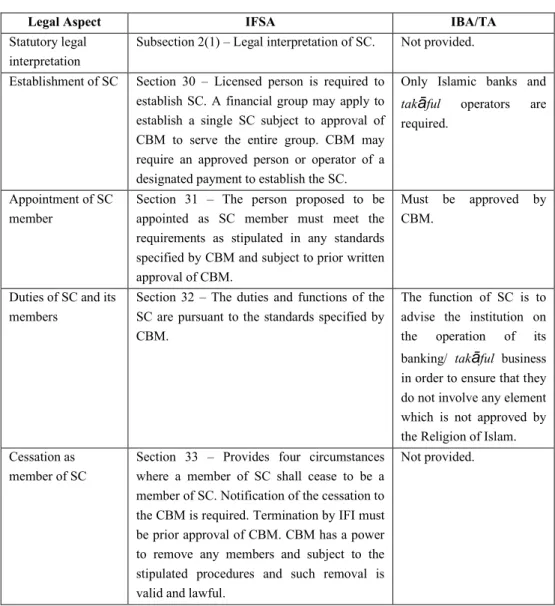
Services Act 2013 (Act 759) (hereinafter referred to as “IFSA”) and BAFIA is repealed by Financial Services Act 2013 (Act 758). In short, IFSA has better provisions in dealing with the affairs of the SC compared to the repealed statutes. FSA requires financial institutions conducting Islamic financial business to comply with the provisions of IFSA. This including the provisions pertaining to the establishment of the SC, the appointment of its members, the duties of the SC and its members, the cessation and notice of cessation as member of the SC, information to be provided to the SC as well as qualified privilege and duty of confidentiality of the SC. The following table represents the comparative provisions of IFSA and IBA/TA in regulating SC.
Table 1: Statutory provisions of IFSA and IBA/TA in regulating SC
Legal Aspect IFSA IBA/TA
Statutory legal interpretation
Subsection 2(1) – Legal interpretation of SC. Not provided.
Establishment of SC Section 30 – Licensed person is required to establish SC. A financial group may apply to establish a single SC subject to approval of CBM to serve the entire group. CBM may require an approved person or operator of a designated payment to establish the SC.
Only Islamic banks and takāful operators are required.
Appointment of SC member
Section 31 – The person proposed to be appointed as SC member must meet the requirements as stipulated in any standards specified by CBM and subject to prior written approval of CBM.
Must be approved by CBM.
Duties of SC and its members
Section 32 – The duties and functions of the SC are pursuant to the standards specified by CBM.
The function of SC is to advise the institution on the operation of its banking/ takāful business in order to ensure that they do not involve any element which is not approved by the Religion of Islam.
Cessation as member of SC
Section 33 – Provides four circumstances where a member of SC shall cease to be a member of SC. Notification of the cessation to the CBM is required. Termination by IFI must be prior approval of CBM. CBM has a power to remove any members and subject to the stipulated procedures and such removal is valid and lawful.
Not provided.
74
Information to be provided to be provided to SC
Section 35 – The IFI and the relevant parties shall provide the document or information as required by the SC. The SC shall not disclose such document or information obtained to any other person.
Not provided.
Qualified privilege and duty of confidentiality
Subsection 36(1) – The member of SC shall not be liable in discharging their duties for a breach of a duty of confidentiality provided that such acts were done or made in good faith. They also are not liable to be sued in any court for defamation for any statement made by them without malicious intention.
Not provided.
Source: Mohammad Azam Hussain, Rusni Hassan & Aznan Hassan (2014)
Based on the above table, it can be pointed out several significant improvement has been made compared to the repealed Acts. Currently, SC has a legal interpretation and no such interpretation given by IBA and TA. However, the legal interpretation given by IFSA seems too general and has yet to clarify the appropriate interpretation of SC. The interpretation that is referred to in section 30 of IFSA is pertaining to the requirement for the establishment of SC for licensed person to conduct Islamic financial business. It does not reflect the essential features of the SC. More specific legal interpretation is necessary by inserting the essential features to describe this body. For instance, SC can be legally interpreted as an independent body established pursuant to the law, have a number of qualified members as may be prescribed by the law and have the duties and responsibilities as may be specified by the law. Thus, it is suggested that the amendment be made to IFSA by inserting more precise interpretation in describing the SC.
Similar to the IBA and TA, IFSA also provides a statutory basis for the establishment of the SC. In addition, IFSA has standardized such requirement which should be observed by a licensed person and approved person to conduct Islamic financial services even if such persons are licensed and regulated by FSA. The requirement almost the same as previously required by IBA and TA.
Meanwhile for financial group, the permission to appoint a single SC to serve the entire financial group is a statutory basis and subject to prior approval from CBM. Apart from that, IFSA grants a power to CBM where CBM may require an Islamic financial adviser, an issuer of a designated Islamic payment instrument, an operator of a payment system and takāful broker to establish SC.
The same goes to financial institutions regulated by FSA and permitted to conduct Islamic financial business are required to observe the provisions of IFSA as well (FSA, section 15) including the requirement to set up SC pursuant to section 30 of IFSA. Similarly CBM may require an approved insurance broker carrying on takāful broking business, an approved financial adviser carrying on Islamic financial advisory business, an operator of a designated payment system or approved
75
operator of a payment system involved in Islamic financial business or an approved issuer of a designated payment instrument involved in issuing a designated Islamic payment instrument pursuant to subsection 30(3) of IFSA to set up a SC.
IFSA also provides general provisions pertaining to the appointment of SC member as well as their duties and functions. The Islamic banks and takāful operators shall observe the guidelines issued by CBM in this regard. IFSA enhances also the matter on the cessation as member of SC which previously stipulated under Sharῑᶜah Governance Framework for Islamic Financial Institutions (CBM/RH/GL 012-3) (hereinafter referred to “SGF”). Apart from that, IFSA grants statutory right for SC to obtain a document and information needed and recognizes the qualified privilege and duty of confidentiality of SC in discharging their duties and responsibilities (Mohammad Azam Hussain, Rusni Hassan & Aznan Hassan, 2014).
Guidelines Regulating the Sharῑᶜah Committees
Apart from statutes, the SC have been regulated by several Guidelines issued by CBM. In December 2004, CBM issued CBM/GPS 1 which clarified three significant aspects relating to the SC including (CBM/GPS 1, paragraph 5 of Part A);
(a) The rules, regulations and procedures in the establishment of the SC;
(b) The role, scope of duties and responsibilities of the SC; and
(c) The relationship and working arrangement between the SC and the Sharῑᶜah Advisory Council (hereinafter referred to as “SAC”) of CBM.
However, effectively from 1st January 2011, CBM/GPS 1 is no longer applicable parallel with the implementation SGF with the following objectives (SGF, paragraph 2.1 of Part 1):
(a) Sets out the expectations of the CBM on an Islamic Financial Institution’s (hereinafter referred to as “IFI”) Sharῑᶜah governance structures, processes and arrangements to ensure that all its operations and business activities are in accordance with Sharῑᶜah;
(b) Provides a comprehensive guidance to the board, SC and management of the Islamic Financial Institution discharging its duties in matters relating to Sharῑᶜah; and (c) Outlines the functions relating to Sharῑᶜah review, Sharῑᶜah audit, Sharῑᶜah risk
management and Sharῑᶜah research.
Since the CBM/GPS 1 is no longer applicable, it would be good to have a comparative analysis between the two Guidelines in regulating the SC of IFIs in Malaysia. In this regard, the discussion is divided into two sections as follows:
(a) SGF has improved the stipulations on the SC; and (b) New stipulations inserted in SGF.
(a) SGF has improved the stipulations on the Sharīʿah Committee
SGF has improved a few things that have been provided in the CBM/GPS1. These include the
76
following matters:
i. Requirement for the Islamic Financial Institutions to establish the Sharῑᶜah Committee Both SGF and CBM/GPS 1 require that every Islamic banks and takāful operators shall establish the SC (SGF, subparagraph 1.3 of Part 2; CBM/GPS 1, paragraph 7 of Part B).CBM/GPS 1 has standardized the requirements for the establishment of the SC in all Islamic banks, takāful operators and also participating banking and financial institutions in the Islamic Banking Scheme (hereinafter referred to as “IBS”). Prior to that, only Islamic banks licensed under IBA and takāful operators licensed under TA were required to establish the SC. No such requirement was stipulated in BAFIA and DFIA.
However there is a difference in terms of SC for a financial group. CBM/GPS 1 allowed a financial institution licensed under BAFIA which participates in the IBS, to establish a single SC for the banking group. However, if a takāful operator is part of that group, the takāful operator must establish its own separate SC pursuant to the requirement of the TA (CBM/GPS 1, paragraph 7 of Part B).
Even though SGF also permits a financial group to establish a single SC to serve the entire group, it is subject to the application for exemption from CBM. Such financial group may apply to CBM and shall convince CBM that its single SC is sufficiently capable to serve the whole financial group (SGF, paragraph 1.9 of Part 2).Accordingly, the consent to establish a single SC to serve the financial group is no longer limited to a financial institution licensed under BAFIA which participates in IBS. Such permission includes the financial institution licensed under the IBA. In the meantime, if the takāful operator is part of the financial group, it is no longer required to establish its own SC. It may depend on SC established to serve the entire financial group subject to approval of CBM.
ii. The appointment and reappointment of the Sharῑᶜah Committee members
SGF has retained the requirement stipulated in the CBM/GPS 1. This includes the appointment of the members made by the Board of Directors (hereinafter referred to as “BoD”) upon recommendations by Nomination Committee (SGF, paragraph 1 of the Appointment of the Sharῑᶜah Committee section in Appendix 2; CBM/GPS 1, paragraph 8 of Part C). Similarly CBM has the discretion to impose necessary conditions in approving the appointment and reappointment of the members (SGF, paragraph 3 of the Appointment of the Sharῑᶜah Committee section in Appendix 2;
CBM/GPS 1, paragraph 9 of Part C). CBM/GPS 1 required that the appointment and reappointment of members shall obtain prior written approval of CBM (CBM/GPS 1, paragraph 8 of Part C).
However, SGF requires that such appointment and reappointment shall obtain prior approval of CBM and the SAC (SGF, paragraph 2 of the Appointment of the Sharῑᶜah Committee section in Appendix 2). In the meantime, SGF is silent on the term of appointment. Unlike CBM/GPS 1, the appointment shall be valid for a renewable term of 2 years (CBM/GPS 1, paragraph 8 of Part 2).
77
It can be seen that SGF provides more specific procedures to be adopted by the Islamic banking and takāful institutions. It also pointed out that the Nomination Committee (hereinafter referred to as
“NC”) of the Islamic banking and takāful institutions plays an important role in screening the proposed individual in order to ensure that the person meets the requirements laid down by SGF and eligible for appointment as a member of the SC. If the person is eligible for such position, the NC will recommend the proposed person to the BoD. The BoD, upon recommendation of its NC, shall nominate the appointment of the proposed person to BNM. It also pointed out that, the final decision as to who shall be nominated to BNM is the responsibility of the BoD.
iii. Application Procedures
CBM/GPS 1 requires that the application for appointment and reappointment of members shall be submitted to the CBM at least 60 days before the proposed date of appointment takes effect by using the form CBM/JKS 1 (CBM/GPS 1, paragraph 10 of Part 2). Such requirement is retained under SGF (SGF, Appendix 2). In addition, SGF requires IFI to conduct a vetting in order to ensure that only a ‘fit and proper’ person is appointed or reappointed as a member of SC (SGF, Appendix 2).
The vetting process is essential to ensure that the proposed person is qualified and deemed fit and proper to be appointed as a member of SC. In this regard, the NC plays an important role in screening the proposed individual as previously discussed.
SGF also stipulates the restriction on a member of SC to perform the role as a member of SC upon the expiration of the appointment until CBM grants approval in the case of reappointment (SGF, Appendix 2). Similarly the IFI is prohibited to make any public announcements if the IFI intends to make any changes of its SC without prior written consent of CBM (SGF, Appendix 2).
iv. Resignation and dismissal of the member of Sharῑᶜah committee
SGF and CBM/GPS 1 have a stipulation pertaining to the resignation and dismissal of the member of the SC. Both guidelines require IFI to notify CBM within 14 days of such resignation and termination (SGF, Appendix 2; CBM/GPS 1, paragraph 18 of Part C). However, there is a difference in terms of stating a reason for such resignation and termination. CBM/GPS 1 only requires IFI to state a reason in the case of termination (CBM/GPS 1, paragraph 18 of Part C). In contrast, SGF requires IFI to state the reason for both cases (SGF, Appendix 2). In addition, such resignation and termination only take effect upon approval from CBM and the SAC (SGF, Appendix 2). No such requirement stated in CBM/GPS 1.
v. Qualification of the member of Sharῑᶜah Committee
Pertaining to the qualification of the member of SC, it is observed that significant improvement has been made by SGF. CBM/GPS 1 only required such member shall be an individual. A company is not allowed to constitute the SC (CBM/GPS 1, paragraph 11 of Part C). SGF has improved such condition by explaining that such individual must be a Muslim (SGF, paragraph 1 of the
78
Qualification section in Appendix 2). According to SGF, it is clear that the religion of Islam is mandatory in nature and shall apply to all persons who will be appointed as a member of a SC.
Indirectly, non-Muslims are not qualified to be appointed for such a position.
In terms of qualification, CBM/GPS 1 only required that the proposed candidate shall at least either have qualification or possess necessary knowledge, expertise or experience in Uṣūl al-Fiqh (Islamic jurisprudence) or Fiqh Muᶜāmalāt (Islamic transaction/commercial law) (CBM/GPS 1, paragraph 12 of Part C). Pursuant to that, the IFI may appoint anyone who has any of the specified conditions.
Moreover, paper qualification in the Uṣūl al-Fiqh (Islamic jurisprudence) or Fiqh Muᶜāmalāt (Islamic transaction/commercial law) will not be mandatory as long as the candidate has the necessary expertise or experience in the above area (CBM/GPS 1, paragraph 13 of Part C).
In contrast, SGF emphasizes more on academic qualification and specifies that a majority of members shall at least hold bachelor’s degree in Sharῑᶜah which include study in Uṣūl Fiqh (Islamic jurisprudence) and Fiqh Muᶜāmalāt (Islamic transaction/commercial law) from a recognized university (SGF, Appendix 2). Hence paper qualification is mandatory for the majority of members.
It is extremely significant to note that SGF mandatorily requires majority of member shall at least hold bachelor’s degree in Sharῑᶜah from a recognised university is very good as a benchmark in Sharῑᶜah qualification. Moreover, by prescribing that the field of study shall include study in Uṣūl Fiqh (Islamic jurisprudence) or Fiqh Muᶜāmalāt (Islamic transaction/commercial law) is compatible with the knowledge required by the SC. However, such condition does not deny qualified persons in other areas related to the Islamic financial business such as finance and law, to be appointed to the SC. The diversity of background of member enables one issue to be seen from different perspectives. In fact, their expertise can be used to support the depth and breadth of the Sharῑᶜah deliberations. However, such members must not form the majority of the SC.
SGF as well emphasizes the knowledge and language proficiency. In this regard, majority members must have strong proficiency and knowledge in written and verbal Arabic, and have good understanding of Bahasa Malaysia (Malay Language) and English (SGF, Appendix 2). Pertaining to language proficiency, the requirement of SGF is important since most of reference materials in the field of Islamic law including muᶜāmalāt (Islamic transaction/commercial) are in Arabic. The absence of the Arabic language proficiency may pose difficulty in doing reference. Even if, Islamic law references can be found in other languages, reference to the original sources is necessary in order to gain the actual understanding on some Sharῑᶜah issues.
In addition to Arabic, proficiency in the English language is also a necessity. The current development of the Islamic financial sector requires members of the SC to be reasonably proficient in English. Lack of English proficiency will cause difficulty in understanding financial contracts
79
which are mostly in English. Proficiency in English as well is an advantage to allow members of the SC
Apart from that, SGF states that the SC may comprise of experts from relevant backgrounds but they must not form the majority of members (SGF, Appendix 2). Similarly, it is preferable if such a body comprises of members with diverse backgrounds in terms of qualification, experience and knowledge (SGF, Appendix 2). The requirements are complementary in nature and would be an advantage if the composition of members of the SC comprise of experts from relevant backgrounds, different qualifications, experience and knowledge. The diversity of background of members may drive the SC to be more effective in carrying out their duties and responsibilities.
vi. Number of members of the Sharῑᶜah Committee
According to CBM/GPS 1, the SC shall consist of a minimum of 3 members (CBM/GPS 1, paragraph 14 of Part C). However, SGF has increased such number and currently IFI is required to appoint a minimum of 5 members to sit in its SC board (SGF, paragraph 2.3 of Part 2). Such number of members is relatively significant to make sure that the SC members are adequate to perform the duties and responsibilities assigned to them. However, the institutions are permitted to appoint more than five persons since the SGF does not specify the maximum number of membership to be appointed. It depends on the discretion of the institutions in ensuring the effectiveness of Sharīᶜah supervision carrying out by their SC.
vii. Disqualification of member of the Sharῑᶜah Committee
CBM/GPS 1 also stipulates the matters pertaining to the disqualification of the members of the SC.
In this regard, CBM has the right to disqualify any member due to any of the following breaches of corporate governance (CBM/GPS 1, paragraph 16 of Part C):
(a) acting in a manner which may cast doubt on his fitness to hold such position;
(b) failing to attend 75% of the SC meetings in a year without reasonable excuse;
(c) being declared a bankrupt under a petition of bankruptcy filed against him;
(d) being found guilty for any serious criminal offence or any other offence punishable with imprisonment of 1 year or more; or
(e) being subject to any order of detention, supervision, restricted residence or banishment.
In addition, the Islamic banks and takāful operators shall terminate the appointment of any member of the SC upon the discovery of any fact that any member of the SC becomes subject to any ground of disqualification or otherwise becomes unfit to hold such appointment as provided by the Guidelines and/or in the letter of approval from CBM (CBM/GPS 1, paragraph 16 of Part C). In this regard, in the early implementation, SGF retained such disqualification conditions SGF, Appendix 2). However, such conditions have been superseded by the policy of Fit and Proper Criteria (CBM/RH/GL 018-5)(hereinafter referred to as “CBM/RH/GL 018-5”) issued by CBM on 28th June 2013 and comes into effect on 30th June 2013 (Fit and Proper Criteria (CBM/RH/GL 018-5,
80
paragraph 6 of Appendix 1).
viii. Restriction on the members of Sharῑᶜah Committee
Pursuant to CBM/GPS 1, Islamic banks and takāful operators were not allowed to appoint any member of the SAC of CBM to serve in its SC. In addition, the Islamic banks and takāful operators were not allowed to appoint any member of SC in another Islamic banks and takāful operators of the same industry (CBM/GPS 1, paragraph 19 of Part D). Instead of retaining the second condition (SGF, Appendix 2), SGF has provided several additional conditions as stipulate under the negative list. In this regard, SGF stipulates that such members shall not have any relationship that could interfere or be reasonably perceived to interfere with the exercise of independent judgment, with the following persons:
(a) an immediate family member such as spouse, children or siblings who are, or who were during the last financial year, employed by the IFI or any of its related companies as a Chief Executive Officer or non-independent board members; and (b) a substantial shareholder of, or a partner in (with a stake of 5% or more), or an
executive officer of, or a director of any for-profit business organization to which the Islamic banks and takāful operators or any of its subsidiaries made, or from which the IFI or any of its subsidiaries received, significant payments in the current or immediate past financial year.
SGF also prohibits a member of the SC being appointed from an employee of the Islamic banks and takāful operators or any of its related companies for the current or the last financial year.
ix. Secretariat to the Sharῑᶜah Committee
CBM/GPS 1 requires Islamic banks and takāful operators to have a minimum of one officer, preferably a person with knowledge in Sharīᶜah, who will serve as the secretariat to the SC (CBM/GPS 1, paragraph 15 of Part C). Similarly pursuant to SGF, Islamic banks and takāful operators are required to establish a secretariat to serve the SC (SGF, paragraph 7.25 of Part 2). In addition, SGF clarifies the functions of such secretariat including coordinating meetings, compiling proposal papers, disseminating Sharīᶜah decisions to relevant stakeholders and engaging with relevant parties who wish to seek further deliberations of issues from the SC (SGF, paragraph 7.26 of Part 2).
x. The duties and responsibilities of the Sharῑᶜah Committee
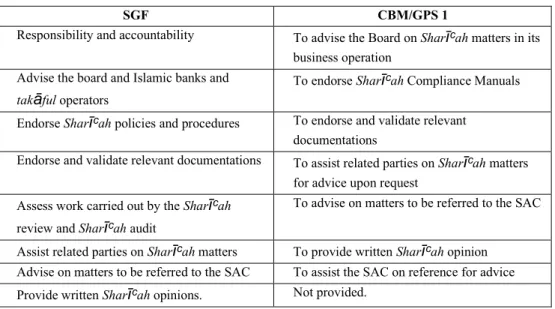
Regarding CBM/GPS 1 and SGF, both guidelines have stipulations on the duties and responsibilities of the SC. Such duties and responsibilities can be seen in the following table:
81
Table 2: The Duties and Responsibilities of the SC under SGF and CBM/GPS 1
SGF CBM/GPS 1
Responsibility and accountability To advise the Board on Sharῑᶜah matters in its business operation
Advise the board and Islamic banks and takāful operators
To endorse Sharῑᶜah Compliance Manuals Endorse Sharῑᶜah policies and procedures To endorse and validate relevant
documentations
Endorse and validate relevant documentations To assist related parties on Sharῑᶜah matters for advice upon request
Assess work carried out by the Sharῑᶜah review and Sharῑᶜah audit
To advise on matters to be referred to the SAC Assist related parties on Sharῑᶜah matters To provide written Sharῑᶜah opinion
Advise on matters to be referred to the SAC To assist the SAC on reference for advice Provide written Sharῑᶜah opinions. Not provided.
Based on the table above, it generally can be observed that, SGF includes new duties and responsibilities of the SC instead of retaining several duties and responsibilities as stipulated in the preceding guidelines. SGF expressly explains the responsibility and accountability of members of the SC as discharging their duties and responsibilities. They are responsible and accountable for all Sharῑᶜah decisions, opinions and views provided by them (SGF, Appendix 4). No such stipulation is found in CBM/GPS 1. Another new function of the SC is to assess the work carried out by Sharῑᶜah review and Sharῑᶜah audit parallel with the implementation of SGF (SGF, Appendix 4).
Again, no such function assigned to the SC under CBM/GPS 1.
Besides that, it can be seen that SGF is also widening the existing duties of the SC. This involves the duties to advise the board and provide input to the IFI. On the other hand, CBM/GPS 1 stated that the duty of the SC was only to advise the board (SGF, paragraph 2 of Appendix 4; CBM/GPS 1, subparagraph 20(a) of Part E). Likewise, SGF has widened the function of the SC in endorsing Sharῑᶜah policies and procedures prepared by the Islamic banks and takāful operators. In this regard, the SC has to ensure that the contents of such policies and procedures do not contain any elements which are not in line with Sharῑᶜah. The preceding guidelines only stated that the duty of this body was to endorse Sharῑᶜah Compliance Manuals (SGF, paragraph 3 of Appendix 4;
CBM/GPS 1, subparagraph 20(b) of Part E).
SGF has maintained the duty of the SC to endorse and validate relevant documents. In this regard,
82
SC is required to approve the terms and conditions contained in the forms, contracts, agreements and other legal documentations used in executing the transactions. Other than that, they also must approve the product manual, marketing advertisement, sales illustration and brochures used to describe the product (SGF, paragraph 3 of Appendix 4; CBM/GPS 1, subparagraph 20(c) of Part E).
Similarly SGF also preserves the duty to assist related parties of IFI such as its legal counsel, auditor or consultant on Sharῑᶜah matters. Accordingly, the SC should provide necessary assistance to the related parties of Islamic banks and takāful operators on Sharῑᶜah matters upon request by them (SGF, paragraph 3 of Appendix 4; CBM/GPS 1, subparagraph 20(d) of Part E). SGF also retains the function of the SC in providing written Sharῑᶜah opinions. This should be observed when the Islamic banks and takāful operators make references to SAC for further deliberation on Sharῑᶜah issues similar to IFI submission of applications to CBM for new product approval (SGF, paragraph 3 of Appendix 4; CBM/GPS 1, subparagraph 20(f) of Part E).
The SGF no longer provides the role of SC to assist the SAC on reference for advice. Such function was provided in the previous Guidelines. Upon reference for advice made by the Islamic banks and takāful operators to the SAC, CBM/GPS 1 required the SC to explain the Sharῑᶜah issues involved and the recommendations for a decision. In addition, it must be supported by relevant jurisprudential literature from the established sources. Similarly, the previous Guidelines stated that, upon obtaining any advice of the SAC, the SC shall ensure that all the SAC’s decisions are properly implemented by the Islamic banks and takāful operators (CBM/GPS 1, subparagraph 20(g) of Part E).
Even though such duties are not required by SGF in detail, the duty to explain the Sharῑᶜah issues involved and the recommendations for a decision are contained in the duty to provide written explanation of the Sharῑᶜah opinions when the IFI makes reference to the SAC for further deliberations. Based on the above comparison, the SGF emphasizes the responsibility and accountability of the SC in carrying out the tasks entrusted to them. As the SC is the only qualified party to make a decision or provide views and opinions relating to Sharῑᶜah matters in the Islamic banking and takāful institutions which appointing them, they should be responsible and accountable for all Sharῑᶜah decisions, views and opinions provided by them. Furthermore, such Sharῑᶜah decisions, views and opinions are binding on the operations of the institutions. This legal sanction is also to remind the SC to constantly cautious and rigorous in making a decision or provide views and opinions relating to Sharῑᶜah matters. This is significant to avoid any issues arising in the future, especially those that may prejudice the Sharῑᶜah compliance of the Islamic banking and takāful institutions.
Advising the BoD and the institution is a key role of the SC. It is important for the SC to advise the BoD parallel with the BoD’s responsibility in directing and overseeing the business and affairs of the
83
institution. The BoD in discharging its functions shall have regard to any decision made by the SC in respect of any Sharῑᶜah issues relating the business, affairs or activities of the Islamic banking and takāful institutions. This is also parallel to the function of the BoD in the implementation of Sharῑᶜah governance framework pursuant to the requirement of SGF. The BoD is ultimately accountable and responsible on the overall Sharῑᶜah governance framework and Sharῑᶜah compliance of the Islamic banking and takāful institutions. Furthermore SGF requires the BOD upon consultation with the SC to approve all policies relating to Sharῑᶜah matters. While the function of the SC to advise the Islamic banking and takāful institutions is to ensure that the institution is at all times complying with Sharῑᶜah as required by the law in carrying out its aims and operations, business, affairs and activities.
In relation to the function to endorse Sharῑᶜah policies and procedures prepared by the Islamic banking and takāful institutions, the SC has to ensure that the contents of such policies and procedures do not contain any element which is not in line with Sharῑᶜah. The function of the SC to endorse and validate relevant documentations where the SC is required to approve the terms and conditions contain in the forms, contracts, agreements or other legal documentations used in executing the transactions. Other than that, they also must approve the product manual, marketing advertisement, sales illustration and brochures used to describe the product.
SGF also requires that all new products shall be certified by the SC and must be backed the relevant fiqh (Islamic jurisprudence) literature, evidence and reasoning. The SC is required to conduct a rigorous deliberation process as well as detailed scrutiny of the legal contracts and other documents relevant to the products or transactions. During the product development process, Islamic banking and takāful institutions are required to refer all Sharῑᶜah issues related to its end-to-end product development design and process to the SC. The requirement for an advice or decision must be made in a comprehensive manner for effective deliberations by SC including explaining the process involved, documents used and other necessary information. In addition, the identified officer shall consult the SC in assessing whether the proposed change gives rise to any Sharῑᶜah issues that are yet to be deliberated by SAC. The involvement of the SC during the product development process is vital to ensure that the Islamic financial products that will be offered by Islamic banking and takāful institutions comply with Sharῑᶜah. It is also to minimize the possibilities of the product being nullified on grounds of Sharῑᶜah non-compliance.
The SC also has a duty to assess the work carried out by Sharῑᶜah review and Sharῑᶜah audit. The SC has to assess the outcome of the review as well any non-Sharῑᶜah compliances as highlighted by the Sharῑᶜah review function. Similarly, the SC has to assess the results of any assessment or findings from the Sharῑᶜah audit function. This is parallel with the implementation of SGF in the Islamic banking and takāful institutions where SC has to perform an oversight role on Sharῑᶜah
84
matters related to the Islamic banking and takāful institutions’ business operations and activities.
Another duty of the SC is to assist related parties of Islamic banks and takāful operators such as its legal counsel, auditor or consultant on Sharῑᶜah matters. Accordingly, the SC should provide necessary assistance to the relevant parties of the Islamic banking and takāful institutions on Sharῑᶜah matters upon request by them. Finally, the function of the SC is to provide written Sharῑᶜah opinions. This should be observed by the SC when the Islamic banks and takāful operators make references to the SAC for further deliberation on Sharῑᶜah issues. Similar when the Islamic banking and takāful institutions submit applications to BNM for new product approval.
Based on the duties prescribed by the SGF, it can be concluded that the SC has significant and comprehensive duties and responsibilities in ensuring that the operations and activities of the Islamic banking and takāful institutions are in compliance with Sharῑᶜah principles. The explanation to the accountability of the SC in discharging their duties is very important to be understood by all members of the SC.
xi. The reporting structure of the Sharῑᶜah Committee
The reporting structure of SC is also clarified by SGF and CBM/GPS 1. Both Guidelines clarify that, the SC shall report functionally to the BoD of the IFI (SGF, Appendix 2 and paragraph 1.6;
CBM/GPS 1, paragraph 22 of Part F).
(b) New stipulations inserted in SGF pertaining to the Sharῑᶜah Committee
Apart from improving the provisions of CBM/GPS1, SGF has included several new requirements pertaining to:
(a) The independence of SC in discharging their duties (SGF, Section III of Part 2);
(b) The competency of SC (SGF, Section IV of Part 2);
(c) Confidentiality and consistency of SC (SGF, Section V of Part 2); and (d) Operation procedures for the SC (SGF, Appendix 5).
In general, the above matters are essential in regulating the SC which previously was not provided by CBM/GPS 1.Based on the comparison made, it can be observed that SGF has improved the regulatory framework of SC compared to CBM/GPS 1. In addition SGF has also inserted several new stipulations which are essential features necessary in regulating the SC. Overall, the following Table 3 summarizes the comparison of provisions of SGF and CBM/GPS 1 as previously discussed.
Table 3: The Comparison of Provisions of SGF and CBM/GPS 1 in Regulating Sharῑᶜah Committee
Items SGF CBM/GPS 1
Requirement for the IFIs to establish the SC
√ √85
The appointment and reappointment of the SC members
√ √Application Procedures
√ √Resignation and dismissal of the member of SC
√ √Qualification of the member of SC
√ √Number of members of the SC
√ √Disqualification of member of the SC
√ √Restriction on the members of SC
√ √Secretariat to the SC
√ √The duties and responsibilities of the SC
√ √The reporting structure of the SC
√ √The independence of the SC
√X
The competency of the SC
√X
Confidentiality and consistency of SC
√X
Operation procedures of the SC
√X
Apart from SGF, there are other Guidelines which should be observed by the IFI in regulating SC including the policy on Fit and Proper Criteria (CBM/RH/GL 018-5). Prior to this, the Islamic banks and takāful operators should comply with the Guidelines on Fit and Proper for Key Responsible Persons (CBM/RH/GL 018-3) and Guidelines on Fit and Proper for Key Responsible Persons for Development Financial Institutions (CBM/RH/GL 005-13).
In general, both Guidelines set out the requirements on the obligations of financial institutions to assess and determine the fitness and propriety of key responsible persons that are accountable or responsible for the management and oversight of the financial institutions. In this regard, members of SC are also considered as key responsible persons for the financial institutions. According to the Guidelines, the assessments of fit and proper criteria of key responsible person are based on three elements including: (a) Probity, personal integrity and reputation; (b) Competence and capability; and (c) Financial integrity.
Such members of SC shall always fulfil and meet the above requirements during their tenure as a member of SC.
The CBM/RH/GL 018-5 is issued pursuant to subsections 47(1), 60(1), 143(2) and section 266 of the FSA and subparagraph 29(2)(a)(ii), subsections 57(1), 69(1), 155(2) and section 277 of the IFSA. This policy comes into force effectively on 30
thJune 2013 and is applicable to all licensed persons and financial holding companies under IFSA and FSA.
CBM/RH/GL 018-5 specifies the matters which should be observed in determining the fit
and proper criteria of key responsible persons to hold such positions in the financial
institutions including the Islamic banking and
takāful institutions. The members of the SC86
are also considered as key responsible persons of the institutions (CBM/RH/GL 018-5, paragraph 5.2 of Part A). Hence, they are subject to the conditions set out by this policy.
The assessment prior to their appointment as well as during their appointment shall be made based on the minimum fit and proper criteria set out by the policy.
Guidelines on Introduction of New Products (CBM/RH/GL 008-3) (hereinafter referred to as “CBM/RH/GL 008-3”)
1and the Guidelines on Introduction of New Products for Insurance Companies and Takāful Operators (CBM/RH/GL/010-14) (hereinafter referred to as “CBM/RH/GL/010-14”)
2have been issued by CBM in describing the applicable regulatory procedures to be observed by financial institutions, Islamic financial institutions, insurance companies and
takāful operators in developing new products respectively(CBM/RH/GL 008-3, paragraph 3.1 of Part A; CBM/RH/GL/010-14, paragraph 3.1 of Part A).
Both Guidelines have clarified the role of the SC in the product development process. In this regard, the SC is required to endorse and validate all product proposals including the terms and conditions contained in proposal forms, offer letters, agreements and other legal documents used in the transaction. The same goes to all product manuals, advertisement or marketing materials, product illustrations and brochures used to describe the product shall be endorsed by the SC. Other than that, the Guidelines also stipulate that all Sharῑʿah issues should be thoroughly researched prior to the deliberation of the SC (CBM/RH/GL 008-3, paragraph 6.12 of Part B; CBM/RH/GL/010-14, paragraph 6.12 of Part C).
Meanwhile Guidelines on Applications for Registration and Operation of Re-takāful Operator (CBM/RH/GL/004-12) (hereinafter referred to as “CBM/RH/GL/004-12”) has provided the requirement for the establishment of SC which should be include in the memorandum and AoA of the Re-takāful Operator. The Guidelines also provide the matters related to the appointment process of the SC (CBM/RH/GL/004-12, subparagraph 2.1(b) and 3.1.1(b) of Part IV). The SC is also subject to the Guidelines on Financial Reporting for Islamic Banking Institutions (CBM/RH/CP 022-1) (hereinafter referred to as
“CBM/RH/CP 022-1”),
3Guidelines on Financial Reporting for Development Financial
1 The Guidelines are issued pursuant to section 126 of BAFIA, section 53A of IBA and section 126 of DFIA.
2 The Guidelines are issued pursuant section 201 of Insurance Act 1996 (Insurance Act) and section 69 of TA.
3 The Guidelines is issued pursuant to section 18, section 19(1) and section 53A of IBA; section 41, section 42 and section 126 of BAFIA; and section 73, section 77 and section 126 of DFIA. The Guidelines is applicable to Islamic banks licensed under IBA; Banks approved under section 124 of BAFIA to carry on Islamic banking business; and Banks approved under section 129 of DFIA to carry on Islamic banking business. The Guidelines come into force for the financial year beginning on or after 1 January 2013 and has supersede the previous Guidelines namely Guidelines on Financial Reporting for Licensed Islamic
87
Institutions (CBM/RH/GL 005-16) (hereinafter referred to as “CBM/RH/GL 005-16”)
4and Guidelines on Financial Reporting for Takaful Operators (CBM/RH/GL 004-6) (hereinafter referred to as “CBM/RH/GL 004-6”).
5The Guidelines laid down the standard format to be observed by the SC in preparing their report to be included in the IFI’s annual financial report (CBM/RH/CP 022-1, paragraph 6.4 of Part A and paragraph 11.4 of Part C;
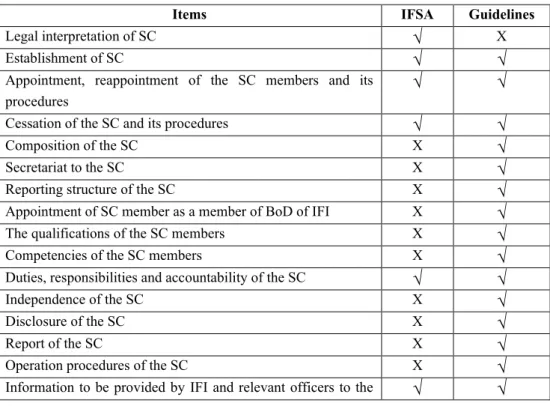
CBM/RH/GL 005-16, paragraph 10.4 of Part B and paragraph 16.4 of Part C; CBM/RH/GL 004-6 paragraph 10.4 of Part II and paragraph 11.4 of Part III). In a nutshell, the Guidelines work as a complementary to IFSA in regulating the legal aspects of the SC. The legal aspects of SC comprehensively being covered by IFSA and Guidelines as reflected in the following Table 3.
Table 3: The legal aspects of SC under IFSA and Guidelines
Items IFSA Guidelines
Legal interpretation of SC
√X
Establishment of SC
√ √Appointment, reappointment of the SC members and its procedures
√ √
Cessation of the SC and its procedures
√ √Composition of the SC X
√Secretariat to the SC X
√Reporting structure of the SC X
√Appointment of SC member as a member of BoD of IFI X
√The qualifications of the SC members X
√Competencies of the SC members X
√Duties, responsibilities and accountability of the SC
√ √Independence of the SC X
√Disclosure of the SC X
√Report of the SC X
√Operation procedures of the SC X
√Information to be provided by IFI and relevant officers to the
√ √Banks (CBM/GP8-i) (CBM/RH/GL/002-2 which issued on 1 July 2005) and Circular on the Application of FRS and Revised Financial Reporting Requirements for Islamic Banks (CBM/RH/CIR/002-8 which issued on 8 February 2010).
4 The Guidelines is issued pursuant to sections 2(2), 73, 74, 76, 78 and 126 of DFIA and is applicable to all DFIs prescribed under DFIA. The Guidelines is effective for financial year beginning on and after 1 January 2013. The requirements specified for disclosures related to Sharīᶜah matters (Paragraph 9 of Guidelines) is effective for the financial year beginning on or after 1 January 2014. However, DFIs may early adopt the requirements.
5 The Guidelines are issued pursuant to Section 41, 56 and 69 of TA and are effective for financial years beginning on and after 1 July 2011.
88
SC
Qualified privilege and duty of confidentiality of the SC
√ √Legal consequences of the SC in discharging its duties and
responsibilities
√ √
Source: Mohammad Azam Hussain, Rusni Hassan & Aznan Hassan (2014) Conclusion
The SC established by the Islamic banking and takāful operator is regulated by IFSA and several Guidelines issued by CBM. IFSA provides a better statutory framework compared to IBA and TA. In some circumstances, IFSA only provides the general principles and grants permission to the CBM to issue relevant guidelines from time to time to strengthen the legal framework of SC. In this regard, the guidelines work as complementary to the statute. In conclusion, undoubtedly Malaysia has a comprehensive regulatory framework to govern the legal aspect of the SC.
References
AAOIFI, Governance Standard for Islamic Financial Institutions No. 1 on the
ShariᶜaSupervisory Board: Appointment, Composition and Report, Article 2.
Banking and Financial Institutions Act 1989 (Act 372) Development Financial Institutions Act 2002 (Act 618)
Engku Rabiah Adawiah Engku Ali & Odierno, Hassan Scott P. (2008).
Essential guide to takāful (Islamic insurance). Kuala Lumpur, Malaysia: CERT Publications Sdn.Bhd.
Financial Services Act 2013 (Act 758) Fit and Proper Criteria (CBM/RH/GL 018-5) Fit and Proper Criteria (CBM/RH/GL 018-5)
Guidelines on Applications for Registration and Operation of Re-takāful Operator (CBM/RH/GL/004-12)
Guidelines on Financial Reporting for Development Financial Institutions (CBM/RH/GL 005-16)
Guidelines on Financial Reporting for Islamic Banking Institutions (CBM/RH/CP 022-1) Guidelines on Financial Reporting for Takaful Operators (CBM/RH/GL 004-6)
Guidelines on Fit and Proper for Key Responsible Persons (CBM/RH/GL 018-3)
Guidelines on Fit and Proper for Key Responsible Persons for Development Financial
Institutions (CBM/RH/GL 005-13)
89
Guidelines on Introduction of New Products (CBM/RH/GL 008-3)
Guidelines on Introduction of New Products for Insurance Companies and
TakāfulOperators (CBM/RH/GL/010-14)
Guidelines on the Governance of SharῑᶜahCommittee for the Islamic Financial Institutions (CBM/RH/GL/012-1)
Ibrahim Warde. (2000).
Islamic finance in the global economy. (Edinburgh: EdinburghUniversity Press.
Islamic Banking (Amendment) Act 2003 (Act A1214) Islamic Banking Act 1983 (Act 276)
Islamic Financial Services Act 2013 (Act 759)
Moḥamad Akram Laldin. (2008). The role of
Sharīᶜah advisors in the development ofIslamic Securities. In Mohamad Akram Laldin (Ed.), Fundamentals and practices
in Islamic finance(pp. 55-69). Kuala Lumpur: International
Shariᶜah ResearchAcademy for Islamic Finance (ISRA).
Mohammad Azam Hussain, Rusni Hassan & Aznan Hassan. (2014). Islamic Financial Services Act 2013 (Act 759): Enhancing the regulatory framework of the Shariah committee or a burden on the Shariah committee. Paper presented in Terengganu International Business and Economic Conference (TIBEC 2014), Universiti Teknologi MARA, Terengganu, September, 2014.
Rusni Hassan, Agus Triyanta and Adnan Yusoff, “Sharīᶜah Compliance Process in Malaysian Islamic Banking”,
Malayan Law Journal, 5 (2011): lxxxi. LexisNexisDatabase <http://www.lexisnexis.com.eserv.uum.edu.my> (accessed 15
thMarch 2012).
Sharῑᶜah Governance Framework for Islamic Financial Institutions (CBM/RH/GL 012-3)
Sudin Haron & Wan Nursofiza Wan Azmi. (2009).
Islamic finance and banking system:Philosophies, principles & practices. Shah Alam, Selangor, Malaysia: McGraw-
Hill (Malaysia) Sdn. Bhd.
Takāful (Amendment) Act 2003 (Act A1212)
Takaful Act 1984 (Act 312)