The copyright © of this thesis belongs to its rightful author and/or other copyright owner. Copies can be accessed and downloaded for non-commercial or learning purposes without any charge and permission. The thesis cannot be reproduced or quoted as a whole without the permission from its rightful owner. No alteration or changes in format is allowed without permission from its rightful owner.
AN EXPLORATORY STUDY ON GST COMPLIANCE TIME COSTS OF SMEs IN THE NORTHERN REGION OF MALAYSIA
BY
MARDHIYAH BINTI MOHD SUBERI 818139
Thesis Submitted to Othman Yeop Abdullah Graduate School of Business, Universiti Utara Malaysia, In Fulfillment of the Requirement for the
Degree of Master of Science (International Accounting) May 2016
i
PERMISSION TO USE
In constructing this thesis, which serves as a partial fulfilment of the requirements for the award of postgraduate degree from Universiti Utara Malaysia (UUM), I hereby consent for the university library to make it unconditionally accessible for verification. I further agree that approval to obtain this thesis, either in part or in whole, for academic pursuits may be given by my supervisor Dr. Noraza Mat Udin or the Dean Othman Yeop Abdullah, Graduate School of Business. Similarly, utilization of this thesis or parts thereof for financial benefit shall not be allowed without prior written approval. In addition, due acknowledgement should be given to me and to Universiti Utara Malaysia for any academic utilization, which may be made of any material, derived from this thesis. Demand for authorization to duplicate or to make other utilization of material in this thesis, in its entirety or to a limited extent, ought to be tended to:
Dean Othman Yeop Abdullah, Graduate School of Business Universiti Utara, Malaysia
06010 Sintok Kedah Darul Aman
ii ABSTRACT
The Malaysia government is always committed in making tax system more effective, efficient, comprehensive, transparent, fair and friendly to users. Thus goods and services tax system (GST) has been implemented in Malaysia since 1 April 2015 to replace the former sales and services tax (SST) system. As such, procedural issues and compliance cost associated with the GST system are of significant interest to the taxpayers. This study is conducted one year after GST system implementation which considered as at the early stage of GST implementation. It focuses on the compliance time cost in terms of the time spent by the Small and Medium Enterprises (SMEs). The respondents of this study are the SMEs in the Northern Region of Malaysia i.e. Penang, Kedah, and Perlis. The result reveals that record keeping contributes to the major increase by percentage in GST compliance time costs followed by learning new GST systems, answering RMCD queries, claiming GST refund and GST payment process. This study also discovers that the demographic background of the SMEs indicates different of opinion in compliance time costs. While GST law complexity and time frequency of GST filing are among the main causes for the increase in compliance time costs of GST for SMEs under this study.
Key words: Goods and Services Tax (GST), Compliance Cost, Small and Medium Enterprises (SMEs) and Tax System
iii ABSTRAK
Kerajaan Malaysia sentiasa komited untuk menjadikan sistem cukai lebih berkesan, cekap, menyeluruh, telus, adil dan mesra pengguna. Oleh itu, cukai barang dan perkhidmatan (CBP) telah dilaksanakan semenjak 1 April 2015 bagi menggantikan cukai jualan dan perkhidmatan (SST). Dengan itu, isu-isu prosedur dan kos pematuhan berkaitan dengan sistem CBP memberi kesan yang signifikan kepada pembayar cukai. Kajian ini dijalankan setahun selepas sistem CBP dilaksanakan yang dianggap sebagai peringkat awal pelaksanaan CBP. Ia bertumpu kepada kos pematuhan dari segi masa yang digunakan oleh perusahaan kecil dan sederhana (PKS). Responden-responden dalam kajian ini adalah PKS di kawasan utara Malaysia iaitu Pulau Pinang, Kedah, dan Perlis. Hasil kajian menunjukkan bahawa penyimpanan rekod merupakan penyumbang utama terhadap peningkatan kos masa pematuhan secara peratusan dalam CBP diikuti oleh mempelajari sistem CBP yang baru, menjawab pertanyaan JKDM, menuntut pulangan balik CBP dan proses pembayaran CBP.
Kajian ini juga mendapati latar belakang demografi PKS menunjukkan perbezaan pandangan ke atas kos masa pematuhan. Manakala kerumitan undang-undang GST dan kekerapan masa memfail GST adalah antara sebab-sebab utama bagi peningkatan kos masa pematuhan GST oleh PKS di bawah kajian ini.
Kata kunci: Sistem Cukai Barang dan Perkhidmatan (CBP), Kos Pematuhan, Perusahaan Kecil dan Sederhana (PKS) dan Sistem Cukai
iv
ACKNOWLEDGEMENT
In the name of Allah, the Beneficent and the Merciful. Power and authority belongs to Allah along, who can decide a future to be certain, and who gave me the opportunity to undertake this study and eventually make it possible.
I would like to start with special appreciation to my lecturers in the School of Accountancy, College of Business in the Graduate School of Business (OYA) as a whole, especially those who taught me in one course or the other. My profound gratitude goes to my amiable supervisor Dr. Noraza Bt. Mat Udin for her kind assistance, constructive criticisms and advices which made this research successful.
I wish to express my indebted gratitude and acknowledgement to my parents in person of Mohd Suberi Saleh and Zaitun Ahmad for their caring, loving, support and concern given to me throughout my life. My propound appreciation also goes to brothers (Miqdad Mohd Suberi, Annas Mohd Suberi, and Mohd Adam Mohd Suberi), the only one sister (Sumaiyyah Mohd Suberi) and the entire family members for their support and prayers.
I do acknowledge the assistance and support given to me by Kementerian Pendidikan Malaysia that gives me Mybrain15 throughout the period of this study. Finally, my profound acknowledge to my colleagues especially in person of Muhammad Akmal Radzi, Nora Fauzana Bt. Zainal, Masturah Bt. Malek, Syazwani Bt. Mohamad, Samihah Suhail, and Roshida Mohamed for their encouragement throughout the period of this study.
Finally, I would like to address a special thanks to Tuan Mohd Sukri Jusoh (Senior Assistant Director of Custom, Seberang Jaya, Penang) and respondents who have contributed significantly participate in answering the questionnaires.
v
TABLE OF CONTENTS
PERMISSION TO USE i
ABSTRACT ii
ABSTRAK iii
ACKNOWLEDGEMENT iv
TABLE OF CONTENTS v
LIST OF TABLES viii
LIST OF ABBREVIATIONS ix
CHAPTER ONE: INTRODUCTION 1.1 Background of the Study
1.1.1 Small and Medium Enterprise (SME) in Malaysia 1.1.2 Challenges of Post Implementation of GST
1 3 4
1.2 Problem Statement 5
1.3 Research Questions 8
1.4 Research Objectives 8
1.5 Scope of the Study 8
1.6 Significance of the Study 9
1.7 Organization of the Thesis 10
CHAPTER TWO: LITERATURE REVIEW
2.1 Introduction 12
2.2 Tax Compliance Costs 12
2.3 Empirical Studies on Tax Compliance Costs 15
2.4 Goods and Services Tax (GST) Compliance Costs in Various Countries 20
vi
2.5 Compliance Costs Burden 23
2.6 Summary 26
CHAPTER THREE: RESEARCH METHODOLOGY
3.1 Introduction 27
3.2 Data Collection Method 27
3.2.1 Population and Sample of the Study 28
3.2.2 Sampling Technique 3.2.3 Questionnaire Distribution 3.2.4 Questionnaire Design
28 28 29
3.3 Measurement of Compliance Costs 31
3.4 Pilot Study 32
3.5 Method of Data Analysis 32
3.6 Summary 33
CHAPTER FOUR: RESULTS AND DISCUSSIONS
4.1 Introduction 34
4.2 Reliability Test 34
4.3 Survey Response Rate 34
4.4 Demographic Background of the Respondents 35
4.5 Compliance Time Costs of GST 38
4.6 Demographic Background of High GST Compliance Time Costs 42 4.7 Reasons for Increment in GST Compliance Time Costs for SMEs 45
4.8 Summary 46
vii
CHAPTER FIVE: CONCLUSIONS AND RECOMMENDATIONS
5.1 Introduction 48
5.2 Summary of Findings 48
5.3 Limitations of the Study 50
5.4 Recommendations for Future Research 50
5.5 Conclusion 51
REFERENCES 52
APPENDICES 59
viii
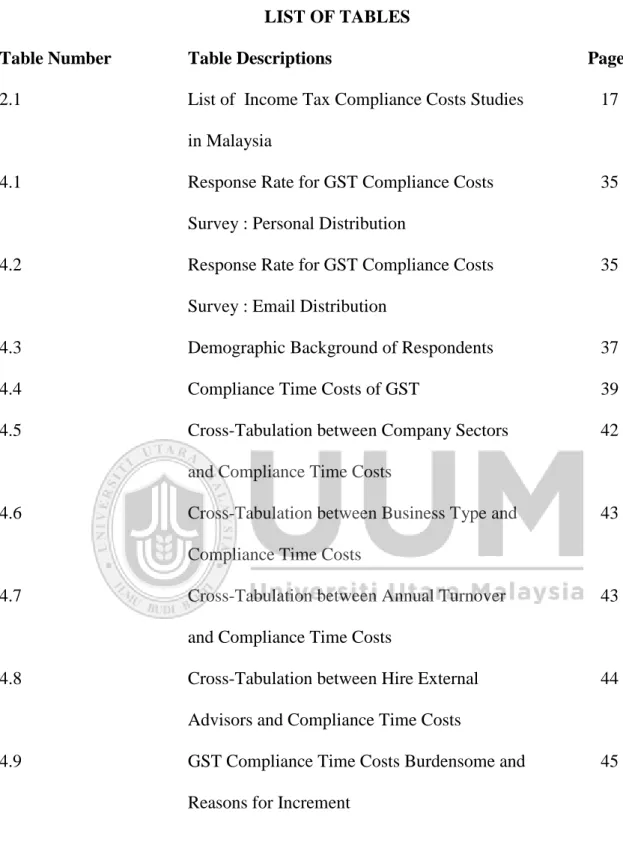
LIST OF TABLES
Table Number Table Descriptions Pages
2.1 List of Income Tax Compliance Costs Studies in Malaysia
17
4.1 Response Rate for GST Compliance Costs
Survey : Personal Distribution
35
4.2 Response Rate for GST Compliance Costs
Survey : Email Distribution
35
4.3 Demographic Background of Respondents 37
4.4 Compliance Time Costs of GST 39
4.5 Cross-Tabulation between Company Sectors and Compliance Time Costs
42
4.6 Cross-Tabulation between Business Type and Compliance Time Costs
43
4.7 Cross-Tabulation between Annual Turnover and Compliance Time Costs
43
4.8 Cross-Tabulation between Hire External Advisors and Compliance Time Costs
44
4.9 GST Compliance Time Costs Burdensome and
Reasons for Increment
45
ix
LIST OF ABBREVIATIONS
Abbreviations Descriptions of Abbreviations CFIB Canadian Federation of Independent Business
CPA Certified Public Accountants
FBT Fringe Benefit Tax
GDP Gross Domestic Product
GST Goods and Services Tax
IDR Indonesia Rupiah
IFC International Finance Corporation
IRBM Inland Revenue Board of Malaysia
NZ New Zealand
MICPA Malaysia Institute of Certified Public Accountants OECD Organisations for Economic Co-operation Developments
PAYE Pay As You Earn
RM Ringgit Malaysia
RMCD Royal Malaysian Customs Department
RPGT Real Property Gains Tax
SARS South African Revenue Service
SST Sales and Services Tax
SMEs Small and Medium Enterprise
SPSS Statistical Package for the Social Sciences
SST Sales and Services Tax
VAT Value Added Tax
UK United Kingdom
US United States
x
UUM Universiti Utara Malaysia
1
CHAPTER ONE: INTRODUCTION
1.1 Background of the Study
Generally, tax is one of the important sources of income for developed and developing countries including Malaysia. Bhatia (2009) stated that the collection of tax as a revenue by the government will be returned as benefits to the public in the form of infrastructural facilities and development of public utilities. Malaysia’s tax system is divided into two categories which are direct and indirect taxes. Under direct taxes, taxpayers have the responsibility to pay tax directly to the tax authority. Examples of direct taxes include income taxes, real property gains tax (RPGT) and stamp duty. Direct taxes are administered by the Inland Revenue Board of Malaysia (IRBM). Whilst, indirect taxes are collected by third party, such as businesses registered with Royal Malaysian Customs Department (RMCD).
The examples of indirect taxes are export duty, import duty, and goods and services tax (GST). Indirect taxes are administered by the RMCD.
In order to generate revenue for a country, taxation is one of the main mechanisms. The Malaysia government is always committed in making tax system more effective, efficient, comprehensive, transparent, fair, and friendly. In order to achieve an efficient tax system, Goods and Services Tax (GST) was implemented on 1 April 2015 (gst.customs.gov.my). The GST is a replacement for sales and service tax (SST) because the Malaysian government aware that GST collections is able to cover the fiscal deficit as a result from reduction in oil prices. In addition, the purposes of implementing GST include to lower cost of doing business, improved standard of living, equality and fairness in tax system, increases global competitiveness, fair pricing to the consumers, and so forth (gst.customs.gov.my). Within less than a year of implementation the GST collection is proved to successfully increase Malaysian revenue (www.thestar.com.my). However, since its implementation, GST is
The contents of the thesis is for
internal user
only
52 REFERENCES
Abdul-Jabbar, H. & Pope, J. (2008a).The effects of the self-assessment system on the tax compliance costs of small and medium enterprises in Malaysia. Australian Tax Forum, 23(3), 289–307.
Abdul-Jabbar, H. & Pope, J. (2008b).Exploring the relationship between tax compliance costs and compliance issues in Malaysia. Journal of Applied Law and Policy, 1(1), 1–20.
Abdul-Jabbar, H. (2009). Income tax non-compliance of small and medium enterprises in Malaysia: Determinants and tax compliance costs. PhD Thesis, Curtin University of Technology, Perth.
Allers, M. (1994). Administrative and compliance costs of taxation and public transfers in the Netherlands. Groningen, The Netherlands: Wolters-Noordhoff.
Americans for Fair Taxation (2007). What the federal tax system is costing you – besides your Approach. Sixth edition. Willey.
Ariff, M., & Pope, J. (2002). Taxation & compliance costs in Asia Pacific economies.
Penerbit.
Bhatia, H. L. (2009). Public finance. Vikas Publishing House PVT Ltd.
Mansor, M., & Pantamee, A. A. (2015). Tax Evasion and Nigeria Tax System: An Overview.
Research Journal of Finance and Accounting, 6(8), 202-211.
Brunton, C. (2005). Measuring the tax compliance costs of small and medium-sized
businesses–a benchmark survey. Final Report.[Online] Available from:
http://taxpolicy. ird. govt. nz/publications/files/smecompliancecosts. pdf [Accessed:
2008-01-30].
Charlet, A., & Butdens, S. (2012). The OECD International VAT/GST Guidelines: past and future developments. World Journal of VAT/GST Law 1(2):175-184.
53
Erard, B. (1997). The income tax compliance burden on Canadian big business (Working Paper 97-2). Ottawa, Canada: Technical Committee on Business taxation, Department of Finance.
Eragbhe, E., & Omoye, A. S. (2014). SME characteristics and value added tax compliance costs in Nigeria. Mediterranean Journal of Social Sciences, 5(20), 614.
Evans, C. (2008). Taxation compliance and administrative costs: an overview.Tax compliance costs for companies in an enlarged European community, 447-468.
Evans, C. (2013). Tax compliance costs for the small and medium enterprise business sector : Recent evidence from Australia, Australian School of Business Research working paper, 1-34.
Evans, C., Ritchie, K., Tran-Nam, B. & Walpole, M. (1997). A Report into taxpayer costs of compliance. Canberra, Australia: Australian Government Publishing Service.
Faridy, N. VAT Compliance Costs and VAT Evasion of Small and Medium Enterprises (SMEs) Sectors in Bangladesh: Is there a Link?
Ferdjani (2015). VAT Compliance Cost for SMEs in Algeria: Master Thesis in Universiti Utara Malaysia.
Glover, J. & Tran-Nam, B. (2005). The GST recurrent compliance costs/benefits of small business in Australia: A case study approach. Journal of the Australasian Tax Teachers Association, 1(2), 237–258.
Gupta, R., & Sawyer, A. (2014, January). Tax compliance costs for small businesses in New Zealand: Some recent findings. In Australasian Tax Teachers’ Association Conference, Griffith University, January.
54
Hansford, A., & Hasseldine, J. (2012). Tax compliance costs for small and medium sized enterprises: the case of the UK. eJournal of Tax Research, 10(2), 288-303.
Hasseldine, J. & Hansford, A. (2002). The compliance burden of VAT: Further evidence from the UK. Australian Tax Forum, 17, 369–388
Hasseldine, J., Evans, C., Hansford, A., Lignier, P., Smulders, S., & Vaillancourt, F. (2012, November). A comparative analysis of tax compliance costs and the role of special concessions and regimes for small businesses in Australia. In Canada, South Africa and the United Kingdom, presented at National Tax Association Conference Providence, Rhode Island (15-17).
Inland Revenue Department. (2010). SME tax compliance costs 2009. Evaluation Report Retrievedfromhttp://www.ird.govt.nz/resources/2/1/21c7d68043c438479c019e4e9c14 5ab7/sme-tax-compliance-costs-eval-report-1.pdf.
International Finance Corporation. (2010b). The compliance and reporting costs for businesses in Uzbekistan. Washington DC. Retrieved from www.ifc.org/uzbee.
Lignier P. & Evans C. (2012). The rise and rise of tax compliance costs for the small business sector in Australia. Australian Tax Forum, 27, 615–672.
Loh, A., M. Ariff, Ismail, Z., Shamser M., andAli, M. (1997). Compliance Costs of Corporate Taxation in Malaysia, 1995. Pacific Accounting Review, 14(3), 134-176.
Mansor, H. A., & Hanefah, M. M. (2008). Tax compliance costs of Bumiputera small and medium enterprises in Northern Malaysia. IJMS, 15(1), 21-42.
Maseko, N. (2013). Determinants of Tax Compliance in Small and Medium Enterprises in Zimbabwe. Available at SSRN 2237849.
55
Mansor, Saad, Ibrahim (2004). The Self-assessment System and Its Compliance Costs.
Nahida and Faridy, (2014). VAT Compliance Costs and VAT Evasion of Small and Medium Enterprises (SMEs) Sectors in Bangladesh: Is there a Link?
National Audit Office. (1997). HM Customs and Excise: Cost to business of complying with VAT requirements. London, England: HMSO.
Palil, Ramli, Mustapha, Abu Hassan (2013). Elements of Compliance Costs: Lesson from Malaysian Companies towards Goods and Services Tax (GST). Asian Social Science, Vol9, No, 11.
Pillai, K. V. (2000). The compliance costs of VAT in the hotel industry in Mauritius. Social Sciences and Humanities and Law & Management Research Journal, 3(7), 52–66.
Plamondon, R. E. & Zussman, D. (1998). The compliance costs of Canada's major tax systems and the impact of single administration. Canadian Tax Journal, 46(4), 761–
785.
Pope, J. (2009). Taxation compliance costs. In P. O’Hara (Ed.) (2009), International
encyclopedia of public policy, 2, Economic Policy (614–627), Perth, Western
Australia: GPERU. Retrieved from
http://pohara.homestead.com/Encyclopedia/Volume-2.pdf.
Pope, J., Fayle, R. & Chen, D. (1993a). The compliance cost of wholesale sales tax in Australia. Sydney, Australia: Australian Tax Research Foundation.
Pope, J., Fayle, R. & Chen, D. (1993b). The compliance costs of employment related taxation in Australia. Sydney, Australia: Australian Tax Research Foundation.
56
Pope, J., Fayle, R. & Chen, D. (1994).The compliance costs of companies’ income taxation in Australia (Research Study No. 23). Sydney, Australia: Australian Tax Research Foundation.
Pope, J., Fayle, R. & Chen, D. L. (1991).The compliance costs of public companies' income taxation in Australia 1986/87. Sydney, Australia: Australian Tax Research Foundation.
Pope, J., Fayle, R. D. &Duncanson, M. (1990).The compliance costs of personal income taxation in Australia 1986/87. Sydney, Australia: Australian Tax Research Foundation.
Price Waterhouse Coopers (2010) The impact of VAT compliance on business. The
assumptions used in gathering World Bank data are shown in the Annex to this article.
Rametse, N. & Pope, J. (2002). Start-up tax compliance costs of the GST: Empirical evidence from Western Australian small businesses. Australian Tax Forum, 17(4), 407–422.
Rametse, N. (2006). Start-up compliance costs of the Goods and Services Tax (GST) for small businesses in Australia. (Unpublished PhD Thesis).Curtin University of Technology, Bentley, Western Australia.
Sandford, C. (1995a). Improving the methodologies. In C. Sandford (Ed), Tax compliance costs: Measurement and policy (pp. 375–401). Bath, England: Institute for Fiscal Studies, University of Bath.
Sandford, C. T., &Hasseldine, J. (1992).The compliance costs of business taxes in New Zealand. Wellington, New Zealand: Institute of Policy Studies.
Sandford, C., Godwin, M. & Hardwick, P. (1989).Administrative and compliance costs of taxation. Bath, England: Institute for Fiscal Studies, University of Bath.
57
Sandford, C., Godwin, M., Hardwick, P. & Butterworth, M. (1981).Costs and benefits of VAT.London, England: Heinemann Educational books.
Sekaran U., and Roger B., (2013) Research Methodology for Business: A Skill-Building Approach Sixth edition. Willey.
Shekidele, C. M. S. (1999). Measuring the compliance costs of taxation excise duties 1995- 96.The African Journal of Finance and Management, 7(2), 72–84.
Slemrod, J. & Blumenthal, M. (1996). The income tax compliance cost of big business.
Public Finance Review, 24(4), 411–438.
Slemrod, J. B., & Blumenthal, M. (1996). The income tax compliance cost of big business.
Public Finance Review, 24(4), 411-438.
Slemrod, J. B., & Venkatesh, V. (2002). The income tax compliance cost of large and mid- size businesses. Ross School of Business Paper, (914).
Slemrod, J. (1997). Measuring taxpayer burden and attitudes for large corporations: 1996 and1992 survey results (Report to the Coordinated Examination Program of the Internal Revenue Service, Working Paper No. 97-1). Michigan: Office of Tax Policy Research.
Susila, B. & Pope, J. (2012). The tax compliance costs of large corporate taxpayers in Indonesia. Australian Tax Forum, 27, 719–772.
Plamondon & Associates Inc. (1993). GST compliance costs for small business in Canada.
Ottawa, Canada: Department of Finance.
58
Vaillancourt, F., Clemens, J., & Palacios, M. (2008). Compliance and administrative costs of taxation in Canada. The impact and cost of taxation in Canada: The case for flat tax reform, Jason Clemens (ed.), 55-102.
Vaillancourt, F., Clemens, J., & Palacios, M. (2008).Compliance and administrative costs of taxation in Canada. In J. Clemens, (Ed.), The impact and cost of taxation in Canada:
The case of a flat tax reform (55–102). Vancouver, Canada: The Fraser Institute.
Yesegat, W. A. (2009). Value added tax in Ethiopia: A study of operating costs and compliance. PhD Thesis, University of New South Wales, Kengsinton, NSW.
Zikmund, W. (1994). Business Research Methods: International Edition (4th ed.). U.S: The Dryden Press.