
Uni TA 1
F332
•
Centre of Research Excellence in Energy and Environmental (CORE3)... 55
Research and Development ... ... ... 60
Reports Accreditation Report ... 76
FENG Seminar Series.. ... ... ... ... ... ... ... 78
ROBOCON Report 2008 ...
b.
80 Miscellaneous Student Achievements ... 84Kelab Sukan, Rekreasi dan Kebajikan Fakulti Kejuruteraan ... ... .... 85
FENG Activities ... ... ... ... ... ... ... 86
SAFE Report ... 90
Advertisements 94
\'( "S I\1ESS:\(a:
VICE CHANCELLOR'S MESSAGE
UNIMAS was formed to spearhead ideas and efforts and also to explore and expand knowledge to the fullest potential while at the same time develop skills and talents such as communication and entrepreneurship skills that will prepare students before they experience the real working world.
To accomplish that, the Faculty of Engineering has put the emphasis on the Outcome-Based Education (OBE) as a mean for the engineering students to excel in their study and later on in their career. In order to support this concept, UNIMAS offers state-of-the-art research and academic facilities for the benefit of both the academicians and the students.
The theme chosen for this issue of FENG Magazine that is "Embracing Outcome-Based Education (OBE) in Engineering Education" will help to introduce to the students and the pu blic to the approach taken by the faculty to better improve its teaching and learning processes.
Lastly, I would like to congratulate the Faculty of Engineering on the publication of this latest issue of FENG Magazine, especially the editorial group for their effort. I hope that with this publication, the public will be better informed of the faculty and its strategy in producing quality graduates that would be able to proactively adapt to the fast changing environment.
Professor Dr. Khairuddin Bin Ab Hamid Vice Chancellor
Universiti Malaysia Sarawak
~tsy..J .&\\~JY'S:)c ~)U\
... .&\~\
I would like to congratulate the entire FENG Magazine Editorial Team members for successfully contributed to the publication of Vol. 2, Faculty of Engineering (FENG) magazine. The Faculty is also indebted to all the contributors of either papers, materials, information, etc. which has become part of the year FENG Magazine.
This is the second FENG Magazine published by the Faculty of Engineering. The theme of this year's magazine is about the adoption of Outcome-Based Education (OBE) in the teach
ing of students in the Faculty of Engineering.
Almost all of the papers in this issue discuss about the experiences of our academic staff in embracing the OBE in engineering education.
Hopefully, the expenences and suggestions published in this magazine will be invaluable for the successful implementation of OBE in the Faculty of Engineering in the future.
I sincerely hope that the materials presented in this issue of FENG Magazine will be useful to for our staff to improve the preparation of their teaching and learning activities. This particular issue will certainly be useful to our new academic staff in their effort to better understand the concept of OBE and can be used as a guideline for improving further the implementation of OBE in the Faculty of Engineering.
Professor Dr. Wan Hashim Wan Ibrahim Dean
Faculty of Engineering
EDITORIAL'S MESSAGE
4..:i\.S y..J
..&I\~.JyS}c
~)LJ\. . . ...&\ .l.a..:J \
I am very delighted at the opportunity to write this editorial note for the second volume of FENG Magazine.
"Embracing Outcome-Based Education (OBE) In Engineering Education" was chosen as the theme for this issue to highlight the past and recent activities as well as achievements in the 2007/2008 seSSIOn by the Faculty of Engineering (FENG), UNIMAS . It is important to note that many of the activities and articles highlighted In this Issue are on the faculty's successes In OBE implementations that gave considerable focus on continuous quality improvements of the instructional delivery system among the faculty's lecturers.
Acceptable level of accomplishment In OBE implementation is vital to ensure unconditional accreditation for all three (3) engineering programmes involved;
among these are Mechanical and Manufacturing, Civil as well as Electronic Engineering that shall take place somewhere in August this year. These activities and achievements are concisely discussed in the 'Reports' section.
Our readers will find many interesting teaching and learning (T&L) articles in the features column pertinent to OBE that aims to foster innovative and effective educa tional practices and technologies in engineering education. In addition , 'Research and Development' section
reveals the successes of FENG faculty members in their research endeavours as well as tonnes of journal and proceedings publications published that significantly demonstrate the quality of research development and innovation activities in the Faculty of Engineering. This issue also includes the students' development and achievements reports by Students Associa tion of Faculty of Engineering (SAFE). Significant achievements by faculty members in various competitions participated are available I n the miscellaneous column.
On behalf of FENG Magazine Editorial Team, I would like to express our Slncere gratitude to our magaZlne production teammates as well as the authors of articles in this Issue and we look forward to your continuous collaboration with FENG Magazine . I strongly believe that this particular Issue will stimulate further interest, and will become a useful source of information on new and noteworthy teaching and learning as well as research development activities.
With best regards and Wassalam .
Mohamad Raduan bin Kabit
Chief Editor
Programme Educational Objectives (PEOs)
PEOI
Uphold the professionalism, ethics and responsibility of the Civil Engineering profession.PE02
Possess a general education and an understanding of the global demand of Civil Engineering markets and hence able to promote themselves in the international arena.PE03
Extend their knowledge by independent learning and continuing education and contribute to the advancement of the profession through involvement in research and development (R&D) activities.PE04
Promote multicultural harmony and unity amongst different races and cultures by involvement in the technical or non-technical societies.Programme Outcomes (POs)
a. Ability to acquire and apply knowledge of mathematics and sciences related to Civil Engineering fundamental.
b. Acquire in-depth technical competence in Civil Engineering discipline.
c. Ability to identify, formulate and solve Civil Engineering problems.
d. Ability to utilize systems approach to design and evaluate operational performance.
e. Understanding of the principles of sustainable development for Civil Engineering design.
f. Understanding and committed to the professional and ethical responsibilities.
,g. Ability to communicate effectively with engineers and community at large.
h. Ability to function effectively as a member or a team leader in a group.
1. Understanding of social, cultural, global and environmental responsibilities of a professional engineer
j. Recognizing the need to undertake life-long learning for individual capacity development.
k. Ability to use the techniques, skills and modern engineering tools necessary for Civil Engineering practice.
Department of Electronics Engineering:
Electronics & Telecommunication Engineering Programme
The PEOs for both programmes under Department of Electronic Engineering have been set by the departmental members in consultation with the stakeholders from industry, students, parents, alumni and also through discussion with faculty members. The PEOs of the programmes are to educate undergraduate students to enable them to demonstrate the abilities listed in the PEOs. These objectives are linked to the POs of the programme.
Programme Educational Objectives (PEOs)
PEOl Applying Electronics Engineering knowledge based on a solid foundation ill
Telecommunication Engineering areas for the needs of the stakeholders.
PE02 Upholding the importance of professionalism and ethics Electronics Engineering profession to form a cultured and more developed society.
PE03 Possessing communication and interpersonal skills, to meet the nation's and stakeholders' aspiration.
PE04 Developing skills in research in Electronics Engineering particularly in the areas of Telecommunication Engineering to generate new knowledge to satisfy the needs of the stakeholders.
a
Programme Outcomes (POs)
a. Ability to apply knowledge of mathematics, science related to Electronics Engineering fundamental.
b. Ability to design and conduct experiments, as well as to analyze and interpret data.
c. Ability to design a system, components and process to meet desired needs.
d. Ability to function in multi-disciplinary teams.
e. Ability to identify, formulate and solve Electronics Engineering problems.
f. Understanding of professional and ethical responsibility.
g. Ability to communicate effectively with engineers and community at large.
h. Broad education necessary to understand the impact of engineering solutions in a global and societal context.
L Recognition of the need for and an ability to engage in life-long learning.
J. Knowledge of contemporary issues and sustainability.
k. Ability to use the techniques, skills and modern engineering tools necessary for Electronics Engineering.
---r- -.. ~~--.
Electronics & Computer Engineering Programme
Programme Educational Objectives (PEOs)
PEOl Applying Electronics Engineering knowledge based on a solid foundation In Computer Engineering areas for the needs ofthe stakeholders.
PE02 Upholding the importance of professionalism and ethics Electronics Engineering profession to form a cultured and more developed society.
PE03 Possessing communication and interpersonal skills, to meet the nation's and stakeholders' aspiration.
PE04 Developing skills in research in Electronics Engineering particularly in the areas of Computer Engineering to generate new knowledge to satisfy the needs of the stakeholders.
Programme Outcomes (POs)
a. Ability to apply knowledge of mathematics, science related to Electronics Engineering fundamental.
b. Ability to design and conduct experiments, as well as to analyze and interpret data.
c. Ability to design a system, components and process to meet desired needs.
d. Ability to function in multi-disciplinary teams.
e. Ability to identify, formulate and solve Electronics Engineering problems.
f. Understanding of professional and ethical responsibility.
g. Ability to communicate effectively with engineers and community at large.
h. Broad education necessary to understand the impact of engineering solutions in a global and societal context.
1. Recognition of the need for and an ability to engage in life-long learning.
J. Knowledge of contemporary issues and sustainability.
k. Ability to use the techniques, skills and modern engineering tools necessary for Electronics Engineering.
p
Department of Mechanical & Manufacturing Engineering:
Mechanical & Manufacturing Engineering Programme
The Mechanical and Manufacturing Engineering programme is designed to provide its graduates with a solid educational foundation on which they can build successful and sustainable careers in mechanical and/or manufacturing engineering or related fields.
Department of Mechanical and Manufacturing Engineering adopts the notion that PEOs are the desired attributes or achievements of its graduates in their professional life. The PEOs of Mechanical and Manufacturing Engineering programme are listed below. These PEOs are consistent with both the mission and vision of the Faculty and the Engineering Accreditation Council (EAC) accreditation criteria.
Programme Educational Objectives (PEOs)
PEOl Uphold the professionalism and ethics of the Mechanical and Manufacturing Engineering profession in national or international arena.
PE02 Enhance knowledge by practicing independence and life-long learning in order to contribute to the advancement of the profession through involvement in research and development activities.
PEOS Promote multicultural harmony and unity amongst different races and cultures through involvement in the technical or non-technical societies.
Having adopted the PEOs, the department established eleven POs consistent with the PEOs and the guidelines of EAC. The POs are divided into two categories which are Technical Knowledge & Competency and Generic Skills. These POs were designed in such a way that students graduating with the Bachelor degree in Mechanical and Manufacturing Engineering must demonstrate the outcomes as listed below.
Programme Outcomes (POs)
Technical Knowledge & Competency
a. Ability to acquire and apply knowledge of mathematics, science and engineering relevant to Mechanical and Manufacturing Engineering.
b. Ability to conduct experiments and feasibility study, as well as to analyze and interpret data relevant to Mechanical and Manufacturing Engineering.
c. Ability to design a system, component or process to meet desired needs in mechanical and/or manufacturing environment.
d. Ability to identify, formulate and solve Mechanical and Manufacturing Engineering problems.
e. Ability to utilize techniques, skills and modern engineering tools necessary for Mechanical and Manufacturing Engineering practice.
Generic Skills
f. Ability to function on a multi-disciplinary team.
g. Ability to exercise professional and ethical responsibility In a multi-cultural environment.
h. Ability to communicate effectively as an engineer.
1. Ability to gather broad education necessary to recognize the impact of engineering solutions in global and social context.
j. Ability to recognize the need and engage in life-long learning.
k. Ability to acquire knowledge of contemporary issues.
Statistic of Academic/Supporting Staff 2007/2008
Since 1993, Faculty of Engineering had acquired knowledgeable, experience and quality academic staff that can offer quality education in the field of engineering. In 2007/2008 session, the Faculty had hired 13 new academic staff. Based on the pie charts for the respective departments below, there are currently 90 academic staff in the Faculty. These include lecturers and tutors that are on study leave.
Civil Engineering Department Mechanical and Manufacturing Engineering Department
On leave, 5, 16%
Lecturers, 26, 71% 17,
84%
Electronic Engineering Department Chemical Engineering Department
On LeaVfl, 0, 0%
On Lea"",, 10, 33¢!ti
20,
Lecturers, 5.
100%
67%
The role of supporting staff (administration and technical) also influence the learning process in the Faculty of Engineering. In 2008, the Faculty had hired 8 new supporting staff (1 Customer Services Officer and 7 technicians) and currently have 46 of them in total. Administrative staff usually help in the day to day running of the Faculty management while technicians generally assist laboratory coordinators
during laboratory sessions. Staff Achievements
Four academic staff and four supporting staff have Statistic of Supporting Staff 200712008 was awarded "Anugerah Pekerja Cemerlang 2007".
They are Dr. Mohamad Omar Abdullah, Dr. Siti
Administration, Halipah Ibrahim, Mdm. SUi Kudnie Sahari and Mdm.
15,33% Ervina Junaidi for academic staff; while for supporting staff, they are Mr. Abu Bakar Ibrahim,
Technical, 31,
67% Mdm. Ismawati Razali, Mdm. Etah Maharup and
Mdm. Hasmiza Kontet. The recipients received their awards during the "Anugerah Pekerja Cemerlang UNIMAS 2007" ceremony that was held at Merdeka Palace on 27 June 2008.
ACADEMICIAN &
PROFESSIONALS
FENG MANAGEMENT COMMITTEE 2007/2008 SESSION
Dean
Prof. Dr. Wan Hashim Wan Ibrahim [email protected]
Deputy Dean (Undergraduate and Deputy Dean (postgraduate and
Students Development) Research)
Dr. Mohammad Ibrahim Safuwi B. Assoc. Prof. If. Dr. Andrew Ragai
Mohammad Zain Henry Rigit
[email protected] [email protected]
Head of Department Head of Department Head of Department
Civil Engineering Electronic Engineering Mechanical and Manufacturing
Dr. Siti Noor Linda Taib Mr. Norhuzaimin lulai Engineering
[email protected] [email protected] Mr. Syed Tarmizi Syed Shazali [email protected]
Senior Assistant Registrar Head of Department Information System Officer
Mr. Abu Bakar Ibrahim Chemical Engineering Mdm. Ismawati Razali
[email protected] Dr. Rubiyah Hj. Baini [email protected] [email protected]
Coordinator
Coordinator Coordinator Coordinator OBE
Generic Courses
Mdm. Mahshuri Yusuf Faculty Cources Mdm. Siti Kudnie Sahari
Accreditation Mdm. Rohana Sapawi
Dr. Mohammad Ibrahim Safawi B. Mohammad Zain [email protected] [email protected] [email protected] mzmi brahi [email protected]
ACADEMICIANS &
PROFESSIONALS
DEPARTMENT OF CIVIL ENGINEERING
DEPARTMENT OF MECHANICAL AND MANUFACTURING ENGINEERING
UNIMAS
MESYUAAAJ' PANEL PENASIHAT INDUSTRI
.lA8ATAN JI.£JUAUTERAAN ELEKTRONI FAKlJI.,Tl KE~AAN
2008
DEPARTMENT OF ELECTRONICS ENGINEERING
SUPPORTING STAFF
ADMINISTRATIVE STAFF
TECHNICAL S TAFF
TECHNICAL STAFF
DEPARTMENT OF CIVIL TECHNICAL STAFF
DEPARTMENT OF ELECTRONICS TECHNICAL STAFF
DEPARTMENT OF MECHANICAL AND MANUFACTURING
TECHNICAL STAFF
Accreditation of Engineering Programmes - The Big Test
Mohammad Ibrahim Safawi b. Mohammad Zain
Department of Civil Engineerin~, Faculty of Engineering, UNIMAS E-mail: [email protected]
1. Introduction
In Malaysia, all engineering programmes must be accredited by an accreditation council called the Engineering Accreditation Council (EAC). The EAC comprises of representatives from four main agencies. They are the Malaysian Qualification Agency (MQA), the Public Services Department (PSD), the Board of Engineers (BEM) and the Institution of Engineers Malaysia (!EM). In the past, the accreditation cycle used to be once in e't7ery five . years and the entire process was more ofa
formality to ensure quality engineering education is offered to students.
As Malaysia is trying to be a signatory of the Washington Accord, the process of accreditation has recently become more stringent with some programmes even failing to meet the minimum expectation while others were given accreditation for only two years with some corrections imposed. There are four engineering programmes in UNIMAS and all went through the scrutiny of the Accreditation Panel on 18-19 August 2008. This paper aims to share some interesting points experienced by the Faculty in our preparation for the recently concluded accreditation exercise.
2. Action from Previous Accreditation After every accreditation process, the Panel normally inform the institution of their strengths and weaknesses. They will highlight the items that need attention and probable action if necessary. The first point to note is
that it is imperative that programme owners, the respective department, take immediate actions on the issues raised by the PaneL Once the department received the accreditation report, . swift action must be taken to review and execute any necessary changes. For example, in 2004 the Accreditation Panels deemed that having 8 and 9 credit hours for Industrial Training and Final Year Project courses respectively are too high. Therefore, in the curriculum review of 2005, the Faculty propose.d to change both courses to 6 credit hours.
The second point to observe is that it is vital that the department understood fully what has been written in the accreditation report so that appropriate action can be taken.
It is favourable if a special committee is given the task to interpret and clarify all the issues in the list. Based on our own previous experience, the issues raised on our curriculum were not very well understood and it resulted in changes being done in· three to four sequences. It would have been more appropriate that changes to the curriculum be done once and for all. Without mentioning any specific details, slow action on issues raised from previous accreditation had resulted in some difficulties' to the department in the subsequent accreditation.
A third point to observe is that the process involved in undertaking the changes may require endorsement of various meetings from the department, Faculty, the "Jawatankuasa
Pembangunan Program Akademik (JPPA)" till the University Senate, Board of Directors of UNIMAS and even the Ministry of Higher Education. As such, a quick and efficient action is necessary as the whole process eQuId take a long time and tedious bureaucratic steps.
Presently, the Faculty has formed a Quality Assurance Unit to assist the Dean's office. The Quality Assurance Unit consist of the Accreditation coordinator, OBE Implementation coordinator, and "Unit Peperiksaan Fakulti Kejuruteraan (UPFK)".
The Accreditation coordinator is responsible for the execution and monitoring of necessary actions that need to be taken after each accreditation exercise.
3. The PEO and, PO
As part of the accreditation criteria, each engineering programme must have a well developed and assessed Programme Educational Objectives (PEOs) and Programme Outcomes (POs). In simple terms, PEOs refer to the career pa~h attained by our alq.mni throughout their working life, presumably five years after graduation, and POs refer to the skills attained by graduates by the end of their studies in LTNIMAS.
PEOs aJ:'e necessary to ensure that the programmes are offer the required engineers to the job market, capable of undertaking contemporary engineering problems and fulfilling the aspirations of stakeholders.
Stakeholders could be the various government agenCIes 1jnked to' engmeermg works;
e,ngineering practitioners, employers of engineering graduates, alumni, parents, and the institution and Faculty members.
The development of PEOs require extensive consultations with these stakeholders to ensure its formatio~ is thorodgh and exhal1stive. The
PEOs have to be assessed and continually improved. A fourth point to highlight is that the Faculty had spent much energy and financial resources in developing the PEOs. It is fair to compliment the vital support accorded by the institution during those times when we were developing our PEOs.
Having developed and published the PEOs alone was not the end but the beginning. There was much work needed to assess the PEOs.
The. timely formation of the UNIMAS Alumni Committee 'assisted much in this respect. It was through this committee that the Faculty started tracking our alumni, their work place, and career development. In the next few years, the expectations will be higher on this committee to continue building the database of UNIMAS alumni and constantly keeping in contact with them. This is indispensable because the Faculty will need to conduct consultations, distribute survey forms, and other assessment tools in order to determine the achievement of the PEOs.
For th,e recently concluded ~ccreditation
exer~ise. little attention was given by the panels on the assessment aspect. Probably.
they were satisfied with the mechanisms by which the PEOs had been developed. It is envi,saged that future accreditation will emphasize, more on Issues related to assessment of the PEOs. The Faculty representative in the UNIMAS Alumni Committee is assisted by the Faculty's own Alumni committee. These will be the groups of peop,le expecte'd to compile ,our database with respect to PEOs assessment.
The POs is another difficult factor in the accreditation process. Its development required similar rigorous exercise as the PEOs. Each programme was required to exhibit substantial evidence of its assessment.
The Accreditation Panels covered quite extensively the issues related to assessment of POs. It is well-known that EAC had adopted OBE approach as an excellent . system of delivery for engineering education and their mjinual requires presentation of evidences of OBE implementation. The evidence of OBE implementation strongly hinges on our success in assessing the POs. It is commonly accepted that in implementing OBE, the means are not as important as the end; course curriculum, course assessment and delivery methods are considered as means and the PO as the end.
The fIfth point to note is the fact that it was not easy for the Faculty to grasps the exact meaning of OBE, to pass down the information to all its staff, motivate their interest in OBE, train staff to adopt OBE teaching delivery methods and assessment; and finally, to encourage staff to make time for the sake of this paradigm shift. During the 2005 to 2008 period, the Faculty sent staff to seven national workshops, organized four internal workshops/
symposiums, presented twelv€ OBEI Accreditation related seminars to all staff and invited nine notable speakers throughout Malaysia to the Faculty. We are fortunate that most of our staff, who attended the Postgraduate Diploma (PGD) course run by the Centre of Applied Learning and Multimedia (CALM) UNIMAS, understood the education philosophy well; and this had made our task easier. All those efforts bore testimony to EAC that OBE is being implemented by the Faculty.
The sixth point to highlight is the fact that all Faculty .staff, both the young and senior ones, cooperated closely, attended patiently all seminars and were excellent in attitude through9ut the entire process. This was equally significant because their positive
Engineering programmes must present evidence of how much the students have achieved the PO.
The whole affair was alien to the Faculty as we are mostly engineers and not educationist.
It
is
fair to mention that' the Accreditation Manual does not stipulate how the task can be accomplished other than mentioning the need to assess the POs. The Faculty tried to show many graphs or tables but these were merely broad assessment and our main problem was in showing direct assessment of the POs. The closest we could endeavour was to come up with a broad assessment of the POs.For the seventh point, the Faculty's successful effort in preparing evidence for the POs assessment is best described in an anecdote. Up till 2008, the POs assessment remained as the poorly covered aspect in our accreditation preparation. No one have the right solution on how best to show evidence of POs achievements.
As the turn of event happened, on 5th August 2008, just few days before the accreditation exercise, the Dean's office came up with the brilliant idea of inviting the EAC Associate Director, Assoc. Prof. Dr. Mohd Salleh, to present some important aspects that need to be considered in preparing for the imminent accreditation. When he dwelled on the issue of POs assessment, he made some mere suggestions on which type of graphs that can be used as evidence.
Taking cue from his suggestions, the Faculty realized that we already have the necessary processes in place and it was just a matter of re-formatting tables and amending some analysis formats to contrive the graph Assoc. Prof. Dr. Mohd Salleh was referring to.
Apparently we have everything under our nose.
OBE ACCREDITATION
members gave their fullest cooperation, rushing through the new formats, processing their data, and finalizing the graphs needed as proof fqr direct assessment of ,Our POs. That
.
was a momentous achievement ·as all programmes passed the Panel's scrutiny of direct evidences of POs assessments.
For future accreditation, it is hoped that the Faculty's Quality Assurance unit will be working . closely with the respective departments m
.
matters.
related .to the assessment of POs. More,efforts and id~as on this aspect are needed so that future accreditation exercise will be well prepared.4. Th~.QMSand CQI
There is a .serious need in the FaGulty, or UNIMAS as a whole, • - to1 ' compile all the important inherent processes. QMS refers to the Quality Management System and CQI refers to the Continual Quality Improvements.
The cOllwilation of these .proce~ses can serve multiple objectives, such as introduci,ng new staff'to existing system, making transparent ap processes they are involved in and many others.
For the eighth point, the Faculty will share our experience particularly in e~tablishing our QMS. Althoug~ the Faculty had publi~hed few
..
manuals such as the FYP manual, UPFK manual, Student Advisory Guide manual, and Credit Transfer manual, the Accreditation Panel still deemed it as insufficient. With respect to the efforts done, the Faculty-did well
.
.
in revising the FYP and UPFK manuals in
• • i · .
2001, introducing the Credit Transfer manual in 2006 and Student Advisory Guide manual in 2008. Similarly, formations of committees like Laboratory Management, Alumni, Quality
Assurance, Technical Specification, Procurement and Safety and Health committees were all contributing steps tow:ards
. .
.ensuring our success in,the aspect of QMS ..
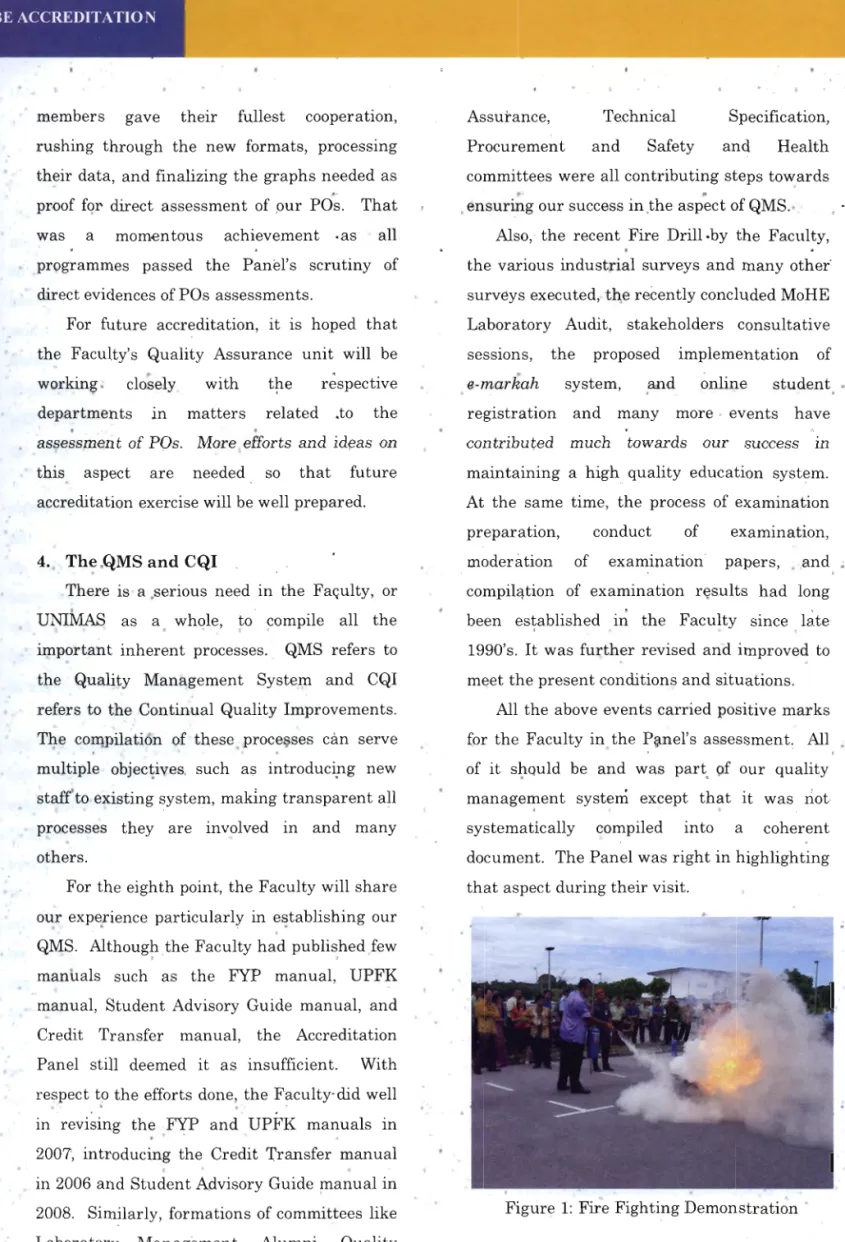
Also, the recent Fire Drill.by the Faculty, the various industrial surveys and many other' surveys executed, th.e recently concluded MoHE Laboratory Audit, stakeholders consultative seSSIOns, the proposed implementation of e-markah system, and online student registration and many more , events have contributed much towards our success in maintaining a high quality education syst~m.
At the same time, the process of examination preparation, conduct of examination, moderation of examination' papers, . and compilqtion of examination r~sults had long been established
.
i~ the Faculty since. .
l~.te 1990's. It was further revised and improved to. .
meet the present conditions and situations. All the above events carried positive marks for the Faculty in,the P1},nel's assessment: All of it sl}Quld be and was part, of our quality management system except that it was riot , systematically compiled into a coherent document. The Panel was right in highlighting that aspect during their visit.
Figure 1: Fire Fighting Demonstration '
,--
For the ninth point, CQI was in fact another critical aspect scrutinized by the Panel.
One fundamental requirement of CQI is the existence of "closing the loop" culture. The
"closing the loop" culture warrants four processes to be in place and these are plan, do, check and act (commonly known as "pdca"). It needs to be mentioned that CQI is not easy to present unless it is already an embedded culture. Since 2005, the Faculty had always prepared extensively in this aspect because many accreditation failures were due to the lack of the "pdca" cycle.
CQI is basically about bringing improvements to our present system. There were many areas that could be covered for improvements but the Faculty opted to work on few major ones. Amongst them, the following were given particular interest, namely, the curriculum, the FYP course, student advisory and laboratory management. As an example, student advisory CQI processes involved identifying weak students, planning for their improvement, acting on remedial courses for them and finally reporting their progress.
Another example of CQI processes on our FYP course involved getting input on students' problems, planning for its solution in -Faculty meetings, acting on the solution by introducing new assessment formats and supervisory logbook; and finally providing feedback on whether problem was solved or still previals.
Time is an inevitable factor in proving the existence of CQI because the whole process needs time to execute. Thus, since 2005, the Faculty had been planning and working out the
"pdca" cycle m varIOUS aspects of its management so that it IS ready for presentation to the accreditation panels.
Another issue with respect to CQI was the method of presenting it to the panel. The Faculty's approach was to highlight the fact that there are secretariats in charge of each
"pdca" -cycle and highlighted the roles they played. In the recently concluded accreditation process, there was no pressing issue raised by the Panels on CQI, either they acknowledged its existence or they missed it.
5. Conclusion
There are more to the above composition but we would like to avoid readers getting irritated with reading long paragraphs. Other aspects assessed were staff development, students, and facilities. The Faculty prepared hard on those aspects and tried to ensure that all weaknesses are remedied. A four years account is not easily compressed in four pages.
There are two keywords that could define the Faculty's ability to prepare extensively for this round of accreditation and those are
"teamwork" and "unity". Overall, the Faculty IS satisfied with the outcome of the accreditation exercise and the Panel acknowledged that we have fulfilled the requirement for an engmeermg programme.
The main concern now is the number of years EAC will award us for the accreditation.
-
ACADEMIC MATTERS
University-Industry Partnership in Education
Norhuzaimin B. Julai, Rohana Sapawi and Siti Kudnie Sahari Department of Electronics Engineering, Faculty of Engineering, UNIMAS
E-mail: [email protected]
There are many University-Industry collaborations between Universiti Malaysia Sarawak (UNIMAS) and partners from private industries as well as government agencies.
Advantages gained from having these collaborations are stated below:
1. Add resources especially human resources to some of the technical courses. There will be pool of people with relevant industry exposure that could help the university in terms of exposing the students to the industries.
11. Multi-research discipline could be well
developed in the universities.
Ill. Good relation with industries.
UNIMAS through the Faculty of Engineering and X-FAB Sarawak Sdn. Bhd.
(X-FAB Sarawak) had signed memorandum of agreement (MoA) on Graduate Diploma in Microelectronics on 24 August 2007. The memorandum was signed on behalf of UNIMAS by its Vice Chancellor, Professor Datuk Dr.
Abdul Rashid Abdullah and on behalf of X-FAB Sarawak Sdn. Bhd., by its Chief Financial Officer, Mr. Stephen Chin Yuen Chien. Before having Graduate Diploma in Microelectronics, the Department of Electronics Engineering, Faculty of Engineering UNIMAS had conducted several joint-ventures with X-FAB Sarawak such as through the offering of Certificate Programme and short courses in 2004.
The Graduate Diploma programme aims to provide an opportunity for X-FAB staff to broaden their knowledge and skills III microelectronics. It is also to encourage collaboration in research between UNIMAS and X-FAB Sarawak III the field of microelectronics. The programme started on 11 August 2007 with 17 X-FAB Sarawak's staff registered for the programme. The curriculum structure of the Graduate Diploma Programme consists of nine modules which need to be completed within four semesters. The total duration of the Graduate Diploma Programme is 17 months. The modules offered are:
PGM 5012: Semiconductor Physics PGM 5022: Advance Microelectronics PGM 5032: Device Physics
PGM 5043: Digital IC Design PGM 5053: Analogue IC Design
PGM 5063: Semiconductor Fabrication (I) PGM 5073: Semiconductor Fabrication (II) PGM 5083: Reliability and Packaging PGM 5093: Final Year Project
Figure 1: Discussion with X-FAB Sarawak Staff
.1 to to m
.s
::If
ff n
e
[}
Under the MoA, the Faculty of Engineering provides qualified lecturers, adequate educational facilities, and materials required to conduct the programme smoothly and effectively, while X-FAB Sarawak provides candidates (employees of X-FAB Sarawak Sdn.
Bhd.) for the programme. The signing of the MoA formalized the Graduate Diploma programme and graduates from this programme will receive the Graduate Diploma in Microelectronics awarded by the U~'IMAS.
The Faculty had implemented Outcome Based Education (OBE) III all its undergraduate programmes. Graduate Diploma also follows similar system where all of the courseworks had OBE components embedded in the courses. For every module, the assessments are in the form of:
1. Assignments/Problem Based Learning (PBL)/ Cooperative Learning (CL)
n. Test/Final Exam
The students are expected to achieve all of the Learning Outcome (LO) as stipulated in the syllabus. Minimum grade of "B-" are required to pass the modules. The assignments, PBL and CL are based on their daily task at the workplace. They are expected to solve problems and able to present their works. The awarded marks will be based on their ability to present their findings. The lecturers who conducted the programs are both from UNIMAS and X-FAB Sarawak as it involves hand-on skills as well as theories. There are few challenges in teaching X-FAB Sarawak staff:
1. They are interested III topics that are related to the developmental stage of their life.
11. They are interested in information that can
be immediately applied to their current jobs.
Ill. They are interested III information and ideas that can solve problems that they faced in their present working environment.
The success of the University-Industry Partnerships can be achieved through these kind of challenges which will benefits both sides in terms of improving the teaching and learning skills of the lecturers and experience the real world knowledge of industrial environments from the X-FAB Sarawak staff.
As for research activities, in 2004, the Faculty of Engineering had conducted research collaboration with Integrated Circuit Design Services (ICDS) which is a subsidiary company under 1st Silicon Malaysia Sdn. Bhd. (currently known as X-FAB Sarawak Sdn. Bhd.) in the area of Integrated Circuit (Ie) design. Under the research collaboration, the Faculty of Engineering was responsible to design Monolithic IC Transformer whereas the ICDS fabricate the transformer. One postgraduate student is currently working under this research collaboration.
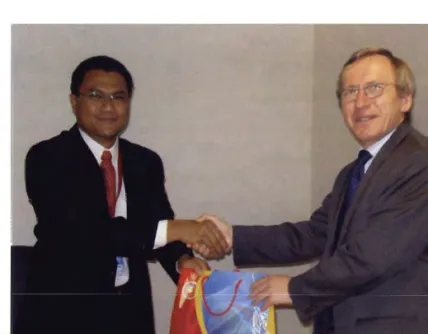
Currently, few research activities especially in the area of semiconductor fabrication and Integrated Circuit (IC) design are being planned with X-FAB Sarawak. The Faculty of Engineering had received a courtesy visit from its group Chief Executive Officer, Mr. Han Jurgen Straub and also by its group Chief Technology Officer, Dr Jens Kosh.
ACADEMIC MATTERS
During their visit, many possibilities were discussed to further strengthen the university
industry partnership between UNlMAS and X-FAB Sarawak. Among the proposed collaboration is to carry out research activities in the area of Opto-Electronics. Also, under the
proposed collaboration, several of UNlMAS staff could be sent to few German universities to carry ou t research ill the area of microelectronics.
Figure 2: X-FAB Group CEO Receiving Souvenir from the Dean
Embracing Constructivism Learning Theory through Problem-based Learning (PBL) for Engineering Education
Charles Bong Hin Joo
Department of Civil Engineering, Faculty of Engineering, UNlMAS E-mail: [email protected]
ABSTRACT In the country's efforts to be a member of Washington Accord, the ,engineering education system is shifting towards outcome-based approach. In outcome-based approach, emphasize is on the outcomes where the product (students) must be able to fulfill the required educational objectives of the programme. In order to achieve the desired outcomes, more effective and innovative teaching and learning methods, e.g. cooperative learning, problem-based learning, etc., is required. This paper aims to explain the concept of constructivism learning theory through the application in Problem-Based Learning (PBL) and how it could contribute towards fulfilling the programme educational objectives (PEOs) for engineering education. Result from a study on Index of Learning Styles (ILS) for randomly chosen academically-challenged Civil Engineering students (CGPA < 2.5) is discussed and recommendation on how PBL could be implemented in order to improve their result is provided.
1. Introduction
Engineering education has been going classroom where teacherllecturer acts more as through a paradigm shift during the recent a facilitator.
years in the country's effort to be a full member One of the delivery methods for of Washington Accord. For engineering constructivism approach is Problem-Based education, students are trained by exposing Learning (PBL). PBL can be defined as a them to poorly defined problem and they are student-centered instructional strategy ill
required to tackle problem that they have which students collaboratively solve problems never encountered rather than training and reflect on their experiences. PBL IS
education where the students are taughtl typically organized within small groups of guided step by step in solving problems. learners where a series of problems are Thus, the method used in delivering provided to learners with guidance at the engineering education has to be changed beginning of the process and the guidance later from the old conventional method where fades as learners gain expertise [1].
students learn by repetition of behaviours This paper aims to provide the general (behaviourism theory) and are not trained idea on constructivism theory and PBL and to be creative in solving problems, to a why it is feasible to adopt this approach in more contemporary approach where students engineering education based on the result from learned actively by creating meaning of histher a survey on learning styles. The survey was experience (constructivism theory). Classroom carried out by the author on randomly chosen environment must also changed from teacherl academically-challenged Civil Engineering lecturer-centered classroom to student-centered students.
2. Constructivism Learning Theory
According to Jean Piaget [2], constructivism may be considered an epistemology (a philosophical framework or theory of learning) which argues humans construct meaning from current knowledge structures. Constructivism theory was developed based on the premise that we all construct our own perspective of the world based on individual experiences and internal knowledge structure. According to this theory, learning is based on how the individual interprets and creates the meaning of hislher experiences. Learners are actively involved in the learning process. This theory is used to focus on preparing the learner to adjust his mental model to incorporate new experiences and problem solving in ambiguous situations.
In this theory, the role of teacherllecturer is to design instruction so that the learner has opportunities to solve realistic and meaningful problems. This can be done through group learning activities to allow learners to interact and solve problems and the teacherllecturer helps by guiding and coaching. According to Lawson, the sequence of learning for this theory is through exploration, terms introduction and finally concept application [3].
Exploration is the first step where the learners are given the chance to explore on their own the issues regarding the topic to be learned. After which the teacherllecturer will introduce the terms and concepts to be learned from the topic. Mter terms introduction, the learners will be given the chance to apply the concepts learned to a new situation. When the learners are able to apply the concept, the cycle is repeated for the next topic. Figure 1 shows the learning cycle for constructivism theory according to Lawson.
-
Figure 1: Lawson's Learning Cycle (1995) [3]
Among the instructional methods that could be used are Problem-based Learning (PBL), guided reflection, apprenticeships, collaborative learning, discovery learning and simulators. Constructivism will effectively contributes to learning under the conditions of when instruction will occur as an interactive process; when learner will incorporate current knowledge to gain insight and understanding of new situations; when diverse resources to aid discovery are available; and when there is adequate time for the learner to discover and process the knowledge.
In considering to apply the method in this theory, however, teacher/lecturer must make sure that the learners have significant knowledge base of the topic that they planned to introduce. The outcomes of instruction are not always predictable because learners construct their own knowledge; thus this theory is not suitable when the end results of the learners need to be the same each time.
3. Problem Based Learning (PBL)
Problem-based Learning (PBL) was first developed and used extensively at McMaster University, Hamilton, Ontario, Canada. PBL is
based on small group learning and it uses problem as the trigger to guide learning. The role of the teacher/lecturer is as facilitator and the students are the active participant/problem solver. By being the active participant, students tend to remember up to 90% of what they learned even after 2 weeks of instruction as depicted by Dale [4] through his cone of experience as shown in Figure 2.
Figure 2: Dale's Cone of Experience [4]
According to Figure 2, in order to achieve higher learning outcomes such as analyze, design, create, and evaluate (which are also the expected outcomes for most engineering courses), active participation is required from the students. Constructivism Learning Theory, through PBL, will be able to provide active learning to students. By simulating real-life experience, PBL will be able to train the students to be more independent and to work as a team while at the same time more creative in problem-solving, traits which are required as an engineer. The steps involves in a PBL session is as shown in Figure 3.
4. Feasibility of PBL
In order to test the feasibility of applying PBL in engineering courses, the author have
conducted an Index of Learning Styles (ILS) study on randomly chosen academically
challenged students. They are the second and third year Civil Engineering students and the study was based on the material developed by Felder and Silverman [5].
Cbn!\ the 'e~ of til< probkm
,bnflcJtioo of""", t =
: Br:wSlOnn tofind a-piarulllO!1S fu" lh< phenomenoo. ~I;
: obse!v«lm :heprobkm
Dt-fme!lle probkm <0 lb.t everyone has tht same pe~lO!1of lhe problem
Figure 3: Steps in a PBL session
Academically-challenged here is defined as student who at the time when the study was conducted carries a CGPA of less than 2.5. The author purposely chased academically
challenged students for the study with the hypothesis that these students perform poorly due to their learning styles that did not suit the current delivery method in engineering courses that is mostly conventional and teacher/
lecturer oriented.
Felder and Silverman classified learning styles into four categories, i.e. either active (ACT) or reflective (REl<j, sensing (SEN) or intuitive (INT), visual (VIS) or verbal (VRB) and sequential (SEQ) or global (GLO).
Active learners tend to retain and understand best by doing something active while reflective learners prefer to think about it quietly first. Sensing learners tend to like facts while intuitive learners often prefer discovering possibilities and relationship. Visual learners
IIIII
p
remember best on what they see while verbal learners get more out of words. Sequential learners tend to gain understanding in linear steps while global learners tend to learn in large jumps.
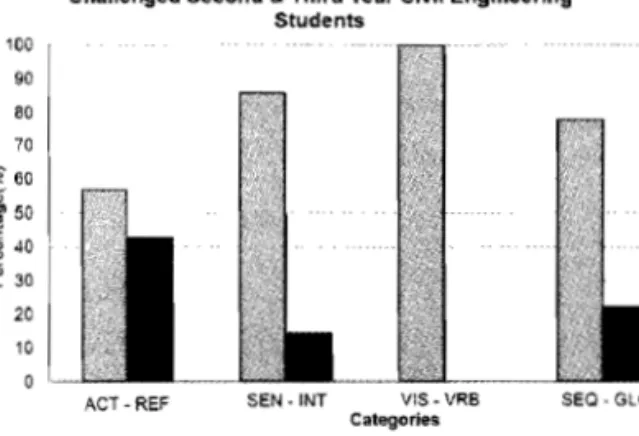
Figure 4 shows the fmdings in the study on Index of Learning Styles (ILS) conducted on academically-challenged second and third year Civil Engineering students.
Index of Learning Styles in % for Academically
challenged Second & Third Year Civil Engineering Students
SEN. INT V'S • VRB SEa GLO
ACT • REF
Categories
Figure 4: Findings of the Index of ILS Study by the Author
From Figure 4, it could be seen that 57%
of the students are active learner compared to 43% who are reflective learner. This shows that these academically-challenged students might learn and understand better in a class that involves active participation like PBL.
Active learners also work well in a group through discussion and topic sharing session, suggesting that cooperative learning may be implemented in the class. In general, active learners retain information better if they could find ways to do something with it.
The result also shows that these academically-challenged students tend to be sensing learner (85.7%) as compared to intuitive learner (14.3%). Sensing learner remembers and understands information best if they can see how it connects to the real world. Again, PBL could help these students
by providing simulation of real-life scenarios where they could participate actively in finding the solutions.
In addition, the result also shows that 100% of' these academically-challenged students are visual learner. Visual learners remember best by what they see, either through pictures, diagrams, flow charts or through demonstration. In most university, however, very little visual information IS presented and students mainly listen to lectures and read material which is not that appealing to this group of students.
Finally, it could also be interpreted from the result that the majority of these academically -challenged students are sequential learner (77.8%) compared to global learner (22.2%). It means that if PBL IS
implemented, the teacher/lecturer have to present the concept in a logically connected manner. They have to be able to relate previous terms or topics to the next.
5. Recommendation for Implementing PBL
The result in this study shows that academically-challenged Civil Engineering students might benefit from the implementation of PBL based on the hypothesis that their learning styles may not have suit the conventional teacher/lecturer centered approach commonly practiced m most engineering courses. For future study, however, the author intended to expand the survey to include the good students (CGPA 2:
2.5) in order to understand their learning styles and whether PBL is suitable for them.
In implementing PBL, subtle introduction is recommended as the students go through their years of study in university/college. It
--r
must be noted that first year engineering students are used to the teacher-centred delivery styles during their junior and high schools days. These students are apt to view their roles as passive recipients of knowledge and might resent if being asked to play active role in class. Furthermore, their knowledge of the programme that they are taking might be limited.
During this early stage, PBL might not be suitable for them due to the limited knowledge on the subject matter and their resentment at playing an active role. At this stage, teacher/
lecturer could play their role by providing an environment that foster close interaction;
probably through more group work and informal cooperative learning. During their second year, in order to expose the students to the element of PBL, they could be exposed to more cooperative and collaborative learning.
And finally during their third and fourth year, they will be introduced to PBL; of course first with guidance and finally the guidance should fade away.
6. Conclusion
In moving towards outcome-based approach in engineering education, a paradigm shift in terms of learning theory and delivery method is unavoidable. The conventional approach, where students learn by repetition (behaviourism theory), are not that practical in producing engineering students that could solve problems creatively and are able to work in a team.
Constructivism theory may be the approach to produce engineering students that fulfill the programme educational objectives In
engineering courses. By simulating real scenario, PBL is one of the delivery methods in constructivism theory that could provide the
opportunity for them to participate actively in problem-solving and work in a team. Result from the author's survey shows that PBL, if implemented in a well-designed manner, could increase the performance of academically
challenged engineering students whose learning styles does not suit the conventional approach. Implementation of PBL, however, must be in stages, first through cooperative learning, then guided PBL before the guidance slowly fade.
7. References
[1] Merrill, M.D. A Pebble-in-the-Pond Model for Instructional Design.
Performance Improvement 41 (7): 39-44, 2002.
[2] Piaget, J. The Psychology of Intelligence, New York: Routledge, 1950.
[3] Lawson, A. E. Science Teaching and Development of Thinking. Belmonth, CA: Wadworth PubL, 1995.
[4] Dale, E. Audio-visual Methods ill Teaching, New York: The Dryden Press, 1946.
[5] Felder, RM. and Silverman, L.K.
Learning and Teaching Styles ill Engineering Education. Engr. Education 78(7): 674-681, 1988.
p
Application of Learning Theories in Teaching and Learning in the Faculty of Engineering
Mohd Shahril Osman, Shafrida Sahrani, Aidil Azli Alias, Kuryati Kipli, Onni Suhaiza Selaman, Siti Nor Ain Musa, Ron Aldrino Chan and Larry Silas Tirau
Faculty of Engineering, UNIMAS E-mail: [email protected]
ABSTRACT Learning theories can be divided into behaviour and constructivism model. Under these models, there are few theories that can relate to students learning styles. Engineering subjects are predominantly cognitive subjects. The complexities of the subjects must be balanced with lecture and practical based resources. The humanistic approach must be included as teaching and learning for engineering students are now relevant. The shift to student centred learning are now a requirement for accreditation process. This paper attempts to describe the teaching and learning process based on learning theories.
1. Introduction students. The descriptions are more on
The teaching and learning approach explaining the theories and the relations within the Faculty of Engineering is between these theories and engineering undergoing a shift from the conventional students. The chosen main theory is the Roger method of teacherllecturer centered to student Experiential Learning [3], and though centred learning. It is now being reviewed [1] constructivism, the theory is also interrelated in conjunction with the newly implemented with the Behaviourism theory. This paper will accreditation process as required by Malaysian discuss in general the description of these Quality Assurance (MQA) and Engineering theories ..
Accreditation Council (EAC). The Faculty of
Engineering adopts Outcome-Based Education 2. Teaching and Learning
(OBE) [2] to enhance the quality of education Students at the Faculty of Engineering as well as to fulfill the accreditation come from various backgrounds. They, requirement. To maintain the quality of however, show similar traits in terms of teaching and learning in the faculty, the learning. In particular, the cognitive part i.e.
involvement of stakeholders and industrial the brain is very much significant. This is due panel advisor are also necessary. to the application based subjects.
The teaching and learning method can be Engineering students however, would generalized as models of either behaviour, perform better if there are laboratory based constructivism and cognitive. The theories are learning i.e. practical method. The learning inter-related as students learning styles varies. process from the cognitive (theories) is then put The variety of these theories is also noticeable into practice by experimental work. In this amongst the engineering students. case, experimental work is the experiential
This paper will describe the various approach [3J learning theories in relation to engineering
The related learning techniques that can be considered for the engineering students is the Rogers Experiential Learning theory. The learning theory distinguished the two types of learning into cognitive and the experiential.
In engineering education, the four year courses can be divided into two phases. The first phase is the first 2 years and the second phase is the last 2 years.
The first phase can be considered as the fundamental parts. At this level, the core engineering or the fundamentals are instilled to the students. Engineering fundamentals are the important elements that distinguish the engineering profession.
The academic knowledge refers to the cognitive part of the Roger Experiential Learning. This part initiate the learners and when engaged together with the experiential learning process (i.e. the passion to self
explore), it would enhance the learning process.
The second stage or the self initiate process
IS the needs for a learner traits. These are process involvement, self-initiation, self
motivated, self-evaluation, etc. These traits relates to the process change and growth or maturity. Each of the engineering students has the ability for natural learning process provided that they have adequate understanding in the cognitive part.
Roger Experiential Learning would necessitate organization change. A positive environment must be prepared to fully implement this theory. This includes adequate and comfortable place to learn i.e. lecture halls and tutorial rooms. Learners must be notified of the purpose of each courses or the learning outcomes as well, in order to comprehend the intention of the topics.
In addition, learning resources such as the lecture notes, references, books, or any other materials must be made available, accessible and adequate. These however, need to be balance with the courses. The learning process also requires balancing the intellectual and emotional components of learning. For example, the amount of course syllabus, lectures, and tutorials for a given courses must be relevant to the students workload.
To initiate the experiential learning, students must also be able to work in a team.
This would give an avenue for ideas exchange and students are free to access any comments or suggestions pertaining to the course. This approach are humanistic where elements of self -motivation is required.
2.1 Learning Traits
There are numerous learning theories that can be reviewed [4, 5]. The two most frequently reviewed are the behaviour (directed) and the constructivist theories. Under these two models, there are few more sub-theories. For engineering students, as mentioned earlier, the fundamental aspects would require the engagement of many different type of theories to represent the students which includes Skinner, Gagne, Bandura, Miller and Thorndike.
2.1.1 Skinner
Skinner Theory is a function of change in overt behaviour. The behaviour is the response to events that occurs in the environment The key element in this theory is reinforcement
The reinforcements can be good grades, praises and satisfaction. Skinner theory is a step by step process. As an example, students
m engineering course must undergo pre-requisite courses. During the intermittent topics, positive reinforcement must be given in such a way that the students may respond positively to the learning process.
2.1.2 Gagne
Gagne's Theory is based on the Conditions of Learning theory. This theory specifies that there are several different types or levels of learning. The principle is that a different instruction is required for different learning outcomes.
Gagne also suggests that learning task for intellectual skills can be organized in a hierarchical manner. Learning hierarchies define what are the intellectual skills that need to be learned. An example of this theory can be observed in an Engineering Drawing course. In this course, students are given verbal instructions, drawing skills, and design strategies to perform the given task.
2.2.3 Bandura
Bandura is a social learning theory based on emulation of ideas, attitudes and also the interest. The students learn through observation and as a result will develop the ability to generate new ideas. The components of this theory are attention, retention, motor reproduction and motivation. In describing these four components for engineering students a good example would be in a laboratory course.
The model events (attention) are the demonstration from the lecturer. The students would then receive (retention), and the cognitive part of the student would then assess
the theory and the practical work. The students are asked to reproduce. As a result, student will show the physical capabilities through the self observation. The motivation of the student will be external reinforcement which in this case, is the evaluation given by the lecturer.
2.1.4 Miller
Miller Information Processing Theory is the idea of short-term memory. The short-term memory consists of digits, words, and chess positions of people's faces. The theory, however, is limited to several sets of memory. The best examples in engineering students are to trouble shoot computer problems or in automotive instructional guidelines.
2.1.5 Thorndike
Thorndike learning theories is a framework of behavioural psychology. It is the association between stimuli and responses. The theory is based on trial and error learning. Students learn from their own mistakes. Some of the related engineering courses are the software
oriented especially for programming courses.
In general, these coursework involves simulation and programming. For example, the use of Matlab, Borland C++, Fortran, etc.
These activities require the students to create programming code. This is based on trial and error. Students learn to associate simulation results with the next trial in order to achieve the correct code or parameter.
3. Summary
The application of learning methods for an engineering student would not be effective if only a single method is applied. The behaviour
, II Ii "
r
"AR.t~ING
THEORIES:, ", I '
j"

![Figure 1: Lawson's Learning Cycle (1995) [3]](https://thumb-ap.123doks.com/thumbv2/azpdforg/11164751.0/30.898.504.755.159.360/figure-1-lawson-s-learning-cycle-1995-3.webp)

![Figure 2: Dale's Cone of Experience [4]](https://thumb-ap.123doks.com/thumbv2/azpdforg/11164751.0/31.898.470.825.299.548/figure-2-dale-s-cone-experience-4.webp)
![Table 1: Bloom's Taxonomy [2]](https://thumb-ap.123doks.com/thumbv2/azpdforg/11164751.0/39.898.87.455.131.900/table-1-bloom-s-taxonomy-2.webp)


