
Government Owned Intellectual Property” means all intellectual property belonging to the Federal Government of Malaysia; Acquisition of intellectual property' means acquisition by transfer, license (exclusive or non-exclusive or sole) or by any other legal means with financing (in whole or in part) by the relevant authority;. Net Revenues' means the gross revenues (including all royalties, fees and other benefits) received from the commercialization of the Intellectual Property, less expenses;.
Policy” means the Intellectual Property Commercialization Policy for Research and Development (R&D) Projects funded by the Government of Malaysia;.
Scenario 7 (Ownership of the Intellectual Property shall vest jointly in the Government of Malaysia and the third party)
TECHNOLOGY ACQUISITION AND INTELLECTUAL PROPERTY ACQUISITION
Technology or intellectual property acquisition is the process of acquiring intellectual property rights for the purpose of using or exploiting a particular technology or intellectual property. It also includes the process of technology transfer, in which foreign expertise is engaged for the local development of a particular technology. Technology or intellectual property may be acquired by outright purchase or by licensing (exclusive or non-exclusive or sole) or by any other legal means.
Intellectual Property acquired under this Article by the Beneficiary with funding provided in whole or in part by the Relevant Body shall become the property of the Beneficiary. All Derivative Intellectual Property developed from the use of the acquired technology or Intellectual Property shall belong to the buyer. Buyer will take all necessary steps to protect intellectual property acquired through registration or other means.
In case the final product is commercialized, the Beneficiary will pay royalties to the relevant body in accordance with the purchase financing agreement. In the absence of terms specifying the fee, the Beneficiary shall pay an equal fee to the Relevant Body. Notwithstanding anything contained in this policy, when there is a national emergency or when there is a public interest, in particular, national security, food, health or the development of other vital sectors of the national economy as determined by the Government of Malaysia. ; or where a judicial or relevant authority has determined that the manner of use by the owner of the Intellectual Property or its licensee is anti-competitive, the Government of Malaysia may decide that, even without the consent of the owner of the Intellectual Property, the Government of Malaysia may use free intellectual property.
All such cooperation agreements will also contain terms predetermining the rights of the parties to commercialize any intellectual property that may then be jointly owned by them;. The Project focuses primarily on product development or improvements to existing third-party products or services and where only the third-party's existing Intellectual Property is involved;. The relevant body should benefit from the project by acquiring relevant industry experience through the exposure provided by working with the third party; and.
The third party must bear the full project costs, including costs for personnel, equipment and facilities.
OFF-SET PROGRAMME
EXPLOITATION OF INTELLECTUAL PROPERTY
In the event that the Center for Innovation and Commercialization decides to commercialize the intellectual property, the inventor(s) shall provide all reasonable assistance to accomplish this goal, such as by providing information promptly upon request, attending meetings with potential licensees, and providing technical advice regarding further development. If the Center for Innovation and Commercialization is not interested in patent protection or commercialization of intellectual property, it shall notify the inventor in writing. The inventor can then submit a written request to the Center for Innovation and Commercialization for an intellectual property grant.
If permission is granted, the Center for Innovation and Commercialization will retain a non-exclusive, non-transferable, irrevocable, royalty-free, worldwide license to the intellectual property for research and educational purposes. In the event that the inventor fails to commercialize the intellectual property within five years without reasonable cause, the Center for Innovation and Commercialization may exercise all commercialization rights related to the intellectual property. The Innovation and Commercialization Center may retain ownership of the invention, but grant the inventor a license to exploit the intellectual property if it deems it beneficial.
If the Innovation and Commercialization Center determines that the Intellectual Property does not belong to a Relevant Body, it will notify the Inventor in writing of its decision, after which the Inventor will be free to exploit it in any way he wishes. In all cases where the Intellectual Property is to be owned jointly, the parties will ensure that any rights to commercialize the Intellectual Property and share in the profits are determined in advance by written contract between themselves.
DISCLOSURE AND EVALUATION OF INVENTION
If the patentability assessment shows that the invention is new, inventive, industrially applicable and has commercial potential, the Innovation and Commercialization Center will attempt to protect the invention. If an obligation exists towards an external party with regard to the Invention on the basis of a financing or research agreement, the Innovation and Commercialization Center will contact the external party and manage the Invention in accordance with the terms of the Invention. agreement with the third party. The Inventor will maintain the confidentiality of the details of the Invention until the Patent Application has been filed or until a decision has been made by the Innovation and Commercialization Center to allow disclosure.
The inventor must assist registered patent agents or registered intellectual property consultants recommended by the relevant body in preparing, filing and prosecuting a patent application. Where the inventor promotes the invention for commercialization to a potential commercializing party prior to the filing of the patent application, a nondisclosure agreement must be signed with such potential commercializing party before any information about the invention is made public to ensure that the interest of. All inventors must disclose the identity of any party interested in the commercial exploitation of the invention to the Innovation and Commercialization Center in sufficient detail and as soon as practicable after the relevant facts have come to their knowledge.
All inventors must disclose any conflicts of interest to the Center for Innovation and Commercialization.
COMMERCIALISATION
The negotiating team representing the beneficiary should have the following qualities: .. a) technical expertise and solid understanding of the technology in question. The negotiating team should consider all options and weigh the pros and cons of each of the following options before reaching an agreement. Exclusive License - The Recipient assigns all rights to exploit the Intellectual Property to the Licensee.
This means that the Recipient waives the rights to exploit the Intellectual Property itself or to grant any additional, subsequent license(s) to another party. Non-exclusive license - the Recipient may grant the rights to exploit the Intellectual Property to one or more parties, including the right to exploit the Intellectual Property itself. Sole License – the recipient transfers all exploitation rights of the intellectual property to the licensee, but retains its rights to exploit the intellectual property itself.
Spin-off Company - The Recipient establishes a company for the purpose of commercializing the Intellectual Property, where Inventor(s) and Recipient may own equity in the company along with any third party, in relationships to be negotiated. Joint venture company - The Recipient establishes an entity together with a third party for the purpose of commercializing the Intellectual Property, where the Recipient and the third party are shareholders of the said company. The Inventor(s) shall provide all information and render all assistance to the Recipient in all phases of the Patent Application and/or commercial exploitation of the Intellectual Property as the Recipient may require from time to time, including, but not limited to, assessment of the Intellectual Property, making amendments to the specification and claims of the Patent Application, and participating in any proceedings regarding Intellectual Property and License infringement.
WEALTH SHARING GUIDELINES
In a situation where two or more inventors develop an intellectual property, payment of the net revenue must be made in accordance with a written agreement between the respective inventors. In the event of a change in the composition of the team of inventors, the terms of such a written agreement must be renegotiated between the old and new members of the team. In the absence of such an agreement, the case must be resolved in accordance with clause 16.0.
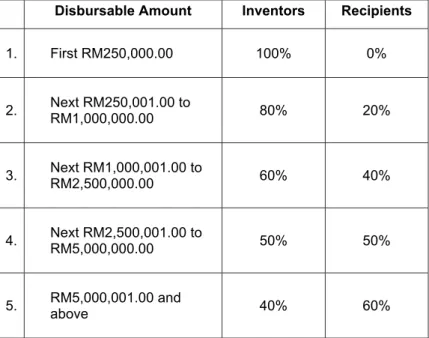
This Policy shall also apply in respect of any income generated from the commercialization of Derivative Intellectual Property, unless the parties have agreed otherwise in writing. Where an Employee creates an Invention in situations covered by para 4.2 above and derives income from such Invention, the Inventor(s) shall be entitled to be paid in accordance with Table 1. In the event Intellectual Property is derived from any Off-Set Program , the ownership of the said Intellectual Property and its derivatives belongs to the designated Off-Set Program recipient.
The distribution of income derived from Off-Set Program Intellectual Property shall be in accordance with Table 1 above.
INCENTIVES FOR INVENTION
GOVERNMENT AND RELATED AGENCY OWNED INTELLECTUAL PROPERTY
In the event that the relevant authority lacks the expertise or is otherwise unable to establish a Center for Innovation and Commercialization, any intellectual property created or owned by the relevant authority shall be entrusted and managed by the Ministry of Science, Technology and Innovation. The granting of a license is reasonable and necessary for: .. a) gathering investment capital necessary for the commercialization of intellectual property;. The applicant undertakes to commercialize the intellectual property within a reasonable period, which may be extended by the Ministry of Science, Technology and Innovation at the request of the applicant, if deemed necessary;
In the case of an intellectual property protected outside Malaysia, the government's interests in foreign trade will be enhanced.
GOVERNMENT RIGHTS (MARCH-IN RIGHTS)
FRAUDULENT ACQUISITION OF FUND AND INTELLECTUAL PROPERTY RIGHTS
DISPUTE RESOLUTION
MORAL RIGHTS AND ETHICAL ISSUES
IMPLEMENTATION OF POLICY
