Family-Controlled Listed Companies in Malaysia and Singapore
GLOBALIZING THE BOARDROOM AMONG FAMILY-CONTROLLED LISTED COMPANIES ON
BURSA MALAYSIA (AN UPDATE) AND
SINGAPORE – THE EFFECTS OF CORPORATE GOVERNANCE ON FIRM PERFORMANCE
MARISSA LEE CHEN LI
BACHELOR OF INTERNATIONAL BUSINESS (HONOURS)
UNIVERSITI TUNKU ABDUL RAHMAN
FACULTY OF ACCOUNTANCY AND MANAGEMENT
DEPARTMENT OF INTERNATIONAL BUSINESS
APRIL 2022
Family-Controlled Listed Companies in Malaysia and Singapore
GLOBALIZING THE BOARDROOM AMONG FAMILY-CONTROLLED LISTED COMPANIES ON
BURSA MALAYSIA (AN UPDATE) AND SINGAPORE – THE EFFECTS OF CORPORATE
GOVERNANCE ON FIRM PERFORMANCE
BY
MARISSA LEE CHEN LI
A final year project submitted in partial fulfilment of the requirement for the degree of
BACHELOR OF INTERNATIONAL BUSINESS (HONOURS)
UNIVERSITI TUNKU ABDUL RAHMAN
FACULTY OF ACCOUNTANCY AND MANAGEMENT
DEPARTMENT OF INTERNATIONAL BUSINESS
APRIL 2022
ii Copyright @ 2022
ALL RIGHTS RESERVED. No part of this paper may be reproduced, stored in a retrieval system, or transmitted in any form or by any means, graphic, electronic, mechanical, photocopying, recording, scanning, or otherwise, without the prior consent of the author.
Family-Controlled Listed Companies in Malaysia and Singapore
iii
DECLARATIONS
I hereby declare that:
(1) This undergraduate FYP is the end result of my own work, and that due acknowledgement has been given in the references to ALL sources of information be they printed, electronic, or personal.
(2) No portion of this FYP has been submitted in support of any application for any other degree or qualification of this or any other university, or other institutes of learning.
(3) Sole contribution has been made by me in completing the FYP.
(4) The word count of this research report is__10,017________.
Name of student Student ID Signature
Marissa Lee Chen Li 18UKB02500
Date: _26/4/2022_______________
Family-Controlled Listed Companies in Malaysia and Singapore
iv
ACKNOWLEDGEMENT
I would like to express my gratitude to my primary supervisor, Mr David Ng Ching Yat, who guided me throughout this project. As he always helped me out with some difficulties that I did not know throughout the project, and I really appreciate what he had done for me.
I would also like to thank my friends and family who supported me and offered deep insight into the study. They had helped me a lot in this project as they supported and motivated me when I’m felt wanted to go give up this project.
Family-Controlled Listed Companies in Malaysia and Singapore
v DEDICATION
This work is the result of many sacrifices. This work is gladly dedicated to those who inspire the researchers.
From parents and guardians to classmates and friends who helped when challenges arose while undertaking this assignment. To University Tunku Abdul Rahman teachers and employees.
Family-Controlled Listed Companies in Malaysia and Singapore
vi
TBALE OF CONTENTS
Copyright ... ii
Declaration ... iii
Acknowledgement ... iv
Dedication ...v
Table of contents ... vi
List of Tables... xii
List of Figures ...xiv
List of Abbreviations ... xv
List of Appendix ...xvi
Preface ... xvii
Abstract ... xviii
CHAPTER 1: INTRODUCTION ... 1
1.0 Introduction ... 1
1.1 Research Background ... 1
1.2 Problem Statement ... 3
1.3 Research Objectives ... 4
1.4 Research Questions ... 4
1.5 Significance of Study... 5
1.6 Chapter Layout ... 7
CHAPTER 2: LITERATURE REVIEW ... 8
2.0 Introduction ... 8
2.1 Family-Controlled Companies ... 8
2.1.2 Globalizing Boardroom ... 9
2.2 Corporate Governance ... 10
2.2.1 Corporate Governance in Malaysia ... 10
2.2.2 Corporate Governance in Singapore ... 11
Family-Controlled Listed Companies in Malaysia and Singapore
vii
2.3 Theoretical Model ... 13
2.3.1 Agency Theory ... 13
2.3.2 Stewardship Theory ... 14
2.3.3 Stakeholder Theory ... 15
2.3.4 Resource Dependency Theory (RDT) ... 16
2.4 Dependent Variables ... 17
2.4.1 ROA ... 17
2.4.2 ROE ... 17
2.4.3 Tobin’s Q ... 18
2.5 Independent Variables ... 19
2.5.1 Number of Board Sizes (BS) ... 19
2.5.2 Percentage of Independent Directors (%ID) ... 20
2.5.4 Number of Women Directors (NOWD) ... 21
2.5.4 Number of Foreign Directors (NOFD) ... 22
2.5.5 Number of Foreign Qualifications (NOFQ) ... 23
2.5.6 Number of Board Meetings (NOBM) ... 24
2.5.7 Number of Foreign Directors in Audit Committee (NOFDAC) ... 24
2.6 Research Framework ... 25
CHAPTER 3: RESEARCH METHODOLOGY... 26
3.0 Introduction ... 26
3.1 Research Design ... 26
3.2 Data Collection Method ... 26
3.2.1 Secondary Data ... 26
3.3 Sampling Design ... 27
3.3.1 Target Population ... 27
3.3.2 Sampling Frame ... 27
3.3.3 Sampling Element ... 29
Family-Controlled Listed Companies in Malaysia and Singapore
viii
3.3.4 Sampling Technique ... 29
3.3.5 Sampling Size ... 29
3.4 Research Instruments ... 29
3.5 Construct Measurement ... 30
3.5.1 Origin of Construct ... 30
3.5.2 Scale of Measurement ... 31
3.6 Data Processing ... 32
3.7 Data Analysis ... 33
3.7.1 Descriptive Analysis ... 33
3.7.2 Inferential Analysis ... 33
3.7.3 Panel Data Analysis ... 34
CHAPTER 4: DATA ANALYSIS ... 35
4.0 Introduction ... 35
4.1 Descriptive Analysis ... 35
4.1.1 Dependent Variables ... 35
4.1.2 Independent Variables ... 37
4.2 Panel Data Analysis ... 41
4.2.1.1 Random Effect Model of ROA ... 41
4.2.1.2 Hausman Test for ROA Malaysia ... 42
4.2.2 ROE Malaysia ... 43
4.2.2.1 Random Effect Model of ROE ... 43
4.2.2.2 Hausman Test for ROE Malaysia ... 44
4.2.3 Tobin’s Q Malaysia ... 45
4.2.3.1 Random Effect Model of Tobin’s Q ... 45
4.2.3.2 Hausman Test of Tobin’s Q Malaysia ... 46
4.2.4 ROA Singapore ... 47
4.2.4.1 Fixed Effect Model ... 47
Family-Controlled Listed Companies in Malaysia and Singapore
ix
4.2.4.2 Hausman Test for ROA Singapore... 48
4.2.5 ROE Singapore ... 49
4.2.5.1 Fixed Effect Model ... 49
4.2.5.2 Hausman Test for ROE Singapore ... 50
4.2.6 Tobin’s Q Singapore ... 51
4.2.6.1 Fixed Effect Model ... 51
4.2.6.2 Hausman Test for Tobin’s Q Singapore ... 52
CHAPTER 5: DISCUSSION AND CONCLUSION ... 53
5.0 Introduction ... 53
5.1 Hypothesis Testing... 54
5.1.1 Hypothesis Testing Summary of ROA Results ... 54
5.1.2 Hypothesis Testing Summary of ROE Results ... 55
5.1.3 Hypothesis Testing Summary of Tobin’s Q Results ... 56
5.1.4 The Summary of Hausman Specification Test ... 57
5.1.5 Hypothesis Tests Summary ... 58
Hypothesis 1... 60
Hypothesis 2... 60
Hypothesis 3... 61
Hypothesis 4... 61
Hypothesis 5... 62
Hypothesis 6... 62
Hypothesis 7... 62
5.2 Summary of Test ... 63
5.2.1 Descriptive Analysis ... 63
5.2.2 Inferential Analysis ... 63
5.2.2.1 Panel Data Analysis (8 years Analysis)... 63
5.3 Discussion on Findings ... 63
5.4 Limitations in Research ... 64
5.5 Recommendations for Future Research ... 65
Family-Controlled Listed Companies in Malaysia and Singapore
x
5.6 Conclusion ... 66
REFERENCES ... 68
References ... 68
APPENDIX.I ... 74
Family-Controlled Listed Companies in Malaysia and Singapore
xii
LIST OF TABLES
Table 2.2.1: Summary of the Malaysian Code of Corporate Governance... 11
Table 2.2.2: Summary of the Singapore Code of Corporate Governance ... 12
Table 3.3.2(a): List of Top 25 Selected Family Controlled Business in Malaysia 28 Table 3.3.2(b): List of Top 25 Selected Family Controlled Business in Singapore ... 28
Table 3.5.1(a): Table of Dependent Variables ... 30
Table 3.5.1(b): Table of Independent Variables ... 31
Table 4.1.1(a): Descriptive Statistics for Malaysia ROA, ROE, and Tobin’s ... 35
Table 4.1.1(b): Descriptive Statistics for Singapore ROA, ROE, and Tobin’s Q . 36 Table 4.1.2(a): Descriptive Statistic for Malaysia’s BS, % ID, and NOWD ... 37
Table 4.1.2(b): Descriptive Statistic for Malaysia’s NOFD, NOFQ, NOFDAC, and BM ... 38
Table 4.1.2(c): Descriptive Statistic for Singapore’s BS, % ID, and NOWD ... 39
Table 4.1.2d: Descriptive Statistic for Singapore’s NOFD, NOFQ, NOFDAC, and NOBM ... 40
Table 4.2.1.1: Random Effect Model of ROA Malaysia ... 41
Table 4.2.1.2: Hausman test Result for ROA Malaysia ... 42
Table 4.2.2.1 Random Effect Model for ROE Malaysia ... 43
Table 4.2.2.2: Hausman test Result for ROE Malaysia ... 44
Table 4.2.3.1: Random Effect Model of Tobin’s Q Malaysia ... 45
Table 4.2.3.2: Hausman Test of Tobin’s Q Malaysia ... 46
Table 4.2.4.1: Fixed Effect Model of ROA Singapore ... 47
Table 4.2.4.2: Hausman test Result for ROA Singapore ... 48
Table 4.2.5.1: Fixed Effect Model of ROA Singapore ... 49
Table 4.2.5.2: Hausman Test Results of ROE Singapore ... 50
Table 4.2.6.1: Fixed Effect Model of ROA Singapore ... 51
Table 4.2.6.2: Hausman Test Results of Tobin’s Q Singapore ... 52
Table 5.1.1: Hypothesis Testing Summary of ROA Results Malaysia and Singapore ... 54
Table 5.1.2: Hypothesis Testing Summary of ROE Results Malaysia and Singapore ... 55
Family-Controlled Listed Companies in Malaysia and Singapore
xiii
Table 5.1.3: Hypothesis Testing Summary of Tobin’s Q Results Malaysia and Singapore ... 56 Table 5.1.4: The summary of Hausman Specification Test ... 57 Table 5.1.5: The Summary of Hypothesis Tests in Malaysia ... 58 Table 5.6 Summary of Previous Research and Current Research Panel Data Analysis Result ... 66
Family-Controlled Listed Companies in Malaysia and Singapore
xiv
LIST OF FIGURES
Figure 2.3.1 Agency Theory ... 13
Figure 2.3.2 Stewardship Theory ... 14
Figure 2.3.3 Stakeholder Theory ... 15
Figure 2.3.4 Resource Dependency Theory (RDT)... 16
Figure 2.6: Board Characteristics that Influence Firm Performance Among Family- Controlled firm in Malaysia ... 25
Figure 3.6: Data Processing ... 32
Family-Controlled Listed Companies in Malaysia and Singapore
xv
LIST OF ABBREVIATIONS
BS Number of Board Sizes
%ID Percentage of Independent Directors
NOWD Number of Women Director
NOFD Number of Foreign Directors NOFQ Number of Foreign Qualifications NOBM Number of Board Meetings
NOFDAC Number of Foreign Directors in Audit Committee
ROA Return of Assets
ROE Return on Equity
MCCG Malaysian Code of Corporate Governance
CG Corporate Governance
DVs Dependent Variables
IVs Independent Variables
SMEs Small and Medium Sizes
DID Domestic Independent Director FID Foreign Independent Director
FEM Fixed Effect Model
REM Random Effect Model
S.D Standard Deviation
Avg Average
N/A Not Available
Family-Controlled Listed Companies in Malaysia and Singapore
xvi
LIST OF APPENDICES
Appendix SPSS for Malaysia and Singapore ... 74
Family-Controlled Listed Companies in Malaysia and Singapore
xvii PREFACE
This research project unit UKMZ3016 Research Project was done by students of Bachelor of International Business (HONOURS) to complete the undergraduate program. The title of the thesis is Globalizing the Boardroom among Family- Controlled Companies on Bursa Malaysia (An Update) and Singapore: The Effect of Corporate Governance on Firm Performance. It is also a project that assembles this intellectual interest and critical thinking of the students. This enhances the integration of capabilities and abilities of the undergraduates in the application of theoretical elements. The main purpose of this research project is to investigate the independents variable that affect the firm performance among Family-Controlled in Malaysia and Singapore. Throughout this project, there are seven variables has been identified which are number of board sizes (BS), percentage of independent directors (%ID), number of woman directors (NOWD), number of foreign directors (NOFD), number of foreign qualifications (NOFQ), number of foreign directors in audit committee (NOFDAC), and number of board meeting (NOBM).
Family-Controlled Listed Companies in Malaysia and Singapore
xviii ABSTRACT
The purpose of this research is to determine if corporate governance mechanism are more significant between Family-Controlled in Malaysia and Singapore. Corporate Governance mechanism that adopted in this research are number of board sizes (BS), percentage of independent directors (%ID), number of women directors (NOWD), number of foreign directors (NOFD), number of foreign qualifications (NOFQ), number foreign directors in audit committee (NOFDAC), and number of board meeting (NOBM). These mechanisms are applied to investigate its relationship towards firm performance. The firm performance is measured by return of assets (ROA), return on equity (ROE), and Tobin’s Q). The samples used in this research are 27 Malaysian Family-Controlled Companies and 13 Singaporean Family- Controlled Companies in the periods 2013-2020. This research applied Panel Data Analysis to investigate the overall 8 years results. There are 2 types of panel estimator approaches that can be implemented which are fixed effect and random effect.
From previous research, there has significant relationship towards Malaysia Family-Controlled Companies which is on BS (ROA & ROE), as current research shows NOWD (ROA & ROE) and NOBM Tobin’s Q) have significant relationship with firm performance. While in Singapore, NOWD (ROA & Tobin’s Q), NOFD (Tobin’s Q), NOFDAC (ROA & ROE), and NOBM (ROA & ROE) have significant relationship towards Singapore Family-Controlled Companies.
Family-Controlled Listed Companies in Malaysia and Singapore
Page 1 of 97
CHAPTER 1: INTRODUCTION
1.0 Introduction
The purpose of this study was to see if Corporate Governance affects firm performance among family-controlled listed companies on the Bursa Malaysia with a globalized boardroom that includes foreign directors and directors with foreign qualifications. This chapter included seven sections: introduction, research background, problem statement, research objectives, research questions, significance of the study, and chapter layout.
1.1 Research Background
In Asia, family-controlled companies make for 17% of the world's 500 biggest family companies. Among these Asian family-owned behemoths are Reliance Industries of India, Sun Hung Kai Properties of Hong Kong, and Kuala Lumpur Kepong Berhad of Malaysia. South Korea and Taiwan are Asia's family business growth engines. They are all fast-growing economies with a family-controlled company model. (Koh, 2017).
According to MCCG (2017), said that Corporate Governance is the way that businesses and issues are coordinated and dealt with so that they can be successful and be good for the company. The success of a company is based on how well the Corporate Governance rules are followed and how well the relationship between the manager, shareholders, and other people in the company works. Good governance will lead to more money for the company and more prosperity for the people. According to Aris, Yusof, Xuan, Zaidi, & Mohamed (2021) said that good Corporate Governance will make investors trust the company. So investors will have more confidence and trust in the company if they know that their money will
Family-Controlled Listed Companies in Malaysia and Singapore
Page 2 of 97
be returned and their investment will make a good return. (Aris, Yusof, Xuan, Zaidi,
& Mohamed, 2021).
In order to be considered effective corporate governance, a company's directors and management must maintain transparency and accountability in decision-making, as well as engage in corporate social responsibility while also caring for the company's shareholders. These are, without a doubt, critical components of a successful business operation (Sulaiman & Ahmad, 2017). According to Agyei & Owusu (2014) mentioned that better Corporate Governance will affect a company's strategic decisions such as finance, valuation, business growth, and management system. Lenders will not lend to a firm with weak Corporate Governance owing to the risk of default and thereby impacting the capital structure (Agyei & Owusu, 2014).
According to previous research, Singapore's corporate governance structure is globally convergent. Such a claim would support low context views like agency theory, which generally reduce national uniqueness and promote universal rationales. They claim that given the drive of economic and cultural globalisation, convergence in governance structures and procedures is inevitable. However, the reality in Singapore is far more complex. Whereas the government has pushed enterprises to apply global capital market logic, the local market is dominated by state-linked and family-owned businesses. (Tsui & Lin, 2014).
The purpose of this study was to investigate the effects of CG variables such as board sizes (BS), the percentage of independent directors (NOID), the number of women directors (NOWD), the number of foreign directors (NOFD), the number of directors with foreign qualifications (NOFQ), the number of foreign directors in audit committee (NOFDAC), and the number of the board meeting on firm performance of family-controlled companies listed on the Bursa Malaysia, such as return on equity (ROE), return on assets (ROA), and Tobin’s Q.
Family-Controlled Listed Companies in Malaysia and Singapore
Page 3 of 97
1.2 Problem Statement
Many studies have been conducted across the world to compare the success of family and nonfamily businesses. However, analysis on Malaysian family businesses focusing on board governance structures and performance lags behind.
There are two studies that we are aware of that examine the success of family and non-family businesses. According to Amran & Ahmad (2011), identified a relationship between board sizes, independent directors, and duality and firm performance. (Amran & Ahmad, 2011). While Singapore’s ethnic Chinese family firms may not perfectly meet this ideal-type, research has revealed that ethnic Chinese firms within a business group demonstrate significant relationships and collaboration. (Tsui & Lin, 2014)
Limited research on how CG affects family-owned businesses listed on Bursa Malaysia. Although the studies on CG had recently increased, there was still a lack of research that determined on CG effect of family-controlled companies in Bursa Malaysia. Furthermore, there is insufficient study conducted with CG on the globalised boardroom (Odehnalová & Pirožek, 2018). There was insufficient research that studied the impact of CG among family-controlled companies with globalized boardrooms. There were only a few research that studied the impact of CG with globalized boardrooms, but not among family-controlled companies.
(Rahman, Rehman, & Zahid, 2018)
Many industries and economies are dominated by family-owned businesses, posing challenges of liquidity, growth, and transfer to a larger organisation. They also pose challenges of internal management, such as intra-family conflicts, succession disputes, and family member exploitation. Where family-controlled businesses dominate, as in many developing economies, systemic concerns arise. (Claessens
& Yurtoglu, 2012)
Family-Controlled Listed Companies in Malaysia and Singapore
Page 4 of 97
1.3 Research Objectives
The primary objective of this research was to investigate if CG characteristics has an effect on company performance in family-controlled listed businesses on the Bursa Malaysia with a globalized boardroom. ROA, ROE, and Tobin's Q were used to assess the firms' productivity.
Secondary objectives were established in accordance with the objectives.
i) To ascertain link between board sizes and firm performance.
ii) To evaluate between the percentage of independent directors and firm performance
iii) To investigate between the number of women directors and firm performance.
iv) To determine between the number of foreign directors and the firm's performance.
v) To comprehend between the number of directors with foreign qualifications and firm performance.
vi) To identify the number of board meeting and firm performance.
To seek the link between the number of foreign directors on the audit committee and firm performance
1.4 Research Questions
The general study topic was:
Does CG effect firm performance in family-controlled listed businesses on Bursa Malaysia with globalized boardrooms?
The specific research questions were:
i) Is there a relationship between board sizes and company performance?
ii) Is there a significant connection between the percentage of independent directors and firm performance?
iii) Does the number of women directors have an impact on corporate performance?
Family-Controlled Listed Companies in Malaysia and Singapore
Page 5 of 97
iv) Does the number of foreign directors have an impact on corporate performance?
v) Could there be a relationship between the number of directors with foreign qualifications and firm performance?
vi) Is there a relationship between the frequency of board meetings and business performance?
vii) Does the number of foreign directors on the audit committee have a substantial impact on the firm's performance?
1.5 Significance of Study
This study was able to contribute to both theoretical knowledge and development practise for stakeholders, policymakers, and academics in Malaysia. Corporate governance, via the formulation of effective rules, plays a vital role in managing the management of working capital. The importance of board sizes, and audit committee in working capital management cannot be overstated. The sizes of the board of directors contributes to the organization’s ability to maintaining an acceptable amount of operating capital. A smaller board of directors is more successful indecision-making than a bigger board of directors, according to (Gill &
Biger, 2012). Small board sizes should be promoted, to facilitate effective communication and decision-making according to (Gill & Biger, 2012). Another internal governance structure that has an influence on a company’s financial management is the audit committee. To increase independence, audit committees should at least three members. An independent audit committee improves working capital efficiency by auditing cash accounts, accounts receivable, account payable, and inventory accounts, therefore reducing agency issues and expenses (Gill &
Biger, 2012).
In the case of Malaysia, the 1997 financial crisis had a negative impact on the Malaysian economy, and several significant firms were forced to close their doors.
Corporate failure as a result of the financial crisis resulted in poor corporate governance. Malaysian regulators have taken successful initiatives to enhance
Family-Controlled Listed Companies in Malaysia and Singapore
Page 6 of 97
corporate governance in the aftermath of this catastrophe. Malaysia Institute of Corporate Governance (MICG), Malaysia Accounting Standards Board (MASB), Bursa Securities Malaysia (BM), Companies Commission of Malaysia (CCM), and Securities Commission are the regulators (SC) (Hassan, Marimuthu, & Johl, 2015).
Singapore is well-known for its robust corporate governance structure, which is comparable to those of developed economies like an Australia and the United States.
Singapore clearly has a poor market for corporate control, which is characteristic of Asian economies. Singapore’s corporate governance rules are built on principle- based approach that is highly influenced by Western countries. Together, these distinctive institutional traits make it possible to compare our findings to those from Australian and US markets, as well as to address the topic of the role of internal corporate governance structures in influencing performance in the Singaporean setting. The Singapore Corporate Governance Committee initially issued the Code of Corporate Governance in 2001, which was revised in 2005 and became effective in 2007 which hereinafter referred to as the Singaporean Code. To create corporate governance procedures, the Singaporean Code uses the principle-based method which also known as the comply or explain approach. As a result, adherence to the Singaporean Code is entirely optional. The Singapore Exchange Limited (SGX), Singapore’s regulatory organisation for publicly traded firms, offer two types of exchange markets, each with its own set of listing requirements in Mainboard and Catalist. Listed companies are required by the Singapore Exchange Listing Rules to declare their corporate governance policies and justify noncompliance in their annual reports. (Nguyen, Locke, & Reddy, 2014) .
Family-Controlled Listed Companies in Malaysia and Singapore
Page 7 of 97
1.6 Chapter Layout
This research is divided into five chapters, the first of which was an overview of the study that included the introduction, research background, research topic, research aims, and questions. The relevance of the study is also highlighted in this chapter.
The second chapter was a review of the literature, which included a discussion of previous studies and theses relevant to the topic. The study methodology, including a description of the methodologies utilized to perform this research, was reported in Chapter 3. The research findings from descriptive analysis and panel data analysis were then described in Chapter 4. The last part, Chapter 5, detailed hypothesis testing such as panel data analysis. This chapter also discusses the study's shortcomings and offers recommendations for future analyses.
Family-Controlled Listed Companies in Malaysia and Singapore
Page 8 of 97
CHAPTER 2: LITERATURE REVIEW
2.0 Introduction
This chapter summarised the literature review. The literatures come from reports, e-books, articles, journals, and theses. This chapter has seven parts: On family- owned enterprises and globalised boardrooms, on Malaysian corporate governance, on dependent variables (DVs) and independent variables (IVs), on the theoretical approach of corporate governance, and on the research framework.
2.1 Family-Controlled Companies
Family businesses have been diligently cultivated by their founding fathers for decades, evolving from modest firms to multi-corporations. The characteristic of family businesses is that they have a strong feeling of family affiliation, and the bulk of ownership is held by family members. Family businesses are reported to provide more than half of Malaysia's GDP. According to Claessens, Djankov, and Lang, around 70% of Malaysian businesses are family-owned. Berjaya Group, Sapura Group, Melewar Group, Genting Group, and YTL Group are examples of major Malaysian family businesses. (Amran & Ahmad, 2011)
According to one survey, the majority of Malaysian family businesses arose from conventional family-owned businesses. Family businesses do not welcome transparency in their methods, and they maintain a corporate culture that is similar to that of the founders. There are a lot of renowned family-controlled businesses, and the number of Malaysian businesses is growing year after year as the country's economy improves (Amran & Ahmad, 2011).
Most family businesses in Singapore and the rest of the world are small or medium- sized (SMEs). An estimated 80% of all SMEs in Singapore are run by Chinese Families (Shen, Christopher, & Liang, 2016).
Family-Controlled Listed Companies in Malaysia and Singapore
Page 9 of 97
Having a large ethnic Chinese population and controlling ethnic Chinese enterprises makes Singapore a particularly interesting case study for studying changes in corporate governance of ethnic Chinese companies. A study focused of how ethnic Chinese enterprises respond to institutional change moulded by the global capital market and the developmental state is provided by the flexibility of Singapore's economy and the role of state agencies in moderating demands for corporate governance changes (Tsui & Lin, 2014).
2.1.2 Globalizing Boardroom
A company's board of directors performs two critical functions. The first is to hire, dismiss, and reward managers, while the second is to advise managers on crucial strategic decisions.
These two roles characterise a board's decision-making and shareholder value generation efficacy. Some foreign directors may be fewer effective monitors. First, distance from corporate headquarters complicates and delays on-site inspections and board meetings. This limits a director's capacity to acquire data and manage (Masulis, Wang, & Xie, 2011).
Firms hire DIDs and FIDs to guarantee compliance and performance. Corporate structures and processes must serve major stakeholders such as shareholders, regulators, and society in order to be conformant. A firm's performance is the financial results from operational activities impacting inputs. Firm performance is compatible with agency theory, whereas conformance is consistent with institutional theory. Employing a DID conforms with national environmental regulations, but employing a FID complies with worldwide criteria. Chinese businesses use both DID and FID to adjust to changing conditions and maintain credibility with their target market (Huo, Malik, Wang, & Xiaorui, 2021) The firm's top managers are undoubtedly chosen for their outstanding abilities. Observable for example, educational and job experiences and non-observable for example, leadership and entrepreneurial skills. Given the difficulty of identifying and measuring unobservable qualities, they argue that observable features may be relevant (Darmadi, 2013).
Family-Controlled Listed Companies in Malaysia and Singapore
Page 10 of 97
2.2 Corporate Governance
2.2.1 Corporate Governance in Malaysia
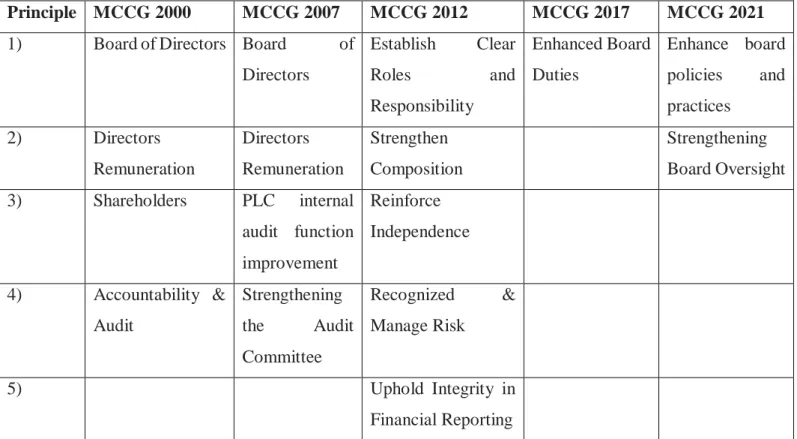
The Malaysian government modified the MCCG from 2000 to 2007. The MCCG 2000 created a set of principles and best practises to improve the level and structure of corporate governance procedures. The MCCG 2007 was primarily aimed at the Board of Directors and the audit function of businesses in order to guarantee that the proper principles and best practises are implemented in a company's structures and operations. Following the amendment of the MCCG 2012, which replaced the 2007 Codes, the purpose is to build and enhance a sound corporate governance structure and procedures that are integrated into their business transactions and culture.
A breakthrough event in Malaysian corporate governance reform, the MCCG (or 2001 Code) was published in 2000. Many academics believe corporate governance is vital in monitoring the firm's operations. However, previous research on the link between corporate governance and commercial performance has shown mixed findings. This research aims to examine corporate governance practises across Malaysia's Top 100 PLCs and the relationship between corporate governance and company performance.
Economically, corporate governance is crucial to directing limited money to the most successful investment initiatives. It is also a component of institutional investor reform efforts. The two forms of corporate governance mechanisms are internal like board sizes, board independence, and board of directors, and external like competitive market situations, managerial labour and talent markets, and corporate control markets. This research used board sizes and board independence, two significant internal indexes of corporate governance. The sections that follow elaborate on these indications (Zabria, Ahmad, & Wah, 2016).
The Malaysian Code on Corporate Governance (MCCG), released in 2000, has influenced corporate governance practises. The MCCG promotes global corporate governance principles and practises that go beyond law, norms, and the Bursa Malaysia. More effective and flexible response to rising corporate governance standards with MCCG. It acknowledges that certain aspects of corporate
Family-Controlled Listed Companies in Malaysia and Singapore
Page 11 of 97
governance need governmental oversight, while others benefit from self-regulation and market regulation. Aside from publicly listed companies, non-public organisations including state-owned businesses, public corporations, SMEs, and capital market intermediaries are pushed to implement the MCCG. Accountability, transparency, and sustainability might be improved by non-listed firms adopting MCCG standards (Suruhanjaya Sekuriti, 2021).
Table 2.2.1: Summary of the Malaysian Code of Corporate Governance
Principle MCCG 2000 MCCG 2007 MCCG 2012 MCCG 2017 MCCG 2021 1) Board of Directors Board of
Directors
Establish Clear
Roles and
Responsibility
Enhanced Board Duties
Enhance board policies and practices
2) Directors Remuneration
Directors Remuneration
Strengthen Composition
Strengthening Board Oversight 3) Shareholders PLC internal
audit function improvement
Reinforce Independence
4) Accountability &
Audit
Strengthening the Audit Committee
Recognized &
Manage Risk
5) Uphold Integrity in
Financial Reporting
2.2.2 Corporate Governance in Singapore
Every company requires a strong Board of Directors to administer and monitor the enterprise. The Board is collectively responsible for the company's long-term success. To achieve this purpose, the Board works with Management and Management reports to the Board. The Board of Directors should meet regularly and as required to address particular issues. Change your Articles of Association (or other basic documents) to enable phone and video conferencing. Annual Report should include the number of Board and board committee meetings held throughout the fiscal year, as well as each board member's attendance.
Family-Controlled Listed Companies in Malaysia and Singapore
Page 12 of 97
The Board should include a strong and independent element capable of making objective business decisions, especially in the absence of management. No one or a small group should be allowed to dominate the Board's decision-making. An
"independent" director has no interaction with the company, its affiliates, its 10%
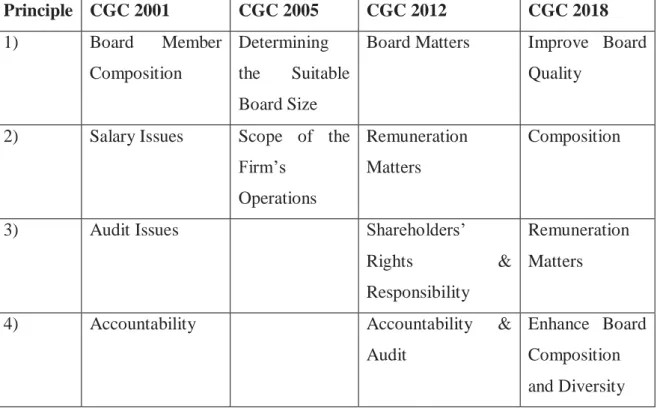
shareholders, or its management that may interfere with their independent business judgement in the firm's best interests. The company's Annual Report should identify each independent director. The Board should evaluate whether the director is independent in character and judgement, taking into account the NC's views, and if any ties or circumstances exist that may influence or seem to influence the director's judgement. Directors who have been on the Board for more than nine years should have their independence assessed more rigorously. A gradual board refreshment should be considered as part of this process. The Board should explain why such a director is independent. The Board should evaluate its size and decide on what size it feels best supports good decision making. The Board should examine the scope and nature of the company's operations, its demands, and the need to minimise disruptions caused by changes in the Board's and board committees' membership.
The Board should not be too big to handle (Code of Corporate Governance 2012, 2012).
Table 2.2.2: Summary of the Singapore Code of Corporate Governance Principle CGC 2001 CGC 2005 CGC 2012 CGC 2018
1) Board Member
Composition
Determining the Suitable Board Size
Board Matters Improve Board Quality
2) Salary Issues Scope of the Firm’s
Operations
Remuneration Matters
Composition
3) Audit Issues Shareholders’
Rights &
Responsibility
Remuneration Matters
4) Accountability Accountability &
Audit
Enhance Board Composition and Diversity
Family-Controlled Listed Companies in Malaysia and Singapore
Page 13 of 97
2.3 Theoretical Model
2.3.1 Agency Theory
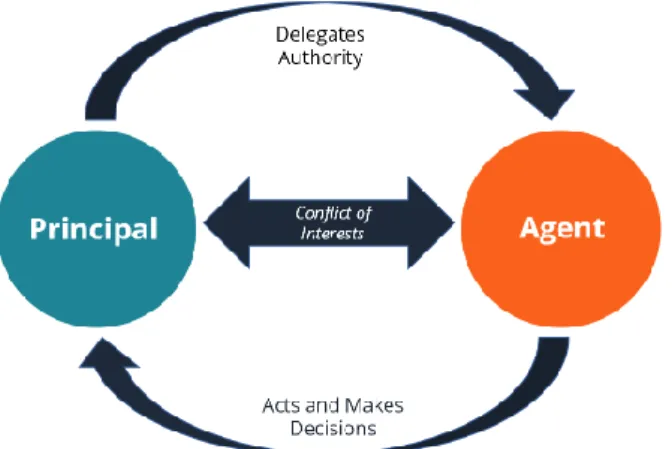
Figure 2.3.1 Agency Theory
Developing countries, although share the same ownership structure. Therefore, focusing solely on agency theory would impede by understanding of corporate governance practises in these economies. Corporate governance is defined by researchers which is based on their research interests (Yusof, 2016).
The separation of owners and managers, as well as the agent's self-serving motive, is noted in agency theory (Nalukenge, Nkundabanyanga, & Ntayi, 2018).
Adherence to International Financial Reporting Standards (IRFS) inhibits self- interest since managers are forced to fulfil tougher accounting rules in order to prepare yearly reports and be in accordance with IFRS. Furthermore, the overarching idea of IFRS aims to reduce knowledge imbalance between the agent and the principal by adhering to information disclosure rules. Furthermore, the stakeholder establishes a corporate governance framework by appointing a board to monitor the management (Nalukenge, Nkundabanyanga, & Ntayi, 2018).
The history of agency problem goes back to when human civilization traded and tried to maximize interests. The problem of agency is one of the age-old problems that have persisted since the inception of corporations. It cannot be ignored as each organization may experience this difficulty in various forms. The agency problem
Family-Controlled Listed Companies in Malaysia and Singapore
Page 14 of 97
has taken many forms over time, as evidenced in the literature. The agency theory literature must be discussed to grasp the agency problem, its different manifestations, and the many costs involved in minimizing the problem. (Panda &
Leepsa, 2017)
2.3.2 Stewardship Theory
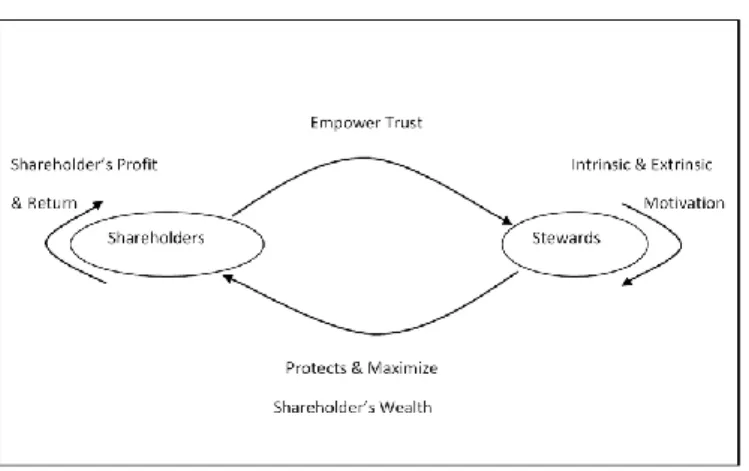
Figure 2.3.2 Stewardship Theory
According to (Abid, Khan, Rafiq, & Ahmed, 2014), stated that the terms of managerial motivation, stewardship theory is an option to agency theory. They asserted that responsibility for the roles of board chair and CEO in stockholder maximises shareholders’ interests. (Abid, Khan, Rafiq, & Ahmed, 2014) specified that focuses on the share of insiders on the board to analyse the relationship with firm performance. They also claimed that approximately 8% of US firms have CEOs who also serve as board chairs. In a comparison in US and other countries like Japan and Australia the duality share is high in US and has been heavily criticised. The executive members are not opportunist shirkers. To be good stewards of the assets that they control within the company, they aimed the goal as to do their work effectively and efficiently. In stewardship theory, it mainly focuses on shareholder’s interest, the objective of the theory is maximizing the productivity, by having approached of sociological and psychological (Abid, Khan, Rafiq, &
Ahmed, 2014).
Directors, unlike agents, are ready to behave in the company's best interests, and will act in ways that lead to collectivist or organisational goals, rather than selfish
Family-Controlled Listed Companies in Malaysia and Singapore
Page 15 of 97
objectives. Meet directors' individual requirements while achieving corporate objectives. Stewardship theory states that people, especially directors, typically perceive themselves as stewards of corporate affairs, and can be trusted to conduct excellent and professional work for themselves. Their commitment to the company's aims surpasses their own. (Keay, Stewardship Theory: Is Board Accountability Neccessary?, 2017).
2.3.3 Stakeholder Theory
Figure 2.3.3 Stakeholder Theory
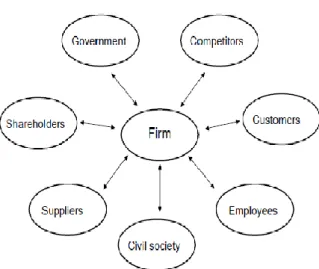
Stakeholders are anyone who has an interest in a company's or foundation's operations and may influence or be impacted by them. Stakeholder assessment is the procedure of determining an organization's stakeholders and evaluating their influence on existing relationships. Practical stakeholder management conducts stakeholder research with every manager within their department to identify the necessary goals and activities to better monitor the inspiration, cohesion and tenacity of key shareholder groups. Stakeholder management is relevant and hierarchical to many activities and projects. This also allows for linking stakeholder analysis to a single scope or activity. Furthermore, in an analytical paper, he argues that the stakeholder approach should be based on the work of Robert F Stewart and Dr Otis J Benepe. At this time, people are increasingly interested in the company’s public image. It also promotes the popularization of a stakeholder approach.
Family-Controlled Listed Companies in Malaysia and Singapore
Page 16 of 97
(Ademola, Detailing Stakeholder theory of management: A Managerial Performance Technique, 2014)
Traditional financial metrics do not fully convey business success when all legitimate stakeholders are concerned. Theorists use ethical principle to develop theories which narratives to understand a company’s mission and obligations, and to expand the scope of company operations to include, for instance, only the treatment of stakeholders. Several normative cores have been proposed to guide these efforts. Kantian capitalism, justice, fair contracts, self-advocacy, and feminism are examples of this. Some theories have embraced aspects of utilitarian thought to promote the social well-being of all involved; however, proponents of Kantian capitalism deny total utility maximization. Some stakeholders’ theorists argue that moral behaviour need not be justified by utilitarianism. (Haataja, 2020)
2.3.4 Resource Dependency Theory (RDT)
Figure 2.3.4 Resource Dependency Theory (RDT)
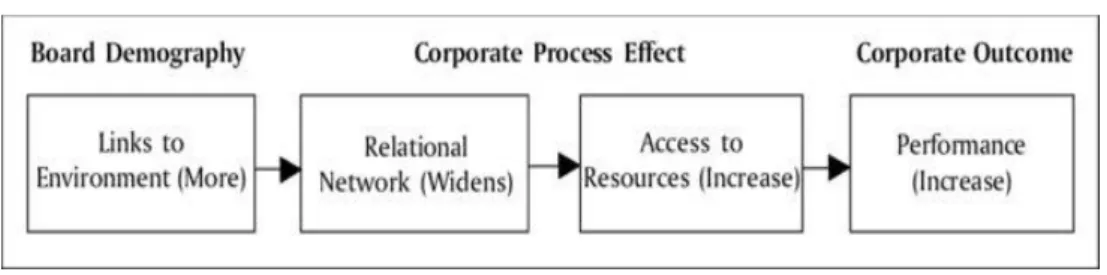
The fundamental recommendation of asset reliance hypothesis is the necessity for natural linkages between the firm and outside assets. The motivation behind chiefs is to associate the partnership to outer variables by co-picking the assets fundamental for endurance. Thus, sheets of chiefs assume a significant part in consolidating imperative parts of ecological unusualness into the firm. Natural availability or organization administration could decrease the exchange costs related with ecological association. The prerequisite for assets inside an association prompts the making of trade connections or organization administration across associations. Moreover, inconsistent asset conveyance prompts reliance in authoritative connections (Yusoff & Alhaji, 2012).
Family-Controlled Listed Companies in Malaysia and Singapore
Page 17 of 97
2.4 Dependent Variables
2.4.1 ROA
Return on resources (ROA) is one of the probability proportions. This proportion is oftentimes featured in fiscal summary investigation since it could mirror an organization's capacity to produce benefits. ROA might be utilized to evaluate an organization's ability to create gains previously, which can then be anticipated for what's to come. The resources being referred to are by and large firm properties either from the actual capital or from unfamiliar cash transformed into organization resources for corporate supportability. A higher ROA number recommends more noteworthy corporate accomplishment because of a better yield on venture rate.
According to, (Rosikah, Prananingrum, Muthalib, IrfandyAzis, & Rohansyah, 2018) stated that the number shows the association's profit from all resources or assets conveyed to the organization. The liquidity proportion is a proportion used to survey an organization's ability to satisfy its transient responsibilities. Obligation The board Proportion is a resource the executives proportion used to decide an association's ability to fulfil it drawn out responsibilities (obligation) used to back every single corporate movement (Rosikah, Prananingrum, Muthalib, IrfandyAzis,
& Rohansyah, 2018).
2.4.2 ROE
While the profit from capital considers the entire measure of money invested in an asset, the return on equity considers about the value part of the speculation. It analyses the profit left over for value financial backers after obligation overhauling costs are deducted to how much value put resources into the resource.
Quite a bit of what has been expounded on return based on capital in conditions of time and book esteem additionally applies to this measurement. The overall gain for the current year is viewed as made by the value venture toward the start of the year, and we utilize the book worth of value to evaluate the value put resources into existing resources.
Family-Controlled Listed Companies in Malaysia and Singapore
Page 18 of 97
One critical contrast between this measurement and return on put away capital is that money isn't gotten out; premium pay from cash is remembered for total compensation, and the book worth of value incorporates the association's money possessions. An organization's profit from value is along these lines a composite profit from the entirety of its resources - cash and functional. To the extent that money contrasts from functional resources as far as chance and return, the profit from value for undertakings with high money levels will be brought down by the low and riskless returns delivered with cash (Damodaran, 2007).
2.4.3 Tobin’s Q
According to Kaijser, proposed that neoclassical investment say that the pace at which investors want to build up their capital stock should be linked to q, which means how much capital is worth in comparison with how much it would cost to build something else. If you're an investor, you should pay more attention to the marginal Q, which is how much extra capital you have and how much it costs to get rid of it. The average Q, which is how much extra capital you have and how much it costs, is less important to you. The marginal Q, on the other hand, is hard, if not impossible, to see in a real-world study. In most cases, researchers look at the average Q. Analysis will only be valid if the average Q and marginal Q are the same.
This is because it is the marginal Q that is important for economic interpretation.
(Kaijser, 2014)
Family-Controlled Listed Companies in Malaysia and Singapore
Page 19 of 97
2.5 Independent Variables
2.5.1 Number of Board Sizes (BS)
For decades, researchers have investigated board structure like size, composition, independence, frequency of board meetings, and ownership structure Various studies have examined important board composition and size components to understand how these board features affect management and thereby effect performance. Board size is directly tied to corporate governance problems. Board sizes relate to an organization's total number of directors. Many corporate governance theories suggest the link between board size and company success. Both the agency and resource dependence theories favour a big board. However, stewardship theory recommends a smaller board size for better management. The board of directors, as representatives of the company's many owners and stakeholders, supervises and oversees the management' performance and activities.
A larger board contains more directors who monitor and manage the firm's performance in the best interests of the stakeholders. According to (Viet, 2013), had found that there a significant relationship between the board sizes and firm performance. (Kalsie & Shrivastav, 2016). This study had found that BS had positive relationship on board independence and firm performance (Kanakriyah, 2021)
H1A: Number of board sizes has a significantly relationship with firm performance (ROA).
H1B: Number of board sizes has a significantly relationship with firm performance (ROE).
H1C: Number of board sizes has a significantly relationship with firm performance (Tobin’s Q).
Family-Controlled Listed Companies in Malaysia and Singapore
Page 20 of 97
2.5.2 Percentage of Independent Directors (%ID)
A study conducted by Fuzi, Halim, and M.K (2016) explored the role of board independence in monitoring and strategic duties. The ultimate aspect of board independence is having enough independent directors. Directors' talent, willingness, and board culture may lead to independence. Formal independence, information accessibility, incentives, and knowledge are all factors considered non-executive directors in China. Over-involvement of controlling shareholders and lack of knowledge of non-executive board roles in China. For example, the Malaysia Code of Corporate Governance requires at least three independent directors to monitor management (Fuzi, Halim, & M.K., 2016). They concluded that the independent directors' composition had nothing to do with earnings management. Although most Malaysian companies had 1/3 or 33% independent directors, this had little impact on earnings management Independent directors of Malaysian Government Linked Companies GLCs have failed in their internal monitoring duties (Fuzi, Halim, &
M.K., 2016). According to (Fernández-Temprano & Tejerina-Gaite, 2020), they had founded that percentage of independent directors has always shows positive coefficient with significant on ROA model.
H2A: Percentage of Independent Directors has a significantly relationship with firm performance (ROA).
H2B: Percentage of Independent Directors has a significantly relationship with firm performance (ROE).
H2C: Percentage of Independent Directors has a significantly relationship with firm performance (Tobin’s Q).
Family-Controlled Listed Companies in Malaysia and Singapore
Page 21 of 97
2.5.4 Number of Women Directors (NOWD)
Gender equality in corporate boardrooms has been a hot subject in global corporate governance forums. Women in leadership positions were debated when Norway first introduced gender quotas on OSE-listed Norwegian firms in 2005. Since then, various governments have encouraged corporate boardroom gender diversity. In 2011, Malaysia became the first Asian country to impose a board gender quota. The board of directors influences a firm's strategic direction and disclosure decisions.
Any country's human capital is at least 50% female. Corporate boardrooms with female representation have access to a talent pool that women can contribute to.
People all throughout the globe are interested in environmental sustainability.
Various stakeholders have pushed businesses worldwide to incorporate environmental sustainability concepts into their daily operations. Investors no longer judge a company just on its financial performance, but also on its non- financial performance (Phua & Ho, 2017). According to (Jyothi & Mangalagiri, 2019) found that women directors had a positive relationship on board and firm performances. Another research by Conyon and He (2017) found that having women on boards improved performance because women had a more quantitative influence on organisations' profitability. (Bruna, ReyĐặng, Ammari, & Houanti, 2021)
H3A: Number of women directors has a significantly relationship with firm performance (ROA).
H3B: Number of women directors has a significantly relationship with firm performance (ROE).
H3C: Number of women directors has a significantly relationship with firm performance (Tobin’s Q).
Family-Controlled Listed Companies in Malaysia and Singapore
Page 22 of 97
2.5.4 Number of Foreign Directors (NOFD)
Foreign members understand a firm's intended outside market techniques.
Consequently, such data may help the firm expand. Foreign directors also strengthen the board's independence. A restricted number of competent local directors, such as corporations in nations with a smaller population, low levels of education, and slower capital market expansion, relate to foreign directors.
International boards are viewed as a cost-effective way to transfer governance. The experiences of its foreign directors expose corporations to the corporate governance aspects and board processes of multinational firms (Alshirah, Rahman, & Mustapa, 2019). According to (Jusoh, Rashid, & Ajis, 2020) had found that there had positive relationship between foreign directors and firm performance. There is a positive and significant relationship between having foreign directors and how well a company does financially. (Assenga, Foreign Directors and Firm Financial Performance:
Evidence from the Tanzanian Listed Companies, 2021)
H4A: Number of Foreign Directors has a significantly relationship with firm performance (ROA).
H4B: Number of Foreign Directors has a significantly relationship with firm performance (ROE).
H4C: Number of Foreign Directors has a significantly relationship with firm performance (Tobin’s Q).
Family-Controlled Listed Companies in Malaysia and Singapore
Page 23 of 97
2.5.5 Number of Foreign Qualifications (NOFQ)
A key component of MNCs' desire for global competitiveness, International Corporate Governance (ICG) captures this. To understand how corporate characters such as managers, owners, boards of directors, and employees, interact and influence the firm's strategic choices, ICG looks at their connections and interests.
A global business also distributes authority and rights among all stakeholders. ICG research investigates MNCs' transnational roles as issuers, carriers, interpreters, and disseminators of governance practises. In certain cases, foreign subsidiaries fully execute corporate governance rules set by their parent company, while others only partly or symbolically do so. It is also possible that the MNC's headquarters or other subsidiaries adopt one company's corporate governance practises (Aguilera &
Haxhi, 2019). In the case of Indonesia, it was determined that board members with foreign qualifications might improve the firm's financial performance (Darmadi, 2013).
H5A: Number of foreign qualifications has a significantly relationship with firm performance (ROA).
H5B: Number of foreign qualifications has a significantly relationship with firm performance (ROE).
H5C: Number of foreign qualifications has a significantly relationship with firm performance (Tobin’s Q).
Family-Controlled Listed Companies in Malaysia and Singapore
Page 24 of 97
2.5.6 Number of Board Meetings (NOBM)
Board meetings are crucial to the board's supervisory role since they are held to discuss outstanding concerns and possible solutions. Defined as essential to successful government. Board meetings are crucial to the Board's tasks. According to the Agency Theory, regular board meetings may assist minimise agency costs and hence benefit corporations. It is easier to settle any urgent problem if the board meets often and is aware on the firm's activities (Al-Daoud, Saidin, & Abidin, 2016).
According to (Al-Daoud, Saidin, & Abidin, 2016), had indicate that board meeting is significantly and positively related to firm performance.
H6A: Number of board meeting has a significantly relationship with firm performance (ROA).
H6B: Number of board meeting has a significantly relationship with firm performance (ROE).
H6C: Number of board meeting has a significantly relationship with firm performance (Tobin’s Q).
2.5.7 Number of Foreign Directors in Audit Committee (NOFDAC)
Audit committee had been supervised all the internal and external audit, internal control, regulatory compliance, and risk management. The audit committee advises the board of directors on matters such as internal auditor independence and competence, financial statement accuracy, and executive compensation. An independent audit committee may be required by a regulator to improve financial reporting accuracy. Audit committees may get the expertise and resources they need to do their jobs (Al-Baidhani, 2014).
H7A: Number of foreign directors in audit committee has a significantly relationship with firm performance (ROA).
Family-Controlled Listed Companies in Malaysia and Singapore
Page 25 of 97
H7B: Number of foreign directors in audit committee has a significantly relationship with firm performance (ROE).
H7C: Number of foreign directors in audit committee has a significantly relationship with firm performance (Tobin’s Q).
2.6 Research Framework
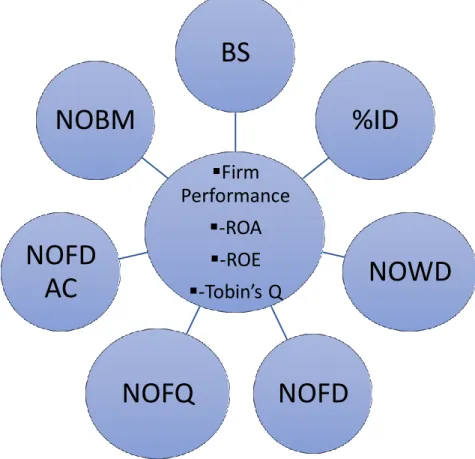
Figure 2.6: Board Characteristics that Influence Firm Performance Among Family-Controlled firm in Malaysia
Source: Developed for research
According to the study goals, a conceptual framework was created. The IVs were composed of board features such as BS, % ID, NOWD, NOFD, NOFQ, NOFDAC, and BM. The DVs were used to refer to the firm's performance as assessed by ROA, ROE, and Tobin's Q. This methodology was used to examine if CG had an influence on company performance among family-controlled enterprises listed on the Bursa Malaysia.
Firm Performance
-ROA
-ROE
-Tobin’s Q
BS
%ID
NOWD
NOFD NOFQ
NOFD AC
NOBM
Family-Controlled Listed Companies in Malaysia and Singapore
Page 26 of 97
CHAPTER 3: RESEARCH METHODOLOGY
3.0 Introduction
This chapter described about the research methodologies that were used in the study, like how they were done. It was divided into seven parts. It covered research design, data collection, sample design, research tools, construct measurement, data processing, and data analysis, as well as the other parts.
3.1 Research Design
To evaluate whether CG has an influence on business performance among family- controlled companies listed on Bursa Malaysia from 2013 to 2020. An analysis of board quality and family-owned company performance using ROA, ROA, and Tobin's Q. Preparation for a research project is characterised as the research approach. Consequently, quantitative research measures and analyses variables to draw conclusions. It involves utilising and analysing numerical data to answer questions like who, how much, what, where, when, and how many (Apuke, Quantitative Research Methods a Synopsis Approach, 2017). The analysis examined data from 2013 to 2020 from family-owned firms and Bloomberg. The panel data analysis requires all eight years of data. The relationship between DVs and IVs was examined cross-sectionally during an eight-year period.
3.2 Data Collection Method
3.2.1 Secondary Data
This research used secondary data, mainly from annual reports. From 2013 to 2020, annual reports of family-controlled businesses listed on Bursa Malaysia were
Family-Controlled Listed Companies in Malaysia and Singapore
Page 27 of 97
acquired from official websites and Bloomberg. The statistics for ROA, ROE, and Tobin's Q came from annual reports and Bloomberg.
The statistics in the annual reports were reliable and accurate since they were all verified by Malaysian authorities. It was straightforward and affordable compared to the original data. Secondary data sources included Google Scholar, e-databases at Universiti Tunku Abdul Rahman, Sage, ResearchGate, and Science Direct.
3.3 Sampling Design
This part included the target population, followed by the sample frame, sampling element, sampling technique, and sampling sizes.
3.3.1 Target Population
This is decided by whether or not individuals of the general population meet the selection criteria. Once a member meets these requirements, he or she is accepted.
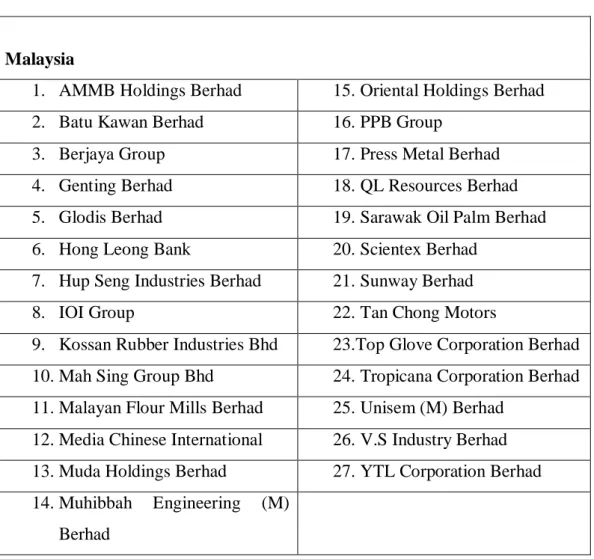
Because the capacity to reply is of little or no value, a few selection criteria may be used (Asiamah, Mensah, & Mensah, 2017). The population for this study was chosen from all of the family-controlled firms registered on the Bursa Malaysia, for which annual reports and financial data were available. As a result, the overall population of this study includes 27 Bursa Malaysia and 13 Singapore listed family- controlled companies.
3.3.2 Sampling Frame
The sampling frame identifies and positions sample units within a population (West, 2016). This study's sample frame included all family-controlled enterprises listed on Bursa Malaysia. "Family Controlled Companies in Bursa Malaysia" provided this list of family-controlled companies by Tan (2016).
Family-Controlled Listed Companies in Malaysia and Singapore
Page 28 of 97
Table 3.3.2(a): List of Top 25 Selected Family Controlled Business in Malaysia
Malaysia
1. AMMB Holdings Berhad 15. Oriental Holdings Berhad
2. Batu Kawan Berhad 16. PPB Group
3. Berjaya Group 17. Press Metal Berhad
4. Genting Berhad 18. QL Resources Berhad
5. Glodis Berhad 19. Sarawak Oil Palm Berhad
6. Hong Leong Bank 20. Scientex Berhad
7. Hup Seng Industries Berhad 21. Sunway Berhad
8. IOI Group 22. Tan Chong Motors
9. Kossan Rubber Industries Bhd 23.Top Glove Corporation Berhad 10. Mah Sing Group Bhd 24. Tropicana Corporation Berhad 11. Malayan Flour Mills Berhad 25. Unisem (M) Berhad
12. Media Chinese International 26. V.S Industry Berhad 13. Muda Holdings Berhad 27. YTL Corporation Berhad 14. Muhibbah Engineering (M)
Berhad
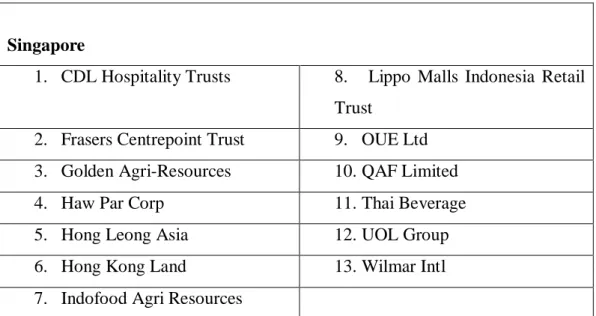
Table 3.3.2(b): List of Top 25 Selected Family Controlled Business in Singapore
Singapore
1. CDL Hospitality Trusts 8. Lippo Malls Indonesia Retail Trust
2. Frasers Centrepoint Trust 9. OUE Ltd 3. Golden Agri-Resources 10. QAF Limited
4. Haw Par Corp 11. Thai Beverage
5. Hong Leong Asia 12. UOL Group
6. Hong Kong Land 13. Wilmar Intl
7. Indofood Agri Resources
Family-Controlled Listed Companies in Malaysia and Singapore
Page 29 of 97
3.3.3 Sampling Element
Not all the family-controlled corporations included in Tan (2016)'s book "Family Controlled Companies in Bursa Malaysia" were used in this study. Some firms were omitted from the population because there was very little and insufficient information and data available. As a result, a sample size of 40 family-controlled businesses was chosen for this study.
3.3.4 Sampling Technique
Probability and non-probability sampling methods exist. This ensures that each instance in the population has an equal probability of getting picked. (Andrea E.
Berndt, 2020).
3.3.5 Sampling Size
The effect magnitude, projected measurement variability, required statistical power, significance requirements, and whether a one- or two-tailed statistical analysis is planned are all factors to consider. (Oribhabor, 2019).
3.4 Research Instruments
The information was gathered from financial statements and annual reports spanning the years 2013 to 2018. To acquire all of the numbers and data for IVs, all of the annual reports were downloaded from the different firms' official websites.
Microsoft Excel was used to calculate the ROA, ROE, and Tobin's Q.
Family-Controlled Listed Companies in Malaysia and Singapore
Page 30 of 97
3.5 Construct Measurement
3.5.1 Origin of Construct
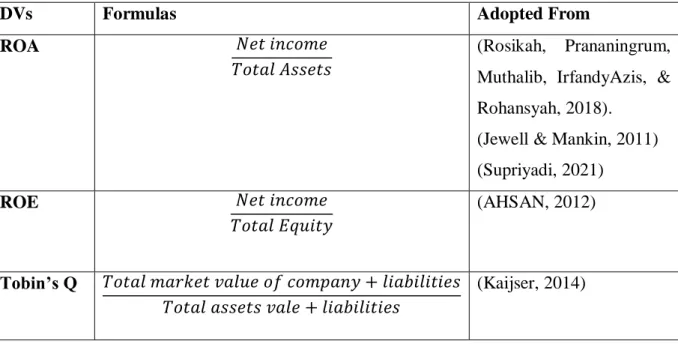
There were 3 DVs and 7 IVs; a table of DVs shown in Table 3.5.1a, although a table of IVs was shown in Table 3.4.1b.
Table 3.5.1(a): Table of Dependent Variables
DVs Formulas Adopted From
ROA 𝑁𝑒𝑡 𝑖𝑛𝑐𝑜𝑚𝑒
𝑇𝑜𝑡𝑎𝑙 𝐴𝑠𝑠𝑒𝑡𝑠
(Rosikah, Prananingrum, Muthalib, IrfandyAzis, &
Rohansyah, 2018).
(Jewell & Mankin, 2011) (Supriyadi, 2021)
ROE 𝑁𝑒𝑡 𝑖𝑛𝑐𝑜𝑚𝑒
𝑇𝑜𝑡𝑎𝑙 𝐸𝑞𝑢𝑖𝑡𝑦
(AHSAN, 2012)
Tobin’s Q 𝑇𝑜𝑡𝑎𝑙 𝑚𝑎𝑟𝑘𝑒𝑡 𝑣𝑎𝑙𝑢𝑒 𝑜𝑓 𝑐𝑜𝑚𝑝𝑎𝑛𝑦 + 𝑙𝑖𝑎𝑏𝑖𝑙𝑖𝑡𝑖𝑒𝑠 𝑇𝑜𝑡𝑎𝑙 𝑎𝑠𝑠𝑒𝑡𝑠 𝑣𝑎𝑙𝑒 + 𝑙𝑖𝑎𝑏𝑖𝑙𝑖𝑡𝑖𝑒𝑠
(Kaijser, 2014)
Source: Developed for the research
Family-Controlled Listed Companies in Malaysia and Singapore
Page 31 of 97
Table 3.5.1(b): Table of Independent Variables
IVs Formulas Adopted From
BS Total number of directors (Kalsie & Shrivastav, 2016)
%ID 𝑇𝑜𝑡𝑎𝑙 𝑛𝑢𝑚𝑏𝑒𝑟 𝑜𝑓 𝑖𝑛𝑑𝑒𝑝𝑒𝑛𝑑𝑒𝑛𝑡 𝑑𝑖𝑟𝑒𝑐𝑡𝑜𝑟𝑠 𝑇𝑜𝑡𝑎𝑙 𝑛𝑢𝑚𝑏𝑒𝑟 𝑜𝑓 𝑏𝑜𝑎𝑟𝑑 𝑠𝑖𝑧𝑒𝑠
(Fuzi, Halim, & M.K., 2016)
NOWD Total number of female directors on board (Phua & Ho, 2017)
NOFD Total number of foreign directors (Alshirah, Rahman, &
Mustapa, 2019)
NOFQ Total number of foreign qualifications (AGUILERA, MARANO,
& HAXHI, 2019)
NOBM Total of number of board meeting (Al-Daoud, Saidin, &
Abidin, 2016) NOFDAC Total number of foreign directors audit
committee
(Al-Baidhani, 2014)
Source: Developed for the research
3.5.2 Scale of Measurement
All the measurements in science were conducted using four types of scales that he named as "nominal", "ordinal", "interval" and "ratio". There were interval (ROA, ROE and Tobin’s Q) and ratio (BS, %ID, NOWD, NOFD, NOFQ, NOFDAC, and NOBM) scale of measurement in this research