We especially want to thank our academic supervisor, Puan Siti Nur Amira binti Othman, who supervised the entire progress of our research project for two semesters. Last but not least, we would like to express our gratitude to Puan Noorfaiz binti Purhanudin, our project coordinator, for coordinating everything related to the completion of the undergraduate project for the Department of Finance and keeping us informed of the information. GDP Gross Domestic Product GEXP Government Expenditures HAC Newey-West method IV Independent Variables OLS Ordinary Least Squares RGDP Real Gross Domestic Product.
This research investigates the relationship between government debt and economic growth in Malaysia using quarterly observations from 2010Q1 to 2019Q4. The dependent variable is real gross domestic product (GDP) of Malaysia, while the independent variables include budget deficit, government expenditure and external debt. To fulfill the research objective, ordinary least squares (OLS) model will be used to determine the relationship between national debt and economic growth.
The results show negative effects of the budget deficit and external debt on real GDP, while public financial expenditures have a positive effect on real GDP.
RESEARCH OVERVIEW
- Research Background
- Research Problem
- Research Objective
- Research Question
- Research Significance
- Introduction
- Educational Institutions
- Policymakers
To investigate the relationship between government debt (budget deficit, government spending, external debt) and Malaysia's economic growth. How is government debt (budget deficit, government spending, external debt) related to Malaysia's economic growth. The impact of government debt on Malaysia's economic growth will be the focus of this study.
The purpose of this study is to examine the components of Malaysia's public debt as an independent variable (government spending, budget deficit and external debt) and their impact on the country's GDP growth. By doing the research, the role of government debt in stimulating a country's economic growth will therefore become clearer. This study will have findings that can provide a more accurate explanation of the relationship between government debt and the country's economic development.
Our study mainly focuses on investigation in relation to specific individual component of public debt and economic growth.
LITERATURE REVIEW
- Economic Growth
- Government Expenditure
- Background
- Government Expenditure and Economic Growth
- Budget Deficit
- Introduction
- Budget Deficit and Economic Growth
- External Debt
- Background
- External Debt and Economic Growth
The development of new technology, goods and processes can stimulate economic growth (Hanushek & Woessmann, 2020). Government spending is one of the crucial elements to boost the country's economic growth (Senawi & Sulaiman, 2020). According to their research, government spending will have no impact on economic growth in the short term, but will have a positive relationship with economic growth in the long run.
According to Wahyudi (2020), the study has shown that public spending has a significant effect on economic growth in Indonesia, which can stimulate the economic growth of a country. But there are few recent studies such as Devarajan, Swaroop and Zou (1996), Folster and Henrekson (2001), Dar and Khalkhali (2002), Romero-Avila and Strauch (2008), Afonso and Furceri (2010), Bergh and Karlsson ( 2009), Nurudeen and Usman (2010), as well as Sáez, Álvarez-García and Rodríguez (2017) said that there is a negative relationship between public spending and economic growth in the countries with higher income. At the same time, Ricardo's equivalent hypothesis indicated that there is a neutral relationship between budget deficit and economic growth in Ricardo's economic theory.
Furthermore, according to Dao and Doan (2013), there is a finding in their paper that budget deficit has a less detrimental impact on economic growth in Thailand. These studies had proved the neoclassical theory in their conclusion that there is a negative correlation between budget deficit and economic growth in the countries. However, some studies have found that the budget deficit has a positive impact on economic growth in Western countries.
Moreover, another study showed that the deficit ratio has a positive effect on the economic growth of the eurozone countries (Kryeziu & Hoxha, 2021). Nevertheless, some researchers conclude that a country's economic growth also depends on the variables chosen for research. Therefore, there is no firm result proving that the higher budget deficit will slow down the country's economic growth.
Policymakers, economists and researchers have debated the use of external borrowing to support economic growth. As a result, it is clear that external debt has a positive, negative or non-linear relationship with economic growth (Shkolnyk & Koilo, 2018).
METHODOLOGY
- Research Design
- The Study's Theoretical Framework
- Econometric Model
- Data Analysis Method
- Data Collection Method
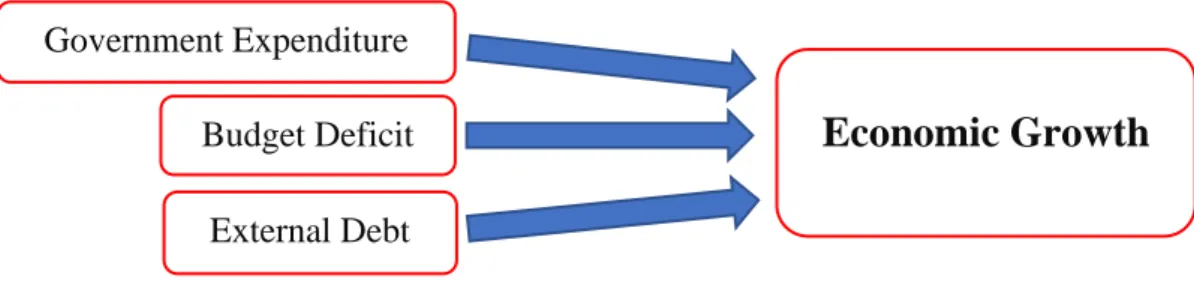
Based on Figure 3.2.1, there are three independent variables selected that can influence the economic growth of Malaysia. The research objective is to investigate and examine how the independent variable including government spending, budget deficit and foreign debt are related to the dependent variable, economic growth of Malaysia respectively. There are various results from many studies. 2017) supports that the government spending has a positive impact on economic growth of the countries.
But some scholars such as Devarajan, Swaroop and Zou (1996), Folster and Henrekson (2001), Dar and Khalkhali (2002), Romero-Avila and Strauch (2008), Afonso and Furceri (2010), Bergh and Karlsson (2009), Nurudeen and Usman (2010), as well as Sáez Álvarez-García and Rodríguez (2017) disagreed that government spending positively influenced economic growth. In addition, it has been claimed that the relationship between government spending and economic growth in Malaysia is either significant or insignificant (Anitasari & Soleh, 2015). Dao and Doan (2013), as well as Rana and Wahid (2017), also discovered that there is an inverse relationship between budget deficit and economic growth.
In addition, external debt as a component of national debt has also been investigated in terms of its relationship and impact on Malaysia's economic growth. There are many studies that demonstrate the impact of external debt on the economic growth of a country. Moreover, the relationship between external debt and economic growth is said to be significant (Dauda, Ahmad and Azman-Saini, 2013; Lau, Lee and Baharumshah, 2015) or insignificant (Cordella, Ricci and Ruiz-Arranz, 2010). ).
Hence, foreign debt will be used in this research model to see how it affects Malaysia's economic growth from 2010 to 2019. According to the findings of literature study, there is an uncertain relationship between government debt and economic growth. Therefore, the purpose of this research is to determine how government debt affects the economic growth of Malaysia.
The existence of the error term is intended to reflect other indirect factors that may affect Malaysia's economic growth. For example, government spending with a coefficient higher than 0 has a positive impact on the country's economic growth.
DATA ANALYSIS
- Introduction
- Variance Inflation Factors (VIF) Test
- Pearson’s Correlation Coefficient Test
- Regression Model using Ordinary Least Square (OLS)
- Durbin-Watson Test
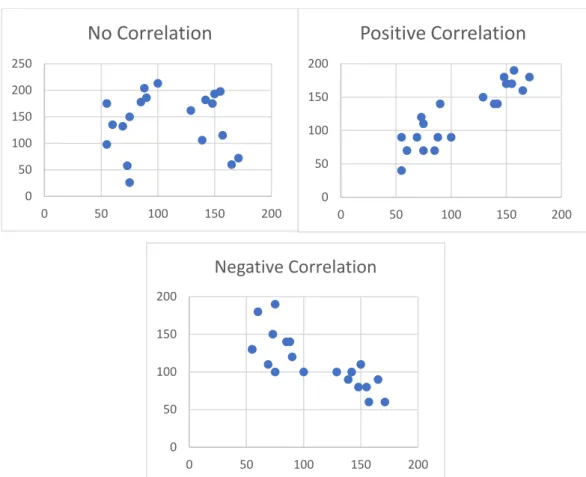
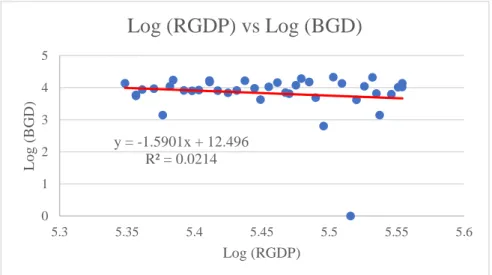
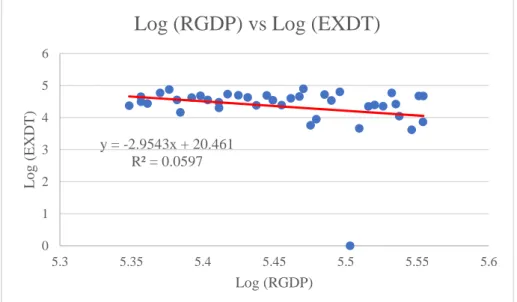
Correlation in positive and negative numbers indicate positive and negative relationships between independent variables and dependent variables, respectively. Most of the data points plotted are consistent, indicating that there is a valid correlation. Most of the data presented in the graph are consistent, which indicates that there is a valid correlation between the independent variables and the dependent variables.
Compared to the other two independent variables, an upward trend line is shown in the graph, which shows that there is a positive relationship between economic growth and public spending. Note: The asterisks indicate rejection of the null hypothesis at the 10%, 5% and 1% significance levels, respectively. The coefficient statistics provided by EViews are then used to estimate the nature of the relationships between the log independent and dependent variables.
The probability, also known as the P value, shown in the Prob column of Table 4.3.1, plays an important role in determining the statistical significance of the relationship between the independent variables and the dependent variable in the model under consideration. Due to the p-value approach used in this OLS method, it is possible to reject the null hypothesis when the p-value or probability of the independent variable is less than a significant level of or 0.10, indicating that the estimate is "statistically significant". ," or vice versa. Moreover, 𝛽2 indicates a negative relationship between the budget deficit and Malaysia's GDP growth over the period 2010-2019.
In addition, 𝛽3 indicate a positive relationship between government spending and Malaysia's GDP growth rate over the period 2010-2019. Since the P-value of log government spending is 0.0000, which is below the significance level of 0.01, it can be concluded that government spending is significant in affecting GDP growth. In addition, 𝛽4 indicates a negative relationship between external debt and Malaysia's GDP growth rate over the period 2010-2019.
In the OLS model, all independent variables are significant in influencing the Malaysian GDP growth rate during the period 2010-2019. There is 67.76% of the variation in forecast GDP growth rate is explained by the variation in budget deficit, government spending and foreign debt.

DISCUSSION, CONCLUSION, AND IMPLICATIONS
- Discussions of Major Findings
- Implications of the Study
- Limitations of the Study
- Recommendation for Future Research
However, P value of budget deficit (0.0001) is lower than significance level (0.05) which means there is a significant relationship between budget deficit and GDP growth rate. Our research has shown that government budget deficit has a significant negative impact on economic growth through Pearson's correlation coefficient test and ordinary least square (OLS) method. However, budget deficit has a negative impact on economic growth due to the government's lack of resources to meet the long-term expenditure (Fatima, Ahmed, . & Rehman, 2012).
Moreover, there is a significant negative impact between external debt and economic growth of Malaysia in Pearson's correlation coefficient test and OLS method. Moreover, Makun (2021) stated that increasing foreign debt has a greater negative impact on economic growth compared to increasing domestic debt. This study also shows that government spending has a positive impact on economic growth of Malaysia.
This result of research can be supported by Wahyudi (2020) who said that there is a significant effect of government spending on economic growth which can encourage economic growth. In addition, Attari and Javed (2013) investigated government expenditure having a long-term positive impact on economic growth. According to Kamis, Majid and Ramlee (2020), government spending on education, health, defense and security, and social services has a positive impact on economic growth.
Moreover, the statistical result showed that there is a negative correlation between the national debt and the national economic growth. The assessment of fiscal deficit on economic growth in transition countries of South East Europe. Government Expenditure, Efficiency and Economic Growth: A Panel Analysis of Low-Income Countries in Sub-Saharan Africa.
Contribution of human capital to economic growth in Sub-Saharan Africa: is health status more important than education? Size of government and economic growth: a new framework and some evidence from cross-sectional and time-series data.