I hope this research project can provide a better understanding on brand loyalty in the imported cosmetics industry. The purpose of this research is to identify the determinants that influence brand loyalty of imported cosmetic brands in Malaysia. This research showed that brand image, promotion, trust and perceived quality have significant relationships with brand loyalty of imported cosmetic brands.
RESEARCH OVERVIEW
- Introduction
- Research Background
- Problem Statement
- Research Objectives
- General Objective
- Specific Objectives
- Research Questions
- Research Significance
- Conclusion
The primary objective of this research is to identify the determinants that influence brand loyalty towards imported cosmetic brands. The purpose of this research is to examine whether determinants will influence brand loyalty towards imported cosmetic brands among women in Malaysia. Therefore, the researcher decided to take the opportunity to conduct this study to find out the factors of brand loyalty towards imported cosmetic brands, as foreign companies could face many problems due to not knowing the Malaysian culture.
LITERATURE REVIEW
- Introduction
- Underlying Theory
- Review of Variables
- Brand Loyalty
- Brand Image
- Price
- Promotion
- Trust
- Perceived Quality
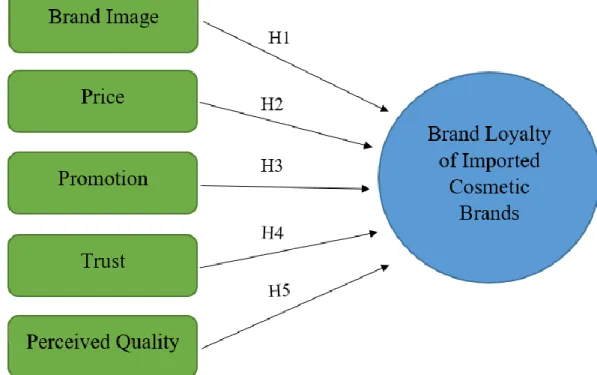
- Proposed Conceptual Framework
- Hypotheses Development
- Relationship Between Brand Image and
- Relationship Between Price and Brand
- Relationship Between Promotion and
- Relationship Between Trust and Brand
- Relationship Between Perceived Quality
- Conclusion
Brand loyalty is one of the fundamental concepts for the company to operate strategic marketing. However, most have found that there is a positive relationship between price and brand loyalty. Brand trust has a positive relationship with brand loyalty” which showed an insignificant relationship between trust and brand loyalty.

METHODOLOGY
- Introduction
- Research Design
- Quantitative Research
- Descriptive Research
- Causal Research
- Sampling Design
- Target Population
- Sampling Frame and Sampling Location… 25
- Sampling Technique
- Sampling Size
- Data Collection Method
- Primary Data
- Research Instrument
- Questionnaire Design
- Pilot Testing
- Construct Measurement
- Measurement Scale
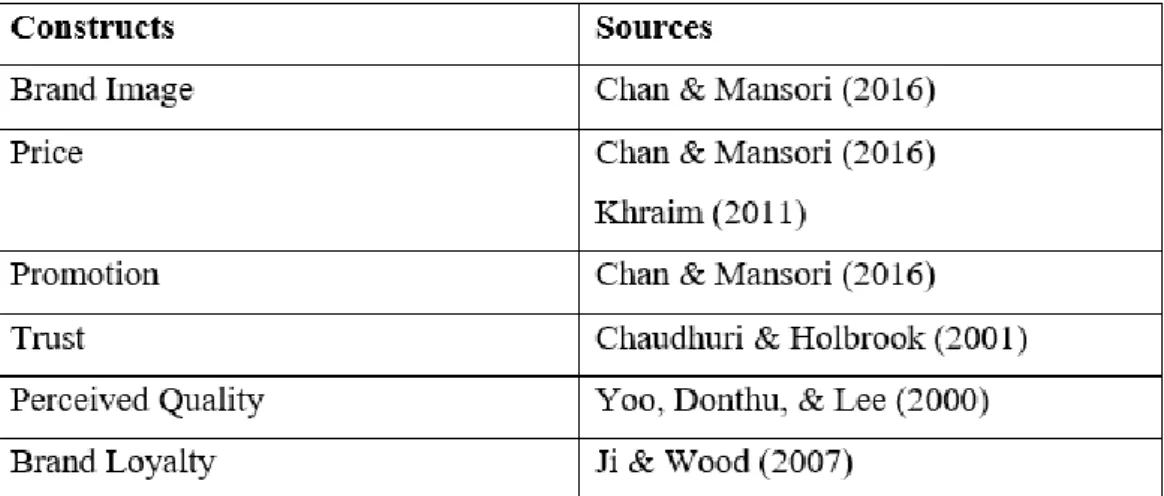
- Origins of Constructs
- Data Processing
- Questionnaire Checking
- Data Editing
- Data Coding
- Data Transcribing
- Data Cleaning
- Proposed Data Analysis Tools
- SPSS
- Descriptive Analysis
- Scale Measurement
- Inferential Analysis
- Conclusion
Non-probability technique is chosen in this research where the samples are selected based on their own opinion or convenience and the probability of the selected unit is unknown (Zikmund & Babin, 2010). Part B is general information of the respondents, which consists of 5 questions, which is the general information about consumers' use and knowledge of imported cosmetic brands. The five-point Likert scale (1-Strongly disagree, 2=disagree, 3=neutral, 4=agree, 5=strongly agree) is used in this part to evaluate the degree of agreement among respondents on the variables.
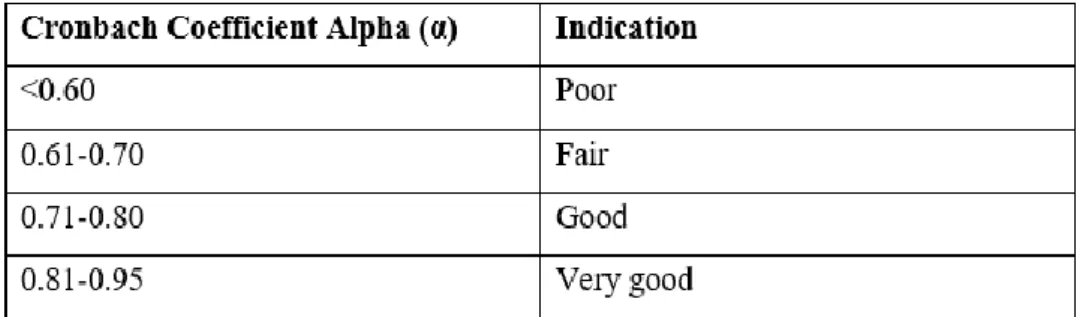
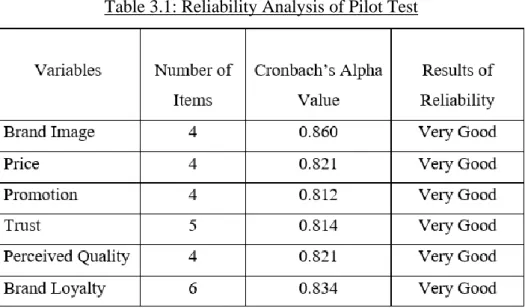
Based on Table 3.1, all Cronbach's Alpha values for all variables are greater than 0.81, which is sufficient in this study. Using an interval scale can evaluate the intensity of the relationship between the items of each variable. This process is intended to ensure the quality of the questionnaire items and the data collected after the distribution of the questionnaires.
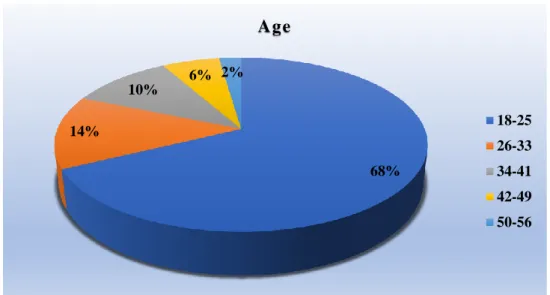
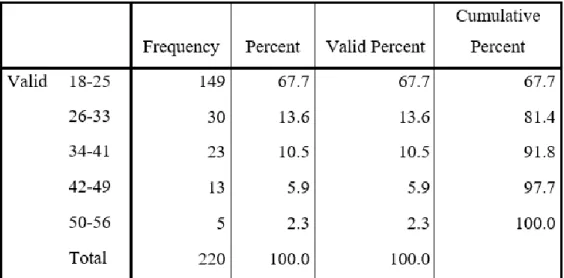
In order to increase the accuracy and consistency of the data, the raw data will be edited first if there is an error. Using SPSS, any ambiguous data will be detected and the data will be replaced, modified or deleted to ensure the consistency of the data collected. It will be used to present demographic data (age, race, relationship status, income/monthly allowance and occupational status) and general information (preferred brand, source of knowledge of preferred brand, frequency, monthly spending and place of purchase of preferred brand) of the respondents.
Cronbach's Alpha determines the reliability and validity of the six constructs: brand image, price, promotion, trust, and perceived quality and brand loyalty of imported cosmetic brands.
DATA ANALYSIS
- Introduction
- Survey Response Analysis
- Descriptive Analysis
- Respondents’ Demographic Profile
- Respondents’ General Information
- Scale Measurement
- Reliability Analysis
- Inferential Analysis
- Chi-Square Test of Independence (χ 2 Test)
- Test of Significant
- Spearman’s Rank Correlation Coefficient
- Conclusion
As can be seen from Figure 4.6 and Table 4.6, most of the respondents are students, who made up 45.5% of 220 respondents, followed by respondents who are employed with 44.1%, respondents with their own business which make up 6.8%, respondents who are unemployed with 2.3% and the remaining 1.4%. According to Figure 4.8 and Table 4.8, most of the respondents know their most preferred brand from their friends which consists of 37.3% while print media has the least percentage which is 5.0%. Based on Figure 4.9 and Table 4.9, respondents mostly buy their preferred brand once every three months with 60.5%.
30.9% of respondents buy the brand twice every three months, which translates to 30.9%, while only 4.5% of respondents buy three times every three months. The least percentage, namely only 4.1% of the respondents, buys more than three times in three months. As shown in Figure 4-11 and Table 4-11, the majority of respondents buy cosmetic products from a specialty store at 30.9, while the second most place of purchase is a personal care store such as Watsons and Guardian at 28.2.
15.9% of respondents buy cosmetic products from online stores such as Hermo and Althea, and 10.5% of respondents buy in the supermarket. In addition, 9.5% of respondents buy from department stores, 3.6% of respondents buy from direct sales and the rest 1.4%. Based on Table 4.12, all variables show alpha above 0.81, indicating very good reliability and internal consistency in the determination of brand loyalty for imported cosmetic brands.
This chapter analyzed the profile of respondents using descriptive analysis and reliability of six constructs using Cronbach's alpha.

DISCUSSION, CONCLUSION AND
Introduction
Summary of Statistical Analysis
- Descriptive Analysis
- Respondents’ Demographic Profile 54
- Inferential Analysis
- Chi-Square Test of Independence
- Spearman’s Rank Correlation
Among six constructs, brand image has the highest coefficient at 0.836, followed by price at 0.831, promotion and perceived quality at 0.819, brand loyalty at 0.816 and trust at 0.811, respectively. The result of the χ2 test shows that there are significant relationships between independent variables (brand image, promotion, trust and perceived quality) and dependent variable (brand loyalty), as the significant levels are respectively 0.000, which is lower than 0.05. However, there is no significant relationship between price and brand loyalty as the significant level is 0.377 which is above 0.05.
The result of Spearman's rank correlation coefficient shows that there are moderate positive relationships between independent variables (brand image, promotion, trust and perceived quality) and brand loyalty.
Discussion of Major Findings
- Brand Image
- Price
- Promotion
- Trust
- Perceived Quality
According to Table 5.1, the result shows that there is a significant relationship between brand image and brand loyalty of imported cosmetic brands. According to Table 5.1, the result shows that there is an insignificant relationship between price and brand loyalty of imported cosmetic brands. According to Table 5.1, the result shows that there is a significant relationship between promotion and brand loyalty of imported cosmetic brands.
The result is in line with the study by Khraim (2011), where the researcher concluded that promotion plays an important role in influencing brand loyalty in the cosmetic industry. According to Table 5.1, the result shows that there is a significant relationship between trust and brand loyalty of imported cosmetic brands. The result is supported by the result of the study by Rubio, Villaseñor, & Yagüe (2017), where trust significantly influences brand loyalty.
Brnad trust is important to determine brand loyalty as it reinforces a brand's integrity and trustworthiness (Chatterjee & Chaudhuri, 2005). According to Table 5.1, the result shows that there is a significant relationship between perceived quality and brand loyalty of imported cosmetic brands. The result is consistent with the study by Bagram & Khan (2012), who found that perceived quality has a significant impact on brand loyalty.
In addition, perceived quality causes consumers to believe in the brand and allows companies to charge a premium price, so price is not a factor affecting brand loyalty for consumers.
Implications of the Study
- Managerial Implications
- Theoretical Implications
The companies should care about these determinants to increase their brand value so that consumers trust their brand more. The managers should plan to add value to the brand, such as being accessible to consumers, having reliable products, and being honest with consumers. These will lead to consumer retention as consumers like high and consistent quality products.
Managers can carefully supervise the product manufacturing procedure to ensure quality and eliminate defective products. Consequently, consumers would feel that companies are considerate of them and remain loyal to companies. Other researchers have benefited from this research as there are limited number of research studies especially on imported cosmetic brands in Malaysia.
It allows others to better understand Malaysians' loyalty to imported cosmetic brands and helps. The framework and findings developed from this study narrow the research gap in examining the determinants of brand loyalty towards imported cosmetic brands among women in Malaysia and also act as a foundation for the study of imported cosmetic brands.
Limitations of the Study
There may be other variables that are also relevant to the brand loyalty of imported cosmetic brands in Malaysia from another perspective, such as consumer attributes.
Recommendations for Future Research
The study only tested on five independent variables which are brand image, price, promotion, trust and perceived quality, which is more focus on product attributes. As the majority of Malaysians are Muslims, they demand more halal cosmetics that they can use safely and legally. The halal cosmetics market is expected to be USD 945.8 million in Southeast Asia (Hassali, et al. 2015).
This proves that halal cosmetic products can be a good business opportunity in the future that is worth studying thoroughly and in depth.
Conclusion
The Impact of Packaging, Price and Brand Awareness on Brand Loyalty: A Reseller Perspective in the Mobile Sector of Pakistan. Determinants of Brand Switching in Mobile Service Providers: A Case Study of Mobile Phone Industry in South Punjab Pakistan. An application of the CBBE model to evaluate brand loyalty for a long-haul travel destination.
The chain of effects from brand trust and brand affection to brand performance: the role of brand loyalty. The impact of packaging, price and brand awareness on brand loyalty: Evidence from the paint retail industry. The role of personality congruence, perceived quality and prestige on ready-to-wear brand loyalty.
Antecedents and consequences of mobile phone usability: Linking simplicity and interactivity to satisfaction, trust and brand loyalty. The Influence of Brand Image and Brand Personality on Brand Loyalty, Mediated by Brand Trust: An Empirical Study. The effect of brand image, price and brand awareness on brand loyalty: The rule of customer satisfaction as a mediating variable.
The relationship between extrinsic characteristics of product quality with brand loyalty on Malaysia national brand motorcycle/scooter. The effect of brand image on overall satisfaction and loyalty intent in the context of color cosmetics. The aim of this study is to examine the determinants - brand image, price, promotion, trust and perceived quality - that will influence brand loyalty towards imported cosmetic brands among women in Malaysia.